What should I be thinking about now? How about death and dying, cultural discombobulation, misogyny, evolution, and pain management?

I told you last post that I would be giving up on my blog. That’s still the case. I’ll likely wrap it up by the end of this month at least in its current format, but that doesn’t mean that I’ve stopped thinking or wanting to write. When my readership fell below fifty views after a post, I decided that maybe it wasn’t worth the hassle of thinking about writing every week. Of course, some people might argue that if I have only one reader that should be enough for me. There’s an argument that can be made both ways. Who knows, things change. 

So, what should I be thinking and writing about now? As I get ever closer to death, it’s hard not to think about death and dying. My sister-in-law who was a couple of years younger than me, died recently. It seems like someone in my immediate circle of friends and family is dying every month. Such is life when one gets to a certain age. Of course, it’s not only older people who die. A forty-nine year old doctor in my Family Clinic died recently of heart failure. However, it’s certainly true that most Canadians, in any case, die at an advanced age. That will be me for sure because I’m already most of the way there.

Lately I’ve been trying to create a metaphor for the dying process. I think I’ve come up with one that makes sense. It’s probably not new to me, either. It’s the image of a wall, maybe a stone wall that can be seen in the distance just beyond a large, open field. In our younger days, the wall is low and hardly visible. We only pay attention to it fleetingly, maybe when we visit someone in the hospital, when we leave a funeral or witness a fatal car crash. Our physical vulnerability is only too obvious at these times. The truth is that we would have a hard time living our lives if we did not ignore the wall most of the time. Some people actually convince themselves that the wall doesn’t even exist and that even if it did, we could walk right through it. The thing is the wall is always there. As we get older the wall gets more visible. It gets bigger, thicker and broader and we begin to see individual stones in it. It begins to draw our attention more frequently. We seem to be getting closer to it and in fact we are.

My wall is clearly visible to me now. It’s so big, I can’t see much beyond it. Earlier in my life I could see mountains on the other side of it. Not anymore. Now, the wall demands my attention. It will not allow me to turn away from it. In a sense it’s a beautiful, solid wall. It’s obvious that much care was taken in its construction spanning the whole evolutionary time on this planet. Everyone has to come to the wall. No one is allowed to pass through it.

The denial of the existence of this wall is the essence of Ernest Becker’s work. My early posts on this blog consist of an exposition of Becker’s work and his contribution to understanding the denial of death. His last book, one that he had no hand in publishing because he was dead, was rightly entitled Escape From Evil. The evil that Becker writes about is death and disease. This book is a must read for anyone who wants to understand the power of denial in our lives because it’s a power that has determined so much of the death and destruction this planet has experienced with Homo sapiens at the centre of it.

Let’s now explore that denial a bit from a different perspective than I would have normally used. First up is how our social world seems to be coming apart at the seams with the war in the Ukraine, growing authoritarian at home and the pandemic that doesn’t seem to want to go away. I’m talking about the discombobulation of our social world and our reactions to it. Later I write about misogyny and evolution with a nod to Aristotle, the consummate misogynist and other philosophers of his time and ilk. But first, discombobulation.

Discombobulated  
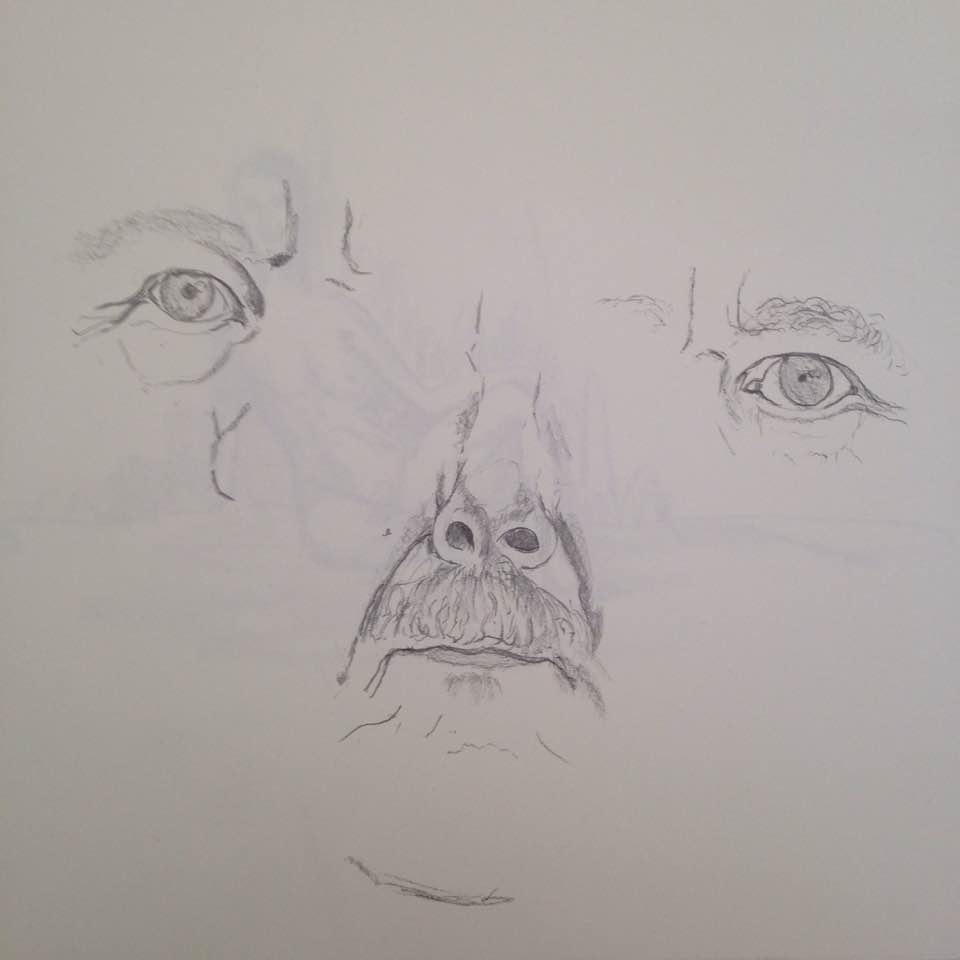
This is my drawing of discombobulation. It’s my personal visual statement of my reaction to the Kurt Vonnegut world we live in today.

The word discombobulation is an old word from the 19th Century that shouldn’t be forgotten because it so expresses the sense that not much makes much sense anymore. The world really hasn’t ever made much sense if one considers humanity’s millennia-old legacy of war and brutality combined with a huge dose of goodwill and caring underlying much of human history. It seems as though every generation has to learn this truth on its own never learning from history. I’ve spent my whole adult life in a quest to unravel this discombobulation. I think I have things more or less worked out (with the help of a lot of people now dead who were much smarter than me), but I can’t seem to communicate that to enough other people for my knowledge to make much sense. At least I feel that way sometimes. I may be like the proverbial falling tree in the forest with no one around to hear it fall. What does it matter? Well, it does matter to me. Sometimes I think of my writing as a drop in the bucket of cultural commentary, but it’s still a contribution.

That said, it’s a contribution that will leave many people behind. Admittedly, reading my blog posts requires a modicum of literacy. I don’t speak to a Grade 8 audience. That in itself will limit the influence of my work. My personal intellectual voyage can never be yours, but we must learn from each other otherwise the discombobulation wins. Patently, there are many people (No, I haven’t done a survey although others have) who are incapable of hearing what I have to say because they have been captured by an ideology that is inherently contradictory in itself but still seems to speak to their individual lives somehow. I’m talking about people who deny that we are inherently social and dependent on each other not only in our families and other intimate relationships, but in a collective sense with people we don’t know personally but who, combined, hugely affect the world we live in.*

I’m referring here to people who see taxes and government as an infringement on their freedom, whatever that means. They have no idea themselves what ‘freedom’ means, and it’s almost embarrassing if you dare ask them what they mean by it because their answers are naive to the extreme and essentially childish. In other aspects of their lives they may be competent enough, but when it comes to thinking about their place in the world and their responsibility to others, they just have no idea, except to spout platitudes they have absorbed by watching too much Fox News or have been absorbed by concentrating on their belly buttons for too long. I’m no big fan of much of what government does, but I’m not willing to chuck out the baby with the bathwater either. 

Recently, Carolyn and I listened to a CBC Ideas podcast on The Authoritarian Personality. The people who fit this profile are the people I’m talking about. The Authoritarian Personality is an idea popularized after the Second World War by Theodore Adorno and others to try to explain why people are attracted to fascist leaders. The book is available to be borrowed for free at the Internet Archive but it’s been revived and republished with an introduction by Peter Gordon of the Frankfurt School and is available on Amazon in various formats, including as an eBook, but it ain’t cheap. The book was first published in 1969 but was in writing for some time before that while the research for it was being conducted in California. The book itself and the blazing controversy surrounding it can be seen at the Internet Archive by simply typing in The Authoritarian Personality in the search function and looking around. Some of the reactions to the book are a full example of discombobulation. In fact, I would argue that the book is itself a treatise on cultural discombobulation as are reactions to it. We live in a discombobulated world but there’s nothing new about that.

So, I’m thinking that this post is long enough. I have probably another 5 or 6 thousand words I want to get out of my system at the moment but I think I need to break those up into manageable chunks. Therefore, I’ll leave this post as it is but I’ll carry on writing about the other topics in the title of this post and present them to you as soon as I get them fleshed out with good references, etcetera. Besides, it’s six o’clock in the morning and I’ve been writing since two thirty. Yesterday I went back to the hospital to get back on my chemo regime. The dexamethasone I took yesterday won’t let me sleep anyway, so instead of fretting that I can’t sleep, I might as well write, but enough for tonight…it’s getting light out and the coffee beckons.

_____________________________________________________________________________

*This is a disparate group of people from grocery store clerks and managers, to cops, to delivery drivers, to municipal workers, librarians, veterinarians, road crews, mechanics, garbage (solid waste) collectors, baristas, Hydro crews, emergency personnel of all kinds, Hospital workers including medical doctors, nurses, technicians, etcetera. I mean anyone you come into contact with on a daily basis and who provides you with a service you depend on. Just think about it. You are massively dependent on others, even people in China and other Asian countries who make your T-shirts, jeans, phones and computers for you, and on the people who work on the planes and boats that get those products to you. How can anyone deny that? But they do because to recognize this fact they would have to accept that their individualism is contingent and not absolute. We are not free to do whatever we want. Let’s just get over that silly notion. I used to challenge my students to unplug their homes, and I mean in every way: cut off water, electricity, the internet, waste collection, everything. Do that for a few days and then let’s discuss how independent and ‘free’ you are.
Blog Down!

So, in the next couple of days I’ll make a final decision but as it stands, I’ll be shutting down this blog in the next month. I may shift my attention to another blog I have, a free one, but I have yet to determine that too.

Thanks to those of you who have been loyal readers over the past few years.

All the best,

Roger

Things Change

My last post was twenty days ago. I used to put them out every week, but things change.

When I started writing this blog in 2012, the year I retired from teaching at the College (NIC) I was focussed on working through my relationship with Ernest Becker’s books The Denial of Death and Escape From Evil. For me these books contained some profound truths about us humans, how we relate to life and death, how we organize our societies as competitions for God’s attention. It’s interesting that we created God as a projection of human values, a projection that we then use as a means of judging our actions to determine just how worthy we are of eternal life. We even, according to Becker and other cultural anthropologists, divided our social groups into moieties (halves) to set up the competitive structure by which we could establish winners and losers for God’s favour, which is nothing less than immortality. Countries and Nations are the logical expression of this thesis. 

We also, over the millennia, elevated man (that is, not woman) to the predominant social position. It took millennia to do that, but once the idea stuck, it got so strongly entrenched that it became normal. The idea that men were somehow superior to women infiltrated all aspects of culture. Women were, for all intents and purposes, relegated to slave status, gatherers of food, and bearers of children. The perfectly natural womanly monthly experience called menstruation where menses (blood and other matter) are released from the uterus was held against women. Blood reminds men of dying. When men fall in combat or by accident, they bleed and they die. Men don’t like that. So women bleeding regularly could not be good either. It is a huge reminder of death. So, many cultures isolate menstruating women, treat them with contempt and shun them. By extension, men could pretend that they were more ‘spiritual’ than women. Women were biological, men spiritual. Men were clean, woman dirty. This could not be more clearly demonstrated than in childbirth, a very messy and bloody process, proceeded by months of lessened capacity and followed by the need to nurture infants, a relationship of dependency that created an avenue for men to assert dominance. These tropes still survive to this day, in some ways stronger than ever. 

I’m still captivated by the ideas I gleaned from Becker, but after I was diagnosed first with pernicious anemia (in the 1990s) and then with multiple myeloma (in October, 2019) my focus changed, and this blog became a chronicle of my life with chronic pain and cancer. Old age, of course, plays a predominant role in my life, how I feel, and how much energy I can devote to any particular task. I don’t think anyone can understand the effects of old age on the body, energy levels and strength, until it becomes personal. I promised myself for decades that once I retired, I would do all the things I had no time to do as a working person. That was true for a time, but when I hit 70, things changed, and they continue to change. From now on I cannot expect things to improve. All I can do is adjust to my changing body with its lower levels of energy, suppleness, and strength. I think my mind is still capable of some surprises. That may be delusional on my part, but that’s fine. I guess I have the right to some minor delusions. 

So, I may be afflicted with cancer and old age, but I was trained in the social sciences and they still have a strong hold on my mind. I still think that we, as men and women, need to reconcile many powerful forces that dominate our lives. One of them is misogyny, the curse that lives deep in our psyches but is not based in biology. But what of basic biology? Well, let’s explore that a bit here.

At the end of my last post I said I would discuss penises and clitorises, so here we are:

Penises and Clitorises.

Most of us have one or the other. The fact is that they are very similar in structure and function. As the long quote below maintains, at the sixth week of gestation we all have clitorises. That’s not quite right. We all have a precursor to both the clitoris and the penis. That is, penises and clitorises arise from the same tissue in the early embryo. So, the pleasure men derive from penile stimulation is the same as women derive from clitoral stimulation. Depending on the chromosomal and hormonal environment we become either female of male, or both, or neither. To say that men and women are opposite sexes is profoundly misleading. We are not, as Alice Dreger so aptly points out in her book I introduce below.

For many years I studied love and sex and taught College courses on the topic just before I retired in 2012. It’s a truism to say that the sex act is a social act so it’s clear that we are social animals right from the start. Like for most animals, our sex lives and our social lives are strikingly interconnected. 

The pleasure we derive from intercourse, and especially from genital stimulation of any kind, including from masturbation, has profound social implications, but not all of us are capable of deriving pleasure from genital stimulation, the source of sexual pleasure. That follows from the fact that humans come in so many sizes and shapes. We vary in a hundred different ways including when it comes to our sexual organs. 

Before the sixth week of gestation (more or less) we are sexually undifferentiated meaning that there’s no way to tell whether an embryo is male or female. After the fourteenth week and the androgens kick in we begin to display our sexual organs. 

There is so much information available on this topic on the internet that I don’t even want to go there. A huge number of popular sites exist along with a large number of scientific ones. I just finished reading a (Kindle) book called Hermaphodites and the Medical Invention of Sex, by Alice Dreger (1998). The book explores the way things don’t always go as we expect in the womb. Yes, the vast majority of us either end up male or female, but that dichotomy isn’t as clear cut as it seems. A visual inspection of external sex organs may lead to the belief that a person is either male or female, but looks can be deceiving and it’s impossible to look inside the brain at the hypothalamus and the sexually dimorphic nucleus (SDN) to determine maleness or femaleness as the brain evaluates it. The quote below is from a popular website. It can give you some idea of what’s available now on the internet since Dreger published her book in 1998. It addresses a point I made earlier about our embryonic selves:

Everyone starts the same in utero.

What determines whether you’re born cis-male or cis-female are your XX or XY sex chromosomes. The XX pair is cis-female and the XY pair is cis-male. During gestation (the time between conception and birth), the genes on the sex chromosomes are expressed and the fetus becomes cis-male, cis-female, or (in some instances) intersex. These sexual differences are expressed as the penis and testes (cis-male), the vulva and vagina (cis-female), or some combination of the two structures (intersex).

However, in the first six weeks of a pregnancy, before the genes in these chromosomes are expressed, all budding fetuses actually begin as cis-female, meaning that everyone begins their development in the womb with a clitoris. (Wow, right?!) Then, one of two things happens due to “a low level of the hormone testosterone [being] released,” this structure grows into a penis, says Laurie Mintz, Ph.D. licensed psychologist, certified sex therapist and author of Becoming Cliterate. Or “when testosterone is absent, the tissues develop into a vulva (including the clitoris) and vagina.”*

[Check out this YouTube event for the experience of a transgendered man. Born a ‘girl’ he never fit in and was always a man in his mind: https://www.youtube.com/watch?v=nOmstbKVebM.%5D

So, enough for now. I still want to explore further the idea of sexual reproduction going back to early eukaryotic cells and the consequences for evolution of sexual reproduction. I also have a number of other related topics I want to explore along with continuing a chronicle of life with myeloma. Later.

_____________________________________________________________________________

*https://www.shape.com/lifestyle/sex-and-love/genital-anatomy-penis-clitoris

One Step Forward and Two Steps Back

Sometimes I think that it would be good if life were simpler. For me, it’s anything but simple. Maybe my expectations are too high. Maybe I’m not being realistic. Maybe if I relaxed a little, all would be better. Maybe. Yet, the complexity just seems to expand, to encompass everything, no matter what I do, or don’t do. 

I’ve been off chemo meds for about five weeks, and I have until the end of March before I go back on them. At least that’s the current plan. There was never a plan for long-term withdrawal from my chemo meds. I haven’t had my blood tested for a few weeks, and it will be another three weeks before I get tested again. I’m of two minds about that. It’s quite possible that the bloodwork will show that myeloma has again taken up full-blown residence in my blood and bone marrow. It may also be that it shows that I’m still okay. It’s always a crap shoot and somewhat tense for that reason. 

More concerning for me is the fact that since my withdrawal from hydromorphone I’ve been in a lot of pain. It hasn’t attenuated much at all. I’ve been able to walk a bit two or three times a week, but any walking I’ve done has been painful. I generally walk around two kilometres, and that takes me half an hour. Not a blistering pace. 

Because of the incessant pain I’m in I’ve had to backtrack and reconsider my decision to cease taking opioids. I took a slow release capsule this morning as a test and I have felt some relief. It may be that I’m dreaming in technicolour if I think that I can manage without pain meds. 

Speaking with my GP/oncologist last week was enlightening. He doesn’t think that the pain I’m having has anything to do with my B12 deficiency, opioid withdrawal or myeloma. He thinks it’s attributable to chronic pain, something I’ve experienced for decades. (I’m not sure I completely agree with him on that.) Thinking back over the past thirty years and it’s clear to me that I’ve had periods before I was diagnosed with myeloma or pernicious anemia when I’ve experienced extreme pain and other very strange symptoms like having a yeasty odour and having my skin welt up after drawing a dull object over it with not a lot of pressure.* In the mid-nineties I had a period of debilitating fatigue to the point where I could barely function. I was also depressed at that time, with good reason to be. 

The chronic pain that I’ve experienced throughout most of my life is associated as much as I can tell, with the consequences of surgeries I’ve had. The two main ones are a laminectomy (disc removal) and a nephrectomy (kidney removal). As well, I’ve had the odd accident on my bike and some running-related injuries. My neck has been a source of a lot of pain over the years brought on mainly by years of hunching over a computer terminal. I envy people who go through life with very little or no pain. There aren’t many of those in my family. I have siblings with MS and fibromyalgia. I have quite a few relatives with autoimmune diseases. It seems to run in the family. We’re also a long-lived bunch. That might be good, but it might not be so good too: all the more time to suffer from debilitating pain. 

The biggest and most distressing challenge I face right now is the weakness in my legs but I may get control over that with a low dose of hydromorphone and gabapentin. I need to move around. That’s a prerequisite for continuing to be able to move around. Being sedentary breeds inactivity and makes it harder and harder to get any exercise. Exercise hurts! Walking two kilometres brings on a lot of pain. Damn! 

And with the price of gas now, I think driving may be an even bigger pain in the ass than I’m feeling now in my ‘lower’ back. I feel that driving into Courtenay for a walk on the River Walkway is a bit frivolous when gas is $2 a litre. I can always walk around Cumberland for free. 

Tomorrow should be better for me in terms of pain. I expect I’ll walk a couple of kilometres tomorrow morning. The weather is supposed to be good. From Thursday on for at least a week it’s supposed to be rainy and cold. No reason not to walk, but it is less pleasant and I like pleasant these days. 

If you didn’t notice, and to end today’s musings, the title of this post works for some things, but not for life itself. Life never goes backwards, no matter how much we wish that it were so, no matter how many anti-ageing creams we use. 

My next post will be on why the penis and clitoris are such wondrous things and why they have so much in common. 

_______________________________________________________

*This is the strangest phenomenon. I would drag the handle of a kitchen knife over my arm and it would welt up for maybe three hours afterwards along the path of the draw. Has that ever happened to you? I’d like to know if you’ve ever experienced this. 

I’ve struggled a lot lately about whether my glass is half full or half empty. I’ve lived seventy-five years. Is that a good thing, a bad thing, or just a thing? 

Whatever. 

Lately, I’ve often mused nostalgically about my past. My present is not what I would have it be, but I’ll write about that below.

For now, I want to write about moments in my past that were particularly instructive for me. You all know that I have cancer. That’s not news. However, some of you may not know that I was diagnosed with kidney cell cancer in 2002. From what I was told, I had what they call a lesion on my left kidney. In this case a ‘lesion’ means a fairly large growth protruding from my kidney. They were loathe to do a biopsy because any puncture of the lesion or any attempt to remove the growth by aspiration was going to spread the cancer far and wide. So, they scheduled me for surgery. I was fortunate to have a very good local urologist perform the surgery with my GP attending (he’s an internist as well as a family physician).

My Nephrectomy

When my time came for my nephrectomy (removal of my kidney) on February 17th, 2002, Carolyn drove me to the hospital early in the morning and left me there to find my way to the surgical unit. I wasn’t there long before they ushered me into the operating room. I was set at ease to see so many people I knew there, including a nurse who was a former student, my GP and the surgeon. I didn’t know the anesthetist although I had met him earlier in the hospital for a pre-surgical interview. 

So, taking my kidney out would be a straightforward affair if you knew what you were doing! Thankfully, the urologist knew what he was doing. In order not to spread the cancer far and wide, he opted to open me up using a 35 centimetre incision between my ribs on underside of my left arm to my midsection but lower on my body. They essentially cut me in half so they could gently lift my kidney out of my body without messing with the surrounding tissue and risking metastasis. I heard later that my GP was humbled by the process of cutting me in half and putting me back together. 

After the kidney was removed and they made sure they hadn’t left anything in there that shouldn’t have been there, they stapled me shut and sent me off to a room upstairs. I was there for a few days. I had a morphine pump to make sure I had no pain but it did have a governor on it so I didn’t overdose. That was kind of them, I think. 

I went home after six or seven days. We had just moved to Cumberland on an acre. There was lots of work to do. I couldn’t do any of it. Thankfully a number of my family members came over. There was lots of help and Carolyn was healthy, as she still is so I watched as my family and some friends helped us move in and get the yard together. 

_____________________________________________________________________

Visit to Cancer Care Centre 

We saw my local GP/oncologist this morning. These meetings are always interesting. I’ve been off chemo for a month and I’ll be off again for another month so that we can more properly assess how I react while not on the chemo meds. I’m also off hydromorphone (opioid), having gone through the nasty process of withdrawal over the past few days. I’ve never taken a very high dose of it, but I have been on it a long time. That makes it a bit of a challenge to stop taking it. I’ve also cut way back on gabapentin, which is a drug initially used for epilepsy, but has been used for all kinds of ailments since (maybe overused). I really have no idea how it’s affecting me because I have had such a mix of medications over the past couple of years that there’s no way I can tell what med is having what effect. It’s supposed to help with my peripheral neuropathy. Maybe it is. Maybe it isn’t. I really don’t know. It’s just a bit confusing and frustrating. 

I was in the Cancer Care Centre at the hospital this morning, as I said, to meet my GP/oncologist, and I saw a few of the usual suspects getting treatment. There was an older woman (probably a bit older than me) getting an infusion in Chair #4. I’ve seen her a number of times before. This time she was with her husband (I presume) who sat in a chair beside her. We nodded to each other. A young woman came by us as we waited to see the doctor. She was in Chair #3 I think. She was dragging her IV pole along beside her as she made her way to the bathroom close by, something I’ve done many times. IV poles, with bags of meds hanging from them with a line entering the arm somewhere, are on casters but they still rattle away as they are dragged along. I thought to myself: “This is my life. I share it with people I don’t know and some I do know, people who share my struggle to one extent or other. What we share is cancer.” But we also share the care and love that the staff gives us. Notwithstanding, every one of us will die. We may survive a year, two, ten, or twenty, but we must die. I’m not complaining about that. It is what it is.

I’ve spent a good part of my life studying life and death. I’m a sociologist, but I’ve not contained myself within that discipline. I’ve struggled to see the big picture of life on this planet and how life cannot exist without death. I know it’s something I’ve brought up before, but it’s always on my mind. 

We’re coming on to spring. My favourite season. Plants spring up everywhere. They count on the decay from previous years to fuel their growth. Life is not a cycle. It’s more like a spiral, with an inevitable end. To think of the seasons as cyclical is a mistake, a comforting mistake, I guess. I’m thinking we have a built-in biological aversion to death. From what I’ve observed, we share that aversion with most other animals. Life is the big draw, death and disease are the ultimate enemy. Our whole culture is built on that false premise. Silly us. 

This spring for me is not like the spring of my tenth year, nor of my fortieth year. I’m hoping this is not my last spring. I’m thinking it won’t be, but the future is promised to no one. 

Teaching on live TV, with Roger Loubert (RIP)on the phones.

So, sometime in 1986-87 I started teaching live-interactive telecourses on the Knowledge Network. The Network was very different then and North Island College had several telecourses telecast on it by a few instructors, me included. I’ve already posted a blog about my experience doing that work. You can check it out here:

One thing I didn’t mention in my 2018 post was the selfless dedication of one of my friends, Roger Loubert, to me and to my courses on the Knowledge Network. He “worked the phones” for the phone-in segments of the courses every two weeks during the academic year and he did it with no expectation of pay or reward. He died at Crossroads Hospice in Port Moody of complications from prostate cancer on July 3rd, 2021. He was just a little older than me. You can read one of his obituaries here.

Roger and I go back to the 1970s. He had come to BC from New Brunswick. I don’t recall any of the details of his migration, but he ended up in Maillardville, a small French-Canadian community in Coquitlam established in 1909. Fraser Mills, on the banks of the Fraser River needed sawmill workers who weren’t “Oriental” but were at least White and who could strike break if needed. The fact that they spoke French was a minor irritant, but they were also Catholic, and that proved a little more problematic because they wanted their own church building if they were going to stay.

Maillardville was were I grew up and it was to remain a French-Canadian community for many years, until the late 1970s. It has remnants of French culture and still has two French-based Catholic Churches. The assimilation rate is over 95% now so you’ll find that most people in the community speak English exclusively and intermarriage has made it more and more difficult to call families French-Canadian anymore. That’s not to be lamented, that’s just the way the world works.

Loubert (that’s what I always called him) thought Maillardville was special, a microcosm of Canada. He invented something called Information Maillardville and rented a room in a building at the busy corner of Brunette Avenue and the Lougheed Highway to store all of his Information Maillardville (stuff) documentation, and there was a lot of that right from the beginning. He eventually moved his stuff to a warehouse in Vancouver around Manitoba and 8th. He lived there too of course. No running water, no anything. Just lots of paper and stuff. He moved it again later to various locations in Coquitlam and environs. After he died, it was left to his friends to clean it up. He would never have given up or gotten rid of his stuff while he was still alive.

Loubert was certainly an eccentric. His eating habits back when I first met him were unusual. His girlfriend at the time was Dutch and she was more hippie than eccentric. I don’t think that veganism was as common then as now but they were both vegans. They cared not an iota about what anybody thought about them. He subscribed to the ‘mucusless’ diet, a diet originated by a German ‘naturopath’ and ‘alternative health educator’, Arnold Ehret, who died in October 1922 at age 56 from a fall and head injury while walking along a sidewalk. He had moved to Los Angeles by then to prey on gullible Californians, I assume. His diet has been thoroughly debunked as ridiculous although it’s sadly still around. Loubert swore by Ehret and carried his book around for some time. Loubert was crazy like that, but he was not insane.

At one point while living in the Port Coquitlam area he adopted ten husky dogs and named them after each Canadian province. I can’t remember how that turned out. I can assume that he fed them before he even fed himself. He was like that. Eventually he got a job driving a school bus. That would have given him time to devote to his cultural and social activities. He was involved in a number of organizations in Coquitlam and adjoining municipalities. As I note above, he died still in possession of his ‘stash’ of Information Maillardville stuff and whatever else he managed to accumulate, which was substantial by all accounts.

Loubert was big on festivals and celebrations, at least when I knew him. He was always trying to organize Festival Maillardville. It never did materialize from what I remember. He could never get buy-in from the parishes in Maillardville (with their parish halls), but there were other festivals in which he could participate like Le Festival du Bois held this year at Mackin Park in early April.

I was a student at Douglas College in New Westminster from 1971 until 1973 then at Simon Fraser University from 1973 until 1980. Loubert and I had intermittent contact after that, especially after Carolyn and I moved to the Comox Valley with the kids in 1983. In 1974 or so I took time off from my studies to work on a project called Plan Maillardville. I was in my third year of my Bachelor’s degree but I was hired to be the project sociologist because not only was I from the area, but I was bilingual. Loubert was delighted by my work on the Plan Maillardville. He was frequently in my office, chatting it up.

For a few years after 1983, Loubert and I, like I said, had only intermittent contact. However, when he found out that I was going to be on the Knowledge Network, that really piqued his interest again. He was always fascinated with radio and TV because of information, of course. So, we met and discussed his participation. He was delighted to be involved.

I had NO budget from North Island College for much of anything except props. Of course the College paid for my transportation and hotel costs, but not much towards the production of the telecourses. So Loubert’s offer to work for nothing was a godsend. During my broadcasts he sat in the control room to take the phone calls during the twenty or so minutes at the end of the hour program we allowed for that. That was every two weeks. He loved to talk on the phone and always used the occasion to chat people up. He was always very sociable on the phone from what I gather.

Loubert was always game to help out. I appreciated him for that. He was definitely one of a kind. Unfortunately I never had the opportunity to thank him again for his dedication to our work on the Knowledge Network. This is not a substitute for that, just a small token of my appreciation.

February 18 Update

[I’ve written about some of the issues I’m having with myeloma before, many times. Because it’s such a presence in my life I can’t help but write about it often. Sometimes, I write about it to provide an update on my treatments and side effects. That’s what this post is about. It’s somewhat technical, but you don’t have to know everything about the drugs involved to understand the thread of my story.]

I sit here in my chair warmed by our new(ish) mini-split HVAC that lives on the wall up to my left with it’s companion outside, visible from the large window just behind me. It’s just after nine in the morning and it’s cold today but clear with the temperature hovering around the zero Celsius mark. We have the wood stove on too because the electric heat just doesn’t cut it when the temperature gets near or below zero. 

Myeloma is always at the forefront of my mind, but now pernicious anemia, and my opioid dependency are butting in and taking up some space of their own in my consciousness. So, in this post I’ll discuss the challenges posed by these issues for me every day. 

I’m so conflicted these days I’m almost completely immobilized. My myeloma saga is putting me in a space where I’m not sure what to think. I’m off my chemo meds for at least one cycle, approximately a month. My local oncology GP as well as my consulting oncologist in Victoria can’t detect much myeloma protein in my blood, if any at all, so it seems logical to give my body a break from the meds. Fair enough. However, for the last 7 cycles the combination of chemo meds (lenalidomide and dexamethasone) along with the monoclonal antibody Daratumumab have effectively erased most, if not all, traces of cancer in my blood. I’ve come to appreciate the protection I get from these meds even though they produce some nasty side effects, peripheral neuropathy** in particular. Still, I know that myeloma will always return. The last time I went off chemo meds was some time ago. I was taking a lenalidomide* based cocktail at 10 mgs per cycle but then I got a severe abdominal rash and had to shut that down. 

After that, I was moved to a drug called bortezomib, along with dexamethasone, and cyclophosphamide. The bortezomib (Velcade is its trade name) had some horrendous side effects for me, threatening to put me in a wheelchair or worse. I quit taking these meds out of desperation, but found that soon my paraproteins were increasing rapidly in my blood. That scared the poop out of me. Time to make another move. 

That’s when I was switched back to lenalidomide (Revlimid is the trade name) but at a minimal dose of 2.5 mgs along with 12 mgs of dexamethasone and an infusion of some 500 mls of Daratumumab per cycle.  That’s the cocktail I just stopped taking. Next month I see my local oncology GP for another assessment. It will be interesting to see what my bloodwork reveals. I’d be lying if I said I wasn’t worried about it. 

To complicate matters, I’m trying to wean myself off hydromorphone (an opioid) and gabapentin , both are widely prescribed pain relievers. Opioid dependency is no picnic. I was first prescribed hydromorphone when I was diagnosed with myeloma in the fall of 2019. Since then the goal has been to fine tune my doses to get the maximum effect while leaving me more or less sentient. It’s been difficult. For some time now I’ve been taking two types of hydromorphone, a slow-release 3 mg capsule and a 2 mg ‘breakthrough’ dose. I’ve taken one 3mg capsule in the morning and two in the evening. Now, as I try to get off this medication, I’m restricting myself to one 3mg in the evenings and none during the day. Last night I thought I’d be tough and not take any meds at bedtime. Well, I soon got schooled by hydromorphone for trying to back off too quickly. By 11 PM I was downstairs into the medicine shelf getting a 3mg capsule to take. The thing is I was not prepared yet for a full withdrawal. My body let me know very quickly. The pain in my back returned with a vengeance, and I couldn’t stand to have anything against my skin. I was completely distracted by itchiness all over my body. Thoroughly unpleasant. I expect that as I restrict my intake of hydromorphone more and more, that I will have fewer pain issues. Ironically, opioids can contribute to pain, especially during withdrawal. 

The reason I’m trying to get off hydromorphone is because of the success we’ve had in dealing with myeloma. I’m thinking that with my myeloma symptoms under control, I may not need as much pain relief as when it was in full bloom. 

As far as the pernicious anemia is concerned, I should have my B12 up to acceptable levels. I’ve injected B12 (cyanocobalamin) eleven times now in the last six weeks. That should do it. However, it will take up to six months before I experience any kind of improvement to my health. It would be nice if I only had one issue to deal with but I think I have things more or less under control for the time being. 

_____________________________________________________________________

•For a list of common side effects of lenalidomide check out this website: https://www.drugs.com/sfx/revlimid-side-effects.html

**I am a member of a myeloma support group. We had a Zoom meeting last Thursday. We are all at different levels of treatment and on various medications but we pretty much all have one thing in common: peripheral neuropathy. The neuropathy in my left hand is now starting to interfere with my ability to type. Given that I write a fair bit, that’s not at all welcome.

Freedom

The word freedom is much bandied about these days particularly by people engaged in or supporting the “freedom convoy” now occupying downtown Ottawa. I thought I’d give a shot at defining it, because I don’t think most people have a clue as to what it means or implies. I invite you to think about what you mean by it, if in fact you use the term at all when it comes to your life. 

The online dictionary (the one living on my computer) defines freedom as:

The power or right to act, speak, or think as one wants without hindrance or restraint: we do have some freedom of choice | he talks of revoking some of the freedoms

  • • absence of subjection to foreign domination or despotic government: he was a champion of Irish freedom
  • • the state of not being imprisoned or enslaved: the shark thrashed its way to freedom
  • • the state of being physically unrestricted and able to move easily: the shorts have a side split for freedom of movement

• (freedom from) the state of not being subject to or affected by (a particular undesirable thing): government policies to achieve freedom from want

• the power of self-determination attributed to the will; the quality of being independent of fate or necessity. 

• unrestricted use of something: the dog is happy having the freedom of the house when we are out.

I also looked up liberty in the dictionary. Here’s what I found:

1 the state of being free within society from oppressive restrictions imposed by authority on one’s way of life, behavior, or political views: compulsory retirement would interfere with individual liberty.* 

• the state of not being imprisoned or enslaved: people who have lost property or liberty without due process

• (usually liberties) a right or privilege, especially a statutory one: the Bill of Rights was intended to secure basic civil liberties

• (Liberty) the personification of liberty as a female figure: the Statue of Liberty

2 the power or scope to act as one pleases: individuals should enjoy the liberty to pursue their own interests and preferences

  • • Philosophy a person’s freedom from control by fate or necessity. 
  • • Nautical shore leave granted to a sailor.

I don’t see a lot of difference in these definitions, at least not in substance. So, to distill these definitions some, it looks like that at the individual level, if you were free or completely at liberty, you would be able to do whatever you wanted to, whenever you wanted to do it.

 Let’s see if that works. Well, if you live in a society, as most of us do, this is a highly improbable and unacceptable idea. I mean, it’s possible, I suppose, for you to do whatever you want, whenever you want to, but you might end up in jail pretty quickly if you try it, or you might end up dead. Try lying in the middle of the freeway at rush hour. That’s something you might want to do, but I wouldn’t recommend it. Or you might want to ignore those pesky red lights at intersections all over the place. Again, you might get away with that a few times, but you may soon end up with a wrecked car or a traffic ticket. Do it again and you may have your license suspended. Driving in this province is a privilege, not a right, and that ‘freedom’ can soon be taken away from you. That would be a good thing for the rest of us who follow the rules because otherwise we would have anarchy. Then again, you might want to have sex with that gorgeous young barista at your local coffee shop, but you might want to ask her before you attempt it. She may not be as into it as you are. 

At another level, you might want to skip paying your mortgage or your rent for a few months because you want to spend the money on a new video game. You can do that if you want, but the consequences may be that you end up living in a cardboard box under an overpass somewhere. You may not want to do that, but we are not always happy with the consequences of our actions. You may be sick and tired of your job and don’t want to do it anymore. Yes, I can relate to that, but I don’t suppose you want to starve to death either, so you have to find some way of paying for groceries. I could go on, but I hope you get the idea. 

No matter who you are, where you live, or how much money you have, there will always be restrictions on your freedom. During the 1980s when Ronald Reagan, Margaret Thatcher and their ilk were the heads of government, they advocated the removal of regulation on business arguing that business wouldn’t do anything to hurt their bottom line so they would always do what their customers wanted. They argued (following the shill economist Milton Friedman) that corporations needed to be released from regulation and when that happened, we’d get the trickle-down effect because they would invest in ‘the economy’ and we’d all end up rich. In truth, give corporations the freedom to regulate themselves and you end up with the MAX 737 catastrophe, the mining disasters that keep showing up in the news (think Mount Polley for a recent example), buildings collapsing in Bangladesh killing hundreds of textile workers, plastic pollution, global warming, the depletion of global fish stocks, etcetera. I could go on. We know what happens now too when corporate tax rates are cut to almost nothing and they are freed from regulation. We get more social income inequality than ever.  Corporations need to have curbs on their freedom. They cannot be allowed to do as they please whenever they please. 

So, what does freedom actually mean when we live in a society with thousands if not millions of other people all wanting to do what they want, whenever they want to? Without rules and regulations limiting freedom you get a shitshow. It doesn’t make sense to allow people absolute freedom. We need a system to maintain order at least to some degree. You may not be happy about having to curb your desires and wants because of other people, but that just has to happen. You learned that as a child, or maybe you didn’t and that’s what’s making you unhappy now. Living in society means having to compromise and negotiate, and to temper our urge to always do as we please. 

So far I’ve considered freedom in the context of the individual and the potential for freedom in a social context. There are other contexts to think about freedom. 

Years ago, the convenience store chain 7-Eleven introduced a marketing slogan: Get your freedom at 7-Eleven! I was incensed! Not sure why except that I was quite convinced that there was no freedom for sale at the 7-Eleven in my town, just mostly fast food and other crap. So, is freedom these days just part of a marketing strategy? It seems so if we consider the evidence. The “freedom convoy” is not about freedom. Taking spokespeople for the ‘movement’ at their word it seems that they want no government interference in their lives. Or they want to become government so they can get rid of all the pesky rules and regulations governments impose on us. Good luck with that. 

It strikes me that we need to think of freedom and liberty on a continuum. Nobody is perfectly free nor is anybody completely unfree. When I taught the odd course at the Matsqui Medium Security ‘Correctional’ facility, I heard one kid saying he wanted to go into solitary confinement so he could have the freedom to work on his college assignments and study for his mid-term exams. This was a month before Christmas. He got his wish. I’m not sure how he did it, but he did. Freedom in captivity. Weird, eh? 

I concluded decades ago that I cannot be free unless we’re all free. If I enslave you, I’m captivated by the need to watch over you, by the need to punish you, by the need to keep you in your place. So the only way to maximize freedom is to do so for everyone. Perfect, absolute freedom is impossible. If someone tries to sell you on that idea, call bullshit on them. They are obviously deluded or disingenuous. Don’t stand for it. 

___________________________________________________________________________

*…and don’t try to convince me that Canada is an oppressive regime. Try living in North Korea.

75 UP

So, this post is about what’s up with me now. I’ve reconciled myself with the fact of my frailty, which I share with all living things. It stands to reason that my body is not as it was twenty or even ten years ago. All individuals of all species, plant and animal have a life course. We’re all born. Even trees, but some of those individuals die young (like the trees that are being cut in the hills above Cumberland), some trees live out what must be considered the outer limit of life’s potential, in the Carmanah Valley, for instance, no thanks to BC’s forest industry. Some of us humans die young. Some die hacked to death in a stupid race war in Rwanda in 1994. Others die horrible deaths in the ovens of Auschwitz. Still others, of all species, die of inborn problems, with their DNA or or whatever. In the end we are all frail, even the biggest and toughest among us, and vulnerable. For most plants and animals eventually, the soft, squishy material that we’re made of becomes increasingly brittle and inelastic as we age and approach our inevitable ends. My squishy material is definitely becoming worn out. It still has some bounciness in it, but nothing like it had years ago, and there’s no turning back. But on with the story.

Being one who kind of likes living (even given what I write above) I dutifully injected B12 into my legs (alternating left and right) once a day for a week mid-January and since then I’ve injected once a week.*That should replenish my B12 levels and keep me going. It may take some time for increased amounts of B12 in my blood to make a difference to my energy levels, but I can be patient as I know that results will come. Of course, I’m fighting a losing battle. We all are. Death will catch up with me regardless of how much B12 I inject or how many chemo drugs I take. I find it almost funny that we talk about medicine, police, firefighters, paramedics, etcetera as saving lives. The best they can do, in reality, is allow life to go on a bit longer, to postpone death. In any case, I have my B12 situation under control.

In terms of myeloma, I’m off chemo drugs for at least a month. Myeloma protein is barely detectable in my blood so this is a good time to lay off for a while and see how things go. It would be grand to get some relief from side effects for a time. Next month sometime they’ll check my blood again to see what the status of my paraproteins(myeloma proteins) are. I can easily go back on chemo if the bloodwork shows a rise in paraproteins. During our last phone call my local GP/oncologist uttered the word remission. I hope he’s right but only time will tell.

Another thing has come to plague me. It looks like it’s true that nastiness comes in threes. I’m getting a CT scan on Monday of my left jaw. I saw an endodontist a while ago because of excruciating pain in one of my left upper molars. He figures I need a root canal. Well, that’s probably true, but because I had a lesion in my left lower jaw that required radiation treatment earlier this year, I wanted some assurance that this issue with my upper jaw wasn’t also due to myeloma. It may be that I should be more trusting, but the symptoms caused by a myeloma lesion and a rotten tooth are similar so I just wanted a little reassurance. I got that when I spoke with an oncologist at the BC Cancer Agency in Victoria last month. She ordered the CT scan the results of which will determine whether I get a root canal or more radiation. My, my. Life can be complicated.

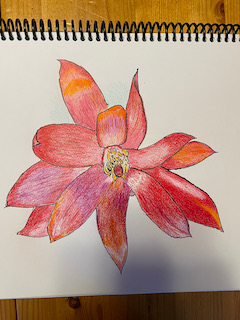
In the meantime, I’m back to doing some drawing. I got a very cheap but good set of coloured pencils for my birthday last month, so I did a couple of drawings. Here they are:

Christmas cactus head on view.
Christmas cactus side view.

I have one more I want to do with the coloured pencils using a different profile. Then I want to do a couple more in watercolour on proper paper, and maybe in acrylic on a large canvas. I’ll have to assess my level of energy before I undertake a large(ish) canvas, but I seem to be getting stronger every day now.

___________________________________________________________________

*If you haven’t read my post from January 13, 2022, you might want to do so now. It outlines my experience with B12 deficiency and pernicious anemia.

Remembrances 2: Pornography

I’ve just finished reading a book by Julia Shaw (Dr. Julia Shaw) who studied psychology at UBC. Her book is called EVIL: The Science Behind Humanity’s Dark Side. (Doubleday in Canada, 2019). Her basic premise in that book is that evil is entirely subjective and we all have evil tendencies within us and the potential to act on them. For Shaw, murderers and torturers, even Hitler, are human. They may have committed atrocities at times, but not 365 days a year, 24 hours a day. For Shaw, no one is objectively evil, not Ted Bundy, not Jeffrey Dahmer, not Paul Bernardo. Not even Hitler. She asks, provocatively, would you have killed baby Adolf if you had been given the chance? Her answer is, probably not because there would have been no way to predict how Hitler would end up on the basis of what he was as a one year old boy. For Shaw, evil is situational a great deal of the time and one person’s evil is another person’s glory. Ernest Becker declares in his book Escape From Evil that the twin pillars of evil are death and disease. He doesn’t objectify people as inherently evil. In essence, he argues, we have a deep-seated cultural aversion to death and disease and we have created a plethora of institutions dedicated to the denial of death and disease (including hospitals, I might add). Those institutions may be at loggerheads with one another as part of the ideologies of competing groups as they go about vilifying each other. But I digress somewhat.

Shaw deals with many instances of evil in the world, including pornography. Like all other themes in her book, Shaw doesn’t condemn people for watching porn, (and she doesn’t even consider it evil). She insists that people who watch porn are not evil, and are in fact, normal. This is true particularly considering that she argues from a 2007 study by Pamela Paul elaborated in her book Pornified (New York: Times Books) that “66 percent of men and 41 percent of women consume porn on at least a monthly basis.”1 When I taught a course in 2010 and 2011 at North Island College called Love and Sex and I did research on porn for the course, I learned that at that time 37% of the income derived online was from pornography. Of course there’s no way of pinning down a reliable statistic on the valuation of pornography, but it’s big business, there’s no doubt about that. Still, as Shaw argues, there is a gloss of shame and moral terpitude that accompanies pornography. Shaw is entirely correct here. In fact, I challenge you to admit yourself to viewing porn, or to have someone else you know admit to viewing porn. I wrote above that I researched porn for a course I taught at NIC in 2010-11. In doing that research, I viewed a lot of porn.

As people got to know that I was doing research on porn I got a lot of: “See any good porn lately, wink, wink, nudge, nudge.” That kind of comment was absolutely uncalled for with veiled suggestions that what I was doing was somehow immoral, but sex is such a powerful subject in our less-than-open society that even doing research on a taboo subject in any way associated with sex was liable to unleash opprobrium and displeasure. As part of my responsibility around this research, I notified the college that I was doing this kind of research and that they should be aware of that because it may show up on my computer. Shaw notes in her book that:

“When attempts at empathy and understanding are made, there is often a particularly vicious utterance that is used to shut them down; the implication that some people should be empathized with, lest we imply that we too are evil. Want to discuss paedophilia? That must mean you are a paedophile.” (p.8)

What I was especially interested in as I investigated porn was the way that women are portrayed by the purveyors of porn. I’m assuming that porn hasn’t changed much in the last ten or twelve years since I conducted my research, but I do know that there is a movement among some women to transform porn.2 In my research I noted that it was very common for women to be referred to as dirty, sluts, etcetera. Actually, I take it back. Porn has changed a lot in the last ten years. Just a quick scan of one porn site and it’s obvious that there’s a lot more DIY porn out there. It’s now common for young women to set up chats or performances of various sorts for money, and incidentally for the pleasure of men,I suppose. And, somehow, tokens have become part of the porn scene. I wasn’t going to get into how that works. Much on the DIY porn is ‘porn-lite’ but there’s still a lot of violent and nasty stuff out there with much denigration of women. It’s hard for me to relate to misogyny given that I had a mother, I have a spouse, many sisters, two daughters, and granddaughters. However, I know about the origins of misogyny in the Biblical story of creation and in many other cultural institutions and myths, and I see misogyny glorified in politics, education, movies, and popular programs like Game of Thrones, among many others.

Actually, porn is no different than many mainstream views on sex as dirty. Why the association of sex with dirt? Well, dirt, death. I’ll not go into this here to any extent. See this post I wrote from March, 2018 for a discussion: https://rogerjgalbert.com/2018/03/27/why-do-some-people-refer-to-sex-as-dirty/ Interesting that I seem to come back over and over again to these themes.

_____________________________________________

1page 145 in Shaw’s book.

2see especially After Pornified: How Women Are Transforming Pornography & Why It Really Matters by Anne G. Sabo, a book I just ordered. (After I read Sabo’s book I’ll get back to you about how women are transforming porn.)