Why do some people refer to sex as dirty?

By sex in the title here, I mean sexual intercourse and sexually related activities. I never could understand the reference. It seemed (and still seems) ridiculous to me. I understand it now, but that doesn’t make it any easier to accept because it’s a metaphor that is deeply demeaning to women of course, but frankly, to all of us. The reference could make sense if it aimed at describing sex in a mud bath, but that’s never the intention, of course.

You all know this. It’s no secret. Men are never referred to as ‘dirty sluts.’ It just doesn’t happen. However, women are  routinely called dirty sluts, particularly by the porn industry, but also by some segments of the population with very categorical views of when, where, and with whom it’s okay to express one’s sexuality.

More basically, I heard with my very own ears parents chastising their children for having their hands ‘down there.’ “That’s dirty, don’t do that!” I’m hoping that it doesn’t happen with younger parents these days but I somehow doubt it. There are people on this planet who are pathetically if not pathologically ignorant, so nothing should surprise us. Moreover, cultural references are pretty pervasive and consistent in linking our ‘private parts’ with dirt. The word pudenda, the plural of pudendum, refers to “a person’s external genitals, especially a woman’s,” that according to the very reliable Google dictionary. Pudendum literally means: “thing to be ashamed of,” according to the same reliable dictionary. So, not only are genitalia dirty, they’re also something to be ashamed of. Now, even as a long time social researcher and somewhat cynical sociologist, I still find this reference to genitalia and sex, especially with reference to women as entirely perverse.

On another tangent, but still on the language train, if I want to refer to someone as not being entirely nice, I may call that person an ‘asshole.’ There we go again. It’s no surprise too that our swear words are pretty much entirely focussed on our genitalia and on sex. In French, swearing also involves the genitalia and such, but in Québec, you’re also liable to hear swear words referencing the Catholic Church and items used during the mass.

Since who knows for how long we’ve been alienated from ourselves. We refer to ‘my’ body. What is the ‘my’ that owns a body? We should’t be surprised, though, because that’s language and our language reflects our morality and our preoccupations and we are silently, unconsciously, subconsciously, and daily reminded of death. Language is entirely metaphorical so we express our fear of death not in direct terms, but obliquely, using metaphor. [By the way, if you want a good read: Talking Power: The Politics of Language, by Robin Tolmach Lakoff, Basic Books, 1990). It’s all about metaphor and politics. She’s got a great chapter in there on women and language.]

Alright, I’ll grant you that excrement is not far from being dirt and if mommy doesn’t want you playing ‘down there’ it could be partly because she doesn’t want you spreading shit all over the place. But that’s not the whole story, nowhere near. Excrement has much more meaning for us than that. Norman O. Brown notes in Life Against Death (p.295):

Excrement is the dead life of the body, and as long as humanity prefers a dead life to living, so long is humanity committed to treating as excrement not only its own body but the surrounding world of objects, reducing all to dead matter and inorganic magnitudes. Our much prized “objectivity” toward our own bodies, other persons, and the universe, all our calculating “rationality,” is, from the psychoanalytical point of view, an ambivalent mixture of love and hate, an attitude appropriate only toward excrement, and appropriate to excrement only in an animal that has lost his own body and life.

What does Brown mean when he writes that we are “an animal that has lost his own body and life.” ‘His’ in this sentence refers to humankind, all of us. In some ways I find it strange that Brown uses ‘man’ to include women and ‘his’ whenever a general possessive pronoun is on his mind. However, Brown is right. Taking a shit is a daily, unconscious, subconscious, reminder of our death and that’s distinctly unpleasant. If we thought about it consciously, we would be traumatized. So we use all kinds of metaphors to try to forget all about death or we joke about it. Few are the people who have come to grips with death and live a full life in their bodies, as their bodies, taking pleasure in them and accepting their aging and their annoying aches and pains. These are people who don’t yearn for a life beyond this life, because for them, that just doesn’t exist.

Just one more thing: What the fuck does ‘taking a shit’ mean? Of course we know what it means, but what can we make of it literally? I really don’t know. However, I’d rather leave a shit than take one, thanks. Enough silliness for one day. More later.


Is Equality Between the Sexes Possible?

Is it possible to have equality between the sexes?

Given the history of sexual relations on this planet, a logical answer would seem to be a resounding NO. But I don’t think that’s so.

Yes, absolutely, I do think that equality is possible. However, it can only be possible when humankind, especially the male fraction of the species, agrees to give up its apotheotic quest for the god-like status of an immortal being. There are hints that there is movement in this direction (more on this later), but we have a long way to go before the bulk of humankind can reconcile itself to the idea that our bodies are all we are and souls do not exist except in our collective conscience.

I sincerely have sympathy for people who want to live forever. Our quest for immortality is the basis for a lot of our sociality. We share a belief in eternal life with others like us. We build institutions and organizations to perpetuate and nurture this belief. It’s an appealing prospect until one begins to read the fine print or we begin to kill each other to defend ‘our’ god against the gods of ‘others’ who dare to try to usurp our vision of the way to eternal life. The way gods work, there can really be only one that is the true god. All others must be pretenders. (This isn’t strictly true. Even one god, the one proclaimed by Moses and Abraham, can be the source of real division, death and mayhem). That said, let’s get to the nitty gritty.

It’s evident that males and females of many species of animal are dimorphic, meaning that the sexes vary in body size, shape and weight, hairiness, and in other easily ascertainable ways. Us humans are significantly dimorphic with males being on average stronger, bigger, etc.[1] So, men and women are not equal in many respects. This has lead a whole lot of conservative thinkers and philosophers going back as far into history as the eye can see to make the logical leap to conclude that these physical inequalities are the natural basis for the social, economic, and political inequality of the sexes. This is patently absurd but it doesn’t stop those who claim a logical basis for their arguments in natural human variation from making their claims on clearly ideological grounds.

It’s certainly true that there is huge variability in male human size, strength and shape. Some theorists might dare to suggest that the Nilotic peoples, especially the Dinka and Nuer, being very tall and thin on average, must be superior to the BaMbuti people of the Ituri Forest in central Africa, who are what we used to call pygmies, and who are very short and compact. The same is true for intra-female variability. The variability of human form is quite evident still, of course, but there is evidence that with international travel and population mixing that the variability that we have seen historically is very slowly attenuating.

Of course, we’ve seen evidence in history that skin colour, eye shape, etc have been significant bases for the imposition of social inequality. We ‘other’ people for all kinds of convenient reasons especially social and economic power. We deny people equality for whatever reason we can dream up or make up as long as it’s in our interests. So, what about the inequality that exists between men and women? Well, I think I’ve repeated it often enough, but it may be worth repeating again. Men have longed for immortality for as far back as we can ascertain. Their literate representatives who have gotten into the history books and have written a huge range of proclamations on the topic going back further than ancient Babylon have been pretty well in agreement that women are a huge stumbling block to achieving the objective of immortality. Women just can’t help but get most of us poor men all lathered up sexually and by that process, take our limited attention away from our focus on our spiritual salvation and eternal life.

It’s pretty common to read in historical documents, including the Bible, of course, that any form of pleasure of the flesh is sinful and leads to eternal damnation. In her book Eunuchs for the Kingdom of Heaven: Women, Sexuality, and The Catholic Church[2] Uta Ranke-Heinemann’s focus is on Church writers, theologians, popes and the like. She also, however, goes beyond her analysis of women and the Catholic Church, to consider relations between men and women taken more broadly. She notes that although it seems that proscriptions and interdictions regarding sex are pretty straightforward in historical texts, we cannot assume that everyone was on board with those specialists, philosophers, theologians, etc., who were often celibates and who lorded it over the masses. It seems the masses weren’t always in agreement with the high and mighty and often ignored interdictions even to the point of suffering persecution and social exile.

Of course, it’s really quite ridiculous to expect people to not enjoy sex. Plainly, there are many circumstances where sex is not at all pleasurable, especially for women and even ejaculation can be painful at times for a small minority of men. Still, essentially, sex and pleasure go hand in hand. I (and I daresay most men) would find it very difficult not to feel some pleasure upon ejaculation. Ironically, according to many writers historically men are not supposed to even experience ejaculation (during masturbation or coitus) unless it’s sanctioned by the authorities and only under very socially proscribed situations. In fact, Ranke-Heinemann notes that church authorities even discouraged sex between spouses, some going so far as to dictate time of day, day of the week, months of the year. Needless to say, the Church fathers were only concerned with male sexual pleasure and regulating it, not female pleasure, which they often assumed never existed.

Let’s not fool ourselves either to think that regulation of sexuality is a thing of the past. Female (and male) genital mutilation is still commonly practiced as well as segregation of the sexes. It’s also still common for states to try to regulate what you can do in the privacy of your bedroom.

One last thing before I move on. It’s clear that not all men are misogynists and women victims. Humans will always find ways of sharing intimacy and revelling in sensual, sexual pleasure no matter what the ayatollah, the pope, imam, rabbi, or whoever goes on about how bad it is and how it detracts from our main goal of immortal life in the presence of our preferred deity. It’s also true that women can have just as much of a stake in immortality as men do. The only difference between men and women in this regard is that men have made up all the rules and women must obey or live eternally in hell.

It’s also clear to me that men and women can equally be jerks, self-serving, mean, nasty, and violent. They may choose different paths to meanness, nastiness and jerkiness on occasion, but elimination of the search for immortality will not necessarily do away with the human condition although I really am optimistic that there will come a time when there will be less basis for stupid, vapid, ignorant human behaviour. The elimination of competition for favour in the eyes of God or just for individual specialness, even on the football field, will take us a long way to equality of the sexes. Just don’t expect dramatic results too soon.

It’s also true, I’m pleased to say, that we can love profoundly and unconditionally. Problem is that we do that in spite of all the social forces that work to divide us when they should be working to bring us together romantically, whether it’s woman with man, woman with woman, man with man or a combination of the above. I’m not saying we should abandon all restraint and engage in all out debauchery, but we should all be engaged in figuring out as we go along what we want rather than have the high and mighty do that for us in the name of a false hope of immortality.

Next: how little innocuous things like words, sayings, and practices can reinforce and even exacerbate sexual inequality.


[1] See de Beauvoir’s The Second Sex for a detailed exploration of this topic. Germaine Greer takes a slightly different look at sexual dimorphism in humans in her book, The Female Eunuch.

[2] New York, Doubleday, 1988.

Misogyny: What the Hell? Okay, Let’s Do This.

So, I’ve been putting off writing this post. The reason is that I’ve been reading, reading, and reading some more. There are hundreds if not thousands of books on misogyny and countless more scholarly articles, never mind the (probably) millions of newspaper, magazine, websites, blogs, and other sources I can’t think of right now, that try to understand misogyny or point out it’s catastrophic consequences especially for women, but also for all of us. And there are original sources to be evaluated including religious texts, philosophical works, and ethnographies. I’ve barely scratched the surface of the literature in reading and teaching a course on love and sex, but there are themes that re-occur again and again so it’s not necessary to read every piece of writing on the topic. What I have read is depressing enough.

I want to say that I have no intention of offending anyone by writing these words today, but some people will inevitably take exception. That I cannot control. Like Copernicus, Galileo, and the more contemporary Charles Darwin (although I’m not in the same category of eminence as they are), I must write what I see as the truth based on decades of study and reflection. That said, let’s do this.

As I wrote in my last post, misogyny started when the animal became the human. Of course, we’ve always been animals, subject to all the vagaries and uncertainties that that entails including the challenges associated with survival, including getting enough to eat and drink, protecting ourselves from threats (floods, droughts, volcanoes, rock slides, predators etc.,) as well as replenishing the species by making babies. However, when we evolved sufficiently to become self-aware, which took millions of years, we were able, with our now bigger brains, to try to deny that we were ever animals in the first place. Or rather, we didn’t specifically deny our animality, we just tamed it by making it subject to control by our ‘self’.

Language has long fascinated me and there is plenty of evidence in our languages of the attempted denial or taming of our animality. If I say to you: “My body is really sore from that workout yesterday,” to what does the ‘my’  in that sentence refer? What is it that can claim ownership of the body? This linguistic turn had profound impacts on humanity long before English evolved. Virtually everywhere I look in the anthropological ethnographic literature, we’ve determined that ‘we’ are in fact not just our bodies, but ‘we’ are much more than that. We’ve managed to convince ourselves via our dreams (awake and asleep), our growing imaginations and probably through trances brought on by drugs, dancing or fasting) that we must be a very special animal indeed. This process led Ernest Becker to argue that it’s our ingenuity and not our animality that “has given [our] fellow creatures such a bitter earthly fate.” (EFE, p.5) As we developed selfhood and  our brains grew bigger and more capable, we convinced ourselves through ritual that we were able to control heaven and earth. We invented rituals and projects like the zodiac to convince ourselves that the heavens were in constant intimate relations with us and we read chicken entrails and runes to determine how we might control natural forces that threatened us. We created culture to oppose nature, as Becker argues, and our cultures are more or less elaborate and sophisticated projects to deny our animality and, consequently, our death.

We always knew that animals died and we were not oblivious to the fact that we all eventually meet the same fate. What to do? Oh, what to do? Well, the ‘forces of nature’ were always overwhelming and difficult to handle but we determined that if we pursued the right rituals, we could affect the course of our lives and of nature. We began to bargain with the forces of nature. “You back off and give us good crops and we’ll sacrifice a bunch of sheep to you. Sound fair?” But the forces of nature (gods) were never satisfied and needed constant reassurance that we would feed them. Kingship developed as a way of having a god present at all times to take our gifts and keep us safe. We, however, the weak, vulnerable species that we are also needed constant reminders that we mattered and that the gods were paying attention and were on our side. So, we split our societies into ‘moieties’ or (literally) halves so that we might have someone to compete against to show the gods how worthy we were. That process is still extant in modern society. We tirelessly set up competitions to prove our worth, our value and we do it most frequently for the glory of our God (gods) or, now, our secular god, our country, that institution that ensures us survival beyond our animal lives. Religion has always promised us eternal life. Why else would it exist? Thousands of religions over the course of history have given people thousands of ways of gaining eternal life. Problem is, in a competitive world, if my way to eternal life promised by my religion is the right way, your’s cannot be. Sorry about that.

Now comes the part where the most momentous invention ever to come from the human species was wrought. That’s the notion that if our bodies are mortal, then the only thing we can do is deny them their due. Because we were now connected to the forces of nature we could pretend that we had an inside track on immortality. Gods were immaterial and immortal, we could be too. If we performed the rituals just the right way, we could ensure our eternal survival. Our rituals became increasingly aimed at chastising the flesh, piling corpses upon corpses to assuage the gods. We needed to put emphasis on our selves, our souls, that immaterial aspect of ourselves that would not die if we performed the proper rituals at the proper time. Our bodies became our enemies. The body became associated with death, the spirit with life. Norman O. Brown states that in fact, the earth is the devil’s domain. Disease and death became the twin pillars of evil for us. Life on this earth was transitory, just a preparation for the immortality we could achieve upon our corporal death if we lived right, did the right things. Our denial of death led to our denial of our bodies and our lives. So, in order to live eternally, we were prepared not to live fully in our animality.

So, why do we associate faeces with dirt? Why must we avoid getting dirty? “We read that the men of the Chagga tribe wear an anal plug all their lives, pretending to seal up the anus and not to need to defecate…The body cannot be allowed to have the ascendency over him.” (Becker, The Denial of Death, p. 32) The Chagga men’s denial is our denial. In another post, I address this fact more fully, but for now, what of women?

Well, women were never the primary class of people who presided over ritual. They were much too busy having babies and being domestic. The first class divide then is between men and women, a mostly natural divide to start with, but with time, the most important class divide was between most men and the priestly class. Women need not apply. Not then, not now. (Yes, you can contest this point if you want.)

In fact, for men, their bodies are traitors to them because of their animal nature, their death instinct. When men and the priestly class came to dominate human societies, women were increasingly seen as the epitome of animality. Men ‘othered’ women for their sexuality, their attractiveness to men, for dragging men into a depraved and animal world. Sex became dirty unless it was sanctioned by the priestly class using the proper rituals. Sexual attraction had to be denied at all costs so that it couldn’t infect men’s spirits, their souls. Problem is, of course, we are a species that reproduces sexually so there was a need for a massive investment in ritual to ‘cleanse’ women especially during menstruation and in the regulation of the female being, of the female world which by it’s very nature condemned men to death. Sins of the flesh are a great way to eventually find yourself in hell. (Of course, things are changing and I’ll deal with that too in another post.) Dante’s hell isn’t as present as it used to be in Abrahamic consciousness but we have other ‘hells’ to replace it.

Enough for today. I will follow this set of blog posts with a list of the materials I used in researching this topic, at least the most important ones.

Without getting into too many specifics, my next post is about how women have been treated throughout history and labelled unclean and a threat to men’s ascension to eternal life. For that we need to visit the Old Testament, especially Leviticus, but other sources as well, including Aristotle, Thomas Aquinas and others partly through Jack Holland’s work, but also through many others including Ernest Becker, Norman O. Brown, Otto Rank, Umberto Eco, Uta Ranke-Heinemann and Carol F. Karlsen. Simone de Beauvoir also figures prominently here.


Misogyny: What the Hell?

On this International Women’s Day, it’s a good time to introduce my next series of blog posts. I don’t intend these short posts to exhaustively cover the topic, but to serve as an introduction and to stimulate discussion and dialogue. In a future post I’ll explain the title above. Much of the significance of this post and those that follow on this topic is summarized in the title.

I’ve scanned a significant sample of the anthropological, historical, sociological, philosophical and theological literature and I’ve done so over decades and there is this stark truth that consistency reveals itself therein: There is no time in history that I can uncover when women were not treated as inferior to men. There is no time, nor place. Oh, there have been matrilineal, matrilocal, and matrifocal societies, but no matriarchal ones, nor have there been ones where women and men have shared power equally other than in Marx and Engels’ concept of primitive communism wherein women had supremacy over domestic life and men over social life, hunting and defence. If it did exist, it didn’t last long.

In response to the pervasiveness of this uneven relationship between men and women, some people might argue (and have they ever) that women are naturally inferior to men and should just accept their place in creation. In fact, this notion has dominated many treatises on the nature of humanity over history. It’s probably more common, even today, than some of us would like to admit.

I reject this notion out of hand, of course, because it’s patently false and the evidence is before our eyes every day. Constitutionally, women are not inferior to men any more than poor people are inferior to rich ones. Differences between the sexes exist of course but they are not grounds for discrimination or prejudice. As Simone de Beauvoir writes in The Second Sex, women have been ‘othered’ not because of any inherent weakness, but because of what they represent to men.

Women have inordinately suffered at the hands of men in history, of that there is no doubt, but many men would argue that women have inflicted their share of suffering onto men too. I’ve known some men who have expressed a profound hatred of women. They seldom can give reasons other than that they were treated unfairly, taken advantage of, abused and rejected. Still, it’s rare to read that a woman has killed her husband or partner during outbursts of domestic violence, while it’s common to read of men killing their wives or partners in the same situations. Men kill women much more frequently than women kill men.

However, for this blog post, I’m not primarily interested in exploring the individual, idiosyncratic expression of misogyny. Rather, I want to explore misogyny as an ideology of very deep-seated human institutional experience, experience that rules our lives as humans of whatever sex and determines to a large extent how we relate to one another in groups throughout history.

Misogyny is defined, for the purposes of this post, as a systemic, overarching and deleterious characteristic of human relations. It divides us. It denies us. It obviously has consequences for all individuals. None of us can escape it’s reach. Women can even be as misogynistic as men (for reasons I will explore later). Men who resist misogyny have a tough go of it because it reaches into every pore or our cultures. It will not be ignored. Still, for humanity to enter a new phase of history, one not characterized by brutality and ignorance, misogyny will have to give way. In the next few thousand words, I explore why that’s the case.

From the time the animal became the human, women have been paying dearly for our flight from death and our longing for immortality. This idea is from Norman O. Brown’s Life Against Death, but it is repeated by other authors in various publications. It’s not often stated in these terms and some explanation of what Brown means here is necessary. Strangely, women are seldom included explicitly in analyses of the human condition and the statement by Brown above is unusual. For Brown, to be human means to be an animal that knows death in a way that no other animal does. Of course animals have a fear of death, that’s very easy to ascertain from simple observation, but animals, unlike humans, don’t make a fetish of it. If they face death as in a predator bearing down on them with intent to kill, they experience fear and flee. If they survive, it takes them very little time to go back to their routine life and the threat to their life is forgotten. Not us humans. No, we carry that fear around, relive it, dream about it, let our imaginations expand on its every detail and we, above all, need to explain it. So far, we haven’t done a great job explaining it. Instead, we’ve spent a great deal of our collective energy denying it, ‘it’ here meaning the death that inevitably catches up to each and every one of us and we’ve been very creative in our denials.

So, at the moment (maybe it took thousands of years) when our ancestors finally ‘became human’ and became self conscious, they realized that their wonderful tummies and the amazing sensations that they felt could not possibly come to an abrupt end. They faced danger on many fronts from predators, natural disasters, feuds and illnesses. They found their loved ones crushed by boulders during a landslide or drowned during a flood. Their bodies were obviously their weakness. They needed a way of transcending their main weakness, their bodies, to convince themselves that they, in fact, did not die although their bodies obviously did. Oh, their bodies might be toast, but not ‘them.’ So they set about creating any number of fantastical immortality-projects to convince themselves that even if their bodies rotted away that ‘they’ would not because they were not just their bodies, not even essentially their bodies, that they had within themselves an immaterial self that survived the end of their bodies. The anthropological literature is replete with descriptions of the incredible number and richness of ways in which peoples have imagined their immaterial selves. These imagined selves are the Yanomamo hekuru and our common variety soul. “Sure, body, you go ahead and rot. I’ll be around forever though. I don’t need you.”

So, what this leads to is essentially and inevitably the systematic cultural denial of the body. As Becker says in Escape From Evil, disease and death are the twin pillars of evil for us. Disease prevents us from enjoying life fully and death cuts it off permanently. Now, that’s no fun.

But what of women in all of this? Well, I’ll get to that in my next post. Suffice it to say here that a major part of our bodily lives is our sexual lives, procreative or not. For men who want to emphasize their immaterial, immortal selves, sex represents a big problem for them. It’s all about body, the great traitor to our immortality strivings. Men could eventually convince themselves that women were essentially body but that they were essentially soul. Now what are the consequences of that?


On my way to my Misogyny post: A Note

So, I’ve been reading tons in preparation for writing my post on the roots of misogyny. One thing I’ve done is re-read for the 20th time, I’m sure, Ernest Becker’s Escape from Evil. I have also re-read his Denial of Death again. This time, I read them with a different eye. I was looking specifically for a direct mention of women, or rather of how a woman might experience the creation of immortality-projects and such things. Actually, I found precious little, and it was disappointing.

In terms of bartering with the gods and creating institutions that are there to deny death and promise immortality, women are nowhere to be seen. Men are the priests, men are the leaders, men are everywhere. Women are nowhere. Granted, it’s complicated and to a large extent men took the bulk of the power in society and have since the beginning as best we can guess, although there is some interesting speculation otherwise.

To me, the interesting question is this: in a species that reproduces sexually, both male and female are required to make babies. There is no inherent reason why males should have all the social power and women have so little. So, why and how did men ever get and hold so much social power? That is the question I will address in my next post. There’s no way I can answer it definitively, but I can make an educated stab at it using all the power of research that I can muster. By the way, I’m not suggesting that women are powerless. In fact, in some ways, women are more powerful than men. It is in the realm of the spiritual and in terms of the creation and sustenance of immortality projects that my interests lie. Many women have written about the inferior status of women. I will address some of their thoughts in upcoming posts.

Another disappointment for me in re-reading Becker, something I hadn’t really paid enough attention to before is his insistence that our immortality projects are now secular. According to him, we’ve moved beyond the magic and promises of religion but our new ‘gods’, money and the nation-state cannot promise us immortality. That is a basic lie although they don’t hesitate in pushing that idea. Nation-states have sold themselves as important sources of meaning in our lives, meaning that seems to be worth dying for given the evidence from the carnage of the wars of the 20th Century. Max Weber, the German sociologist, argued that we live in a demystified world. I think that magical thinking is still very powerful in the world today. We are terrified of death and are willing to attach ourselves to whatever scheme we find plausible enough to lead the way into immortality. In many instances, those schemes are passed down through the generations, but new schemes pop up all the time outside of family and often in opposition to traditional familial values.


When the internet finds out that ignorance is bliss it goes crazy!

Alright, so here’s my rant for the week. Nice clickbait title, eh?

Clickbait titles are a tease, of course. They want you to follow them because their income depends on the number of hits they get. Our natural curiosity makes us vulnerable to this tactic and we fall for it all the time. Well, I thought I’d try to get you to have a look at my blog by using this stupid title. Is it working?

The title is misleading, of course, as many clickbait titles are. However, accuracy is not as important as getting you to click on their bait. Ignorance has its cost and its consequences. Ignorance may not be bliss, but it is a necessary condition for all of us. We cannot know everything about everything. The trick is to recognize and accept that.  You can only do something about it by way of learning to be open minded, critical (as in dissecting ideas, values, political events, everything) and scientific. Even at that, you may part the curtain of ignorance slightly. You’ll never open it completely.

Ignorance is the normal human condition at this time in history, especially since the industrial revolution. We have dealt with it using division of labour and so far that’s worked fairly well. A division of labour means that we cannot know everything about everything so we depend on other people to help us out every day of our lives with tasks we have no idea of how to accomplish ourselves. All of us are entirely dependent on others just to make it through a normal day and the more we live in a technologically complex world, the more that’s true. Basically, we are completely ignorant of most of the systems we rely on just to get through each day. And we don’t sweat that. It seems normal. It’s all good.

You may be adept at some things and a klutz at others. You may be a wonderful carpenter, a great mechanic, a skilled brain surgeon or a gifted musician but you’re not likely good at carpentry, mechanics, brain surgery, and music. You’re probably not one of the very few people who know about electricity and how to get it into your home. You trust that there are people who can ensure that electricity gets to your computers, stoves, refrigerators and heaters. You probably know nothing about farming either unless you’re one of the specialists in that field. Oh, you may dabble in growing your own food, but you may not know how to grow food on a scale large enough to feed your family or your village. You depend on others to produce the food you need. With some exceptions you will never know any of them personally. It’s true that some of us get pretty handy with tools, can grow a few veggies, repair a broken piece of furniture, glue a toy back together, or sew a badge on a shirt. We can do stuff without being an expert. But for the big stuff, we must leave it to the experts. Of course, experts can and do make mistakes and we need to make them accountable for their mistakes. What we need in that case is a method to measure success or failure and agree on a system of accountability. That in itself is no easy task. Science is a method of creating models of how the world works. Science can create systems to evaluate just how accurately any idea, structure, method, process, etc., conforms to how the world works.

So, we are ignorant of most things and that’s okay. However, there are things that you will pay dearly for if you ignore them.

For instance, if you see a little warning light on the dash of your car come on that looks like an oil can with one little drip of oil coming out of the spout and you ignore it and keep driving anyway there’s a good chance that you’ll trash your engine in the process. Don’t ignore warning lights on your dash! Automakers put them there for a reason. Don’t ignore the flashing lights at a railway crossing! Sheesh. Don’t run red lights!

The fact is that we get lots of warnings in our daily lives that we must heed, some of them are metaphorical warning lights that light up in our everyday lives that we ignore at our own peril, like ignoring our diet, high blood pressure, or a cold silence emanating from our partner. This is all fine and dandy, but there’s a whole other dimension to ignorance that revolves around ideas, policies, values, and social practices. That’s where I want to go now.

I know nothing about brain surgery and I don’t think you should trust me to remove your appendix. However, I have studied society and history for decades and I would expect that you would recognize that and give me my due. At least hear me out and listen to what I have to say before thinking of what you will come up with as a rebuttal based solely on your own personal experience or hearsay.

Most of you will have no educational experience to even begin to figure out what I’m up to here any more than you can figure out what makes a computer tick. It’s not because you’re stupid (well, some people really are) it’s because you’re ignorant, unknowing. My use of the word ignorant is not pejorative or negative, it’s accurate. You are largely unknowing and don’t have the resources to really figure out the dynamics that drive your existence, not your ideas, your values, your wants and desires, your sexuality, your emotions, nor your very lives and how difficult it is to figure out what the hell is going on. You may have some idea of what drives the dynamics of your life, and in fact, ignorance is not an either or thing. It can be partial…and, of course, that can be dangerous. Every day when I went to work, I was paid to think about these things. How many people have that kind of privilege?

This may sound harsh, but it’s simply true and there’s no way around it. We simply cannot know all things we need to know to live. Furthermore, we are all blinded by our institutions, those habits that drive our actions and thoughts. They prevent us from seeing the world for what it is. Why and how does that happen? Many scholars and scientists have spent their lives sorting out these issues with a great degree of success in my mind. To figure out how the social world works, you just have to know who these scholars and scientists are and read everything they wrote (or write). Then you have to think real hard about how their works relate to each other and build on each other. Who has the time or inclination to do that? The consequence of not doing that is continued ignorance (but don’t feel bad about that). The cost of doing it, unfortunately, in my experience is social compromise and intellectual loneliness (and I can live with that).

I really do feel that I have a fairly good grip on what drives us as humans in our specific cultures and how our cultures evolve. I got this grip from careful and systematic study at university and in private research. That makes me an expert, I guess.

In my next few blog posts I’ll explore various aspects of our lives and suggest models to explain them. That’s the scientific way. You can ignore what I say, of course. You may have particular expertise in a given activity or occupation. I’m sure I wouldn’t presume to tell you how to do your job.  If you want to know something about how society works, you might want to ask me or someone else who has spent a lifetime learning about these things. We each have our areas of expertise. Mine is society and history.

I’m a student of social and cultural life in a historical context. If you have anything you are curious about, ask me. See what comes out.

My next blog is about women and the way women have been portrayed and treated over history. A lot of what I write about will revolve around misogeny, sex, reproduction, patriarchy and seduction.

My mom died last night.

As a blogger, I will blog. That’s just the way it is. My mother died last night at around midnight. She lived for 15 years or so in a care facility called The Dufferin, in Coquitlam, BC. She was almost 94 years old.

Her room is quiet now, but really, it’s no longer her room. Soon, someone else will occupy it and there will be no trace of my mother’s time there except in the memories of the care aides and nurses who looked after her. I can’t say enough good things about the care my mother received at The Dufferin. Part of that is because of the dogged persistence of my sisters Lucille Haveland and Claudette Friesen but it’s also because of the caring attitudes of the people who looked after mom every day. They had way more contact with my mother in the last few years than I did. In fact, I rarely saw my mother over the last few years. We live on Vancouver Island, a 5 hour trip including a ferry ride from The Dufferin and when we did go to Vancouver over the years we always stayed with my daughter and her family. We just didn’t see my mother or many of the rest of my family either for that matter. For probably 17 years before her death, she carried a heavy burden of dementia and she was certainly not the woman I knew as a young boy growing up. It was hard to see her like that. I do wish I had made more time to see mom over the years, but I can’t change that now. Still, she was my mother, changed as she was. She was gentle, warm and tender. She loved her family. She loved all of us.

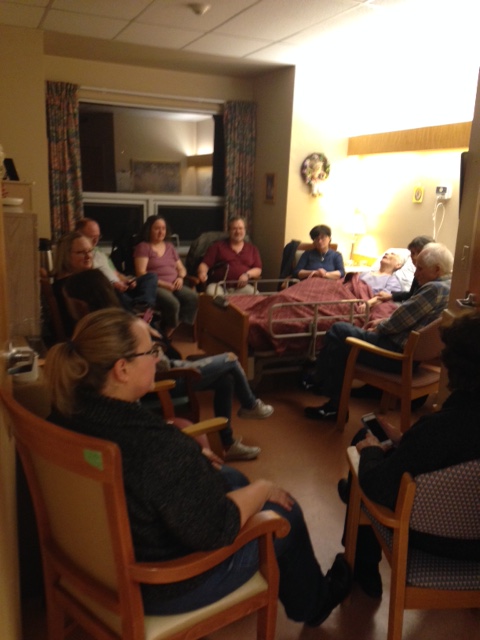
Over the last few days, her room at The Dufferin was anything but quiet.

IMG_2902

As you can see she was surrounded by family. Not all of us could fit in the room at the same time so we would leave the room now and again and spend time out in the hallway. At any one time there could be as many people in the hallway as in her room. That’s no surprise because she raised 15 children, only three of which could not make it to the Dufferin in the last few days to bid farewell to their mother(one being deceased and the other two living far away with health issues of their own). Husbands, wives, grandchildren, great grandchildren rounded out the group along with a steady procession of care aides.

My mother is gone. The people who do these things took her body away in the middle of the night not two hours after her last breath. That’s how fast and efficiently these things get done. What they couldn’t take away though was the laughter and the love that was palpable in the hours and days before her death and that saturated the room. We can be an irreverent group at times and we proved to be just that over the last few days, but that irreverence was always tinged with love and trust. Our mother’s death has brought us together again. We feel her in our love for each other.

I’ll have more to say in the coming days. For now, I’m home in Cumberland, on Vancouver Island, resting and awaiting news about when the funeral will happen.

Take care, all of you and hug your loved ones.


Growing grapes on the Beaufort Range.

I live on one of the main roads that lead out of Cumberland, BC. Cumberland is on the eastern slopes of the Beaufort Range at about a 500 foot altitude. Over the past few weeks we have witnessed at least a dozen logging trucks headed out of town every week day down the Trent River Main headed who knows where. That’s been going on for years but it seems logging activity is picking up around here. Certainly, the clearcuts are getting bigger and bigger just up the slopes from our little community and they’re getting more numerous.

I don’t know much about what sustains a forest. I’m a sociologist, not a biologist nor an ecologist. What the ecologists tell me, however, is frightening. Logging and development are wreaking havoc with ecosystems and changing the landscape in very visible ways. I’m of two minds about that. Should we care?

But let me step back for a moment and ask a few questions some of you may have answers to.

  1. Given climate change and the report yesterday that increasing temperatures are accelerating, has anyone given thought to how a changing global climate will impact our forest and marshland ecosystems on Vancouver Island?
  2. Is there a tipping point where the amount of logging in any specific area will permanently change the local climate so that certain species of trees cannot grow here any longer?
  3. In the foreseeable future are we looking at the conditions ideal for growing grapes on the hillsides above Cumberland? Are we looking at a potential wine growing situation here?

I know that logging in the Comox Valley and in most areas on the eastern slopes of Vancouver Island mountain ranges is proceeding apace. I’m not at all against logging per se. After all, I’m a woodworker and sculptor in wood. We also still burn wood on occasion in our wood stove. I do, however, question the logic of the kind of clearcut logging we’re witnessing here. There are many ways that forests can serve the economic interests of communities and I’m not at all sure that what’s happening here at the moment is in our best interests. There are alternatives, but I doubt that they are given serious consideration.

Given that the mountain sides above us are all privately owned by logging companies who are themselves largely owned by pension funds, the current model is unlikely to change. Making pots of money is the name of the game and quarterly profits must increase or shareholders may look to invest their money elsewhere. I’m not sure pension managers know anything about logging or forestry, but they do know how to push for increased revenues. So, forestry managers must deliver the goods or risk losing their stake in the venture.

In some ways I grieve the loss of the wonderful forests that surround us, but I also realize that the land hereabouts was pretty much clearcut a hundred years ago to resemble a barren landscape. We live in second and third growth tree plantations, not forests. I’m quite shocked at the size of much of the timber I see leaving on the trucks by my home. I can’t image many of the logs on those trucks would be of much use except to make pulp or chips for strandboard, nor can I image you’d get as much as a 2X4 out of some of them.

That said, maybe I need to chill out and accept what’s happening. After all, I enjoy a nice Chardonnay. Maybe, soon enough, we’ll be a world class wine growing area with a balmy climate while California becomes a desert once again. Maybe we’ll have vineyards as far as the eye can see. Cheers! Maybe we can grow hops too!


What Will a Post-Employment Future Look Like?

One of my former students, a frequent commentator on my blog, commented on my last post about my disillusionment and the nature of capital. She asked two questions in particular that I will address in this post:

“Do you see hope for mankind’s survival after workers are replaced by robots and machines and software? If so, do you have an idea of how we humans will be able to sustain ourselves once traditional “jobs” have disappeared?”

These are both good questions. To answer the first one, I’ll say right off that I’m no utopian. I leave the musings about future worlds to the utopians, dystopians, novelists and science fiction writers. There are enough Star Wars and Star Treks to go around. Still, there are some things I can say about the future that are science-based and predictable. However, it’s necessary to first think about what ‘mankind’s survival’ means.

The word survival needs some consideration. Ultimately, none of us, nor any of our marvellous creations survive or ‘live beyond’. Science, especially palaeontology, archaeology and related disciplines, have made it clear that our planet has only been around for a few billion years and we, as a species, have only evolved in that last few million. Us modern humans are a very recent addition to the planet and as with everything else, we’re still evolving and will continue to do so until we go out of existence, and that’s a sure thing. I used to challenge my students to come up with an example of anything that was amenable to perception via our senses that had not or would not come into existence at some point and go out of existence at a later point. Everything comes and goes. Life is a process, not a thing. Of course, I’m sure you can come up with a lot of “what if’s” here as in what if we blow ourselves to bits with nuclear weapons before we get a chance to evolve more or less peacefully out of existence? That may happen. We may try to commit species suicide, but it’s highly unlikely that every human on the planet would be eliminated by nuclear war. I’ll let the dystopians speculate on that one.

Besides, species don’t always disappear completely. They often evolve into other species over long periods of time. So, ultimately, survival is not an option for us, nor is it for any other species. It’s not even  an option for mountain ranges and continents, or the universe, according to some scientists. Nothing ever stays the same. Our limited sensual and perceptual abilities and weak sense of time often prevent us from fully appreciating that.

That said, and moving on, mankind will easily survive the advent of robots and extreme mechanization. I think my student’s question was more in line with the question: “what are we going to do when robots do everything for us?” I really don’t know. Probably some of the things we do now. Work will still need to be done. It is on Star Trek’s Enterprise. (Do you think people get paid on the Enterprise? What would they spend their money on, especially when you can order an Earl Grey tea, hot, at the replicator anytime you want without putting a toonie in a slot?)

Marx actually speculated on a post-capitalist world in one of his books, The German Ideology, but lived to regret it because he was afterwards forever branded a wide-eyed utopian. Later in his life he focussed almost entirely on writing Das Kapital, a basically scientific venture. By then he had abandoned his youthful idealistic philosophizing and political pamphlet writing. But I digress.

What I argued in my last post was that employment would come to an end, not work. I should have made that more clear. Employment is a way work gets organized. Working for wages is only one of many ways work can get organized. Slavery is another way. Work can get done too by volunteers. The point is that employment will disappear but work won’t. To take this one step further: Marx concluded (not specifically in these words) that communism will come when we are all unemployed. Now, that’s not strictly true. Markets existed in ancient Egypt, they just weren’t the dominant means of creating wealth. In the future, if things continue as they are, some employment may still exist, but it won’t be the dominant social relation of production.

The truth is, businesses are rapidly eliminating employees in a number of critical large scale industries. Machines have been eliminating, at an accelerating pace, a lot of the more onerous and dangerous tasks we used to perform as a matter or course. Who would have thunk that lawyering could be automated. It can be and already is to some extent. There are research algorithms that can do away with a lot of the work previously done by junior lawyers and minions in law firms. Lawyers will still be with us for some time, of course, but they don’t have any long term immunity from elimination. Same goes for physicians and surgeons. Very few activities we now take for granted have a guaranteed future. That idea seems impossible at the moment, but could a person living when the Gutenberg press was invented have been able to foresee the use of computerized printing, freeways and skyscrapers?

The point here is that the historical trajectory we are on suggests that capital is replacing labour at a greater pace than ever before in the execution of work. The mechanism by which this occurs is the constantly shrinking margins of profit and the inability of the whole capitalist world (not necessarily individual capitalists) to exploit workers.* In practical terms, if a large scale fast-food chain manages to eliminate most of its workforce, it will have a harder and harder time making money. This is partly because in eliminating its workforce it would also be eliminating a major market for its products. Obviously, there is no direct equivalence between workers and their ability or not to buy hamburgers, but if enough businesses eliminate a significant part of their labour force, there is obviously less and less in the way of aggregate wages to buy commodities. It’s true that fast-food workers could go work elsewhere, but if most other large employers are also doing the same thing, there will soon be nowhere to go. Meet a huge number of American workers. That’s exactly  the situation they’re in. Some may ‘choose’ to become self-employed, but that’s just another way of surreptitiously eliminating employment.

Employment will not be eliminated next week, or next month or next year. Probably not in the next 100 years. But it will be. If that’s true, how will we then sustain ourselves? With no wages, what would we do to buy things? Well, the trick here is to avoid thinking about the future in terms of the present. That’s tough. We have stores full of stuff for us to buy. What would they do? Change drastically, that’s what. Can you imagine a ‘store’ where you walk in, take what you need and leave (legally, that is)? Hoarding? Why would anyone hoard if they can get whatever they need anytime they need it? Besides, we have to ask ourselves why we need all the ‘stuff’ we buy. Do we really need it to be happy, to be fulfilled? As I already noted, we can’t think about a future world by simply imposing our current institutions on it.

Wow, is this a utopia I promised not to get into? I don’t think so. The logical conclusion of the elimination of employment is the elimination of employer/employee relations, wages, salaries and the need for any kind of benefits.  Some countries are already moving toward a guaranteed income for everyone out of the pool of income produced nationally by way of industrial production and business profits. Their education and health services are already paid for by the state.

Earned salaries and wages will no longer exist. Won’t that do away with human initiative? Yes, as we know it. But following the logic of the falling rate of profit to its conclusion suggests a number of consequences we cannot predict at this time. What will people do in a world without employment? Lots of things. Like I said, work will not be eliminated and may be more popular than ever. Most jobs will be eliminated however and, frankly, that looks like a good thing from where I sit right now. Many women who for a long time have not been paid for domestic work might also approve. If they don’t get paid for what they do, then why should the rest of us? Seems fantastical, doesn’t it? Well, it’s no more fantastical than the creation of employment in the first place. Jobs have not always existed, that category of labour was created in Europe starting around the 11th century,  but work has always been necessary because things need to get done. What may come of all of this is a much more equal distribution of the fruits of social production. How that would unfold politically I have no idea except to say that it would have to be a global affair. It may not come peacefully either.

As fodder for a future blog post, one thing I’ve always found fascinating is our love affair with our jobs. Maybe a topic for another post. It’s funny, though, why we seem to crave vacations and get lots of congratulations upon our retirement. Maybe we don’t love our working lives so much after all because we seem happiest when we don’t have working lives or when we ‘vacate’ them.

As a bit of an aside, but a point still relevant to make here, some of us were (in my case as a retiree) and are quite happy with the work we did or do. We were/are the fortunate ones. I loved teaching, but I didn’t particularly love my job. I liked the pay too, of course, but a paycheque is only one way that’s possible to reward a person for doing work. I’ll save this for another blog post too.

___________________________________________

*This statement itself requires much more elaboration, but I’ll save that for another post.

I’m disillusioned.

I spent my entire adult life studying, thinking about and teaching university courses on history, social relations and  social institutions. I researched how successive historical periods with their own set of class relations came and went. I was particularly interested in the nature of capital and how it relates to labour. I still am, I guess, but I’m not at all convinced that anyone wants to or can share in my knowledge. My scholarly trajectory has been unique. I’ve researched the ideas of a number of historians, political economists, sociologists, psychologists, semanticists, semioticians, philosophers, geologists, cultural geographers and anthropologists of the last two centuries and more. I can’t imagine that very many other people have studied the same constellation of thinkers or who have come to the same conclusions I have about history.

I’m quite active on Facebook, but I’m about to back away from any political discussion on that social medium. There is no way of developing an argument that is cohesive, well-developed and grounded in reality in a Facebook post. The trolls don’t necessarily dominate Facebook, but they often make the Facebook experience distinctly unpleasant. Even well-meaning people who don’t have the background in the social sciences that I have been privileged to acquire can make Facebook frustrating and annoying. This all may sound elitist, and there may be a touch of truth to that observation, but only to the extent that the knowledge I’ve acquired is very difficult to communicate to people who don’t share at least some of the background I have.

Take the concept of capital as an example. I’ve written about capital in the past. This blog has many posts that touch on the concept, if they’re not directly and entirely concerned with it and its relationship with other social institutions such as employment, business and the nation-state.

It’s my observation (I don’t have any scientific information to support this statement) that most people think of capital as money. It’s true that in accounting capital is considered money used to run a business. And because finance capital has become so important in the last 100 years, it’s also become synonymous with capital. Money is a social relationship but is considered a ‘thing’ in the modern mind. Capital, as I see it, and in classical economics, includes money and assets used in the production and reproduction of wealth. Marx, in Capital, distinguishes fixed from variable capital. Variable capital is the investment a capitalist makes in wage-labour. I’ve always considered capital to include labour, an idea that has gotten me in more than one heated discussion with colleagues. For me, if I hire someone to work for me, the work that that person performs is in fact an asset that contributes to my productive goals, and hence should be considered capital. If I’m a slave owner in Rome in 33 AD, my slaves must be considered my capital because they are a vehicle that allows me to accumulate more capital. In essence, for me, capital and labour are the flip sides of the same coin. Labour is always required to produce capital and capital is nothing but crystallized labour, that is, all the labour that was required to produce it. Another example going even further back in history: a bow and arrow, or spear created by a hunter must be considered capital. They embody the labour that it took to create them and they are used to create more wealth, i.e., meat for the family and community table.

Countries, businesses and individuals can have capital. In fact, it’s inconceivable that in this day and age a country or business could operate without capital. Capital assets including money, land, labour, tools (including buildings, machinery, software and that sort of thing) and knowledge, are a prerequisite of large scale industrial production.

Capital does not refer exclusively to assets in a capitalist mode of production. Capital exists whenever and wherever humans create the means to increase their stock of tools, machinery, etc., as a strategy to ensure their material survival. Capital accumulation exists wherever people can produce and stockpile more than enough assets to ensure their immediate survival.

For a number of reasons that are beyond  the scope of this short post to explore, modern capitalist production aims to replace labour as much as possible in the productive process. There is a historical dynamic to capital accumulation that leads inevitably to more and more replacement of labour by capital in the productive process. So, tools, machinery, robots, etc., (with their load of crystallized labour) are constantly in the process of replacing labour. Careful to note that I use ‘labour’ here and not ‘work.’ Work is a unit of measure of the amount of energy required to perform a given task. Labour defines how work is to be conducted. Employment, just to refine the possibilities a little, refers to a particular relationship between labour and capital in the context of a labour market,  where a person’s labour-power (their capacity to work and create wealth) is bought and sold.

Currently, global capital accumulation is the culmination of a process whereby workers are becoming less and less of a factor in production and when they remain part of the productive process are devalued to the point where they are unable to even reproduce themselves. Yes, we are not yet at a critical stage in this process, but the last 3 or 4 decades have clearly shown how corporations have moved commodity production around the planet to areas of cheap labour and lax labour and tax laws. They’ve also replaced workers ‘at home’ with mechanized systems. McDonald’s, as well as other fast food chains, is in the process of replacing front line staff with automated order taking software and hardware processes. Their initiate in this is not unusual and is in fact the goal of most corporations in all fields of production, from agriculture to mining to food and clothing production. Everybody is in on it. There are many consequences of this process and I’ll tackle those in future posts.

Suffice it to say here, that unless one has done a serious study of the dynamics of capital and labour in historical context, how can it be possible to understand one’s relationships to capital? People confuse labour with work with employment. They see these concepts as interchangeable. They’re not. Does that matter to the average person on this planet? Not at all.

Thus, appealing to a person’s rationality is useless on the grand scale of things. It’s not, however, in some immediate and personal ways. It seems the farther we get from daily life, the harder it is to understand the relationships that control us. So appeals to reason might work for some people some of the time, but people generally don’t have the knowledge and information required to apply reason to larger geopolitical events and situations. This may seem elitist, and maybe it is, but I’m not happy about it, no matter what it is. I often feel that my entire life of thought and research has been for naught because I can’t share it in any meaningful way, at least not with the social tools we have at our disposal most of the time, especially the social media.

More to come on Trump, trolls and half-truth.