I taught university level courses in sociology and criminal justice for over 30 years but now I'm retired and at 72 was diagnosed with multiple myeloma, bone marrow cancer. This site is now a chronicle of my journey with myeloma.
Although less than 1% of all enterprises were MNEs, they held 67% of all assets in the Canadian economy. MOFAs owned more assets than FMOCAs, with 49% of the total…Half of MNEs were Canadian majority-owned, with foreign affiliates (MOFAs) and half were foreign majority- owned, with Canadian affiliates (FMOCAs).
This is a short post designed mostly to share this information from Statistics Canada. Sure, go ahead and read my piece, but check out the Stats Can material too. By the way, MNE means Multinational Enterprises, MOFA means Majority-owned Canadian Affiliate, and FMOCA means Foreign-Owned Canadian Affiliate.
So, did you get that? Multinational corporations by count are less than 1% of the number of enterprises in Canada yet control 67% of ‘Canadian’ assets. That is not the whole story either, by any stretch of the imagination. MNEs pay way less taxes than they should on average so they also draw inordinate amounts of wealth from all of us while returning very little back to us as a country.
So, have a look at this photo of a power inverter we own. It converts twelve volt DC into 120 volt AC current. It says it was designed in Canada and Assembled in China. I’m assuming it was designed by a Canadian company, but I don’t know. I’d have to do more research because there are many possibilities. It could be that it was designed by a Canadian company for another Canadian company, or it could have been designed by an American company with a Canadian affiliate. It is called the Motomaster Eliminator, which means that it was manufactured by some business to be sold in Canadian Tire stores. There’s no way that Canadian Tire manufactured it. Canadian Tire contracts with manufacturers to build things and put the Motomaster name on them. So, is our inverter a product of Canada or China? There is no manufacturer named on the product. It’s getting to be more and more difficult to identify the sources of the commodities we regularly consume. The inverter says it was assembled in China, but were all the parts that make up the inverter made in China? Not likely. They could have been made anywhere in the world and shipped to China for assembly.
It used to be that the Ford Motor Company manufactured all of their cars in Dearborn, Michigan. The plant, which was huge, took in raw materials from all over the world and converted those raw materials on site into parts that were then assembled on site. Not any more. Now Ford cars have parts that come from all over the world, components manufactured and assembled in various locations into transmissions, engines, etc., then assembled to completion in Michigan, or in other plants here and there in the world, including in Canada.
Very few value-added products are now manufactured from scratch in Canada or in any other country, for that matter. Much of ‘Canadian’ raw material gets shipped overseas or to the U.S. for use in a multitude of commodities. Nationalism is no longer a factor in economic decision-making unless there is money to be made in using attachment to country as a marketing tool. It’s common for ‘Canadian’ businesses to do this when and if they can. It’s possible that some business owners have a real affinity for their country, but even then, the underlying logic is still making money.
In another aspect of this situation it’s notable that in many circumstances, along with our power inverter, many commodities are designed in North America and manufactured elsewhere to take advantage of cheap raw materials and labour-power. Truth is we live in a very complex world while people want to see nothing but simplicity in it. You tell me if when I use the toothpaste we just bought that says on the package that it was made in Mexico that I’m brushing my teeth with Mexican toothpaste? No? Then what am I doing and why does it matter so much to some people?
Big business in the form of multinational corporations is pretty much operating within its own world of supply chains and profit and loss statements. It raises its head about the money well only long enough to sniff the air to see what is going to be the next vehicle for their drive for profit. That will not cease anytime soon but it will cease. The race is on to see whether corporate capitalism collapses from its own internal contradictions before the planet sheds us for our excessive consumption and disregard for other life forms. I have no idea what the outcome of this race will be but it may be that both processes happen simultaneously. In that case, Armageddon here we come. Glad I won’t be around for that.
[This post was first published in June 2019, about four months before my myeloma diagnosis. Lately, I’ve been re-reading my posts looking for the best ones to re-post. This one is a particular favourite of mine, so here it is for you again. I don’t think I can express the ideas presented here any better now than I did back in 2019. I’ve been trying, but with no success. So, rather than continuing to beat my head against the wall, I decided to give myself a break and re-post this piece now. I hope you find it interesting (again).]
We are born, we live and breathe for various lengths of time, then we die. Seems rather pointless, really. For as long as we know, and from all the historical records that we have unearthed or discovered one way or another, we can only conclude that humans have not ever been terribly enamoured with this situation.
Of course, most animals are averse to death, or at least to dying. Death itself isn’t particularly scary, it’s the getting there that we have a problem with. Even an ant feeling attacked will flee or fight. Of course, once it’s dead there is no issue. Not all animals face dying in the same way. Without being too anthropomorphic, some are stoic, some are frantic. In humans, some are even self-destructive but I’m not sure that death is what suicides want. Relief from pain and suffering is probably the goal more often than not, but in many cases, death seems the only respite, the only place where there may be peace. Of course, that’s silly because there is no ‘place’ after death. Death cannot be a respite from pain and suffering because we have no way of experiencing relief from pain in death. Death is the absence of sensation, of thought, or feeling; it’s the absolute negation of consciousness. Death is no thing. Before we are conceived we are also nothing, no thing. Life as we think of it as sentience, feeling, consciousness, starts sometime in our development. It’s hard to know when. In a way, death puts an end to the whole story. Historically and linguistically, we have wanted to contrast living with dying, but they are not opposites. Death is the only way life can happen. So, why, generally, is it so hard for us to let go of life? Well, like all other animals we have a survival instinct, or an instinct for self-preservation. With rare exceptions, there seems to be an inherent drive in all animals to continue to live. I don’t think any species would get very far without it. It does present a problem for us, however. It means we go to great lengths using our big, unfortunate brains to deny death using whatever means we can, and boy do we have lots of means! Our cat is afraid of death. She skulks around wary of a stray cat in our neighbourhood we call Mean Gene because he beats up on our Princess Pretty Paws. Still, she hasn’t managed to institutionalize death denial. She just can’t take it that one step beyond immediate, visceral run-like-hell action. And when Mean Gene is no longer in sight, Princess is just fine. She is not anxious and preoccupied with dying. She’s still interested in her food bowl, however.
What it gets right down to is the fact that as animals we reproduce sexually and engender offspring who are themselves immediately on a trajectory to death. Living and dying are the same process. Stop dying and you’re dead. Now that seems completely unfair. We are built to die! What the hell! Well, that just can’t be, damn it!
Over the millennia, we’ve created any number of ways to convince ourselves that we don’t really die, that although our bodies may perish, our ‘souls’ do not, and that makes us immortal in a god-like way, really. For us to be immortal we must be gods and by our earthly deaths experience apotheosis. Millennia ago, when we were still in our infancy as a species, we were awed by the powers of nature and our extreme vulnerability in the face of them. We decided that there must be some sentient power that controlled the forces of nature, the floods, volcanos, fires, landslides, and other deadly phenomena. Not only were there powerful natural forces, but they were capricious and unpredictable as well as uncontrollable.
In our silly wisdom, we figured out that maybe, just maybe, we could barter with the gods so that they would leave us alone. If we presented the gods with gifts, even living gifts (as in virgins thrown into a volcano), maybe we could obviate the damage the gods inflicted on us. It was fine to kill all the people in the next village, but leave us alone, please. Well, that didn’t always work according to plan, so an explanation was necessary. So, if our village was ravaged by a fire even though we had been really good and had made lots of sacrifices to the gods, maybe those sacrifices just weren’t enough. We just had to kick up the giving a notch or two. Sadly, we are still very much controlled by this narrative.
In my last three posts I considered the fur trade in the northern half of North America. I suggested that indigenous peoples traded fur (beaver as well as otter, mink, fox, muskrat, lynx and many others) for manufactured European tools, the most important being axes, hatchets, kettles, knives and guns. The trade began we don’t know quite when but possibly as early as the early 15th Century incidentally to fishing on the Grand Banks and in the Gulf of St. Lawrence. I also wrote that the trade didn’t really get off the ground until the 17th Century when Samuel de Champlain made several trips to the St. Lawrence in search of furs or whatever else he could return to Europe for a profit.
Indigenous peoples as early as 1534 when Jacques Cartier entered the St. Lawrence on the first of his three trips to North America, were eager to obtain European trade goods. That’s not in dispute.¹ The superiority of European iron, brass, and copper tools was not lost on indigenous people although some might argue that this superiority is strictly one that is adapted to capital accumulation and commodity production rather than for the creation and use of tools designed for immediate use. Still, the Indigenes, by all accounts, were driven to adopt European tools and soon lost the capacity and the skill to use their old tools.
To say that Indigenous people were driven to adopt European tools is not to say that Indigene and European were equal in the trade. Hunt (see footnote 1) goes so far as to say:
The great desirability of the trade goods to the Indian who had once known them became shortly a necessity, a very urgent necessity that permitted no renunciation of the trade. As new desires wakened and old skills vanished, the Indian who had fur, or could get it, survived; he who could not get it died or moved away. But, whatever he did, life for him could never again be what it had been: old institutions and economies had profoundly altered or disappeared completely at the electrifying touch of the white man’s trade, which swept along the inland trails and rivers with bewildering speed and wrought social revolution a thousand miles beyond the white man’s habitations, and years before he himself appeared on the scene.
It was the incursion of Europeans into North America that eventually wrought the decimation of Indigenes in North America through intertribal war, smallpox, measles, whooping cough and displacement in the face of settlement. If a real accounting of the European invasion of North America were done, one would find that the Europeans had ‘won’ the contest hands down. I’m not sure, however, that the ‘win’ is especially sweet given the current state of our land, sea and air, our societies, our ways of ‘making a living’, and our often strained interpersonal relations. That said, I’m not sure all Indigenous people would want to return to pre-contact times. Life then was not as idyllic as we would like to think and the ‘noble savage’ was neither particularly noble, nor savage, at least no more or less than the rest of us.
We must keep in mind that the commercial fur trade based on the beaver lasted almost three hundred year as a dominant industry with the period 1670 to 1870 standing out as the most active. A lot can happen in two hundred years. For generation after generation, the Indigenes were driven by the lure of European trade goods but in the process, they transformed themselves and were coerced, often with the help of the clergy, into becoming the workforce of European capitalists. Old rivalries turned into bloody conflicts with the arrival of European guns and other weapons. The Mohawk, who numbered at most 12,000 people and who had been dominated for a long time by the Algonquin and Huron, who numbered probably 100,000, crushed the Huron in a bloody war culminating in 1649-50.
It can be argued that early on in the fur trade, Indigene and European were on a much more equal footing than there were to be later, say in the 19th Century. Early on, Europeans relied as much on Indigenous technology as the Indigenous peoples relied on European technology. The canoe made the early trade possible and Indigenous agriculture fed the drive of the trade inland. After 1830, and the decline of the demand for beaver fur in Europe along with the virtually complete destruction of the bison and the rise of forestry as a staple trade, the need for Indigenous workers in the fur trade declined. They were abandoned more and more to their own devices. Starvation was rampant and disease murderous. In all of this in what we now know as The West, Catholic clergy vied with the Protestants for the souls of the remaining individuals. The Oblate missionaries declared the Protestants as the ‘agents of Satan’ but to their chagrin, the Protestants were often aligned with the British trading out of Hudson’s Bay and their work was doubly challenging as a result.
By 1870 when the Hudson’s Bay Company sold Rupert’s Land to the Canadian Government the tragic trajectory of the Indian Act was about to be played out. Indigenous people became wards of the Canadian state and are still technically so with some exceptions. Indigenous people were crowded onto reserves and their rights eroded with several amendments to the Act. Nevertheless, resistance was always a factor in Indigenous life and the flowering of Indigenous political activism and individual success, even at the white man’s game, business enterprise, is testament to the resilience of Indigeneity. Still, the structural disadvantages and personal racism Indigenous people face are staggering.
To study the fur trade and the colonization of the northern half of North America is to study the trials and tribulations of Indigenous North Americans coming to grips with the inexorable, inevitable, spread of Western Civilization into their lands, into their families, their social relations and their ways of life. Their struggles were human struggles, not unlike the ones we experience today. Their lives weren’t simpler than ours. In fact their lives were often more precarious and more complicated than ours. Their loves were no less so. Alliances were often sealed with marriages between Indigenous women and European men although sexual intimacy and desire don’t need the sanction of politics to flourish. Indigenous men and women were as capable as we are of subterfuge, of lying, of deceit, and of treachery. They were also as capable of love, joy, caring, mutual support, as well as profound grief from loss of family members from disease and death as we are. They had dreams and arguments. They ‘othered’ people as we do. They had an idea of who was ‘good’ and who was ‘bad’, just like we do. They were just as powerless in the face of historical, global political economic forces as we are. In the end, they lived and died, just as we do.
¹ See esp.
Hunt, George, 1940. The Wars of the Iroquois: A Study of Intertribal Trade Relations. Madison: The University of Wisconsin Press. The introduction is most relevant here, especially pages 4 and 5. Also see:
Innis, Harold, 1930. The Fur Trade in Canada. New Haven: Yale University Press. See especially page 392 but the whole book is about the spread of the fur trade west from the Atlantic to the Pacific.
Human beings kill. We kill plants and animals at an incredible rate and transform their basic life elements into ourselves when we eat them. We cannot do otherwise. We must ingest other organisms to survive. We are generally omnivorous. That means we will shove anything and everything down our throats even if now and again we choke on something. So, we kill for food. We also kill for fur, bones, scientific research and just for fun. We seem to enjoy driving lead into other animals and into each other. We have institutions that encourage it, thousands of them. The market is one of the most important ones but the military is close behind as is factory farming both on land and water.
For this blog post, however, I want to focus on one historical incidence of our obsession with killing other animals, and it’s on beaver that I focus my attention here. This post is about our obsession with killing beaver leading to the creation of Canada.
I’ve already written about how the fur trade was initially (in the 16th Century) incidental to the fishery on the Grand Banks and the Gulf of St. Lawrence. From there, and moving into the 17th Century, the fur trade moved inland. Samuel de Champlain first arrived in the St. Lawrence River in 1603 and in the next couple of decades travelled up the Ottawa River, along a trade route that had existed long before contact, to the Mattawa, Lake Nippising, the French River and on to Georgian Bay, Lake Huron, and Lake Superior. In 1968, Parks Canada published a book by Eric W. Morse called Fur Trade Canoe Routes of Canada/Then and Now. With an introduction by Pierre Elliot Trudeau, who canoed with Morse on occasion, the book presents a detailed first hand exploration of historical fur trade routes and their conditions as of the publication of Morse’s book in 1968. The current landscape barely resembles the one extant when Champlain first explored it in the first half of the 17th Century. It seems we just couldn’t leave well enough alone. We killed off most of the beaver whose dams mitigated flooding and erosion and replaced them with concrete dams and culverts. What could go wrong? Ask Sudbury. It just declared a climate emergency. It sits at the epicentre of the historic beaver kill off.
Morse’s book clearly shows how the fur trade routes originating in the St. Lawrence essentially followed the southern edge of the Canadian Shield all the way to Lake Athabasca via Lake Superior, Rainy Lake, Lake of the Woods, Lake Winnipeg, the North Saskatchewan River, and winding it’s way into the Mackenzie River drainage system through La Loche in what is now northern Saskatchewan. In a sense, a shorter route to the interior was via Hudson’s Bay and it’s drainage system which included Lake Winnipeg, but which followed a number of routes inland depending on the time of year and the conditions at the time. The fur trade necessarily followed the geography of the rivers, lakes, and portages that would lead to the quickest and most efficient route to the money embedded in beaver fur. The further away from salt water the beaver had to be hunted because of their depletion along the established routes the more the trade cost in terms of infrastructure and human power. For the first hundred years until at least the 1650s, Europeans had not set foot in the interior as traders. Indigenous middlemen such as the Algonquin, the Huron and later the Odawa and others west of the Great Lakes, including the Chippewa, Ojibwa, Potawatomi and further west, the Dakota Sioux, the Assiniboine and the Cree. In the north, the Chipewyan were dominant. To the west of them the Strange, the Sikani and the Carrier among others east of the Rockies. The Tlingit provided important trade routes to the West Coast as did the Tahltan who were connected to the coast along the Stikine River, and other groups.
Every Indigenous group in what is now Canada coveted European trade goods the moment they first encountered them and did whatever it needed to do to get them including waging war with their neighbours or competitors wherever they might live. For instance, the Iroquois (as we know the Haudenosaunee) terrorized the Montagnais and other groups who trapped beaver and wished to trade with the Europeans along the St. Lawrence and down the Richelieu River to Lac Champlain and beyond. By 1650, the Iroquois (mostly the Mohawk) had routed the Huron and broken up their Georgian Bay trading empire. The Wendat (Huron) had earlier displaced the Algonquin. Once they became dependent on European trade goods, Indigenous peoples no longer had fetters in their hunt for beaver. They participated wholeheartedly in the industrial pursuit of beaver fur. Indigenous peoples were the workforce for the fur trade and were thus not deliberately eliminated. The Americans, in contrast, worked to systematically eradicate indigenous populations south of the St. Lawrence and the Great Lakes all the way to the Gulf of Mexico because they were in the way of agricultural settlement moving west at an increasingly rapid rate. They did not succeed entirely but there is little left of pre-contact indigenous culture. Of course it’s true that there is very little left of European culture of the 15th Century either.
To follow the settlement of the west in the early 1870 with the creation of Manitoba and British Columbia, with Alberta and Saskatchewan in 1905 is to know that the area north of the 49th Parallel was to remain tied to the British Empire as a part of Canada. The Americans realized early that they could advantageously trade with the Northwest Company to bring furs through Michilimackinac. John Jacob Astor of the American Fur Company, the wealthiest American of the time arranged a deal where his company, the Michilimackinac Company, and the Northwest Company agreed to mutually respect ‘their’ territories. Astor was an astute businessman and negotiator. His strengths as a trader lay on the Pacific Coast and in the Lake Michigan area and he was more than willing to leave the north to the British (for a price). Ultimately the trade in beaver fur would be the base of his wealth, but it would not remain so. Astor made most of his wealth in New York real estate after the signs of the demise of the fur trade were too clear to ignore. Harold Innis writes:
“The northern half of North American remained British because of the importance of fur as as staple product. The continent of North America became divided into three areas: (1) to the north in what is now the Dominion of Canada producing for, (2) to the south in what were during the Civil War the secession states producing cotton, and (3) in the center the widely diversified economic territory including the Now England states and the coal and iron areas of the middle west demanding raw materials and a market. The staple-producing areas were closely dependent on industrial Europe, especially Great Britain. The fur-producing area was destined to remain British…
The Northwest Company and its successor the Hudson’s Bay Company established a centralized organization that covered the northern half of North America from the Atlantic to the Pacific…It is no mere accident that the present Dominion coincides roughly with the fur-trading areas of northern North America…The Northwest Company was the forerunner of the present confederation.” ( from The Fur Trade in Canada, Yale University Press, New Haven, 1930, page 396)
From this perspective, the true Fathers of Confederation are Alexander Mackenzie, David Thompson and Simon Fraser of the Northwest Company rather than John A. Macdonald and Etienne Cartier.
In my last post I wrote about the various biomes in North America and how Indigenous groups were adapted to the local conditions. It’s safe to say that we know very little about the thousands of years pre-contact in North America especially from the perspective of Indigenous people themselves. There are tons of accounts of European colonialism and the history of Europe is accessible to us all although it may not be as objective as some people think. The question is: Who gets into the history books? Why, kings and Queens, Knights, Bishops, and Popes. You’d think it was a giant chess game!
That said, and getting back to beaver, the trade in beaver fur was largely concentrated north of the 49th Parallel and in most cases, north of the 55th up to the barren lands of the Canadian Shield. In the south, beaver fur was of lighter and poorer quality that in the north and beaver were nowhere near as abundant. On the eastern seaboard, beaver were soon wiped out in the Hudson-Mohawk River system. By the mid-17th Century, the beaver were virtually wiped out along the eastern shores of North America they were so heavily trapped.
The hunt for beaver makes for a fantastic story because it is nowhere near as straightforward as it might seem. The image of a beaver graces our nickel in honour of its role in the creation of the country. See the beaver on the nickel:
It has a rightful place there, I believe, but it would be just as right to have it grace a one-pound British note or a Euro because the trade in beaver fur had as much of an impact on European economic development as it had in North America. During the 17th Century in Britain the mercantile capitalist elite and the gentry were able to capture the British government (we sometimes call it the Cromwellian Revolution) but the newly-created industrial capitalist class was just getting a full head of steam, and employed over fifty percent of the working population. The situation was not the same in France where the Absolutist Monarchy maintained a much higher grip on economic activity. The need in North America for European trade goods like knives, kettles, awls, guns and steel traps created a huge impetus for European industrial development and innovation. That impetus was the result of the North American Indigenous peoples’ desire or craving for tools that made their lives so much easier than they had been previously.
So, the beaver fur most sought after by European hat makers was called castor gras d’hiver or fat winter beaver which is also called coat beaver. It was fur that had been worn by indigenous people for fifteen to eighteen months, fur on the inside which tended to loosen the long guard hair leaving the soft, velvety ‘wool’. As I noted before, the early fur trade was incidental to the fishery on the St. Lawrence. Even in 1534 as Jacques Cartier sailed into the Gulf of St. Lawrence, Indigenes, probably Abenaki and other coastal groups he encountered, offered him coat beaver that they waved over their heads stuck on long poles. He traded with them in 1535 and 1541 meaning that they already had knowledge of the European market for beaver pelts before Cartier even showed up. No doubt Basque and other European fishing boats had landed on the coast and sailors had recognized the value of the clothes that the Indigenes wore and traded some European tools for a few skins. However, the fishers had no organization to exploit the fur trade so it stayed incidental to the fishery until well into the next century after the arrival of Samuel de Champlain in 1602 when he brought organization to the trade and build Québec in 1608. The Montagnais who lived north of the St. Lawrence traded with the Europeans at Tadoussac, having come down the Saguenay River fully clothed and leaving naked after trading the very clothes off their backs for European trade goods.
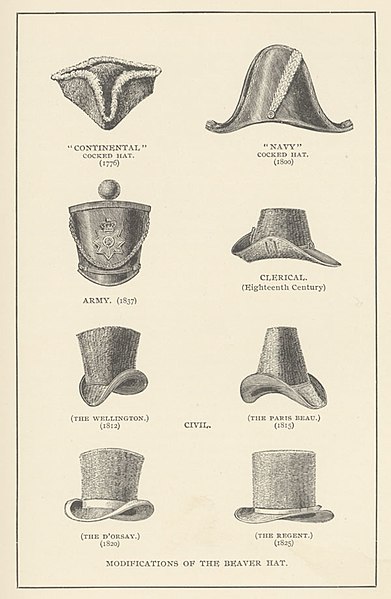
Another grade of beaver fur was called castor sec or parchment beaver. It was beaver that had not been worn but prepared immediately after the animal was killed, dried and readied for sale. Hat makers in Europe used both types of fur when making beaver hats like the ones below:
This photo is in the public domain.
Beaver hats were, for the most part, felted hats. That means that the beaver ‘wool’ was shaved from the beaver skin and then felted by a process of applying heat and moisture which causes the hairs to mat together to create a smooth ‘cloth’. Beaver hats in these styles were popular from 1550 until 1850 or so when Chinese silk became the fabric of choice in the making of hats for the well-to-do.*Incidentally, there is a Eurasian beaver (castor fiber) but it had been virtually wiped out in Europe by the mid-sixteenth century. The Russians were manufacturers of beaver hats too and they turned to new sources when the Eurasian beaver disappeared from their territories due to indiscriminate hunting and trapping. The Russian invasion of Siberia was largely due to the fur trade. My focus here, though, is on North America.
In my next post I trace the growth of the North American Fur trade as it spread across what we now know as Canada and its transformation of Indigenous groups into hunters and trappers or middlemen for the European trade.
____________________________________________________________________ *The story of the European hat making industry and market is intriguing in itself. Many of the hat makers were in Spain and Portugal but the hats in many grades were sold all over Europe although at times they fell out of favour and the North American Fur trade faltered.
I haven’t written much here in the last while because of my other commitments. I chair a Museum board of directors and we’re very busy right now with governance reviews and all kinds of other activities. I’m also involved in an affordable housing nonprofit and other community organizations. It’s funny, but, on the one hand, when I don’t write for a while I feel restless and more anxious than usual. On the other hand, when I do write or draw or paint or sculpt, I often feel guilty for being so self absorbed. It’s not rational to feel this way, but that’s the way it is and I’m not about to get psychiatric help for it. At my age, I’ve learned to accept some of my more irrational feelings knowing that my frontal cortex is not completely in charge of my feelings and behaviour.
Besides, there are great alternatives to psychoanalysis or psychiatry, family time being one of them. I know that family time for many people means tension, pain and sorrow. That’s not true at all for me. My family is the glue that holds me together. We don’t always agree on everything as a family but on the important things we do agree. We absolutely all agree in the healing power of family connection. As a sociologist, especially one influenced by Norbert Elias, Thorstein Veblen, and Emile Durkheim among others, I understand the power of human connections. The absence of closeness, touching (physical and psychical), and interdependency can lead to early death in children and lifelong stress and anxiety in adults. We need other people, it’s as simple as that. Elias goes so far as to say that we as individuals don’t exist. We exist only on the social level. Everything beyond our most basic physical, tropismatic activities like peeing and pooping are social and even those activities are shrouded in social valuation. We don’t exist in society only in the present either. Our social connections go back a long way and often in ways obscure to us in our current mindscapes.
All that said, for two weekends in a row now, I’ve spent time with family. We don’t live close to our daughters and their families so if we want to get together we have to travel or they have to travel. It takes a substantial effort and it costs money. This past weekend my daughters came over from Vancouver with their families to where we live on Vancouver Island. We have three grandchildren under the age of ten and they make great house guests. One of our daughters and her husband also brought along one of his brothers and his wife. They all came to help us old wounded elders get a new porch built on the house and do a lot of gardening and related work. Without them our acre of gardens would soon revert to a natural state and we would be compelled to seriously consider downsizing. I’m just not yet ready for that.
The weekend before, Carolyn and I travelled to Vancouver to stay with one of my daughters and her family so that we might all attend a Mother’s Day Brunch event that one of my older sisters puts on every year for the family and friends. The whole family was not in attendance (I still have thirteen brothers and sisters as well as countless nieces, nephews, cousins and assorted other relatives) but it was well attended. My sister puts on a spread fit for kings and queens. Lots and lots of great food on offer. So much love goes into that event. My grandchildren had never experienced it before so this was a first for them.
I could go into more detail about each event, but the point is that on both weekends the spirit that reigned was one of helpfulness, caring and sharing. I’m not the most effusive guy out there, but I know that even if we’re not always on the same political wavelength, we know the value of family solidarity and togetherness. I’m also not given to maudlin outbursts. This is as close as it comes. However, I need to acknowledge my deep-seated need for human connection and love. That need, my family fulfills to my heart’s brim all the time, every day but especially on weekends when they come to help build a new porch! I pity people without family support no matter how one defines family.
Unfortunately, when our natural families do not or cannot provide us with the love and support we naturally crave as humans, we sometimes turn to other types of family in the form of gangs, politically or religiously extreme groups or we turn on ourselves and die inside like children in orphanages who literally died from emotional deprivation, neglect, or suffered hospitalism (See Rene Spitz’s study of Hospitalism). That’s the downside to our craving for connection.
I haven’t written here in some time because I’m working on another writing project that’s taking up a lot of my time, plus I have a number of other gigs that are taking my attention away from here.
I’m still very much concerned with social justice issues and, for today, the nature and reliability of science. I’m a scientist (retired). I care about the nature of the scientific method and that all of us can trust the findings of science. Science education is woefully inadequate for the task at hand, which is educating the public (all of us) as to the scientific method and how critical thinking is such an essential part of it.
The article I’m sharing with you here by Dorothy Bishop is aimed at educating us to the dangers of shoddy science and the ways that are leading to more reliable and trustworthy scientific findings and publication.
That said, there’s no accounting for the reliability and integrity of journalists and reporters who, without any background in science or any sense of the impact of their reports, publish misleading and often tentative or even false scientific findings. Journalists and reporters have their own deadlines and job requirements, I understand that, but not checking basic facts is unacceptable. The report falsely linking autism with vaccinations is a case in point. The fraudulent report made for what journalists might consider good reporting, but it fed into the general public’s distrust of science and scientists.
Add to that the general ignorance and fear that drives large segments of the population and we end up with a perfect storm of ridiculousness and absurdity.
As Gwynne Dyer notes, most people are fine as individuals but get us together in groups and we can behave very badly. People are strange indeed. I don’t see the future being much different from the past in terms of how humans behave. We haven’t evolved that much in the past thirty thousand years. We’re just as collectively short-sighted and stupid as ever and I don’t see that changing any time soon. We’re still strangled cognitively by our fear of death and our longing for immortality. That pushes us to allow our amygdala to dominate our behaviour rather than our frontal cortex. Good luck, all. We’re going to need it.
The three links below of several hundreds that can be found on the internet news sources these days indicate clearly the rapidly accelerating advance of automated technology moving towards the elimination of jobs.
So far, the action seems to be very widespread but is moving especially rapidly in retail as is clear from the evidence in Australia, Japan and the US. The rationale used to justify automation by Walmart management in the US is creative and ridiculous at the same time. Nobody in management wants to say that their companies are trying to reduce or eliminate their workforces altogether. But that’s exactly what’s happening.
Karl Marx predicted this very outcome in the mid-19th Century arguing that in their efforts to control or reduce their costs of production, businesses, after overproducing in the search for profits, turn to automation to control their labour force and return to profitability. The process has been going on for a long time.
It seems perfectly reasonable for businesses to try to become more ‘efficient’ by automating jobs that are tedious and repetitive, often dangerous. For individual businesses this seems like an effective strategy to control their costs and their processes. The problem is that there is anarchy in the business world, no coordination, and competition prevents cooperation between businesses in the same field of operations. The result is that there is a reduction in the aggregate number of workers in any given area and the reality is that bots don’t buy anything. Workers are also consumers so doing away with workers is doing away with your very own customers. Nobody I know in business is worried about taking customers away from their competitors, but if Walmart eliminates much of its labour force by automation that will inevitably also reduce its customer base.
So, the question is should you mourn or celebrate the loss of your job through automation? The answer is yes and no. The actual issue is not jobs, but income. You should definitely mourn loss of income. The loss of a job not so much. Jobs, i.e, employment, are not really in sync with the human capacity to work. Humans, as Veblen is quick to point out, are programmed to work, but if they are presented with meaningless, repetitive, boring work that is really to make someone else look good or get rich, they balk. So doing away with boring, stupid, meaningless jobs is a good thing in my mind. Several countries are now toying with a guaranteed basic income. It will take some time yet for the importance of this strategy to become more widespread.
We’re at a real crossroads at the moment. With the advent of advanced robotics, automation, and especially artificial intelligence, work will be required of fewer and fewer people for shorter and shorter lengths of time. There will be, in a very short period of time, a huge surplus of people as workers and a shortage of people as consumers. The elimination of tedious labour could result in an explosion of creative energy as people are freed to think for themselves and act according to their talents and abilities. However, they will need income to be able to do that.
One thing for sure, there will have to be a greater distribution of wealth because it does no one any good to hoard cash and take money out of circulation. It sure doesn’t help corporations involved in the sale of consumer goods. From this perspective, banks and financial institutions are at loggerheads with consumer driven businesses. There will have to evolve a very different ethic, one at odds with the current capitalist Neo-liberal one that I wrote about in my last blog post.
I love strange books with compelling titles and The Space Merchants by Frederik Pohl and C.M. Kornbluth fits the bill. This book, first published in 1952 but with the seventh and last printing taking place in 1972, was printed in the U.S.A. It’s based sometime in the future and looking back to it’s publication in 1952 from a 2012 vantage point is a bit strange. Pohl and Kornbluth obviously had to design a future that was credible to a 1952 readership still infused with memories of World War II and trying to deny the existence of the Korean War. In some ways, that’s not too difficult a task, but in other ways the challenge is daunting. For instance, the characters in the book still use phones like in 1952, board planes on the tarmack at airports and smoke incessantly, but space travel is common. The book is about the marketing business and how it has evolved. Lies are common and the bigger the lie the better. Products are not simply advertized anymore. Marketing businesses create products to sell not based on their utility but on their salability. (How far is THIS from our current reality?) They are trying to sell people on Venus colonization. How can they make Venus attractive to potential colonists? It’s virtually uninhabitable. I leave it to you to find a copy of the book to see how the main character in the book, Mitchell Courtenay, gets along. What I want to highlight here is a simple paragraph on page 7 of my edition of the book which reads:
“Fowler Schocken inclined his head. ‘Thank you, Matthew,’ And he meant it. It took him a moment before he could go on. ‘We all know,’ he said, ‘what put us where we are. We remember the Starrzalius Verily account, and how we put Indiastries on the map. The first spherical trust. Merging a whole subcontinent into a single manufacturing complex. Schocken Associates pioneered on both of them. Nobody can say we were floating with the tide. But that’s behind us.”
Indiastries [my emphasis]. ‘Now that’s prescient,’ I thought to myself. Pohl and Kornbluth project into the future a trend that was in its infancy in 1952 with post-war globalization and geopolitics, that is, the corporate drive to find cheaper raw materials and labour wherever they might be. Of course, that’s a movement or trend that started long before epitomized by Christopher Columbus and his P3 venture, but did it ever take off after WW II. Now, global business corporations scour the globe like bottom feeders, looking for the cheapest raw materials and the cheapest labour. In the case of raw materials, its a little more difficult than with labour. Raw materials are found where they lie in the earth. It’s possible for hard rock mining companies, oil producers and other exploiters of the earth’s ‘natural resources’ to more to parts of the earth previously unexplored to uncover precious commodities like gold. Canadian mining corporations are all over Mexico, Central and South America mining and exploring for minerals. That doesn’t mean Canada has no gold left in ‘them thar’ hills, but the ‘business climate’ is much better in Mexico and the near absence of environmental regulation (or their enforcement) is just fine, thank you. And labour is cheap, cheap, cheap. For secondary or value added manufacturers and businesses operating in the service sector, the ‘Third World’ is their oyster. They’ve managed to cut deals with impoverished governments all over the world to set up export processing zones (EPZs) which are sometimes secured compounds, sometimes entire cities or regions, where powerful global corporations can set up shop, exploit cheap labour, pay no duties, no taxes, and face no environmental or health and safety regulations. Corporations have flocked to the EPZs. ‘Our’ corporations are abandoning North American, Japanese, European, Australian and South Korean labour and moving production to EPZs or other facilities in the ‘Third World’ at an exponential rate. There is no turning this around. China and India are big players in providing cheap labour for ‘our’ corporations making it hard to pick up any ‘consumer’ product these days that’s not manufactured there. But make no mistake about it. Those products are not Chinese or Indian products. They are Nike, Apple, Dell, Monsanto, Nestlé, Wal-Mart, etc., etc, products produced by cheap labour in poor countries bypassing ‘expensive’ labour ‘here.’
So, Indiastries. Looks like it’s well on the ways to reality. India harnessed as a whole by a single manufacturing trust. With how rapidly things are changing these days, how far down the road can that be? Pohl and Kornbluth were pretty prescient guys. Only problem I find with their scenario is who’s going to buy all these wonderful products made in India and elsewhere in the ‘Third World?’ Won’t be workers here because they’re putting us out of work as fast as they can. We’ll see how it goes.
This is a re-blog of a post I wrote in 2012. I think it’s quite relevant following my last post.
Suppose you need a trench dug. It needs to be 50 centimetres deep, 120 centimetres wide and 30 metres long. You’ve never had to undertake such a project before. You have a choice of tools: pointed stick, shovel or back hoe. It would take you no time to learn how to use the pointed stick, a small amount of time to learn how to dig with a shovel, but learning how to use the backhoe would take you a substantial amount of time. What would you choose to do?
Now, think about this. You have a choice. You can mobilize 1000 people to dig your trench, 100 people to dig it with a shovel or 1 person to do it with a backhoe. All three of these options would take exactly the same amount of time. What would you choose to do?
I know what I would do in this situation. I’d hire the guy with the backhoe. I wouldn’t for a minute contemplate hiring 1000 people with pointed sticks to dig my trench. That’s because it’s realistic for me to make this decision in the time and place in which I live. Obviously, if I lived 30,000 years ago, I would not have the option of using a backhoe. A pointed stick would be my only option and I would easily be able to mobilize all the help I need among my tribal members.
It seems like a no-brainer to think that history has been a steady progress towards more and more sophisticated technology: pointed sticks to shovels to backhoes. However, not everything is what it seems. Let’s see what this situation looks like for someone starting from scratch. Let’s make the scenario really simple. Let’s have you dig a trench 3 metres long, 30 centimetres deep and 20 centimetres in width.
The pointed stick is indeed a very simple tool and can be gotten with very little effort, sometimes by just picking one up off of the ground under a tree. Simple tools like this allow a person to get right down to work. A little sharpening with a sharp rock might help if an already pointed stick couldn’t just be found, and some hardening over a fire could make the tool more durable.
The shovel is a whole other thing. To make a shovel, even a fairly basic one, requires some wood and shaped metal, preferably a hard metal. So, while the person with the pointed stick is hard at work digging the trench, the person who has chosen to dig the trench with a shovel is looking around for a suitable piece of wood for the handle. That shouldn’t be difficult, although the wood may need some shaping. But then finding a suitable metal by mining will be more challenging. Extracting the metal from the ore by smelting then forging the metal and shaping it before fitting it on the handle will complete the project. Chances are pretty good too that more than one person will be involved in the making of a shove. There may be a specialist wood worker, a miner, a smelter and a blacksmith. By the time the shovel is ready for work, the pointed stick wielding worker may well have finished digging his trench.
The backhoe is hopeless if the challenge is to start from scratch. The guy with the pointed stick would have already cut half a million trenches in the time it would take a person, or even an army of people, to build a backhoe from scratch.
The Social Character of Human Production
What this all means is that human labour must always be assessed in its social context. All of the tools mentioned above have a certain amount of labour in their making. The sum total of the time it takes to dig a trench with a pointed stick, a shovel or a backhoe is only part of the story. The time it takes to fashion said tools must also be taken into account when calculating the time it takes to make something or accomplish a particular task. The labour embedded in the tool prior to when the digging actually starts is called crystallized labour or dead labour because it’s no longer active, having already played its part in creating the necessary tools to do the job. There is very little crystallized labour in a pointed stick, a lot more in a shovel, and a massive amount more in a backhoe. So, which tool is the most efficient? It depends on the social conditions under which the task is undertaken.
The reality is that the more sophisticated the tool, the more crystallized labour contained in it. In the case of the backhoe, there are centuries of accumulated knowledge, techniques of raw material acquisition, processing, shaping and assembly probably including thousands of workers in many parts of the globe over many, many years. It also includes the work performed in the petrochemical industries that bring the machine alive so it can perform its duties. The pointed stick and the shovel have no need for extraneous inputs in their operation. Of course, once a backhoe exists it can, with one operator and enough diesel fuel, cut in a month as many trenches as a person with a pointed could cut in a lifetime.[1]
The crystallized labour included in any tool is part of the necessary capital required to produce anything. The tools themselves are capital. Another thing: the amount of capital necessary to produce the backhoe is social capital. It’s taken masses of people centuries to come up with the backhoe. It’s not the work of any single individual. A major aspect of this process is that pooled capital is subject to appropriation by people who organize the productive process but who don’t actually produce anything themselves as individuals. A backhoe is a product of the accumulation of capital and its control by a small minority of the population. So, historically what has happened is that the productive forces, particularly the tools and knowledge needed to make things happen have been increasingly socialized then privately appropriated. That’s history, folks. But what exactly does appropriation mean?
Capitalist Appropriation
Appropriation means that ownership of the means of production has historically been privatized or concentrated in the hands of a few individuals as soon as there appeared the need for a division of labour or specialization in the productive process. The objective of appropriation early on was to remove control over the process from the people who actually used the tools and did the work. Frederick Winslow Taylor, in the early 20thCentury, created scientific management[2], a process whereby specialized workers, craftsmen, were removed as active agents in the factory to be replaced by managers who broke down the productive process into its constituent parts assigning workers, now disenfranchised, to accomplish just one task along an assembly line. Workers no longer individually created products but contributed only to one task in the process of the creation of a product. The quintessential expression of scientific management early on was implemented by Henry Ford in his assembly-line production of automobiles.
Workers were not too pleased about having their control over the productive process wretched from their large calloused hands so the early 20thCentury featured some of the most active labour protests and strikes in history. Needless to say, the process by which control over production shifted from workers to owners and managers started much earlier than in the 20thCentury as did labour strife. Regardless, the 20thCentury has proven to be THE century of capital’s monopolization of the productive process. In doing so, it has broken down the production of commodities[3]into specialized activities and has globalized the process, a situation made possible by shipping containers, cheap air transport, the internet, just-in-time production tied to supply chains, and the vassalization of countries.[4]It’s clear that the few individuals and the organizations they represent who control global wealth are finding it increasingly difficult to find effective investments. The reasons are simple in conception but complex when aggregate global capitalist activity is considered.
A Shrinking Rate of Profit
As Marx noted, the only way a capitalist can make a profit through surplus value is by not paying his workers full value for their labour. In fact, profit is essentially the appropriation of unpaid wages. Veblen contested this Marxian notion in his The Place of Science in Modern Civilizationbecause, as he argued, who says workers deserve the right to the full value of their labour. Nevertheless, it’s still true that for many millennia human production has predominantly been a social affair so why shouldn’t we all share equally in what we produce? Well, we could and we might still, but we haven’t to date except for the odd ‘primitive’ situation millennia ago or in more and more marginalized indigenous tribal situations today.
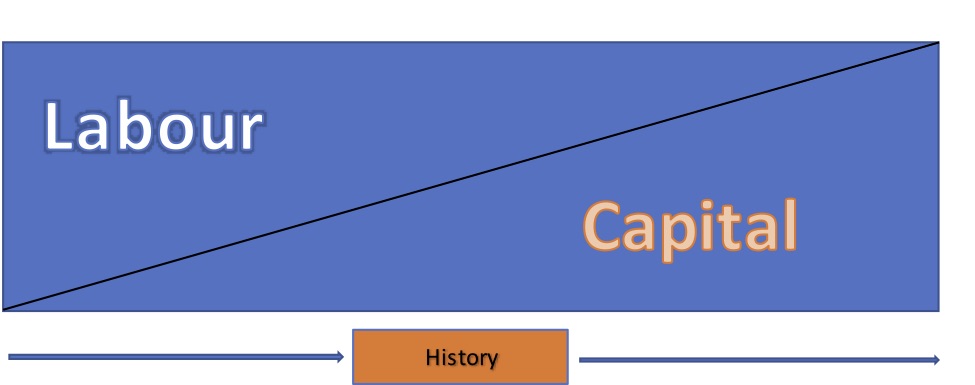
So, as we carry on today with increasing automation, computerization, AI, and technological innovation, the margins of profit continue to shrink because the more capital or dead labour is used in the productive process, the less room there is to extract surplus value from the process and make a profit. If, for example, Macdonald’s were to successfully replace all of its workforce with robots, it would find it more and more difficult to make a profit by paying its workforce less than the value that it produces. And, of course, robots don’t buy hamburgers, don’t pay taxes. The value of labour embodied in them as capital will allow for some profit to be extracted from the business of making hamburgers, but that basis for the creation of profit will quickly dry up. As the graph below shows, the amount of capital expended in the productive process is increasing historically while the share of labour in the process is steadily decreasing and/or devalued. Where we are along this process is anyone’s guess but I’m certain that we’re well past the midpoint and probably closing in on the far right side of the graph.
So, as workers we have been systematically excluded from ownership and control over the productive process. Still, Marx found reason to be optimistic about the future. That’s the subject of my next post.
Figure: Labour and Capital in Human History
[1]These estimates are completely arbitrary of course but are included to approximate the variation in values that are obvious in the scenario introduced.
[4]Vassalization: My word for the process by which the finance capitalist global oligarchy has come to treat countries. Certainly, since the 1970s but as a process going back to at least Bretton Woods, finance capital has turned countries or nation-states into vassals. From this perspective, countries are no longer sovereign or democratic, but instead are subordinate managers of the working class and guarantors of private property and private accumulation of capital.



 Roger Albert - Always a Sociologist: Now Living With Myeloma