I taught university level courses in sociology and criminal justice for over 30 years but now I'm retired and at 72 was diagnosed with multiple myeloma, bone marrow cancer. This site is now a chronicle of my journey with myeloma.
Well, it’s January 1st, 2019. It’s late in the afternoon here. It’s broken cloud overhead and about 4˚C. This morning Carolyn and I went for a longish walk of about 5.3k on a lovely forest trail that used to be a railway bed. It runs between Cumberland and Royston. The trains that ran on the tracks mostly carried coal but there was also a passenger train that used the tracks now and again, even into the 1950s. Now, the trail is wide and flat as you would expect from a decommissioned rail bed. Ideal walking for me. Carolyn, on the other hand, walks as fast as a demon even though she’s 66 years old. I can barely keep up with her, but she indulges me and slows down, which for her is tough, I know. We miss our old walking companion, Wilco, aka Mr. Sniffy the Brittany spaniel. He died in July last year so now we can only walk with his memory. But I digress.
Last week I decided that I would continue blogging on any number of topics including the ones Jack Minard suggested: capitalism, democracy, liberalism, etc. However, I’ve also decided to write a sketch of how my intellectual development unfolded from as far back as I can remember. I spent a lot of time in universities and colleges during my lifetime and my ideas and viewpoints changed significantly and frequently as I read and had to incorporate my readings into what I had already read and studied. Teaching had a huge impact on how I approached subjects of study, what attracted my attention intellectually and practically in terms of pedagogy. One reason is that when I started teaching at SFU and Douglas College in the mid -70s the colleges in BC were quite new and begging for instructors. At SFU I was a teaching assistant and worked for a number of profs. At Douglas I was the instructor for introductory sociology courses but I also got to teach a History of Québec course. I had no experience teaching history, so it was a steep learning curve for me, but well worth it. I learned so much. That drew me into a greater interest in Canadian history and the study of indigenous cultures, although at SFU I worked with Noel Dyck and he was instrumental in getting me interested in colonialism and what he calls coercive tutelage. But enough of that for now. The ‘sketch’ may become a kind of autobiography, but for now, I’m not calling it that.
In terms of the topics Jack suggested I’ve got a 5000 word blog post sitting here in draft form that I need to finish up but I may also break it up into smaller, more accessible chunks. In working on this post I’ve done a lot of reading, pulling books off of my shelves but also from the shelves of the internet archives and the Gutenberg project. I seem to be a little out of control. The post seems to want to grow exponentially. Well, I’ve got a lot to say…ask any of my former students. That means I have a lot to write about too.
Here’s a taste of where I’m going with democracy. It’s a quotation from a nondescript political science monograph that I have called Democracy in the United States, Second Edition, by William H. Riker (1965): …”democracy” is frequently used in the contemporary world without justification either in logic or in observation. It has, that is, become a stock and abused slogan in the vocabulary of propagandists for almost every system of government.’
Yes, indeed. In the next few weeks I’ll try to tease out some of the real from the propaganda, some of the essential from the silly.
So, after I asked in a recent post for ideas of what I should write about, Jack Minard sent me this:
Write about the difference between political or social organization and economic organization. I.e. do democracy and capitalism have any hope of co-existing well? Always seemed like a bad marriage to me! Doesn’t capitalism depend on inequality while democracy would do best with complete equality of opportunity? Of course there are differences in people. Some “cream” will always rise to the top… your thoughts?
Well, I started writing a post in respond to Jack’s comment a few days ago and before long I was up to 5000 words and I felt that I had barely touched the subject. A friend suggested a series of blog posts and I’m leaning in that direction although others have suggested that I should write a book. At 72, a book seems a little daunting although I surely have enough material to write one. Blog posts seem more manageable. I don’t know. I’m still making up my mind. However, Jack opened up a porthole to my memory of the countless books and articles I’ve read over the decades as well as the uncountable number of hours I’ve spent in thinking about these things and in teaching about them. Ask Carolyn how often she’s caught me in a virtual altered state as I explored in my mind all the threads of evidence and connection I’ve collected over the decades of thought and contemplation. She’d be talking to me and I’d be off somewhere in my mind wondering about a sentence in Marx or Veblen, Innis, Nietzsche, Elias, or Becker. I have been known to be ‘into myself’ for hours if not days and weeks on end, lost in thought. It’s been my adult life, but I can recall that even in my early teens I had an insatiable curiosity about things as my father discovered over and over again as I would dissect clocks, motors, engines and whatever else was at hand in an effort to learn about their workings and their essences. I still do that with words.
So, what about democracy and capitalism? To be sure, there’s a lot to be said and a lot has already been said about ‘them’. Of course, the word is not the thing as Plato and others have remarked nor is the map the territory (Korzybski), and both democracy and capitalism have to be explored as concepts as well as more or less real worldly phenomena. When I was still teaching, I pointed out to my students that dictionaries are closed systems. Try this: take a word like map. Go to its dictionary definition and then go to the definitions of each word that’s used to define it. You’ll soon discover that you end up in a rabbit hole with no exit: The map is a representation, the representation is a map, and so on. Democracy is a fine concept, then, but what is its reality? Rule by the people? What does rule mean? And who are The People? Does democracy imply that each individual participates in the exercise of power? If the leaders of a country tout it as the greatest democracy ever on the planet are we to just take their word for it? How do we decide if a country is REALLY a democracy? These are all questions I will attempt to answer in subsequent blog posts.
Capitalism is easier to define in some ways than democracy although there is some disagreement as to the effective use of the concept. I personally don’t use it, but because jack brought it up, I’ll explain. Fernand Braudel, one of my favourite social historians, wrote that Marx never used the term. Re-reading Marx’s work with the specific intention of proving Braudel wrong, I had to conclude that, no, he was correct. I haven’t found the term anywhere in Marx and if there’s anyone who would have used it, it would be Marx. But he didn’t. The reason is fairly simple. Whenever an ism is added to a word, it refers to a system, a movement, something like that. Wikipedia notes: Capitalism is an economic system based on the private ownership of the means of production and their operation for profit. Marx defined his work as the materialist conception of history and he was not impressed with other theorists who tended to see structures and systems independently of them as a process. Marx uses the notion of the capitalist historical mode of production to describe the focus of his analysis. This may seem like just semantics, but it’s not. Capitalism as a word describes a set of relationships frozen in time and place. Marx was more interested in the historical development of capitalist relations of production born in feudal relations and still with us. Marx wrote in the Introduction to Capital, Volume 1 (I paraphrase): “All I have wanted to do is the same for political economy that Darwin did for biology.” Engels repeated this same sentiment in his eulogy to Marx in 1883. That doesn’t mean that Marx was looking for a mechanism like natural selection in political economy. I’ll explore this further in another blog post. Why do I spend so much time here on what Marx had to say? Because his work, not entirely original but still seminal, is not to be denied in any discussion of the capitalist mode of production and its special place in history. Marx understood that the capitalist mode of production would inevitably go global and he was correct. Needless to say, capital is high on my list of fun things to think about along with labour.
What is the relationship historically between the capitalist mode of production and political systems like democracy? Neither depend on each other, that’s certain, not theoretically, nor in practice. This is one very important theme I will explore in the coming weeks.
So, I guess I’ve decided to go with blog posts rather than a book. I suppose blog posts can be pasted together to make a book in any case. So it probably doesn’t matter. That said, I have lots to say about capitalism and democracy and their surrogates, business and representative government. I’ll do that in the next many posts I write. I’ll use Canada as a subject in most cases but the United States is also in my crosshairs. I’ll roam around European history and literature. I’ll return to my dissertation and comment on Harold Innis’ notions on nationalism. I’ll throw in some Veblen. Marx will appear here and there as will a slew of other writers. I don’t want to get bogged down in semantics, but clarification of terms is essential. The first chapter in Bertell Ollman’s book Alienation: Marx’s Conception of Man in Capitalist Society is called: With words that appear like bats. It’s worth it, I think, to take a bit of a stroll through Ollman’s book, something you can do for free by clicking on the title of his book above. I say this not only as a reference to Marx and his critics, but to the use of words in general. So many words appear like bats, flitting in and out of the dusk so fast it’s hard to get a good look at them. Democracy and capitalism are those kinds of words. Batty they are, but maybe with the right camera we can at least get a good approximation of what they represent and how they relate to one another. Stay tuned.
I won’t comment on this quote here. It speaks for itself and is cannily prescient. Read on.
Tyranny springs from democracy much as democracy springs from oligarchy. Both arise from excess; the one from excess of wealth, the other from excess of freedom. ‘The great natural good of life,’ says the democrat, ‘is freedom.’ And this exclusive love of freedom and regardlessness of everything else, is the cause of the change from democracy to tyranny. The State demands the strong wine of freedom, and unless her rulers give her a plentiful draught, punishes and insults them; equality and fraternity of governors and governed is the approved principle. Anarchy is the law, not of the State only, but of private houses, and extends even to the animals. Father and son, citizen and foreigner, teacher and pupil, old and young, are all on a level; fathers and teachers fear their sons and pupils, and the wisdom of the young man is a match for the elder, and the old imitate the jaunty manners of the young because they are afraid of being thought morose. Slaves are on a level with their masters and mistresses, and there is no difference between men and women. Nay, the very animals in a democratic State have a freedom which is unknown in other places. The she-dogs are as good as their she-mistresses, and horses and asses march along with dignity and run their noses against anybody who comes in their way. ‘That has often been my experience.’ At last the citizens become so sensitive that they cannot endure the yoke of laws, written or unwritten; they would have no man call himself their master. Such is the glorious beginning of things out of which tyranny springs. ‘Glorious, indeed; but what is to follow?’ The ruin of oligarchy is the ruin of democracy; for there is a law of contraries; the excess of freedom passes into the excess of slavery, and the greater the freedom the greater the slavery. You will remember that in the oligarchy were found two classes—rogues and paupers, whom we compared to drones with and without stings. These two classes are to the State what phlegm and bile are to the human body; and the State-physician, or legislator, must get rid of them, just as the bee-master keeps the drones out of the hive. Now in a democracy, too, there are drones, but they are more numerous and more dangerous than in the oligarchy; there they are inert and unpractised, here they are full of life and animation; and the keener sort speak and act, while the others buzz about the bema and prevent their opponents from being heard. And there is another class in democratic States, of respectable, thriving individuals, who can be squeezed when the drones have need of their possessions; there is moreover a third class, who are the labourers and the artisans, and they make up the mass of the people. When the people meet, they are omnipotent, but they cannot be brought together unless they are attracted by a little honey; and the rich are made to supply the honey, of which the demagogues keep the greater part themselves, giving a taste only to the mob. Their victims attempt to resist; they are driven mad by the stings of the drones, and so become downright oligarchs in self-defence. Then follow informations and convictions for treason. The people have some protector whom they nurse into greatness, and from this root the tree of tyranny springs. The nature of the change is indicated in the old fable of the temple of Zeus Lycaeus, which tells how he who tastes human flesh mixed up with the flesh of other victims will turn into a wolf. Even so the protector, who tastes human blood, and slays some and exiles others with or without law, who hints at abolition of debts and division of lands, must either perish or become a wolf—that is, a tyrant. Perhaps he is driven out, but he soon comes back from exile; and then if his enemies cannot get rid of him by lawful means, they plot his assassination. Thereupon the friend of the people makes his well-known request to them for a body-guard, which they readily grant, thinking only of his danger and not of their own. Now let the rich man make to himself wings, for he will never run away again if he does not do so then. And the Great Protector, having crushed all his rivals, stands proudly erect in the chariot of State, a full-blown tyrant: Let us enquire into the nature of his happiness.
In the early days of his tyranny he smiles and beams upon everybody; he is not a ‘dominus,’ no, not he: he has only come to put an end to debt and the monopoly of land. Having got rid of foreign enemies, he makes himself necessary to the State by always going to war. He is thus enabled to depress the poor by heavy taxes, and so keep them at work; and he can get rid of bolder spirits by handing them over to the enemy. Then comes unpopularity; some of his old associates have the courage to oppose him. The consequence is, that he has to make a purgation of the State; but, unlike the physician who purges away the bad, he must get rid of the high-spirited, the wise and the wealthy; for he has no choice between death and a life of shame and dishonour. And the more hated he is, the more he will require trusty guards; but how will he obtain them? ‘They will come flocking like birds—for pay.’ Will he not rather obtain them on the spot? He will take the slaves from their owners and make them his body-guard; these are his trusted friends, who admire and look up to him. Are not the tragic poets wise who magnify and exalt the tyrant, and say that he is wise by association with the wise? And are not their praises of tyranny alone a sufficient reason why we should exclude them from our State? They may go to other cities, and gather the mob about them with fine words, and change commonwealths into tyrannies and democracies, receiving honours and rewards for their services; but the higher they and their friends ascend constitution hill, the more their honour will fail and become ‘too asthmatic to mount.’ To return to the tyrant—How will he support that rare army of his? First, by robbing the temples of their treasures, which will enable him to lighten the taxes; then he will take all his father’s property, and spend it on his companions, male or female. Now his father is the demus, and if the demus gets angry, and says that a great hulking son ought not to be a burden on his parents, and bids him and his riotous crew begone, then will the parent know what a monster he has been nurturing, and that the son whom he would fain expel is too strong for him. ‘You do not mean to say that he will beat his father?’ Yes, he will, after having taken away his arms. ‘Then he is a parricide and a cruel, unnatural son.’ And the people have jumped from the fear of slavery into slavery, out of the smoke into the fire. Thus liberty, when out of all order and reason, passes into the worst form of servitude…
Robert Sapolsky is a Stanford University neuroscientist. In this video he introduces a course he taught (7 years ago at least) on human behavioural biology to a freshman class. As he explains in this video, students don’t need any prerequisites for this course. They don’t need a science background.
Although the course is called Introduction to Human Behavioural Biology, it’s about avoiding categorical thinking in science but also generally in life.
Sapolsky is one of the most talented and entertaining lecturers I’ve had the pleasure of listening to and watching. I would have loved to have taken his course. It’s well worth watching this video in its entirety (57 minutes). The second video in the series is 1 hour and 37 minutes long, but again well worth the time to watch and re-watch. Aside from these YouTube videos Sapolsky was featured in a 2008 National Geographic video called Stress (available on YouTube) which I used in my classes. It compares olive baboons in Africa with stressed out British bureaucrats in Whitehall, London, the seat of the British civil service.
If you want, you could watch the YouTube video now and after watching it continue reading below to see why I suggest you watch it.
I’ve recently had to think about categorical thinking because of a comment made by a commentator to my blog who suggested, very innocently I’m sure, that it’s probable that older people get set in their ways. She wasn’t denigrating that outcome as she saw it suggesting that it’s likely natural (as I interpret her meaning). I had to think: is categorical thinking inevitable as we age and am I a ‘victim’ of categorical thinking? My answer to both questions is a categorical no! Categorical thinking is not inevitable and if there’s anything I have spent my whole career trying to avoid, it’s categorical thinking.
At the moment I’m reading a (1999) book by Ellen Meiksins Wood called The Origin of Capitalism. Well, over the years I’ve read dozens of books on this topic from various perspectives within various disciplines. Every time I pick up a book, any book, I’m open to having my mind changed and my ideas modified. Otherwise, why read anything? In this case, Wood is presenting me with a viewpoint on the subject I haven’t seen before and I’m still wondering what to make of it. I keep shaking my head because her perspective is quite foreign to me. For one thing, she is focussed on the origins of capitalism. Capitalism is a word Marx never used. At best it refers to a political-economic system. When Marx discusses capital or the capitalist mode of production, he’s not referring to a system, but to a period in history. I have to re-read Wood to ensure that I understand her notions of capitalism and especially her contention that capitalism originated in English agrarian life. Equally strange is her use of the terms revolution and class.
Reading Meiksins forces me to rethink categories. I will assess her perspective and incorporate it wholly or in part into my worldview or reject it based on the evidence.
I just received another book in the mail today. It’s by R.D. Laing, one of favourite rogue psychiatrists. It was written in 1976, the year I entered grad school, and is entitled The Facts of Life. After I’m done reading these books and watching more Robert Sapolsky on YouTube, something which always helps buoy my spirits, I’ll re-read Chaos: Making a New Science by James Gleick. Sapolsky is really high on this guy so I have to read it again in light of the video posted above.
Please, enjoy Sapolsky. Find his other videos on YouTube. He’s a delight!
For some time now I’ve subscribed to Maria Popova’s website called Brain Pickings. I get her weekly email newsletter. Her website provides a fresh view on many things including emotions. In this episode of her newsletter Popova focusses on the philosopher and poet David Whyte.
It’s worth subscribing to her newsletter.You won’t be disappointed.
Click on her name above for her take on David Whyte and his refreshing view on anger, forgiveness and maturity.
Actually I’ve watched all of our dogs die except two. The only two we didn’t watch die were Little One and Chitka. Little One because she was no longer in our care. It was a long time ago and we had to give her up because where we were moving to wouldn’t have her. With Chitka, neither Carolyn nor I had could go in when he was euthanized. Too painful. All the others, Cedric, Oren, Max and recently, Wilco, all died at the hands of a vet with us present. They were all old and ready to go but that never makes it any easier. None of them did us the favour or dying in their sleep at home.
On August 3rd of this year, we took Wilco to the vet for one last time but not before we took him down to the beach in Royston and for a little drive around town. I still think about him every day, remembering his goofiness. He loved the Royston beach and used to chase his ball there for as long as we’d throw it for him. He and his ball were inseparable for the first seven years we had him.
After that, he lost interest, we suspect because he was in a lot of pain and it just wasn’t fun anymore. He even stopped chasing cats and rabbits about 18 months ago.
He was probably sixteen years old and couldn’t walk anymore. I had to carry him into the car and lift him out. The vet staff took him into the clinic. Our vet, Carol Champion checked him out and agreed with our decision to have him put down. A few minutes later, as he lay in his usual position on the floor she gave him a sedative. When she was certain he was sedated she injected him with what I think was pentobarbital. It took less than a minute and I noticed he wasn’t breathing anymore. I stroked his back a few times and gave him a pat on the head but he was gone. Carolyn and I were very upset but the staff at the clinic was super and so supportive. I find it very hard not to cry on these occasions so I just let it happen. I miss him a lot.
Having Wilco with us for 10 years or so, watching him with his ball, stalking the fish in the aquarium and chasing bears on the logging roads and on camping trips makes it hard to let him go. He was family.
I’ve said this before but I’ll say it again. If I’m in a lot of pain and immobile and as old as Wilco (relatively speaking) I’d be quite happy to die like he did, surrounded by caring people not willing to watch him suffer anymore.
After he was euthanized, he was taken to a pet crematorium somewhere north of Courtenay located on a working farm where he joined a number of other pets to be cremated together and have their ashes spread out on the fields.
Not all animals have the idyllic life Wilco lived, nor the peaceful, loving death. Of course every living thing is on a death trajectory. That’s no surprise. Essentially, living and dying are the same process. That’s one of the main reason we are so conflicted as a species around life and death. We fear life because we know it will bring us death. Our culture, our politics, our everything are aimed at eliminating threats, imagined or real, to our ‘lives’. We insist that our deaths must be meaningful or we deny death altogether.
I’ll get into a long diatribe into the essence of life and death later, in another series of blog posts although you’ll find the archives in this blog full of references to death denial. Suffice it to say for now that life must consume life. Up to this time, life on this planet has been the mutual devouring of species. Can that change? Should we be more ‘humane’ in how we raise and kill other species for our own consumption? Does it matter how long a calf lives before it’s slaughtered for us? Does it matter how much pain and suffering we inflict on other species in the name of scientific research or simply to grace our dinner plates? Is life really just suffering? For now, I’ll just leave you with these questions. I may offer up answers, at least tentative ones, to these questions in future posts. Stay tuned.
I owe a great deal to North Island College. I worked there from 1983 until 2012. That’s quite a stretch. My time there was mostly fruitful (I got paid decently), challenging but exhausting too. It probably didn’t have to be that way, but it’s my nature I guess to never allow a vacuum on time in my life. Whatever time I have seems to be filled and if it isn’t I get to filling it as soon as possible.
I got the job at the college because I was an experienced sociology instructor who had taught a number of sociology courses, but who also taught the history of Québec at Douglas College, I was (am) bilingual, and I had experience with teaching studying techniques. In the context of a unique distance education organization that hired tutors rather than instructors, the president of the college soon realized that I could tutor a large number of course. And I did. Like I wrote in my last post, I tutored students from all over the north island in courses on sociology, anthropology, Canadian history, geography, French, and studying techniques. Eighteen courses in all.
At the time (1983) the college had a lot of what it called learning centres all over the place. Twenty-one in all if I recall. The main ones were in the Comox Valley, Campbell River and Port Alberni, but there were learning centres in Port Hardy, Port Alice, Port McNeill, Sointula, Alert Bay (ironically in the abandoned residential school), Cortes Island, Ucluelet, etc.. Just before my time the college also had mobile units that travelled to Denman and Hornby Islands, and a ship, a converted ocean-going tugboat called the Samarinda, that was supposed to bring education to the remotest places on a wild and wooly coast. That didn’t last long. The Samarinda’s propeller graces the foreshore park in Horseshoe Bay. The rest of the vessel is long gone. Meanwhile, the distance ed. thing rolled right along.
The college expanded into doing telecourses on the Knowledge Network. The first ‘tutor’ to take on the job was Michael Catchpole, a Port Alberni psychologist who did as I did and travelled to Vancouver to the Knowledge Network studios to do his thing at least once a week between September and May. We were followed by a couple of English instructors. We did that until 1992. The college also developed its own internal kind of television network after the Knowledge Network gig went bust. For example, I might be teaching a course in Courtenay which was being broadcast live to Port Alberni. That was a riot…literally. Controlling the remote site was a special challenge but the local students weren’t always thrilled with the arrangement either because they weren’t getting my full attention. I constantly had to remind myself that there were students out there that I couldn’t see in at least one other site, sometimes two other sites. Technically it was a constant challenge because we had no techs that were always available because they had more than one course to deal with themselves and they often worked with marginal equipment off the sides of their desks. Fun and games. But we carried on.
Getting back for a minute to the older days, the end of learning centres was entirely predictable. Small villages like Sointula couldn’t sustain a learning centre for long because once a group of students took a course, that was it. There was no second group ready to go in the next term. When the college finally closed the centre in Sointula I think the hue and cry could be heard from as far away as Port Alberni. In the early 90s, there was a coup at the college. Dennis Wing, the first president and the strongest advocate for distance education anywhere was turfed and Neil Murphy took over with the mandate of transforming the college into a conventional community college. In 1992 the college moved from a number of sites in Courtenay to its current campus on Ryan Road, a new facility was built on Roger Street in Port Alberni and Campbell River got a new campus in the same buildings as Timberline High School. I had to commute there every week to teach on that campus as well as in Courtenay. I even travelled to Port Alberni on occasion to be with my ‘remote’ students. Finally, I was the first instructor at the college to teach an entirely online course for students in the north island. I think I had eight students.
The college’s official history is pretty sparse and doesn’t tell anywhere near the whole story. For instance, it says nothing of our union organizing and the establishment of CUPE Local 3479 and The Federation of Post Secondary Educators Local 16 as the North Island College Faculty Association. I was its first president but only lasted a short time in that role because I was burnt out and headed for a health crash for which I had to take months off. That was not my most enjoyable time at the college. As far as I can see there’s one line in the official timeline about NIC and the Knowledge Network. Frankly that is a bit disappointing but the college doesn’t owe me anything. I got well paid and generally very well treated by the administration during the times I had to take time outs for health reasons. Of course, I’ve left out a lot of the juicy bits. Can’t tell all, of course. Lawsuits could ensue. But, mygawd, there’s a lot more to tell.
I should say in conclusion that I was awarded emeritus status at the college as I retired and I received two teaching awards in my time there, one for innovation in teaching and the other for teaching excellence from a group at the University of Texas at Austin dedicated to celebrating such things.
Jeez. As I posted my last few blog entries I kept remembering more and more incidents, situations and conditions about my life teaching. The whole thing was entirely unconventional. I’d need to write a book to include even a fraction of the goofy and bizarre things that happened along with the mundane.
When I taught sociology and studying skills on the Knowledge Network from 1897 to 1992, the conditions in the studio were as far removed from what went on in a classroom as can be in terms of physical environment. The studio was always super hot with huge lights needed to ensure good colour on the set. There were many people directly involved in the on-air production: 3 camera operators in the studio with me as well as the floor director, the overall director in the control room as well as a number of technicians overseeing the quality of the picture and other aspects of the production. Timing was extremely important. The floor director would count me down at the beginning of the hour but every segment of the program was timed to the second. At the end of the program the floor director would count me out.
Dan Moscrip was most often the director but others were also involved. My buddy Roger Loubert volunteered regularly to man the phones for the call-in section of the program. That was especially important because NIC was responsible for the production of the telecourses and no one came forward to pay for anyone to man the phones. Roger did a great job. Much appreciated. This was really live television on a shoestring.
After I did my thing in the studio, I would hop into my rental car and head into town with Roger sometimes. But I also did other things. I have lots of family in the Vancouver area but I had very little time to visit anyone. I did spend some time with my father-in-law who was in a long term care hospital conveniently located just steps away from the studios in Burnaby. Then I’d get back to the airport for my flight home and back to my ‘normal’ life.
NIC, at that time, was a distance education operation. I was considered a tutor and not an instructor. It was verboten to refer to ourselves as instructors and we didn’t have classes, we had study groups. Most of our students were spread all over the north island and we were in contact with them mostly by phone and by mail. When I started at NIC in 1983 I was put in charge of 18 courses as tutor in subjects ranging from Canadian History to French to studying skills, anthropology, geography and sociology. These were strangely fun times. It was really a lot of work keeping up with the content of so many courses so I could be in a position to answer student questions. A lot of the grading was handled by tutors at Athabasca University in Alberta, where most of our packaged courses originated. I developed the studying skills courses myself on the basis of Tony Buzan’s program laid out in his book, Use Your Head. Tony later went on to head an international self improvement organization but his mother lived in White Rock and I had him on my program once. I’ll see if I can dig that up.
I think I’ll write at least one more post on my teaching experiences. There’s so much to tell. Stay tuned.
So, in my blog post on teaching I left out a major part of my teaching experience. That was writing and presenting 254 live-interactive telecourses on the Knowledge Network. These telecourses were North Island College courses, but used the Knowledge Network as the transmission medium. I started with a studying skills course then added another one to be followed by an introductory sociology course and then a second sociology course.
When I say that my courses were live-interactive, I mean that I went on live with only an 8 second delay. No rehearsals, no retakes. It also means that we opened the phone lines during most of broadcasts to entertain questions or comments from the audience, sometimes they were even my students. One of my favourite comments came from a guy living in Masset in Haida Gwai. He was obviously drunk, slurring his words, but he was able to get out a comment: “I think your program is a crock of shit!” I did the only thing I could do and entertained the next caller. Never a dull moment. Mostly I got kudos, even from people in prison. I had a number of students in prisons in Saskatchewan. My courses ran all over Western Canada and I had students from many small and large communities, close to a thousand one year. I think it was 1987 or 1988, I accounted for 10% of the college’s course enrolments.
I did my courses live from the Knowledge Network studios first at UBC then in Burnaby on Mathissi Place. I travelled to Vancouver mostly be plane, often a twin or single Otter, stayed in Vancouver overnight at a hotel close to the airport, did my shows then flew home. I did this every week during the Fall and Winter terms from 1987 until 1992. During the summers I worked on scripts and new material. I also was in charge of courses on campus too so I was a very busy guy.
I learned much later that some of my colleagues thought that I was getting extra money for doing the Knowledge Network work. Absolutely not. It was just part of my job. It was exciting to do television teaching, but it was also exhausting and I paid for it health wise.
If you want, you can now transport yourself back to 1990, pretend you’re sitting in your living room with the TV on and my program comes on. This is what it was like:
Yes, you can have a laugh at my expense. I can take it.
Alright, so I’ve written a little bit about teaching and writing in my last two blog posts. If I decided to, I could write a book about teaching and writing. In my last two posts I didn’t touch on my philosophy of teaching nor it’s sociological and economic dimensions. I just introduced you to my practice. In a later blog, I want to address my intellectual development in all of its many manifestations, permutations and stages. Now, in this fourth post in this series I come to art.
The act of creating or making art, in my humble opinion, should be called arting. If I can teach and write, I should be able to art. I know, as a verb it doesn’t work in the English language. It should. I’ve been arting for a long time. It’s never been a way for me to make a living nor do I have much formal training in art, like I had in teaching and writing. Still, it’s been an important part of my life.
When I was a kid I’m sure I played with crayons. I may even have drawn stick people on the wall of the bedroom, but I can’t recall. What I vividly remember maybe at the ages of five or six is watching my older sisters, Thérèse in particular, drawing what I can only describe as fashion figures, always young women with elaborate hairdos, flowing gowns and elegant arms. Thérèse would not consider herself an artist now, but I thought she was amazing. Some of my other sisters probably did it too, but I don’t recall. If they read this, they could maybe jog my memory. A little later in my life I clearly remember my uncle Denis paint a kind of small cartoon character on the side of my brother-in-law’s car. It blew me away. How could anybody do such a wonderful thing? I’m sure these events had something to do with my compulsion to paint and draw later in my life, but I don’t recall actually making the connection at the time. I don’t think I ever said to myself: “Boy, I want to do that too!” It wasn’t like that. Then I went off to boarding school and art was not on the curriculum. Music and theatre were taught to some extent, but sports dominated extra-curricular activities.
When I left boarding school before completing grade twelve, it took me some time to adjust to life on the outside. After some time I took an informal painting course with a nun I had not previously known. (I was taught in elementary school by nuns but she wasn’t one of them.) My sister Lucy and my uncle Denis were also involved. Lucy painted like a dream as did my uncle. I had already tried to paint. I bought some cheap oil paints, a rickety easel (which I still have), a couple of brushes, canvas boards and eventually some canvas and stretchers. I put together a few paintings, some quite large but none very good. Well, I was just starting out, but I was impatient. I wanted to paint a masterpiece. I bought some how-to-paint books (I still have those too). One by Robert Wood, a California landscape painter caught my fancy as well as a book of photographs he took that could be used to inspire paintings. I used that to paint a sunset and it turned out pretty well. (I’m not sure where that painting is now. Maybe long gone after a short stint in a dumpster) I was encouraged. I didn’t draw well at the time so I stayed away from painting figures. That came much later. This painting is based on a Ringo Starr album cover. I don’t know why I wanted to paint it but I did and I realized that I could have some control over my paints and brushes.
The kids were scared of this painting for a long time. They still may be for all I know. The grandkids probably are too. Who knows why.
I also painted this little boat. I still have this painting. It’s 16 X 20 and hangs in my studio in the corner. It’s a reminder of what I did in the far distant past. Yes, far distant past.
I think it’s okay for what it is and when I did it.
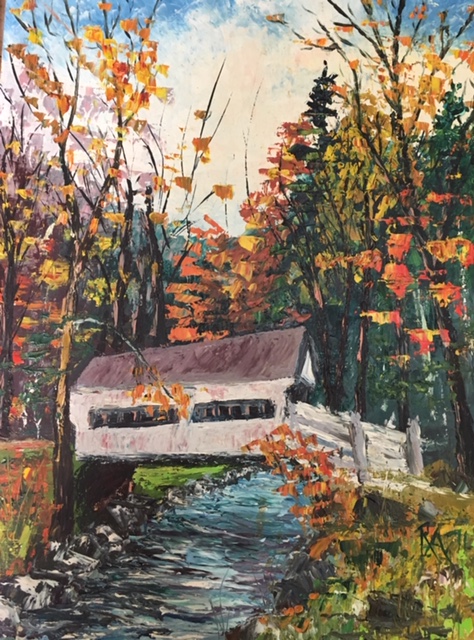
This covered bridge painting I did in 1971 while I studied with the nun I mentioned before (Damn, I wish I could remember her name!)
Covered Bridge 1971. 18X24 Oil painting
So, anyway, this is some of my earlier work. By 1974 I was doing more drawing but I was in university and that put a cramp in the time I could dedicate to my art. And besides, we got married in 1973 and that also took up some of my time…in an entirely good way, I might add.
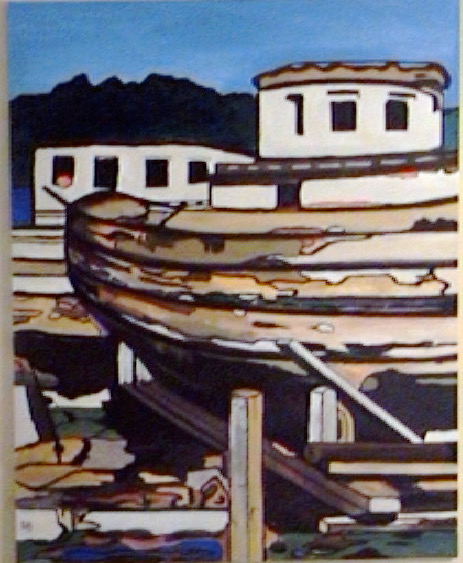
It took me ten years to get back into arting after we had moved to the Comox Valley the year before. That’s when I read Betty Edwards’ book Drawing on the Right Side of the Brain. It inspired me to draw again, but this time in a more realistic style. I wanted to be able to draw what I saw when I wanted to. So, I started doing this kind of thing:
Then this:
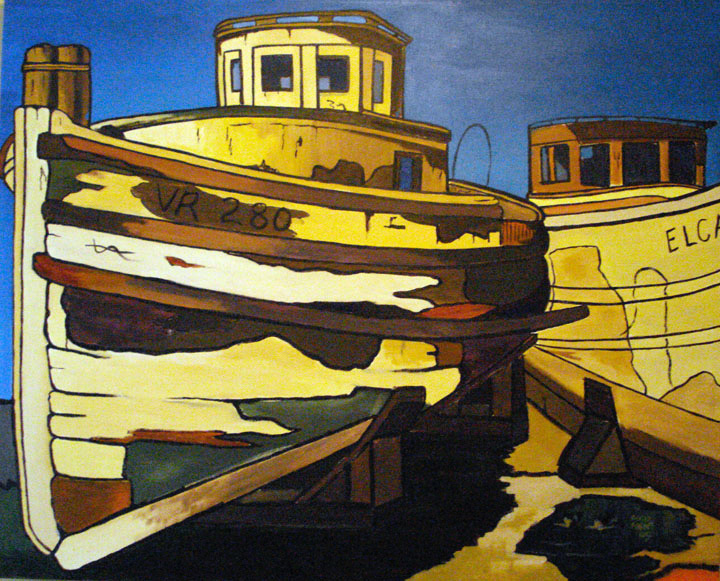
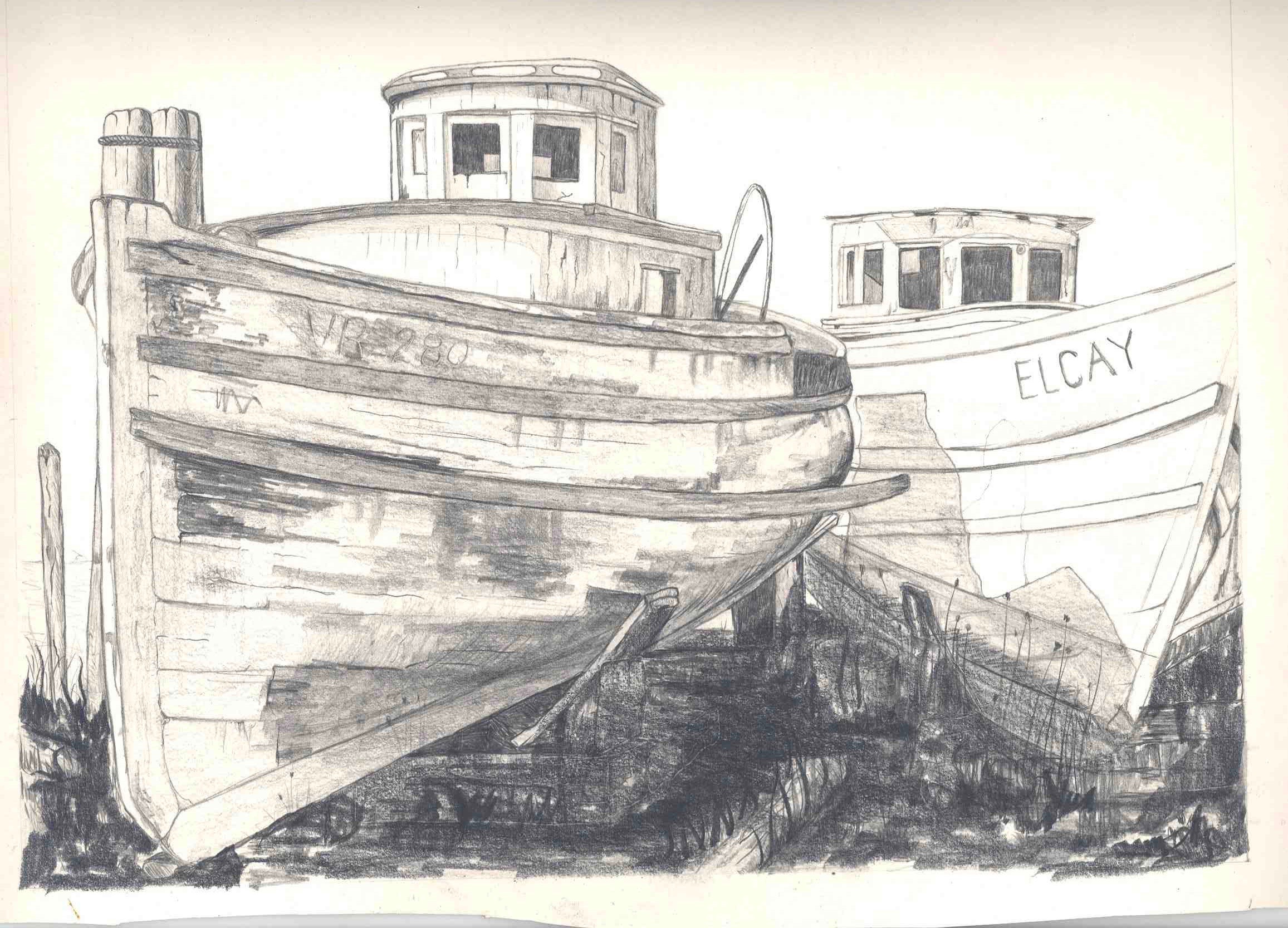
These two last images of derelict boats (the pencil drawing and the acrylic painting) came from some photographs I took on River Road in Delta, BC, I can’t remember exactly when, but it would have been in the 1970s sometime. Over the years I did three more acrylic paintings incorporating two boats from the photographs I took in the 70s, the Elcay and the VR 280:
River Road Derelicts 36 X 40 inches. Acrylic.
I also did a pencil drawing of the same two boats in the mid 90:
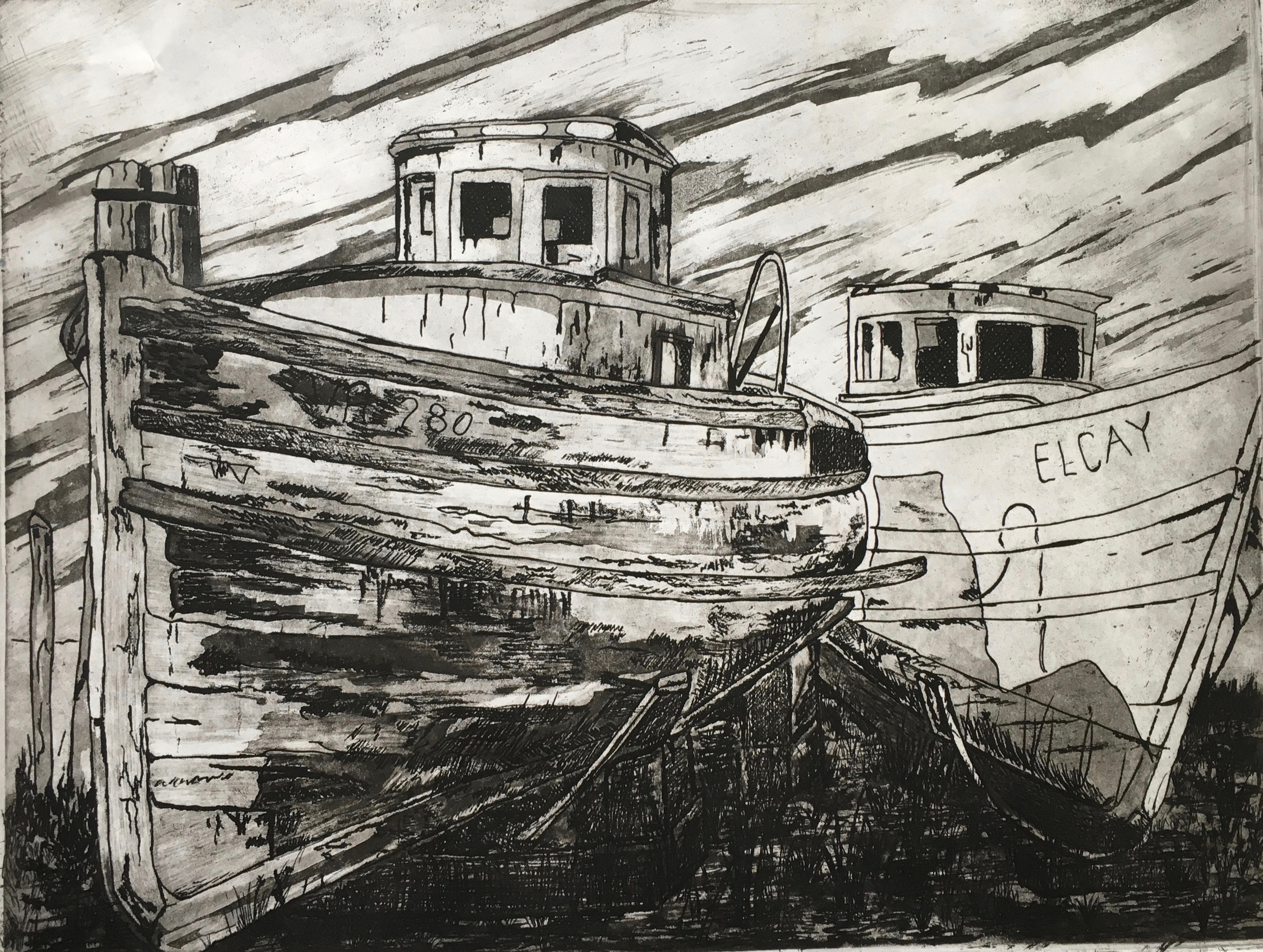
That drawing and a course I took in printmaking at North Island College with John Hooley changed my direction to some extent. I was still interested in painting and drawing, but now I would add printmaking to my repertoire, a medium I very much enjoy. This drawing became the first intaglio print I did. I used a zinc plate that was etched in nitric acid to get the effect I wanted, which was this:
I really need to take a better photograph of this piece. I have an edition of 30 of these prints (I do believe) that are now for sale. I’ve already sold a couple.
During my course with John Hooley I also learned how to do relief printing and silkscreening. I need to take a silkscreening course again because the techniques and materials have changes so much in the last 25 years.
After moving to Cumberland in 2002 I had a large studio available to me:
That allowed me to set up a painting and leave it on the easel as long as I needed to instead of having to take everything down every time I finished a session because we needed the space for something else. I’m now working on some prints and have a printing set-up in my studio for relief printing. I also have a large acrylic painting on the go…which I WILL finish soon because I want to finish up an oil painting I started 10 or 15 years ago at least. Me in my studio ten years ago:
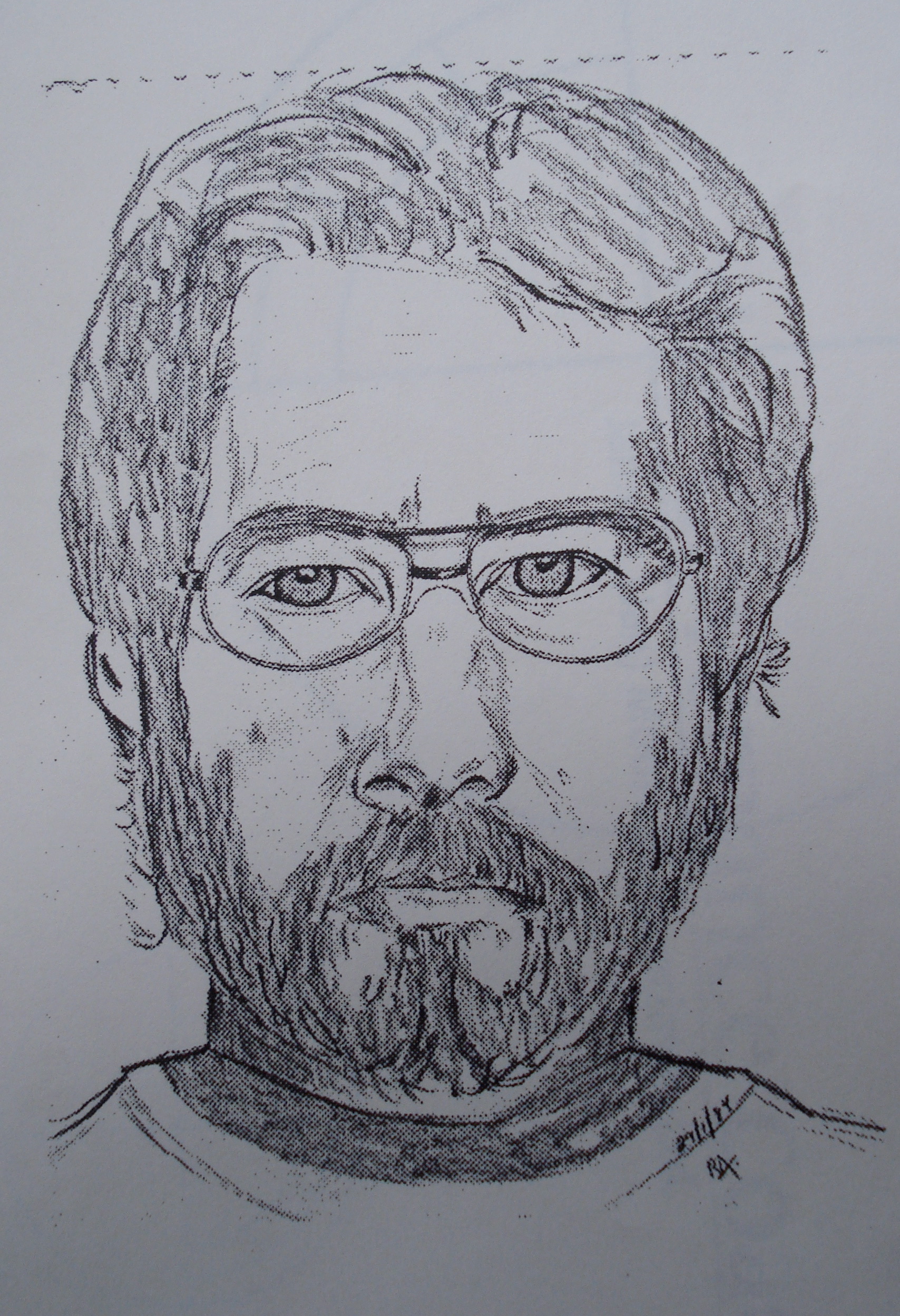
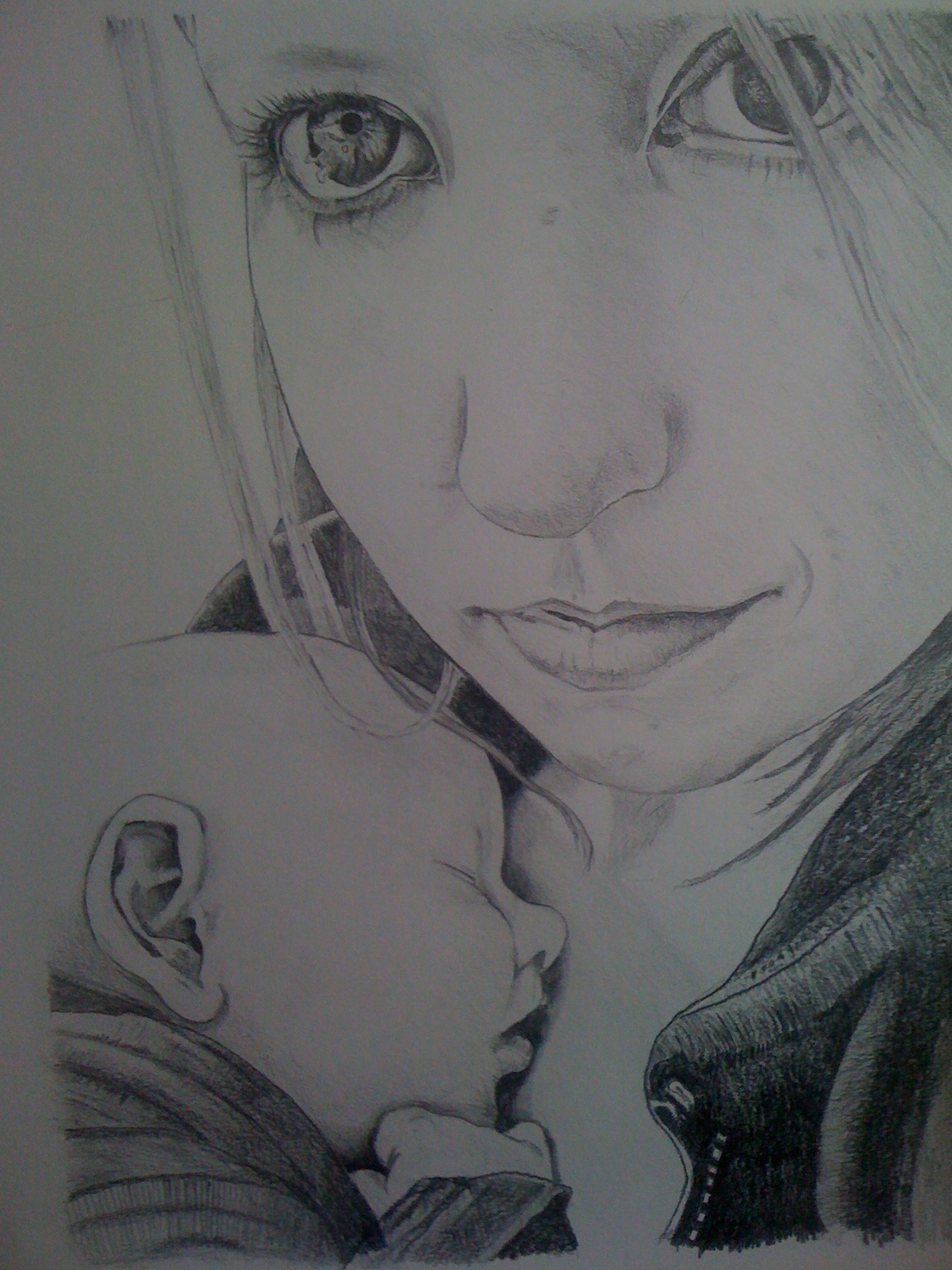
Five years ago I did this from a photograph one of my former students who was a new mom at the time allowed me to use. She has this drawing. I’ve always meant to do a painting based on this drawing. It’s still my intention, but I have stopped pressuring myself to do this kind of thing. It will happen if it happens. One thing is certain, I have no shortage of projects. My only limitations are my aging body and time.
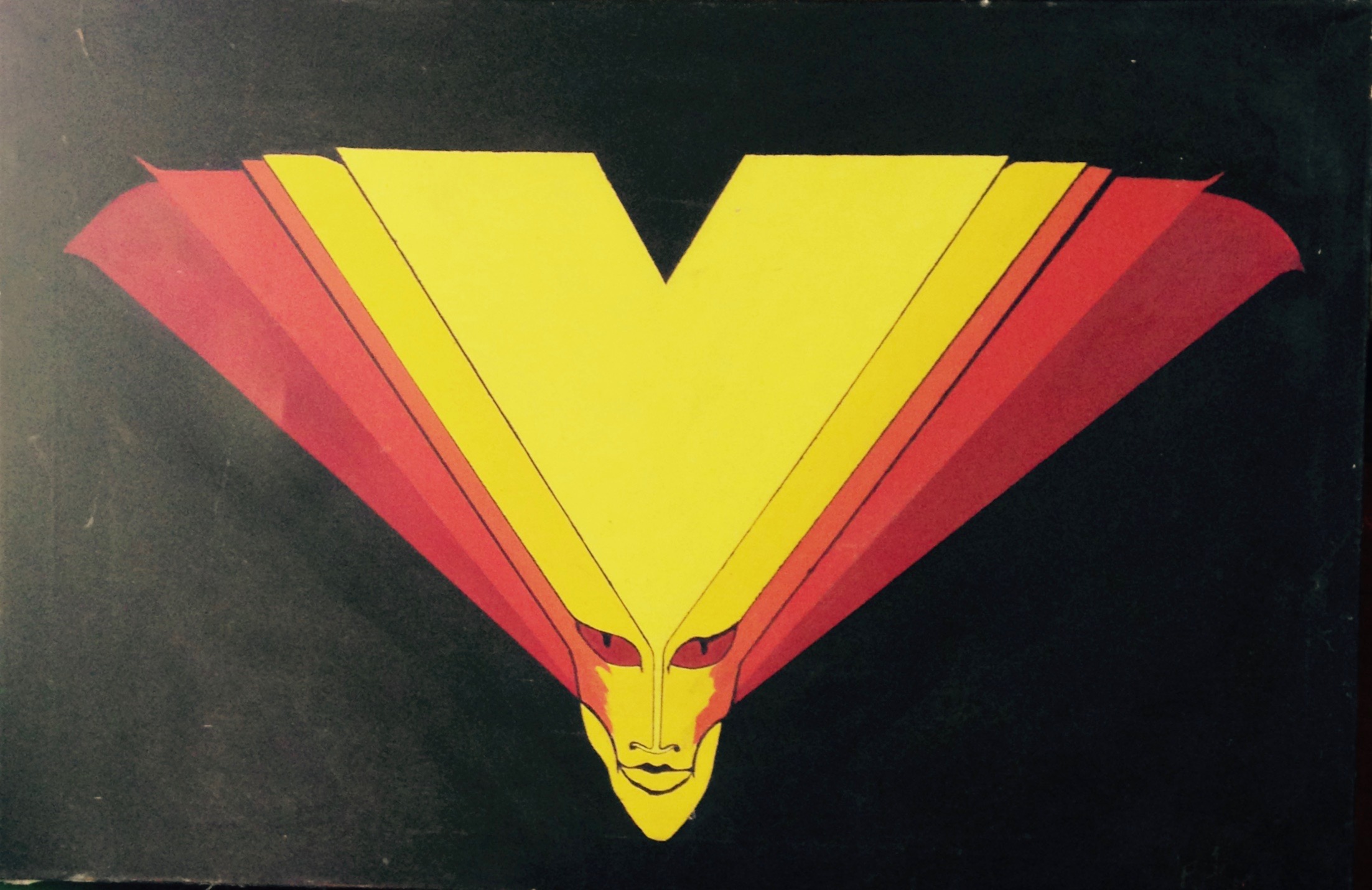
Over the past 25 years I’ve done a number of realistic pieces but I tend more to the impressionistic side of things and I even do what some people would consider pretty kooky works. I’ve copied the works of some of the masters including Vermeer and Schiele. I can’t say that I’ve been overly influenced by any one artist of the past. I just do what comes to mind.
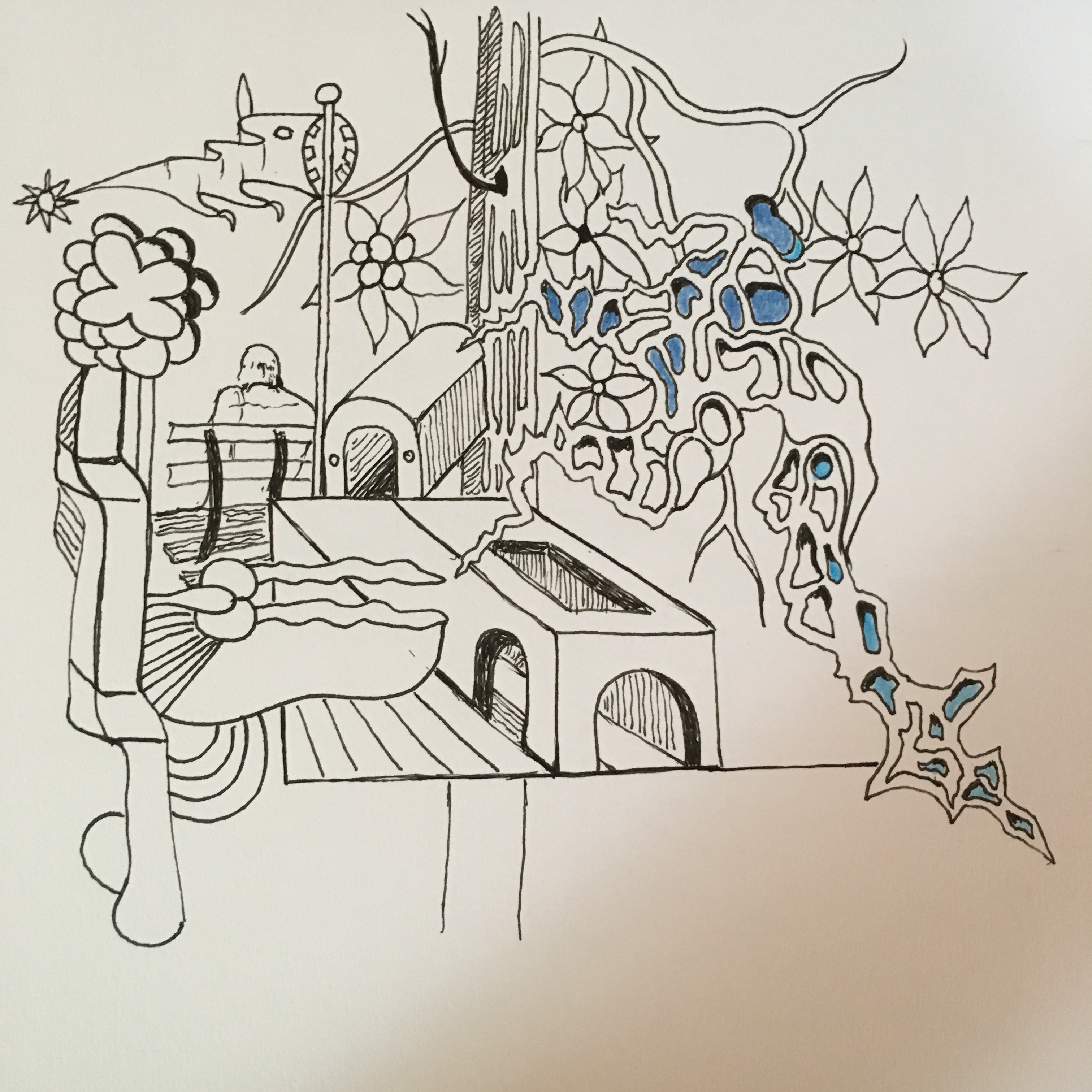
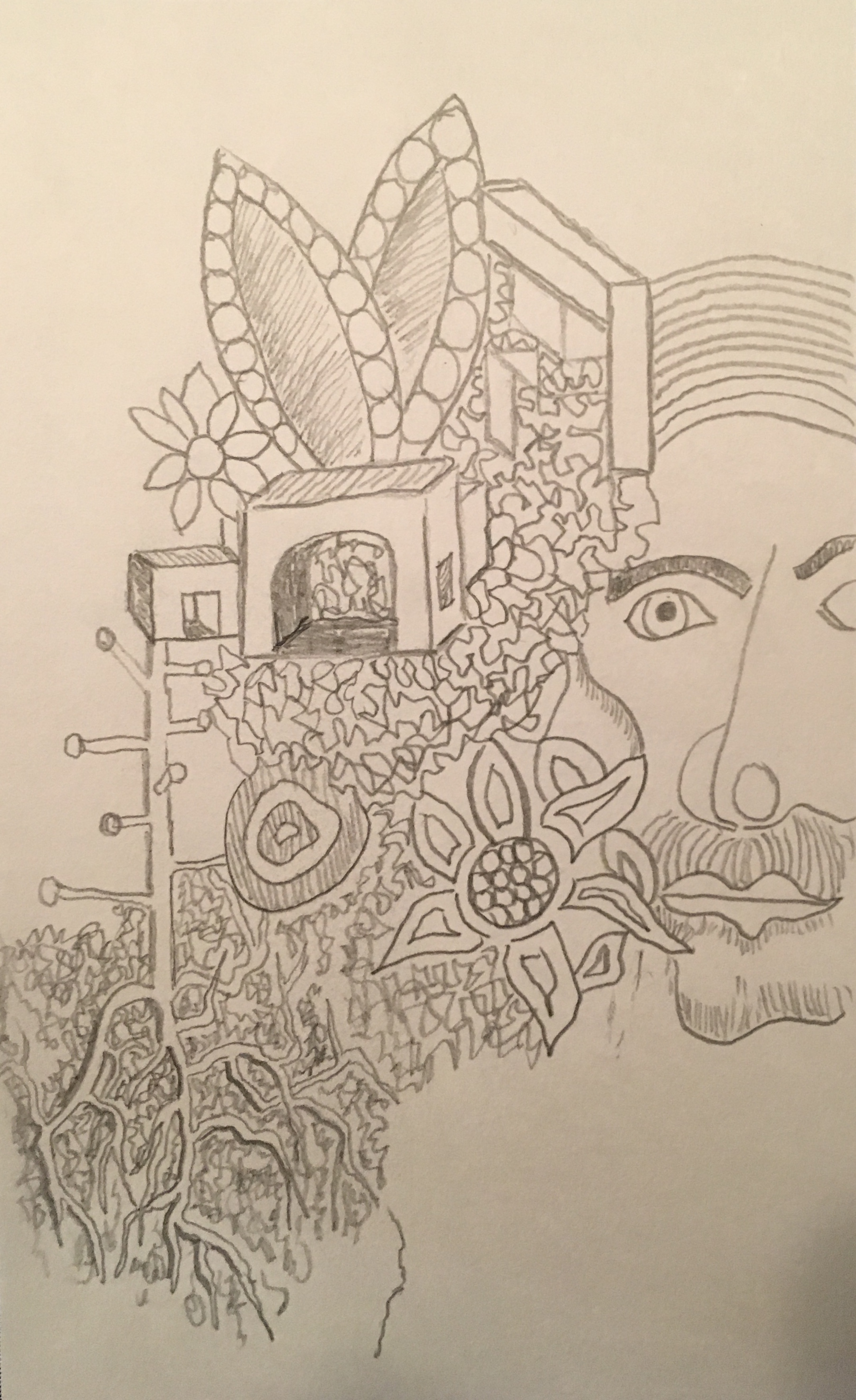
I love to doodle and sometimes I’m astonished by what comes out:
I often carry a drawing notebook with me but don’t always use it. Sometimes I just sit and think about painting or drawing subjects. Art is never far from my thoughts. Neither is writing. They tend to compete for brain space. Carolyn knows all too well what this means for my lack of attention to other things I could very well be attending to in my environment, social and natural especially as they concern her. My brain is a busy place. If a subject attracts my attention in a particularly forceful way I’ll sit and draw it if it’s possible given time and place. Drawing people on the ferry and sitting at picnic tables in parks has been fruitful for me in terms of drawing subjects. I’m finding too that I’m increasingly drawn to ink rather than pencil for my doodles and mini sketches. My ink drawings tend to be less precious and more spontaneous. I like that.
A group of printers and I associated with the Comox Valley Printmakers Association just last weekend had a pop-up exhibition and sale in Cumberland. We had some 500 people come through in my estimation. Some say more came through. Now I have to finish up some flooring upstairs in the house and some window and door trim. Art has to be set aside for a bit. That said, I never stop thinking about it. But, you know what? I have to clean up my damn studio. I may want to be on a studio tour sometime soon.
That’s enough for now. I’ve already started to plan my next blog post. It will be a about my intellectual development.





 Roger Albert - Always a Sociologist: Now Living With Myeloma