It turns out we die from the feet up.

[Disclaimer: Don’t read this post if you are sensitive around the topic of death and dying up close.]

It turns out we die from the feet up. Well, that’s not strictly true in every circumstance, some people die from a bullet to the head,  but it has an element of truth to it. As I noted in a previous post, my amazing mom died last week, on the 13th, very near midnight. She would have been 94 on April 4th. I wrote before that she died a good death, but that’s not what this blog post is about.

For three days or so before mom died, we held a vigil by her side. I have many siblings but two of my sisters were especially attentive towards our mom and visited her virtually every day at her care facility in Coquitlam. They were especially present during this vigil, but most of my other siblings showed up at one time or another as did some of their children and even grandchildren. We spent many hours in mom’s room and out in the hallway. Some of my sisters (and a brother-in-law or two) spent nights by my mother’s side too.

My mother was 93 when she died. Her story is really astounding and is one of sacrifice, caring, selflessness and dedication. She married my father on January 28th, 1946. He had 5 daughters from his first marriage. His wife died in childbirth as she was giving birth to her first son. Because my father had to work to support the family I assume he put out the call for help and my mother, 21 at the time, answered that call. She moved into dad’s house to look after the 5 children and to do all the housework too. Long story short, my mom soon after married my father and they proceeded to have 10 more children, I being the oldest. I’m 71. I was born in 1947, a year after my parents were married. My eldest sister from dad’s first marriage is about to turn 83.

Well, it turns out that although we are a loving and caring family we are also prone to irreverence. We love to laugh and tease each other but we also care about and respect each other, despite our differences. As my mother lay dying, we got to wondering just how the staff knew that she was in fact near death. We asked questions and the nurses and care aides responded in very matter of fact ways. How can we tell when someone is near death? I had heard that when the kidneys shut down that’s a sure sign that the end is near but in this case, mom had not had food or liquids for 2 or 3 days. It would be difficult to tell if and when her kidneys shut down. All this time, mom’s pulse appeared to be quite strong and although her breathing was irregular, it seemed to be consistent.

One of the nurses then told us that it’s possible to roughly assess how long it will be before someone takes their final breath by looking at their legs. When the toes and feet get cold and a line of blotchy skin appears, that means that it won’t be long. Now, nurses and care aides have a lot of experience with having people die on their watch. It would be foolish to ignore what they have to say.

After that, we proceeded to periodically lift the blankets off of mom’s feet to see how her toes and feet were doing. We didn’t notice any special coldness at first. Even on the day of the 13th, it didn’t look as if her feet had changed much in colour or temperature. We often checked on mom’s feet to see if they were getting colder or if the line of blotchy skin was going up her leg. The nurse said that when the line gets to the knee, that’s it. Death slowly creeps up our legs. Of course, there was no question of mom coming out of this crisis alive, so it was just a waiting game now.

I left the care facility around 4:30 PM on the 13th so I could have dinner with my daughter and her family in Vancouver. We half expected mom to still be alive in the morning when we returned to the care facility. I was getting exhausted too and needed a good night’s sleep. As it turned out, that day was the last one I would see my mother alive. In the early morning minutes of the 14th I got calls from one of my sisters and a brother-in-law telling me that mom had passed away, but my phone was on vibrate and I missed their calls. At breakfast, I learned that my mother had passed away a few hours earlier. Within two hours of her death, the people from the funeral home came around and took her body away. Shortly after that, some of my family members cleaned out her room of all of her personal belongings leaving no trace of her ever having been there.

I called my sister and we talked about what happened as mom got closer and closer to taking her last breath. It so happens that the nurse was correct. Mom’s legs had indeed gotten cold and blotchy as her heart became too weak to pump blood to her extremities. By the time she died, her legs were cold up to her knees and her legs were blotchy.

So, along with the grief and sadness that we all felt as we watched our mother/grandmother/great grandmother/mother-in-law die, we learned about how the process evolves.

Right up to her last moments our wonderful caring mother had something to teach us.
My back is hooped! I need a new one.

My lower back is permanently damaged because of an industrial injury that I had when I was around 20 years old, followed by a disc removal in my lumbar region. Over the decades that injury and surgery have often left me incapacitated and practically immobilized at times. The pain spikes up to a 10 at times although if I lie still it’s manageable. Dare I try to move and I get gut wrenching debilitating pain spikes. In 2002 I was diagnosed with kidney cell cancer so a surgeon removed my left kidney leaving a 14 inch scar from my abdomen in front to close to my spine at the back. Gladly, the cancer had not metastasized and I’m cancer free 16 years later. The pain from the surgery, however, has not abated much and it has joined up with the pain from my disc surgery and injury to create a crazy nexus of pain on my left side from my hip  to my upper thoracic area. Joining this happy little pain scenario is a B12 deficiency that has left me feeling constantly hung over and exhausted. Add to that a couple of other injuries to my right knee and both shoulders makes life very interesting. So, what have I done about this and what can I do now about this?

Through all of this I’ve tried to maintain some normalcy in my life. At times it was impossible and I had to take months off of work on three occasions. Now that I’m retired I can’t take time off anymore! Such a drag.

Over the years, I’ve tried a number of ways of dealing with my back pain and I’ve had scores of very well meaning people suggest ways that they’ve tried and found effective  in dealing with back pain including any number of varieties of physiotherapy, exercise, massage, acupuncture, yoga, meds, diet, etc., etc., etc. I have availed myself of most of the remedies recommended. Nothing seems to work for any length of time although I have gotten stretches of pain-reduced time over the years and I have been able to paint, sculpt (even using a chainsaw), printmake and putter in my shop. I cherish those times, and I want them back.

A couple of days ago, we (my family and I) attended my mother’s funeral in Maillardville. Before leaving my daughter’s home in Vancouver to go to the church for the ceremony I thought I would reach down and tie my shoes. Big mistake. That triggered a pain reaction in my back that almost had me passing out. The ceremonies at the church and later at the cemetery were very difficult because of the pain, never mind the grief. Yesterday, I drove home and although I was not entirely pain free, I was more or less comfortable. That’s the way this pain syndrome works. It comes and goes. This morning I did a stupid thing again. I tried to tie my shoes. Not too bright, this old man. I was aiming to go with Carolyn to walk the dog. Instead, I lay on the couch hopped up on T3s. I’ve got some pain relief right now and can sit and type this on my computer, but I have no idea how long this will last. Tomorrow, I call my M.D. I doubt he can do anything, but maybe prescribe some more T3s. I see a neurologist at the end of February. I hope he will be able to help me with the pain, the exhaustion, the dizziness, etc.

I tell you this not because I want sympathy. Maybe a little understanding would be good, but that can only come with knowledge. Hence this blog post. One problem is that most of the time I look pretty normal and healthy. People assume that I am and I don’t blame them. I do, however, find it a little frustrating when people ask me how I’m feeling. I don’t know what to say. It’s complicated. I have normal blood pressure, my pulse is good. In fact all my vital signs are good. I’ve just had an MRI that told me that my brain is in pretty good shape. So, yeah, it’s complicated. It might be good for those of us who experience debilitating pain to have a gauge implanted under the skin of our forearms indicating the level of pain we are experiencing at any given moment. I’m joking, of course, but…

Being at my mother’s funeral a couple of days ago was sobering to say the least. I couldn’t help but think about my own mortality and morbidity. My eldest sister is 82, almost 83 years old. She’s in good shape and could easily live well into her 90s. Most of my siblings are in good shape although MS and other autoimmune issues run in the family and I expect most of us will live long lives. It’s in our genes. But my parents’ generation is almost all gone. It’s our turn now to leave this mortal coil, and we will, one after the other, it’s just a matter of time.

More about my take on life and death in my next post coming soon.

My mom died last night.

As a blogger, I will blog. That’s just the way it is. My mother died last night at around midnight. She lived for 15 years or so in a care facility called The Dufferin, in Coquitlam, BC. She was almost 94 years old.

Her room is quiet now, but really, it’s no longer her room. Soon, someone else will occupy it and there will be no trace of my mother’s time there except in the memories of the care aides and nurses who looked after her. I can’t say enough good things about the care my mother received at The Dufferin. Part of that is because of the dogged persistence of my sisters Lucille Haveland and Claudette Friesen but it’s also because of the caring attitudes of the people who looked after mom every day. They had way more contact with my mother in the last few years than I did. In fact, I rarely saw my mother over the last few years. We live on Vancouver Island, a 5 hour trip including a ferry ride from The Dufferin and when we did go to Vancouver over the years we always stayed with my daughter and her family. We just didn’t see my mother or many of the rest of my family either for that matter. For probably 17 years before her death, she carried a heavy burden of dementia and she was certainly not the woman I knew as a young boy growing up. It was hard to see her like that. I do wish I had made more time to see mom over the years, but I can’t change that now. Still, she was my mother, changed as she was. She was gentle, warm and tender. She loved her family. She loved all of us.

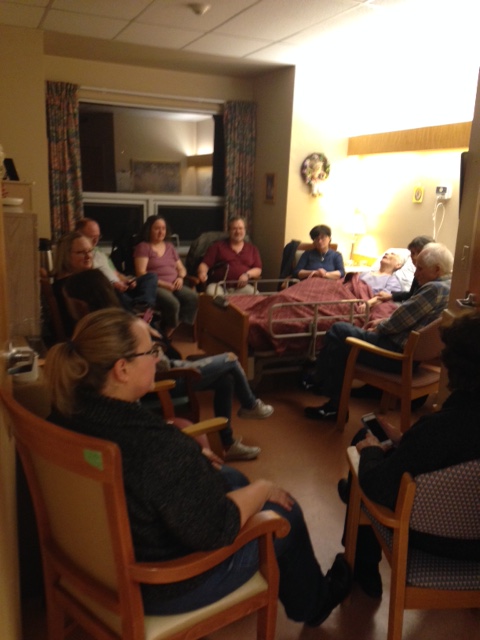
Over the last few days, her room at The Dufferin was anything but quiet.

IMG_2902

As you can see she was surrounded by family. Not all of us could fit in the room at the same time so we would leave the room now and again and spend time out in the hallway. At any one time there could be as many people in the hallway as in her room. That’s no surprise because she raised 15 children, only three of which could not make it to the Dufferin in the last few days to bid farewell to their mother(one being deceased and the other two living far away with health issues of their own). Husbands, wives, grandchildren, great grandchildren rounded out the group along with a steady procession of care aides.

My mother is gone. The people who do these things took her body away in the middle of the night not two hours after her last breath. That’s how fast and efficiently these things get done. What they couldn’t take away though was the laughter and the love that was palpable in the hours and days before her death and that saturated the room. We can be an irreverent group at times and we proved to be just that over the last few days, but that irreverence was always tinged with love and trust. Our mother’s death has brought us together again. We feel her in our love for each other.

I’ll have more to say in the coming days. For now, I’m home in Cumberland, on Vancouver Island, resting and awaiting news about when the funeral will happen.

Take care, all of you and hug your loved ones.


Should I Tell You What I Really Think?: My Insignificance Is My Liberation.

[Disclaimer: What I write here is really too simple and consists of a lot of shorthand. Truthfully, I’m finding it difficult to translate 45 years of study and research into a few lines in a blog post. If you think it’s not working please let me know. Let me know too how I could better communicate and translate my decades of experience.

Analogy. This post consists of an analogy. It’s not perfect by any means, but it may help put our obsession with individuality into perspective. It seems to be clear that every human is a separate material entity. As Otto Rank puts it in The Trauma of Birth, we are objects to other people and in fact, the process of objectification starts when an infant realizes that it is separate from its mother. My view deviates from Rank’s and follows one proposed by Norbert Elias from his books, The Civilizing Process, What is Sociology? and others. [Elias is the subject of a future blog post] Elias’ view is that we are best considered as processes rather than as things. That said, I want to offer here my own strange take on human life using an analogy that should be fairly easy to understand.

So, for me, a human individual is akin to one cell in a human body. The human body, in this case, is analogous to the sum total of all humans on the planet. Like I said, the analogy, like all analogies, falls short of qualifying as a perfect equivalency yet at its core there is a simple truth to be had, I think.

We each have trillions of individual cells in our bodies. I read somewhere that every cell in our body is replaced every seven years or so. That’s not entirely true, but mot of our cells regularly die and some percentage are replaced on a regular basis. Eventually, of course, the cellular organization we call ourselves is no longer viable and we call that death. Death, however, is a slow process that begins the day we are conceived and goes on some time after the doctor declares us dead (and until cremation). How is this analogous to the species as a whole? Well, millions of people died in wars in the 20th Century but that didn’t prevent the species from carrying on. An individual human death is about as significant to the species as one cell dying in our bodies. That may seem harsh, but it’s real. People come and go. Millions of people die every year while millions are born. The species hardly notices. We do care as individual people. There is no doubt about that. When we have someone close to us die, that affects us, but the billions of other people on this planet take no notice at all.

Our cells work together to keep us alive and functioning, but the loss of any individual cell has little effect on the whole body. I can slap my wrist and kill a few hundred or thousand skin cells, but my body doesn’t really mind too much. It carries on like nothing happened. If I cut off my arm, I can still live. We can lose a lot of cells and still survive.

When I was teaching I used to torment my students with a standard lecture at the beginning of each term. This lecture emphasized the importance of society and the inherent interconnections we have to other people and to social organization. In a society that glorifies the individual, it can be humbling to consider just how dependent we are on others, most of whom we have never met.

In my lecture, I’d start off by saying that an individual human being doesn’t exist, cannot exist. We only exist in relation to others. We are the product of a most basic social act, the sex act. After that, we require the assistance of others to stay alive. We need to be fed, clothed, washed and looked after for many years. I argue in fact that the dependencies never stop. We are social animals in every sense of the term. We depend on others for everything. The language(s) we speak, the values we have, our ‘successes’ and ‘failures’ are a consequence of our social relations. One cannot be successful in a vacuum. Not only that, but in our world, with some exceptions of course, we depend on others to make our clothes, grow our food, provide us with electricity, build our homes, make sure our poop goes away when we flush the toilet and fresh water gets pumped to our faucets.  We also depend on people for companionship, for hugs, for approbation. The evidence is strong that if we don’t get hugs and the company of others as babies a quarter of us die before the age of four. Our interdependencies ARE us. We don’t exist as things, but as processes interwoven with many other processes we call organizations be they families, neighbourhoods, restaurants, churches, mosques, synagogues, provinces, countries and workplaces among many others. That’s why we volunteer to die for these organizations, we sacrifice our lives to them, we bow down to them, we feel undying affinity with them.

Of course, very few people think about these things. We are encouraged from a very early age to be independent, self-contained, and capable of making our own decisions. But, unfortunately, we’ve been sold a bill of goods. Individuality is an illusion, just as a single human cell does not and cannot live by itself; it only exists in relationship to other cells and to the whole body.

As humans we tend to consider ourselves special. In fact, some people believe that we are created in the image of a god or other. We aspire to live forever and create elaborate stories to convince ourselves of the veracity of our beliefs in immortality. Sadly, we are truly insignificant as individuals for the survival of the species, as insignificant as an individual cell in my body is to my life. That said, for me, there is a sense of release and comfort that goes along with that realization. My insignificance is my liberation.

More later.


Escape 24: So, where do we go from here?

Roger JG Albert's avatarRoger Albert - Always a Sociologist: Now Living With Myeloma

Escape 24:  So, where do we go from here?

At the end of Chapter 8 Becker has a short section on transference.  Freud wrote a book on transference, a phenomenon he observed in clinical practice where a patient would transfer to his doctor feelings she once had towards her parents.  Patients were quick to abandon their egos to the new power figure in their lives.  Others, among them Adler, Rank, Jung and Fromm extended Freud’s observations.  It’s because of them, Becker argues that “today we can say that transference is a reflex of the fatality of the human condition.  Transference to a powerful other takes care of the overwhelmingness of the universe.” (p.127).  Transference is an incredibly powerful impulse.  How is it that “men were so sheeplike when they functioned in groups – how they abandoned their egos to the leader, identified with his powers just as they did once…

View original post 564 more words

Escape 23: Each society is a hero system that promises victory over evil and death.

Just let the title of this post sink in. Then ask yourself if it’s reasonable to think that the promises of victory over evil and death are possible. Meditate on that for a bit. Review history books. Read Becker.

Roger JG Albert's avatarRoger Albert - Always a Sociologist: Now Living With Myeloma

Escape 23: Each society is a hero system that promises victory over evil and death.

Since there is no secular way to resolve the primal mystery of life and death, all secular societies are lies…Each society is a hero system that promises victory over evil and death.  But no mortal, nor even a group of as many as 700 million clean revolutionary mortals, can keep such a promise…it is not within man’s means to triumph over evil and death.  For secular societies the thing is ridiculous…cultures are fundamentally and basically styles of heroic death denial. 

 If each historical society is in some ways a lie or a mystification, the study of society becomes the revelation of the lie…We can then ask empirically, it seems to me, what are the costs of such denials of death, because we know how these denials are structured into styles of life.  These…

View original post 94 more words

Escape 22: The Science of Man after Hitler

Roger JG Albert's avatarRoger Albert - Always a Sociologist: Now Living With Myeloma

Escape 22: The Science of Man after Hitler

I have lingered on guilt, sacrifice, heroism, and immortality because they are the key concepts for the science of man in society that is emerging on our time. 

 Sociology has largely ignored this kind of analysis because it’s been caught up with it’s own immortality-project, it’s own definition of itself as a structural or constructionist endeavour.  History, evolution and process are not welcome in its parlour.  In my younger days I thought that if I wrote interesting and relevant material I would be taken seriously.  I was a bit naïve.  Sociologists could ignore Hitler or Mao as aberrations.  Becker mentions two sociologists who bucked the trend, Kenneth Burke and Hugh Dalziel Duncan.  I don’t know their work.  It was never on the curriculum when I studied at university.  Although Burke died it 1995 he was born in 1897 so his work…

View original post 587 more words

Escape 21: Scapegoating 101: “Hell is other people.”

Yup, for most of us hell is other people, but not just any other people. Read on.

Roger JG Albert's avatarRoger Albert - Always a Sociologist: Now Living With Myeloma

Escape 21: Scapegoating 101: “Hell is other people.”

This is going to be a shorter post than the last few…which have been way too long.  I fear I’m getting pedantic in my old age.  Say it ain’t so.  I’ll carry on now, pedantry or not.  One positive thing I’m getting out of this is that my typing skills are improving, if nothing else.

So, in the last post we looked at Becker’s use of the term ‘sacrifice’.  This post is about a related term, scapegoating.  Scapegoating is a form of sacrifice…in the early days using a real goat.  Now we do it with people, mostly people we blame, realistically or not, for all of our troubles.  Becker opens this part of Chapter 8 with a quote from Jean-Paul Sartre, the existentialist, who said “Hell is other people.”  I need to put that on a T-shirt, damn it!

From the beginning…

View original post 780 more words

Escape 20: Why do we have to fight the death star?

Just read it.

Roger JG Albert's avatarRoger Albert - Always a Sociologist: Now Living With Myeloma

Escape 20: Why do we have to fight the death star?

No, this post isn’t exactly about Star Wars, but that movie is such a brilliant commentary on a power mega-machine gone mad that it could easily serve as a basis for the discussion here. In many ways, movie makers have been more intuitively in tune with the insanity of the world today than most intellectuals and politicians, of course. Maybe after I finish this Becker marathon, I’ll turn to how movies and books have given us insights into our basis fears of life and death.

Chapter 8 in Becker’s EFE is called The Nature of Social Evil.  It’s a very dense chapter in which Becker can now get to the nitty-gritty.  He’s laid the groundwork and summarizes it in the first paragraph of the chapter, which I reproduce here in its entirety.

We have seen with Rank that the driving…

View original post 694 more words

Escape 19: All you wanted to know about human evil but were afraid to ask!

Does this ring a bell? From this post: In his conclusion that much of the misery on this planet is a consequence of our attempt to deny our animal nature, the question for Reich is: how could we so willingly give over [our] destiny to the state and the great leader? (p. 93) Because we’re such suckers for promises of prosperity and good times ahead if only we follow the great leader, the steady, thoughtful great leader. But, unfortunately, in attempts to avoid natural plagues and disasters by investing our trust in great leaders we unwittingly unleashed another plague brought on by our thoughtless allegiance and obedience to the politician.

Roger JG Albert's avatarRoger Albert - Always a Sociologist: Now Living With Myeloma

Escape 19: All you wanted to know about human evil but were afraid to ask!

Well, it looks like I may just get through this 30 day Becker marathon in 30 days.  I’m on Chapter 7 now, which starts on page 91.  Since there’s 170 pages in the book I’m close to half way there.

As noted earlier, Becker is the great synthesizer.  He gleans in a critical way the works of others to build his own model of how the world works.  Those ‘others’ include hundreds of scholars of all disciplines as can be verified by a glance at the bibliographic entries in his many books, but major influences have been Hocart, Huizinga, Brown and Rank.  The school of psychoanalysis to which Becker subscribes is the school, which broke away from Freud.  Rank was a special protégé of Freud’s but could not accept Freud’s Oedipus Complex and other aspects…

View original post 513 more words