A third post relating to the Ernest Becker Legacy conference held at SFU earlier this month.

As promised this is the third post of my ruminations about the Becker conference.

[A sad aside: I took my time with this post because my trusty MacBook Pro that I bought in early 2011 decided life was not worth living anymore and pulled the plug on itself. So what to do? Buy another computer of course. Maybe later. What I did instead was pull the hard drive out of it and put it in its own stand-alone case. Now I can boot it from Carolyn’s computer just like it was my own aside from a few little glitches. It’s very slow though because it has to run through a USB port, We’ll fix that by increasing the ram in Carolyn’s computer and get it a new battery while we’re at it. Now Carolyn and I have to share a computer, sort of. I’m actually typing this on an old PowerBook G4 I had in my studio for pulling up photos for painting. It can’t handle a lot of new software including Chrome and Firefox, but it’s better than nothing and I can get my mail and do this. So that’s good. It won’t be good for the Cumberland Forest Society’s Trivia Night in a couple of weeks – I’m the quiz master and we need to drive a projector with new software. For that we’ll need my (ah..Carolyn’s) MacBook Pro with its new ram and battery. I actually amazed myself by how much I grieved over the loss of my computer. Thankfully, I was able to salvage it’s brain even if I had to let its heart go.]

I’ll restrict my comments here to the presentation by Andrew Feldmár. It was on Sunday morning, the last presentation of the conference. To be honest, I was a little hung over at the time but that was probably appropriate given the content of the  presentation. So Feldmár was a very popular professor in the psychology department at SFU for many years. He was there when I was first a student at SFU in 1972. I didn’t take any courses from him. I was kind of anti-psychology at the time. I’m much less so now. In fact, even at the time I read a lot of psychology and psycho-analytical writing. Still, it was generally reading on the critical side. I understand that psychology has its place in the world, but my perspective and that of a lot of my fellow grad students was that psychology’s focus on the individual was an ideological bow to the individualism characteristic of capitalism, the basic target of our collective criticism. Even more, we considered psychiatry, specifically, as an extension of the police in modern society, persecuting anyone not ‘towing the line’ of modern capitalist institutions. Feldmár shared our critique of psychiatry although I didn’t know that at the time.

In fact, Feldmár worked with one of the most famous critics of psychiatry, R.D. Laing, who worked in Britain and conducted a lot of experiments on the ontology of schizophrenia and other ‘mental illnesses’. Laing was a most impressive guy who virtually pissed off the entire body of psychiatry at the time. I’ve recently been re-reading his The Divided Self and continue to be impressed by his work. Of course, his ‘colleagues’ considered him a brash, arrogant rebel. All the more reason I would read his work. Laing as well as Thomas Szasz and others more recent like Peter Breggin argue that schizophrenia arises in certain individuals because of a confluence of genetic/biological predispositions and family dynamics. They argue that families and ‘society’ create schizophrenia and that it is not a disease per se, but is a dynamic set of relationships that become intolerable to the ‘patient’, In other words, families create schizophrenics, not an idea very popular with the families of schizophrenics. To be clear, Laing and Szasz did not feel that the families of schizophrenics were in any way malevolent, except in the sense that the people with the power in the family, generally the parents, would stand on very strict behavioural parameters for their children not allowing their children to develop their own sense of self and self-determination. Asking the parents of schizophrenics why they thought their children became ‘ill’, they determined that to a large extent, the parents felt that they had absolutely no responsibility for it arguing that they had provided their children with all the best life could offer them including love and acceptance.

In fact, the situation in the family, Laing finds, is highly complex, and is founded on a series of contradictory behaviours expected of the children by their parents. So how would Laing endeavour to ‘cure’ schizophrenia? Well, Laing used LSD very successfully to ‘shake up’ the patient in a way that allowed them to see their situation from a different perspective. A recent CBC Ideas program notes that using LSD in therapy resulted in a 50 to 90% success rate for certain ‘problems’ such as alcoholism and other mental illnesses. Andrew Feldmár, in his talk, discussed the use of psychedelic drugs in therapy and how successful it’s been in Laing’s experience and his own. Of course the ‘establishment’ opposition to the use of psychedelic drugs pretty much made the practice illegal and illegitimate although there’s been somewhat of a revival lately. Feldmár is a large part of this revival in his current work and hearing about it firsthand was amazing to say the least.

However, I don’t believe that Feldmár’s presentation lived up to its title, A Laingian/Psychedelic/Therapeutic Perspective on “The Denial of Death”. I don’t recall Feldmár talking a lot about Becker although Becker definitely leaned heavily on Laing and Szasz in the psychological aspects of his work. I would have appreciated a more direct outline of how Becker uses Laing and Szasz in his work. Becker never mentions psychedelics and therapy that I know of. I have to go back and look as some of his earlier works. I’ve focussed much more on Becker’s later works, The Denial of Death and Escape From Evil, for my own purposes. Like I said, I was a little hung over on Sunday morning, October 4th, when Feldmár made his presentation. If I’m misrepresenting him in any way here, I’d be happy to hear about it.

By the way, I’ve decided to write one more post on this topic. It’s not about the conference directly, but about an interaction I had with an old professor of mine and one of Becker’s colleagues at SFU. That will come next week.

Follow up on yesterday’s post on the Ernest Becker Legacy Conference at SFU

In my last post I mentioned some of the conference speakers, among them Sheldon Solomon and Jack Martin. I quite enjoyed both of their talks which together summarized Ernest Becker’s thought and his biography. To generalize beyond caution, I dare say that every one of us is an ever changing individual confluence of experiences, actions, achievements, ideas, values, etc., bounded by a sac of flesh and bone and  wrapped in a social weave of interdependencies. Solomon and Martin ‘gave’ us the confluence that was Ernest Becker in as much complexity as was possible in a short time.* Of course, the conference title implied that Ernest Becker’s legacy would be the focus of discussion. In Becker’s case the legacy in question refers to the range of ways and means his ideas have informed those of others who have followed him. It’s what he left behind for others to use and build upon. That’s a staggering amount of information, ideas and insights to put it mildly. 

Most people who have used Becker’s work have focussed on this or that aspect of it. There’s too much of substance in Becker’s work spread over too many disciplines, making it close to a unified theory of social and biological life on a grand scale, to use the whole thing as a starting point for further analysis. We can gnaw away at the details and go from there, but it’s most difficult to follow Becker on the grand scale of things. A person would have to share his confluence of influences at the very least. I mean, he described his last book as a synthesis of Marx and Freud. Well, who is competent to judge whether or not he actually did that? Someone who at least shares his reading list and sees the world in ways that he did. Was he referring just to Marx and Freud or were these two names rallying terms for a huge number of writers and authorities that he also used? His Freud also included Rank, Jung (to a lesser extent), Adler, Brown, Jones and many others. His Marx included Frankfurt School types, the more humanistic Marxists like Fromm. In fact, I don’t see a lot of classical Marxism in Becker’s work so he must not have meant Marx,  but Marx-ists.  Becker’s confluence is complex and massive and  hardly matches anyone else’s so I think that we literally cannot follow Becker in the entirety of his thought. In fact, a prerequisite for reasonable commentary on Becker’s overarching thought, I  think, is a familiarity with the bulk of his reading list. You’ll need a few years to get through it.  You’ll also need an openness to his interpretation. 

I’ve already written that people have settled on aspects of Becker’s work to elaborate. It’s probably safer and necessary to do that in any case as I have just argued. So, we come to David Loy, a very nice man if I’ve ever met one, a Buddhist scholar, an activist one by all accounts. Google his name. He’s written a few books. His talk was interesting, but not so much for me because I just don’t easily go to ‘religious’ places in my thinking. Of course I’m probably doing Loy an injustice and I wouldn’t want to do that. Still, I probably wouldn’t read any of his work but I would love to sit and watch a beautiful sunset with him.

Larry Green was another of the conference speakers and a big part of the organizing crew. I have so much respect for all of the organizers and the participants in this conference and Larry is right up there. He earned my respect for whatever that’s worth (I have no illusions about the insignificant space I take up on this planet, so what would he do with my respect? I do not mean this in any kind of self-deprecating way.). He is a long time psychotherapist (44 years) and teaches the odd course at City University Canada. The blurb in the conference document states “His contribution will focus on alternatives to “in-group” identification as a source of ontological security.” That’s a tall order. Becker’s discussion of the moiety in Escape From Evil would be enough to scare me away from suggesting an alternative to how things have been organized socially on this planet for thousands of years with people dividing themselves into competing groups all the better to prove how wonderful and worthy a winning group is in its barter with the gods for immortality. For me, the problem is that Green is focussed on individual accommodation to life on this planet and not on the overall ontological issues around  group formation and social conflict. But that’s not meant to be a criticism, just a problem for me…as a sociologist who taught Canadian history, French, Anthropology and Sociology at a freshman level. Notice, there’s no Psychology in there. That doesn’t mean that I don’t have the utmost respect for a number of psychologists, psychoanalysts and even psychiatrists (one even still living). I just don’t follow them around into theory very far. I’m too much of a social evolutionist and Marxist for that.

Speaking of Marxists, Brad Hornick was one of the speakers. He used his time to talk about his own life and what he thought was necessary for the creation of social change great enough to reverse the insane course we’re on destroying the planet as fast as we can. Becker, in the closing paragraphs of Escape From Evil mentioned that if we could come up with a new immortality project, say one that was aimed at climate change, that we could just change the course of history and maybe save ourselves in the process. I don’t think he was all that confident if would happen, but he threw that in as a possibility. Hornick argued that capitalism has to go in order for any positive advances can be made to this planet’s climate. Commodity fetishism is not going to allow us to easily let go of our obsession with possessing goods, so we have to get rid of commodity fetishism. Frankly, I don’t hold out a lot of hope for humanity, but Hornick isn’t giving up and I respect him for that. He’s a grad student at SFU in my old S&A department there. I wish him all the best. It’s a tough row he’s decided to hoe. I doubt if many people at the conference had any idea of what he was talking about but it may have challenged them a little and prodded them to think of how Becker’s work can be used to address some of the fundamental social issues of our time. 

The last speaker I  took in during the conference was Andrew Feldmár. I’ll save my comments on him for tomorrow. I’ll also discuss briefly a couple of other speakers not yet mentioned. Tomorrow it is.


  • Confluence means flowing together, as in rivers and such things. The idea of a person as a confluence, that is, the sum total of ideas, values, experiences, influences, etc., all come together in a sac of flesh and bone surrounded by, interweaving and interdependent with others in a social maelstrom came to me in the shower the other day. It’s what accounts for what we call our individuality. No two people share perfectly the same set of ideas, values, experiences, etc., but some of us  overlap in those areas and we form communities on the basis of those overlaps (sometimes voluntarily, sometimes by accident or necessity, sometimes by circumstance).
  • I could not have come up with this idea if I had not read widely in sociology and other related disciplines. It’s only on the basis of my reading list that I can even conceive of such strange things. Some of you may shudder a bit while reading this as you try to make sense of it from the point of view of your own confluence. The more you read the same kinds of ideas I did (and do) and share the same class background, etc., the more you may be able to parse my meaning. Very few people on the planet share my reading list or yours for that matter, that is if you have a reading list. Most people don’t. That in itself is neither here nor there. I can say though that having an extensive reading list in certain disciplines is definitely not a prerequisite for a happy life. In fact it can complicate life beyond salvage resulting in an inability to enjoy the simple things. But aren’t I getting serious now? Time to lighten up a bit. 
  • © Roger J.G. Albert 2015

A conference last weekend: Death, Ideologies and Cultures: The Legacy of Ernest Becker

So, last weekend I attended a conference at Simon Fraser University in downtown  Vancouver. The conference was entitled: Death, Ideologies and Cultures: The Legacy of Ernest Becker

I must say to start off that I commend the organizers and the conference sponsors, in particular the SFU Institute for the Humanities, the Psych Department and the Ernest Becker Foundation, led by Dr. Neil Elgee (who attended the conference too). Except for some confusion over communication about the actual venue of the conference, it was run smoothly. Sessions started and ended on time, by and large. The speakers were excellent. The keynote speaker, Sheldon Solomon, who has been heavily involved in promoting Becker’s work for decades now, is a very compelling and engaging speaker. Thank you, Sheldon! I’ve heard him speak via film before in an excellent movie called Flight from Death directed by Patrick Shen and produced by Greg Bennick and Shen. It’s an excellent documentary about Becker’s work and addresses in its second half what’s called Terror Management Theory, created by Solomon and colleagues, the very successful attempt to operationalize some of the more salient aspects of Becker’s work. If you want to see Solomon at his best, check out this documentary. 

When I was still teaching, the volume of research into Becker was not particularly impressive, but it’s growing splendidly as can be attested by the evidence presented during this conference. I have always, and still do, find it interesting how so many disparate ideological perspectives on the world use Becker to support their findings or to help underpin their practice, from Buddhists to Protestant theologians to psychologists of all kinds and even to the odd Marxist. Jack Martin, the first presenter on Saturday morning gave us a Cole’s Notes overview of Becker’s life and work. He’s writing (written?) a biography of Becker. Becker’s wife, Marie and her son were on hand for his presentation. In fact, Marie was present for most of the conference. I wondered how she felt listening to Martin go over details of her life with Becker. There was no  telling by the expressions on her face. I expect she was and is a very stoical person but I only spoke with her briefly so that’s probably an erroneous assessment. Her son (I can’t remember his name) wasn’t too impressed with the gathering, I sensed. I recall that he made some comment about the futility of conferences like this or even about the value of his father’s work. Fair enough. 

There is no substitute to reading Ernest Becker’s work itself. The Denial of Death and Escape From Evil are his last two books. The Ernest Becker Foundation has a list. I do a blow by blow outline of Escape From Evil on this blog. Check out the archives for that. It was some time ago now. I have more thoughts on the conference and some of the presenters. I’ll be back tomorrow.

See the Ernest Becker Foundation: http://ernestbecker.org/?page_id=125

The importance of social intimacy for individual growth.

I posted this on another of my blogs back in 2011. However, I thought it would be good to re-post:

In my last post I wrote something to the effect that our lives are like dances between self-aggrandizement and self-effacement, between self-expressive individuality and the need to pay homage to our collectivities, those groups and associations upon which we completely depend for life and prosperity.

All of us are caught in a tango of cognitive dissonance. On the one hand we need to express ourselves as individuals while not turning our noses up at our collectivities (societies, nations, families, workplaces, etc.). We ignore our collectivities at our own peril. It’s built into our genes. There is research that demonstrates clearly the importance social connection is to us. In 1945 Rene Spitz conducted research comparing children raised in orphanages and those raised with their mothers in prison. After four years, a quarter of the orphanage children were dead, the others seriously socially impaired. By contrast, those children raised by their mothers in prison were fine. The difference between the two groups of children was the amount of daily physical and emotional contact they experienced. Children in prison had lots of physical and emotional contact, those in orphanages very little sporadic attention. The sparse research done on feral children supports the idea that without human intimate contact we do not fully develop as humans. Our very intelligence (IQ) is dependent on social contact. A longitudinal study conducted by Skeels and Dye (in Roberta Berns, 2009; Shackne: http://www.schackne.com/Nurture.htm) starting in the 1930s and concluding in 1966 found that two children removed from an orphanage as hopelessly retarded and were moved to an adult facility that cared for retarded adults substantially improved within a few months and displayed increased sociability and intelligence. They subsequently moved 13 children to the adult facility and all of them improved dramatically. In a follow up study done 25 years later, “they found that all of these “hopelessly retarded” children had grown up to live normal and productive lives. Some even made it to college and became professionals.” (Shackne) In contrast, the control group of children left in the orphanage for ‘retarded’ children experienced no such improvement. More recently a study found the same kind of results with Romanian children confined to orphanages and moved to foster homes.(http://www.guardian.co.uk/science/2006/feb/18/medicineandhealth.lifeandhealth/print)

So we are by definition social animals, so much so that in the absence of social contact we die or are severely cognitively and physically impaired, sometimes permanently. We are beholden to our societies for all that we are. As Ernest Becker points out repeatedly in his books The Denial of Death and Escape from Evil, our societies are the source of all power. It behooves us to keep a watchful eye out to make sure we don’t get irretrievably cut off from this source of power by exhibiting too much individuality. The glue that holds us together in societies is tested every day in every aspect of our lives. Shame, guilt, embarrassment and opprobrium are institutions that maintain strong social ties as much as love does. And we dance. We try a little self-expression and see how that goes. We try a little more and see how that goes. We test the limits of individual possibility. We retreat. We get up on the dance floor but soon sit down if we notice people noticing us too much. Our language is replete with mechanisms for enforcing and re-enforcing social ties and for allowing the expression of individuality without compromising our social connections.

More Trade News in Brief Week 21 (18 – 24 May 2015)

We don’t think in these terms very often because we tend to use our countries as our basic unit of analysis and thought. However, more and more we must realize that finance capital has completely eclipsed the power of government and is THE dominant force in the world today. So, we must look beyond our borders and see all of us who work as our brothers and sisters, no matter where they work. This ILO report makes it clear that 75% of our brothers and sisters work in very precarious conditions and the situation will only get worse for us all.

Bogdan Marius Beleuz's avatarTrade News in Brief

World Employment and Social Outlook 2015

The International Labour Organization (ILO) today warned of widespread insecurity in the global employment market, saying that some 75 per cent of all workers are employed on temporary or short-term contracts in informal jobs often without any contract.

Trade News in Brief

Check here for more.

——————————————————————————————————————————————–—

UNCTAD – Global Investment Trends Monitor

Hong Kong (China) and China were the second and the third largest investors in the world, after the United States which remains the largest single source of outward foreign direct investment (FDI).

Countries in developing Asia have, for the first time, collectively invested more money abroad than countries in the North American and European regions.

Download:

Global Investment Trends Monitor

Read more folowing the link.

——————————————————————————————————————————————–—

FAO Predicts World Food Import Bill to Fall to Five-Year Low

FAO’s first forecast for global cereal production in 2015 amounts to 2.509 billion tonnes, a…

View original post 37 more words

YOU TRUST EVERYONE

YOU TRUST EVERYONE

Driving in downtown Vancouver over the past few days reminded me of something I used to ask my students in a lecture I did about sociality and social integration. I used to ask them whom they trusted. They would invariably point to family or friends or jokingly say they trusted no one. But, of course, we trust all kinds of people implicitly and regularly all the time. Our trust is not restricted to our intimates. It’s tough though because although we consciously and unconsciously think of other people and their effects on us, we deny that they have any control over us. Most of us truly believe that we and we alone are responsible for our lives and actions.

Truth is, we’re so conditioned by the ideology of individualism that we hardly think in social terms at all, about other people and their profound effects on our lives. There was even the spectacle a few years ago of a British prime minister suggesting that there is no such thing as society at all, only individuals and individual action.

Well, we are connected in ways we hardly understand and virtually never attend to and one way we deny that is by labeling other people. We often label people pejoratively in a myriad of ways. We denigrate others and don’t have any sense of connection with them, in fact we are often repulsed by them. Yet every time we get into our cars and drive down a busy street or highway we trust all of them, even the repulsive ones, like they were family.

Just think of the number of people driving anywhere downtown on any given day and there is bound to be a wide variety of people you could think of. There may be commuters, delivery truck and taxi drivers, moms and dads driving their kids to school, police cars and ambulances, service vehicles of all kinds but there could also be murderers, rapists, criminals of all kinds, violent domestic offenders and of course there will be a motley collection of more or less unsavory characters like conservative politicians, bond traders, media hypers, regular bullies and just plain obnoxious people most of whom you would never choose to associate with in any way in any other circumstance. Not all these categories of people are mutually exclusive either. A mom driving her kids to school could be beating the crap out of her kids when they get home in the afternoon and the service van driver could very well be a rapist. We just don’t know. We still trust them.

We trust that if they’re coming at us in the oncoming lane at 60, 80 or 120 k/hour they will not wander into our lane and kill us. Even if we’re going in the same direction as they are, we trust that they won’t wander into our lane and force us onto the side of the road, maybe into an abutment or barrier. Either way we may very well die. Of course there are accidents, but they are unintentional or are supposed to be. We don’t usually ascribe accidents to malevolence. To ignorance and stupidity, yes, but not malevolence.

You may argue that you really don’t trust them. Well, of course you do. You may not like it, but you do. If you drive, you trust. You trust every other driver on the road. I know that’s a scary thought, but that’s the way it is. You trust murderers with your life.

Just a little depressing viewpoint for you about crime, poverty and ill-health.


Be thankful that there’s crime in the Comox Valley. Without crime there would be a huge hit to the Valley economy. Just think about it. No need for police. Save a few million there. No need for criminal lawyers, counselors, support staff. Save a few more there. No need for probation or parole offices, John Howard Society. None of that. There would be no domestic assault, so no need for The Transition Society or other support services for women fleeing domestic abuse. So, next time you see someone doing something criminal, thank them for their contribution to the economy. If they go to jail, they even do a better job of contributing to the economy. Inmates have to be fed, watched all the time and ‘administered.’ There’s lot of money for business in servicing prisons.  Never mind that there’s a lot of money in building prisons, tons of concrete and such things. Stephen Harper would love more jails.  He must have friends in the concrete business.


Poor people as so important to the economy too. Wow. If there was no poverty, there would be no need for social services, affordable housing, the Food Bank, most of what The Salvation Army does, nor for soup kitchens and charities of all kinds.

And holy jeez. If we were all healthy and never sick, wow, think of the savings there. No hospitals, no doctors, no physiotherapists, no pharmacists, no labs, none of those.

The Comox Valley depends on crime, poverty and sickness to have a healthy economy. To figure that out, all you have to do is look at the stats or read the Comox Valley Social Planning Society’s Quality of Life Report. It’s available online at:

http://cvsocialplanning.ca

So, next time you run into a criminal, a poor person or someone who is physically or mentally ill, give them a big hug, a warm handshake and a huge THANK YOU. So many jobs in the Valley depend on them, both direct and indirect. Maybe the Economic Development Society should promote crime, poverty and sickness. It just might do more for economic development in the Valley than what they’re doing now.

And you know what? I haven’t even mentioned fear yet. My, my. If we could eliminate fear we could get rid of so many services we’d hardly need anyone to do anything anymore. So, get out there and scare the shit out of somebody. For the sake of the economy!

Rushing to print is often a mistake.

Rushing to print is often a mistake and I do believe I rushed to print with my last couple of posts. I think that was a mistake. Research can often turn up evidence from the past that makes a lie out of what we thought was true. Does this really matter? Maybe. Not certainly. It depends on what we want to depict, on what we want to understand and have understood.  I could write fiction, drawn from my imagination, enriched by my experience. How would that be different than what I am doing here? The ‘truth’ of fiction is in how believable it is, how sympathetic the characters are and how ‘realistic’ the scenes. In turning my gaze on my family, I enter a very different realm than I would occupy writing fiction. Of necessity, family histories are mostly fiction, the details of lives lived drowned in a sea of unrecorded continuity just as one tree can be made insignificant standing in a forest. Moments that stand out get into the history books.  Sometimes, they are recorded in a photograph.  More often not. When writing about family, the truth sometimes comes out slowly, not always in one go.  Even the ‘truth’ of a photograph, objective as it might seem, can be revealed more fully in all its complexity when the past, present and future of the depicted scene are entertained.

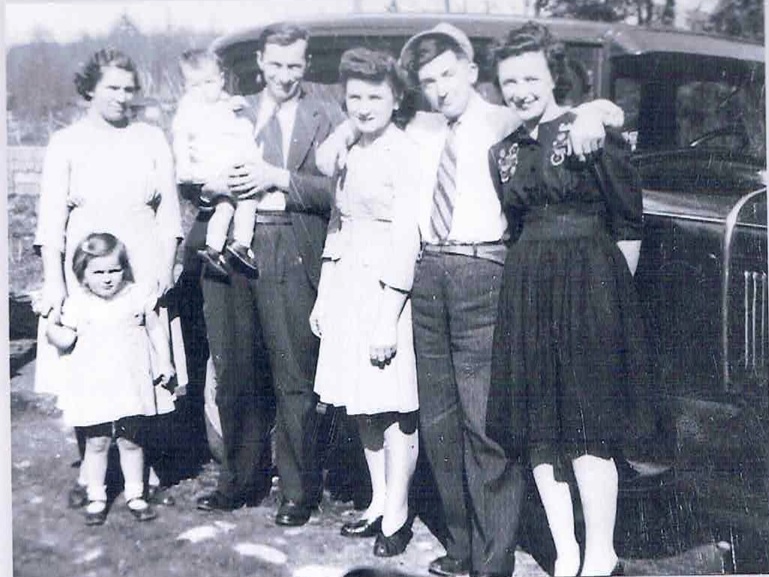
When I look at the picture I analyze in my last post, I am struck by the innocence of the scene, the mundane aspect of it.  The full impact and relevance of the scene cannot be appreciated at first glance. The scene is nothing outside of its living context. The people depicted in the photograph have no idea what awaits them in the near future, the death, panic and sorrow that they will suffer, as well as the love and sacrifice that will energize life and make it livable for them. What can I see in their faces? Nothing that belies their future. My mother would never have dreamed when this picture was taken that within 3 years she would be having a baby with the man standing next to her in this picture, a man married to the woman who stood just on the other side of him, both of whom had been her family’s close friends for years.

Now, I must make a correction to my previous post where I suggest that Yvonne died on June 22nd, 1945, because it was rumoured my father couldn’t afford a transfusion which would have saved Yvonne’s life. That may still be true, but I now know that my father had asked my mother and aunts to give blood to save his wife. Cecile donated blood sometime after midnight on June 22nd, but it was too little too late.   I learned this by looking through calendars my sister Claudette created for us over the years which contain pages from a diary my mother kept for a few years during the 1940s. It may be that my father had to find blood donors himself because he didn’t have the money to buy blood from the usual sources.  I find this difficult to believe because St. Mary’s was a Catholic hospital and I can’t imagine they would let someone die who couldn’t afford a blood transfusion, but no one lives who can set the record straight.  That makes the photo I introduce in my last post even more compelling to me because now, Cecile, my wonderful older aunt, standing on the far right in this picture, is also intimately involved in the final stages of the drama that was to unfold at St. Mary’s Hospital on June 22nd, 1945.  Death in childbirth was not as common in 1945 as it had been in previous generations but everyone knew that it was a dangerous time.  Yvonne was 29 years old, a mother of five daughters.  Such a tragedy.

It seems my mother and her family were very close to my father and his family for some time before they were married.  There was much socializing between the families starting in Alberta around Bonnyville and continuing in and around New Westminster in British Columbia.  My mother’s diary is full of references to visits to my father’s home in the years leading up to June, 1945.  She writes on Sunday, January 7th, 1945: “My day off [from work at St. Mary’s Hospital]. Went to Zenons for supper and a party.  Stayed until 3 AM.  Had lots of fun…”  On Sunday, March 11th, “I went to Zenons for supper then to a card party. I won $1.50 first prize womens. Zenon won $10.00 door prize…had lunch at Fraser Café with Albert and Gill, Mrs. Lagrange and Zenons.” The close familiarity between the Alberts and Leguerriers is evident in the photograph and it waits patiently, silent in the background to give added meaning to the scene for those who wish to know. The events to unfold in the following few months can only be understood in light of the tight bonds that existed in the community of ‘ex pats’ from Alberta now living in British Columbia.

A photograph can hide as much as it shows.  It can give us the impression of time stopped for an instant, frozen in a way that allows us to return to contemplate the moment, to relive the essence of a snapshot, lingering and maybe meditating on it.  It’s an illusion, of course, but that doesn’t prevent us from taking pictures, from trying to momentarily pause the clock. But clocks are stubborn things.  They stop for no one.

I have another photograph.  This one was probably taken on June 25th, 1945, the day of Yvonne’s funeral. She was buried along with her son, Roger, in St. Peter’s Catholic Cemetery in New Westminster.  It shows my father kneeling before Yvonne’s grave which is covered in flowers, his five daughters by his side.  The same day, my father asked my mother to quit her job at St. Mary’s Hospital, come work for him and look after the girls.

I have an old photograph.

I don’t usually have people edit my work before publishing. I probably should because every good writer needs a good editor. With regard to my last post, my five older siblings are my half-sisters not my step-sisters. My daughter, Arianne, was kind enough to point that out.

Roger JG Albert's avatarRoger Albert - Always a Sociologist: Now Living With Myeloma

I have an old photograph. I don’t know who took it and I’m not sure exactly when it was taken, but it must have been sometime in 1944 because in the picture my father is holding in his arms my step-sister, Denise, who was born on January 10th, 1943. In the photograph she appears to be a year old or so, which would mean the photo would have been taken sometime in mid 1944. Given that my father’s first wife, Yvonne, died on June 22nd, 1945, it stands to reason that the photo was taken sometime in 1944. It doesn’t look like Yvonne was pregnant at the time with Roger, but she may have been.

There is no obvious way to tell where the photo was taken, but the ground is dry and there’s no snow. I’m guessing it was taken somewhere in or close to…

View original post 617 more words