Ant Under Glass. Should I Kill It?

I’m finding it fascinating how I’m so unable to write at the moment. Well, of course I can write, but I’m flummoxed when it comes to writing a coherent blog post. My age may have something to do with it, but there’s more to it than that. In the past couple of weeks I’ve started writing a blog post four times and for pity’s sake, I can’t complete even one. I guess I’m losing it. That’s not something I want to accept, but as we get older we all lose multiple abilities. It’s inevitable. Eventually we lose all ability. That’s when we die. Dead people don’t have abilities. 

In some ways, I think I’m getting gun shy. People are dying all around me and I’m just here waiting for the sniper to pick me off. I’m keeping my head down, but that strategy will only be good for a time. The Sniper in Charge (SIC) will find me. I have no idea how long it will take for her/him to find me, but it will happen. That has me distracted, very distracted. You may find that this blog post reflects that distraction. It’s anything but coherent. But here goes anyway.

I learned the other day from a very young blogger and her father that mindset is everything in life. To some extent I agree. It’s self defeating to go into a project with the attitude that “I can’t do that.” Of course most of us can do that. Yes, we can. But that attitude is contingent on age and other characteristics we have that may make it impossible to have a ‘can do’ attitude. No matter how much I may want to, making babies is not possible anymore for Carolyn and I. We are both beyond that project. 

The young person I’m referring to here is female. She and her sister operate a small sawmill as part of the family’s logging, lumber, and firewood business. They are both still teens and are very active in life outside of their work. In many ways, they are exceptional. They work in a family business. I don’t know how common that is these days but they may very well be the only young women in North America operating a sawmill of any size. Most people would consider that Man’s work. Her father declared in an interview she did with him in a recent blog post that they come from a Judaeo-Christian tradition and are actively Christian, in that they pray to God and all that. That fact gives them access to a whole community of like-minded people giving them wide acceptance in the community for their business and other activities. That’s just life for them. I’m sure they don’t see their faith and status as God-fearing White Folk giving them any kind of advantage in life. They would argue that they have just made the right decisions in life and people who make the right decisions in life create advantage for themselves by their very actions. There are various interpretations as to the accuracy of this kind of view, but it seems to work for them. It doesn’t work for a very substantial part of the population as sociology has clearly demonstrated over decades of research. 

Well, I guess mindset is important for me too. I can either whine and complain about the fact I have a cancer that won’t go away and will eventually kill me, or I can just get on with things and ignore my ultimate demise. I’ve commented on a recent post that death is akin to a wall. I see it clearly on the horizon, but why focus on it? Actually, it’s hard not to focus on it, but it doesn’t make sense to do nothing else. It certainly is distracting, however. 

I just captured a carpenter ant. I’ve got it on my side table under a shot glass. I can observe it moving about. It really wants to get out of this predicament and constantly looks for ways out. When I tap the glass it goes absolutely still. It’s a winged ant which means that it is at a stage in its life when it is bound to search out a new home. At this time of year they come out of the woodwork, literally. This ant seems very confused. This small prison it’s in is thwarting its destiny, which is, along with its buddies, to eat our house, which is made of wood, so lunch is served. However, I’m not particular enamoured with its destiny because we have conflicting interests. So, what should I do with this ant? I could easily kill it, or keep it imprisoned until it dies, or I could release it so that it can start munching on my house. Even if I release it outside, it’s still liable to find a spot to have a nibble. Obviously it cannot eat us out of house and home, but we know from past experience that it can, along with its buddies, cause a lot of damage. So what do I do? 

Help me out here. What should I do?  
Ant Under Glass

I’ve struggled a lot lately about whether my glass is half full or half empty. I’ve lived seventy-five years. Is that a good thing, a bad thing, or just a thing? 

Whatever. 

Lately, I’ve often mused nostalgically about my past. My present is not what I would have it be, but I’ll write about that below.

For now, I want to write about moments in my past that were particularly instructive for me. You all know that I have cancer. That’s not news. However, some of you may not know that I was diagnosed with kidney cell cancer in 2002. From what I was told, I had what they call a lesion on my left kidney. In this case a ‘lesion’ means a fairly large growth protruding from my kidney. They were loathe to do a biopsy because any puncture of the lesion or any attempt to remove the growth by aspiration was going to spread the cancer far and wide. So, they scheduled me for surgery. I was fortunate to have a very good local urologist perform the surgery with my GP attending (he’s an internist as well as a family physician).

My Nephrectomy

When my time came for my nephrectomy (removal of my kidney) on February 17th, 2002, Carolyn drove me to the hospital early in the morning and left me there to find my way to the surgical unit. I wasn’t there long before they ushered me into the operating room. I was set at ease to see so many people I knew there, including a nurse who was a former student, my GP and the surgeon. I didn’t know the anesthetist although I had met him earlier in the hospital for a pre-surgical interview. 

So, taking my kidney out would be a straightforward affair if you knew what you were doing! Thankfully, the urologist knew what he was doing. In order not to spread the cancer far and wide, he opted to open me up using a 35 centimetre incision between my ribs on underside of my left arm to my midsection but lower on my body. They essentially cut me in half so they could gently lift my kidney out of my body without messing with the surrounding tissue and risking metastasis. I heard later that my GP was humbled by the process of cutting me in half and putting me back together. 

After the kidney was removed and they made sure they hadn’t left anything in there that shouldn’t have been there, they stapled me shut and sent me off to a room upstairs. I was there for a few days. I had a morphine pump to make sure I had no pain but it did have a governor on it so I didn’t overdose. That was kind of them, I think. 

I went home after six or seven days. We had just moved to Cumberland on an acre. There was lots of work to do. I couldn’t do any of it. Thankfully a number of my family members came over. There was lots of help and Carolyn was healthy, as she still is so I watched as my family and some friends helped us move in and get the yard together. 

_____________________________________________________________________

Visit to Cancer Care Centre 

We saw my local GP/oncologist this morning. These meetings are always interesting. I’ve been off chemo for a month and I’ll be off again for another month so that we can more properly assess how I react while not on the chemo meds. I’m also off hydromorphone (opioid), having gone through the nasty process of withdrawal over the past few days. I’ve never taken a very high dose of it, but I have been on it a long time. That makes it a bit of a challenge to stop taking it. I’ve also cut way back on gabapentin, which is a drug initially used for epilepsy, but has been used for all kinds of ailments since (maybe overused). I really have no idea how it’s affecting me because I have had such a mix of medications over the past couple of years that there’s no way I can tell what med is having what effect. It’s supposed to help with my peripheral neuropathy. Maybe it is. Maybe it isn’t. I really don’t know. It’s just a bit confusing and frustrating. 

I was in the Cancer Care Centre at the hospital this morning, as I said, to meet my GP/oncologist, and I saw a few of the usual suspects getting treatment. There was an older woman (probably a bit older than me) getting an infusion in Chair #4. I’ve seen her a number of times before. This time she was with her husband (I presume) who sat in a chair beside her. We nodded to each other. A young woman came by us as we waited to see the doctor. She was in Chair #3 I think. She was dragging her IV pole along beside her as she made her way to the bathroom close by, something I’ve done many times. IV poles, with bags of meds hanging from them with a line entering the arm somewhere, are on casters but they still rattle away as they are dragged along. I thought to myself: “This is my life. I share it with people I don’t know and some I do know, people who share my struggle to one extent or other. What we share is cancer.” But we also share the care and love that the staff gives us. Notwithstanding, every one of us will die. We may survive a year, two, ten, or twenty, but we must die. I’m not complaining about that. It is what it is.

I’ve spent a good part of my life studying life and death. I’m a sociologist, but I’ve not contained myself within that discipline. I’ve struggled to see the big picture of life on this planet and how life cannot exist without death. I know it’s something I’ve brought up before, but it’s always on my mind. 

We’re coming on to spring. My favourite season. Plants spring up everywhere. They count on the decay from previous years to fuel their growth. Life is not a cycle. It’s more like a spiral, with an inevitable end. To think of the seasons as cyclical is a mistake, a comforting mistake, I guess. I’m thinking we have a built-in biological aversion to death. From what I’ve observed, we share that aversion with most other animals. Life is the big draw, death and disease are the ultimate enemy. Our whole culture is built on that false premise. Silly us. 

This spring for me is not like the spring of my tenth year, nor of my fortieth year. I’m hoping this is not my last spring. I’m thinking it won’t be, but the future is promised to no one. 

Teaching on live TV, with Roger Loubert (RIP)on the phones.

So, sometime in 1986-87 I started teaching live-interactive telecourses on the Knowledge Network. The Network was very different then and North Island College had several telecourses telecast on it by a few instructors, me included. I’ve already posted a blog about my experience doing that work. You can check it out here:

One thing I didn’t mention in my 2018 post was the selfless dedication of one of my friends, Roger Loubert, to me and to my courses on the Knowledge Network. He “worked the phones” for the phone-in segments of the courses every two weeks during the academic year and he did it with no expectation of pay or reward. He died at Crossroads Hospice in Port Moody of complications from prostate cancer on July 3rd, 2021. He was just a little older than me. You can read one of his obituaries here.

Roger and I go back to the 1970s. He had come to BC from New Brunswick. I don’t recall any of the details of his migration, but he ended up in Maillardville, a small French-Canadian community in Coquitlam established in 1909. Fraser Mills, on the banks of the Fraser River needed sawmill workers who weren’t “Oriental” but were at least White and who could strike break if needed. The fact that they spoke French was a minor irritant, but they were also Catholic, and that proved a little more problematic because they wanted their own church building if they were going to stay.

Maillardville was were I grew up and it was to remain a French-Canadian community for many years, until the late 1970s. It has remnants of French culture and still has two French-based Catholic Churches. The assimilation rate is over 95% now so you’ll find that most people in the community speak English exclusively and intermarriage has made it more and more difficult to call families French-Canadian anymore. That’s not to be lamented, that’s just the way the world works.

Loubert (that’s what I always called him) thought Maillardville was special, a microcosm of Canada. He invented something called Information Maillardville and rented a room in a building at the busy corner of Brunette Avenue and the Lougheed Highway to store all of his Information Maillardville (stuff) documentation, and there was a lot of that right from the beginning. He eventually moved his stuff to a warehouse in Vancouver around Manitoba and 8th. He lived there too of course. No running water, no anything. Just lots of paper and stuff. He moved it again later to various locations in Coquitlam and environs. After he died, it was left to his friends to clean it up. He would never have given up or gotten rid of his stuff while he was still alive.

Loubert was certainly an eccentric. His eating habits back when I first met him were unusual. His girlfriend at the time was Dutch and she was more hippie than eccentric. I don’t think that veganism was as common then as now but they were both vegans. They cared not an iota about what anybody thought about them. He subscribed to the ‘mucusless’ diet, a diet originated by a German ‘naturopath’ and ‘alternative health educator’, Arnold Ehret, who died in October 1922 at age 56 from a fall and head injury while walking along a sidewalk. He had moved to Los Angeles by then to prey on gullible Californians, I assume. His diet has been thoroughly debunked as ridiculous although it’s sadly still around. Loubert swore by Ehret and carried his book around for some time. Loubert was crazy like that, but he was not insane.

At one point while living in the Port Coquitlam area he adopted ten husky dogs and named them after each Canadian province. I can’t remember how that turned out. I can assume that he fed them before he even fed himself. He was like that. Eventually he got a job driving a school bus. That would have given him time to devote to his cultural and social activities. He was involved in a number of organizations in Coquitlam and adjoining municipalities. As I note above, he died still in possession of his ‘stash’ of Information Maillardville stuff and whatever else he managed to accumulate, which was substantial by all accounts.

Loubert was big on festivals and celebrations, at least when I knew him. He was always trying to organize Festival Maillardville. It never did materialize from what I remember. He could never get buy-in from the parishes in Maillardville (with their parish halls), but there were other festivals in which he could participate like Le Festival du Bois held this year at Mackin Park in early April.

I was a student at Douglas College in New Westminster from 1971 until 1973 then at Simon Fraser University from 1973 until 1980. Loubert and I had intermittent contact after that, especially after Carolyn and I moved to the Comox Valley with the kids in 1983. In 1974 or so I took time off from my studies to work on a project called Plan Maillardville. I was in my third year of my Bachelor’s degree but I was hired to be the project sociologist because not only was I from the area, but I was bilingual. Loubert was delighted by my work on the Plan Maillardville. He was frequently in my office, chatting it up.

For a few years after 1983, Loubert and I, like I said, had only intermittent contact. However, when he found out that I was going to be on the Knowledge Network, that really piqued his interest again. He was always fascinated with radio and TV because of information, of course. So, we met and discussed his participation. He was delighted to be involved.

I had NO budget from North Island College for much of anything except props. Of course the College paid for my transportation and hotel costs, but not much towards the production of the telecourses. So Loubert’s offer to work for nothing was a godsend. During my broadcasts he sat in the control room to take the phone calls during the twenty or so minutes at the end of the hour program we allowed for that. That was every two weeks. He loved to talk on the phone and always used the occasion to chat people up. He was always very sociable on the phone from what I gather.

Loubert was always game to help out. I appreciated him for that. He was definitely one of a kind. Unfortunately I never had the opportunity to thank him again for his dedication to our work on the Knowledge Network. This is not a substitute for that, just a small token of my appreciation.

75 UP

So, this post is about what’s up with me now. I’ve reconciled myself with the fact of my frailty, which I share with all living things. It stands to reason that my body is not as it was twenty or even ten years ago. All individuals of all species, plant and animal have a life course. We’re all born. Even trees, but some of those individuals die young (like the trees that are being cut in the hills above Cumberland), some trees live out what must be considered the outer limit of life’s potential, in the Carmanah Valley, for instance, no thanks to BC’s forest industry. Some of us humans die young. Some die hacked to death in a stupid race war in Rwanda in 1994. Others die horrible deaths in the ovens of Auschwitz. Still others, of all species, die of inborn problems, with their DNA or or whatever. In the end we are all frail, even the biggest and toughest among us, and vulnerable. For most plants and animals eventually, the soft, squishy material that we’re made of becomes increasingly brittle and inelastic as we age and approach our inevitable ends. My squishy material is definitely becoming worn out. It still has some bounciness in it, but nothing like it had years ago, and there’s no turning back. But on with the story.

Being one who kind of likes living (even given what I write above) I dutifully injected B12 into my legs (alternating left and right) once a day for a week mid-January and since then I’ve injected once a week.*That should replenish my B12 levels and keep me going. It may take some time for increased amounts of B12 in my blood to make a difference to my energy levels, but I can be patient as I know that results will come. Of course, I’m fighting a losing battle. We all are. Death will catch up with me regardless of how much B12 I inject or how many chemo drugs I take. I find it almost funny that we talk about medicine, police, firefighters, paramedics, etcetera as saving lives. The best they can do, in reality, is allow life to go on a bit longer, to postpone death. In any case, I have my B12 situation under control.

In terms of myeloma, I’m off chemo drugs for at least a month. Myeloma protein is barely detectable in my blood so this is a good time to lay off for a while and see how things go. It would be grand to get some relief from side effects for a time. Next month sometime they’ll check my blood again to see what the status of my paraproteins(myeloma proteins) are. I can easily go back on chemo if the bloodwork shows a rise in paraproteins. During our last phone call my local GP/oncologist uttered the word remission. I hope he’s right but only time will tell.

Another thing has come to plague me. It looks like it’s true that nastiness comes in threes. I’m getting a CT scan on Monday of my left jaw. I saw an endodontist a while ago because of excruciating pain in one of my left upper molars. He figures I need a root canal. Well, that’s probably true, but because I had a lesion in my left lower jaw that required radiation treatment earlier this year, I wanted some assurance that this issue with my upper jaw wasn’t also due to myeloma. It may be that I should be more trusting, but the symptoms caused by a myeloma lesion and a rotten tooth are similar so I just wanted a little reassurance. I got that when I spoke with an oncologist at the BC Cancer Agency in Victoria last month. She ordered the CT scan the results of which will determine whether I get a root canal or more radiation. My, my. Life can be complicated.

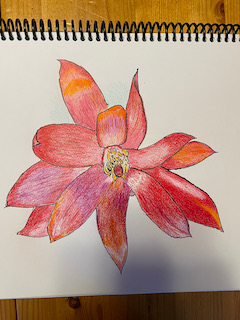
In the meantime, I’m back to doing some drawing. I got a very cheap but good set of coloured pencils for my birthday last month, so I did a couple of drawings. Here they are:

Christmas cactus head on view.
Christmas cactus side view.

I have one more I want to do with the coloured pencils using a different profile. Then I want to do a couple more in watercolour on proper paper, and maybe in acrylic on a large canvas. I’ll have to assess my level of energy before I undertake a large(ish) canvas, but I seem to be getting stronger every day now.

___________________________________________________________________

*If you haven’t read my post from January 13, 2022, you might want to do so now. It outlines my experience with B12 deficiency and pernicious anemia.

Pernicious Anemia and Multiple Myeloma: A link?

Well, well. I should have known. Sometime before I was diagnosed with multiple myeloma in October of 2019, I was diagnosed with pernicious anemia. That’s a vitamin B12 deficiency that cannot be corrected by just taking a supplement. With a B12 deficiency, a dietary supplement can fix the problem, but pernicious anemia is a situation where B12 cannot be absorbed into the blood by ordinary means because of a missing intrinsic factor, a protein which is produced in the gut by gastric parietal cells. For me to get vitamin B12 into my bloodstream I need to inject it intramuscularly. I do it myself because I can’t be bothered to go to the Nursing Centre or somewhere where someone can do it for me. It’s a simple jab in the leg. No big deal, but for me it’s a life saver. As Martyn Hooper, the Founder and President of the Pernicious Anemia Society (PAS) in Britain, says it regarding his own experience: “Consequently, should I stop receiving injections then I would once again be unable to make healthy red blood cells and would gradually become anaemic and eventually die”*. Hooper was undiagnosed for years and has suffered permanent neural damage because of the delayed treatment. It’s a question of life or death. Pernicious anemia is called pernicious because it’s deadly. Just to add a bit of fun to it, it’s also incurable, just like myeloma. Towards the end of this post I specifically address the link between pernicious anemia and myeloma, but for now I need to deal with pernicious anemia.

As it turns out, I had been on monthly injections of B12 for years before about six months ago I let it slide. I ran out of B12 and just didn’t bother asking my GP for another prescription. Truth be told, I didn’t really feel as though the monthly injections were doing any good. Of course, my whole body was thrown into chaos by myeloma making it very difficult to pinpoint the source of any given issue I may be having, and there were lots of those. Frankly, I should never have stopped injecting B12, but it’s not going to do me much good to beat myself up about it. I’ve already spent enough time doing that.

About three weeks ago, after feeling like I’d been going downhill for some time, I called my GP’s office and requested a B12 blood test and a prescription for a new supply of it. This past Monday I went to the lab for my regular monthly blood workup in preparation for my chemo appointment today, but this time B12 was added to the assay. On Tuesday I got the results. No wonder I haven’t been feeling well, the level of B12 in my blood was way below the recommended amount. I came in at 84 pmol/L when the reference range is between 150 and 600. The literature I’ve scoured is inconclusive, but it seems that 150 is way too low for most people and 1000 is recommended by some sources for seniors to maintain good cognitive and neural health. In any case, my GP’s office contacted me this morning and told me that for the coming week I should inject B12 daily, for the following month, every week, and thereafter once a month. I’ll have to make sure the docs add B12 to my monthly blood assay so that I can ensure that I have the requisite amount in my blood. I think I’ll aim for 1000 pmol/L. If I can’t maintain that with a monthly injection, I’ll increase it to bi-monthly, etcetera. 

I haven’t conducted a scientific poll, but I doubt that most people know about how important vitamin B12 is for good health. B12 is crucial for the production of red blood cells. B9 (folate) is also important as is D3 but these can be easily supplemented. It’s worth doing an internet surf to find out more about B12 especially if you’re feeling chronically tired for no reason. I think the PAS is a great source but there are others, lots of them. The challenge is to recognize the stupid sites and not use any of their stupid suggestions or offers of stupid products. Make sure that if a site makes specific claims like methylcobalamin is better than cyanocobalamin get a second opinion. Martyn Hooper injects methylcobalamin twice a week (5mg/ml). It’s available online but it’s not cheap. He offers only one source for his assertion that methylcobalamin reduces peripheral neuropathy whereas cyanocobalamin doesn’t, and that paperis about ALS and methylcobalamin in megadoses. I generally trust Hooper, but we all make mistakes and sometimes we get headstrong about our own health and how to manage it. Hooper has good reason to be pissed at the medical profession, and the medical establishment in Britain and if you read his very accessible books you’ll know why.

Now we get to the fun part…the one with no conclusive argument: the relationship of pernicious anemia with multiple myeloma. So far, very little research has been conducted on the links between pernicious anemia and myeloma. This article does address the issue but is ambivalent in its findings as you can ascertain from this quote:

For multiple myeloma, increased risk was seen only with pernicious anemia, an inflammatory condition in the stomach leading to vitamin B12 deficiency. This association was also demonstrated in two other large studies, which found few other autoimmune conditions associated with multiple myeloma.1617 Because of the lack of association with other autoimmune conditions, our finding may point towards the involvement of vitamin B12 deficiency. Indeed, vitamin B12 deficiency has been reported in patients with multiple myeloma and in patients with the precursor condition, monoclonal gammopathy of undetermined significance.161946 Although multiple myeloma may cause vitamin B12 deficiency by consuming stored vitamin B12,47 we speculate that vitamin B12 deficiency could promote the development of multiple myeloma by causing derangement of one-carbon metabolism, as proposed in other cancers.48 2

See citation below.

This study3 shows a more significant association between myeloma and pernicious anemia: “Using a large population-based dataset, we observed a 3-fold significantly increased risk of MM among subjects with a personal history of pernicious anemia, which has been found in previous studies.” Now, that got my attention. It’s clear that I had pernicious anemia before I had myeloma – at least that’s what I think. However, because I wasn’t diagnosed with myeloma for a long time before I contracted the disease it may be that I had both pernicious anemia and myeloma at the same time. 

All I know is that pernicious anemia and multiple myeloma share a whole load of effects and they are both incurable and fatal if not treated. I’ll let you know how my current B12 therapy goes. Right now it’s being affected by today’s injection of Daratumumab. Oh well. I always liked a puzzle.

_____________________________________________________________________________________

* from: What You Need to Know About Pernicious Anaemia and Vitamin B12 Deficiency by Martyn Hooper, Chris Steele)

1Izumi Y, Kaji R. Clinical trials of ultra-high-dose methylcobalamin in ALSBrain Nerve 2007:59 (10): 1141-1147.

2  Lesley A. AndersonShahinaz GadallaLindsay M. MortonOla LandgrenRuth PfeifferJoan L. WarrenSonja I. BerndtWinnie RickerRuth ParsonsEric A. Engels. Population-based study of autoimmune conditions and the risk of specific lymphoid malignancies. International Journal of CancerVolume 125, Issue2, 15 July 2009, Pages 398-405

3Ola LandgrenMartha S. LinetMary L. McMasterGloria GridleyKari HemminkiLynn R. GoldinFamilialcharacteristics of autoimmune and hematologic disorders in 8,406 multiple myeloma patients: A population-based case-control studyInt J Cancer 2006 Jun 15;118(12):3095-8.

Life and Death: How Absurd!

[This post was first published in June 2019, about four months before my myeloma diagnosis. Lately, I’ve been re-reading my posts looking for the best ones to re-post. This one is a particular favourite of mine, so here it is for you again. I don’t think I can express the ideas presented here any better now than I did back in 2019. I’ve been trying, but with no success. So, rather than continuing to beat my head against the wall, I decided to give myself a break and re-post this piece now. I hope you find it interesting (again). Just got news that an old colleague of mine just died. It seems we’re dropping like flies these days. Pretty easy to predict.]

We are born, we live and breathe for various lengths of time, then we die. Seems rather pointless, really. For as long as we know, and from all the historical records that we have unearthed or discovered one way or another, we can only conclude that humans have not ever been terribly enamoured with this situation.

Of course, most animals are averse to death, or at least to dying. Death itself isn’t particularly scary, it’s the getting there that we have a problem with. Even an ant feeling attacked will flee or fight. Of course, once it’s dead there is no issue. Not all animals face dying in the same way. Without being too anthropomorphic, some are stoic, some are frantic. In humans, some are even self-destructive but I’m not sure that death is what suicides want. Relief from pain and suffering is probably the goal more often than not, but in many cases, death seems the only respite, the only place where there may be peace. Of course, that’s silly because there is no ‘place’ after death. Death cannot be a respite from pain and suffering because we have no way of experiencing relief from pain in death. Death is the absence of sensation, of thought, or feeling; it’s the absolute negation of consciousness. Death is no thing. Before we are conceived we are also nothing, no thing. Life as we think of it as sentience, feeling, consciousness, starts sometime in our development. It’s hard to know when. In a way, death puts an end to the whole story.  Historically and linguistically, we have wanted to contrast living with dying, but they are not opposites. Death is the only way life can happen. So, why, generally, is it so hard for us to let go of life? Well, like all other animals we have a survival instinct, or an instinct for self-preservation. With rare exceptions, there seems to be an inherent drive in all animals to continue to live. I don’t think any species would get very far without it. It does present a problem for us, however. It means we go to great lengths using our big, unfortunate brains to deny death using whatever means we can, and boy do we have lots of means! Our cat is afraid of death. She skulks around wary of a stray cat in our neighbourhood we call Mean Gene because he beats up on our Princess Pretty Paws. Still, she hasn’t managed to institutionalize death denial. She just can’t take it that one step beyond immediate, visceral run-like-hell action. And when Mean Gene is no longer in sight, Princess is just fine. She is not anxious and preoccupied with dying. She’s still interested in her food bowl, however. 

What it gets right down to is the fact that as animals we reproduce sexually and engender offspring who are themselves immediately on a trajectory to death. Living and dying are the same process. Stop dying and you’re dead. Now that seems completely unfair. We are built to die! What the hell! Well, that just can’t be, damn it!

Over the millennia, we’ve created any number of ways to convince ourselves that we don’t really die, that although our bodies may perish, our ‘souls’ do not, and that makes us immortal in a god-like way, really. For us to be immortal we must be gods and by our earthly deaths experience apotheosis. Millennia ago, when we were still in our infancy as a species, we were awed by the powers of nature and our extreme vulnerability in the face of them. We decided that there must be some sentient power that controlled the forces of nature, the floods, volcanos, fires, landslides, and other deadly phenomena. Not only were there powerful natural forces, but they were capricious and unpredictable as well as uncontrollable.

In our silly wisdom, we figured out that maybe, just maybe, we could barter with the gods so that they would leave us alone. If we presented the gods with gifts, even living gifts (as in virgins thrown into a volcano), maybe we could obviate the damage the gods inflicted on us. It was fine to kill all the people in the next village, but leave us alone, please. Well, that didn’t always work according to plan, so an explanation was necessary. So, if our village was ravaged by a fire even though we had been really good and had made lots of sacrifices to the gods, maybe those sacrifices just weren’t enough. We just had to kick up the giving a notch or two. Sadly, we are still very much controlled by this narrative. 


18 Looking in the Mirror.

[This is a reprint of a post I wrote in January of 2020. I reproduce it here in honour of Elizabeth (Bunny) Shannon who was especially drawn to it. Bunny died of cancer last month. She was a friend and an extraordinary person. I am privileged to have known her]

When I look in the mirror I see an old man. I don’t see an old man with cancer. I just see an old man with a white beard, not much hair, and wrinkly skin. Melanoma (skin cancer) often leaves visible, sometimes unsightly and disfiguring lesions. I don’t have melanoma, although my father did. No, I have myeloma (bone marrow cancer) and its damage is all done on the inside, invisibly. So, I guess I can keep expecting people who see me say: “Wow, you’re looking good!” I guess I DO look good! Now, the last thing I want is to discourage people from telling me how good I look, so keep it up! However, the invisibility of my condition is deceiving. I remember when I was a kid my friends and I used to work on our cars. That was still possible when I was a kid. Often we’d stand around looking into the engine compartment (often of my 1956 Pontiac four-door hardtop) wondering what could possibly be wrong as if just staring at the engine would give us some kind of clue. The engine was always sparkly clean and there was nothing obviously gone awry. If I had money by some quirk of circumstance I might take the car to a mechanic. If not, we might borrow my dad’s tools and start taking things apart. That usually ended up badly. Yes, the most undesirable conditions in life are often on the inside, impossible to see or diagnose by just looking at the person or car in question. I find it best to consult mechanics when our car shows signs of disfunction. I find it best to consult medical specialists for treatment related to my body. I guess I could try to treat myself using any number of the ‘cures’ available on Dr. Google, but I would like to live a while longer, thanks. Besides, I’m not that desperate.

Speaking of medical specialists, we saw my local oncologist today. I see him every five weeks. The result of our visit is that I will carry on with a second course of chemotherapy. We’ll evaluate how well it went in five weeks. My first course of treatment seems to have gone as well as could be expected. The little excavator in my bone marrow is slowly running out of gas and my red blood cell garden is growing again. I’m still exhausted and that won’t change for some time yet, but things are certainly going in the right direction for now. I think I just might be a model patient. So, where does this all leave me?

Well, I may be on my way towards remission. If and when I do go into remission, and that’s by no means guaranteed at this point, that would buy me some time. By that I mean that I may have a few years more to live, though inevitably, either the myeloma will kill me or some other condition will. I won’t be walking away from this situation, brush the dust from my sleeves and carry on. No, I’m on a one way street. So are you, of course, but I can see that damned barrier at the end of the street. I’m hoping that you’re still far enough away from it that you can live in blissful denial for a while longer. I don’t have that luxury. So now what do I do with my life?

That question came up in a recent Facebook thread, albeit expressed in a different way, but with the same effect, I believe. The question comes down to this: If you knew that you had a given amount of time left to live (six months, two years, whatever), what would you do with your time? Would you to be seized by an overwhelming sense of urgency? Would you be determined to cram as much activity and experience into your remaining time as possible? Or would you curl up in a fetal position in a corner of your bedroom quivering and whimpering while you await your inevitable demise? If you have the money and the energy you might want to get out there and travel the world. If you have a spouse, that might complicate things more or less because they may not want the same things you do and may not want to get caught up in your sense of urgency. The last thing you need when facing terminal cancer is marital discord. I think there’s a lot to be said for just carrying on with life as before.

If you have the energy and the money then good on ya. If you travelled a lot before your diagnosis then travel after. Your eventual energy deficits will tell you when to stop. If you were fairly sedentary, more into being at home and puttering around the yard, then that would be something you might want to continue doing. The stress of travel may not be that good for you. Looking around the Cancer Centre at the North Island Hospital this morning I didn’t see a lot of people with obvious enough vigour to engage in a lot of physical activity. In any case, back to my situation.

My exhaustion prevents me from doing much in the way of physical activity. If I do go for a walk I pay for it later. Travelling is impossible. At one point I thought it might be possible, say, to take a direct flight to Puerto Vallarta back and forth from Comox, but there are a number of contingencies that make that next to impossible that have more to do with arthritis and disk degeneration than cancer. Besides, I take chemo drugs once a week orally but also by injection at the hospital. For three or four days after I take my meds I feel crappy, really crappy so the chances of enjoying myself on a beach somewhere are slim to none.

So what do I want to do, and what do I actually do? Well, I want to work on our canoe, finish some paintings, do odd jobs around the property and visit family and friends in Vancouver and further afield. What I actually do is sit and lie down a lot. As I sit and lie down, I read, and sometimes I even write. At the moment I’m reading social history around the Middle Ages and doing a bit of research on my family roots in Normandy. That’s something I would have done anyway, but I do miss working in my shop and studio and going for long walks with Carolyn and our imaginary dog. My oncologist thinks I will regain my energy, at least as much as an old man can expect. If so, that would be great. I’d love to get back to canoeing, camping and puttering.

When I get closer to dying I will know it, and I expect I will have time to think about it, but there really isn’t much thinking that is productive about dying, at least not for me. I’ll know when it’s time for palliative care. I don’t want to live as long as the oncologists might want to keep me alive. I’ll make the decision when the time comes. I don’t think it will be a really hard decision. I know that beginnings are impossible without endings. My ending is a lot closer now than my beginning! That’s fine. Frankly, I’m much more concerned with my family than I am with myself. They are the ones left behind to mourn. But both of my parents are dead and we got on with life after their deaths. My family will do the same when I’m gone. That’s what we do as humans. Like it or not, accept it or not, rage against it or cower in a dark corner, the end result is the same. Don’t sweat it.

Trials and Tribulations

[Feeling a little disjointed today…]

If you’ve been reading this blog for any length of time, you’ll know that it’s all about me and my trials and tribulations around my experience with myeloma, old age, medicine, chemotherapy, and its side effects. Of course, I’m not completely self-absorbed, just mostly so. To be honest, it’s been a bit difficult to focus on anything else. Myeloma and its effects have taken over my (and my family’s) life. The pandemic hasn’t helped either. Both myeloma and the pandemic have severely restricted any social activity in which I used to take great pleasure. Driving is a challenge but not impossible. My neck seems to be getting somewhat better after the dexamethasone injection in my neck about six weeks ago. Now I fear that my time with Daratumumab may be coming to an end. I don’t know that for sure, but the neuropathy in my left hand is getting quite bad. Increased peripheral neuropathy is a side effect of Daratumumab and may be a signal that my body is rejecting the Dara. I talk to an oncologist in Victoria next month and we’ll certainly talk about my chemo treatments. On top of that I have a tooth that is dying if not completely dead. The endodontist I saw about that says I need a root canal and I should be on antibiotics for a bacterial infection just below that tooth. To be on antibiotics I probably need to cease chemotherapy treatments for a time. That’s another thing I need to talk to the oncologist about. So it goes. 

By the way, I’ve just finished reading The Cancer Code (2020) by Dr. Jason Fung. Aside from being a practicing nephrologist in Toronto, Fung is a prolific writer. This book on cancer is fine although Fung focusses on tumor-based cancers and mentions myeloma only in passing. I quite like his analysis and where he ends up suggesting that cancer is subject to evolution and natural selection like any organism. He argues that in the past cancer was seen as a mistake, then as a somatic mutation, but he writes: 

“Cancer had always been considered a single genetic clone, so evolutionary processes were considered irrelevant. But the realization that cancers evolve was electrifying. For the first time in decades, we had a new understanding of how cancer develops. The entire field of science known as evolutionary biology could now be applied to understand and explain why cancer develops mutations.” (from “The Cancer Code: A Revolutionary New Understanding of a Medical Mystery (The Wellness Code Book 3)” by Dr. Jason Fung)

Daratumumab is a monoclonal antibody. It worked well for a time. I hope it works for a while longer, but it is destined to fail when it no longer responds to myeloma’s mutations. He notes that cancer cells act like prokaryotes or single-celled organisms and not like eukaryotes or multi-celled organisms. According to Fung, we are on the cusp of a major paradigm shift in cancer treatment, but it will be expensive. What do we do about that? 

______________________________________________________________________

Just to remind myself that I’m still a sociologist, I’ve spent quite a bit of time lately reading and watching MSNBC, CNN, The Guardian, NPR, BBC, Al Jazeera, Ring of Fire, Beau of the Fifth Column, and other newsy YouTube videos. I check out some Canadian content, but the elephant next door is far more compelling than Trudeau’s antics or O’Toole’s foibles. I’ll come back to the US below, but before I go there, I just want to say that I’m reading a book by David Graeber and David Wengren published just last year called The Dawn of Everything. The book challenges everything we know about the “Western” version of history and is a refreshing read. For one thing it sheds value on indigenous ideas and ways of seeing as providing the real challenges to the philosophers (Locke, Hume, Hobbes, etc.) of the Enlightenment, Rousseau, and other incipient lefties. The authors reject the idea that indigenous peoples were the child-like innocents they are often portrayed as by European travellers and colonizers. They also challenge the idea that things can’t change, that we’re stuck with large scale, ridiculous, bloated states. Unfortunately, Graeber died on September 2nd, 2020, three weeks after this book was released. He was fifty-nine years old. That hardly seems fair.

I don’t know how many of you are interested in American politics. It can be a nasty, grubby place at times and unless you are steeled against media biases and distortions of reality, you might be left with all kinds of strange ideas about what’s really going on to the south of us. One thing is for certain, I’m getting just a little perturbed at the ignorance and stupidity of some American politicians in Congress who shout “socialism” every time Biden and the Democrats dare spend a dime on regular, run-of-the-mill citizens or on infrastructure. They want all the cash to go to the 1%. I’m still not sure how that benefits them personally unless they believe Milton Friedman’s ridiculous trickle-down theory by which if regular people as taxpayers give billionaires all the money that some of it will trickle down to them. That is such a bullshit theory. The proof of that is that it’s never worked and the concentration of wealth in the über-wealthy is clear evidence of that. 

Ted Cruz, Rand Paul, Josh Hawley, Marjorie Taylor Greene, Lauren Boebert, Jim Jordan, and their ilk in the Republican Party and sitting members of Congress obviously haven’t a clue what socialism is, or, if they do, they are being disingenuous about it. The truth is that it may be some of both. For these clowns, any money spent on bridges, highways, city roads, the electrical grid, wastewater systems, potable water, etcetera, is evidence of socialism. So stupid. They take the notion of individual initiative and investment to the extreme. But, of course, they just want to get re-elected and making outrageously false statements is the name of the game. They can always be retracted later when nobody is paying attention.  

I’d say that I follow American Congressional politics as entertainment, but it’s not funny. There is a fairly serious challenge to the status quo there from a far-right racist Republican cabal and some people seem to want to continue the Civil War of the early 1860s. I do take some comfort in the fact that there are over 300,000,000 people in the United States and that would be a hard ship to turn around. I have a lot more to say about the US, supply chains, the wane of capitalism, the rise of oligarchy (which is already close to the surface), and history. Stay tuned. 

I strongly recommend reading Heather Cox Richardson on Facebook. You’ll get a well-researched commentary on American politics from a classy historian. Check her out.

Slowly Falling Apart

For this post, I decided to create a collage of quotes and commentaries from books I’ve been reading lately. They range from comments on death and dying to philosophy, culture, and the future. So far in this blog, I’ve refrained from commenting on American Congressional politics, but I just may go there soon. I told my sociology students year after year throughout my college teaching career that the American empire would fall, as all empires fall, not from external conquest but from implosion due to unresolved, long standing conflict. The American empire, specifically, will fall because of commodity production that depends on longer and more complex supply chains and failing profits. America is falling on its own sword of profits. Supply chains and economic processing zones in a plethora of ‘developing’ parts of the world have been an issue for decades while only recently making it onto mainstream media commentary and news. I’ll explain in a future post.

US politics has to wait. It’s a mess down there but it’s a mess everywhere on the planet at the moment. Let’s move on.

________________________________________________________________________________

Robert Sapolsky is one of my all-time favourite guys. He has a number of his Stanford University lectures on YouTube. He’s a neuroscientist who specializes in stress. He worked in the field for many years with Olive baboons in Africa. I have a video in which his work with the baboons is featured. On the topic of the human condition he writes:

“we are now living well enough and long enough to slowly fall apart. The diseases that plague us now are ones of slow accumulation of damage—heart disease, cancer, cerebrovascular disorders.” (from “Why Zebras Don’t Get Ulcers: The Acclaimed Guide to Stress, Stress-Related Diseases, and Coping (Third Edition)” by Robert M. Sapolsky)

Now, ain’t that the truth! If you check out Stats Canada’s vital statistics you’ll find out that cancer is the leading cause of death in Canada. Actually, life is the leading cause of death everywhere, but as far as the observable evidence of bodily decay and death goes, cancer is determined to be the immediate major causes. Writing this makes me want to go back and binge watch Sapolsky on YouTube. Not only does he have a lot to say, but he says it in such an engaging way that binge watching is entirely feasible. I’ll be sharing more from Sapolsky later, but now on to another very different writer.

This is a quote from another book I’m reading that I want to share with you. Talk about falling apart! Robinson is a contemporary novelist writing in the sci-fi genre with dystopian tinges. He writes:

“Say the order of your time feels unjust and unsustainable and yet massively entrenched, but also falling apart before your eyes. The obvious contradictions in this list might yet still describe the feeling of your time quite accurately, if we are not mistaken. Or put it this way; it feels that way to us. But a little contemplation of history will reveal that this feeling too will not last for long. Unless of course the feeling of things falling apart is itself massively entrenched, to the point of being the eternal or eternally recurrent individual human’s reaction to history. Which may just mean the reinscription of the biological onto the historical, for we are all definitely always falling apart, and not massively entrenched in anything at all. 31 India” (from “The Ministry for the Future: A Novel” by Kim Stanley Robinson)

Most of this quote will be difficult for you to fathom because it’s out of context. It’s the last sentence that really matters. To help you out a little with the context of this quote, the ‘order of your time’, in the first sentence means that in the course of your life you feel out of control. You can’t go back, you can’t stay still. You can only go forward towards your death. This applies not only to us as biological entities but also to our cultural and social constructs which also are bound to come and go in a generally disorderly way. We cannot be ‘massively entrenched’ in life because daily existence makes a lie of any attempt to avoid moving toward death.

Now, more from Robinson in another of his sci-fi novels set far from Earth on a ship and a moon.

“Existential nausea comes from feeling trapped. It is an affect state resulting from the feeling that the future has only bad options. Of course every human faces the fact of individual death, and therefore existential nausea must be to a certain extent a universal experience, and something that must be dealt with by one mental strategy or another. Most people appear to learn to ignore it, as if it were some low chronic pain that has to be endured. Here in this meeting, it began to become clear, for many of those present, that extinction lay at the end of all their possible paths. This was not the same as individual death, but was instead something both more abstract and more profound.” (from “Aurora” by Kim Stanley Robinson)

Robinson is not a great writer in terms of composition, but he is a very perceptive commentator on the human condition. His novels are all about the fragility of humanity in the face of evolution and death, both on an individual and social level. Death denial is a consistent theme in human history and as a goal, has engendered a mass of immortality tales with “supernatural” characters as diverse as Zeus, Jesus, Shiva and a mess of lesser gods. These characters are our heroes who will save us from death if only we believe in them. But then we come face to face with evolution and biology which care not a wit whether we believe in them or not, and which just carry on.

_________________________________________________________________________

So, what about falling apart?

It’s clear that average death rates have risen consistently over the decades on the planet although in the US they’ve been falling for some demographics. Falling or not, on average we live well into our seventies. In fact, Stats Can tells me that if I live to be seventy-four I can expect to live another fourteen years. These are average life expectancies, of course. Millenia ago, living to thirty-seven years of age was considered average. People died of things then we seldom die of these days (such as appendicitis).

Sapolsky understands that the longer we live the more things can go wrong in our bodies. That’s self-evident the longer we live. If we get injured while young we can expect to heal and then just get on with things. As we (I) get older the healing process slows down.

There are a few very fortunate people, especially in the world’s richest parts, who suffer very little as they get old. I don’t think I know any of those people (well, maybe one or two). That said, there is an inevitable decline in capacity as we age. That doesn’t mean we should stop living and simply prepare for death because we know it’s going to happen. For me, I have much reduced capacity. At seventy-four I have maybe a quarter of the capacity I had at fifty. But a quarter is better than nothing. I still have shit to do! I’m falling apart, yes. In fact, I can’t fall much farther, but that’s fine, I still have a way to go.

I want my goddamned life back! Redux

[I wrote the post below in April, 2021. I’m still feeling it and still living with the issues I raised in this post in April! I think it’s worth a repost. Life is infinite, but any expression of life is finite. As expressions of life, some of us are more inclined to accept our finality, our death, than others. In April I was particularly pissed off about my lack of resilience and strength. I guess that my attitude in this regard has changed somewhat. I’m more inclined now to just accept my limitations and to accept death as the only inevitable consequence of life, and maybe have a little fun while waiting for it. I will die soon enough. This can’t go on forever! I’ve always understood death from a philosophical and anthropological perspective. Now things are getting more real every day. It’s a bit scary, but it’s not something I turn away from. Of course, I may feel differently about all of this if you ask me about it next week! So, don’t ask me.

On another topic entirely, I’m concerned about this blog. I’m getting tapped out as far as writing about my life, its trials and tribulations. I do have a lot of things to write about but they are less personal and more sociological than the content of most of my current posts. After all, I am still a sociologist. Early on in this blog, in 2013, I wrote extensively about Ernest Becker and his books, The Denial of Death and Escape From Evil. I still consider these books to be critical as they confront the issues of the many cultural ways we try to deny death, like misogyny. I’m still amazed at misogyny and its close relative, patriarchy. I may write soon about religious denials of death as expressed in Sunday rituals and the overwhelming need many of us feel to transcend the physical beings that we are, a need fulfilled by religion. I will write too about the recent implantation of a pig’s kidney into a human. Just think about the philosophical and sociological implications of that as you eat your bacon for breakfast!

Ciao for now! Read on…]

I may want it back, but of course I can’t have it back. I can never have it back at least not the way I lived it when I was fifty years old. We can’t live backwards on this planet. It’s just not possible to go back in time. Furthermore we can’t achieve the physical vigour at seventy that we had a forty. Cognitive vigour is another thing entirely, but I find that since my retirement, I’m just not as sharp as I used to be. Writing this blog helps me keep my cognitive skills in some state of repair, but it’s harder all the time to maintain a certain level of critical skill when the couch beckons. It’s perfectly okay to be lazy in old age although lazy has a moral connotation that doesn’t apply to inactivity in old age. Strangely enough, there is an expectation in our culture that the aged should be occupied at productive activity even in old age, or we should at least go golfing and volunteer at the local SPCA. I was caught up in this moral silliness for a while, but cancer soon disabused me of any expectation that I could stay active in old age. My mobility is highly compromised and was even before my cancer diagnosis. But that’s okay. I had my time being physically active and strong. Our lives are made up of stages. I’m on the last stage.

Every now and then I forget how old I am and the fact that I have cancer, arthritis, and degenerative disk syndrome. In this forgetful state I try to do things that I did easily when I was 30, 40, 50, or 60, even 65. For instance, today I got it into my head that I could still chop wood. Silly man. It was just one piece. I thought there would be no harm in that but Carolyn reminded me that I would pay for my silliness later, maybe tonight. The thing is that one of my chemo meds is a steroid called dexamethasone. I take it just before I go to the hospital for my Daratumumab infusion. It reduces pain and increases stamina. It also gives me the shakes and a false sense of capacity. That’s when I think I’m still physically capable of doing things like working in my shop or cutting woodblocks for printing. [I haven’t given up yet, damn it.]

So, that’s it. We all know that human life is finite. We speak as though we understand and accept that. But you know what? There is a ton of research that establishes beyond a doubt that we generally do not accept the finality of death. I’ve written about the denial of death over and over again for decades. But you don’t have to count on me for information and confirmation. Just consult the bible in your hotel room. Or just go to the religion section in your local library, although I’m reading a novel at the moment that deals with death avoidance in quite a non-religious, creative way. The novel (the last of three in a trilogy) is set on Mars sometime in the future. It’s called Blue Mars which follows Green Mars and Red Mars. About half way through the book one of the lead characters, Nirgal, who was born on Mars, takes a trip to Earth (Terra) and almost dies. To understand the quote below it’s important to know that Martian scientists had developed a longevity program that allowed people to live much longer than they would normally have. People would have to have this procedure involving stem cells and telomeres repeated at intervals. Some of the characters were a hundred and fifty years old and more.

“But Nirgal had seen Simon die even though Simon’s bones had been stuffed with Nirgal’s young marrow. He had felt his body unravel, felt the pain in his lungs, in every cell of him. He knew death was real. Immortality had not come to them, and never would. Delayed senescence, Sax called it. Delayed senescence, that was all it was; Nirgal knew that. And people saw that knowledge in him, and recoiled. He was unclean, and they looked away. It made him angry.”

from “Blue Mars (Mars Trilogy Book 3)” by Kim Stanley Robinson

So, even in this scientific, atheistic world, people longed for a longer, productive, and meaningful life and a painless senescence followed by immortality yet as Nirgal points out, ‘delayed senescence’ is all that people could hope for. Even if they lived to be a thousand years old, their lives were still finite, albeit much longer than what one could expect without the longevity treatment. As the quote highlights, people sensed that Nirgal knew about mortality and shunned him for it.

I understand senescence because that’s what I’m living now. It is not delayed for me. Chemotherapy is nothing more than a longevity treatment. As we undertake chemotherapy we expect to live longer (see my next blog post) but, as I’ve learned, the price of chemo for me is reduced capacity although that’s not true for everyone and for every kind of chemotherapy.