Maybe this should go on iTunes!

Maybe this should go on iTunes!
This is very different from what I ordinarily post. Music from the 90s. I’m quite close to one of the band members and guys are pretty cool too! Some of you will definitely remember this band. Many of you won’t but have a listen. I like their music, always have.
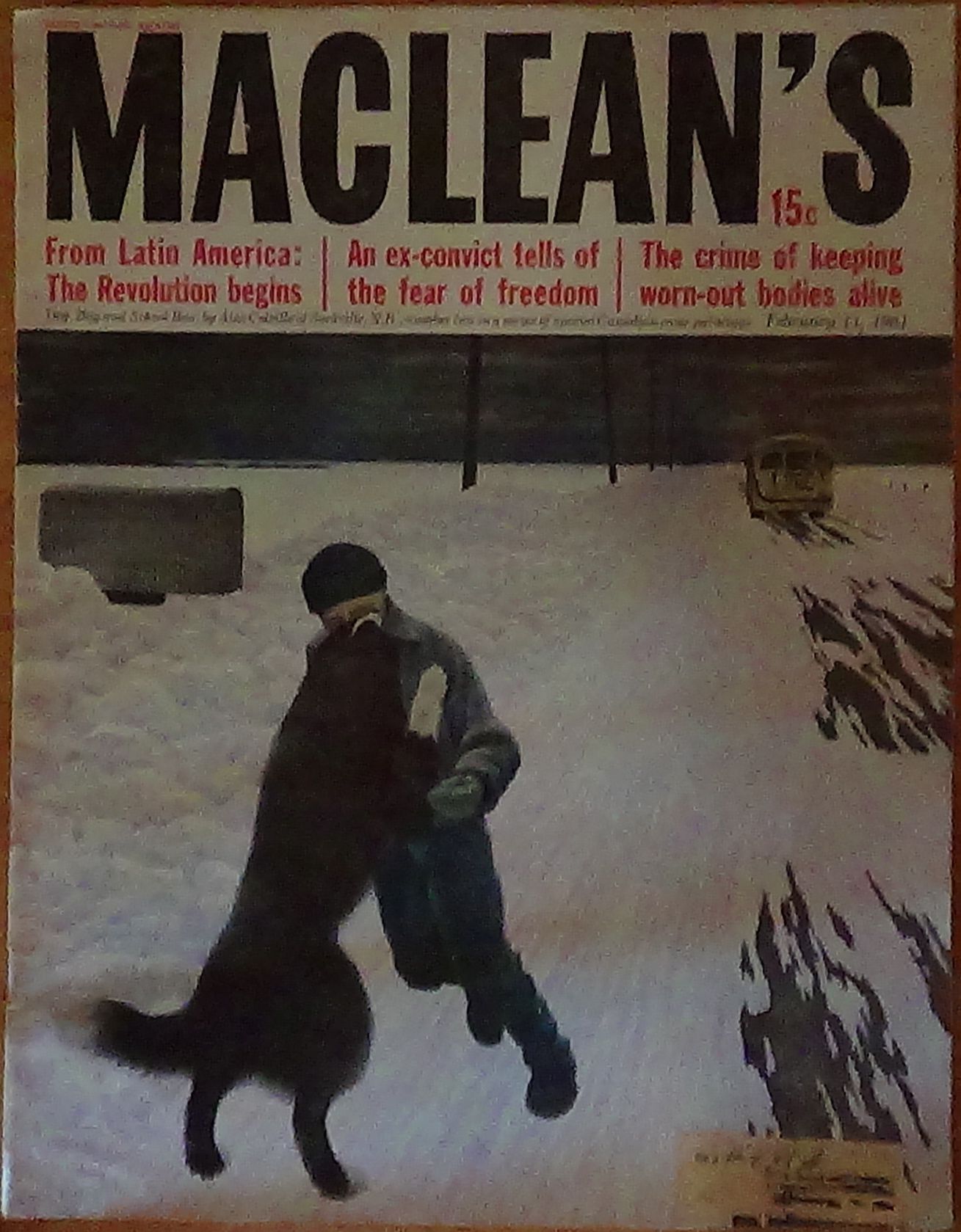 It’s February 11th, 1961. Maclean’s publishes a photo of an Alex Colville painting as its cover. It’s called Dog, Boy and School Bus. “Colville’s paintings…bring in as much as $2,000 each; he is almost certainly the most successful of the Canadian painters who draw what other people see.”[1] He is 40 years old. He dies on July 16th, 2013 a rich and famous old man of 92. Peter C. Newman is the Ottawa editor of Maclean’s. Peter Gzowski and David Lewis are Preview editors. I’m fourteen years old and attending College St-Jean in Edmonton. I’m in grade 9. I’ve never heard of Alex Colville, Peter Gzowski, David Lewis or Peter C. Newman. Knowing of them would come later when they would all go on to greater things and I would go to university.
On November 22nd, 1963, in Dallas, Texas, President of the United States, John F. Kennedy is assassinated, but in the winter of 1961 that is not an event anyone would have anticipated except the planners of that event. He had been elected in 1961 and sworn in as President on January 20th, 1961. Kennedy was not in office a month when Maclean’s wrote: “Watch for John and Jackie Kennedy – in store windows. A U.S. mannequin manufacturer has started a line of store dummies modeled on the new president and his wife – and their famous hairdos.”[2] It’s the only mention of the Kennedys in the February 1961 edition of the magazine.
The headlines (on the cover) for the February 1961 edition of Maclean’s are: From Latin America: The Revolution begins; An ex-convict tells of the fear of freedom; and The crime of keeping worn-out bodies alive. Cuba, led by Fidel Castro, had successfully fought against Fulgencio Batista, the then president of Cuba and a great friend of the American corporations who were finding Cuba a great place to do business. The nasty revolution thing was about to spread all over South and Central America, Africa, the Middle East and other countries here and there. Viet Nam was about to explode. The French colonialists had been kicked out in 1954 but there still raw materials to be had there and the Americans were interested. So were the Chinese. The Maoists were firmly in power in China. Capitalism eventually won in China mostly by attrition and bribes but that would take the death of Mao and great changes in the Chinese leadership. Maclean’s is greatly worried about South America and the nasty Venezuelan students bent on overthrowing president Betancourt. The tanks are on the streets of Caracas and surrounding the university where the ‘hothead’ students don’t really understand what’s going on and are challenging the authorities. They get clobbered but things eventually change as they must and old dictatorships fall grudgingly, slowly, but paving the way to the future with corpses of the poor piled deep. Maclean’s is nonetheless worried.
It’s also worried about Belgium where there are riots in the streets. The Flemish north is dominant but the French-speaking Walloon southern part of the country is angry and seething. The headline reads: BELGIUM: the violence is racial and religious. Canada be warned. Belgium is not unlike Canada and there could be trouble with those French speakers here too. Well, yes, but Trudeau took care of that when he replaced the mild mannered Lester B. Pearson as the 15th Canadian prime minister. The Front de la liberation du Québec (FLQ) put up a bit of a fight in the early 1970s, but nothing much came of it. Nothing much came of the ‘manifestations’ in Belgium either. It’s a nice little European country today without any colonies, but you win some you lose some. The beer is still good and the cafés full. What more could an American tourist ask for?
There are more stories in the February 1961 edition of Maclean’s. The one about the fear of freedom is a bit self-serving and strange as is the one about euthanasia. They shoot horses don’t they? Aside from the fact that there are cigarette ads in the 1961 copy and none in my 2013 copy as well as no ads for smart phones in 1961, the issues are still somewhat the same, just framed differently.
I love looking through old copies of popular magazines. They remind me of how strident we got about issues 40 or 50 years ago, how morally outraged we got and how little things have changed to make us calmer and more accepting. Well, capital accumulation proceeds apace and the problems of the 50s and 60s, although nasty in their own way are just a part of a process that is leading to some much nastier times before things get better and they will. I promise you that.
Fine art and all that: just another case of marketing and self-aggrandizement?
So, I’ve been an amateur artist for decades. Because I had full time work teaching sociology at a community college, I couldn’t indulge my predilection for painting, drawing and other forms of artistic expression except during summer breaks, but even then only sporadically. I did find the time to read art books though, both how-to books and books on art history and about individual artists especially the Renaissance greats, the Dutch and Flemish masters, the Spanish painters Goya and Valasquez, the Impressionists and German and Austrian Expressionists like Egon Schiele. I’ve only been marginally interested in North American painters, printers and sculptors. I do have a lot of respect for Rothko, Diebenkorn, O’Keeffe, Rivera, Kahlo, Moore, Henri, Close and some of the Canadian Group of Seven as well as Colville and the Pratts. But I probably shouldn’t name drop. It can quickly get undignified and there are too many artists I would undoubtedly miss mentioning.
Whatever we can say about art, it’s as much about who the buyers are as who the producers are. Otto Rank (in Truth and Reality) argues that art is the expression of a strong ego although he’s also quick to point out its superego dimensions. I think that social institutions (summarized by the term ‘superego’) not only drive artistic expression, but the buyers of ‘art,’ to a large extent, dictate content. Virtually none of the great Renaissance artists did work for the sheer pleasure of it although there must have been an element of joy, accomplishment and personal satisfaction in the work. They were more often than not commissioned and if they strayed at all from the vision that church leaders had, as Caravaggio did in a depiction of Saint Matthew[1], his work was rejected and he had to start over again with a work more in line with their ideas of how Saint Matthew should be portrayed. In other words, they were constrained by the superego. Of course if artists didn’t get commissions they starved. And who commissioned their work? Well, it sure wasn’t the poor.
In the Middle Ages and much of the Renaissance, the Church was the principle source of income for artists. Some wealthy politicians and merchants were able to commission self-aggrandizing works, but it was mainly the Church that was interested in art. Much of the artistic production of the great masters was designed to respond to the Church’s need to glorify God, the saints and other sundry notables. When the city-states dominated Italy, the masters of those cities were able to spend their fortunes on paintings of themselves and their families as long as the artists were willing to portray them in very flattering ways, eliminating annoying blemishes and poorly curved noses and chins. When the aristocrats and especially the monarchs of Europe eclipsed the Vatican’s power then the painters and sculptors produced the most lavish and spectacular marketing-type works. David’s work is a great example of this. His monumental works are political statements in their own right. His The Coronation of Napoleon, which hangs in The Louvre, is a blatant glorification of political power. David was Napoleon’s ‘official’ painter and neither men did things in a small way. David was Napoleon’s marketing department.
Real, significant changes in the content of paintings accompanied the rise of merchant capital in but not really until well past the Reformation when the shine went off the Protestant shunning of ostentation especially in Italy and Holland. Then merchants had their portraits painted by the likes of Rembrandt, Vermeer and Hals. Van Dyck was plugged into the aristocratic world and worked in England a great deal. I’m not interested here in setting out a detailed or even general art history of the Western World. I’m not at all qualified to do such a thing in the first place. But I have studied history extensively, particularly political economy and that’s my perspective.
My point here is that artists and their patrons are caught up in a dance of power wherein the former want to freely express their egos while the latter want to shackle those very egos to their own superegos. The world of art in Flanders and Holland was incredibly diverse and millions of paintings were produced in the late 17th and early 18th centuries in several genres. However there was a conspicuous absence of ‘religious’ art during this period. There was no market for it so none was produced. There were great markets where paintings and art works were sold; they ended up in the hands of the burgeoning middle class to decorate their homes.
Now, the situation has been altered such that art supplies are easily purchased by millions of people and art training is everywhere. There are thousands of YouTube videos on every aspect of art imaginable. Millions upon millions of paintings and sculptures, sometimes quite good ones, flood local markets and the internet alike. This is all ‘stuff.’ We seem to be producing more ‘stuff’ just for the sake of it, art works included. Needless to say, I’ve left out whole areas of artistic expression here like the theatre and music but I’ll leave that for another day. Suffice it to say that the same ideas I’m applying to visual art are also generally applicable to the performing arts. There’s always been ‘high’ art and ‘folk’ art. The former seems to get into the history books more easily.
I’m vulnerable to a lot of fault-finding here, of course, because my sweep has been very general and I haven’t at all taken account of some of the very important transition periods in the history of art where tensions between artist and patron are intensified and artists search for new patrons. I’m thinking here specifically of the mid to late 19th century and the advent of the Impressionists. Most of them never really made a lot of money while they were alive. Their egos overpowered the superego of the time and they were thus shunned for their self-aggrandizement and their lack of humility.
I’ve set down a little over 1000 words here, barely an excursus into the subject but I think that there is a palpable tension around ‘art’ now that needs to be explored. Some people have already explored the domain and have laid down some stones of understanding along the pathways therein, but as I like to produce ‘things’ like paintings and sculptures, I also want to explore the significance of that travel in writing. I’m particularly interested in exploring the role of ego development within the context of a weakened ‘community.’ I’m thinking that with the hyper-individualism that plagues the world today we may end up producing ‘art’ for an audience of one, ourselves. And so what if that happens?
[1] See the introduction of E.H. Gombrich’s The Story of Art, the Phaidon pocket edition.
So, as I engage in producing the 2013 Quality of Life report for the Comox Valley Social Planning Society I’m struck with the number of questions I have about just what quality of life means. I’ve determined that it’s not about comfort or serenity, the lack of problems or adversity, happiness or the lack of it, wealth, health, recreation, culture, fast cars, sex, food or much of anything else. It’s not even only about personal, individual feelings and circumstances. So what is it about? There are a number of organizations that have produced quality of life indices and reports. The UN is into it: (http://hdr.undp.org/en/statistics/). The Canadian Index of Wellbeing (CIW)(https://uwaterloo.ca/canadian-index-wellbeing/) has determined that the quality of life in Canada is declining regardless of the fact that the Gross Domestic Product may be rising. We are obviously into contiua here. The UN rates countries on a continuum of quality of life using a large number of indicators in three categories, heath, education and living standards. The CIW uses dozens of indicators and eight domains or categories: community vitality, demographic engagement, education, environment, healthy populations, leisure and culture, living standards and time use. Some of these domains address individual dimensions of wellbeing, others how community affects personal wellbeing. The CIW is on to something here, I find. On a continuum of wretchedness to bliss, I expect that a person living on the streets of Kolkata would be at the wretchedness end of the scale while someone living in a fancy house on the beach in Comox would be on the other (blissful) end without being too categorical about it. However, the world is never as simple as it seems and I’m not a good judge of the quality of life of a person living on the streets anywhere, especially India.
To me, some self-determination is important in thinking about quality of life as is sociality. So, for me, life in a prison isolation cell would qualify as extremely wretched even though health, sanitation and food would not necessarily be issues. And there are tradeoffs. Idleness due to unemployment may adversely affect income, but there is a certain liberation in not having to go to work. Problem is, we have developed strong moral, legal and political objections to unemployment to the point where the unemployed are considered morally weak, self-indulgent, lazy and worse. So not working (for the employable) carries a stigma and the unemployed suffer opprobrium.
I suppose, for me, quality of life hinges on a number of factors including basic health, a roof over my head, access to effective sanitation, enough money to keep food on the table, clothes on my back and maybe go out the odd evening to a movie, a day in the park or on the beach, a visit to a library or an art gallery, having friends over for tea, being able to move about without too much difficulty, and community support when things go sideways. Emergency services, then, take on more importance than they might otherwise in determining quality of life. The question is, can I count on the help of others in the community if I get sick, lose my source of income, my house burns down, I get beat up on the street or bullied at work?
Of course, comparison is the foundation of quality of life studies and indices. How do I measure my wellbeing? Well, it will be good or bad in comparison to the person next to me or in the next town, city, province or country. If I have nothing to compare my life to others, the whole question of quality of life is meaningless. As for the Comox Valley, what makes this place unique in terms of quality of life? I’m not sure there is a basis for comparison with other similar sized communities on Vancouver Island.
These are just some of the thoughts I’ve been having recently on the subject of quality of life. There’s lots more…for later.
So, I haven’t exactly been burning the place up with posts these days. The reason is that I’m distracted by other work. I’m working on the Comox Valley Social Planning Society’s (CVSPS) 2013 Quality of Life (QofL) report. It’s the fourth report to come out since 2002. This is a major undertaking and is taking up a lot of my time. I’m doing the work pro bono which I feel is OK since I’m retired from teaching and want to keep my hand in the research side of my career. I’m generally inclined to get paid for what I do, but this is an exception to my rule. Along with my work on the QofL report I’m also involved in the Comox Valley Housing Task Force on the Future Directions Committee. I post occasionally on my ‘homelessness’ blog (rogeralbert.org) if you want to see what I’m up to in this field of interest I have. And I want to continue to paint, draw and sculpt. Carolyn, meanwhile, would have enough work to keep me busy in the gardens here for the whole summer along with the fact that there seems to be an endless, renewable source of chores to do and little tasks I need to accomplish as time goes by. And I need to keep fit! Today that meant a 5 kilometre walk (a short one today) followed by a 45 minute workout in the gym this afternoon. That, in a nutshell, is why I’ve been neglecting this blog. That doesn’t mean I’m disinterested in the topics I bring up here. On the contrary, the last one I raised is very close to my heart and I will pursue it with vigour once some of these other projects are out of the way, especially the QofL report. If you’re interested, the last QofL report is available on the CVSPS website: http://cvsocialplanning.ca. I recruited a few of my students a few years ago to work on the last report. This one is mine to do. It’s a good thing I have been able to recruit some very competent help for the ‘data collection’ end of things. I’ll still do the writing and editing, but I’ll need a lot of help to gather the information needed to get this thing off the ground.
So that’s what I’m up to for the moment. Things can change. BTW, check out my art blog too: http://rogeralbert.blogspot.com. I posted a couple of pieces I recently completed for a fundraiser. Check them out.
Tom Engelhardt has published an interesting analysis of America today and its leadership in this article. Read this article, it’s well worth it. However, Engelhardt is missing a crucial dimension in his analysis. He argues that Americans are lead by people who create ‘enemies’ at every turn, not real ones, but made up ones all over the world, enemies incapable of doing the US much harm at all, if any. He argues that external enemies can be useful and so they are. They provide a way of maintaining domestic solidarity and compliance in the face of perceived external ‘enemies.’ Without these ‘enemies’ Americans may have the time and inclination to really think about what the real problems are with their country. Engelhardt refers to the number of people who die every year in the US by suicide by gun (19,000), homicide (11,000) and automobile crashes (32,000 and rising again) as evidence that Americans have selective outrage when it comes to how people die. More people die on American highways every year than are killed in all of its ‘wars.’ All of this is fine analysis but it leaves out one important issue. What is the real reason for the need for enemies? That’s where Ernest Becker comes in.
Some social scientists may dispute the lack of empirical evidence in his work, but I fail to see their point. No, Becker’s analysis of the role of ‘the enemy’ in his book Escape From Evil was not arrived at following lab experiments. It was arrived at after careful historical and anthropological analysis of how and why we make war, why we kill and take joy in it, why we are so quick to follow a ‘leader’ who promises us prosperity. Becker aims to show how our fear of death and yearning for immortality lead us to all kinds of very distasteful behaviour towards our fellow women and men. According to Becker we perpetrate evil in our attempt to eliminate evil.
So, reading Engelhardt should be followed by a reading of Escape From Evil which will help to put his work into a more fundamental context.
Not much action on this blog lately! Truth of the matter is that I got very ill early in March and stayed that way for most of the month. Nasty flu. Then I confess that I’ve had outrage overload for a bit and find myself uninspired to write. So, what I’ve decided to do is leave current affairs alone for a while. I’ve got over 50 posts on current affairs and I want to give that interest of mine a break. [We’ll see how long that lasts!] Instead, in this blog, I want to address some issues around evolution, particularly the notion of evolution as it applies to social institutions. As Harold Innis (1894-1952), the economic historian and political economist who spent most of his career at the University of Toronto after getting a PhD from the University of Chicago, was quick to point out, following many others including Thorstein Veblen, that empires come and go. There is no example to the contrary. Every empire in the history of our species on this planet is either deceased or moribund. Go back as far as you like. Empires don’t last forever, So the question is not whether or not an empire – say, the U.S.-centered finance corporate empire – will survive, the question is how will it die? How did the Roman Empire wane and die, for instance? Or the British Empire? Are there patterns in these events or processes? Indeed there are. Imperial overreach is a concept used to try to explain why empires fail. There are different versions of it (http://www.mmisi.org/ma/32_03/lankevich.pdf) as these two reviews of Paul Kennedy’s book The Rise and Fall of the Great Powers: Economic Change and Military Conflict from 1500 to 2000 make clear. But for me, it’s fairly straightforward, say in the case of Rome. Here’s how it works.
An empire is born in the ruins of previous failed and exhausted quasi-states. Said empire begins to grow slowly by conquest. In that it faces sometimes strong external opposition but also domestic strain because the more military conquest is the favoured instrument of international relations, a ‘thinning’ of the young males in the population is inevitable. As well, there is the stress of volatile consumer markets caused by military conquest. But wait! The empire grows stronger. Conquest brings wealth and new recruits. Military success fuels more military activity and the armies get spread farther away from home. In order to maintain conquered lands, military leaders from the Empire’s armies become governors and bureaucrats of far-flung provinces. There aren’t enough Romans to keep this machine in play so one strategy is to free trusted slaves or not enslave some of the opponents of the Empire, the really nasty ones (warlords, really) in what we now know as France, Germany, and Britain, negotiating with them instead entry into the Empire’s sphere of trading activity while allowing them to maintain land holdings of their own. Once this practice becomes commonplace, there is an internal threat to the Empire and that is the erosion of slavery, the real economic base of the Roman Empire. Rome grew too widespread geographically to control all of its subject peoples from Rome. Communications strategies just can’t keep up with the logistical and military demands of maintaining an empire like Rome, keeping enemies at bay and conquering new territories. That’s imperial overreach. The American Empire won’t fail for the same reasons because essentially there is no ‘American’ Empire.
The prevailing empire in the world today is not based in any country or nation state and it’s not geopolitical. It’s financial. As Thorstein Veblen was keen to point out, states are creatures of higher order institutions like private property and class power. Capital rules. In our times (for the last 700 years or so) merchant capital slowly gained in power at the beginning of the feudal period and held on to power pretty well into the early 19th century in Europe. It was replaced as the dominant form of capital by industrial capital which itself slowly gave way to finance capital in the second half of the 20th century. This is an evolutionary process. Marx sees the driver of this as the process by which capital replaces labour in production. Of course this is too simple a presentation of a very complex process, but essentially, that’s it. Of course all capital is a product of human labour, but capital has had a smaller and waning use for labour in the productive process as automation, Fordism and technology become prevalent. The price of labour-power varies in different parts of the world and for different occupations, but there is a long-term tendency for the value of labour to fall everywhere.
My point is that countries are not in charge, nor are politicians. Capital is and has been for some time. For centuries it’s been in a struggle with labour, the only reason capital exists, to gain a larger part of the value produced by human labour. For centuries now, capitalists have tried and largely succeeded in reducing the value of labour with the help of the state. In the US now we have the spectacle of corporate business leaders and politicians openly sharing the same bed, seemingly without any guilt or shame whatsoever. And we have the pathetic spectacle of vast numbers of people completely ignorant of how they are being manipulated by the state and its communications corporations blithely going about their lives in the belief that the American (and in my case, Canadian) government acts on their behalf. Flags fly everywhere. Patriotism is a powerful force. However, it’s not powerful enough to counter the despair and angst that will drive many marginalized and disempowered people from turning on each other and others in a desperate search for meaning in their lives in the absence of a good, well-paying job and a sense of social security.
The end of the finance capitalist empire will come only when it has reached and dominated every nook and cranny on the planet and when it has exhausted itself in trying to eliminate labour. Finance capital is well on its way to dominating the entire planet. Countries are still based on land and borders and are thus restricted in their activities. Corporations have few restrictions now and want even fewer in the future. Countries and their citizens don’t stand a chance against finance capital because they operate within an old paradigm. That paradigm is based on the false assumption that countries have economies, trade with one another and are the basic global unit of analysis. Yes, countries can still go to war with one another, but the more finance capital and production infiltrate every corner of the planet it makes less and less sense to bomb the hell out of your own factories in the target countries because chances are that where you’ve located them to take advantage of low wage costs. Global war is a thing of the past as global production drives us and our labour-power into a global market. That doesn’t mean that threats of war and local military operations aren’t useful to reduce domestic dissent by targeting a foreign enemy. We’ve experienced over the last hundred years or so the consolidation of states into larger and larger units. The European Union is an example of this type of consolidation but so are the plethora of free trade agreements that are part of the geopolitical map these days. And why this expansion? To help in the free flow of capital and labour. Globalization is foremost a process of freeing up capital to move as it sees fit unencumbered by elected parliaments and other political institutions. It’s also about the control of labour by the free movement of production. If a ‘Canadian’ forestry company moves one of its sawmills to the Philippines to take advantage of cheap labour there, it’s effectively controlling labour in Canada.
After decades of study and observation of geopolitics and capitalist production I can’t help but conclude that the future will be fraught with uncertainty as governments give up power to finance capitalists and we are left with no democratic way of deciding anything about our lives. Politicians have sold us out for a pittance and now we’re increasingly at the mercy of the big banks and business corporations that are psychopathic by their very nature, unrestricted in their expressed need to pollute the planet at will, dominate our lives with pharmaceuticals aimed a lot less at making us healthy than to making corporate profits, and privatizing all public lands and services. Profits rule. Who gives a shit if they serve to help us or kills us.
Marx predicted that the end of the capitalist mode of production will come when labour has been largely replaced by capital in human production. Machines don’t buy commodities so by eliminating workers and replacing them with machines, the capitalist class is eliminating itself. What’s the fate of countries like the US and Canada? Well, before it gets better it will get much worse. There is bound to be class war in the US and all over the world, it’s just a matter of time. Throw enough people out of work and out of their homes, make cities impossible to live in and see what happens. We haven’t suffered enough yet to push us into precipitating a revolution, but we’re headed in that direction. What can stop the momentum?
So, I’m a consumer, a taxpayer, a worker (retired now), a voter, a citizen…all of these statuses contradict each other in one-way or another. As a citizen, I get to vote every 4 years or so (woopty- doo) to elect people who are supposed to represent our political interests and pass laws to protect us all and provide a legal framework for acceptable individual conduct. But, the government (our elected representatives) is dedicated to creating a prosperous and wealthy country and so their goal is to create economic development. All other goals, for the government, are secondary to or support the first goal. Kicking the shit out of the Employment Insurance scheme and skimming money from it to general revenue is a goal in support of economic development.
Economic development, of course, means private corporate enterprise. So the government sees its prime goal as the support and driver of the private corporate agenda. So we get to vote for the government every four years or so to represent our political/economic interests by promoting, encouraging and subsidizing private corporations so that they can, as the ideology goes, create wealth for all of us. But there’s a problem here because as workers we suck away at private profit by actually getting paid to work. Now that’s a problem for private corporations and the government. Private corporations are dedicated to reducing the costs of labour because they’re a drag on profits. That means using technology to replace workers as much as possible or reducing the value of their labour (as in McDonaldization). Governments support that process in countless ways. One way is by slowly and gradually, one project at a time, encouraging the use of foreign temporary workers or moving manufacturing and some services overseas where the wages are much lower. As an aside, I read all the time in the newspapers about the ascendency of China with its huge cheap labour force and manufacturing capacity when in fact, it’s not so much China that’s ascended but American, European, Australian, Korean, Japanese and Canadian manufacturers that have set up shop in export processing zones in poor countries all over the world and especially China that account for the growth of the ‘Chinese’ economy. What we’re seeing here is a leveling out of the value of labour globally. Chinese workers are steadily getting higher and higher wages (by demanding them backed by lots and lots of labour unrest) while we are on a race to the bottom with our government telling us that we make too much money and that’s why Canada is not competitive. What a load of crap! In any case, back to my main theme keeping in mind that as workers we are apparently a burden on corporate profits and all the benefits we receive, including decent pensions are completely unreasonable. The more I hear these stupid arguments the more I think that the government and corporations would like all of us to be making minimum wages…if that did happen, kiss goodbye to corporate profits because we wouldn’t be able to shop anymore, even at Walmart and they’d have to build bigger bridges so we would all have space to live under them. What a cheerful prospect! So as citizens, we support governments that support our bosses who would like to get rid of us as workers because we’re too expensive but as I point out, lower wages mean lower profits in the long run. So how are we doing as consumers? Well, read on.
On CBC (Canadian Broadcasting Corporation) radio a few weeks ago we heard the President and CEO of the Credit Counseling Society of Victoria exhorting people to avoid getting into debt. Apparently, we (Canadians) are in more personal debt (not counting mortgages) than in most countries. (at last count about 164% of income) Well, I think that’s good advice. By all means stay out of debt. At the same time, however, we (at home here) get calls every day from credit granting organizations like banks urging us to borrow more and more. They offer low interest rates and long repayment terms. Not only that, but we face a daily barrage of exhortations to buy, buy, buy. Cars, furniture, electronics, software, music. How can we resist? We need to feel good about ourselves. We need to get the high we get when we buy things (more on this in a future post). And to compound the matter we get ‘consumer confidence’ numbers on our daily stock market reports. When consumers stop buying it’s bad for the economy, don’t you know. So do we go with the banks or the Credit Counselling Society and Marc Carney’s Bank of Canada? Obviously we buy things and get into more and more debt. So as consumers of commodities, even debt (which has become a commodity), we are really doing our job. The tipping point will come, however, when the margins we have between personal debt and the ability to repay get so squeezed that we must collapse, not only as individuals but as a society.
Of course, as a worker, I get paid and taxed on my income. That makes me a taxpayer. There’s even an organization in Canada called the Canadian Taxpayer’s Federation (CTF) that is supposed to be protecting us against our governments spending too much money on useless things. Of course their definition of useless is not my definition of useless, but there you go. It’s almost as if the CTF seems all the money governments spend on programs etc. as money stuffed into a toilet bowl or down an empty well or mineshaft never to be seen or used again. The reality is that governments spend money, wisely or not, and that money gets circulated in ‘the economy.’ I was a college instructor for 36 years. During that time I made pretty good money and it mostly came from taxpayers via the provincial government. I paid taxes 0n my income and on my property…all of it going to support businesses and local government infrastructure and programs. So as a worker I paid taxes but got some of that money back in exchange for teaching all those years. My wages and taxes (now my pension and taxes) go to support business and government. As a resident of BC and Vancouver Island in particular, I want to see good, well-maintained roads (cleared of snow at the moment) and for that I have to pay. Every cent the government spends goes somewhere. Ask the contract snow-clearing guy if he thinks the government should spend less. The more I get paid the more I can pay back to support this kind of thing. But it seems that the CTF wants us to pay lower taxes so we can presumably contribute more to corporate profits by buying more burgers and fries. The truth is that governments spend strategically and because of commitments to ongoing contracts have only a certain margin of cash to play with. They frantically need us to believe their bullshit ideology so we go on seeing ourselves in fragmented ways as either citizens, taxpayers, workers, or consumers. We are all of those statuses combined in ways that cannot be profitably seen in isolation. Think about it next time you hear someone ranting about spending way too much money on taxes or about goddamn union members making way too much money and sitting on their asses all day long.
To summarize, it seems we spend too much money and that puts us in terrible personal debt. We also don’t spend enough money and that’s bad for ‘the economy.’ We get paid way too much (which allows us, of course, to spend so much) and pay way too much in taxes but are dependent on those very taxes to keep government subsidies to business high. We vote every four years within a system that guarantees the preeminence of corporate profits, much of that going to weakening our national sovereignty. In that way we continue to weaken our own position as workers or as members of a community with common interests. Divide and conquer is and has been government policy for decades. As citizens, we’re supposed to be in charge, but our role there is contradicted by our role as workers because we are a drag and an impediment to corporate profits with our high wages and corporate profits are the main concern of government. It’s all pretty crazy. More later.
Yes, the title is a wee bit provocative but let me explain. In 1996, Daniel Jonah Goldhagen published Hitler’s Willing Executioners: Ordinary Germans and the Holocaust. This book, from the back cover on my edition, “…lays to rest many myths about the Holocaust: that Germans were ignorant of the mass destruction of Jews, that the killers were all SS men, and that those who slaughtered Jews did so reluctantly. Hitler’s Willing Executioners provides conclusive evidence that the extermination of European Jewry engaged the energies and enthusiasm of tens of thousands of ordinary Germans.” Goldhagen systematically addresses many conventional explanations for The Holocaust: 1) the perpetrators were coerced, 2) that they were merely following orders, 3) that they were under very severe psychological pressure, 4) that they were petty bureaucrats needing to perform whatever tasks assigned them for the sake of their own career advancement, and 5) that people performed isolated and fragmented tasks so that they couldn’t appreciate the significance of their actions. He then addresses each of these explanations and rejects them categorically. He argues that a great deal of horrifying brutality and genocide was exercised not by insane people, but by ordinary people carrying out their sacred duty to The Fatherland. This may be hard to believe, and the only real antidote to this scepticism is a thorough reading of Goldhagen’s book, but he is very convincing in his argument. His book is carefully researched and highly insightful.
For Goldhagen, The Holocaust was not the result of aberrant individuals, bureaucracy, indifference, ignorance or individual pathology of any kind and it was only possible because Germany and Germans, ordinary Germans, were systematically changed into anti-semites in very large numbers well before the war started. It was, he argues, the culmination of a process by which the German people, ordinary Germans, were convinced over decades that the biggest impediment to Germany’s apotheosis, its rise to true glory, was the Jewish people. Over decades before the war, Jews were portrayed as the greatest evil that Germany faced as a nation. So, it seems that Germans in their passionate love of The Fatherland were not only willing executioners of Jews (and other groups of people seen as a threat, either to The Fatherland, as in the case of Jews, or the Aryan race as in the case of people with mental or physical disabilities, the Romany, etc.), but enthusiastic, gleeful, inventive, proud and patriotic perpetrators of unbelievable brutality towards Jews. There is a photograph in Goldhagen’s book of a German soldier, an ordinary German soldier, shooting in the back of the head a young mother while she holds her child in her arms. He did it in front of the camera, proud of his patriotic deed. Obviously, human beings are capable of incredible personal barbarism but that barbarism is more often than not released against ‘the other,’ the perceived source of all evil and danger to the group, whether it be the marriage, family, community, town, city, province, country or ideology (pick any one). The soldier who shot the young mother did not see his deed as barbaric, but rather as patriotic, as one more step in the elimination of the Jewish evil infecting glorious Germany and threatening to weaken the Aryan race. From this viewpoint, every time a German kills a Jew, man, woman or child, Germany gets stronger. Essentially, the Jewish people were offered up as a sacrifice to ensure the future prosperity of the German nation. From here on, my argument gets a little complex and much of it arises in Ernest Becker’s work summarized in his posthumous book Escape From Evil (1975) in which he writes:
…the psychology of the Nazi experience, […] served as a grim refresher course on the metaphysics of mass slaughter. Leo Alexander, in his outstanding paper on the SS, points out how much the Nazis were animated by what he calls a ‘heathen concept’: they had a whole philosophy of blood and soil which contained the belief that death nourishes life. This was ‘heathen’ indeed: we recognize it as the familiar archaic idea that the sacrifice of life makes life flow more plentifully…Goering, for example, made a statement early in the war that ‘with every German airman who is killed by the enemy our Luftwaffe becomes stronger. (p.103)
So the logic of mass murder becomes clear. The ‘cleansing’ of Germany of the ‘dirty’ Jews was supposed to make Germany stronger, an idea that had been brewing for a long time in the German mind. In essence, Goldhagen’s insistance that Germany was infected long before the Nazi era with a profound antisemitism fits in perfectly with Becker’s observation that The Holocaust was not an ‘event’ in history, but a consequence of a profound and longstanding insecurity that ordinary Germans had regarding the state of Germany. Relief from this insecurity culminated in the execution and torture of masses of Jewish people. It became the duty of all right-thinking, patriotic and heroic citizens to participate fully in the elimination of the Jewish evil, an evil inherent in every sub-human Jewish man, woman and child, the evil that threatened, in their minds, the very source of their life and power, The Fatherland. Of course, the whole enterprise was a lie. No amount of killing could save the German nation.
So, what can we now make of Goldhagen’s contention that it was ordinary Germans who were the perpetrators of Hitler’s program to eliminate Jews from Germany (and everywhere else given enough time)? What we can say is that most evil in the world is not the result of the actions of aberrant individuals -although they definitely express their aberrance when permitted to or encouraged by the state – but of ordinary people expressing their love for country or idea (racial purity, the uselessness of the poor, God, the glory of money, etc…). As Becker states it, “…evil comes from man’s urge to heroic victory over evil.” (p.136)
What lesson can we learn from Goldhagen (and Becker – but more on that later)? That blind nationalism and unquestioning faith in God and country have, and can still, lead ordinary people into committing the most atrocious, genocidal actions possible. The Rwandan massacre of 1994 is an example of just such a thing and let us not think for a moment that it will never happen again. From the vitriol I’ve been reading in comments following articles on the Idle No More movement, I expect that ordinary Canadians could be led into the same genocidal frame of mind as ordinary Germans were during the Nazi era. Canadians are not anywhere close to becoming genocidal now, but systemic racism, scapegoating and a profound ignorance of the actions of their own government towards aboriginal people can set the stage for popular descent into crass racism and incivility. When the government’s agenda are dominated by the private accumulation of capital, any perceived impediment to economic growth such as treaty negotiations will be seen by some as a threat to Canada as a nation and it’s sovereignty. Once aboriginal people are openly scapegoated and blamed for a poor economy we will have to be doubly vigilant to ensure that the situation does not get out of hand and degenerate into widespread and open hostility towards First Nations.
 Roger Albert - Always a Sociologist: Now Living With Myeloma