37 Me, my Body and I: Part 3

It’s time to wrap up this diatribe. Like I said at the end of my second post in this series, I’ve strayed a long way from the usual content of this blog. After this post I have to reconsider my work here. I’m getting into the long stretch of road in my chemotherapy treatments. I’m getting tired and you must be getting tired of reading this stuff. The end of this part of my road is at least six months away. Things are looking good according to my lab results, but who knows. Every day brings something new which may be fodder for this blog, maybe not. Whatever. I do have to tell you about a recent weird experience I’ve been having, but that will be for my next post.

In this post, the third in the series about what will happen to ‘me’ after “I” die, I want to suggest that our conception of our selves, especially our idea that we are beings composed of mind, body and soul, is socially-constructed. In a sense though, it matters not where these ideas come from if they have a real impact on my life.

By way of an example, if I have a stroke, for instance, I may attribute it to a curse put upon me by a disgruntled recently past relative for a purported wrong that I did him. However, it’s far more likely that my stroke was brought on by a busted artery in my brain. Nonetheless, the stroke and its consequences are what they are never mind their provenance. Durkheim stated that no religion is false. By that he meant that, in my example above, the stroke is real no matter where and how we think it originated. A more contemporary sociologist who wrote extensively on religion, Peter Berger, argues that much of what we call religious behaviour and even religious thinking and hypothesizing cannot be understood by deduction or reduction. He proposes that we use induction to figure out the ‘reality’ of religious experience, that we start with how we feel and experience in real terms, in our living beings, and acknowledge those feelings as real before we attempt any kind of explanation of them. This kind of fits with Unamuno’s views, although Berger is much more prosaic than Unamuno the poet-philosopher.

The provenance of the ‘soul’ is interesting and there is much speculation about it as originating in our dreams, for instance, or during hallucinogenic experiences, but once a belief in the ‘soul’ is socially established it, it has real world consequences.

Today, I intended to address the work of Emile Durkheim and Ernest Becker with maybe a little Max Weber, Karl Marx and Norbert Elias thrown in for good measure but I’ve decided not to do that in any formal sense. I have come to accept the futility of trying to summarize very complex arguments from a number of writers and how they interconnect at least in a relatively short blog post. I’m not here to convince you that I’m right anyways.

That said, all the above characters were sociologists except for Ernest Becker and he would definitely qualify as an honorary sociologist. They all conclude that religion and all ideas concerning souls, demons, angels, gods, and various other supernatural beings originate in society (i.e., in the family, school, church, law courts, governments, etcetera) defined very broadly. However, whatever their origin, religious, metaphysical ideas have real world consequences according to these guys. That’s clear.

Before getting any further into this post, I want to tell you a little story. You might be shocked to learn that I wasn’t always the model son. Sometimes I could be downright annoying and troublesome for my mom, and she didn’t deserve any bullshit from me. But she got some anyway. I remember one time (of several) when I was particularly obnoxious and teased my poor mom relentlessly.

I said to my mom: “Ma, if you had been abandoned on a desert island as a baby and were raised by monkeys, would you still be the same person you are now.”

“Yes,” she says, “of course.”

I retorted: “But what language would you talk? Would you talk monkey talk? What things would you believe? Would you believe in God?”

She replied something along these lines: “I would believe in God and I’d be the same person I am today. I don’t know any other languages besides French and English and why would I believe anything different than I do now?”

That was my mom. She wasn’t stupid by any measure, but she was ignorant in many ways mostly because she was busy raising a pack of kids and she was way too tired to be very curious and she couldn’t read metaphysics. By her answers to my questions she demonstrated a naïveté that ran deep but that allowed her to live her life in relative contentment. If my mom was ignorant in some ways, she was very knowledgeable in others. She raised tons of children, made bread like a pro and was a dedicated member of her church (although she didn’t know much about Catholic theology beyond what was in the Sunday missal). Later in her life she took up woodworking and was good at it, that is until my dad decided to sell the house and the shop from under her. After that, she fell into dementia and never recovered. I think she lost her appetite for life at that point. I loved my mom, I really did, and I regret teasing her. That’s one of my big regrets in life.

So, what was it about my mother’s responses that is significant for me here? I guess I was shocked by her very strange idea of her personhood and her unstated notion that ‘she’ was an unchanging, unchangeable being regardless of her surroundings and upbringing. It’s plain to me and I expect to most people that everything we know we’ve learned from others, either directly from other people in our homes, schools, churches, and from books or from any number of other sources. Of course, that includes any kind of ‘spiritual’ ideas we may have as well as our sense of immortality. Elias argues that we are not the individualists we think we are. He says humans are really interdependencies and interweavings. No human ever stands alone given the richness of the sources of our ‘selves’. The language(s) we speak, our gender, our cognitive skills, intelligences, values, religious/spiritual beliefs, etcetera are all learned, that is, socially derived.

It’s clear to me that my mother denied the influence of any possible ‘foreign’ source of her personhood. Obviously, there is no way my mother could know of her Catholic God if she was raised by monkeys on a desert island. The concept of God, like of language, and table manners is learned. How would my mom learn about the Catholic God? Many societies have concepts of God or gods or some such supernatural beings. There are hundreds (and there have been thousands) of religions on the planet, each with its own unique conception of immortality and supernatural beings (if they conceive of any). Babies born into those societies learn the rules and values of their specific communities. Why would my mother not realize that her position was untenable? I would suggest that her commitment to her beliefs outweighed any sense she might have had about the logical inconsistency of her position. She was like a Trump supporter in that sense. She may have been yanking my chain, but I doubt it.

Which god do you worship (if any)? Well, if you do still worship a god, probably the one your parents do (or did). These days, however, there is a movement towards more individualistic, personal forms of spirituality, a trend which fits in nicely with capitalist morality, individualism and consumerism while allowing people to retain a belief in the immortality of the ‘soul.’ It’s also true that significant numbers of people are now defaulting to atheism or agnosticism in greater numbers than ever before, a movement also compatible with capitalist morality. There is still a great deal of intergenerational retention going on today even if there are obvious exceptions. So the frontier mentality of rugged individualism and fending for yourself is still a thing in the Twenty-first Century. Of course, as individuals, we can be creative, and come up with new ideas and ways of doing things but we always do so using materials, processes and relationships that already exist. How else could it happen?

The truth is, we, none of us, can conceive of anything absolutely new under the sun. Everything we invent, think about, or imagine has roots in our interactions and interdependencies with other people via our social relations, past and present. The present is always built on the past. Inventions are generally new conceptions of how to use and combine already existing technologies or ideas. That means that new religious denominations or churches are invariably modifications on past ones. How many variations on Christianity are there? Lots…I haven’t counted them. Which one is the ‘true’ variant?

As I note above, one perspective all the writers and thinkers I mention above have in common is that they all agree that religion and our ideas of personhood originate in society as does the belief in immortality. Durkheim, for example, argues that the concept of God is actually a personification of society, a personification that can then be used to judge the behaviour of adherents still living. Elias in his book What is Sociology? builds a conception of individual/societal interaction by using a metaphor of a card game. In his metaphor, a card game is happening with four or five players. The game has rules, of course, to which all players must adhere. Then, one person decides to leave the game and another person joins in. That change of players does not affect the game, nor the rules. The new player must adhere to the rules like the drop-out did. The game is a metaphor for society. We are born into society, learn all the rules, then leave (die). Society goes on. The game goes on. Society, seen from this perspective, is supra-human. It exists above and independently of any individual yet has control over all individuals and circumscribes the parameters of possible ideas and decisions individuals can make. No wonder we come to think of it as divine.

Because society is supra-human and veritably invisible to most people, it’s not a stretch to understand why people ascribe to it a supernatural existence disconnected from their individual lives. Because it IS disconnected to their individual lives in a real sense. As Elias would say, the game goes on no matter what individuals do as players. To which Durkheim would add: the individual ‘soul’ is in the game but is actually a piece of the collective, social SOUL. Therein lies our idea of its immortality. Society exists before us and after us. It’s virtually immortal. Our souls are immortal because they are a piece of the greater social SOUL.

Durkheim defines religion as: “a unified system of beliefs and practices relative to sacred things, that is to say, things set apart and forbidden — beliefs and practices which unite into one single moral community called a Church, all those who adhere to them.” (from Elementary Forms of Religious Life, 1912) For Durkheim, sacred things are by definition social things and the sacredness of things can change with changing social conditions.

Ernest Becker goes much further than Durkheim when he argues that culture as a whole is sacred. For Becker there is no distinction between profane and sacred. It’s culture as a whole that promises people immortality. In fact, he argues that “Each society is a hero system that promises victory over evil and death.” (from Escape From Evil, 1975, page 124)* Of course, no society can promise such a thing. Becker writes:

But no mortal, nor even a group of as many as 700 million clean, revolutionary mortals, [in reference to China] can keep such a promise, no matter how loudly or how artfully he protests or they protest, it is not within man’s means to triumph over evil and death. For secular societies the thing is ridiculous: what can “victory” mean secularly? And for religious societies victory is part of a blind and trusting belief in another dimension of reality. Each historical society, then, is a hopeful mystification or a determined lie. (EFE, page 124)

Marx would have agreed with Becker here but he concluded that religion was the opium of the people, a salve to soothe the savage treatment that most people received under capitalism (as one might find depicted by Charles Dickens.) He found that religious beliefs were instrumental in mollifying the masses and having them accept class inequality under capitalism. Weber also recognized the class basis of religion although his definition of class was not the same as Marx’s. Weber, in his Sociology of Religion, addresses the early rise of religious behaviour in human interaction with drastic natural events like floods, volcanic eruptions, hurricanes, tornadoes, etcetera, the ‘soul’ in its various iterations and manifestations, and ritual. He argues that the forms of gods varies depending on natural and social conditions.

In conclusion, I just want to re-emphasize the notion that according to the sociologists I mention here as well as countless other sociologists and social scientists I don’t mention, ‘society’ is the source of our beliefs about the immortality of our person by way of our ‘souls.’ There is no ‘supernatural’ teacher that teaches us our values around immortality, and any ideas we have around these notions come from notions already just laying about out there waiting to be picked up and incorporated into our world view. In other words, our ideas around the immortality of the ‘soul’ do not result from perceived connection to an immortal God or gods, but from the immortality of society.

______________________________________________________________________

*There is no substitute for reading Becker because his argument forms a cohesive whole. Pulling a quote out of his book, although provocative, is probably not helpful although I do it. I can’t help myself. If it spurs people to go read Escape From Evil so be it. Many of my early posts on this blog constitute a review of EFE. That would be a place for you to start in trying to understand his work. Just type Becker in the search box in my blog and you’ll find the relevant posts all numbered and everything or you can start here: https://rogerjgalbert.wordpress.com/wp-admin/post-new.php?post_type=post&jetpack-copy=874. You can then work your way through the archives on my blog site.

Durkheim (Elementary Forms of Religious Life) and Weber (The Sociology of Religion) both have sections of their books on the soul. Do a bit of research if you’re curious. Dr. Google is full of stuff on these guys and I’ve got all the books for local people to borrow if you’re interested. Elias is great. His book The Civilizing Process is well worth the read.
36 Me, my Body and I: Part 2

To begin I want to dwell for a minute on Sigmund Freud’s ideas about the human personality. It’s a secular formulation, not surprising as Freud was an atheist. I’ll get to more religious formulations in a bit but Freud shows how personality can be conceived as being made up of three ‘parts’: the id, or libido (sexual energy), the ego, and the superego. The ego, in this scheme of things as I understand it, is the part of the personality where the needs of the id and the superego are negotiated and worked out. The superego is that manifestation of the human personality that accounts for social norms, values and morality. The fact is that the id, ego, and superego are not really ‘parts’ of the human personality, but manifestations of the various and often contradictory needs inherent in the id and superego. In other words, they are not things and can only really be identified by what they do or manifest.

For example, the id of a young man (I can attest from personal experience) may be consumed, or at least, pre-occupied with thoughts of sex, sex and more sex. The superego, on the other hand says, wait up there cowboy, you can’t have sex with anyone or anything at any time. There are social rules around these things. Listen up! NO sex with your sisters, brothers, or your mother, nor with sheep, goats, or monkeys! You hear? The id counters by arguing: well, what am I supposed to do with all this energy? You tell me I’m not even allowed to masturbate! That’s not fair! In these ‘debates’ sometimes the id wins, more often the superego does. There are people who have no social conscience or social ‘brakes’ to their behaviour. We call them psychopaths or sociopaths. People with rampant, out-of-control ids can be very dangerous as sexual predators and can be uncontrollably violent. Freud’s scheme has to be considered along with other aspects of what it means to be human such as bodily integrity, intelligence, and upbringing. Personality is very idiosyncratic if you haven’t noticed. It’s all very complex but it’s what accounts for our individuality.

What Freud’s personality scheme does for my purposes here is to highlight the fact that we can easily conceive of our personalities made up of semi-independent parts. This idea is integrally important to the religious, spiritually-minded, and Christian (certainly) notion that we are made up of body, consciousness, and soul, different aspects of us that are related but have a life of their own, so to speak. To think of the soul as immortal, it’s critical to separate it from the body which dies although some religionists, especially Darbyists* (who would probably find the 1991 film Rapture right up their alley), would prefer to go to heaven with their bodies intact. Rapture (the film) depicts end-of-time second coming of Jesus and the ascension of the human body and soul to heaven. Some religionists are very keen to see their physical bodies live eternally but they’ll settle for their consciousness or soul carrying on after their bodies die.

This is the position of Miguel de Unamuno, the Spanish Basque scholar who was for a long time the don of Salamanca University in Bilbao. I introduced you to Unamuno in one of my recent posts. I refer to Unamuno here because he is such a keen advocate for the immortality of the soul. He published The Tragic Sense of Life in 1920. It’s a rambling poetic rant and an impassioned plea to realize the limitations of reason in coming to grips with the most important problem he reckons facing us all and that is the immortality of our souls. For Unamuno, the longing for the immortality of our souls is what makes us human. He writes:

“That is to say that you, I, and Spinoza wish never to die and that this longing of ours never to die is our actual essence. Nevertheless, this poor Portuguese Jew, exiled in the mists of Holland, could never attain to believing in his own personal immortality, and all his philosophy was but a consolation which he contrived for his lack of faith. Just as other men have a pain in hand or foot, heart-ache or head-ache, so he had God-ache. Unhappy man! And unhappy fellow-men!” (from “The Tragic Sense of Life” by Miguel de Unamuno, Kindle Edition, page 43)

According to Unamuno, except for a few minor and aberrant individuals and groups, humans have throughout history consistently believed in the immortality of the soul. That commitment and longing for immortality that is at the very core of our beings and is effectively an instinct of perseverance as Unamuno sees it is our membership card in humanity. If we don’t believe or if we insist on finding a logical, reasonable explanation for the immortality of the soul then we are evil, wicked people who refuse to be a part of the human community. Unamuno can surely be called a hero in the social imperative of death denial. He finds atheists and non-believers of all sorts abhorrent. “If consciousness is, as some inhuman thinker has said, nothing more than a flash of light between two eternities of darkness, then there is nothing more execrable than existence” writes Unamuno. Life, for Unamuno is absolutely meaningless if the immortality of the soul is not the prime human fact and goal. Unamuno is very keen to separate reason from life. He says reason cannot prove one’s immortality, only life can, and it’s a question of faith. The soul has primacy in Unamuno’s scheme of things and is his ticket to immortality. Interestingly, he’s not as concerned with the existence of God as he is in his own immortality.

A more contemporary aficionado of the immortality of the soul is Ram Dass who just died recently. He believes that the soul must exist and it must be immortal because otherwise our earthly lives are meaningless. He writes:

“To be here for fifty to eighty years only to be annihilated at the end just doesn’t make sense. Nothing else in the universe is that inefficient. We have to be here to learn; otherwise our difficulties are truly meaningless. For the Ego, the roles we grow into and the positions we hold at the pinnacle of aging are the culmination of life. For the Soul, learning is the culmination. When we expand our self-image to include the Soul, we notice a marked shift in our personal consciousness, a liberation from the small egotistical self into a far more spacious context. From this Soul level, we are able to view our Egos from the outside in. This allows us to observe our minds and bodies in ways that will seem new and surprising, as if the trapdoors of the “self” have been opened and we can finally step outside, enjoy the view, and put a welcome distance between who we are (from Soul’s perspective) and the suffering we experience at the level of body and mind. Thus, with practice, we cultivate the tremendous healing of knowing ourselves as spiritual beings, too.” (from “Still Here: Embracing Aging, Changing, and Dying” by Ram Dass, page 28)

Well, I see a lot of problems with Dass’ non-sequiturs to start off . Why doesn’t it make sense that we are annihilated at the end of lives? And ‘nothing else in the universe is this inefficient’? What kind of silliness is this? Efficiency as a criterion for the immortality of the soul is ridiculous. Dass would be much better off just borrowing arguments from Unamuno than putting forward illogical ‘reasons’ for the immortality of the soul. Furthermore, he argues that we can see ourselves from “this Soul level”. Magical thinking indeed! But Dass appeals to a large audience of people intent on believing that when they die, they don’t really die because their souls carry on into eternity. I can seriously say that I’ve explored the implications of this idea through years of study, introspection and meditation, including, like Dass, the use of hallucinogens. Frankly, I just don’t see the point in adding a fictitious construction called the soul to our personalities. In a way (and I’m sure I’ll get up some people’s noses for saying this) it strikes me that believing in the immortality of consciousness or the ‘soul’ requires a great deal of collective narcissism and chutzpah. Where do we get off thinking we’re so special under the sun that we get to live eternally and no other life forms do? Note that I write ‘collective’ narcissism. As individuals we have no reference other than social ones to decide what to believe. We can be the humblest of individuals yet still be trapped in the overarching cultural imperative for apotheosis via immortality.

Of course I DO argue that in a sense we DO live eternally, just not in our current human configuration or through the ‘soul’. I know that I’m now a long way from discussing myeloma and my daily grind under its treatments. That is so. However, it’s important for me, as I approach my inevitable death whether it happens in six months or ten years, to clarify my point of view. There’s a certain amount of catharsis going on here, no doubt. Most people want to live forever. Not me. I’m perfectly happy to see my consciousness evaporate when my heart stops and at that point all the atoms and molecules that made up my body will be free to go. Have fun, little buddies!

In the third post in this series coming up shortly, I reflect on the works of Emile Durkheim and Ernest Becker. Both worked as social scientists. Durkheim died in 1917, Becker in 1974. Both had a lot to say about the soul and the sacredness of society as a source of the personal sense of immortality. Both have played a large part in my intellectual life but Becker sticks with me much more viscerally than the cerebral Durkheim. Both argue in their own way that the power of religion lies in society.

Stay tuned.

_____________________________________________________________

* “Though Darby may have burned his bridges, his message gained a larger and larger following. Today his dispensational premillennialism is the view of many modern fundamentalists and conservative evangelicals.” From: https://www.christianitytoday.com/history/people/pastorsandpreachers/john-nelson-darby.html

35 Me, my Body and I: Part 1

I’m quite attached to my body. Frankly, it is a long way from perfect, but I’ve grown fond of it over the years and have become increasingly tolerant of its idyosyncracies and foibles. It’s served me well in lots of ways. One special way it’s done so is by helping to create my two daughters thus ensuring genetic continuity for me and Carolyn. It can’t take a lot of credit for that, Carolyn having done most of the heavy lifting, but still, there were moments of joyful participation in the magical process by which my daughters were conceived and born.

Now, however, my body has decided that it’s getting time to move on. It seems to be quite relentless in this idea. My body has an intelligence of its own, as does all life on the planet. It’s not going to sit still. Life is about change. I’ve pretty much come to grips with dying. I understand it intellectually and am now in the throes of living it. Death is an ultimate form of disengagement from the world for me (I), but in another sense it’s just another form of re-engagement for all the atoms and molecules that make up the complexity of the structures in my body.

For me, as I’ve noted before, we are the stuff of stars. Translating that into language closer to home, it means that the material that makes up my body and all life on the planet has always existed and will always exist as long as the universe is around to sustain it. According to Brian Cox, the universe itself is finite so all bets are off as to what happens to matter and energy in billions of years when the universe itself is worn out and darkly still. For the moment, however, we can say that the universe is the ultimate driver of life on earth and anywhere else it might exist in the cosmos. “Life” here needs to be conceived in very broad terms and not just related to biological organisms. Galaxies can be said to have a life span, mountain ranges and continents too. Nothing is forever. Nothing.

There are two aspects of myself that are of interest to me for this discussion: what happens to my body after death and what happens to my consciousness. These are no longer arid philosophical considerations, they have never been closer to home in a real visceral sense for me, and are mobilizing all of my intelligence and emotional energy.

Without sounding too arrogant, I think I have both of those pretty much figured out after fifty years of study, thought and introspection. As far as my body goes, it’s quite simple, really. I’m a big proponent of simplicity in the search for solutions to life’s problems. That means that I adhere to the philosophical principle called Occam’s razor, or the idea (without being too simplistic) that the simplest solution to a problem is probably the best.

“Antoine Lavoisier described the law of conservation of mass (or the principle of mass/matter conservation) as a fundamental principle of physics in 1789.” That formulation was followed later by the law of the conservation of energy and later still, after Einstein, by the law of the equivalence of mass and energy or the idea that mass can be transformed into energy and vice-versa, but neither can be lost in the process. Bringing this idea down to my level, it is my sense that what makes up my body has always existed and always will, giving me a real sense of connection with all life on the planet and a very real sense of continuity with all life, past and present, including with my ancestors. Put simply, when I die, my body and all of its constituent elements return to the pool of raw materials available for the construction of new forms of life, as I’ve noted before. I can’t emphasize enough the notion of continuity here. In the face of my immanent annihilation, I take solace in the notion of my intimate connection with life in the cosmos and as part of an ongoing process of life. That still leaves me with a problem. What about my consciousness?

I think that my consciousness, when my heart stops beating, will no longer exist in any way, shape or form. Why should it? My consciousness is organically tied to my body and cannot exist without that living connection. Break that connection and the light goes out. So, in anticipation of my death, I may mourn the loss of consciousness above all. That doesn’t mean that I think it has any means or justification for existence beyond the demise of my body. Remember Occam’s Razor. I see no need at all for any supernatural intervention in all of this, something I think is unnecessary given the perfectly plausible and simple scientific explanations available to explain life and its continuity. It seems I’m probably in a minority on this one.

Now, if I were to write a play based on what I’m going through at the moment, I would surely incorporate as a basic plot line the plethora of imaginative constructions (ideologies) that argue that consciousness does not die with the body, but has a life of its own and goes on ‘living’ after the heart stops and all brain activity ceases. I’d have to put my own ideas of continuity up against the age old ideas of the perpetuation of consciousness beyond bodily death. I can envision a Waiting for Godot or My Dinner with Andre type of play. Frankly, I’m perfectly content with the idea that my consciousness will not outlive my body. It’s the simplest and most elegant solution in my mind although it has some serious social implications that I need to explore next. However, in the play I envision, proponents of the immortality of consciousness and/or the soul would need to have their say.

It’s not a huge stretch to go from the perpetuation of consciousness after death to the idea of the soul and its existence independent yet connected to the body and its survival post-death. The ethnographic literature is full of descriptions from ancient cultures about the role of the soul in human life and its immortality. Sociology addresses modern versions of this idea. It seems that for millennia, humans have been loathe to entertain the possibility of total and absolute death and have been, across the board, wedded to the idea of the immortality of the soul even more than they have espoused the existence of God or any other supernatural force. Thousands of religions and their associated churches or societies have come up with often contradictory ideas related to the makeup and activities of the soul and its place in the universe. These contradictions have often been the source of violent confrontations and pogroms, because if my idea of how to get to heaven is the right one, yours has to be wrong and I’ll kill you to show how much more powerful my conception is to yours. These are ideas I need to explore in part 2 of this post.

Stay tuned for part 2 which I’ll release on Sunday, March 8th.

34 To live and to die.

Yesterday we went to the lab for the nth time so that the tech might gather some of my mucky blood for analysis. My last trip to the lab was fine, but the results were incomplete. Apparently there was a problem with one of the samples that had to be shipped to Victoria so the results weren’t available to us. Samples requiring electrophoresis in their analysis are sent to Victoria. Apparently there have been some issues with the transport of samples. Maybe the samples coagulate on route, maybe they get lost. Who knows. All I know is that the results of these lab tests tell me how I’m doing and can give me confidence in asking the right questions of my oncology team. It’s okay this time because I just got a new set of tests. They’d better come back readable, that’s all I have to say about that. Hear me VIHA? Now, on to more important things.

I wrote this at the end of my blog post entitled Overdiagnosis? I promised to get back to it so here we go.

In my view, my destiny is to die. Like all other living things on this planet, living and dying are the same process and life depends on death for its continuation. No death, no life. I feel that in my very bones! That’s where my oncology team is doing battle with my own body to try to keep me alive a while longer. Of course, eventually whatever the oncology team will do won’t be enough and I’ll die.

So, how exactly does the body shut down as it’s dying? Cancer may very well be one (a very important one) of the mechanisms that is ‘natural’ in its role in having us die. Maybe cancer is not the pathological evil that it’s made out to be. What would happen if cancer did not exist? How would we die then? What does it mean to die of natural causes? How can we figure that out?…I think science and medicine have a lot to learn about us yet.

So, let me address one question at a time. Our bodies are ephemeral things, programmed to ‘die’, which means programmed to return them to the pool of raw material available to other organisms as they organize matter into various structures, themselves programmed to ‘die’. The body ‘shuts down’ in a number of ways depending on circumstance at the time of death. If you get shot in the heart, the process is quick, but immediately cells ‘know’ what’s going on and act accordingly. When my mother died, the nurse in the care home where she lived explained that staff can tell when a person is close to death by looking at their feet and legs. The weaker the heart gets, the less it can pump blood to the extremities. That means that the feet, then the legs show progressive signs of blood loss, losing colour and tone. Maybe that will happen to me. Whatever the circumstances, our bodies are prepared for the moment of death and ‘know’ what to do. Our minds are another thing. I’ll get back to the mind in my next blog post.

Cancer is as natural a process as muscle building. In my case, the likely culprit in triggering my myeloma is an oncology gene, not a factor exterior to my person like an environmental carcinogen, and my immune system was likely complicit in making sure myeloma spread to all of my bone marrow. My bone marrow, it seems, just got tired of producing marrow and started to produce myeloma protein instead, crowding out the cells that produce hemoglobin and other healthy blood cells. I really don’t think that that is a pathological process. Pathology implies that there’s something wrong with the body breaking down and dying. There isn’t. Dying is as natural to us as being born. The problem is that our big brains have a hard time letting go so they unleash our minds in a futile battle against entropy. Ultimately, they deny death itself. We’ll get back to that next post.

I think it’s reasonable to ask the questions I pose above: What would happen if cancer did not exist? How would we die then? What does it mean to die of natural causes? If cancer and other ‘deadly diseases’ didn’t exist we’d die from other causes. Simple as that. So, if medicine eventually ‘cures’ cancer or heart disease, or stroke, it will just have to move on to do battle with whatever other cause is determined to kill us. Scientific medicine is based on a pathology model so is organized to do battle with disease and death. That means that it assumes that there are normal ways to be a human and pathological ways. The idea is to ‘fix’ the pathological ways to bring the human back to ‘normality’. Unfortunately, there is no way to fix death, although there are a variety of ways of conceiving of death (but that’s the subject of my next blog post.). So what would happen if science gave up on the pathology model? It would have to study what is ‘normal’ human development, and not be fixated on correcting what “goes wrong”. It would have to cease thinking of disease and death as evil. Of course, evolutionary models are gaining in importance and they aren’t pathologically based. Furthermore, I’m sensing glimmers of the recognition of the weaknesses in the pathology model in the medical clinic, but pathology is a strong draw and won’t likely go into abeyance anytime soon as a favourite basic framework for the practice of medicine. I figure that until science and medicine face reality, the suffering sometimes caused by attempts to prolong life will have to be closely scrutinized along with the Hippocratic oath, and we won’t be able to deal with death as a natural part of life. So where does that leave me?

I can tell you that I’m not convinced that chemotherapy is the best course of action for me. Yes, it will likely allow me to live longer, but how long? And in the meantime, I get obsessed by my lab results and Carolyn and I reckon time by where I am in my chemo cycle and how that makes me feel. Not sure that’s such a good thing.

32 This is no fun at all.

Well, this is no fun at all.

I’m not silly enough to believe that a life with myeloma would be fun, but I’m kind of disappointed that it’s been such an unmitigated downer. I am, I can now see, destined to drag this goddamned disease with me into the grave. Come on, I knew that! Still, a bit of a break now and then would be welcome. Is that too much to ask?

Actually, I think the nastiness I’m experiencing in spades right now stems mostly from the chemo meds rather than from the myeloma itself. This past week would support my idea that the meds are as bad as the disease at the moment for making me feel tired, dizzy, and in pain.

I went to the hospital on Thursday for my bortezomib shot after taking all the rest of my chemo drugs in the early morning. I expect Thursdays to be non-days, and this one was certainly that. A non-day is one when I can’t gather enough strength to do much of anything. However, Friday and Saturday also turned out to be non-days and Sunday wasn’t much better.

I felt a little beaten down. Of course, I should have expected it because my local oncology GP did warn me that they were going to ‘challenge’ me with my chemo med doses. No more mamby-pamby half doses for me! I was to get the full meal deal! Yes, indeed. Silly me.

Then I figured that maybe I needed a good dose of positive thinking to counteract all of these drugs. Maybe all I needed was a little endorphin fix. After all, I used to teach positive thinking on the Knowledge Network back in the ‘good ol’ days’ of 1986 to 1992. I used to teach as Ehrenreich points out “that on many levels, individual and social, it is good to be ‘positive,’ certainly better than being withdrawn, aggrieved, or chronically sad.”*

The problem is I’ve learned a few things since the early 1990s, not the least of which are the limitations of positive thinking. The American Cancer Society on its website states very clearly:

An important part of coping with a cancer diagnosis is recognizing emotions and feelings. Treatment that deals with our emotions and relationships (sometimes called psychosocial interventions) can help people with cancer feel more upbeat and have a better quality of life. But there’s no good evidence to support the idea that these interventions can reduce the risk of cancer, keep cancer from coming back, or help the person with cancer live longer. Still, things like group support, individual therapy, mindfulness, and relaxation techniques can be used to help reduce distress and cope with the emotions that come with a cancer diagnosis.

https://www.cancer.org/cancer/cancer-basics/attitudes-and-cancer.html

So, it seems that belonging to a support group has some positive effects, not on survival or anything like that, but in feeling less tired and in stress reduction. There is a support group in the Valley. I haven’t attended any of the meetings yet. I’ve been too goddamn exhausted to do that until now, but maybe next month! Then, maybe I’ll be less tired!

The American Cancer Society, on its website, starts off with this: When a person is told they have cancer, they might find themselves wondering:

  • Did I bring the cancer on myself?
  • Can my emotions really make cancer grow or affect the outcome of my treatment?
  • Can I control the tumor growth by visualizing how my body is fighting the cancer or by thinking myself well?
  • Would relaxation or keeping a “positive attitude” help cure my cancer?

I can easily reply an emphatic NO! to all these questions and the website goes on to refute each in turn.

Ehrenreich writes:

In the rational explanation that many psychologists would offer today, optimism improves health, personal efficacy, confidence, and resilience, making it easier for us to accomplish our goals. A far less rational theory also runs rampant in American ideology—the idea that our thoughts can, in some mysterious way, directly affect the physical world. Negative thoughts somehow produce negative outcomes, while positive thoughts realize themselves in the form of health, prosperity, and success.✤

The upshot of the idea that negative thoughts produce negative outcomes is the notion that people bring their diseases on to themselves by thinking negatively. Never mind that this idea is completely debunked by the American Cancer Society and people like Barbara Ehrenreich, there is a strong current of belief ‘out there’ that we are the victims of our own negativity. That goes for people with chronic illnesses, auto-immune diseases, and cancer. If you’ve got it the ‘reasoning’ goes you’ve brought it upon yourself.

This of course dovetails nicely with the predominant capitalist morality in our culture which states that individuals are inherently responsible for their actions and weakness of all kinds is abhorred, shunned, and denigrated. If people exhibit any signs of weakness, whether they are poor or in ill-health, it stands to reason that they must be responsible for their condition. That’s why people, especially those caught up in a full-blown subscription to capitalist morality, often go to great lengths to hide their poverty and ill-health. They are also the ones that tend to judge most harshly the poor, the homeless, the disenfranchised, the physically disabled, the chronically ill and the aged, even if they themselves could be included in any one of the categories I just mentioned.

Myeloma is a disease of the bone marrow. It’s entirely organic. As of yet there is no cure for it. It will not respond to positive thoughts or negative ones either, for that matter. Ehrenreich writes that “There is a vast difference between positive thinking and existential courage.” ✦ If there’s anything I strive toward it’s existential courage. However, if you catch me in a moment of deep angst over my imminent (yes, ten years is imminent) death, cut me some slack. I can’t always be perfect!

__________________________________________________

*Barbara Ehrenreich, Bright-Sided: How Positive Thinking is Undermining America. 2009. Kindle Edition, Location 89.

✤Ibid., Location 125.

✦Ibid., location 145.

30 Living in the Shadow of Death

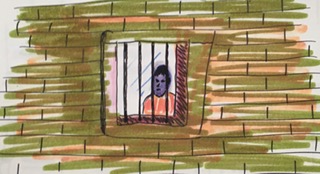
Strangely enough, I find myself wondering about what it would be like to live on death row.

We don’t have death rows in Canada, but there are about two thousand six hundred Americans in twenty-nine states right now sitting in cells awaiting their deaths by lethal injection or by other means, depending on the state. Most are still waiting for their date with the devil because they can appeal in so many ways and it seems that the average time now spent on death row is over sixteen years. There is an increasing hue and cry in the US about the time people have to spend on death row arguing that the wait itself is “cruel and unusual punishment.”

…the European Court of Human Rights in 1989 ruled that extended periods on death row violated a provision of the European Convention of Human Rights that forbids “inhuman or degrading treatment or punishment.” While acknowledging the legality of the death sentence in certain cases, it nonetheless forbade Britain to deport a German man to Virginia to face capital charges because he might spend years on death row facing “the anguish and mounting tension of living in the ever-present shadow of death.”

https://www.bnd.com/living/liv-columns-blogs/answer-man/article151691567.html

Right, “he might spend years on death row facing ‘the anguish and mounting tension of living in the ever-present shadow of death'”. Well, you know, I’m feeling a little like that myself, actually. I’ve been told I have an incurable cancer, but one that can be treated. It looks like I will go into remission sometime, probably in a few months, but who knows for how long. After that, if my myeloma doesn’t react to new treatments upon an inevitable relapse, I will surely die from organ failure. So, I wait and wait and wait not knowing if my next chemo treatment will work or not. The end result is preordained, however. No getting around that. How is this different from a death row inmate who applies for an appeal for his terminal sentence not knowing whether or not he will be successful? If he is successful this time, what about the next time? He knows that at some point the avenues for appeal will run out. When that happens he will suffer from organ failure like me, but that will be a systemic, total failure of all bodily systems as he lies there on a gurney in the execution room being administered a lethal injection of a deadly concoction of poison.

The analogy I use between my cancer diagnosis and a death row sentence is certainly not perfect. No analogy is. For instance, I don’t have to spend the bulk of my days in a small cell with bars. Nor do I have guards watching over me. That said, the comparison between my myeloma diagnosis and a death row sentence is fair if focussed on the psychological dimensions of an indeterminate cancer survival prognosis and an indeterminate execution date for the death row inmate. Chemotherapy is akin to an appeal: both buy some time but just postpone the inevitable.

I imagine that death row inmates are not pre-occupied twenty-four hours a day with the fact that they will eventually end up on the gurney in the execution room more than I am focussed all the time on the fact that my cancer is incurable, and hence terminal under the ‘right’ conditions. It’s just that the uncertainly of the situation is combined with the certainly of the outcome. That is disconcerting to say the least. I am definitely living “in the ever-present shadow of death”, but, of course, we all are. My shadow is possibly more opaque than yours at the moment, that’s all. Until I got my ‘death sentence’ I could go about my days thinking about projects I was doing, walks we would be going on, trips we would take. Now, it’s not so easy to do these things. Oh, it’s still possible, but utter exhaustion, chemo, lab and doctor visits, imaging sessions, etcetera, complicate things. I can only hope things will be different when I go into remission. I have a canoe that needs a new canvas skin and I have a sculpture I want to complete.

This all brings me back to the ‘value’ of sudden death. Sudden death does have a very important feature: its suddenness. No time to think about it, no time to live in anguish, etcetera. Looks like I won’t have the luxury of a sudden death. Maybe I will, we never know, but the way it’s going now, it’s not likely. So I have to figure out another tactic, or set of tactics to deal with the uncertainty of my life but with the certainty of my imminent death.

Problem is my death is not just about me. Yes, it’s an intensely personal experience, but other people are involved. Is it fair for anyone to focus so much on having a good death that they ignore everyone around them? Is it okay to be completely selfish about our own dying?

According to this op-ed in the Los Angeles Times, dying at home, although it seems like a reasonable thing to do, entails consequences, especially for care givers, and especially when home support and respite care are not available. This op-ed provides me with a not-so-subtle reminder to get my living will done. I probably shouldn’t procrastinate on that one.

29 A Balancing Act

So, yesterday we went to the hospital for my usual Thursday injection of bortezomib and to get the rest of the meds I take orally. This time it was a bit different because I am now on a full dose of cyclophosphomide. I was a bit trepidatious about it. I wondered if the symptoms going from a half dose to a full dose might produce twice the level of distress from the symptoms. Would I have more nausea? Doesn’t seem like it at the moment. Would I have more brain effects like lightheadedness and dizziness? Doesn’t seem like it for now. At this point it seems like it’s business as usual. I may lose my hair with the added dose of cycloformaldehyde (my name for cyclophosphomide) but that’s no big deal, I could also see darkening of skin colour and nails hardening, etcetera. Those effects are yet to be seen. Another side effect of my chemo meds is infertility. Gee, that’s really got me worried.

My tummy seems nicely settled at the moment. That’s good. Hydromorphone (hydro for short) tends to make one constipated. It sure as hell did that to me. However, most of the chemo meds I’m taking tend to produce diarrhea. Do they balance each other out? Not necessarily. Pooing regularly is very important to me now and I sure don’t need to rip my anus apart with constipation. Bring on the Dulcolax. One in the morning and one at night seem to do the trick, but I have to be on top of it because things change so quickly with chemotherapy. At the moment all is okay on the anal front. Oh, and my butt gives profuse thanks to our bidet toilet seat. That was one very wise purchase!

Last night I took my usual dose of hydro (which I found out doing research a couple of days ago that it’s one of the drugs some states in the US use for lethal injections in capital punishment). Because I have my bortezomid injection earlier in the day and I’m prone to swelling and issues around the injection site, I was told to take Benadryl as a means of counteracting that. So, I took a couple of Benadryl and that helped me sleep for four hours or so, but the dexamethasone (dex) kept pushing back wanting to make me more hyper. I slept, like I said for four hours, but after that the dex won and I lay awake for most of the rest of the night. However, thankfully, the Benadryl did counteract the dex so that I wasn’t as hyper as I might get otherwise. I was quite relaxed, actually. Around four AM I took another one milligram of hydro because my hip was hurting me more than I am prepared to tolerate. That seemed to do it, the pain attenuated and I was more comfortable. Taking one milligram of hydro on another day under different conditions and it would have no effect. It’s all about timing and balance.

As I lay in bed last night unable to initially fall asleep I checked out the ceiling above our bed. A few weeks ago I noticed signs of wetness in the ceiling drywall. It’s pretty easy to tell if your roof is leaking and you have drywalled ceilings. The paint begins to ripple and buckle slightly as the water soaks through the drywall. I am prepared to put up with some of that, but we need to ensure that it isn’t getting much worse. We painted that ceiling not long ago so I had a baseline to work with. I don’t think it is getting worse, but the solution is to get up on the roof and tighten all the screws holding down the metal roof. Metal roof screws can loosen off over time and cause problems ten or fifteen years after installation so it’s a good idea to tighten them down periodically. We’ve done that, thanks to Tim (our son-in-law) on the studio roof, and the shop roof is only a couple of years old so no need to do anything with that roof. Now, it seems, we have to do the house. I’m not about to go up there, neither is Carolyn. We’ll have to hire somebody to do that, somebody steady on their feet and with good, non-arthritic hands.

Then I thought about the studio. It’s a bit of a mess at first glance, but I set it up to do some printing months ago and it does look like a mess. But it’s not really. Someone else looking at it or going in there sees mess (unless they’re an artist). It does need some tidying up, but I’m the only one who can do that, except for moving some of the heavier pieces of equipment and my sister-in-laws stuff. A number of people have shoved ‘stuff’ into the studio to get it out of the house and out of the way, but in doing so have damaged one of the paintings I was working on, punching a hole in the middle of it. It was bound to happen. Now I have to decide if it’s worth repairing that painting or not. Sooner or later I’m going to have to go into the studio and assess my capacity to work. I could maybe do a small woodcut or linocut or finish a painting or two. I’ve got lots I could do, but do I have the energy, and can I overcome the shakes that are a side effect of some of my chemo meds? And what about that arthritis? Those are the questions.

At one point last night, about twenty minutes after taking the extra one milligram of hydro, I lay on my back and realized, heh, I don’t have pain anywhere in my body! Holy shit. I can guarantee you that that is a rare occurrence. How did it happen? Well, as best as I can figure, I had all my various meds balanced out. The slow-release hydro was looking after my regular pain, the Benadryl was counteracting the dex as well as looking after the injection site issues. As long as I stayed still, I was painless! Of course, a few minutes later, when I decided to move to sleeping on my right side, I started getting pain in my thoracic area, something I’m quite familiar with. But heh! Lesson about balance taken!

Balance seems to be everything in my life at the moment. It sure wasn’t always a concern for me to the extent that it is now. Now, I could think about going into my studio and working, say, for an hour instead of for a whole day. I can think about going for short walks instead of running marathons thus balancing my need to rest with my need for exercise. I need to take time to think about how my meds work and how to get the most out of them without too much stress on my body and emotions. Age is a huge issues but instead of pining for the good ol’ days, finding age and cancer appropriate balance is working for me. Of course, I’m still going to die, but that will help out with the cosmic balance between life and death. More on this to come.

28 Moving on up.

So, I’m over the shock of my cancer diagnosis. It’s been four months, after all. That doesn’t mean I’m happy about it, but it does mean that we (and I have to include Carolyn in everything here) have moved on from the initial storm of emotions around the diagnosis to settling in for months of chemotherapy and complete disruption of our lives. We are moving into a new routine. Every day is almost predictable, at least for now. I can’t say that I’m bored at this point, but I certainly am getting restless. I’ve gone down to the studio a couple of times lately and poked around. I really do miss drawing and printmaking. I want to get back to them soon and I really want to finish a small sculpture I started last year. Problem is I’m so exhausted all the time.

Not all people with cancer have the same reaction to the disease itself nor to the chemo meds and the opioids. Not all cancer patients are anemic all the time and I’m told that not all experience a lot of pain or the exhaustion I’m feeling. Every cancer is different and close to two hundred types have been identified. Breast cancer is the most common followed by lung and prostate cancers although there are several different varieties of all three types of cancers. Multiple myeloma is very uncommon and is the rarest of the blood cancers. Lucky me.

This morning we saw the local oncology GP and he told us that everything is going well with my therapy but that for the third cycle starting tomorrow they will be punching up the cyclophosphomide (the main chemo med) to one hundred percent. I didn’t know this, or I forgot, but I haven’t been up to full dose on this chemical yet. The doctor said that they started me off slowly to ensure that I could tolerate the shit, but now they were going to have to ‘challenge’ me. I have no idea how that is going to affect the side effects I am inevitably going to get except to amplify them. Yep, that’s what I can expect, amplified side effects. Yum.

I also learned this morning that I have six more chemotherapy cycles before they can consider whether or not I’m in remission. That means I will know by late August or early September. Oh well, I didn’t want to do anything this summer anyway, now did I. The way I’m feeling at the moment, I’m thinking that I might be able to get out on some short excursions come the sunnier, warm weather, but laying about the back yard by the pond sipping a cold drink doesn’t seem so bad either. Today is the last day of my previous cycle and the best of the whole lot because I’ve had a bit of a ‘holiday’ from my meds. Tomorrow, I’m back in the trenches with full-blown cyclo, dex, and bortozemib. I had an infusion of zoledronic acid today too, that’s a bone strenghtening drug. It gives me a raging headache so I take a couple of acetaminophen to help deal with that.

I have to get back to the hospital in a couple of hours for a CT scan of my right femur and cervical spine area. My orthopaedic surgeon wants to check my cervical spine for any changes in my degenerative disk disease and arthritis, my other nemeses. He also wants to determine if the excavators in my femur are in any danger of breaking through the bone or not. I’ve been experiencing more pain in the area lately and he wants to stay on top of that. Good for him. I like his attitude.

Enough for now.

25 Overdiagnosis?

In my last post I left you hanging with suspense! Well, in this post I have a couple of issues to raise that should quell any after effects of inordinate suspense left behind from reading my last post. One is about overdiagnosis, which I promised to raise again, and the other is about cancer itself and what would happen if it didn’t exist.

So, in her book Natural Causes, Barbara Ehrenreich addresses what she calls overdiagnosis. This is a situation wherein currently powerful imaging techniques can, for example, ‘see’ many more, and smaller, lumps in a person’s neck than was previously possible. The question is then put to the patient: “We’ve found a lump in your neck. What would you like us to do?” Patient, very concerned: “Is it cancer?” Doctor: “We don’t know, but we can always remove it.” Patient: “Well, let’s not take any chances. Let’s get rid of it.” Ehrenreich claims that in seventy to eighty percent of these cases in the US the surgery was unnecessary.

I have my own example of overdiagnosis. I had a parotid gland removed from the left side of my face years ago. There was evidence that it was enlarged, but nothing to say it was malignant. I had a choice to make and opted to have it removed. It was unnecessary surgery. Because of it I was left with insensitivity on the left side of my face and a scar leading from my ear down the side of my neck. It’s a crapshoot. How many people do you think would turn down the surgery?

Recently, Dr. Brian Goldman of the CBC’s program White Coat, Black Art, wrote in his blog about overdiagnosis. He writes that overdiagnosis “means identifying problems that weren’t causing symptoms and were never going to cause the patient harm.” The source for most of his information is a study led by Prof. Paul Glasziou, director of the Institute for Evidence-Based Healthcare at Bond University in Australia. It used data collected over a thirty year period by the Australian Institute of Health and Welfare. The results are quite astounding. Goldman writes:

The researchers found that, in men, 42 per cent of prostate cancers, 42 per cent of kidney cancers and 58 per cent of melanomas were overdiagnosed. In women, 22 per cent of breast cancers, 58 per cent of kidney cancers and 54 per cent of melanomas were overdiagnosed.

Overdiagnosis can arise from overly prescribed testing including screening tests like mammography. Increasingly sensitive imaging equipment can detect smaller and smaller lesions and tumours, benign or malignant. It’s often difficult to tell whether a tumour is benign or malignant. In the case of kidney cancers, invasive biopsies are not often carried out for fear of spreading cancer cells to adjacent lymph glands. So, surgery is a crapshoot. Do we operate or not? The default position is surgery because few people would be willing to take the risk of leaving a possibly benign tumour in their bodies.

To take this even further, Goldman’s blog post argues that even “incidental abnormalities” or cancers that would never have caused symptoms or led to full-blown rapid onset pathological mitosis are being surgically extirpated. We probably all have asymptomatic cancer cells in our bodies that may never result in any health threat because of them.

In the September 11, 2017 issue of The New Yorker Siddhartha Mukherjee is back at it with a thoroughly provocative article entitled: Cancer’s Invasion Equation: We can detect tumors earlier than ever before. Can we predict whether they’re going to be dangerous?

Good question. The gist of Mukherjee’s argument in this article is that two things are required for a full-blown cancer to make itself known which he metaphorically refers to as the seed and the soil. This metaphor he borrowed from a 19th Century English doctor interested in cancer research, Stephen Paget. His idea was that a cancer cell (the seed) would grow only if the local bodily ecosystem (the soil) was conducive to that growth. It could happen that the cancer cell falls on barren ‘soil’ and does not grow and divide. On top of that, on close examination cancer cells could be found that would never produce any symptoms. Some cancer researchers were now becoming human ecologists. Some even began to ask why people don’t get cancer and not just why they do when they do.

In my case, I may have carried the myeloma ‘oncogene’ for a long time but my ‘soil’ wasn’t yet ready to receive it. It may be that it was just a matter of time in my case, age being a big factor, but there may have been others that contributed too to creating the right conditions for my myeloma to go from dormant (smoldering) to active. Now, there’s no turning back for me. The seed has been planted and the hemoglobin garden in my bones is turning into an oncological garden.

There’s a final note towards the latter part of Mukherjee’s book The Emperor of all Maladies that makes me realize how little we know about cancer at this stage and about the process of dying and what that entails. Mukherjee writes:

“Taken to its logical extreme, the cancer cell’s capacity to consistently imitate, corrupt, and pervert normal physiology thus raises the ominous question of what “normalcy” is. “Cancer,” Carla said, “is my new normal,” and quite possibly cancer is our normalcy as well, that we are inherently destined to slouch towards a malignant end. Indeed, as the fraction of those affected by cancer creeps inexorably in some nations from one in four to one in three to one in two, cancer will, indeed, be the new normal—an inevitability. The question then will not be if we will encounter this immortal illness in our lives, but when.” (from “The Emperor of All Maladies: A Biography of Cancer” by Siddhartha Mukherjee)

So, how exactly does the body shut down as it’s dying? Cancer may very well be one (a very important one) of the mechanisms that is ‘natural’ in its role in having us die. Maybe cancer is not the pathological evil that it’s made out to be. What would happen if cancer did not exist? How would we die then? What does it mean to die of natural causes? How can we figure that out? Stay tuned. I think science and medicine have a lot to learn about us yet.

22 The Unrelenting Presence.

Carolyn and I have just finished reading The Emperor of All Maladies: A Biography of Cancer, by Siddhartha Mukherjee. The author, an oncologist and Renaissance man, who won a Pulitzer Prize for non-fiction for this work in 2011, masterfully addresses the war on cancer over the past few centuries or so, but with a special focus on more recent events and ‘successes’ relating to specific cancers and new treatments. Cancer, as the books so often argue, is not one disease but lots of different diseases. They all have one thing in common, though: pathological mitosis.

I’m not going to review the book today. I will, though, sometime soon. I’m kind of bummed out right now and not really in the mood to write a long blog post. I took my chemo meds again today. That’s always a fun time, but I’m still confused about just what accounts for how I’m feeling. Sometimes we call these feelings ‘symptoms’ but I don’t like that word much. I’m not sure why. For instance, this afternoon I felt exhausted, and lightheaded, somewhat dizzy too so I went to bed for a nap. As I lay there my body was tingling all over. Is that a feeling or a symptom? If it’s a symptom, is it a symptom of my myeloma, the chemo meds or something else? It’s still tingly, but not as intensively as this afternoon.

I’m bummed, but I should be celebrating, I guess. I had a five minute telehealth conference with my Victoria-based oncologist yesterday morning that’s left me feeling a little empty. For one thing, although he called me by name when we made screen connection (It’s like Skype on steroids), he was not prepared in the slightest for the interview. He asked me how I was doing on a chemo cocktail he had withdrawn me from a few weeks ago. Then he asked me what he could do for me. Well, shit. He then got so focussed on the computer screen he was looking at with my charts all over it that I might as well have not been there. So, I asked him about my lab results. Yes, he said, everything is going very well. The drugs are working. Reason to celebrate, right? Yes, I suppose, but then he says that I had better get used to the shitty quality of life I have because that’s my future. Even if I go into remission. Well, slap me in the back of the head! It wasn’t that long ago that he sat before me and told me I’d regain some good quality of life in remission. Maybe he was having a bad day. Now I was having a bad day too. I felt that this guy needs a talking to about compassion. He rebuffed any attempt I made at personal conversation. He was cold and completely detached. Maybe he was having a bad day but maybe not. Maybe he’s like this most of the time. Then I thought, maybe my expectations are too high. Maybe I should think of him as a consultant, more than as a doctor treating me like my GP would. After all, I see him for five minutes every four months. So, whatever, I’m still bummed out. Distractions like writing, reading, and watching YouTube videos are good for me, but I can’t be distracted a hundred percent of the time. Any break, any crack in my distractions and the dark light of myeloma reminds me in no uncertain terms of my mortality.

Mukherjee is so informative. I learned a lot reading his book. I’m also reading a book on Medieval medicine and even a thousand years ago, ‘doctors’ recognized cancer for the killer that it is, but they looked for the causes in ‘black bile’ and other humours gone bad. Towards the end of his book Mukherjee gets real for me. It’s all fine and dandy to ‘know’ about cancer, to study it, to follow developments in its treatment, but now, cancer has me up close with its unrelenting presence. I leave you with two quotations from Mukherjee’s book. I am these quotations.

“The poet Jason Shinder wrote, “Cancer is a tremendous opportunity to have your face pressed right up against the glass of your mortality.” But what patients see through the glass is not a world outside cancer, but a world taken over by it—cancer reflected endlessly around them like a hall of mirrors.” (from “The Emperor of All Maladies: A Biography of Cancer” by Siddhartha Mukherjee)

AND…

“Cancer is not a concentration camp, but it shares the quality of annihilation: it negates the possibility of life outside and beyond itself; it subsumes all living. The daily life of a patient becomes so intensely preoccupied with his or her illness that the world fades away.” (from “The Emperor of All Maladies: A Biography of Cancer” by Siddhartha Mukherjee)

Read the book

Enough for now. Maybe I’ll have more gumption tomorrow.