16 I meditate on my last breath.

Yesterday afternoon Carolyn tucked me into bed. The zoledronic acid infusion I got Thursday at the hospital has left me feeling like I have a nasty flu combined with a smashing hangover. I fell asleep almost immediately but when I woke up I could hear the rain beating on our metal roof. I love that sound. Today, the dexamethasone is kicking in and it’s leaving me in a state of nervous fibrillation. I’ve never done speed, but I expect the sensation must be something like that. Now is a good time to write because I have this bizarre energy that needs an outlet. However, the dex gives me the shakes making it difficult to keep my fingers singly on the keys of my computer.

So, getting back to yesterday afternoon. Like I said I slept for some time and woke to the sound of rain pounding the metal roof. I just lay there. I find that lying in bed staring at the ceiling is not a bad way to pass the time. I could never do that before. I had the work ethic really bad when I was still gainfully employed and long after truth be told. Now, my body has taken charge of my reluctant mind and has forced me to sit still, to lie down and not feel guilty about it. Cancer has its upsides I guess, but I’m not sure that I fully subscribe to its methods. One thing for sure: There is no normal in my life anymore: sleep times vary, meals are still on schedule as are the ritual pill taking, but I can’t count on feeling the same way during each new cycle of chemotherapy that I felt on the previous one. Dex is predictable but the intensity of its effect varies. I only have to take it one more time on this course of chemo lasting until January. I start taking it again in late January when I start my second course of chemo with my fifth cycle. A course of chemo lasts approximately four weeks, a cycle, one week. At least that’s the pattern now. But I digress.

I’m lying on my bed focussed on the cedar beam that crosses the ceiling in the middle of our bedroom, light pouring in from the three windows just behind me at the head of the bed. I close my eyes and think about death. Well, more about dying than death, actually. It’s the process of dying that is absorbing me, not death itself which for too long we’ve considered the opposite of life. Dying is another thing altogether. Dying is the separation of consciousness and body. Consciousness in my estimation comes to an end at the point of death but my body, this collection of matter brought together by processes millions of years old, will immediately begin to become unglued. It loses its integrity as a collection of cells and begins to decompose, that is, to lose its composition.

I don’t have to tell you this. It’s hard to live for any length of time without coming across at least one death in the family, among friends, or by reading the news or obituaries on the local papers. We know about death although we don’t quite know what to make of it or how it pertains to us. It’s strange that for most of us we take for granted that ‘we’ don’t exist before our conception and birth and that ‘we’ become ‘we’ by a combination of hereditary traits, learned behaviour, and environmental factors. ‘We’ or ‘I’ are constructs. We are not born fully operational. We become ‘I’ over time, slowly developing personality traits, habits, and idiosycracies that define us as unique individuals. But we resist very strenuously the idea that if we come we must also go. But I digress again!

So, I’m back in my bedroom, lying on my back on my bed in that state of half sleep, very relaxed and I meditate. I meditate on my last breath. I’m thinking that dying is not much different than living. When we fall asleep and lose consciousness we have no idea whether we will awaken or not, we just take if for granted that we will. I’ve had two brothers-in-law die this past year. One died during the night in bed next to my sister. We say he died in his sleep. True enough. He wasn’t conscious when he took his last breath. Neither was my mother who died nearly two years ago, but she had demential and was so hopped up on morphine that I can’t say she died in her sleep. My sisters were there at the moment of her death. I missed it by a few hours. I was in pretty bad shape myself two years ago with symptoms on myeloma that went undiagnosed at the time. I was perennially exhausted, in a great deal of pain, and I couldn’t stand the vigil as my family surrounded my mom’s death bed waiting for her to take her last breath. I prefer to think of my dying as just another falling asleep kind of experience. My last one of course, but still.

Needless to say, there are only one or two ways of being born that I know of, but millions of ways to die. I like to think that my last breath will be in the comfort of home or at least in a hospice, somewhere nice. Many, many millions of people worldwide don’t die under such benign circumstances. Violent death is common. Five thousand Canadians die in vehicle crashes a year, fifty thousand Americans meet the same fate. I don’t fancy that as a way of dying, but if it’s quick, maybe. I can’t imagine being hacked to death with a machete after watching my family meet the same fate in 1994 Rwanda, or being shot by a stray bullet in Aleppo leaving me wounded and watching the blood spill out of me. No, give me a peaceful, quiet place to die.

I’ve been diagnosed with an incurable cancer but I’m told that it’s more like a chronic treatable condition than a CANCER that kills fast and unannounced. I’ve got some time to think about my last breath. I’m not sure if that’s good or bad. Certainly, I’ll roll with it. I remember clearly when I was a kid of twenty or so. I had a fairly serious back injury while working at a sawmill on Lulu Island and I needed back surgery to remove a disk in the lumbar area of my back. I was a kid in search of meaning in my life, not such an unusual thing. I remember lying in my hospital bed after the surgery, hanging over the edge puking my guts out and thinking to myself. I can milk this for everything it’s worth. I could stay on Compensation for a long time then go on disability or something along those lines. Or I could get out of the hospital and use this time to get my shit together. And that’s what I did. I got my shit together. I enrolled in the liberal arts program at Douglas College in New Westminster and never looked back. My injury allowed me time to think about my future without the pressure of work. That was luxurious, and it worked.

Now, I don’t need to get my shit together. It’s been together for a few decades and I’m happy with my shit. My encounter with cancer, in a way similar to my experience with my back surgery, is giving me time to think about my last breath, but to also remember that every breath I take until my last one is worth paying attention to and celebrating. Whatever I do until I take my last breath is not so important. Of course, I can’t help but do something and I will do things that have always mattered to me. It’s impossible to do nothing and still be alive. Even lying on the couch ‘doing nothing’ is doing something. Whatever I do will be the right thing at the time because it will be what I do. In any case it won’t matter one iota after I’m dead because ‘I’ won’t be around to care or experience regret or any other sentiment.
15 Access to medical records

It is shocking to read on the CBC News today that LifeLabs has been hacked with an ensuing leak of information on 15 million LifeLabs customers including email addresses, passwords, medical records, et cetera. This is not good news. LifeLabs is a private medical laboratory business that has provided employment for members of my family and which is reputable, and generally reliable. It’s seriously unfortunate that the breach of information has occurred but it’s obvious (if implied) from the news source that it was a case of cyber blackmail, something that can easily happen to any company.

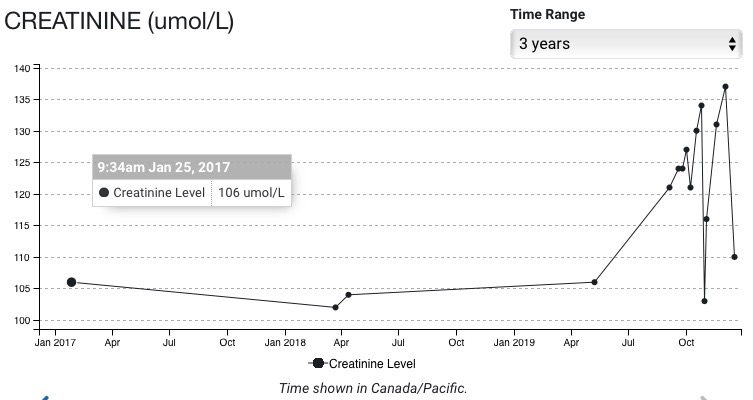
I had LifeLabs online access to my medical records years ago but in the last few years I’ve used VIHA (Island Health) labs exclusively, mostly the lab in Cumberland. Very convenient. Last time we were there (on Monday morning) the tech turned us on to MyHealth which is a new (to us anyway) service to allow patients access to our own medical records including lab and imaging results. This service is equivalent to the service offered by LifeLabs. It’s very comprehensive and I love it. We were able to access online records of our Monday morning Cumberland lab visit by early in the afternoon! Spiffy! So, I have an appointment with my GP tomorrow and I’ll already have looked at all my numbers and will be able to refer to them intelligently with my doctor. Carolyn and I have done a fair bit of research on myeloma, my bone marrow cancer, and understand what the numbers mean to some extent. Because I have only one kidney, the creatinine levels in my blood are of particular interest to us. They measure kidney function, something that can be impaired by myeloma but also by the chemo drugs I’m taking. My numbers show that my kidney is almost functioning normally again! Have a look at the graph below.

For an old researcher like me this is exciting, especially since it’s about my own blood work! Referring to the graph, you’ll see that on January 25th 2017, my creatinine level was 106 umol/L (which means micromoles per litre). That is above the reference range (60-100 mol/L), but not terribly so. Now see what happened in April 2018. There was a slight jump in my creatinine levels, but that was just the start of things going really wonky. By May of 2019 my creatinine levels began to spike up. In late September and during October my creatinine levels were all over the map. I think the radical drop from 134 to 103 umol/L from October 25th to the 29th was very likely because of a prednisone infusion on October 26th. On December 2nd, my creatinine levels were at 137 umol/L and by two days ago on Monday had dropped to 110 umol/L, almost back to normal.

This graph only goes back three years. If it went back further you’d find other times when I had spikes in my creatinine levels, not surprising since I lost my left kidney to cancer in 2002. For instance, in 2008 I went in for a blood test (not shown on the graph) and my creatinine levels were 114 umol/L, (within the reference range which at that time was 70-120 umol/L and not the 60-100 umol/L that it is now. Why the reference range changed, I have no idea). That probably wasn’t a spike, but it shows that my creatinine levels were generally above the reference range or very near it.

What I find really interesting about this graph is that I seem to be able to see immediately the effects of certain treatments on things like creatinine levels. I’m now definitely in a better position to ask the right questions of my medical team.

I’m sure medical professionals may have some doubts about to value of making this kind of information available to patients. I’m sure some patients might just go off the rails if they see lab results in MyHealth that are in red (indicating something abnormal is going on). Overall, I think this is a good move on the part of VIHA but I’d sure like to hear what the pros have to say about it.

In the meantime, if you’re a LifeLabs customer, good luck. There are resources you can access if you feel your medical records may be compromised. Check out the news reports on this. It’s all over the CBC and Facebook.

14 Now we wait.

I started the second course of chemotherapy using the new cocktail of drugs called CyBorD: cyclophosphamide, bortezomib and dexamethasone. Ya just got to be impressed by that line-up of fancy Latin names for that nasty little prickly army of toxic chemicals that we have to wear gloves to handle and that I gleefully (albeit not without some trepidation) ingest every week. Next week they’ll also infuse me with zoledronic acid, a drug that is supposed to strengthen bones. So far, so good. I may have said this before, but I will reiterate that the staff at the Cancer Centre at the hospital here in the Comox Valley is really fine. I feel that I’m being looked after. I have a person I can reach on the phone if I have any issues or questions and they’ve given me a letter to take to the Emergency Department if for any reason I should need to go there.

We won’t know for a while yet what effects the chemo drugs are having on my myeloma. It’s a waiting game, but I suppose the whole process is pretty much of a waiting game. There are so many questions and very few answers at the moment. In my last post I told you that I was going to see an orthopaedic surgeon in Campbell River. Well, we drove up to CR on Monday (the 9th) to his clinic in Willow Point. His name is Dr. Deke Botsford and he is a specialist in hip and joint replacement surgery, but he’s also capable of dealing with the issue I have which is the lesions in my femurs. To be precise, the lesions are in what’s called the distal part of the femur which is the part of the femur closest to the knee. He told us that that was an unusual site for myeloma lytic lesions to form but he also said that there were treatment possibilities. So, the lytic lesions are the result of paraproteins in my blood excavating my bone marrow thereby weakening my bone and getting in the way of the creation of hemoglobin. The excavations are called lesions. It may be that the chemotherapy treatments I’m on will arrest the growth of these lesions but then again maybe not. Botsford could drive a rod up my femur from my knee all the way to my hip joint so as to stabilize the bone and keep pain at bay. Or, he figured I might benefit from radiation therapy. I expect my oncologist will want to wait for a while to see what the chemotherapy treatments are doing before launching into another therapy. I see Botsford again in early February at the hospital in Campbell River to get an x-ray of my right femur and to assess the state of affairs in my bones. It seems that my right leg especially is weakened by the paraprotein excavations, but it is not likely to spontaneously break. It could break if I fell, for instance, or banged it a little too hard on a door jamb or something. I’ll try hard to see that doesn’t happen.

As far as pain goes, I’m dealing with it. I’ve reduced my intake of hydromorphone, my main opioid line of defence, but things seem stable enough. The zoledronic acid has a nasty side effect in that it can create elevated levels of pain in the back so I won’t be trying to wean myself off of hydromorphone anytime soon. Besides, if I do back off a bit with the hydromorphone, something I’ve tried a couple of times, I can feel pain creeping back into my ribs and back so I don’t think I want that to happen.

I have been going out a lot, of course, to the lab, the hospital and to doctors’ offices, but late yesterday afternoon Carolyn and I went to the Cumberland Brewing Company to meet with some friends. That’s the first social outing I’ve been on in three months or so. It was taxing, and today I’m exhausted, but it was also good to get out amongst friends and sip on a bitter. Even though I’m very tired I still managed a visit from a good friend and former student now living in Nanaimo. We drank tea out of mugs she made and delivered to us three weeks ago. Everyone has been so kind and generous. Gifts of food and goodies keep coming. I really feel the love.

12 So it begins…

First off, I’d like to welcome all of you who are new to following my blog. It’s gratifying to know that my writing is of interest.

[Still holding off on the post about the Emergency Department at the Royal Jubilee Hospital in Victoria. I’m working on it, but I need to write this post and at least one more first.]

Day before yesterday Carolyn drove me up to the North Island Hospital, Comox Valley Campus (I think that’s right) for my first chemotherapy treatment using a drug combination sometimes referred to as CyBorD. The ‘cy’ stands for cyclophosphamide, ‘bor’ stands for bortezomib and ‘d’ stands for dexamethasone. This article from 2009 suggests that this combination is associated with a very rapid response with manageable toxicity. I can only hope that it works for me.

I get the cyclophosphamide (cyclo) and the dexamethasone by tablet to be taken orally every seven days on a cycle of four weeks. I get a subcutaneous injection of bortezomib on the same day as I take the oral doses of the other two drugs. I get another drug by infusion once a month. It’s called zoledronic acid and is a bone strengthening medication often given to patients who have weakened bones due to cancer, which I do. I haven’t had my first injection of zoledronic acid yet but that’s coming soon.

So, I take a schwack of pills, probably fifteen, every Thursday morning then head up to the hospital in the afternoon for my bortezomib injection and for a visit with the oncology nurses. The oncology department at the hospital is superb. The staff is wonderful, calm, attentive and supportive.

The day before the day before yesterday Carolyn drove me to the hospital for a visit with the GP oncologist who is the local connection I have with the oncologist at the BC Cancer Agency in Victoria. Like the rest of the staff, Dr. Bakshi explained all the procedures I was about to experience calmly and attentively. One thing I appreciated with Dr. Bakshi was the way he explained the difference between myeloma and other forms of cancer. Myeloma is not like pancreatic cancer or other forms of virulent cancer. It’s more of a lay-low, make you sick for a long time type of cancer. It’s not unusual for people with myeloma to live ten years after being diagnosed and by then life is mostly a rear-view mirror phenomenon in any case. Myeloma is a disease mostly of older people.

I have to keep this post short because I have very little energy today. Yesterday I had a ‘high’ which was like I imagine I would feel after drinking twenty cups of strong coffee. Boy was I hyper! That’s caused by the dexamethasone. I had a hell of a time trying to sleep night before last, but last night was okay. I finally got a different prescription for my pain meds, hydromorphone. It’s a slow release prescription. I take two tablets a day twelve hours apart rather than taking two short acting tablets every four hours. I still have to get up to pee at night a couple of times, but not having the alarm go off every four hours is quite nice.

Today I got up feeling like I had a huge hangover. That feeling is still with me. It’s not all that pleasant, but it’s tolerable and I’m not going to complain about it. I knew that chemotherapy was not going to be a cake walk and I was right. I have a long way to go with it yet and the experience with it will change as I go along. I just hope I can tolerate this cocktail of meds and it doesn’t push my peripheral neuropathy to intolerable levels, nor does it damage my poor lone kidney.

More tomorrow if I can.

10 Today is not a good day.

Yesterday was okay. The day before was fine, but it’s hard to predict from day to day what my day will be like when I wake up in the morning. When I woke up this morning I knew that I wouldn’t be having a good day and contemplated just staying in bed. I try to maintain a modicum of a schedule so I like to get up around the same time every day although over the past couple of weeks my rising time has shifted a bit to the 8 AM side and is less inclined to stick to my former rigid 7:30 AM time.

I know my day won’t be a good one if I wake up from an unsound sleep with my body in full tingle mode, especially if it’s accompanied by the sensation of spiders crawling all over my legs. My reaction to my first cursory assessment of the state of my body is to hunker down, pull the covers over my head, and forget about it. But I don’t do that, do I. No, I get up, stagger into the bathroom clutching my cane in the hope that it will help me maintain my balance, and get myself into the living room where I usually plunk myself down into my recliner. I know I will spend the day in utter exhaustion reluctant to even get up to pee.

This pattern of not knowing until I wake up what my day will be like has been going on for years. That’s nothing new. I have no idea what differences in my daily routines will be wrought by the new chemical soup I will be ingesting in various ways as the oncologists stir up a new chemotherapy routine for me next week. The chemotherapy is bound to throw things out of whack in lots of ways some I can prepare for, some I can’t do anything about. Over the years, I’ve almost gotten used to being restricted in my mobility, but in fairly predictable ways. If I wanted to do something, like attend a meeting or go to a concert, I would know that if I did that I’d pay for two or three days after with exhaustion and pain. It was unthinkable to contemplate attending an event two days in a row or doing simple jobs around the property after a previous day of activity. My life has become less and less social over the years.

Truth be told, I’m a little depressed. The time between chemotherapy treatments has given me time to think, and thinking often gets me into trouble. So, I did an evaluation of my life to date going over high and low points, achievements and regrets. Probably a mistake, but one I’ve frequently made so I’m familiar with it. I even looked at pictures of myself over the years, from the time I was around two years old to quite recently. I thought about the different stages of my life, my time at home with my family, my time away to boarding school in Edmonton, my crazy teen years, working with my father, college, university, marriage, teaching, volunteer work, art, woodwork, etcetera. Then on top of that I overlaid health issues that I’ve experienced. I don’t need to go over all of my health problems here, but I had a few broken bones along with the discovery in the early 90s that I was vitamin B12 deficient and that I would need to inject B12 into my leg every month or so for the rest of my life. The discovery of my B12 deficiency was made when I complained to my doctor about fatigue, brain fog, dizziness, and that sort of thing. In 2002 I had my left kidney removed because I had renal cell cancer. Later I had an appendectomy. Still, I complained of fatigue, brain fog, dizziness and vertigo. There is a high incidence of Multiple sclerosis in my family so we chased that for a while but found nothing. Recently I was diagnosed with multiple myeloma which makes sense of all the other symptoms I’ve been having. I’ve probably had ‘smouldering’ multiple myeloma for years. So, now, I come to this:

I’m 73 years old (very close to it). I have bone marrow cancer, one kidney, B12 deficiency, degenerative disk disease (in my neck), arthritis, and who knows what else ails me. I’m old enough to die as Barbara Eirenreich argues and I’m okay with that, but the suspense is killing me. I’m being told that I could live quite a few more years with a few good ones thrown in there too. Still, I have incurable cancer and old age is coming after me. I’m beginning to envy people who die of sudden heart attacks or massive strokes. They have no time to think about all the things there is to think about.

I’ve discussed this with a friend of mine who also has multiple myeloma and his idea is that he doesn’t focus on his disease at all, or on his age, or any other potential killer. No, he focusses on what needs to be done: the shed needs a new roof, the canoe needs a new skin, baseboards need to be installed, grandkids need hugs. Dying will take care of itself when there is no other option, when it goes to the top of the priority list and refuses to be ignored any longer. I find myself thinking the same way. Yes, I get a little depressed when the extent of the threats to my life are displayed in front of me, but I get over it pretty quickly.

And I think about life and death. They aren’t opposites as we generally think of them. They cannot exist without each other. My life, like the lives of the nine generations of my ancestors who have lived in Canada are blips or interludes in the continuity of time and space. Mushrooms are a good analogue for us, I think. They push up through the ground cover from the mycelium below, flowering for a bit then melting back into the biomass to contribute again to the mass of life on this planet. Of course, for most of us in the course of history, thinking of ourselves and our species primarily as biological phenomena hasn’t been enough. The fact that we are temporary agglomerations of matter is not terribly satisfying for us and our big brains. We’ve loathed death and we deny it in every way we can, individually and socially. I try to face death as I face life. I try to put my life, my history, the phases of my body’s growth and decay in the broadest context I can. I don’t care to give them more importance than they are entitled to in the context of life on this planet.

My post on the social inequality in Emergency Departments is coming but my next one is about our immune system, the traitor that it is.

9 Grinding It Out

My oncologist called this past Wednesday to discuss changing my chemo cocktail. The one I had been on for less than a week caused a very bad rash around my whole midsection along with a mild fever. So, I stopped taking that set of meds and am now waiting for word from the pharmacy here at the hospital telling me that my new meds have arrived. I’ve got appointments lined up for the first week of December, but I may be called to come in earlier. It’s all par for the course. Hurry up and wait.

Thing is, this new set of meds has caused some pretty significant side effects for a couple of people I know with myeloma. We’ll have to keep a close watch on symptoms, especially those related to peripheral neuropathy. Can’t say I’m looking forward to the new meds but then again, I’m not too sure what the alternatives would be. I’ve sometimes thought about what would happen if I turned down any and all chemo. I know that there are drugs that are more palliative than chemo and I seriously wonder how many more years of good quality life I could get out of benign neglect rather than with aggressive intervention. These are just things I think about late at night when I’m falling asleep along with visualizing my death bed.

I’ve been reading Barbara Ehrenreich’s book Natural Causes. She’s a couple of years older than me and had a malignant tumour removed from a breast some time ago. She’s fit, she’s healthy but she also writes that: “I gradually came to realize that I was old enough to die.” She means that she’s had a good life, a fulfilling life, which is much more than is afforded many of us. She notes that the military considers eighteen year olds old enough to die and that there is no ‘best before date’ stamped on our asses. Some political leaders lead well into their eighties and nineties. That said, there is a time, when we reach seventy or so years of age when our obituary is likely to read “died of natural causes” than anything else. At a certain age, she argues, there is no need for an explanation for dying. It’s okay to die. Of course we should expect to die. Dying is as natural as being born although we generally consider it a travesty and a high order insult to life. I visualize myself dying, but I’m not convinced that the visualization can ever be very accurate. The closest I can come to visualizing the end of my life is when I’ve had a general anesthetic. Under a general anesthetic, the first drug they administer puts one under, makes one unconscious. If that’s the way I’m going to go, I can live with that. I watched as they put our last dog Wilco down a year ago August. First the sedative, then the lethal dose of whatever it is that kills. That kind of end would be fine with me. If I have to do it, and I don’t see any way out, this is what works for me.

Pain is an entirely other matter. I’ve had too much of that in my life and I don’t want to die under a heavy blanket of pain. Some pain would be alright, but nothing overwhelming. No pain would be the best, but that’s asking a lot of this aging, crumbling body to deliver. So, I’m willing to compromise and accept some pain when my dying time comes. I watched my mother as she lay dying in her nursing home bed almost two years ago now. She had Alzheimer’s and was unable to communicate at all verbally. She did communicate her pain, however. She was under high doses of morphine but we could tell when the morphine would wear off because she would get more and more agitated. I have no idea what she was experiencing, but I have the strong sense that it wasn’t at all pleasant. I was not there in her room when she actually took her last breath but as my sister recalls it, it was all fairly anti-climactic. Chances are very good that I won’t follow my mother’s example in death. For one thing, with myeloma I’m not likely to live long enough, and for another thing, I’ll probably still be sentient and able to make some decisions myself about my own death, unlike what happened to my mother. My mother was a very fine mother, cheeky as all get out sometimes and able to maintain a sense of humour before some pretty daunting odds at times. Dementia robbed her of end of life quality of life. That’s a shame. One of my sisters died a few years ago. She was four years older then me and had lung cancer. She was sentient for most of the time or her dying, but I wasn’t there when she finally gave up her last breath. I was a ferry ride away and unable to make it. She died a half hour before I got to the hospice centre where she ‘lived’. I know one thing for sure. She was pumped full of morphine for some time before she died and that effectively shut down her ability to decide anything.

Lately I’ve been experimenting a little with my pain meds. I’m on a large dose of hydromorphone (not related to morphine- a lot stronger, actually) taking two 1mg pills every four hours. I tried to back off some and take a lower dose every four hours for a day. I felt I could probably manage that because my pain was pretty much under control. Mistake! My pain is under control because I’m taking shitloads of hydromorphone. When I tried to back off, pain started to come back in my neck, ribs, right pelvic area, legs and shoulders. I knew that if I didn’t resume my twelve mg pill load a day that I would soon be completely incapacitated and bedridden. The decision was a no-brainer, but I was hoping for a better outcome.

One of the issues, of course, is that I haven’t really started treatments yet for multiple myeloma. I’ve been diagnosed and all that, but I haven’t had any chemotherapy to mitigate the effects of the disease, so it may be that in a few weeks or months and I go into remission that I’ll be able to back off my pain meds successfully. Wow, that would be cool. For now, I’ll continue ingesting lots of hydromorphone and maybe indulge in a beer or two, maybe even a tiny bit of scotch. It’s okay, all my specialists say a couple of beer are ok. I didn’t ask them about the scotch.

One (or more) of my readers here have suggested that I don’t swear anywhere near enough in my narrative. Well, fuck that! I’ll swear if I want to, swear if I want to, swear if I want to. You’d swear too, if it happened to you! (Figure out the song this is based on). Fuck!

8 Tread lightly, you could break a bone!

I told you in my last post that I had gotten a skeletal CT scan a week ago Saturday, November 9th. I know what these scans are looking for and I was somewhat apprehensive about getting the results. I still haven’t heard from my oncologist about the scan and I won’t be talking to him about it until Wednesday, the 20th. However, my GP called me on Friday the 15th at 5:30 PM to talk to me. Truth is, whenever my GP calls at 5:30 on a Friday evening it’s never good news.

The first question he asks me is if I’d heard anything about the scan. I said no, nothing. He then proceeds to tell me that I have a four centimetre tumour (lesion) in my right femur. Now, that’s a fairly large lesion but it’s in a fairly large bone too. Still, one of the main problems with multiple myeloma is bone lesions. Patients can have several bone lesions simultaneously making their lives somewhat precarious. Any wrong move can lead to broken bones and immobility.

My GP is rightly concerned about this femoral lesion and tells me that I may need a full length splint to keep my leg immobilized but it’s Friday evening now and I’m in no shape to even consider getting one, especially if it means going to the ER. That’s not going to happen. Not in a hundred years!

After a time my GP and I settle on a plan to keep me more or less immobilized, at least until Monday. Carolyn and I get back to our dinner. A while later my GP calls again after having consulted with an orthopaedic surgeon. The surgeon tells him that I will probably need radiation on that tumour and that radiation treatments happen in Victoria. Until then, I need to keep my right leg as immobile as possible. We’re getting a wheelchair on Tuesday. That will help, and on Wednesday I talk to my oncologist about where we go from here in terms of chemotherapy and now radiation treatments.

You know what? I want some straight answers. That’s all. I know that straight answers are not as easy to come by as they should be, but I’d like a clear, unadulterated assessment of my prognosis at the moment, if you don’t mind. So far, my oncologist and I had not even discussed bone lesions and the treatments for them, and we assumed that the lenalidomide/dexamorphosone chemotherapy drug combination would work and that we would reassess in a year or so.

Yes, I understand that multiple myeloma is highly treatable although it’s incurable, but every myeloma patient presents with an idiopathic set of conditions making blanket prognostications about remissions and potential lifespans kind of useless, if not overly optimistic. So far I have no idea how bad a case of myeloma I presented with and my oncologist is not really interested in what stage I’m at. He says he’s much more interested in how a patient responds to treatments than where they might be on a staging continuum. That’s fine. I hope that sometime soon we will actually be able to assess just how I’m doing on a new course of chemotherapy drugs and that we will be able to conclude that what I’ve experienced so far is a temporary glitch in my treatment.

Whatever. I like taking road trips on winding roads in unfamiliar territory, but a nice stretch of open highway now and again can be exhilarating too. I’d like to see some open road for a change where obstacles can be seen a long way off and I can put the petal to the metal. Is that too much to ask for?

7 About pain, cold sweats, hallucinations, delayed chemotherapy, rashes and, other fun stuff.

[A note: I’m used to writing posts here of approximately a thousand words. Because I’m so fatigued with anemia and other conditions that affect my concentration, for the foreseeable future I’ll make my blog posts a little shorter. That way I will be able to continue writing and not tire myself out too much.]

I started the chemotherapy drugs, lenalidomide and dexamethasone last Thursday morning. I was to take one lenalidomide tablet and five dexamethasone, continue with the lenalidomide for three more weeks and five dexamethasone tablets every Thursday morning until they were done. Frankly, it was a relief to finally get going on a treatment for my multiple myeloma (MM), any treatment. Well, you know what they say about the best laid plans of mice and me. They never go according to plan, and this was not about to become an exception to the rule.

It must have been Saturday (I got a CT scan that day) when I noticed that my butt was getting really itchy. Well, naturally, I scratched it. I knew it isn’t a good thing to scratch an itch, but I just couldn’t help myself. The welts just got bigger and hotter and covered my whole midsection. I developed a slight fever. Carolyn, my very competent care aide spread some lotion on my backside and up under my armpits to relieve some of the itching. Damn good thing too because I was close to losing it.

Well, it turns out that the reason I developed this rash in the first place is that I happen to be allergic to my main chemotherapy drug, lenalidomide. Now, that’s not cool! Lenalidomide is an oral therapy drug, and for that reason is very convenient to take. So, it’s the weekend, I’m itchy as hell, but I persist in taking my chemo meds. On Tuesday, yesterday, I call the oncology nurse in Victoria who seemed quite concerned about the rash. She tells me that she would try to track down my oncologist to get some idea of what to do. My regular oncologist was out of the Cancer Centre at meetings but she tracked down his colleague who told the nurse to tell me to cease taking lenolidomide immediately. So, great. Here I am, not a week into taking my first course of chemo meds and now I can’t take them anymore! What the hell is that all about, universe?

I was pretty bummed out for a time there, but then I realized that this is not an uncommon turn of events in oncology. In fact, about 40% of people enrolled in the lenalidomide/dexamethasone regimen turn out not to be able to tolerate the drugs.

A Cancer Clinic receptionist called this morning to set up a telephone consultation with my oncologist for the 20th, next Wednesday. At that time I should learn more about my next course of treatment as well as what they learned from my last CT scan. Strangely enough, I also got a call from the hospital here in Courtenay telling my that I needed to call them and set up a second course of treatment. She mentioned lenalidomide and I said it’s unlikely that it would be for lenalidomide because in all likelihood, I’m allergic to it and I was told to stop taking it. I guess it takes a while for messages to get from Victoria to Courtenay and back. I soon learned to take all phone calls from the hospital or the Cancer Clinic with a grain of salt and usually wait for confirmation from a third source before moving on with anything.

In my next post I’ll address the fun topics of pain, hallucinations, and cold sweats.

I was going to write a post about the social triage that happens in emergency departments everywhere, and I will get around to that, but for now I have other more pressing issues to deal with. I’m intent on documenting my experiences with myeloma as completely as possible so, for the moment, that will be my priority for this blog. One strange thing that’s happened to me is that I have a recurring dream about the emergency department at the Royal Jubilee Hospital. More on that to come.

6 Today I write about pain.

Before I do that, however, I want you all to feel free to contact me. If you have problems with privacy i.e., you don’t want your comments to appear in public, please let me know when you post comments, or pm me on Messenger or you can email me at rogalb@shaw.ca.

Things can change very quickly these days and positive things do happen! Oh, I still have myeloma and I started chemo yesterday. That seems fine. The pain in my neck has attenuated too. Who knows why. I can feel it lurking around my cervical spine, but for now it’s keeping a respectful distance. I can actually type and stay relatively focussed. I pay for that by not taking as much hydromorphone. AND my kidney is back to normal…for an old guy like me anyway and that’s very good news. I was thinking I may need a wheelchair to get around and we were making arrangements for that, but for the moment, I’m good. I’m feeling okay at the moment, ten times better than I felt two days ago, but that’s how it goes with chronic pain. Things can easily go back to shitty in a flash. Of course I know that I’m an old guy with cancer and I can see the exit door over there just beyond the bright white light, but I can’t see the handle yet, so I think I have some time. Besides, I can put that to the back of my mind. It doesn’t help at all to focus on things I can’t inevitably change and stick to the things that can get me, and others, better quality of life now and for the near future.

So, pain. My last blog post was about Carolyn’s experiences at the Emergency Department here in Courtenay. My penultimate posts were about my visit to the oncologist in Victoria and my subsequent disastrous ER visit the following day. I sit here somewhat unable to piece together accurately in sequence what happened to me since last Wednesday. Truth is I’ve seen two specialists since then, have had a ct scan with another one scheduled for tomorrow which showed that I have severe disk degeneration in my neck that is, along with arthritis, creating the pain vortex in my neck. My neck pain has been a roller coaster of severity. I have a neck brace that helps with that too as you can see from the photo below. Hi!

My office

Now, this is where it gets interesting because my oncologist tells me that my neck pain has nothing to do with my myeloma. It has everything to do with my disk degeneration and arthritis. So, I ask: does the myeloma contribute at all to pain in my body? Of course it does, comes the answer. It attacks your bones. The ct scan did not find the right kinds of lesions on my cervical spine, so they were not the source of my neck pain. Well, okay. I guess I can go along with the argument that my nasty bulging disks are responsible. I mean I had surgery on my lower back decades ago to alleviate a ruptured disk problem so I’m familiar with that. Still, recently I’ve had over the top thoracic skeletal pain which really was caused by my myeloma so whatever. I’m getting a ct scan tomorrow to check that out among other things.

So, what I’ve been able to piece together through moments of excruciating pain and hallucinating sedation, is that the pain I’m experiencing the most severely seems to be concentrated in the bony/connective parts of my body that had already suffered trauma. I’m thinking specifically of the area on my left thorax where my kidney as removed, the lower back cervical area where I had a disk removed, the left heel where I had planers fasciitis, that sort of thing. My neck too and my shoulders where I had rotator cuff tears, both sides due to falls and long term overuse issues.

I started asking this question to whoever would listen: is there an association between myeloma and increased intensity of pain in areas of previous bone trauma? Answer: I don’t think so, but probably not. Question: Do you know of any research between myeloma and where it affects the body most? Answer: Not that I know of. I had a chat with my daughters about this. They’re no slouches when it comes to research: One of them works in the field of non-profit housing and the other in biomedical research. They are my truly trusted experts. But, I have access to a lot of material too because I’m still associated with North Island College as emeritus and have library privileges.

Okay, that still leaves me dealing with my own experience of pain and those of others (read the comment by Tanya Wood based on my last post), some of whom have chosen to remain anonymous. I’m especially concerned with Emergency Departments and with receptionists (gatekeepers) in GP offices who, I know are just doing their jobs, but who, when I call to simply ask that can the doctor just tell me if I can increase my dosage of hydromorphone says: “Well, the doctor will have to see you for that” To which I answer: I can barely move. I have excruciating pain and can barely get out of my chair. Can he just tell me quickly about increasing my already existing prescription with pills I already have?” “Well, no, the doctor will have to see you.” So, I couldn’t take anymore of that and told her we’d get back to them. Later, Carolyn called and talked to someone else who said someone would be in touch. My doctor called me later in the day when he had done his patient visits for the day, something he as often done in the past and I knew he would do again. So, all day I was left figuring out how many more hydromorphone pills to take before overdosing. I’m not at all suicidal, so that’s a concern. I’ve known of many people who have died from accidental overdoses. I wasn’t about to be one of them, but my pain was so intense it was a good thing I wasn’t standing at a subway station waiting for a train anytime last week. I may just have acted compulsively and jumped onto the tracks. Of course that’s a little hyperbole, but that’s okay among friends, isn’t it?

I wrote to Tanya Wood (who’s husband, Darren, died a couple of years from complications resulting from a tragic accident) in response to her heart wrenching comment that ER departments are microcosms of our culture. They operate using the same moral assumptions as everyone else in society. We have deep-seating cultural aversions to death and disease. Most of those are built on our huge biological insecurities. I paraphrase here Ernest Becker who wrote something like: Disease takes away our ability to enjoy the pleasures of life and death does that permanently. He calls death and disease the twin pillars of evil for us. [You need to read some of my early posts to get a sense of how brilliant I feel Becker was.]

So, in a sense, I’m not surprised at the cavalier attitude most staff members have towards people coming into Emergency departments everywhere. Don’t get me wrong. There are some very dedicated and caring medical staff working in ERs doing a mostly thankless job which, I’m sure, can be extremely rewarding at times too but the system is stacked against them and they will, I’m certain, be looking for different work soon if they don’t toe the line. And, of course, as I’ve already noted in a previous post that pain is invisible so ER staff can’t just take your word for it. Not only that, but if you come in really agitated that you’re in extreme pain and need some meds now they may tag you as a troublemaker and make you wait all that much longer for help. There’s a big screen tv in the ER waiting room at the Royal Jubilee Hospital explaining in great detail why you must wait and why. There are signs saying no foul language or threats or whatever will be tolerated. There are security people everywhere dressed just like police. I wonder what they would do if somebody with Turette’s Syndrome came in following a car crash or, as is quite common, some people can’t utter a full sentence without ‘fuck’ in it at least once. These people may just suffer from undeveloped communicative skills but they are probably not dangerous. The message is clear: if you want treatment here you had better stay calm, cool, and collected. Of course, precautions must be taken, but I’m not sure that blanket prohibitions are the way to do it.

Pain, in our culture, is associated with weakness and most people are loathe to talk about it even to the point of not seeing a doctor because they’re embarrassed about the location of their pain or don’t want to admit weakness. Weakness of any kind is just not acceptable. Do you see any weak superheroes in the movies? Well, some of them show some slight or passing weaknesses but they always triumph over them in the glorious light of their super strength. That’s in the movies. In Diehard movies the hero falls off of an eighteen storey building onto the top of a moving van below, rolls of of that onto the sidewalk where he encounters villains walking towards him shooting up a storm with their AR-15s (or whatever), gets hit, falls through the open door of a bar, sidles up to the bartender and asks for a scotch on the rocks. The young, gorgeous, female bartender gives him his drink and comments on the two gaping bullet wounds on his shoulder. He respond in true superhero in training fashion: “These, nah, just flesh wounds.”

Real heroes are immune to pain it seems so if you really want to be a superhero, boys and girls, don’t complain about pain!

Pain doesn’t kill. It’s a sign that something organic is out of whack and needs attention. Failure to attend to pain often results in dire consequences for the patient but any complaint of pain is not treated initially by medical staff as an organic issue, but rather as a moral one. We are all assumed to be moral degenerates unless proven otherwise by the cognoscenti. Of course that’s not true in every case, but the underlying assumptions are always there. Overlying all of this too is the assumption that there is an acceptable amount of demonstration allowed with different levels of injury. So, for a broken leg, some amount of whimpering is allowed, and for the pain I went in with some moaning and groaning is okay, but only when there’s movement happening otherwise sitting quietly is what’s expected. In any case they have a scale of acceptable pain demonstration. Don’t mess up their expectations and assumptions. But as I said, our reaction to pain culturally is really screwed up so you’d have to think that in an ER that would be doubly evident. It’s not right but that’s the way it is. Is there anything we can do about it? Maybe, but it’s complicated and requires a lot of knowledge and challenges to authority. Authority does not like being challenged. That itself is a challenge since authority has all the lawyers it wants to line up against you, often using your money. But lets poke the beast a little and see if it demonstrate any signs of weakness or pain.

I’m not dead yet, and I’m coming for you, VIHA, and related government departments and agencies. You’re trying to get rid of pathology services entirely in the North Island and that’s a travesty. Some of you in the business may need to retake your Hippocratic oath. More on this later. I need to do more research to know exactly what the situation is, but when I’m ready you’ll know about it.

So, for now, I’ve seen my oncologist, my kidney specialist, my pathologist and now I need to have my beer specialist on my team. I won’t be going out to see him anytime soon, but I heard he might just deliver. Damn, there’s so much more to say!

One of my previous posts about disability and people in wheelchairs. It might be of interest after reading this post.

3 What? I’m giddy about seeing an oncologist?

Well, giddy might not be exactly the correct word to use here but it’s close. I’ve known for a month or so now that I have multiple myeloma, an incurable bone marrow cancer, but I have also been told that it’s treatable and some people live for some years after their diagnosis. But I’m not sure about anything yet because I have yet to see an oncologist. That changed yesterday, at least the anticipation part.

Yesterday, around 1 PM I got a call from the BC Cancer Agency in Victoria, telling me that I have an appointment with an oncologist at the clinic on Thursday, the 31st of October, Halloween morning, at 10:30 AM. I have no idea what to expect because I have no idea at what stage my cancer is at nor what treatment options there are. Oh, I can make up stories based on Dr. Google research, but that’s a futile pursuit. This disease is idiopathic. No two patients are alike. I guess that’s true for most cancers. There are commonalities and there are individualities. The only reason they can be treated at all is because of the commonalities. Without pathological patterns no illness could be treated. Still, the idiopathic aspects of this disease make it hard to compare experiences with others facing the same disease. We can commiserate, but that’s about as far as it goes. That said, there is comfort in commiseration.

So, this morning at 7:45 I attended the medical lab in Cumberland so they could take a dozen vials of blood and some urine (boy, did I have to pee when I got there) in anticipation of my appointment with the oncologist, but also with a nephrologist in Nanaimo on November 7th. On Saturday I have a CT scan and on Sunday I do a twenty-four hour urine collection for the nephrologist. I might already have told you this, but I am taking prednisone now and I’ve had an infusion of some drug the name of which I forget. So, in effect, my treatment has already started. I can’t wait to see what the oncologist has in store for me come Halloween morning.