2 Multiple Myeloma Makes Me Special!

I’m always a sociologist so whatever happens to me triggers an instinct I have to do check it out, do the research, connect the dots. In my book, the more information we have the better. At the moment, we have an information deficit and that’s frustrating but, hopefully, that’s about to change.

In any case, one of my first research stops is Statistics Canada. What’s there to learn there? Well, for one thing, multiple myeloma (MM) is a pretty rare form of cancer and that makes me special, don’t you think? Stats Can reports that there will be about 3000 people in Canada diagnosed this year with it. That’s not a very high number. Stats Can also projects that from 2018 to 2022 only 70 men in BC will be diagnosed with MM in my age group every year. Because doctors seldom encounter it, it can be difficult to diagnose, but back to that in a bit.

I’m in good company too when it comes to MM. Jim Carr, the Liberal Member of Parliament for Winnipeg Centre and Minister of International Trade in the Federal Cabinet, was diagnosed with MM the day of the election (Monday, Oct. 21st) when he went into the hospital complaining of flu-like symptoms. By Tuesday he was receiving chemotherapy and dialysis and by Thursday the CBC was reporting that the Minister said he was doing fine, felt okay and was going to continue serving his constituents and the Canadian People. I’m so happy for him. He won’t be cured, but he will probably be able to function quite well for some time to come. By contrast, my doctors knew I had MM three weeks ago and I have yet to see an oncologist and will have to drive 225 kilometres to Victoria for the pleasure. Living in the boonies as we do, access to specialized health care can be spotty at best and will only get worse if the Vancouver Health Authority has its way. (That’s the subject of another blog post but DecafNation, George Le Masurier’s excellent blog, has been on to this for some time). It’s true that an oncologist in Victoria is on my case and has already prescribed medications for me and I got an infusion of a drug a couple of days ago at the hospital here to help with the pain and ‘strengthen bone’. Still, I feel that I’m not getting the level of care I would have gotten if I were a member of the Canadian political aristocracy or if I lived in a large metropolitan centre. My age likely has something to do with it too. I’m an old guy and not likely to live too long anyway and besides, I’m no longer a contributing member of the economy having retired from teaching at North Island College in 2012. Does that sound like sour grapes? It may be, but socio-economic status (class, gender, age, and geographical location, etc.) has a lot to do with health care provision whether we like to admit it or not.

Alright, so back to my situation. I’ve probably had MM for a long time. I have low B12 and was diagnosed with pernicious anemia at one time by a locum (temporary replacement for my regular doctor) , but my doctor didn’t really accept this diagnosis and prescribed B12 monthly injections (which I do myself). The thing is, I had been going to my doctor for years complaining of being tired, having brain fog, being in lots of pain, and suffering from peripheral neuropathy. To give my doctor credit, he ordered MRIs of my brain and spinal cord, lower back, ultrasounds, etc., because there is a history of Multiple Sclerosis and other immunological diseases in my family. To add to this, I has a kidney removed in 2002 because of renal cell cancer, leaving me with one kidney. For a long time we tested my creatinine levels to ensure my kidney was functioning properly and it did for years. In the last three or four years however my kidney showed signs of being very unhappy. Creatinine levels were rising and still are, and I was getting weaker and weaker all the time with worsening symptoms.

My social life was taking a huge hit. Over the past few years I’ve had to pretty much give up going out in the evening because I’m exhausted. I had to give up life drawing, printmaking and sculpting. I had to resign from the Village of Cumberland’s Homelessness and Affordable Housing Committee and I had to resign as Chair of the Board of the Comox Valley Art Gallery (although frankly I had been doing that long enough). I can no longer go on long walks with Carolyn, something that we both really enjoyed.

After a while, I think my doctor kind of gave up trying to figure out what was wrong with me and I was beginning to wonder if it was all in my head.

About a month ago, all that changed. We had gone camping in Strathcona Park in August. I was not feeling great, but well enough to get the canoe out and paddle/sail/motor around a bit. A couple of times, however, we got into bucking huge headwinds and were forced to paddle hard. Carolyn and I are seasoned paddlers and we know what to do. I felt pretty strong and we handled it fine. Of course we had some muscle pain, but scotch helped out with that a bit! Then my daughter and her family joined us. One day as I was sitting at the camp site doing nothing, my back started hurting something awful. By the time I decided to take some ibuprofen (not to be taken by anyone with any kidney issues) my pain was pushing 9 or 9.5 on a 10 point scale. I was taking T3s like they were candy. When it was time to go home, my son-in-law drove the truck and trailer. I rode shotgun. I have driven very little since and not at all for the last month.

A short time later, I made an appointment to see my doctor to let him know about the back pain and my use of ibuprofen. He figured we had better do some blood testing and we did. He was headed out on vacation for three weeks so I wouldn’t be seeing him again until Oct. 22nd or so. Well, he called me on Friday at around 5:30 and told me that my kidney was leaking protein into my urine and that he had referred me to a kidney specialist in Nanaimo. That was a bit of a shock. I didn’t quite know what to say so I left it at that.

Over the weekend, Carolyn and I sat down and wrote down all of my symptoms and questions to which we wanted answers. On Monday, I called the medical clinic and got an appointment to see a locum to ask questions about what a protein leak meant and to lay out my symptoms. Well, he ordered more blood tests and imaging. We saw him again on Thursday by which time he already had a strong suspicion that I had multiple myeloma. On Friday he called and pretty much confirmed the diagnosis. On Monday we saw another locum and she ordered more tests and imaging as well as a bone marrow biopsy. She also referred me to the Cancer Clinic in Victoria.

So, in less than ten days, the locums had figured out that I had cancer and were moving fast to get me treatment. Possibly all that it took was a fresh set of eyes on my case. Certainly, the referral to the kidney specialist would have got me some results but I’m not scheduled to see him before November 7th. I wondered what my regular doctor would say when he got back from vacation. I am definitely pissed off that I went so long undiagnosed, but I don’t really blame my GP entirely for that. I may not have impressed on him the real state of my distress and MM is not easy to diagnose because it shares symptoms with so may other ailments. Besides, raving about past injustices will get me nowhere. I need to focus my full attention on the present and the future.

So, in any case and in the meantime, I called the Cancer Clinic and a person there confirmed my referral, gave me an ID number and said that I would be seeing such-and-such a doctor. Well, my regular doctor informed me just this past week that there had been a mix-up in the referral and that I would be seeing another doctor at the clinic. We have yet to hear from the Cancer Clinic. If I don’t hear from them by tomorrow afternoon I’ll be calling them again. We need some goddamn answers and I need to get some goddamn treatment. Stay tuned.
New American Civil War?

I’m sitting here pretty much incapacitated by some undetermined health issues, anticipating yet another doctor’s appointment tomorrow to go over yet another set of lab results, and trying to distract myself from too much inward looking self-pity. At least I can still write. The brain fog I’m experiencing makes it somewhat more difficult than in the past, but I can still do it, especially if I write about something I have some passing knowledge of.

A new American Civil War? Perhaps. The first American Civil War in the 1860s was fought by agricultural capitalists in the South against industrial capitalists in the North but it was couched in state-based rhetoric: Northern states versus Southern states. During the war, there was less emphasis on the economic interests than on slavery, ‘freedom’, and the need for a ‘United’ States. Capitalism can tolerate slavery to some extent, but it really needs a labour force that is also a consumer force. Slavery is incompatible with a growing need for mass consumption. Of course the first American Civil War was fought using non-economic rhetoric and propaganda but the underlying logic of the war was economic and political. Contemporary Confederate flag wavers are not focussed on economic, but on some imagined lost ‘freedom’, and Southern solidarity: Us hard-done-by-Southerners versus You overbearing, holier-than-thou Northerners. The longevity and sustainability of Southern feelings of oppression by the North should tell us something about the depth of feeling in the US now. Looking at a map of the US featuring red and blue states illustrates that there are still glaring geographical differences in people’s attitudes and in their political loyalties. The Southern states, now including Texas, are still feeling hard-done-by. (Some of the northern mid-American agricultural/rural states likewise). Visiting Texas it’s clear that there is an underlying uneasiness and separatist impulses have not completely dissolved. I haven’t visited Idaho, Wyoming or Montana, but rural, agricultural areas are clearly alienated from New York and California. It may be the United States of America, but it’s not the Solidarity States of America. Internecine squabbles and jealousies abound.

The Second American Civil War may well have a rhetorical veneer of statism and rage (yes, rage) over perceived (and sometimes real) social and economic inequalities, but if Donald Trump is successful, it will be a moral war, one fought by people who have fully absorbed the moral imperatives of the capitalist promise of free enterprise (while hardly benefitting from it personally) against people they perceive to have abandoned American ‘freedom’ and ‘liberty’. The move to impeach Trump will only further solidify the camps, but Trump has not given the Democrats many options. I’ve recently read a number of articles in the New Republic and in other publications that argue that the way to combat Trumpism is not to call out Trump supporters as stupid, ignorant morons, but to engage in dialogue and community building with them so as to understand their grievances and support them in coming to a more reasoned assessment of the issues. I’m not sure there’s time for that.

Trump will continue to inflame passions with his frequent Tweet storms and rallies, accusing high level policy makers of treason and high crimes. How long can this go on? How long will it be before we see a convoy of Mad Max wannabes rampaging through the streets of America’s major cities randomly shooting people, raping and pillaging? How long will it be after the initial skirmishes and outburst will be see anti-Trump militias grow in defence of their families and communities? What of the police? Will they serve the American Constitution against concerted attacks on democracy from all sides? Will they be peacemakers or will they take sides? And what of the military? Will the military take sides? Would the military support Trump if he decided not to vacate the White House after a narrow electoral defeat in 2020?

It’s dreadful to even think about possible scenarios of violence, lawlessness, and totalitarianism but to not think about them is irresponsible.

I’m a Canadian. As Pierre Trudeau said decades ago, we are a mouse sleeping next to an elephant. Woe be the moment when the elephant rolls over in his sleep. For Canadians there is no isolation from American extremism. Over 80% of us live within a hundred miles of the American border. We have family and friends in the US. We worry about their safety and security.

I am a retired college teacher. I told my students decades ago that America was headed for a civil war. The tensions caused by American corporations creating global markets and (at least for the moment) eliminating good paying jobs in manufacturing to exploit cheap labour in Asia, Africa and South and Central America, were bound to lead to widespread social unrest, nationalism and jingoism. I don’t think that global supply chains and markets are going to be easily dissuaded by Trump. They continue to create subsidiaries and engage contractors in China, India and elsewhere. North American manufacturers continue to expand their supply chains and are not interested in containing their activities to US territory nor would they be interested in repatriating manufacturing. I can’t imagine Nike returning to Oregon to manufacture its products. It has no capacity to do so in the US and it would be prohibitively expensive to build new factories in Beaverton, Oregon, the site of its headquarters. There are some agricultural corporations that are moving their processing facilities from Canada to the US in a move, in part, to placate Trump supporters, but they still need Canadian raw materials. The complexity of global capitalism is staggering and strangely enough, that is what gives me any hope at all that a second American Civil War can be avoided. Many US manufacturing corporations that keep research and development functions in the US but produce their commodities everywhere else on the globe are pushing back against Trump’s tariffs. For example, iPhones are made in several places, mostly in China (check out FoxxCon) but may also be made in India shortly. US tariffs will force the price of iPhones upwards, but that’s true for many so-called American products made in China and elsewhere. The world is now so economically intertwined and interconnected that starting a war with China, say, means crushing America’s own manufacturing and processing capacity. I’m hoping that America’s business leaders will have the guts to seriously oppose Trump. I’m not sure that will happen and they may just try to wait him out. I’m unconvinced, however, that any business opposition to Trump will be able to coalesce sufficiently to help ease tensions in the US domestically.

The picture is much more complex than I’ve presented it here, and I may be a victim, like many others, of hyped up, sensationalist news. However, I perceived, like others, this trend in America for decades, before social media, fake news and the gutting of the CBC and other formerly independent news sources. I read widely and I search out different points of view. Trump supporters are caught up in a cult-like mindset unencumbered by reason and will not easily be dissuaded even if dire predictions of the imminent collapse of America do not come to pass. Sadly, some extreme lefties are caught up in the idea that all Trump supporters are ignorant, stupid slobs. There isn’t much room for moderation, reconciliation, or peace in this extremism. Is it possible for the political ‘middle’ to assert itself and put a stop to all forms of extremism? If so, how would that happen? If not, where do we go from here?

THC and CBD: My Personal Experience.

So, I’ve had chronic pain for decades, at least since the early 1990s. I use acetaminophen regularly, sometimes resorting to T3s and even hydromorphone (oral morphine) on occasions where the pain and discomfort were (are) extreme. I can’t take ibuprofen because I have only one kidney (my left one was removed because of cancer in 2002) although it works the best for me. The other day, as a tribute to our silliness, Carolyn and I went canoeing on Buttle Lake in Strathcona Park. Such a beautiful place, but the wind can come up very strongly. We knew it could do that, but we blithely went out in the canoe anyway, and surely enough we got caught in a very snotty windstorm. We had to paddle at ramming speed for quite a while. My 72 year old body protested on every stroke. A couple of days later things came to a head and I had excruciating pain in my back because of a severe muscle strain (probably a tear, but who’s quibbling). So now I had acute pain competing with my chronic pain for attention. Both were winning at this stage. Enter CBD and THC.

There are lots of websites extolling the virtues of CBD and THC for the treatment of chronic pain, arthritis included. Here is one example from Medical News Today. WebMD is what I judge to be a fairly reliable source of internet-based medical information. Like this article in WebMD argues, consulting a physician is always important before using CBD as a medicine.

Great, so in the interests of attempting to alleviate some of my chronic pain, and being desperate, I decided to try using CBD and THC. To that end I had an MD ( a locum in my medical clinic) refer me to a group of health care professionals (physicians, nurses and therapists) at a clinic not far from my home. I figured I’d be a test subject although I know very well that a one person study is not a study at all. I was called shortly thereafter to a consultation with a physician who has experience with using CBD and THC medicinally. I was prescribed the use of CBD daily for chronic pain and THC at night to help me sleep through the night. On the physician’s recommendation I bought a 40 MG vial of CBD and a 40 MG vial of THC from what they said was a reputable manufacturer. So far, I’ve found that the manufacturer has been very careful to sell me only what I have a prescription for. The physician I saw prepared for me a sheet of instructions for taking CBD and THC. Since then, I’ve had regular calls from the clinic inquiring as to my experience with the products. I completed my first course of using CBD and THC a while back and have recently picked up my second prescription.

I really hoped that CBD and THC would work for me. T3s are fine, but harsh on the stomach. The THC is fine. It gets me stoned to some extent so I tried to take it only at nighttime. Doing what I do in my daily life, I can’t be stoned all the time. I need a clear(ish) head. I have enough trouble with brain fog as it is because of my immune disease. I don’t want to add to it with meds that don’t work all that well. I don’t think CBD worked for me at all, ever. I kept giving it a shot paying very close attention to my symptoms but I felt no improvement.

After I injured myself canoeing, I saw an MD again. I still had a few T3s left so I wasn’t too concerned. Well, the T3s ran out really fast. At one point when my pain was pushing 9.5 out of 10, I took T3s, up to 4 at a time and washed that down with a ml of CBD and another of THC. I also had some alcohol to really wash it down. I was then able to sleep, but I couldn’t keep that insanity up for long. So, back to the my regular medical clinic for some more T3s.

I also went back to the other clinic, the one that prescribed the CBD and THC for me. I had a consultation with an MD there and we basically agreed that CBD was not going to work for me. Clearly, it doesn’t work for everybody. I may still try using THC, but only at bedtime, and only if I’m feeling I need it for putting me to sleep. I may cease taking it altogether.

I’m quite sad about this because I had high expectations. At the moment all I can do to keep my pain levels down is to do very little of anything. Obviously I can write, but walking is even difficult and going out to socialize is increasingly unpleasant. Damn it, I love to socialize! I still go out and do volunteer work and maybe go to a restaurant now and again, but I have to rest frequently.

I knew that CBD and THC had not been tested using double-blind studies, but I hoped they would work anyway. Unfortunately for me, that wasn’t (and isn’t) the case. I sincerely hope they work for you.

I’m a Cancer Survivor but I won’t be a Life Survivor.

It seems odd for me to describe myself as a cancer survivor. Oh, I had cancer, alright. In 2002, very early in the year, I was diagnosed serendipitously with kidney cell cancer. I had gone to see my GP about acid reflux so he sent me to to the hospital to have an ultrasound to check it out. The ultrasound tech wasn’t looking for anything in particular is my guess, but she zeroed in on my left kidney and sure enough there was a lesion there that they strongly suspected was kidney cell cancer. The techs didn’t tell me that, of course. They don’t discuss the results of a scan with patients in my experience. My GP was the one to break the news to me. His office called me to tell me the doctor wanted to see me at 5:30 the following day. I didn’t think much of it at the time, but in hindsight, that was an unusual thing for my GP to do. In any case, he broke it to me and said that the best chance of a full recovery for me was surgery as soon as possible. Then he sent me off to see the urologist who would perform the surgery. They didn’t perform a biopsy they said because of the fear of spreading the cancer which at that point was restricted to my left kidney. Fair enough.

So, after all the preliminary tests were done and I had seen the surgeon and the anesthesiologist my surgery was scheduled for the third week of February. Normally, of course, I would have been teaching at that time, but that wasn’t going to happen so the college arranged for subs on very short notice, one of whom was to die of cancer a few years later. The thing is that there are no obvious symptoms with kidney cell cancer. As far as I know, it doesn’t usually affect kidney function, so my kidneys didn’t show any signs of stress or disease. I felt fine. I did some work around the property. It so happened that we were just in the process of buying a new place in Cumberland, BC when I was diagnosed. There was a lot to do. We had an acre of property with the house and several outbuildings. It was a good thing that I wasn’t particularly debilitated. That was to come later.

Needless to say, a cancer diagnosis is traumatizing for everyone involved. I was concerned for my family as much, if not more, than for myself. Strangely, I was convinced that this cancer wouldn’t kill me so I was pretty upbeat about the whole thing. Why I felt this way I have no idea. It could be I was in denial. We humans are great at denial, even me.

Finally, I had my day in the operating room. I arrived at the hospital with Carolyn early in the morning with hardly anyone around. We said our goodbyes and I was taken to the pre-op area. They didn’t waste any time getting me ready and into the operating room. That I remember. My GP was in attendance and assisting, although I didn’t see him in the operating room at the time. Later, my GP told me that the surgeon had cut me in half laterally on my left thoracic area so that the kidney could be gently lifted out helping to keep the cancer contained. He said it was quite daunting. That’s what happened. Since then I’ve made do with one kidney. One of my former students was a nurse in the OR. We joked around until the anesthetic kicked in. Having a former student in OR isn’t unusual because many of my students were in the nursing program and were taking my sociology courses as electives. It happened again last year when Carolyn went in to have her appendix removed. My former students are everywhere!

I tell you all of this so you get a sense of what I mean when I say I’m a cancer survivor, but I find it hard to describe myself as such. I think of cancer survivors as people who have had to struggle for weeks, months or years on chemo and/or radiation, losing their hair and being in horrible pain the whole time. I have known many people who have succumbed to cancer, but I also know a number of people who have fought it, and fought it valiantly for long periods of time and survived. My cancer recovery was not at all long and drawn out. The surgery put an end to it. Done. Well, mostly done. My surgery was seventeen years ago and my left thoracic area has been a source of constant pain since then, aggravated often by the slightest movement. The pain in my side never lets me forget about the cancer that almost claimed my life. It gets pretty tiresome at times and saps my energy, but I carry on because what else is there to do? No, suicide is not an option.

So, I guess I’m a kind of cancer survivor, but I won’t be a life survivor. No one has ever been, nor will anyone ever be a life survivor. Nothing can ‘cure’ us of death. My surgery has allowed me to live longer and that’s fine, but I’m still in line for dying. And that’s fine. I don’t have any illusions about life and death. Life demands death. Life cannot happen without death. Denying that gets us nowhere. So, every day is one more day to enjoy and struggle over. When it’s done it will be done. That’s it. I know that some of you might think it odd that I say it, but if I had died on 2002, that would have been fine too. Carolyn and my family would have been sad and would have mourned my loss, but they would have gotten on with their lives. That’s what we do when people close to us die, we get on with our lives until our turn comes.

Beauty in Death

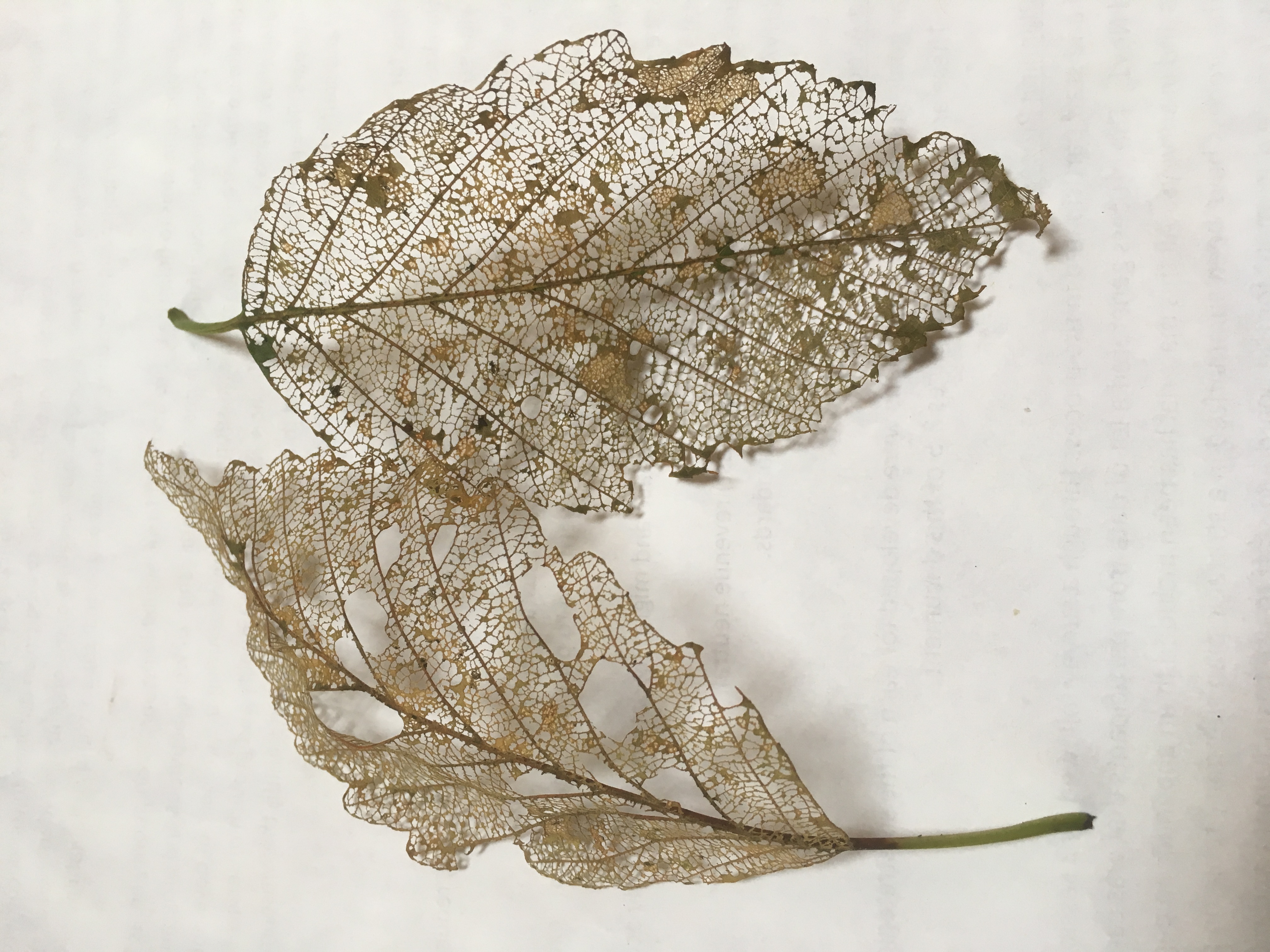
Alder leaves – Skeletonized by alder flea beetles

The photograph above is of skeletonized alder leaves caused by alder leaf beetle larvae. The adults chew holes in the leaves while the larvae leave the ‘skeleton’ of the leaf intact but strip it of the ‘meat’ of the leaf.

We have several alders on our property and they all look terrible with leaves dropping or dead but still on the tree. From what we’ve read on the internet the trees generally survive an alder flea beetle infestation, but I’ll believe it when I see it. Of course alders lose their leaves in the fall, but ordinarily, the leaves drop off in a heavy wind and are generally intact yet brown. The skeletonization of alder leaves is the product of the little black alder leaf beetle larvae. The effects of the two processes are entirely different and are obvious upon inspection.

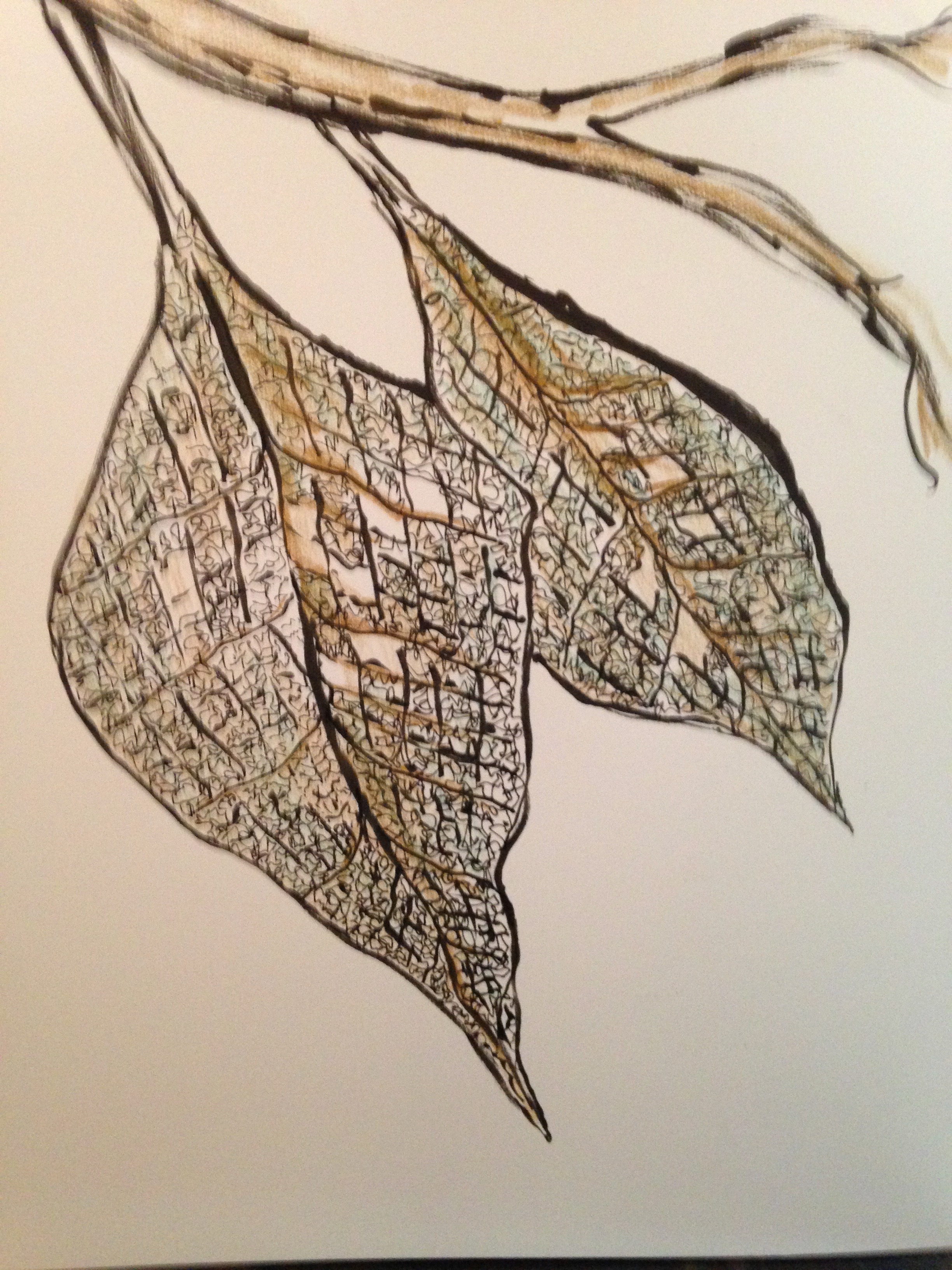
But enough technical stuff. The point of this post is that I find these skeletonized alder leaves quite beautiful. I love the intricacy of the connections of the veins. I love their strength. I haven’t used these particular leaves as a drawing subject, but I have drawn skeletonized leaves.

I can’t remember just when I drew these skeletonized leaves, which are not alders, but it was a few years ago certainly.

It’s difficult to see death in these leaves because we hardly see life in trees at the best of times. Forest companies don’t deal in trees, don’t you know, they deal in ‘fibre.’ When we see a load of logs on a logging truck going down the highway we don’t think of death (if we think of anything at all) related to the truck and its load. I have no real evidence to write this, but I do understand the culture and the language that denies death and this has that culture and language all over it.

That said, there is death in these leaves. They are dead or at least fully within the process of disintegrating and becoming compost for future plant growth. Their ‘meat’ is gone and all that remains is their ‘skeletons’. I find beauty in skeletons. I’m not sure why. We have lots of bones around here, bits and pieces from various deceased animals including a mouse, a tiny bird, raccoons and deer. Skeletons, for some reason, at least clean and bleached ones, have a simplicity and elegance that is always hidden in life. They require death to release them from their ‘meaty’ cover, to bring them to our attention, and to give them life. Maybe that’s why I find them so attractive.

Do you have a university degree? Did your parents?

Did you know? Children in lower income families (22.6%) are less likely to obtain a university degree than those in higher income families (59.3%). By responsibly using new data sources, we provide Canadians with greater insights.

From: https://www150.statcan.gc.ca/n1/daily-quotidien/190702/dq190702e-eng.htm?CMP=mstatcan

Statistics Canada puts out a report every day called The Daily. Lately, it’s added a new feature to The Daily called Did you know? I quite like this new feature.

The observation about the relationship between education and family income comes to you courtesy of The Daily. It’s a simple statement of fact based on the masses of information on us that Stats Can collects. Of course the devil is in the details as they say. I’d need to dig a bit deeper into the Stats Can website to determine what ‘lower income’ means and also what ‘family’ means. It’s not as simple as it seems because Stats Can has different ways of determining family.

But let’s just leave it at the basic level it’s presented to us by Stats Can and think about why children in lower income families are less likely to obtain a university degree than children from higher income families. Let’s see how this basic fact can be explained by various political groups or parties for their own ends and what ‘greater insights’ Canadians might get from contemplating this fact.

If I subscribe to a Social Darwinian ethic with roots going back to Thomas Hobbes and John Locke, I might just argue that the greater numbers of upper income progeny going to university and getting degrees is the natural order of things. They are ”successful” because they are superior to the lower class rabble. They have the personal traits that make them successful, traits that the poorer schmucks down the road lack. Personal initiative is everything. Poor people just don’t have any of it. They are lazy and must be prodded to get them to work or to study.

If I count myself among the ranks of ‘progressives’, I may very well argue that the reason that poor people don’t go to university is that the social odds are stacked against them. They lack the financial resources to attend university. They don’t have the advantage of having attended superior elementary and secondary schools. They don’t have a home life conducive to reading or intellectual work, and their parents are probably people who don’t value a higher education.

Others along the ‘progressive’ spectrum put more emphasis on structural factors that impede access to higher education for low income people. For them, the class system steers individuals along certain pathways. It divides us and ensures we remain divided by selectively supporting certain social programs and not others. Social inequality from this perspective is not about individual differences. It’s about class and other group characteristics.

So, Stats Can can produce numbers like this but the insight it generates is not objective. The insight is filtered through a number of screens depending on the ideological framework deployed to make sense of it. There is virtually no gain to be had in trying to convince a dyed-in-the-wool Social Darwinist that Marx was correct in his analysis of class, and vice versa, of course.

[BTW, putting together another post about the meaning of things. Maybe by Sunday or Monday.]

Is It Wrong To Think About The Past A Lot?

Wrong. Right. These are moral concepts of course and play on our social and cultural expectations of proper behaviour.

Thinking about the past a lot may be contrary to some of the prime values of capitalism, growth, entrepreneurship, accumulation of money and compound interest. These values are all future oriented. What I find is that as I get older, I am less interested in the future because I have less of it, and I’m more preoccupied with the past, I think, because I have more of it. That’s not to say that I don’t think at all about the future, make plans, and that sort of thing, but my days being alive are numbered while my days lived accumulate, and accrue more interest every day.

Basically, this is a commentary on how people treat older people who keep bringing up stories of their youth or their prowess in sports, business, or what-have-you, or want to hang on to special keepsakes as they go into an elder care facility. We don’t have a lot of patience for people who “live in the past”. This isn’t true for everyone obviously, but I’ve witnessed older people (older than me) being discouraged from talking about the past or keeping special things with them as they moved into a care facility. The facility my mother went into as she got too old and demented allowed her to keep photos, trinkets, and some furniture. Not much, but enough. My mother wouldn’t have noticed in any case as she was profoundly affected by dementia for the last decade of her life.

Life presents to us some pretty basic patterns: We’re born with nothing and are given things for the first few years by our parents as necessities or as gifts, then we slowly start accumulating ‘stuff’, lots of ‘stuff.’ By the time we get to my age (72), we are expected to be less interested in stuff and more concerned with getting rid of said stuff. That’s all fine, but my stuff is a surrogate for my life. My books, drawings, paintings, prints, and sculptures accumulated over decades of teaching and art practice contain bits of me, especially those works that I produced myself. I look at my shelves at remember the context in which I acquired this or that book, did this or that painting. My life is largely in my past now. That’s not to say I don’t look forward to seeing my family in Vancouver, or relaxing by our pond. It just means that it’s reasonable for a person my age to spend more time thinking about what happened in days gone by, and unless there’s lots of money involved, worry about compound interest. In any case, I don’t know for how many of you this perspective holds true, but it’s mine and I’m keeping it.

Lately, Carolyn and I have talked about downsizing. We even put our house on the market for a few days, changing our minds ultimately for good reasons. That action was prompted by the fact that our aging bodies can’t handle the work involved in maintaining an acre of gardens. So we need help to keep this place going and that’s fine. But I fear downsizing too because I can see bits and pieces of my life disappear into the lives of strangers or into the landfill. I know I can’t take it with me, but until then, even if I never read another book on my shelves, I’d like them to stay just where they are.*

_____________________________________________

  • There are exceptions to the books I need to keep, of course, but even the old sociology textbooks I have which are of no use to anybody are still an old part of me and I will grieve their passage into the landfill. It’s not so much the content of a book being of interest to anyone, it’s about how much interest it has (had) for me.

Multinational Enterprises in Canada: .8% of enterprises, 67% ownership of ‘Canadian’ assets.

Although less than 1% of all enterprises were MNEs, they held 67% of all assets in the Canadian economy. MOFAs owned more assets than FMOCAs, with 49% of the total…Half of MNEs were Canadian majority-owned, with foreign affiliates (MOFAs) and half were foreign majority- owned, with Canadian affiliates (FMOCAs).  

From: https://www150.statcan.gc.ca/n1/pub/11-621-m/11-621-m2019001-eng.htm

This is a short post designed mostly to share this information from Statistics Canada. Sure, go ahead and read my piece, but check out the Stats Can material too. By the way, MNE means Multinational Enterprises, MOFA means Majority-owned Canadian Affiliate, and FMOCA means Foreign-Owned Canadian Affiliate.

So, did you get that? Multinational corporations by count are less than 1% of the number of enterprises in Canada yet control 67% of ‘Canadian’ assets. That is not the whole story either, by any stretch of the imagination. MNEs pay way less taxes than they should on average so they also draw inordinate amounts of wealth from all of us while returning very little back to us as a country.

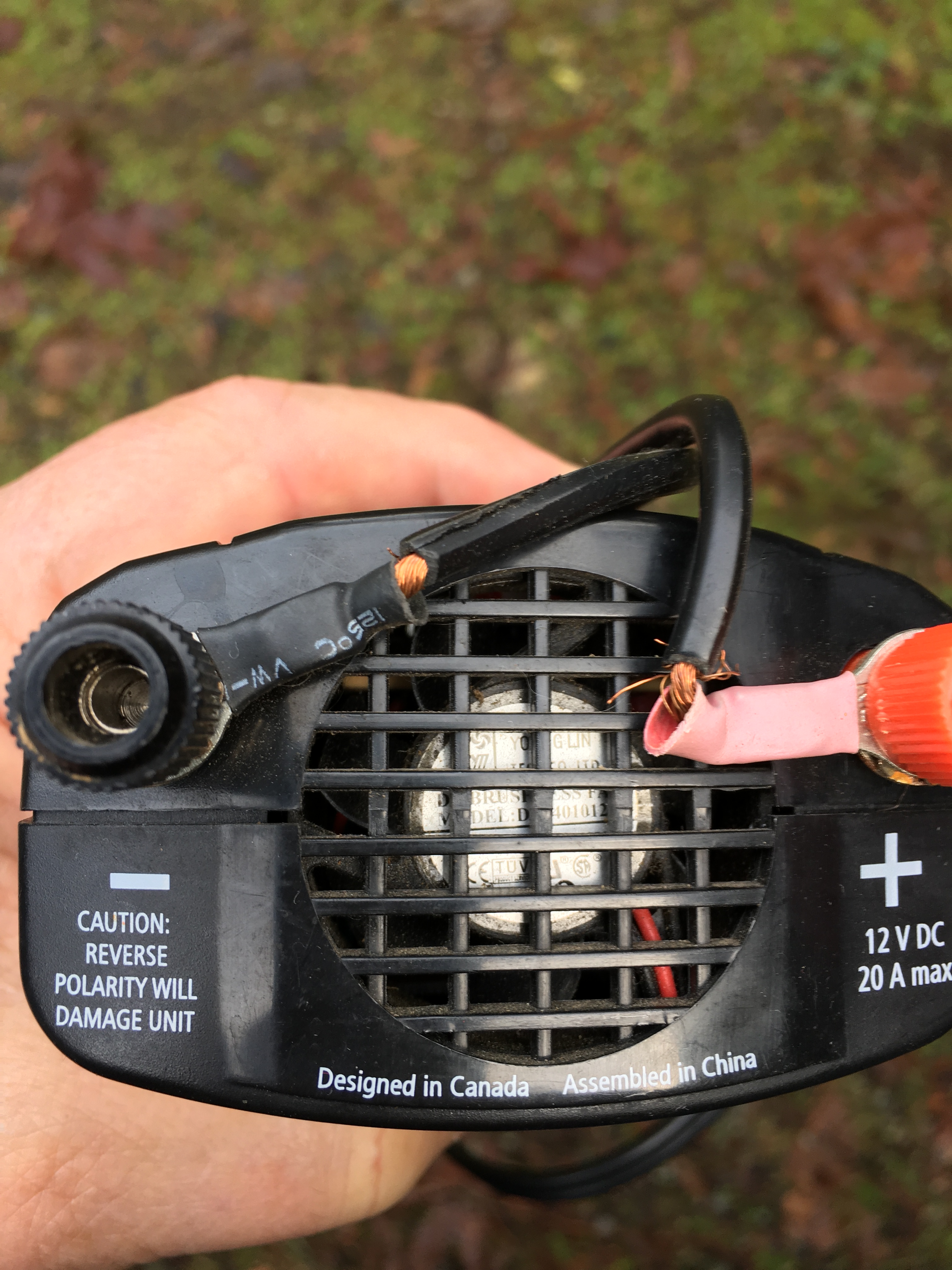
So, have a look at this photo of a power inverter we own. It converts twelve volt DC into 120 volt AC current. It says it was designed in Canada and Assembled in China. I’m assuming it was designed by a Canadian company, but I don’t know. I’d have to do more research because there are many possibilities. It could be that it was designed by a Canadian company for another Canadian company, or it could have been designed by an American company with a Canadian affiliate. It is called the Motomaster Eliminator, which means that it was manufactured by some business to be sold in Canadian Tire stores. There’s no way that Canadian Tire manufactured it. Canadian Tire contracts with manufacturers to build things and put the Motomaster name on them. So, is our inverter a product of Canada or China? There is no manufacturer named on the product. It’s getting to be more and more difficult to identify the sources of the commodities we regularly consume. The inverter says it was assembled in China, but were all the parts that make up the inverter made in China? Not likely. They could have been made anywhere in the world and shipped to China for assembly.

It used to be that the Ford Motor Company manufactured all of their cars in Dearborn, Michigan. The plant, which was huge, took in raw materials from all over the world and converted those raw materials on site into parts that were then assembled on site. Not any more. Now Ford cars have parts that come from all over the world, components manufactured and assembled in various locations into transmissions, engines, etc., then assembled to completion in Michigan, or in other plants here and there in the world, including in Canada.

Very few value-added products are now manufactured from scratch in Canada or in any other country, for that matter. Much of ‘Canadian’ raw material gets shipped overseas or to the U.S. for use in a multitude of commodities. Nationalism is no longer a factor in economic decision-making unless there is money to be made in using attachment to country as a marketing tool. It’s common for ‘Canadian’ businesses to do this when and if they can. It’s possible that some business owners have a real affinity for their country, but even then, the underlying logic is still making money.

In another aspect of this situation it’s notable that in many circumstances, along with our power inverter, many commodities are designed in North America and manufactured elsewhere to take advantage of cheap raw materials and labour-power. Truth is we live in a very complex world while people want to see nothing but simplicity in it. You tell me if when I use the toothpaste we just bought that says on the package that it was made in Mexico that I’m brushing my teeth with Mexican toothpaste? No? Then what am I doing and why does it matter so much to some people?

Big business in the form of multinational corporations is pretty much operating within its own world of supply chains and profit and loss statements. It raises its head about the money well only long enough to sniff the air to see what is going to be the next vehicle for their drive for profit. That will not cease anytime soon but it will cease. The race is on to see whether corporate capitalism collapses from its own internal contradictions before the planet sheds us for our excessive consumption and disregard for other life forms. I have no idea what the outcome of this race will be but it may be that both processes happen simultaneously. In that case, Armageddon here we come. Glad I won’t be around for that.

Life and Death: How Absurd!

[This post was first published in June 2019, about four months before my myeloma diagnosis. Lately, I’ve been re-reading my posts looking for the best ones to re-post. This one is a particular favourite of mine, so here it is for you again. I don’t think I can express the ideas presented here any better now than I did back in 2019. I’ve been trying, but with no success. So, rather than continuing to beat my head against the wall, I decided to give myself a break and re-post this piece now. I hope you find it interesting (again).]

We are born, we live and breathe for various lengths of time, then we die. Seems rather pointless, really. For as long as we know, and from all the historical records that we have unearthed or discovered one way or another, we can only conclude that humans have not ever been terribly enamoured with this situation.

Of course, most animals are averse to death, or at least to dying. Death itself isn’t particularly scary, it’s the getting there that we have a problem with. Even an ant feeling attacked will flee or fight. Of course, once it’s dead there is no issue. Not all animals face dying in the same way. Without being too anthropomorphic, some are stoic, some are frantic. In humans, some are even self-destructive but I’m not sure that death is what suicides want. Relief from pain and suffering is probably the goal more often than not, but in many cases, death seems the only respite, the only place where there may be peace. Of course, that’s silly because there is no ‘place’ after death. Death cannot be a respite from pain and suffering because we have no way of experiencing relief from pain in death. Death is the absence of sensation, of thought, or feeling; it’s the absolute negation of consciousness. Death is no thing. Before we are conceived we are also nothing, no thing. Life as we think of it as sentience, feeling, consciousness, starts sometime in our development. It’s hard to know when. In a way, death puts an end to the whole story.  Historically and linguistically, we have wanted to contrast living with dying, but they are not opposites. Death is the only way life can happen. So, why, generally, is it so hard for us to let go of life? Well, like all other animals we have a survival instinct, or an instinct for self-preservation. With rare exceptions, there seems to be an inherent drive in all animals to continue to live. I don’t think any species would get very far without it. It does present a problem for us, however. It means we go to great lengths using our big, unfortunate brains to deny death using whatever means we can, and boy do we have lots of means! Our cat is afraid of death. She skulks around wary of a stray cat in our neighbourhood we call Mean Gene because he beats up on our Princess Pretty Paws. Still, she hasn’t managed to institutionalize death denial. She just can’t take it that one step beyond immediate, visceral run-like-hell action. And when Mean Gene is no longer in sight, Princess is just fine. She is not anxious and preoccupied with dying. She’s still interested in her food bowl, however. 

What it gets right down to is the fact that as animals we reproduce sexually and engender offspring who are themselves immediately on a trajectory to death. Living and dying are the same process. Stop dying and you’re dead. Now that seems completely unfair. We are built to die! What the hell! Well, that just can’t be, damn it!

Over the millennia, we’ve created any number of ways to convince ourselves that we don’t really die, that although our bodies may perish, our ‘souls’ do not, and that makes us immortal in a god-like way, really. For us to be immortal we must be gods and by our earthly deaths experience apotheosis. Millennia ago, when we were still in our infancy as a species, we were awed by the powers of nature and our extreme vulnerability in the face of them. We decided that there must be some sentient power that controlled the forces of nature, the floods, volcanos, fires, landslides, and other deadly phenomena. Not only were there powerful natural forces, but they were capricious and unpredictable as well as uncontrollable.

In our silly wisdom, we figured out that maybe, just maybe, we could barter with the gods so that they would leave us alone. If we presented the gods with gifts, even living gifts (as in virgins thrown into a volcano), maybe we could obviate the damage the gods inflicted on us. It was fine to kill all the people in the next village, but leave us alone, please. Well, that didn’t always work according to plan, so an explanation was necessary. So, if our village was ravaged by a fire even though we had been really good and had made lots of sacrifices to the gods, maybe those sacrifices just weren’t enough. We just had to kick up the giving a notch or two. Sadly, we are still very much controlled by this narrative. 


“Indians” in the Fur Trade

In my last three posts I considered the fur trade in the northern half of North America. I suggested that indigenous peoples traded fur (beaver as well as otter, mink, fox, muskrat, lynx and many others) for manufactured European tools, the most important being axes, hatchets, kettles, knives and guns. The trade began we don’t know quite when but possibly as early as the early 15th Century incidentally to fishing on the Grand Banks and in the Gulf of St. Lawrence. I also wrote that the trade didn’t really get off the ground until the 17th Century when Samuel de Champlain made several trips to the St. Lawrence in search of furs or whatever else he could return to Europe for a profit.

Indigenous peoples as early as 1534 when Jacques Cartier entered the St. Lawrence on the first of his three trips to North America, were eager to obtain European trade goods. That’s not in dispute.¹ The superiority of European iron, brass, and copper tools was not lost on indigenous people although some might argue that this superiority is strictly one that is adapted to capital accumulation and commodity production rather than for the creation and use of tools designed for immediate use. Still, the Indigenes, by all accounts, were driven to adopt European tools and soon lost the capacity and the skill to use their old tools. 

To say that Indigenous people were driven to adopt European tools is not to say that Indigene and European were equal in the trade. Hunt (see footnote 1) goes so far as to say: 

The great desirability of the trade goods to the Indian who had once known them became shortly a necessity, a very urgent necessity that permitted no renunciation of the trade. As new desires wakened and old skills vanished, the Indian who had fur, or could get it, survived; he who could not get it died or moved away. But, whatever he did, life for him could never again be what it had been: old institutions and economies had profoundly altered or disappeared completely at the electrifying touch of the white man’s trade, which swept along the inland trails and rivers with bewildering speed and wrought social revolution a thousand miles beyond the white man’s habitations, and years before he himself appeared on the scene. 

It was the incursion of Europeans into North America that eventually wrought the decimation of Indigenes in North America through intertribal war, smallpox, measles, whooping cough and displacement in the face of settlement. If a real accounting of the European invasion of North America were done, one would find that the Europeans had ‘won’ the contest hands down. I’m not sure, however, that the ‘win’ is especially sweet given the current state of our land, sea and air, our societies, our ways of ‘making a living’, and our often strained interpersonal relations.  That said, I’m not sure all Indigenous people would want to return to pre-contact times. Life then was not as idyllic as we would like to think and the ‘noble savage’ was neither particularly noble, nor savage, at least no more or less than the rest of us. 

We must keep in mind that the commercial fur trade based on the beaver lasted almost three hundred year as a dominant industry with the period 1670 to 1870 standing out as the most active. A lot can happen in two hundred years. For generation after generation, the Indigenes were driven by the lure of European trade goods but in the process, they transformed themselves and were coerced, often with the help of the clergy, into becoming the workforce of European capitalists. Old rivalries turned into bloody conflicts with the arrival of European guns and other weapons. The Mohawk, who numbered at most 12,000 people and who had been dominated for a long time by the Algonquin and Huron, who numbered probably 100,000, crushed the Huron in a bloody war culminating in 1649-50. 

It can be argued that early on in the fur trade, Indigene and European were on a much more equal footing than there were to be later, say in the 19th Century. Early on, Europeans relied as much on Indigenous technology as the Indigenous peoples relied on European technology. The canoe made the early trade possible and Indigenous agriculture fed the drive of the trade inland. After 1830, and the decline of the demand for beaver fur in Europe along with the virtually complete destruction of the bison and the rise of forestry as a staple trade, the need for Indigenous workers in the fur trade declined. They were abandoned more and more to their own devices. Starvation was rampant and disease murderous. In all of this in what we now know as The West, Catholic clergy vied with the Protestants for the souls of the remaining individuals. The Oblate missionaries declared the Protestants as the ‘agents of Satan’ but to their chagrin, the Protestants were often aligned with the British trading out of Hudson’s Bay and their work was doubly challenging as a result. 

By 1870 when the Hudson’s Bay Company sold Rupert’s Land to the Canadian Government the tragic trajectory of the Indian Act was about to be played out. Indigenous people became wards of the Canadian state and are still technically so with some exceptions. Indigenous people were crowded onto reserves and their rights eroded with several amendments to the Act. Nevertheless, resistance was always a factor in Indigenous life and the flowering of Indigenous political activism and individual success, even at the white man’s game, business enterprise, is testament to the resilience of Indigeneity. Still, the structural disadvantages and personal racism Indigenous people face are staggering. 

To study the fur trade and the colonization of the northern half of North America is to study the trials and tribulations of Indigenous North Americans coming to grips with the inexorable, inevitable, spread of Western Civilization into their lands, into their families, their social relations and their ways of life.  Their struggles were human struggles, not unlike the ones we experience today. Their lives weren’t simpler than ours. In fact their lives were often more precarious and more complicated than ours. Their loves were no less so. Alliances were often sealed with marriages between Indigenous women and European men although sexual intimacy and desire don’t need the sanction of politics to flourish. Indigenous men and women were as capable as we are of subterfuge, of lying, of deceit, and of treachery. They were also as capable of love, joy, caring, mutual support, as well as profound grief from loss of family members from disease and death as we are. They had dreams and arguments. They ‘othered’ people as we do. They had an idea of who was ‘good’ and who was ‘bad’, just like we do. They were just as powerless in the face of historical, global political economic forces as we are. In the end, they lived and died, just as we do.  


¹ See esp. 

Hunt, George, 1940. The Wars of the Iroquois: A Study of Intertribal Trade Relations. Madison: The University of Wisconsin Press. The introduction is most relevant here, especially pages 4 and 5. Also see:

Innis, Harold, 1930. The Fur Trade in Canada. New Haven: Yale University Press. See especially page 392 but the whole book is about the spread of the fur trade west from the Atlantic to the Pacific.