The Wealthy Need The Poor

Just a quick note to start off the day. The title says it all. The wealthy need the poor. In fact, it doesn’t matter who ends up poor, it just matters that many people do. I mean, who can know if someone is wealthy if there are no poor people around to compare them to? No, poor people are essential to the wealthy for many reasons. First, they make a great cautionary tale, as in, “see what can happen to you, my child if you don’t put your nose to the grindstone, work hard, aspire to the things that make us rich and believe in free entreprise, because mygawd it’s our way to glory and eternity.” Of course, in the same vein, they are also a great example of how not to live your life. “Those people have made a poor choice in parents. You’ve at least started life not making that mistake!” They are also a great source of cheap labour and can’t save any money so everything they make goes right back into the hands of business. What a great setup.

Actually, it’s  really quite simple. We live in a class society no matter how much we attempt to deny it. Wealth and poverty are a consequence of that, not the cause. So we have rich and poor people as an inevitable consequence of the way our society has evolved. Wealth is a major moral goal so poverty must be a major moral failure. So we merrily blame the poor for their circumstances and for all the ills of the world. We don’t have the good sense to see who and what are really to blame.

Strangely enough, there is no such thing as ‘capitalism’, which is a word that would describe a system of wealth accumulation that can be compared to the evil isms, socialism and communism. Capitalism is an a-historical concept that fails to take history into account. Capital accumulation and the rapid concentration of wealth in finance capital will come to an end. What will come after? I have some sense of that in very broad terms but that’s the subject of another post.

The Dorm

When I was twelve years old my parents sent me away to boarding school in Edmonton. It was at great sacrifice for them and for the family because with my many siblings needing attention and money spent on them, investing as much as they did in me was surely a hardship. The parish paid for my tuition and that sort of thing, but my parents still had to dish out lots of cash for my expenses like hockey equipment, clothes, outings and sundry other things. Attending Collège St-Jean was a privilege because I got a very good classical education in French and English and I can still speak French more or less fluently to this day because of it. I doubt if I would have gone to university later without this early experience.

I was a student at the Collège St-Jean on the south side of Edmonton for 4 years starting in 1959. I went for a fifth year but couldn’t handle it and came home after a couple of weeks. I was a bit of a psychological mess. I’m sure I badgered my parents to attend this boarding school over a thousand kilometres from home because all of my friends were going too. In fact, there were 40 of us boys from BC attending the College in the early 60s. As I said, it was a privilege attending the College, but it was not all fun and games. The testosterone alone was choking as was the odor in the dorm. We played a lot of sports and not all of us were careful with our personal grooming…and that’s putting it gently.

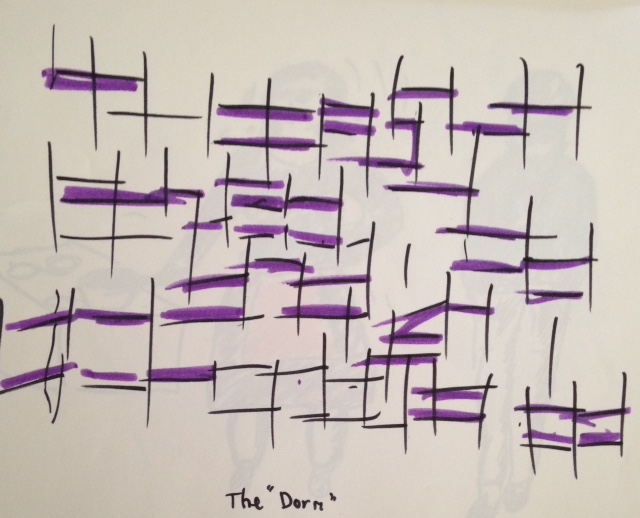
The first 2 years I attended the College I slept in a dorm with 124 other guys 12 to 15 years of age. Five rows of bunk beds were the main feature of this building along with a narrow washroom/shower room containing probably 5 or 6 shower stalls and as many toilets along with a whole row of sinks where we would wash, brush our teeth and admire ourselves in the mirrors. This is  how I remember the dorm:

Dorm

This is how I remember my relationship with the priests who ran the school:

Blue me.jpg

Well, that’s a little unfair because some of the priests at the College were caring and respectful men. Some were less so and some were downright violent, not that my friends and I didn’t deserve a little chastisement from time to time. In fact, at times we were not the best examples of good behaviour. In fact, we were often little shits. I won’t go into detail but I’m sure we deserved any punishment we got.

It’s only in recent years that I’ve been able to look back on my College days with some degree of objectivity. It was a very emotional time but that’s the way it is for teens.


The Trouble with Wealth

We all want to lead the good life, but what does ‘the good life’ mean? In our world it means to live a life in comfort, economic and physical security and good health. It means being a moral person. It’s hardly ever pointed out, but being a moral person in our world generally means conforming to the ideals and goals of a market economy within a system of private entreprise and possessive individualism. Morality, although it’s often thought of as a set of abstract principles detached from everyday life, is actually determined by the dominant socio-economic structures of our society. Being a ‘good’ citizen is, undoubtedly, an aspect of being a moral person, but most of us never give a second thought to the role that nations have played in our history or what roles they play in our lives now. Countries or nation-states like Canada, the US, Spain and France, are political structures that support private entreprise and that nominally employ a representative form of government that is generally believed to be democratic. I would argue that the states I mentioned above as examples are not democratic in their essence and do not act in the interests of their populations except in rare circumstances and often tangentially at that. Of course, their main objective is to convince you that they do act in your interests. Most of us believe it because we have no knowledge basis to think otherwise.

We’ve been convinced that the key to leading a good life is to get a ‘good’ job, work hard, be frugal and buy things, as many things as possible because they are often what give our lives meaning. I’ve written about this before. Do a search of my archives. I don’t want to get sidetracked here, so I’ll move on. Suffice it to say that one major ideal in our world is the achievement of prosperity with includes good health and enough wealth to lead a comfortable, secure life.

So, what are the social consequences of the drive to achieve prosperity, especially from the perspective of those who have it? Well, the achievement of a certain level of prosperity and wealth is a major moral imperative in our world. So, if you have prosperity, you are a moral person. If you don’t, if you’re poor or somehow lacking in the trappings of wealth, you are an immoral person. It’s really just as simple as that. Yes, there are exceptions and not all of us, by any means, buy into this ideology. What I am arguing is that most of our social institutions are geared to supporting private entreprise, the pursuit of wealth, and possessive individualism. So, for example, our governments are set up to treat the poor, the homeless and those with marginal physical and mental health with disdain and as objects of derision and opprobrium. Being poor carries with it shame and guilt because a person’s poverty is a clear sign of their immorality, of their incapacity to achieve the prosperity to which we all aspire. We rub people’s noses in their poverty at all possible turns.

Human life, in our world, has little intrinsic value. The value of human life is contingent on how productive we are, how prosperous we are, how clever and smart we are. Unfortunately, those qualities are much more easily achieved for some of us than for others. We do not have equal opportunity. Racist exclusion, the marginalization of women and generational inheritance of advantage all play a role in how we ‘end up’ in life.

I’m not saying that individuals have no responsibility for how they ‘end up’. They do. But the structures of our society militate against certain groups of people making them immoral even before they attempt anything. From a start of immorality, it’s very difficult if not impossible to achieve the moral objectives of prosperity and wealth.

Of course, this is all very complex. We can discuss that if you like, but, essentially, the one thought I want to convey here is the idea that poverty in our world equals immorality. So much of how we organize the world and think of ourselves and our neighbours stems from that basic principle.
Trump and protectionism

This is just a short blog that is a reaction to a CBC radio interview this morning with a representative of the Canadian Manufacturers and Exporters Association (CMEA). The interviewer asked the rep from the CMEA how Trump’s presidency would affect Canadian manufacturers. His reply was that Canadian manufacturers are worried, but that Trump’s rhetoric is just that, rhetoric designed to appeal to particular gullible and self-interested audiences, and fact is something else. He said that if the US imposes tariffs on Canadian goods, then Canada should do the same with regard to American goods.

Problem is, there is a basic flaw in this perspective. Canada produces nothing. The US produces nothing. Corporations, sometimes registered in one country or another, produce things and services for sale. People produce things, not countries so why do economists and journalists still insist on using the country as their primary unit of analysis? When are they going to stop saying that Canada’s trade with the US is this and that, rather than focusing on the real situation which is that corporations are dominant and manipulate governments for their own interests? Ironically, many ‘Canadian’ manufacturers have their products produced in China or in other countries that provide them with tax breaks, lax labour and environmental laws, and cheap labour in export processing zones. And just because a corporation has a head office in Toronto and is technically a Canadian corporation that doesn’t mean that its prime motivator is to serve Canada as a country. No, its prime motivator is profit and as long as a Canadian head office serves its interests that’s fine, the moment it doesn’t do that anymore, its ‘loyalty’ will dissolve as quickly as salt in water and it will move its head office elsewhere. More to the point, of course, is that much of ‘Canadian’ manufacturing is controlled from abroad. That led Harold Innis (Google him) to note in the late 1940s that Canada is a country with its brains spread all over the globe.

Economists and journalists need to give their head a shake and stop letting corporate capital and its governmental lackeys lead them around by the nose.


My death

I’ve been thinking a lot about my death lately. I know most people would not approve of this seemingly morbid preoccupation but I find it keeps me focussed on my life and what I have left of it.

Speaking of death goes against a most important moral precept we have, one of our most cherished ideals: health. A focus on health along with wealth and happiness is supposed to keep us in a good mental state and thinking positively about our lives and our activities. Given our obsession with health, it’s not surprising that we don’t want to hear about death. Death is the ultimate failure of health, now isn’t it? We seem to love to speak about our healthy lifestyles and post comments on Facebook about our healthy diets. We are constantly bombarded with ads and opinions about how to stay healthy. We are admonished for not eating healthily, drinking too much booze or engaging in activities that could ‘damage’ our health.

Don’t get me wrong, I’m not against being healthy. I’m just saying that it’s immoral in a world that glorifies health to be unhealthy. Now before you go off telling me I’m full of crap, think about it. Think of how we speak in hushed tones when someone is found to be ill and the words we speak to the relatives of the sick and ailing. Think of how we are uncomfortable around people who are obviously ailing or seriously ill. We equate illness with weakness and mygawd we must stay strong!

Disease and death as Ernest Becker so eloquently put it are “the two principle evils of the human organismic condition. Disease defeats the joys of prosperity while one is alive, and death cuts prosperity off coldly.” (EFE, page 3)

So, why do I think about my death? Why do I anticipate the moment of my last breath? Well, I know my death is tomorrow. I was 20 years old yesterday although I’m now 70, so how far down the road can my death be? It will be on me in a moment just as old age has come in a blistering flash. Time truly does fly. So, in thinking about my death, I give my life some meaning, some urgency. Life and death are one in the same thing. One cannot exist without the other so in denying death we are denying a crucial part of what makes us alive.

Our denial of death is a great cultural conspiracy to keep us feeling guilty and to keep us in line, conforming to the moral ideals that rule our world. Yes, like most animals, we have a primordial will to live, but unlike most animals we have wreaked havoc on the world in our ill-fated attempts at guaranteeing our immortality. Anyone who dares oppose our chosen path to immortality beware because you will soon be targets of our wrath.

Tomorrow I tackle morality and wealth. If you’re poor you might as well be dead in our world.


More musings from 2000: Ah, the sweet odour of dried cow dung.*

I think of the sense of smell as being more emotional, more personal than the senses of sight and hearing. I want to say it’s a smaller sense like taste and unlike the senses of sight and hearing, yet it can be a window on so many aspects of the physical world unavailable to sight and hearing.

For instance, I love the smell of pepper and oregano on my pasta and the smell of wood fire on my hands. These are intimate, close smells, but I also love the smell of the ocean as it fills my nostrils to busting with a panoply of pleasant and sometimes less pleasant odours. I love the smell of the forest on a hot summer day, yet I love the close odour of my body, washed and unwashed and the smell of my earwax. Sometimes odours are overwhelming like the smell of urine on a crowded street in Paris or how Kye Bay used to stink of raw sewage before they cleaned it up a few years ago. Sometimes I find odours repugnant like that of vomit yet I find the odour of dried cow dung strangely compelling.

Metaphorically, I love to smell or sniff out clues like a detective when I do research. There is very little more exciting in my work than being on the trail of a bit of an idea or concept that I need to bring together with previously gained bits of knowledge into a whole higher level of understanding.

By the way, I used the concept of exciting in the last paragraph. What is it about excitement that seems to be so compelling to us, or at least to marketers? Why do cars, clothes, scents, detergents, appliances, flooring, and just about everything else have to be so damned exciting? Is there a certain odour that’s produced with excitement that attracts us? Is it an evolved trait or a cultural mechanism used by salespeople to get us to buy things? Should I pursue this line of thinking? It’s really just a smelly little speculation, so probably not. I have bigger fish to fry and smell up my metaphorical kitchen.

*Slightly edited in the name of good taste.

Do I want to learn?: Some random thoughts from my 2000 notebook.

My whole life has been a quest to know. I have always wanted to learn. And I have learned a great deal. The question is not a general question about learning. The question is whether or not I want to learn and to finally know the way through the loneliness of an unbalanced life. Finally is probably not the correct word because finality is an illusion.

I always knew that there was a connection between body and will or body and mind. I knew it but I needed to taste it, to hear it, make it mine in the fullness of my senses.

How to dissolve the power of social pressure? Now that’s another question entirely. Life outside of society is impossible but society is rife with ideological traps like the need for immortality and its hero systems for the denial of death. I know this. But I haven’t made it mine yet. It sits in the front of my brain and resists trickling down into the pores of my skin and the cells of my nether parts. It sits isolated – knowledge without absorption. I may know what’s good for me, but that’s not enough. I need the will to transcend knowledge into experience, into life. I need to bind knowledge to the rest of me.


A language you cannot speak.

So, this has been on my mind for some time. I’ve long been interested in the origins of language and especially written language. There was a fascinating program on CBC’s Ideas program recently featuring Geneviève von Petzinger a paleo-anthropologist from the University of Victoria on ancient symbols found in caves dating some 30-40 thousand years ago. This is a taste of her ideas: Ice age symbols. Her research shows that it might be possible that the first modern humans had a form of abstract written communication. If that is so, many hypotheses about the first origins of human written communication are way off.

I’m sure that even at the very beginning of the process of human written communication there was only a small minority of people that could create symbols and probably not many more that could read them. Communications were all on a need-to-know basis. But written communication and literacy were a huge step in human evolution. Now, we all take language and writing for granted.

The invention of the modern computer has created an entirely new kind of exclusive language that is inaccessible to most people. Machine language with its on an off switches is completely incomprehensible to humans unless they have the code that makes all of the sequences of on and off switches mean something. We (humans) can communicate with our machines (computers) via certain interfaces but computers  actually don’t need human intervention to communicate with each other.

Take bar codes for example. The idea of the bar code was conceived of in the late 1940s but it wasn’t fully operationalized until much later. Now they are all over the place. They are used to track packages in transit, control stock and inventories, and contain medical records among many other uses. The machines that read bar codes don’t need human intervention to do so, but humans need an interface technology to know what the machines are doing.

I wonder how long it will be before machines begin to covertly, in the mind hive that is the internet, create their own language, one not accessible to humans at all. This 2 dimensional QR-code is my blog address: http://rogerjgalbert.com. Go ahead, scan it with your phone (you’ll need to download a reader to do that).

blogbarcode

It’s a symbol that computers (including my iPhone) can easily read. I don’t have a clue about what all the lines and squares mean. My computer knows all that. I think it’s akin to the process whereby humans first invented written, symbolic communication. Is this the kind of symbol that computers will use in their own communications devoid of human input? I don’t know, maybe it’s the plot of a new dystopian novel.

The Azure window collapse and ‘social ills’: a view from a ‘right wing’ website.

I realized  that there is no link here to the original article. Here it is: http://theduran.com/collapse-maltas-azure-window-can-teach-us-social-ills/

This is an interesting article with many Beckerian twists and turns. The basic argument is: Don’t sweat it because you die, we all die, and that’s just the way it is. We don’t need to be sentimental about species extinction or environmental protection.

So, should we be concerned about death, animal suffering, species extinction, climate change, the disappearance of viable forests and any number of other issues as being catastrophic and unacceptable?

I wanted to post this, but I’m not ready yet to comment yet in any detail. Soon. This is such an important moral question.

Sign my petition against petitions!

Well, it’s not true. I don’t have a petition to stop petitions so the title of my post here is fake news. Why not post some fake news. Everybody else is! Well, that’s not true either, but you get my point.

In any case, I’ve signed many petitions in my day, and I continue to do so, but it’s getting tedious. SumOfUs, Change.org, etc., etc., etc. There’s a petition for everything. Sometimes petitions are aimed at government, sometimes at businesses like Nestlé’s, Monsanto and a thousand others. In my email today there was one about the palm oil business that’s currently raping and pillaging rain forests in Indonesia, destroying orangutan habitat as it goes along. At the end of each email there is always the plea to donate money and share their campaign with others.

The thing is that the vast majority of the causes that come across my email accounts with petition solicitations are really quite worthy although sometimes a little heavy on the hype. I agree with most of them. Still, I’ve started just deleting their emails without even looking at them. I’m feeling a little guilty about that. Partly it’s because I’m not really engaged in the good fight on the streets or in any other way, not anymore at least, so this is one small way to still contribute, I suppose. Oh, I was out there for decades, but fatigue has set in and I’m retired…from active employment and now,  maybe from other things too. I’ve long been an ‘activist’, but I can’t say that my activism has accomplished that much. There’s still no shortage of ‘evil’ in the world. In fact, it may be getting thicker, denser and more widespread than in the seventies although it’s hard to top the evil things that occurred all over the world in the first half of the Twentieth century. There’ll always be things to protest against, I guess. I’m just finding that the saturation of my email account with petition requests is getting a little ‘old’ as they say. So what is an old, tired guy to do, especially one with an autoimmune disease that saps my energy as efficiently as a spider saps the life out of a hapless fly caught in its web. Maybe it’s time for the youngun’s to take the lead. It’s tough though, because I still care. I can always unsubscribe to petition sites, but then I really feel like I’ve completely withdrawn from the social world. I know, it’s not rational, but it’s the way I’m feeling these days.