Civil War in the U.S.A.

Some people might argue that as a Canadian I should mind my own business and refrain from commentating on American politics. I don’t buy that, obviously. There are whole university departments dedicated to commenting on politics both national and International. It would be a sad day when we were restricted to commenting on our own national issues. In any case, what’s happening in U.S. politics now is liable to affect us all sooner or later.

Robert Reich in an opinion piece in The Guardian argues that the second American Civil War is happening now. He proposes some evidence for this in his piece. It’s not hard to find.

The structure of the American political system itself was constructed via a series of compromises between the federal and state powers, between conservatives and liberals. The federal government consists of Congress with the House of Representatives and the Senate. They are the legislative branches of the state while the executive branch is the presidency. The Supreme Court is the third branch in this triangle of power and it is the judicial branch. Now, these three branches of government are supposed to mind their own business with Congress passing laws, the president enacting them and the Supreme Court deciding on the legality of Congressional and other actions brought to it. It’s much more complicated than that, but that’s its essence. The compromises that were negotiated were always to be temporary, only to last as long as better arrangements were negotiated. They never were.

Sadly, the three branches of government rarely mind their own business. Instead, they often choose to carry forward the political agenda of whatever group to which they adhere. This is the basis of Reich’s argument. The red states (dominated by Republican ‘lawmakers’) and blue states (dominated by Democratic ‘lawmakers’) are keen to serve their respective political agenda. No issue more clearly defines the differences between the Republicans and the Democrats than the access to abortion issue.

As Reich points out, the current Supreme Court seems to favour the abolition of abortion rights but what it actually does is turn the issue over to the states knowing full well that bonkers state legislators in Florida, Texas, Alabama, Mississippi, et cetera, will criminalize abortion in all instances including when pregnancies arise from incest, rape, or ectopic pregnancies.

Republicans generally side with states’ rights against those of the federal government. It’s not a mystery why this is so. Red states in the graphic below are dominated by Republicans while the Blue states are dominated by Democrats. The Senate is composed of one hundred members, two from each state, so Wyoming with a population of 576,851 has the same number of senators as California with a population of 39,237,836 as of July 2021. Wyoming, according to the map below is a red state, that is one controlled by Republicans. You’ll note that red states dominate a large swath of the country while the blue states hug the coasts in the west, northwest and eastern seaboard. There is a distinct geographical identification of blue and red states. There are clearly more red states although they don’t represent a majority of the population.

Reich seems to be tired and almost resigned. I’ve been following his work for years and it seems to me that there is a certain air of defeat in his words.

From: https://medium.com/reluctant-moderation/the-fundamental-difference-between-red-states-and-blue-states-8ad4820585cd.

Lawrence O’Donnell, the MSNBC host of The Last Word graphically represents what he sees as the breakup of the United States which he portrays by striking out United before States of America in the screen behind him as he argues that the electoral college is subverting the will of the people in the US. In fact, the Electoral College confirmed Trump in 2016 even though he had clearly lost the popular vote. He argues that a minority in the US is now in control of government. His argument is one that is hard to contest given the overwhelming evidence in support of it.

I’m not an American but I am a sociologist and over the past few decades (1976-2012) while I was still working as a college instructor I told my students every semester that they should mark my words: the American Empire will collapse. It will do so by imploding, not by an external threat. Nothing lasts forever. The question is not whether or not it will collapse, but how and when. Internal contradictions that are leading to the collapse of the US Empire can be found in the falling rate of profit which has led many American corporations to move production facilities offshore and seek markets all over the world. Cars may be assembled in the US, but their parts are manufactured all over the world and shipped to the assembly plants using just-in-time manufacturing. Supply chain issues involve a major strain on warehouse-less production requiring parts arrive for assembly as they are needed. It’s a ‘skinny’ system with little room for error.

It will also collapse as a result of the unresolved social divisions that exist based on race, economic inequality, and gender. The religious right has been able to seize the reins of power, and is flexing its muscles at all levels of state and federal government. Reich sees the second civil war as being relatively peaceful. I can’t imagine the knuckle-draggers are going to allow that to happen. They revel in violence. Given the licence to rape and pillage they are now getting from Congress and the Supreme Court, and they most certainly will take advantage of it. This summer will be one to watch.

As Reich and others have pointed out, the Republican led resurgence of state power using the Supreme Court and Congress as weapons in the struggle is already tearing the country apart. The abortion issue will serve to exacerbate divisions and heat up tempers. There is no sign of compromise or respectful dialogue anywhere to be seen. I hope I’m wrong about that.

I look to our neighbours to the south and despair. Will future generations look back on present day America and ask: Is that what you all wanted: the destruction of the country you all purport to love? Seems insane. It probably is, and it may be too late to do anything about it. History will take its course.
Social Media Have Us Just Where They Want Us.

April 29th, 2022

It’s still hovering around freezing in the mornings, but temperatures rise by early afternoon to hover around the 10 to 15˚C range. I usually get up around 7:30. By then the birds are well into their daily routine. The robins are pulling up moss to get at juicy grubs and worms. It’s great to see so many golden crowned sparrows and hummingbirds in the yard competing for access to the feeders. My recliner is in a position in the living room where I have a great view of bird activity in the front yard. 

Years ago, Carolyn and I would get up, get ready for work, have breakfast and listen to the CBC morning program. Now we open our computers or other devices and immerse ourselves in the problems of the day as expressed by MSNBC, CBC News, The Guardian, The Globe and Mail, et cetera. Do this every morning and the only result will be a profound depression. I’m not suggesting that we should not check out internet news sources, but it’s imperative to keep their offerings in the right perspective. After all, they are all in the business of making money and that one characteristic of their existence should give up plenty of pause. Same goes for Facebook and its offspring Instagram, Twitter, and YouTube. 

This morning in my Pocket email (check it out) I got notice of an article in The Atlantic, a liberal magazine I’ve been reading on and off for many years. The article is called WHY THE PAST 10 YEARS OF AMERICAN LIFE HAVE BEEN UNIQUELY STUPID: It’s not just a phase.* The author is Jonathan Haidt.The (very long) article does a great job of dissecting the way social media have driven us into a number of hard social positions that make it increasingly difficult to engage with people we would not normally have anything to do with. I posted this paragraph from the article on Facebook: 

“Mark Zuckerberg may not have wished for any of that. But by rewiring everything in a headlong rush for growth—with a naive conception of human psychology, little understanding of the intricacy of institutions, and no concern for external costs imposed on society—Facebook, Twitter, YouTube, and a few other large platforms unwittingly dissolved the mortar of trust, belief in institutions, and shared stories that had held a large and diverse secular democracy together.”

Then I wrote: 

“Yes, indeed. But I’m not sure I would hang out with a lot of people in any case, ones who still have Canadian flags on their pickups and shout ‘Freedom’ at us at every turn.”

I was being slightly provocative, wondering if the article was going to be right. It was, in spades. On my computer, there was no further comment from Facebook, but on my phone I get several follow up suggestions: Totally agree!!! You got that right!!! I know right!! And Most definitely. 

These ‘suggestions’ for follow up comments make it easy to agree with me with very little effort. This, according to the article fosters a sense of us versus them, hardening social positions and creating even more division than already exists in our lives. Facebook could easily have provided comment suggestions like: Are you sure?!!! Is this what you really think?!! Maybe we should do a bit more investigating!!! Or something along those lines. 

It’s obvious that Facebook’s design is conducive to producing, over the past ten years, a decline in social consensus and civility. It seems we are having a more difficult time than every just being civil to each other…on the roads, in the grocery stores, and online. I’m picking on Facebook, but other platforms are just as guilty as Facebook of undermining our sense of democracy and encouraging an increasing acceptance of autocracy and oligarchy. 

Haidt argues that there is no malice in what social media are doing except that they are following the drive for profit. The article argues that: “ Shortly after its “Like” button began to produce data about what best ‘engaged’ its users, Facebook developed algorithms to bring each user the content most likely to generate a ‘like’ or some other interaction, eventually including the ‘share’ as well. Later research showed that posts that trigger emotions––especially anger at out-groups––are the most likely to be shared.” And the more shares, the more money for Facebook. 

I think it’s time we got a lot more savvy about how easily we can be manipulated into producing exactly the kinds of inputs on Facebook that make people increasingly impatient, angry and intolerant, precisely those kinds of emotions that create an environment where money can be most easily accumulated for Facebook itself. 

I strongly recommend the Haidt article. You can read it on The Atlantic website. I think you can read up to five articles before having to pay…but don’t quote me on that. If Haidt is right we’re in for a rough ride over the next few years. 

Before wrapping up this post, I do want to tell you that in the proper spirit of sociological research I’ve been watching several YouTube channels of people doing things like boat building, auto repair and restoration, industrial mechanics, woodworking, and that sort of thing. I suspect given the many clues they give me that they are most likely Trump supporters or the equivalent. Yet none of them talk politics, at least not directly, and they all offer interesting content that is unrelated to politics. My point is that people are multidimensional. We need to remind ourselves all the time that there is always a point of potential contact between people if we look for it. Still, I worry about Haidt’s findings. I reckon that he’s probably correct and that saddens me no end. 

* (Illustrations by Nicolás Ortega.)

Ant Under Glass. Should I Kill It?

I’m finding it fascinating how I’m so unable to write at the moment. Well, of course I can write, but I’m flummoxed when it comes to writing a coherent blog post. My age may have something to do with it, but there’s more to it than that. In the past couple of weeks I’ve started writing a blog post four times and for pity’s sake, I can’t complete even one. I guess I’m losing it. That’s not something I want to accept, but as we get older we all lose multiple abilities. It’s inevitable. Eventually we lose all ability. That’s when we die. Dead people don’t have abilities. 

In some ways, I think I’m getting gun shy. People are dying all around me and I’m just here waiting for the sniper to pick me off. I’m keeping my head down, but that strategy will only be good for a time. The Sniper in Charge (SIC) will find me. I have no idea how long it will take for her/him to find me, but it will happen. That has me distracted, very distracted. You may find that this blog post reflects that distraction. It’s anything but coherent. But here goes anyway.

I learned the other day from a very young blogger and her father that mindset is everything in life. To some extent I agree. It’s self defeating to go into a project with the attitude that “I can’t do that.” Of course most of us can do that. Yes, we can. But that attitude is contingent on age and other characteristics we have that may make it impossible to have a ‘can do’ attitude. No matter how much I may want to, making babies is not possible anymore for Carolyn and I. We are both beyond that project. 

The young person I’m referring to here is female. She and her sister operate a small sawmill as part of the family’s logging, lumber, and firewood business. They are both still teens and are very active in life outside of their work. In many ways, they are exceptional. They work in a family business. I don’t know how common that is these days but they may very well be the only young women in North America operating a sawmill of any size. Most people would consider that Man’s work. Her father declared in an interview she did with him in a recent blog post that they come from a Judaeo-Christian tradition and are actively Christian, in that they pray to God and all that. That fact gives them access to a whole community of like-minded people giving them wide acceptance in the community for their business and other activities. That’s just life for them. I’m sure they don’t see their faith and status as God-fearing White Folk giving them any kind of advantage in life. They would argue that they have just made the right decisions in life and people who make the right decisions in life create advantage for themselves by their very actions. There are various interpretations as to the accuracy of this kind of view, but it seems to work for them. It doesn’t work for a very substantial part of the population as sociology has clearly demonstrated over decades of research. 

Well, I guess mindset is important for me too. I can either whine and complain about the fact I have a cancer that won’t go away and will eventually kill me, or I can just get on with things and ignore my ultimate demise. I’ve commented on a recent post that death is akin to a wall. I see it clearly on the horizon, but why focus on it? Actually, it’s hard not to focus on it, but it doesn’t make sense to do nothing else. It certainly is distracting, however. 

I just captured a carpenter ant. I’ve got it on my side table under a shot glass. I can observe it moving about. It really wants to get out of this predicament and constantly looks for ways out. When I tap the glass it goes absolutely still. It’s a winged ant which means that it is at a stage in its life when it is bound to search out a new home. At this time of year they come out of the woodwork, literally. This ant seems very confused. This small prison it’s in is thwarting its destiny, which is, along with its buddies, to eat our house, which is made of wood, so lunch is served. However, I’m not particular enamoured with its destiny because we have conflicting interests. So, what should I do with this ant? I could easily kill it, or keep it imprisoned until it dies, or I could release it so that it can start munching on my house. Even if I release it outside, it’s still liable to find a spot to have a nibble. Obviously it cannot eat us out of house and home, but we know from past experience that it can, along with its buddies, cause a lot of damage. So what do I do? 

Help me out here. What should I do?  

Ant Under Glass

Things Change

My last post was twenty days ago. I used to put them out every week, but things change.

When I started writing this blog in 2012, the year I retired from teaching at the College (NIC) I was focussed on working through my relationship with Ernest Becker’s books The Denial of Death and Escape From Evil. For me these books contained some profound truths about us humans, how we relate to life and death, how we organize our societies as competitions for God’s attention. It’s interesting that we created God as a projection of human values, a projection that we then use as a means of judging our actions to determine just how worthy we are of eternal life. We even, according to Becker and other cultural anthropologists, divided our social groups into moieties (halves) to set up the competitive structure by which we could establish winners and losers for God’s favour, which is nothing less than immortality. Countries and Nations are the logical expression of this thesis. 

We also, over the millennia, elevated man (that is, not woman) to the predominant social position. It took millennia to do that, but once the idea stuck, it got so strongly entrenched that it became normal. The idea that men were somehow superior to women infiltrated all aspects of culture. Women were, for all intents and purposes, relegated to slave status, gatherers of food, and bearers of children. The perfectly natural womanly monthly experience called menstruation where menses (blood and other matter) are released from the uterus was held against women. Blood reminds men of dying. When men fall in combat or by accident, they bleed and they die. Men don’t like that. So women bleeding regularly could not be good either. It is a huge reminder of death. So, many cultures isolate menstruating women, treat them with contempt and shun them. By extension, men could pretend that they were more ‘spiritual’ than women. Women were biological, men spiritual. Men were clean, woman dirty. This could not be more clearly demonstrated than in childbirth, a very messy and bloody process, proceeded by months of lessened capacity and followed by the need to nurture infants, a relationship of dependency that created an avenue for men to assert dominance. These tropes still survive to this day, in some ways stronger than ever. 

I’m still captivated by the ideas I gleaned from Becker, but after I was diagnosed first with pernicious anemia (in the 1990s) and then with multiple myeloma (in October, 2019) my focus changed, and this blog became a chronicle of my life with chronic pain and cancer. Old age, of course, plays a predominant role in my life, how I feel, and how much energy I can devote to any particular task. I don’t think anyone can understand the effects of old age on the body, energy levels and strength, until it becomes personal. I promised myself for decades that once I retired, I would do all the things I had no time to do as a working person. That was true for a time, but when I hit 70, things changed, and they continue to change. From now on I cannot expect things to improve. All I can do is adjust to my changing body with its lower levels of energy, suppleness, and strength. I think my mind is still capable of some surprises. That may be delusional on my part, but that’s fine. I guess I have the right to some minor delusions. 

So, I may be afflicted with cancer and old age, but I was trained in the social sciences and they still have a strong hold on my mind. I still think that we, as men and women, need to reconcile many powerful forces that dominate our lives. One of them is misogyny, the curse that lives deep in our psyches but is not based in biology. But what of basic biology? Well, let’s explore that a bit here.

At the end of my last post I said I would discuss penises and clitorises, so here we are:

Penises and Clitorises.

Most of us have one or the other. The fact is that they are very similar in structure and function. As the long quote below maintains, at the sixth week of gestation we all have clitorises. That’s not quite right. We all have a precursor to both the clitoris and the penis. That is, penises and clitorises arise from the same tissue in the early embryo. So, the pleasure men derive from penile stimulation is the same as women derive from clitoral stimulation. Depending on the chromosomal and hormonal environment we become either female of male, or both, or neither. To say that men and women are opposite sexes is profoundly misleading. We are not, as Alice Dreger so aptly points out in her book I introduce below.

For many years I studied love and sex and taught College courses on the topic just before I retired in 2012. It’s a truism to say that the sex act is a social act so it’s clear that we are social animals right from the start. Like for most animals, our sex lives and our social lives are strikingly interconnected. 

The pleasure we derive from intercourse, and especially from genital stimulation of any kind, including from masturbation, has profound social implications, but not all of us are capable of deriving pleasure from genital stimulation, the source of sexual pleasure. That follows from the fact that humans come in so many sizes and shapes. We vary in a hundred different ways including when it comes to our sexual organs. 

Before the sixth week of gestation (more or less) we are sexually undifferentiated meaning that there’s no way to tell whether an embryo is male or female. After the fourteenth week and the androgens kick in we begin to display our sexual organs. 

There is so much information available on this topic on the internet that I don’t even want to go there. A huge number of popular sites exist along with a large number of scientific ones. I just finished reading a (Kindle) book called Hermaphodites and the Medical Invention of Sex, by Alice Dreger (1998). The book explores the way things don’t always go as we expect in the womb. Yes, the vast majority of us either end up male or female, but that dichotomy isn’t as clear cut as it seems. A visual inspection of external sex organs may lead to the belief that a person is either male or female, but looks can be deceiving and it’s impossible to look inside the brain at the hypothalamus and the sexually dimorphic nucleus (SDN) to determine maleness or femaleness as the brain evaluates it. The quote below is from a popular website. It can give you some idea of what’s available now on the internet since Dreger published her book in 1998. It addresses a point I made earlier about our embryonic selves:

Everyone starts the same in utero.

What determines whether you’re born cis-male or cis-female are your XX or XY sex chromosomes. The XX pair is cis-female and the XY pair is cis-male. During gestation (the time between conception and birth), the genes on the sex chromosomes are expressed and the fetus becomes cis-male, cis-female, or (in some instances) intersex. These sexual differences are expressed as the penis and testes (cis-male), the vulva and vagina (cis-female), or some combination of the two structures (intersex).

However, in the first six weeks of a pregnancy, before the genes in these chromosomes are expressed, all budding fetuses actually begin as cis-female, meaning that everyone begins their development in the womb with a clitoris. (Wow, right?!) Then, one of two things happens due to “a low level of the hormone testosterone [being] released,” this structure grows into a penis, says Laurie Mintz, Ph.D. licensed psychologist, certified sex therapist and author of Becoming Cliterate. Or “when testosterone is absent, the tissues develop into a vulva (including the clitoris) and vagina.”*

[Check out this YouTube event for the experience of a transgendered man. Born a ‘girl’ he never fit in and was always a man in his mind: https://www.youtube.com/watch?v=nOmstbKVebM.%5D

So, enough for now. I still want to explore further the idea of sexual reproduction going back to early eukaryotic cells and the consequences for evolution of sexual reproduction. I also have a number of other related topics I want to explore along with continuing a chronicle of life with myeloma. Later.

_____________________________________________________________________________

*https://www.shape.com/lifestyle/sex-and-love/genital-anatomy-penis-clitoris

I’ve struggled a lot lately about whether my glass is half full or half empty. I’ve lived seventy-five years. Is that a good thing, a bad thing, or just a thing? 

Whatever. 

Lately, I’ve often mused nostalgically about my past. My present is not what I would have it be, but I’ll write about that below.

For now, I want to write about moments in my past that were particularly instructive for me. You all know that I have cancer. That’s not news. However, some of you may not know that I was diagnosed with kidney cell cancer in 2002. From what I was told, I had what they call a lesion on my left kidney. In this case a ‘lesion’ means a fairly large growth protruding from my kidney. They were loathe to do a biopsy because any puncture of the lesion or any attempt to remove the growth by aspiration was going to spread the cancer far and wide. So, they scheduled me for surgery. I was fortunate to have a very good local urologist perform the surgery with my GP attending (he’s an internist as well as a family physician).

My Nephrectomy

When my time came for my nephrectomy (removal of my kidney) on February 17th, 2002, Carolyn drove me to the hospital early in the morning and left me there to find my way to the surgical unit. I wasn’t there long before they ushered me into the operating room. I was set at ease to see so many people I knew there, including a nurse who was a former student, my GP and the surgeon. I didn’t know the anesthetist although I had met him earlier in the hospital for a pre-surgical interview. 

So, taking my kidney out would be a straightforward affair if you knew what you were doing! Thankfully, the urologist knew what he was doing. In order not to spread the cancer far and wide, he opted to open me up using a 35 centimetre incision between my ribs on underside of my left arm to my midsection but lower on my body. They essentially cut me in half so they could gently lift my kidney out of my body without messing with the surrounding tissue and risking metastasis. I heard later that my GP was humbled by the process of cutting me in half and putting me back together. 

After the kidney was removed and they made sure they hadn’t left anything in there that shouldn’t have been there, they stapled me shut and sent me off to a room upstairs. I was there for a few days. I had a morphine pump to make sure I had no pain but it did have a governor on it so I didn’t overdose. That was kind of them, I think. 

I went home after six or seven days. We had just moved to Cumberland on an acre. There was lots of work to do. I couldn’t do any of it. Thankfully a number of my family members came over. There was lots of help and Carolyn was healthy, as she still is so I watched as my family and some friends helped us move in and get the yard together. 

_____________________________________________________________________

Visit to Cancer Care Centre 

We saw my local GP/oncologist this morning. These meetings are always interesting. I’ve been off chemo for a month and I’ll be off again for another month so that we can more properly assess how I react while not on the chemo meds. I’m also off hydromorphone (opioid), having gone through the nasty process of withdrawal over the past few days. I’ve never taken a very high dose of it, but I have been on it a long time. That makes it a bit of a challenge to stop taking it. I’ve also cut way back on gabapentin, which is a drug initially used for epilepsy, but has been used for all kinds of ailments since (maybe overused). I really have no idea how it’s affecting me because I have had such a mix of medications over the past couple of years that there’s no way I can tell what med is having what effect. It’s supposed to help with my peripheral neuropathy. Maybe it is. Maybe it isn’t. I really don’t know. It’s just a bit confusing and frustrating. 

I was in the Cancer Care Centre at the hospital this morning, as I said, to meet my GP/oncologist, and I saw a few of the usual suspects getting treatment. There was an older woman (probably a bit older than me) getting an infusion in Chair #4. I’ve seen her a number of times before. This time she was with her husband (I presume) who sat in a chair beside her. We nodded to each other. A young woman came by us as we waited to see the doctor. She was in Chair #3 I think. She was dragging her IV pole along beside her as she made her way to the bathroom close by, something I’ve done many times. IV poles, with bags of meds hanging from them with a line entering the arm somewhere, are on casters but they still rattle away as they are dragged along. I thought to myself: “This is my life. I share it with people I don’t know and some I do know, people who share my struggle to one extent or other. What we share is cancer.” But we also share the care and love that the staff gives us. Notwithstanding, every one of us will die. We may survive a year, two, ten, or twenty, but we must die. I’m not complaining about that. It is what it is.

I’ve spent a good part of my life studying life and death. I’m a sociologist, but I’ve not contained myself within that discipline. I’ve struggled to see the big picture of life on this planet and how life cannot exist without death. I know it’s something I’ve brought up before, but it’s always on my mind. 

We’re coming on to spring. My favourite season. Plants spring up everywhere. They count on the decay from previous years to fuel their growth. Life is not a cycle. It’s more like a spiral, with an inevitable end. To think of the seasons as cyclical is a mistake, a comforting mistake, I guess. I’m thinking we have a built-in biological aversion to death. From what I’ve observed, we share that aversion with most other animals. Life is the big draw, death and disease are the ultimate enemy. Our whole culture is built on that false premise. Silly us. 

This spring for me is not like the spring of my tenth year, nor of my fortieth year. I’m hoping this is not my last spring. I’m thinking it won’t be, but the future is promised to no one. 

Teaching on live TV, with Roger Loubert (RIP)on the phones.

So, sometime in 1986-87 I started teaching live-interactive telecourses on the Knowledge Network. The Network was very different then and North Island College had several telecourses telecast on it by a few instructors, me included. I’ve already posted a blog about my experience doing that work. You can check it out here:

One thing I didn’t mention in my 2018 post was the selfless dedication of one of my friends, Roger Loubert, to me and to my courses on the Knowledge Network. He “worked the phones” for the phone-in segments of the courses every two weeks during the academic year and he did it with no expectation of pay or reward. He died at Crossroads Hospice in Port Moody of complications from prostate cancer on July 3rd, 2021. He was just a little older than me. You can read one of his obituaries here.

Roger and I go back to the 1970s. He had come to BC from New Brunswick. I don’t recall any of the details of his migration, but he ended up in Maillardville, a small French-Canadian community in Coquitlam established in 1909. Fraser Mills, on the banks of the Fraser River needed sawmill workers who weren’t “Oriental” but were at least White and who could strike break if needed. The fact that they spoke French was a minor irritant, but they were also Catholic, and that proved a little more problematic because they wanted their own church building if they were going to stay.

Maillardville was were I grew up and it was to remain a French-Canadian community for many years, until the late 1970s. It has remnants of French culture and still has two French-based Catholic Churches. The assimilation rate is over 95% now so you’ll find that most people in the community speak English exclusively and intermarriage has made it more and more difficult to call families French-Canadian anymore. That’s not to be lamented, that’s just the way the world works.

Loubert (that’s what I always called him) thought Maillardville was special, a microcosm of Canada. He invented something called Information Maillardville and rented a room in a building at the busy corner of Brunette Avenue and the Lougheed Highway to store all of his Information Maillardville (stuff) documentation, and there was a lot of that right from the beginning. He eventually moved his stuff to a warehouse in Vancouver around Manitoba and 8th. He lived there too of course. No running water, no anything. Just lots of paper and stuff. He moved it again later to various locations in Coquitlam and environs. After he died, it was left to his friends to clean it up. He would never have given up or gotten rid of his stuff while he was still alive.

Loubert was certainly an eccentric. His eating habits back when I first met him were unusual. His girlfriend at the time was Dutch and she was more hippie than eccentric. I don’t think that veganism was as common then as now but they were both vegans. They cared not an iota about what anybody thought about them. He subscribed to the ‘mucusless’ diet, a diet originated by a German ‘naturopath’ and ‘alternative health educator’, Arnold Ehret, who died in October 1922 at age 56 from a fall and head injury while walking along a sidewalk. He had moved to Los Angeles by then to prey on gullible Californians, I assume. His diet has been thoroughly debunked as ridiculous although it’s sadly still around. Loubert swore by Ehret and carried his book around for some time. Loubert was crazy like that, but he was not insane.

At one point while living in the Port Coquitlam area he adopted ten husky dogs and named them after each Canadian province. I can’t remember how that turned out. I can assume that he fed them before he even fed himself. He was like that. Eventually he got a job driving a school bus. That would have given him time to devote to his cultural and social activities. He was involved in a number of organizations in Coquitlam and adjoining municipalities. As I note above, he died still in possession of his ‘stash’ of Information Maillardville stuff and whatever else he managed to accumulate, which was substantial by all accounts.

Loubert was big on festivals and celebrations, at least when I knew him. He was always trying to organize Festival Maillardville. It never did materialize from what I remember. He could never get buy-in from the parishes in Maillardville (with their parish halls), but there were other festivals in which he could participate like Le Festival du Bois held this year at Mackin Park in early April.

I was a student at Douglas College in New Westminster from 1971 until 1973 then at Simon Fraser University from 1973 until 1980. Loubert and I had intermittent contact after that, especially after Carolyn and I moved to the Comox Valley with the kids in 1983. In 1974 or so I took time off from my studies to work on a project called Plan Maillardville. I was in my third year of my Bachelor’s degree but I was hired to be the project sociologist because not only was I from the area, but I was bilingual. Loubert was delighted by my work on the Plan Maillardville. He was frequently in my office, chatting it up.

For a few years after 1983, Loubert and I, like I said, had only intermittent contact. However, when he found out that I was going to be on the Knowledge Network, that really piqued his interest again. He was always fascinated with radio and TV because of information, of course. So, we met and discussed his participation. He was delighted to be involved.

I had NO budget from North Island College for much of anything except props. Of course the College paid for my transportation and hotel costs, but not much towards the production of the telecourses. So Loubert’s offer to work for nothing was a godsend. During my broadcasts he sat in the control room to take the phone calls during the twenty or so minutes at the end of the hour program we allowed for that. That was every two weeks. He loved to talk on the phone and always used the occasion to chat people up. He was always very sociable on the phone from what I gather.

Loubert was always game to help out. I appreciated him for that. He was definitely one of a kind. Unfortunately I never had the opportunity to thank him again for his dedication to our work on the Knowledge Network. This is not a substitute for that, just a small token of my appreciation.

75 UP

So, this post is about what’s up with me now. I’ve reconciled myself with the fact of my frailty, which I share with all living things. It stands to reason that my body is not as it was twenty or even ten years ago. All individuals of all species, plant and animal have a life course. We’re all born. Even trees, but some of those individuals die young (like the trees that are being cut in the hills above Cumberland), some trees live out what must be considered the outer limit of life’s potential, in the Carmanah Valley, for instance, no thanks to BC’s forest industry. Some of us humans die young. Some die hacked to death in a stupid race war in Rwanda in 1994. Others die horrible deaths in the ovens of Auschwitz. Still others, of all species, die of inborn problems, with their DNA or or whatever. In the end we are all frail, even the biggest and toughest among us, and vulnerable. For most plants and animals eventually, the soft, squishy material that we’re made of becomes increasingly brittle and inelastic as we age and approach our inevitable ends. My squishy material is definitely becoming worn out. It still has some bounciness in it, but nothing like it had years ago, and there’s no turning back. But on with the story.

Being one who kind of likes living (even given what I write above) I dutifully injected B12 into my legs (alternating left and right) once a day for a week mid-January and since then I’ve injected once a week.*That should replenish my B12 levels and keep me going. It may take some time for increased amounts of B12 in my blood to make a difference to my energy levels, but I can be patient as I know that results will come. Of course, I’m fighting a losing battle. We all are. Death will catch up with me regardless of how much B12 I inject or how many chemo drugs I take. I find it almost funny that we talk about medicine, police, firefighters, paramedics, etcetera as saving lives. The best they can do, in reality, is allow life to go on a bit longer, to postpone death. In any case, I have my B12 situation under control.

In terms of myeloma, I’m off chemo drugs for at least a month. Myeloma protein is barely detectable in my blood so this is a good time to lay off for a while and see how things go. It would be grand to get some relief from side effects for a time. Next month sometime they’ll check my blood again to see what the status of my paraproteins(myeloma proteins) are. I can easily go back on chemo if the bloodwork shows a rise in paraproteins. During our last phone call my local GP/oncologist uttered the word remission. I hope he’s right but only time will tell.

Another thing has come to plague me. It looks like it’s true that nastiness comes in threes. I’m getting a CT scan on Monday of my left jaw. I saw an endodontist a while ago because of excruciating pain in one of my left upper molars. He figures I need a root canal. Well, that’s probably true, but because I had a lesion in my left lower jaw that required radiation treatment earlier this year, I wanted some assurance that this issue with my upper jaw wasn’t also due to myeloma. It may be that I should be more trusting, but the symptoms caused by a myeloma lesion and a rotten tooth are similar so I just wanted a little reassurance. I got that when I spoke with an oncologist at the BC Cancer Agency in Victoria last month. She ordered the CT scan the results of which will determine whether I get a root canal or more radiation. My, my. Life can be complicated.

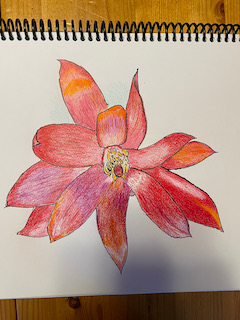
In the meantime, I’m back to doing some drawing. I got a very cheap but good set of coloured pencils for my birthday last month, so I did a couple of drawings. Here they are:

Christmas cactus head on view.
Christmas cactus side view.

I have one more I want to do with the coloured pencils using a different profile. Then I want to do a couple more in watercolour on proper paper, and maybe in acrylic on a large canvas. I’ll have to assess my level of energy before I undertake a large(ish) canvas, but I seem to be getting stronger every day now.

___________________________________________________________________

*If you haven’t read my post from January 13, 2022, you might want to do so now. It outlines my experience with B12 deficiency and pernicious anemia.

Pernicious Anemia and Multiple Myeloma: A link?

Well, well. I should have known. Sometime before I was diagnosed with multiple myeloma in October of 2019, I was diagnosed with pernicious anemia. That’s a vitamin B12 deficiency that cannot be corrected by just taking a supplement. With a B12 deficiency, a dietary supplement can fix the problem, but pernicious anemia is a situation where B12 cannot be absorbed into the blood by ordinary means because of a missing intrinsic factor, a protein which is produced in the gut by gastric parietal cells. For me to get vitamin B12 into my bloodstream I need to inject it intramuscularly. I do it myself because I can’t be bothered to go to the Nursing Centre or somewhere where someone can do it for me. It’s a simple jab in the leg. No big deal, but for me it’s a life saver. As Martyn Hooper, the Founder and President of the Pernicious Anemia Society (PAS) in Britain, says it regarding his own experience: “Consequently, should I stop receiving injections then I would once again be unable to make healthy red blood cells and would gradually become anaemic and eventually die”*. Hooper was undiagnosed for years and has suffered permanent neural damage because of the delayed treatment. It’s a question of life or death. Pernicious anemia is called pernicious because it’s deadly. Just to add a bit of fun to it, it’s also incurable, just like myeloma. Towards the end of this post I specifically address the link between pernicious anemia and myeloma, but for now I need to deal with pernicious anemia.

As it turns out, I had been on monthly injections of B12 for years before about six months ago I let it slide. I ran out of B12 and just didn’t bother asking my GP for another prescription. Truth be told, I didn’t really feel as though the monthly injections were doing any good. Of course, my whole body was thrown into chaos by myeloma making it very difficult to pinpoint the source of any given issue I may be having, and there were lots of those. Frankly, I should never have stopped injecting B12, but it’s not going to do me much good to beat myself up about it. I’ve already spent enough time doing that.

About three weeks ago, after feeling like I’d been going downhill for some time, I called my GP’s office and requested a B12 blood test and a prescription for a new supply of it. This past Monday I went to the lab for my regular monthly blood workup in preparation for my chemo appointment today, but this time B12 was added to the assay. On Tuesday I got the results. No wonder I haven’t been feeling well, the level of B12 in my blood was way below the recommended amount. I came in at 84 pmol/L when the reference range is between 150 and 600. The literature I’ve scoured is inconclusive, but it seems that 150 is way too low for most people and 1000 is recommended by some sources for seniors to maintain good cognitive and neural health. In any case, my GP’s office contacted me this morning and told me that for the coming week I should inject B12 daily, for the following month, every week, and thereafter once a month. I’ll have to make sure the docs add B12 to my monthly blood assay so that I can ensure that I have the requisite amount in my blood. I think I’ll aim for 1000 pmol/L. If I can’t maintain that with a monthly injection, I’ll increase it to bi-monthly, etcetera. 

I haven’t conducted a scientific poll, but I doubt that most people know about how important vitamin B12 is for good health. B12 is crucial for the production of red blood cells. B9 (folate) is also important as is D3 but these can be easily supplemented. It’s worth doing an internet surf to find out more about B12 especially if you’re feeling chronically tired for no reason. I think the PAS is a great source but there are others, lots of them. The challenge is to recognize the stupid sites and not use any of their stupid suggestions or offers of stupid products. Make sure that if a site makes specific claims like methylcobalamin is better than cyanocobalamin get a second opinion. Martyn Hooper injects methylcobalamin twice a week (5mg/ml). It’s available online but it’s not cheap. He offers only one source for his assertion that methylcobalamin reduces peripheral neuropathy whereas cyanocobalamin doesn’t, and that paperis about ALS and methylcobalamin in megadoses. I generally trust Hooper, but we all make mistakes and sometimes we get headstrong about our own health and how to manage it. Hooper has good reason to be pissed at the medical profession, and the medical establishment in Britain and if you read his very accessible books you’ll know why.

Now we get to the fun part…the one with no conclusive argument: the relationship of pernicious anemia with multiple myeloma. So far, very little research has been conducted on the links between pernicious anemia and myeloma. This article does address the issue but is ambivalent in its findings as you can ascertain from this quote:

For multiple myeloma, increased risk was seen only with pernicious anemia, an inflammatory condition in the stomach leading to vitamin B12 deficiency. This association was also demonstrated in two other large studies, which found few other autoimmune conditions associated with multiple myeloma.1617 Because of the lack of association with other autoimmune conditions, our finding may point towards the involvement of vitamin B12 deficiency. Indeed, vitamin B12 deficiency has been reported in patients with multiple myeloma and in patients with the precursor condition, monoclonal gammopathy of undetermined significance.161946 Although multiple myeloma may cause vitamin B12 deficiency by consuming stored vitamin B12,47 we speculate that vitamin B12 deficiency could promote the development of multiple myeloma by causing derangement of one-carbon metabolism, as proposed in other cancers.48 2

See citation below.

This study3 shows a more significant association between myeloma and pernicious anemia: “Using a large population-based dataset, we observed a 3-fold significantly increased risk of MM among subjects with a personal history of pernicious anemia, which has been found in previous studies.” Now, that got my attention. It’s clear that I had pernicious anemia before I had myeloma – at least that’s what I think. However, because I wasn’t diagnosed with myeloma for a long time before I contracted the disease it may be that I had both pernicious anemia and myeloma at the same time. 

All I know is that pernicious anemia and multiple myeloma share a whole load of effects and they are both incurable and fatal if not treated. I’ll let you know how my current B12 therapy goes. Right now it’s being affected by today’s injection of Daratumumab. Oh well. I always liked a puzzle.

_____________________________________________________________________________________

* from: What You Need to Know About Pernicious Anaemia and Vitamin B12 Deficiency by Martyn Hooper, Chris Steele)

1Izumi Y, Kaji R. Clinical trials of ultra-high-dose methylcobalamin in ALSBrain Nerve 2007:59 (10): 1141-1147.

2  Lesley A. AndersonShahinaz GadallaLindsay M. MortonOla LandgrenRuth PfeifferJoan L. WarrenSonja I. BerndtWinnie RickerRuth ParsonsEric A. Engels. Population-based study of autoimmune conditions and the risk of specific lymphoid malignancies. International Journal of CancerVolume 125, Issue2, 15 July 2009, Pages 398-405

3Ola LandgrenMartha S. LinetMary L. McMasterGloria GridleyKari HemminkiLynn R. GoldinFamilialcharacteristics of autoimmune and hematologic disorders in 8,406 multiple myeloma patients: A population-based case-control studyInt J Cancer 2006 Jun 15;118(12):3095-8.

Time For Celebration

[I wrote this (slightly edited) post in 2017, a couple of years before I was diagnosed with myeloma. Time is a subject that has been on my mind for a very long time. I wrote my dissertation about the work of Harold Adams Innis (1894-1952). He was very much preoccupied with time and wrote extensively about it late in his career (and life it turns out). So have been hundreds of other philosophers, social theorists, physicists, biologists, etcetera. We think about time on many levels of analysis, from cosmic time to microseconds in productive processes. We think about it in social as well as personal terms. We are especially concerned with it when it begins to run out. Read on]

How do you experience the passage of time?

Time is a big subject and has been the focus of many philosophical and scientific ponderings and is, of course, a major preoccupation of the world’s religions and cultures. There is also the individual, institutional and cultural projects around time and its importance to our lives. We mark (as distinguished from experience) time in many ways. We use clocks and calendars. (The Maya had two calendars, that’s how important time was to them.) We carefully note the passage of the seasons with special celebrations, and we celebrate our birth days every year. We don’t celebrate the day we die, of course, we let others do that in the form of wakes, funerals, and these days, celebrations of life because we are no longer in any shape to celebrate anything ourselves.  We ask: “What time is it?” and we expect to get an answer: “Why, it’s two thirty in the afternoon.” We don’t expect “the anthropocene” as an answer although it would be technically correct.

But this blog post is not about any of this. It’s about how we experience time. In many ways, time and life are synonymous. As individuals we need to be conscious to experience time. In our dreams time is irrelevant or, at least, it can take on bizarre aspects, but we aren’t aware of that until we wake up and can reflect on our dream and its bizarre depiction of time. Writers, novelists in particular, distort time as a regular practice.

We experience time as past, present, and future although we live only in the present. The past and future are cultural constructs that have only the reality we give them. Our memories and our recollections of events are highly selective. There is no such thing as an objective past. We select events, actions, people, names, places, etc. and construct a cognitive map of them into a coherent picture, a picture that is congruent with our life as we experience it and build a store of impressions by which we then judge our actions and those of others. Recall is impressionistic, not realistic. It deceives us all the time as we ‘fit’ the past into our current views of things. 

We are most often not even aware that that’s what we’re doing. We drive, we brush our teeth, we pay taxes, we get on airplanes, we go to libraries, we bank, we vote and most often we don’t question these actions or even consider them a part of a consistent set of habits of life and thought that we learn from others as we live out our lives in networks of interdependencies. As Norbert Elias argues we are less individuals than interdependencies and interweavings. Our daily thoughts and desires, as they join collectively to express themselves as consciousness, make us more Borg than anything. Magically, however, we learn to believe that we control all aspects of our lives as individuals and sadly, people who have shitty lives can only blame themselves for that. That’s the classical economic view of things. Classical economics, according to Thorstein Veblen, uses what he calls the hedonistic calculus to describe how we make decisions in our lives. For him, classical economists (and I would add more contemporary trickle-down ones like Milton Friedman) think of us as ‘globules of desire’ who everywhere seek to maximize pleasure and avoid pain. Of course, life just doesn’t work that way. We do not judge every situation or opportunity we encounter in life as a calculation of pleasure or pain. There are numerous capacities and propensities we bring to our daily lives that have everything to do with the need to delay pleasure, accept pain or make decisions clearly not in our own interests. 

We interpret the past, the present and the future based on our ideologically constructed maps of how the world works. And, boy, do we love our maps. We hang on to them for dear life. Those ideas we cherish, those beliefs we idealize are created in a cauldron of the past, a past we had no hand in making and that starts presenting itself to us the moment we drop out of the womb. Of course, the ideas we pick up early in life we often reject later as we join more and more interdependencies and interweavings, some of which will have more appeal and relevance as the world changes around and in us. 

Christians and adherents to many other religions accept time as a concept, but deny its existence after death when, for them, eternal life kicks in. How could we experience time in a state of eternity? Time is change. What would happen in a place of eternity? I’m no theologian, but I’d be curious as to how a theologian would deal with the question of time in eternity.

Merry Christmas, all, and Happy New Year. 

Life and Death: How Absurd!

[This post was first published in June 2019, about four months before my myeloma diagnosis. Lately, I’ve been re-reading my posts looking for the best ones to re-post. This one is a particular favourite of mine, so here it is for you again. I don’t think I can express the ideas presented here any better now than I did back in 2019. I’ve been trying, but with no success. So, rather than continuing to beat my head against the wall, I decided to give myself a break and re-post this piece now. I hope you find it interesting (again). Just got news that an old colleague of mine just died. It seems we’re dropping like flies these days. Pretty easy to predict.]

We are born, we live and breathe for various lengths of time, then we die. Seems rather pointless, really. For as long as we know, and from all the historical records that we have unearthed or discovered one way or another, we can only conclude that humans have not ever been terribly enamoured with this situation.

Of course, most animals are averse to death, or at least to dying. Death itself isn’t particularly scary, it’s the getting there that we have a problem with. Even an ant feeling attacked will flee or fight. Of course, once it’s dead there is no issue. Not all animals face dying in the same way. Without being too anthropomorphic, some are stoic, some are frantic. In humans, some are even self-destructive but I’m not sure that death is what suicides want. Relief from pain and suffering is probably the goal more often than not, but in many cases, death seems the only respite, the only place where there may be peace. Of course, that’s silly because there is no ‘place’ after death. Death cannot be a respite from pain and suffering because we have no way of experiencing relief from pain in death. Death is the absence of sensation, of thought, or feeling; it’s the absolute negation of consciousness. Death is no thing. Before we are conceived we are also nothing, no thing. Life as we think of it as sentience, feeling, consciousness, starts sometime in our development. It’s hard to know when. In a way, death puts an end to the whole story.  Historically and linguistically, we have wanted to contrast living with dying, but they are not opposites. Death is the only way life can happen. So, why, generally, is it so hard for us to let go of life? Well, like all other animals we have a survival instinct, or an instinct for self-preservation. With rare exceptions, there seems to be an inherent drive in all animals to continue to live. I don’t think any species would get very far without it. It does present a problem for us, however. It means we go to great lengths using our big, unfortunate brains to deny death using whatever means we can, and boy do we have lots of means! Our cat is afraid of death. She skulks around wary of a stray cat in our neighbourhood we call Mean Gene because he beats up on our Princess Pretty Paws. Still, she hasn’t managed to institutionalize death denial. She just can’t take it that one step beyond immediate, visceral run-like-hell action. And when Mean Gene is no longer in sight, Princess is just fine. She is not anxious and preoccupied with dying. She’s still interested in her food bowl, however. 

What it gets right down to is the fact that as animals we reproduce sexually and engender offspring who are themselves immediately on a trajectory to death. Living and dying are the same process. Stop dying and you’re dead. Now that seems completely unfair. We are built to die! What the hell! Well, that just can’t be, damn it!

Over the millennia, we’ve created any number of ways to convince ourselves that we don’t really die, that although our bodies may perish, our ‘souls’ do not, and that makes us immortal in a god-like way, really. For us to be immortal we must be gods and by our earthly deaths experience apotheosis. Millennia ago, when we were still in our infancy as a species, we were awed by the powers of nature and our extreme vulnerability in the face of them. We decided that there must be some sentient power that controlled the forces of nature, the floods, volcanos, fires, landslides, and other deadly phenomena. Not only were there powerful natural forces, but they were capricious and unpredictable as well as uncontrollable.

In our silly wisdom, we figured out that maybe, just maybe, we could barter with the gods so that they would leave us alone. If we presented the gods with gifts, even living gifts (as in virgins thrown into a volcano), maybe we could obviate the damage the gods inflicted on us. It was fine to kill all the people in the next village, but leave us alone, please. Well, that didn’t always work according to plan, so an explanation was necessary. So, if our village was ravaged by a fire even though we had been really good and had made lots of sacrifices to the gods, maybe those sacrifices just weren’t enough. We just had to kick up the giving a notch or two. Sadly, we are still very much controlled by this narrative.