18 Looking in the Mirror.

[This is a reprint of a post I wrote in January of 2020. I reproduce it here in honour of Elizabeth (Bunny) Shannon who was especially drawn to it. Bunny died of cancer last month. She was a friend and an extraordinary person. I am privileged to have known her]

When I look in the mirror I see an old man. I don’t see an old man with cancer. I just see an old man with a white beard, not much hair, and wrinkly skin. Melanoma (skin cancer) often leaves visible, sometimes unsightly and disfiguring lesions. I don’t have melanoma, although my father did. No, I have myeloma (bone marrow cancer) and its damage is all done on the inside, invisibly. So, I guess I can keep expecting people who see me say: “Wow, you’re looking good!” I guess I DO look good! Now, the last thing I want is to discourage people from telling me how good I look, so keep it up! However, the invisibility of my condition is deceiving. I remember when I was a kid my friends and I used to work on our cars. That was still possible when I was a kid. Often we’d stand around looking into the engine compartment (often of my 1956 Pontiac four-door hardtop) wondering what could possibly be wrong as if just staring at the engine would give us some kind of clue. The engine was always sparkly clean and there was nothing obviously gone awry. If I had money by some quirk of circumstance I might take the car to a mechanic. If not, we might borrow my dad’s tools and start taking things apart. That usually ended up badly. Yes, the most undesirable conditions in life are often on the inside, impossible to see or diagnose by just looking at the person or car in question. I find it best to consult mechanics when our car shows signs of disfunction. I find it best to consult medical specialists for treatment related to my body. I guess I could try to treat myself using any number of the ‘cures’ available on Dr. Google, but I would like to live a while longer, thanks. Besides, I’m not that desperate.

Speaking of medical specialists, we saw my local oncologist today. I see him every five weeks. The result of our visit is that I will carry on with a second course of chemotherapy. We’ll evaluate how well it went in five weeks. My first course of treatment seems to have gone as well as could be expected. The little excavator in my bone marrow is slowly running out of gas and my red blood cell garden is growing again. I’m still exhausted and that won’t change for some time yet, but things are certainly going in the right direction for now. I think I just might be a model patient. So, where does this all leave me?

Well, I may be on my way towards remission. If and when I do go into remission, and that’s by no means guaranteed at this point, that would buy me some time. By that I mean that I may have a few years more to live, though inevitably, either the myeloma will kill me or some other condition will. I won’t be walking away from this situation, brush the dust from my sleeves and carry on. No, I’m on a one way street. So are you, of course, but I can see that damned barrier at the end of the street. I’m hoping that you’re still far enough away from it that you can live in blissful denial for a while longer. I don’t have that luxury. So now what do I do with my life?

That question came up in a recent Facebook thread, albeit expressed in a different way, but with the same effect, I believe. The question comes down to this: If you knew that you had a given amount of time left to live (six months, two years, whatever), what would you do with your time? Would you to be seized by an overwhelming sense of urgency? Would you be determined to cram as much activity and experience into your remaining time as possible? Or would you curl up in a fetal position in a corner of your bedroom quivering and whimpering while you await your inevitable demise? If you have the money and the energy you might want to get out there and travel the world. If you have a spouse, that might complicate things more or less because they may not want the same things you do and may not want to get caught up in your sense of urgency. The last thing you need when facing terminal cancer is marital discord. I think there’s a lot to be said for just carrying on with life as before.

If you have the energy and the money then good on ya. If you travelled a lot before your diagnosis then travel after. Your eventual energy deficits will tell you when to stop. If you were fairly sedentary, more into being at home and puttering around the yard, then that would be something you might want to continue doing. The stress of travel may not be that good for you. Looking around the Cancer Centre at the North Island Hospital this morning I didn’t see a lot of people with obvious enough vigour to engage in a lot of physical activity. In any case, back to my situation.

My exhaustion prevents me from doing much in the way of physical activity. If I do go for a walk I pay for it later. Travelling is impossible. At one point I thought it might be possible, say, to take a direct flight to Puerto Vallarta back and forth from Comox, but there are a number of contingencies that make that next to impossible that have more to do with arthritis and disk degeneration than cancer. Besides, I take chemo drugs once a week orally but also by injection at the hospital. For three or four days after I take my meds I feel crappy, really crappy so the chances of enjoying myself on a beach somewhere are slim to none.

So what do I want to do, and what do I actually do? Well, I want to work on our canoe, finish some paintings, do odd jobs around the property and visit family and friends in Vancouver and further afield. What I actually do is sit and lie down a lot. As I sit and lie down, I read, and sometimes I even write. At the moment I’m reading social history around the Middle Ages and doing a bit of research on my family roots in Normandy. That’s something I would have done anyway, but I do miss working in my shop and studio and going for long walks with Carolyn and our imaginary dog. My oncologist thinks I will regain my energy, at least as much as an old man can expect. If so, that would be great. I’d love to get back to canoeing, camping and puttering.

When I get closer to dying I will know it, and I expect I will have time to think about it, but there really isn’t much thinking that is productive about dying, at least not for me. I’ll know when it’s time for palliative care. I don’t want to live as long as the oncologists might want to keep me alive. I’ll make the decision when the time comes. I don’t think it will be a really hard decision. I know that beginnings are impossible without endings. My ending is a lot closer now than my beginning! That’s fine. Frankly, I’m much more concerned with my family than I am with myself. They are the ones left behind to mourn. But both of my parents are dead and we got on with life after their deaths. My family will do the same when I’m gone. That’s what we do as humans. Like it or not, accept it or not, rage against it or cower in a dark corner, the end result is the same. Don’t sweat it.
Trials and Tribulations

[Feeling a little disjointed today…]

If you’ve been reading this blog for any length of time, you’ll know that it’s all about me and my trials and tribulations around my experience with myeloma, old age, medicine, chemotherapy, and its side effects. Of course, I’m not completely self-absorbed, just mostly so. To be honest, it’s been a bit difficult to focus on anything else. Myeloma and its effects have taken over my (and my family’s) life. The pandemic hasn’t helped either. Both myeloma and the pandemic have severely restricted any social activity in which I used to take great pleasure. Driving is a challenge but not impossible. My neck seems to be getting somewhat better after the dexamethasone injection in my neck about six weeks ago. Now I fear that my time with Daratumumab may be coming to an end. I don’t know that for sure, but the neuropathy in my left hand is getting quite bad. Increased peripheral neuropathy is a side effect of Daratumumab and may be a signal that my body is rejecting the Dara. I talk to an oncologist in Victoria next month and we’ll certainly talk about my chemo treatments. On top of that I have a tooth that is dying if not completely dead. The endodontist I saw about that says I need a root canal and I should be on antibiotics for a bacterial infection just below that tooth. To be on antibiotics I probably need to cease chemotherapy treatments for a time. That’s another thing I need to talk to the oncologist about. So it goes. 

By the way, I’ve just finished reading The Cancer Code (2020) by Dr. Jason Fung. Aside from being a practicing nephrologist in Toronto, Fung is a prolific writer. This book on cancer is fine although Fung focusses on tumor-based cancers and mentions myeloma only in passing. I quite like his analysis and where he ends up suggesting that cancer is subject to evolution and natural selection like any organism. He argues that in the past cancer was seen as a mistake, then as a somatic mutation, but he writes: 

“Cancer had always been considered a single genetic clone, so evolutionary processes were considered irrelevant. But the realization that cancers evolve was electrifying. For the first time in decades, we had a new understanding of how cancer develops. The entire field of science known as evolutionary biology could now be applied to understand and explain why cancer develops mutations.” (from “The Cancer Code: A Revolutionary New Understanding of a Medical Mystery (The Wellness Code Book 3)” by Dr. Jason Fung)

Daratumumab is a monoclonal antibody. It worked well for a time. I hope it works for a while longer, but it is destined to fail when it no longer responds to myeloma’s mutations. He notes that cancer cells act like prokaryotes or single-celled organisms and not like eukaryotes or multi-celled organisms. According to Fung, we are on the cusp of a major paradigm shift in cancer treatment, but it will be expensive. What do we do about that? 

______________________________________________________________________

Just to remind myself that I’m still a sociologist, I’ve spent quite a bit of time lately reading and watching MSNBC, CNN, The Guardian, NPR, BBC, Al Jazeera, Ring of Fire, Beau of the Fifth Column, and other newsy YouTube videos. I check out some Canadian content, but the elephant next door is far more compelling than Trudeau’s antics or O’Toole’s foibles. I’ll come back to the US below, but before I go there, I just want to say that I’m reading a book by David Graeber and David Wengren published just last year called The Dawn of Everything. The book challenges everything we know about the “Western” version of history and is a refreshing read. For one thing it sheds value on indigenous ideas and ways of seeing as providing the real challenges to the philosophers (Locke, Hume, Hobbes, etc.) of the Enlightenment, Rousseau, and other incipient lefties. The authors reject the idea that indigenous peoples were the child-like innocents they are often portrayed as by European travellers and colonizers. They also challenge the idea that things can’t change, that we’re stuck with large scale, ridiculous, bloated states. Unfortunately, Graeber died on September 2nd, 2020, three weeks after this book was released. He was fifty-nine years old. That hardly seems fair.

I don’t know how many of you are interested in American politics. It can be a nasty, grubby place at times and unless you are steeled against media biases and distortions of reality, you might be left with all kinds of strange ideas about what’s really going on to the south of us. One thing is for certain, I’m getting just a little perturbed at the ignorance and stupidity of some American politicians in Congress who shout “socialism” every time Biden and the Democrats dare spend a dime on regular, run-of-the-mill citizens or on infrastructure. They want all the cash to go to the 1%. I’m still not sure how that benefits them personally unless they believe Milton Friedman’s ridiculous trickle-down theory by which if regular people as taxpayers give billionaires all the money that some of it will trickle down to them. That is such a bullshit theory. The proof of that is that it’s never worked and the concentration of wealth in the über-wealthy is clear evidence of that. 

Ted Cruz, Rand Paul, Josh Hawley, Marjorie Taylor Greene, Lauren Boebert, Jim Jordan, and their ilk in the Republican Party and sitting members of Congress obviously haven’t a clue what socialism is, or, if they do, they are being disingenuous about it. The truth is that it may be some of both. For these clowns, any money spent on bridges, highways, city roads, the electrical grid, wastewater systems, potable water, etcetera, is evidence of socialism. So stupid. They take the notion of individual initiative and investment to the extreme. But, of course, they just want to get re-elected and making outrageously false statements is the name of the game. They can always be retracted later when nobody is paying attention.  

I’d say that I follow American Congressional politics as entertainment, but it’s not funny. There is a fairly serious challenge to the status quo there from a far-right racist Republican cabal and some people seem to want to continue the Civil War of the early 1860s. I do take some comfort in the fact that there are over 300,000,000 people in the United States and that would be a hard ship to turn around. I have a lot more to say about the US, supply chains, the wane of capitalism, the rise of oligarchy (which is already close to the surface), and history. Stay tuned. 

I strongly recommend reading Heather Cox Richardson on Facebook. You’ll get a well-researched commentary on American politics from a classy historian. Check her out.

Slowly Falling Apart

For this post, I decided to create a collage of quotes and commentaries from books I’ve been reading lately. They range from comments on death and dying to philosophy, culture, and the future. So far in this blog, I’ve refrained from commenting on American Congressional politics, but I just may go there soon. I told my sociology students year after year throughout my college teaching career that the American empire would fall, as all empires fall, not from external conquest but from implosion due to unresolved, long standing conflict. The American empire, specifically, will fall because of commodity production that depends on longer and more complex supply chains and failing profits. America is falling on its own sword of profits. Supply chains and economic processing zones in a plethora of ‘developing’ parts of the world have been an issue for decades while only recently making it onto mainstream media commentary and news. I’ll explain in a future post.

US politics has to wait. It’s a mess down there but it’s a mess everywhere on the planet at the moment. Let’s move on.

________________________________________________________________________________

Robert Sapolsky is one of my all-time favourite guys. He has a number of his Stanford University lectures on YouTube. He’s a neuroscientist who specializes in stress. He worked in the field for many years with Olive baboons in Africa. I have a video in which his work with the baboons is featured. On the topic of the human condition he writes:

“we are now living well enough and long enough to slowly fall apart. The diseases that plague us now are ones of slow accumulation of damage—heart disease, cancer, cerebrovascular disorders.” (from “Why Zebras Don’t Get Ulcers: The Acclaimed Guide to Stress, Stress-Related Diseases, and Coping (Third Edition)” by Robert M. Sapolsky)

Now, ain’t that the truth! If you check out Stats Canada’s vital statistics you’ll find out that cancer is the leading cause of death in Canada. Actually, life is the leading cause of death everywhere, but as far as the observable evidence of bodily decay and death goes, cancer is determined to be the immediate major causes. Writing this makes me want to go back and binge watch Sapolsky on YouTube. Not only does he have a lot to say, but he says it in such an engaging way that binge watching is entirely feasible. I’ll be sharing more from Sapolsky later, but now on to another very different writer.

This is a quote from another book I’m reading that I want to share with you. Talk about falling apart! Robinson is a contemporary novelist writing in the sci-fi genre with dystopian tinges. He writes:

“Say the order of your time feels unjust and unsustainable and yet massively entrenched, but also falling apart before your eyes. The obvious contradictions in this list might yet still describe the feeling of your time quite accurately, if we are not mistaken. Or put it this way; it feels that way to us. But a little contemplation of history will reveal that this feeling too will not last for long. Unless of course the feeling of things falling apart is itself massively entrenched, to the point of being the eternal or eternally recurrent individual human’s reaction to history. Which may just mean the reinscription of the biological onto the historical, for we are all definitely always falling apart, and not massively entrenched in anything at all. 31 India” (from “The Ministry for the Future: A Novel” by Kim Stanley Robinson)

Most of this quote will be difficult for you to fathom because it’s out of context. It’s the last sentence that really matters. To help you out a little with the context of this quote, the ‘order of your time’, in the first sentence means that in the course of your life you feel out of control. You can’t go back, you can’t stay still. You can only go forward towards your death. This applies not only to us as biological entities but also to our cultural and social constructs which also are bound to come and go in a generally disorderly way. We cannot be ‘massively entrenched’ in life because daily existence makes a lie of any attempt to avoid moving toward death.

Now, more from Robinson in another of his sci-fi novels set far from Earth on a ship and a moon.

“Existential nausea comes from feeling trapped. It is an affect state resulting from the feeling that the future has only bad options. Of course every human faces the fact of individual death, and therefore existential nausea must be to a certain extent a universal experience, and something that must be dealt with by one mental strategy or another. Most people appear to learn to ignore it, as if it were some low chronic pain that has to be endured. Here in this meeting, it began to become clear, for many of those present, that extinction lay at the end of all their possible paths. This was not the same as individual death, but was instead something both more abstract and more profound.” (from “Aurora” by Kim Stanley Robinson)

Robinson is not a great writer in terms of composition, but he is a very perceptive commentator on the human condition. His novels are all about the fragility of humanity in the face of evolution and death, both on an individual and social level. Death denial is a consistent theme in human history and as a goal, has engendered a mass of immortality tales with “supernatural” characters as diverse as Zeus, Jesus, Shiva and a mess of lesser gods. These characters are our heroes who will save us from death if only we believe in them. But then we come face to face with evolution and biology which care not a wit whether we believe in them or not, and which just carry on.

_________________________________________________________________________

So, what about falling apart?

It’s clear that average death rates have risen consistently over the decades on the planet although in the US they’ve been falling for some demographics. Falling or not, on average we live well into our seventies. In fact, Stats Can tells me that if I live to be seventy-four I can expect to live another fourteen years. These are average life expectancies, of course. Millenia ago, living to thirty-seven years of age was considered average. People died of things then we seldom die of these days (such as appendicitis).

Sapolsky understands that the longer we live the more things can go wrong in our bodies. That’s self-evident the longer we live. If we get injured while young we can expect to heal and then just get on with things. As we (I) get older the healing process slows down.

There are a few very fortunate people, especially in the world’s richest parts, who suffer very little as they get old. I don’t think I know any of those people (well, maybe one or two). That said, there is an inevitable decline in capacity as we age. That doesn’t mean we should stop living and simply prepare for death because we know it’s going to happen. For me, I have much reduced capacity. At seventy-four I have maybe a quarter of the capacity I had at fifty. But a quarter is better than nothing. I still have shit to do! I’m falling apart, yes. In fact, I can’t fall much farther, but that’s fine, I still have a way to go.

I want my goddamned life back! Redux

[I wrote the post below in April, 2021. I’m still feeling it and still living with the issues I raised in this post in April! I think it’s worth a repost. Life is infinite, but any expression of life is finite. As expressions of life, some of us are more inclined to accept our finality, our death, than others. In April I was particularly pissed off about my lack of resilience and strength. I guess that my attitude in this regard has changed somewhat. I’m more inclined now to just accept my limitations and to accept death as the only inevitable consequence of life, and maybe have a little fun while waiting for it. I will die soon enough. This can’t go on forever! I’ve always understood death from a philosophical and anthropological perspective. Now things are getting more real every day. It’s a bit scary, but it’s not something I turn away from. Of course, I may feel differently about all of this if you ask me about it next week! So, don’t ask me.

On another topic entirely, I’m concerned about this blog. I’m getting tapped out as far as writing about my life, its trials and tribulations. I do have a lot of things to write about but they are less personal and more sociological than the content of most of my current posts. After all, I am still a sociologist. Early on in this blog, in 2013, I wrote extensively about Ernest Becker and his books, The Denial of Death and Escape From Evil. I still consider these books to be critical as they confront the issues of the many cultural ways we try to deny death, like misogyny. I’m still amazed at misogyny and its close relative, patriarchy. I may write soon about religious denials of death as expressed in Sunday rituals and the overwhelming need many of us feel to transcend the physical beings that we are, a need fulfilled by religion. I will write too about the recent implantation of a pig’s kidney into a human. Just think about the philosophical and sociological implications of that as you eat your bacon for breakfast!

Ciao for now! Read on…]

I may want it back, but of course I can’t have it back. I can never have it back at least not the way I lived it when I was fifty years old. We can’t live backwards on this planet. It’s just not possible to go back in time. Furthermore we can’t achieve the physical vigour at seventy that we had a forty. Cognitive vigour is another thing entirely, but I find that since my retirement, I’m just not as sharp as I used to be. Writing this blog helps me keep my cognitive skills in some state of repair, but it’s harder all the time to maintain a certain level of critical skill when the couch beckons. It’s perfectly okay to be lazy in old age although lazy has a moral connotation that doesn’t apply to inactivity in old age. Strangely enough, there is an expectation in our culture that the aged should be occupied at productive activity even in old age, or we should at least go golfing and volunteer at the local SPCA. I was caught up in this moral silliness for a while, but cancer soon disabused me of any expectation that I could stay active in old age. My mobility is highly compromised and was even before my cancer diagnosis. But that’s okay. I had my time being physically active and strong. Our lives are made up of stages. I’m on the last stage.

Every now and then I forget how old I am and the fact that I have cancer, arthritis, and degenerative disk syndrome. In this forgetful state I try to do things that I did easily when I was 30, 40, 50, or 60, even 65. For instance, today I got it into my head that I could still chop wood. Silly man. It was just one piece. I thought there would be no harm in that but Carolyn reminded me that I would pay for my silliness later, maybe tonight. The thing is that one of my chemo meds is a steroid called dexamethasone. I take it just before I go to the hospital for my Daratumumab infusion. It reduces pain and increases stamina. It also gives me the shakes and a false sense of capacity. That’s when I think I’m still physically capable of doing things like working in my shop or cutting woodblocks for printing. [I haven’t given up yet, damn it.]

So, that’s it. We all know that human life is finite. We speak as though we understand and accept that. But you know what? There is a ton of research that establishes beyond a doubt that we generally do not accept the finality of death. I’ve written about the denial of death over and over again for decades. But you don’t have to count on me for information and confirmation. Just consult the bible in your hotel room. Or just go to the religion section in your local library, although I’m reading a novel at the moment that deals with death avoidance in quite a non-religious, creative way. The novel (the last of three in a trilogy) is set on Mars sometime in the future. It’s called Blue Mars which follows Green Mars and Red Mars. About half way through the book one of the lead characters, Nirgal, who was born on Mars, takes a trip to Earth (Terra) and almost dies. To understand the quote below it’s important to know that Martian scientists had developed a longevity program that allowed people to live much longer than they would normally have. People would have to have this procedure involving stem cells and telomeres repeated at intervals. Some of the characters were a hundred and fifty years old and more.

“But Nirgal had seen Simon die even though Simon’s bones had been stuffed with Nirgal’s young marrow. He had felt his body unravel, felt the pain in his lungs, in every cell of him. He knew death was real. Immortality had not come to them, and never would. Delayed senescence, Sax called it. Delayed senescence, that was all it was; Nirgal knew that. And people saw that knowledge in him, and recoiled. He was unclean, and they looked away. It made him angry.”

from “Blue Mars (Mars Trilogy Book 3)” by Kim Stanley Robinson

So, even in this scientific, atheistic world, people longed for a longer, productive, and meaningful life and a painless senescence followed by immortality yet as Nirgal points out, ‘delayed senescence’ is all that people could hope for. Even if they lived to be a thousand years old, their lives were still finite, albeit much longer than what one could expect without the longevity treatment. As the quote highlights, people sensed that Nirgal knew about mortality and shunned him for it.

I understand senescence because that’s what I’m living now. It is not delayed for me. Chemotherapy is nothing more than a longevity treatment. As we undertake chemotherapy we expect to live longer (see my next blog post) but, as I’ve learned, the price of chemo for me is reduced capacity although that’s not true for everyone and for every kind of chemotherapy.

Dexamethasone for the Win!

Last post I more or less said that I would not write about pain anymore. Well, that’s not really practical if I want to write about my life so that idea is out the window. Lately pain has been my life. It’s dominated everything that I do and don’t do (because of it). So, away we go.

Along with the general pain in my legs and back from the chemo treatments I get, I have serious neck issues that are fairly common in older people, that is, vertebrae that collapse or the passages in the spine shrink (stenosis). For all of you young’uns out there, this is your future. However, most people don’t have pain to accompany these age-related changes. I just happen to be one of the lucky ones to get excruciating pain in my neck that includes cramps and a low-grade throbbing pain. Most of this I can handle. The cramps require immediate attention much like a charley-horse in the leg muscles. I often wear a neck brace to keep my neck from moving too much and inducing the cramps. In fact, I’ve just put one on because looking down on my keyboard is a sure way of bringing on a cramp.

I’ve been exasperated with my neck pain because it severely limits my mobility and I want to do some painting, drawing, and boat work. As soon as I look down for any length of time, I get a cramp and that really cramps my style, if you know what I mean. So, I called my GP. He, I’m sure being sick and tired of me complaining about pain referred me to the Pain Clinic at the hospital in Nanaimo. They called me from the clinic surprisingly quickly and we set up a telephone appointment with Dr. Pariser, one of the doctors who works at the clinic. We decided on a procedure. It would take place on October 6th, yesterday. All that was left was the waiting.

Carolyn drove me down to Nanaimo yesterday morning when I got to see Dr. Pariser. We decided on a treatment that’s been around for a long time and that works fifty percent of the time and only after a month following the procedure. It (the procedure) involves injecting a steroid in the spinal cord to deaden the pain. It’s clinically referred to as an epidural. Epidurals are sometimes given to women during labour but they are not uncommon for lower back pain.

In my case the steroid was dexamethasone. I’ve often mentioned dexamethasone (dex) in my previous posts because it’s a staple medication of my chemotherapy and it has interesting side effects. I was a bit surprised when Dr. Pariser told me that he would be injecting dex into my neck, but he assured me that there would be no adverse effects from adding this dosage of dex into my mix along with my monthly oral 12 milligrams taken in conjunction with my infusion of Daratumumab at the hospital. Frankly, I didn’t know what to expect in terms of side effects from the dex injection in my neck. It didn’t take long to find out.

Before I tell you about the effects of the dex injection in my neck I want to tell you about another source of pain I’ve had recently that prompted a visit to my dentist. It started innocently enough with a bit of sensitivity in an upper left molar. It has a large crown which has been there for some twenty-five years. X-rays showed a probable need for a root canal. Well, that was fine and dandy, but when could that be scheduled. I was in pain NOW. My dentist was very concerned and referred me to a group of dental specialists in the Valley that specializes in this kind of work. Great. Their office called me and cheerfully informed me that I was booked for an appointment on November 15th. Yahoo! That’s all I needed: a six week wait for a consultation, never mind the procedure. After whining for a bit I got the appointment moved up to October 15th. That was some improvement but still a long way off given the level of pain I was in. I mean, this pain trumped all other pain in my body. It was excruciating, it was relentless.

So, yesterday when we drove to Nanaimo I was still in a lot of pain, but it had attenuated some due to an onslaught of hydromorphone. I take hydromorphone daily in a small dose for pain associated with my multiple myeloma, its side effects and the side effects from the chemo. I take a slow-release dosage morning and night, but I also have a stock of what’s called breakthrough medication for times when the slow-release dosage just doesn’t cut it anymore. Over the last while I used a lot of breakthrough hydromorphone. It has a lot of side effects that I don’t particularly enjoy, like insomnia, but too bad about that. I needed pain relief and damn the torpedos! It’s a good thing I had my breakthrough hydromorphone.

This is where serendipity comes in. I love serendipity. Dex can relieve pain. I had pain in my mouth as well as my neck so what would dex do for my molar pain? Well, I’m pleased to report that the dex pretty much killed the pain in my mouth, at least for now. I don’t expect the pain relief to last a long time, but any relief is welcome. I have the hiccups, a common dex side effect so I know it’s working. Strangely enough, I slept very well last night. Insomnia is also a common side effect, but it’s also a side effect of other meds I’m taking so who knows what’s going on in my body.

As a bit of a side note, if there are scientists reading this, scientists interested in pain and its management, you might want to think about a way of letting others know how much pain we’re in. That wouldn’t have any pain relief effects, but it may increase positively the way most people react to people with chronic pain. I mean, it’s hard to know if someone is in pain or not. People can fake it. There are clues in bodily function and blood work, but not many that show physically. Arthritis can sometimes show clearly in the body. In the last decade of his life, my father’s hands became deformed with arthritis. He was unable to open them, and he kept them clutched against his chest. Maybe, if our pain wasn’t obvious, if our limbs glowed blue or green that would be a clear indication of pain. Whatever. Work on it.

So, in summary, dex was a clear winner for me yesterday and today. I still had a shake (liquid diet) for breakfast today like yesterday rather than my usual granola or toast, but I’ll carry on with that because I really like the shakes Carolyn makes! Besides, I expect my toothache to reappear as the dex wears off. So be it. Pain management is very complex because the pain never stays the same in terms of source or intensity. It’s like playing whack-a-mole, but with no fun involved.

Fall is upon us. I’m liking it.

It’s late September and Fall starts by the calendar in the next couple of days. It actually started about three weeks ago reckoned by dropping temperatures and increasing humidity. I quIte like this time of year. Cool temperatures and refreshing rain. I managed to get out yesterday. We went to the official opening of our new firehall and to the Foggy Mountain Fall Fair where we bought some T-shirts at the Cumberland Community Forest Society booth and some goodies (including Palestinian organic olive oil) at the World Community booth before getting some lunch from a food truck the name of which escapes me (Farmers something or other- the food was excellent). I was quite tired from a poor night’s sleep the night before, but everything turned out okay. I had a nap when we came home while Carolyn went out for coffee with a friend. Chemotherapy is keeping me alive but there is a price to pay. I get tired easily and the pain is still a big part of my life. The fact that I’m seventy-four years old may also have something to do with my lack of spark! Of course it does! I’m walking some, and I’m going to try riding my bike later this week when there is less rain in the forecast. I’m willing to pay the price. I always seem to benefit from exercise even though there is short term pain involved. I’d sure like to get off hydromorphone and gabapentin, but the withdrawal symptoms are hard to take. Tomorrow I hope to get some work done on the canoe. I may just do a blog post on that project alone. I’ve done a bit of drawing lately too but my neck pain really puts a damper on any sustained drawing practice. Sometimes I wear a neck brace and that helps.

Plant life here in the garden is both rejoicing at the rainfall, and at the same time preparing for the dormancy of Fall or the end of life. The vegetable garden is almost done. The raspberry plants are still throwing out a few stragglers but are pretty much done as are the blueberries. We picked the pears a couple of days ago and the plums a couple of days before that. We now have several jars of delicious plum jam thanks to Carolyn’s hard work. The pears aren’t quite ripe yet so we’ll wait until the end of the week to process them. That’s always a bit of a chore, but the results are worth it.

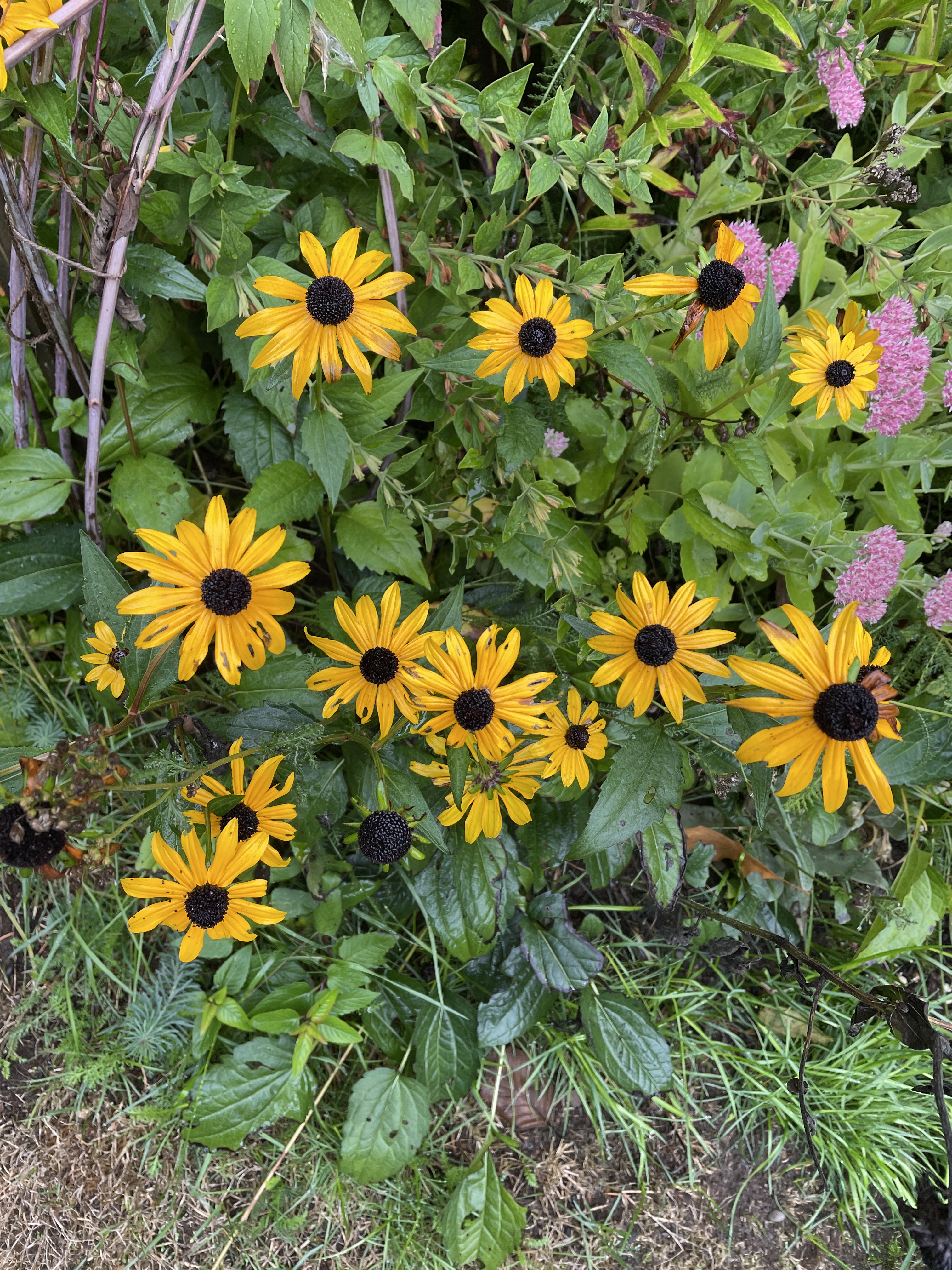
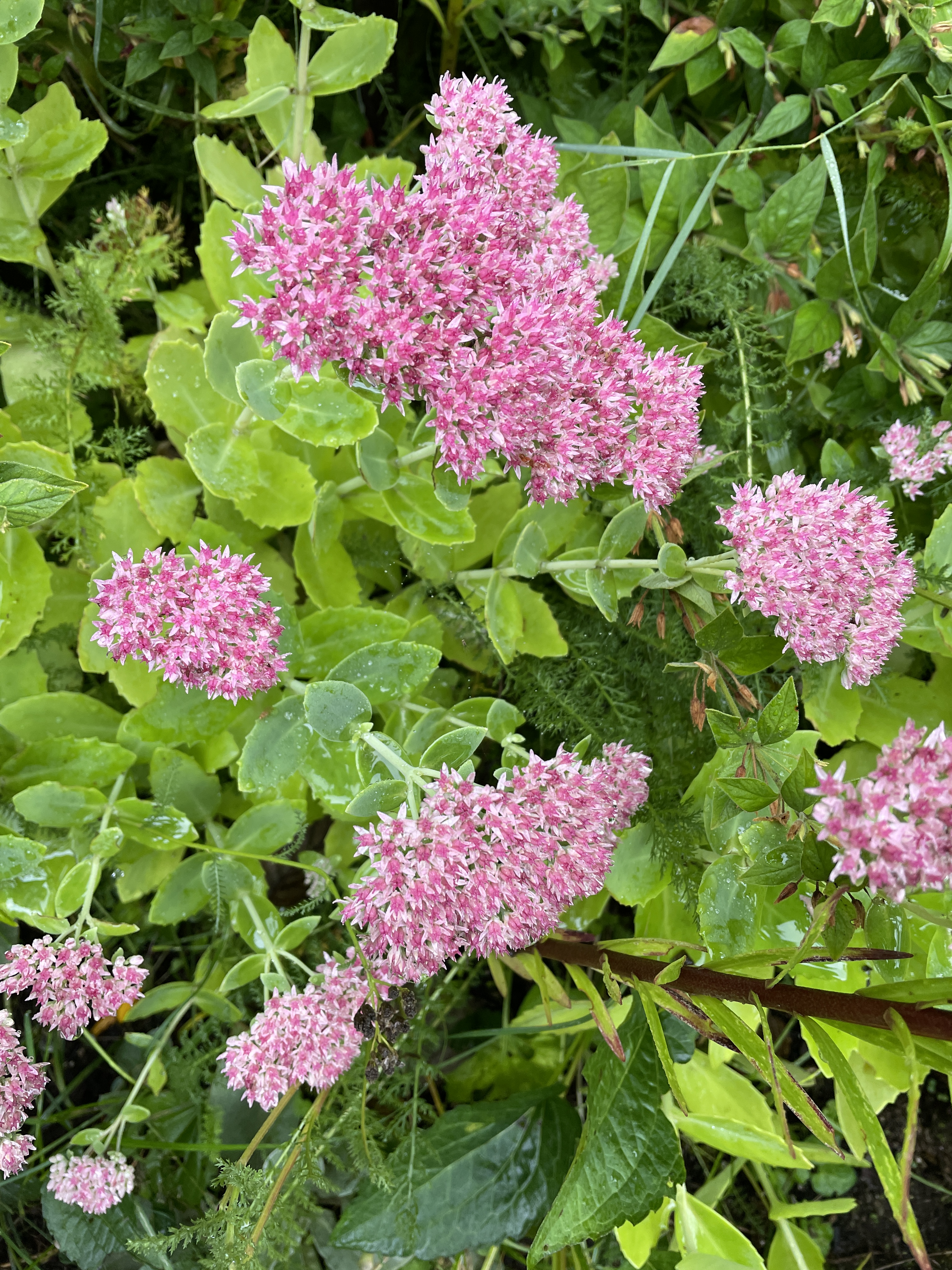
The ferns and grasses are still standing firm against the oncoming seasonal changes, but most of the flowers are giving up and bowing to the need to get some sleep. A few, like the begonias, sedums, and Black-eyed Susans

Begonia
Black-eyed Susans
Sedums

still buck the trend and proudly flaunt their colours against the overwhelming greens and browns of the fall and winter. Of course, speaking of colour, winter could also bring the white of snow, but that won’t be for some time yet. The long term forecast is for snow early in the season this year, but we’ll wait to see what happens. It’s always a crap shoot as to when the snow will come on the mountains, but the ski hill on Mount Washington generally aims to open in early December. It doesn’t always work out that way because the freezing levels are fickle in this area and it’s possible that skiing won’t happen until January. We should see the first snow on the Beaufort Range soon. Logging is about to start again close to the Village too. I’m of two (maybe three) minds about that. As a woodworker I can hardly condemn the practice of cutting timber and I know that my pension plan is invested in forestry companies, but I’m not keen on seeing logs go offshore to be processed either and I’m interested in learning more about how clearcutting and road building affect carbon sequestration and the production of atmospheric oxygen. We don’t have to worry about running out of atmospheric oxygen just yet (Google it). The processes of atmospheric change fascinate me at a scientific level. I’m particularly interested in long-term modelling of atmospheric change.

Pond Pano shot

The pond is full after the recent torrential rain. The sticklebacks will probably survive the winter as they have over the past few years (except for the year of the turtle!), but it would be good to keep Tilly out of it so as not to disturb their nests. That won’t be an issue as we enter Fall. Next summer she will be over two years old and we’re hoping she will leave the pond alone. That’s probably an empty hope. For now, Tilly loves the pond and she wades in it often then comes into the house to shake, spraying water everywhere. Yes, she is a bit of a brat.

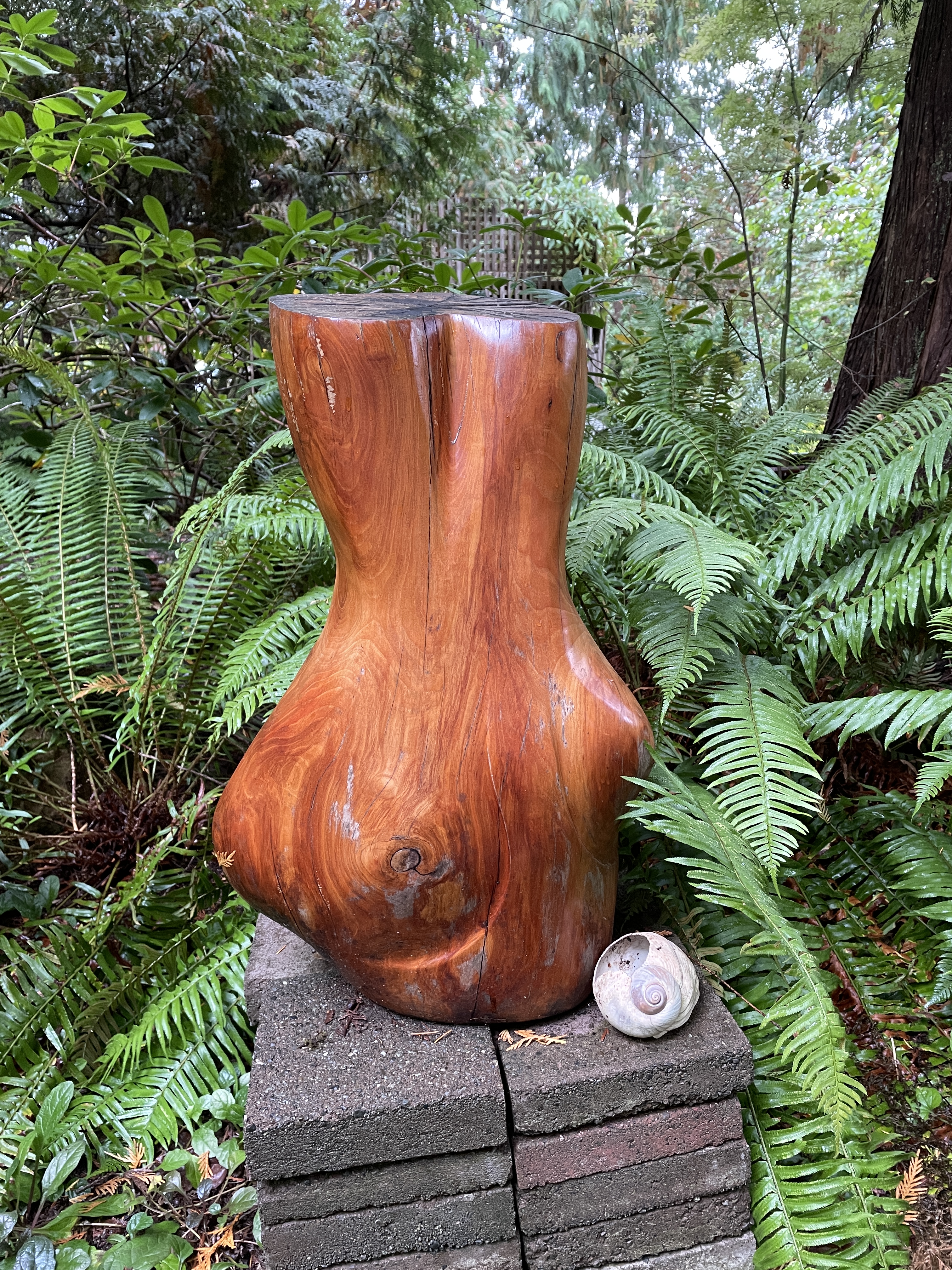
Sculpture

I’m not sure why I’m making note of this here, but this sculpture lives up by the pond area under a big cedar tree and surrounded by ferns. I finished it with spar varnish the year I carved it (maybe three or four years ago?) and I thought about refinishing it because it’s showing signs of deterioration. However, I decided to leave it and let entropy take its course. I’m not concerned about how long it will last in the elements but it will be around long enough for me to enjoy it.

I guess that I’m attracted to the changes of seasons rather than to the seasons in their full bloom. That may be because the times that mark seasonal change are the best reminders of entropy and its importance in our lives and in life generally on this planet. I quite enjoy this time of year even though it marks the end of the warmth of summer and the beginning of the cold of fall nights and winter days. I’m not a big fan of the heat of summer or the cold of winter. I’m more a middling kind of guy.

Ta ta for now.

Ho Hum.

I guess it’s not really ho hum, but my life is definitely just ticking along. The ‘injuries’ I’ve sustained via myeloma and chemotherapy have prevented me from doing a lot of physical activity, but I keep getting the medical people telling me to stay active! It’s a tightrope I walk. Well, not a real tightrope, but you know what I mean. Do exercise? Pay for it afterwards for days with pain and joints that do not want to move. Don’t do exercise? Shorten my life and make moving around increasingly difficult. This is no fun. Well, it’s true that it’s no fun. Pain is no fun. But who promised me that I would have fun all the time? Fun is for the young and healthy, or at least for the healthy (of all ages). I really don’t expect to have ‘fun’ anymore. Should I be having fun? What kind of fun should I be having? Is there more than one kind of fun I should be having? Is reading a book fun? What kind of fun can I have when my left knee keeps wanting to fold on me without warning? If I get down on the floor, I may not be able to get up again. That’s no fun…I guess, although it might be fun for somebody to watch me try to get up off the floor. Is betting fun?

I really like this time of year. It’s cool in the shade and warm in the sun. We walked on the River Walkway this afternoon. It was cool in the shade and warm in the sun. We had iced coffee. Yummy. Is having an iced coffee on a warm, sunny afternoon on the River Walkway fun? I don’t know. Maybe I was having fun. I’m not sure.

I was going to write about pain and death today, but then I decided to keep it light. Pain and death are heavy. Fun is light! Long live fun! I DO really want to have fun, to possess it, to keep it close to me and give it a big hug but I’m not sure that’s the way it works.

You might think that chemo is no fun. Well, you might be wrong. Being hooked up to an infusion machine for a couple of hours has its moments. There’s no pain involved, but being tethered to a ‘tree’ with bags of saline solution and meds flapping around presents certain challenges when the need for a pee break presents itself. Thankfully, the ‘trees’ we use have battery powered brains and can be unplugged from the wall sockets. That way we (I in particular) can wheel them around to the bathroom and pee while we hang on to them and try not to pee on the lines. It’s difficult because the lines hang down quite far, often right in front of my pant zipper. It’s fine for women because you sit down to pee but for us guys the danger is omnipresent. Of course I can sit down to pee, but my anatomy resists that. The issue is compounded because the toilet seat in the bathroom attached to the Cancer Care Centre won’t stay up. That means I either have to hold it up while I also hold up the lines and other things or pee on the seat. Yes, the damned toilet has a slot in the front/middle but I’m not that great at aiming my stream which is erratic at the best of times. I don’t have the straight-as-an-arrow powerful stream I used to have in my youth. I used to be able to control my pee stream with little effort. Now I’m just glad when I can pee at all. I’ve gotten very used to just standing in front of a urinal or a toilet for several minutes at a time just waiting for pee to happen. It always wants to come, it’s always right there…but no. It can get embarrassing if there are other people around also waiting to use the ‘facilities’. It’s especially bad in theatres when at half time break during a musical performance or a play when peeing is so important but I just stand there with ten guys in line behind me waiting. Damn! So embarrassing. But what a relief when it finally happens. Now that’s a lot of fun!

The nurses in the Chemo Centre are a lot of fun. We joke around as they try to find a vein in my arm to poke. My veins resist entry. They hide very well. It’s a challenge for the nurses to find a vein in my arm on the first try. It gets a bit messy if it goes to three tries. If it does go to three tries the first nurse generally gives up and lets another nurse have a go. Whoa. That’s a lot of pressure to perform! I freak them out by pointing to good possible spots then watch them stick the needle in. They think that’s weird. Most people look away when they get poked. One of the nurses gave me a soft ball the size of a tennis ball to squeeze all day long. That, apparently, makes the veins stand out. I think it may be working. She got it first try last time I was in.

I talk to my local oncologist next Wednesday. That will be fun. He’s a nice guy. We always have pleasant conversations. Did I say I like this time of year? Well, I do. Summer is almost over so I can get back to regular blogging. I must say, I’ve been lazy this summer and have been hooked on cat videos on YouTube. I’ve also gotten tired of writing about chemo and the life of a cancer patient. Oh, I’ll still write about those things, but I’ll also throw in lots of other bits of stuff. Stay tuned.

Happy birthday, David.

# 87. The Last Post in a Series.

Last Friday morning, we (Carolyn and I) had a meeting with my oncology consultant, Dr. Nicol Macpherson, at the BC Cancer Agency in Victoria. We meet with the oncologist in Victoria maybe three times a year. The rest of the time we have a local GP who specializes in cancer treatment. Our local GP oncologist is Dr. Bakshi. We’re quite happy with the service we get from the BCCA and from the local staff of nurses and Dr. Bakshi at the Cancer Care Centre at the Comox Valley Hospital. The meeting with Dr. Macpherson this morning was especially eventful. 

I knew that I was doing well with the chemotherapy and monoclonal antibody treatments I am getting. I started my current regime in mid-February of this year and the progress I made in a month was nothing short of stunning. We keep an eye on my frequent lab tests by logging into an Island Health website called MyHealth. On that site I get to see all the results of my lab tests, imaging results, and upcoming appointments. Obviously, we need to know what we’re looking at when we check out my blood serum profile including my paraprotein and Kappa Free Light Chain numbers which are of particular interest in my case. After some research and consultation, we now have a grip on what the lab results mean for my myeloma activity although the information is always incomplete and must be interpreted fully by someone who has better access than we do to the numbers. That someone is Dr. Macpherson in Victoria although Dr. Bakshi must also have access to my numbers, and my GP is probably copied on all the documentation coming from the hospital here and from Victoria. Now for the fun part:

So, Macpherson told us this past Friday morning that there is no trace of myeloma protein in my blood at the moment. No trace at all. He expects that that will be the case for the foreseeable future, years probably. 

We have been hoping for this result, but we had a bit of a setback late last year and early this year so we were doubtful that the zero myeloma protein in my blood would be an ongoing condition. It now appears that it is. The next few weeks will give us a definitive answer, but the situation looks very good. I have to keep reminding myself that myeloma is incurable but treatable. At the moment I’m in full remission. Inevitably the myeloma will make a comeback. We don’t know when, and that’s the frustrating part of this narrative. Still, we are in a good place right now and probably for some time to come. 

The situation with my cancer being resolved for the time being, I’ve had to rethink the focus of this blog. I have published well over four hundred posts but only eighty-seven addressing explicitly my experience with myeloma. Given the current situation I’ve decided to close the series of posts dedicated to myeloma and open up the blog for other topics and commentaries on current affairs, life and death. I started this blog in 2012, the year I retired. That’s quite some time. Maybe I’ll aim for a thousand posts. There’s no purpose in doing so but I can set up an arbitrary goal if I want. Whatever. 

Sometimes I’m tempted to shut the thing down completely but then I get the itch to write a commentary about current affairs, to get something off my chest, or just to post pictures of the beauty that surrounds me on our property here in Cumberland. We’re approaching the summer solstice. This time of year often brings unsettled weather and exponential growth in the garden which actually needs more heat and sun to ripen fruit and get the lilies to bloom. The lilies are coming up now, slowly, but soon they will colour the garden with splashes of red, yellow, orange, and white. The rhododendrons are still in bloom, at least some of them, but the dogwood and the wisteria have pretty much shed their blossoms and are moving on to create more branch and leaf structure. The weather prognosticators are suggesting that a warm, sunny trend is on the menu for next week. If that happens, we will again be able to sit out by the pond or on the deck next to the water feature there, drink tea and read. We will eat out on the deck again in warm comfort. 

Life is the weirdest thing, and I don’t mean just as it applies to humans. It seems a little perverse to me, actually. The whole thing does. The birth, growth, maturation, and then decay seem to be a waste of experience and a slap in the face to beauty which it prepares to annihilate in a short time in the last quarter of life. It celebrates renewal but only on the destruction of what went before. The death of one generation means life for the next one. For us humans the process of life is particularly insulting in that it promotes the growth and accumulation of knowledge, of piles of household goods, and property in general just as it prepares to shut it all down and make fodder out of it. Of what use is that? None that I can surmise. But, in any case, let’s not glorify usefulness. 

The concepts of use and purpose don’t apply to life or they apply completely to it. Death is necessary as a base for life. No death, no life. So, ultimately the purpose of death is to act as a basis for life. Life, in the spring, likes nothing more than a pile of shit or manure to drive new growth along. That may be true, but it doesn’t mean I have to like it. My death is not far off. According to the statistics, I have maybe five more years before I reach the average length of life in Canada for males. Given the success we’re having with chemotherapy and monoclonal antibodies I could just reach the average lifespan. Eventually, myeloma may well kill me, but whatever, something has to do the deed. I need to die, we all do, to make room for future life. Bring it on.

A picture containing tree, plant, flower, arranged

Description automatically generated
A nice picture of white, red, and orange lilies to end with.

#86. ???????

I woke up this morning at seven twenty three and got out of bed at seven twenty eight. In that five minutes between seven twenty three and seven twenty eight I had a couple of thinks1. These were little thinks, nothing momentous or earth-shattering. They were thinks about what I would do today. I decided on a couple of things to work on, writing a blog post is one and the other is going down to my studio to continue a clean up I started some time ago in preparation for some work I want to do.

Today is the day after my Daratumumab infusion at the hospital. That’s a bi-monthly event for me. We get to the hospital for a nine o’clock appointment. I grab a coffee after being logged in at the Wellness Centre then make my way to the Cancer Care Centre. After getting settled in they hook me up to an IV drip and then call the pharmacy to tell them I’ve arrived and that they can prep the Dara. Yesterday it took over an hour for the pharmacy to get the Dara to the Cancer Care Centre. I waited patiently but with a little frustration, I must admit. After about ten fifteen they released the Dara starting the infusion. I read my book for a bit but soon fell asleep. I woke up at eleven forty five. Cool. The infusion was almost done. It generally takes about one and a half hours. At about twelve twenty, Carolyn picked me up and we came home.

Along with the Dara, as you well know, I take dexamethasone and lenalidomide. These are the chemo drugs. Dara is not a chemo drug, but a monoclonal antibody. Click on the word Daratumumab in the paragraph above for some good information about Dara. Dex and Lena are very different drugs that do different things in the blood. Dexamethasone is a steroid and has some annoying side effects like interfering with sleep. That it did last night. I slept in fits and starts and got maybe four hours of sleep total. I won’t get much sleep until Monday.

My life these days is organized around my chemotherapy. Of course, my Dara infusions predominate, but the dex has the most immediate and dramatic effects aside from the hydromorphone. I most often go to bed before nine o’clock in the evening. I rarely go to sleep right away, however. Yesterday, I did fall asleep after going to bed at eight thirty. I woke up about forty-five minutes later with a start. I had gone to sleep with the cat laying between my legs. I dreamt that the cat had been joined by my brother. I woke up with nobody on the bed with me. I was startled when I woke up but relieved too because I find it uncomfortable to have the cat sleep with me. I mean, I could easily get her off the bed, but I’m a sucker for the cat. She rules.

A preoccupation I have these days relates to the purpose of life and how to determine what to do with the time I have left to live. I have all kinds of time every day to think about things so off I go. Obviously there will be some physical restrictions that hamper the kinds of activities I can do; after all, I am seventy-four years old. One serious big think I’m having these days is coming to grips with the kinds of activities I am still capable of doing amongst the many I did during my younger years. I don’t want to simply lay back and avoid any activities that would require of me exertion that might tire me or leave me incapable of doing anything for a couple of days afterwards. I’m still strong enough, but I’m not as well coordinated as I used to be. I’m learning that I have to strike a balance between what I want to do and what I’m really capable of doing. There is a slew of activities I did when I was younger that are beyond me now. I have to be realistic about these things. I cranked up the chainsaw the other day and chopped a bit of wood. That was fine. I could do that. But what I want to do in terms of sculpture would require that I use saws and chisels for a sustained period of time. I don’t know if I have the sustainability to sculpt, but I know I can paint and draw. Whether I have the desire to do these things is another question.

____________________________________________________________________________

1 This is a verb being used as a noun, but it’s probably not original.

The questionable quality of longevity.

Lately I’ve been reading books from the 90s. The books by Kim Stanley Robinson, especially the Mars Trilogy are, not surprisingly, set on Mars and span a period of several hundred years. It seems Robinson is not inclined to write about earthly events and characters, focussing his attention instead on Mars, her moons, and the asteroid belt that he has also transformed by technology to support human life. The book of his I’m currently reading is called Aurora and is about the travels of humankind outside the solar system for the first time. Their destination is the Tau Ceti e system some twelve light years from the Terran Solar System. It takes them many generations and 170 years to get there, a scenario packed with angst about life and death.

In an earlier work, Robinson confronts mortality straight on. He concludes about the characters in The Mars Trilogy that:

A long life is not necessarily a good life.

Their lives were long, very long indeed if they took “the treatment”. They could not yet know just how long they could live because few of them had died of causes relatable to an ordinary life, of ‘natural causes’ not that they were invincible. It’s true that most inhabitants of Mars were over two hundred years old. Two had died in an explosion, one had died by violence, another by being swept into a roaring river of ice into the depths of a swift moving glacier. In his Mars Trilogy Robinson has cleverly endowed his protagonists with very long lives. However longevity does not equal high quality and death will not be denied.

“There were all kinds of madness, evidently. Ann wandering the old world, off on her own; the rest of them staggering on in the new world like ghosts, struggling to construct one life or another. Maybe it was true what Michel said, that they could not come to grips with their longevity, that they did not know what to do with their time, did not know how to construct a life.”

from “Blue Mars (Mars Trilogy Book 3)” by Kim Stanley Robinson.

Mars colonists may not know what to do with their two hundred or more years of life. What about us? How do we decide what to do with our lives? How do we construct a life whether we have a month left to live or two hundred years?

This is really an unfair question given the vast range of possible answers along a plethora of trajectories. But it’s a question that can generate some critical thinking about our lives and how we live them. For that reason I feel justified in asking it. Still I think that narrowing the focus of the question could be valuable.

The questions that interest me the most concern our relationship with death and immortality. These are ‘intellectual’ questions that have nothing to do with the material requirements of life. Of course, no matter how we look at it, life means movement. Death implies stillness. That may be why so many of us are gripped with the need to do…something…anything. Doing justifies living. Stillness or inactivity reminds us of death.

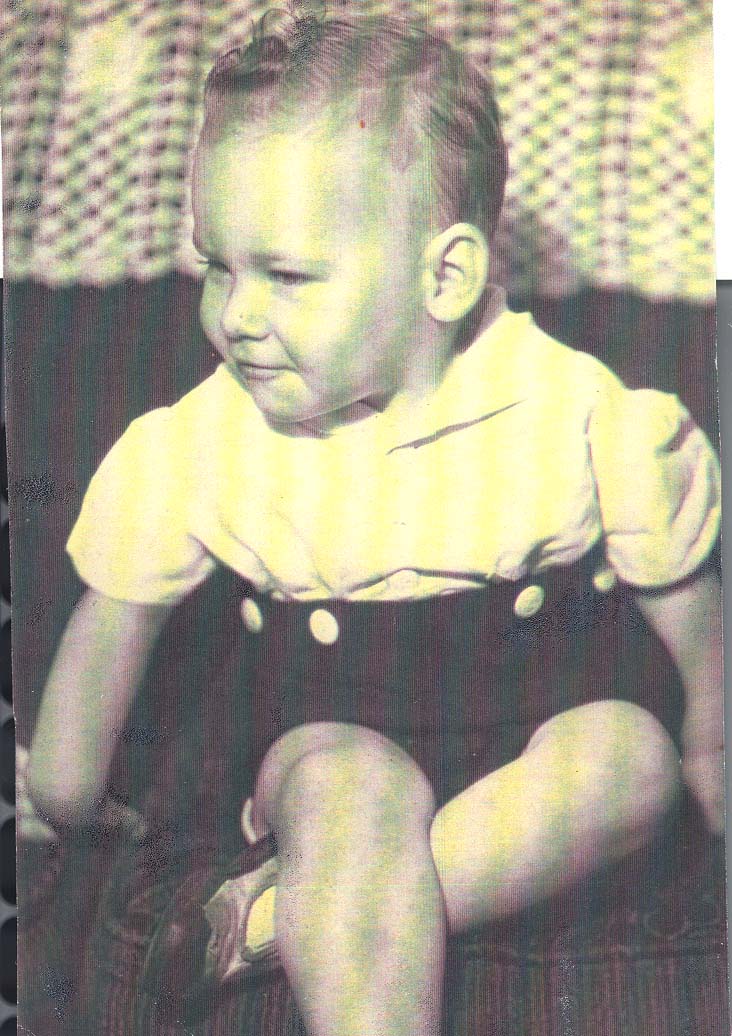
Me at a very young age. Don’t know exactly how old.

This photo is of me at a very young age, not sure exactly how old. That said, I am not the person you see in the photo. In fact, although arguably I am the person depicted in this photo, I have very little in common with that person. I could say that in the photo you see an embryonic version of me and that may well be true. We, the little dude in the photo and I, are obviously related; we share a life trajectory. But there is not one molecule in my body now that existed in the little dude back then. And the little dude hadn’t read Marx or Darwin. According to Milan Kundera in Immortality little dude would be in the happy first stage of life. The second stage is the preeminently active stage when we realize that death is real and that it is hounding us. To fend it off we must do, build a career, a family, a community. The trajectory in this stage is characterized by growth and the morality of the time expects material production from us. I am in the third and final stage of life, or at least I can be found transitioning into the final stage, the WTF stage, I call it. It’s the stage when strength is fast being replaced by fatigue and exhaustion. Kundera writes:

“Fatigue: A silent bridge leading from the shore of life to the shore of death. At that stage death is so close that looking at it has already become boring.”1

I’m bored, but only to tears, not to death. I’m just now standing on the crest of the bridge but I can easily make out the shore of death on the horizon which is becoming clearer and more distinct every day. According to Kundera, this third stage is where freedom can be found. If I knew what freedom was I might be more eager to actively pursue it. The third stage will come or I will die in angst fussing over the quality of my life experiences and my immortality which, of course, can only exist after my death.2

_________________________________________________________

1 Kundera, Milan. 1990. Immortality. New York: Harper Perennial. page 71.

2. Kundera considers immortality as that view that encompasses an entire lifetime but is also restricted to it. It is a fixed entity that has no place except in the memories of those left behind. It is not soul based unless you can think of the soul as the totality of what we leave behind. It is not eternal life but the memory of a whole life lived. Death completes my life.