32 This is no fun at all.

Well, this is no fun at all.

I’m not silly enough to believe that a life with myeloma would be fun, but I’m kind of disappointed that it’s been such an unmitigated downer. I am, I can now see, destined to drag this goddamned disease with me into the grave. Come on, I knew that! Still, a bit of a break now and then would be welcome. Is that too much to ask?

Actually, I think the nastiness I’m experiencing in spades right now stems mostly from the chemo meds rather than from the myeloma itself. This past week would support my idea that the meds are as bad as the disease at the moment for making me feel tired, dizzy, and in pain.

I went to the hospital on Thursday for my bortezomib shot after taking all the rest of my chemo drugs in the early morning. I expect Thursdays to be non-days, and this one was certainly that. A non-day is one when I can’t gather enough strength to do much of anything. However, Friday and Saturday also turned out to be non-days and Sunday wasn’t much better.

I felt a little beaten down. Of course, I should have expected it because my local oncology GP did warn me that they were going to ‘challenge’ me with my chemo med doses. No more mamby-pamby half doses for me! I was to get the full meal deal! Yes, indeed. Silly me.

Then I figured that maybe I needed a good dose of positive thinking to counteract all of these drugs. Maybe all I needed was a little endorphin fix. After all, I used to teach positive thinking on the Knowledge Network back in the ‘good ol’ days’ of 1986 to 1992. I used to teach as Ehrenreich points out “that on many levels, individual and social, it is good to be ‘positive,’ certainly better than being withdrawn, aggrieved, or chronically sad.”*

The problem is I’ve learned a few things since the early 1990s, not the least of which are the limitations of positive thinking. The American Cancer Society on its website states very clearly:

An important part of coping with a cancer diagnosis is recognizing emotions and feelings. Treatment that deals with our emotions and relationships (sometimes called psychosocial interventions) can help people with cancer feel more upbeat and have a better quality of life. But there’s no good evidence to support the idea that these interventions can reduce the risk of cancer, keep cancer from coming back, or help the person with cancer live longer. Still, things like group support, individual therapy, mindfulness, and relaxation techniques can be used to help reduce distress and cope with the emotions that come with a cancer diagnosis.

https://www.cancer.org/cancer/cancer-basics/attitudes-and-cancer.html

So, it seems that belonging to a support group has some positive effects, not on survival or anything like that, but in feeling less tired and in stress reduction. There is a support group in the Valley. I haven’t attended any of the meetings yet. I’ve been too goddamn exhausted to do that until now, but maybe next month! Then, maybe I’ll be less tired!

The American Cancer Society, on its website, starts off with this: When a person is told they have cancer, they might find themselves wondering:

  • Did I bring the cancer on myself?
  • Can my emotions really make cancer grow or affect the outcome of my treatment?
  • Can I control the tumor growth by visualizing how my body is fighting the cancer or by thinking myself well?
  • Would relaxation or keeping a “positive attitude” help cure my cancer?

I can easily reply an emphatic NO! to all these questions and the website goes on to refute each in turn.

Ehrenreich writes:

In the rational explanation that many psychologists would offer today, optimism improves health, personal efficacy, confidence, and resilience, making it easier for us to accomplish our goals. A far less rational theory also runs rampant in American ideology—the idea that our thoughts can, in some mysterious way, directly affect the physical world. Negative thoughts somehow produce negative outcomes, while positive thoughts realize themselves in the form of health, prosperity, and success.✤

The upshot of the idea that negative thoughts produce negative outcomes is the notion that people bring their diseases on to themselves by thinking negatively. Never mind that this idea is completely debunked by the American Cancer Society and people like Barbara Ehrenreich, there is a strong current of belief ‘out there’ that we are the victims of our own negativity. That goes for people with chronic illnesses, auto-immune diseases, and cancer. If you’ve got it the ‘reasoning’ goes you’ve brought it upon yourself.

This of course dovetails nicely with the predominant capitalist morality in our culture which states that individuals are inherently responsible for their actions and weakness of all kinds is abhorred, shunned, and denigrated. If people exhibit any signs of weakness, whether they are poor or in ill-health, it stands to reason that they must be responsible for their condition. That’s why people, especially those caught up in a full-blown subscription to capitalist morality, often go to great lengths to hide their poverty and ill-health. They are also the ones that tend to judge most harshly the poor, the homeless, the disenfranchised, the physically disabled, the chronically ill and the aged, even if they themselves could be included in any one of the categories I just mentioned.

Myeloma is a disease of the bone marrow. It’s entirely organic. As of yet there is no cure for it. It will not respond to positive thoughts or negative ones either, for that matter. Ehrenreich writes that “There is a vast difference between positive thinking and existential courage.” ✦ If there’s anything I strive toward it’s existential courage. However, if you catch me in a moment of deep angst over my imminent (yes, ten years is imminent) death, cut me some slack. I can’t always be perfect!

__________________________________________________

*Barbara Ehrenreich, Bright-Sided: How Positive Thinking is Undermining America. 2009. Kindle Edition, Location 89.

✤Ibid., Location 125.

✦Ibid., location 145.
30 Living in the Shadow of Death

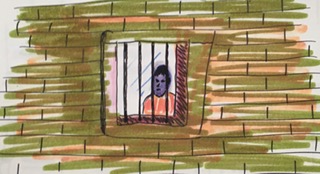
Strangely enough, I find myself wondering about what it would be like to live on death row.

We don’t have death rows in Canada, but there are about two thousand six hundred Americans in twenty-nine states right now sitting in cells awaiting their deaths by lethal injection or by other means, depending on the state. Most are still waiting for their date with the devil because they can appeal in so many ways and it seems that the average time now spent on death row is over sixteen years. There is an increasing hue and cry in the US about the time people have to spend on death row arguing that the wait itself is “cruel and unusual punishment.”

…the European Court of Human Rights in 1989 ruled that extended periods on death row violated a provision of the European Convention of Human Rights that forbids “inhuman or degrading treatment or punishment.” While acknowledging the legality of the death sentence in certain cases, it nonetheless forbade Britain to deport a German man to Virginia to face capital charges because he might spend years on death row facing “the anguish and mounting tension of living in the ever-present shadow of death.”

https://www.bnd.com/living/liv-columns-blogs/answer-man/article151691567.html

Right, “he might spend years on death row facing ‘the anguish and mounting tension of living in the ever-present shadow of death'”. Well, you know, I’m feeling a little like that myself, actually. I’ve been told I have an incurable cancer, but one that can be treated. It looks like I will go into remission sometime, probably in a few months, but who knows for how long. After that, if my myeloma doesn’t react to new treatments upon an inevitable relapse, I will surely die from organ failure. So, I wait and wait and wait not knowing if my next chemo treatment will work or not. The end result is preordained, however. No getting around that. How is this different from a death row inmate who applies for an appeal for his terminal sentence not knowing whether or not he will be successful? If he is successful this time, what about the next time? He knows that at some point the avenues for appeal will run out. When that happens he will suffer from organ failure like me, but that will be a systemic, total failure of all bodily systems as he lies there on a gurney in the execution room being administered a lethal injection of a deadly concoction of poison.

The analogy I use between my cancer diagnosis and a death row sentence is certainly not perfect. No analogy is. For instance, I don’t have to spend the bulk of my days in a small cell with bars. Nor do I have guards watching over me. That said, the comparison between my myeloma diagnosis and a death row sentence is fair if focussed on the psychological dimensions of an indeterminate cancer survival prognosis and an indeterminate execution date for the death row inmate. Chemotherapy is akin to an appeal: both buy some time but just postpone the inevitable.

I imagine that death row inmates are not pre-occupied twenty-four hours a day with the fact that they will eventually end up on the gurney in the execution room more than I am focussed all the time on the fact that my cancer is incurable, and hence terminal under the ‘right’ conditions. It’s just that the uncertainly of the situation is combined with the certainly of the outcome. That is disconcerting to say the least. I am definitely living “in the ever-present shadow of death”, but, of course, we all are. My shadow is possibly more opaque than yours at the moment, that’s all. Until I got my ‘death sentence’ I could go about my days thinking about projects I was doing, walks we would be going on, trips we would take. Now, it’s not so easy to do these things. Oh, it’s still possible, but utter exhaustion, chemo, lab and doctor visits, imaging sessions, etcetera, complicate things. I can only hope things will be different when I go into remission. I have a canoe that needs a new canvas skin and I have a sculpture I want to complete.

This all brings me back to the ‘value’ of sudden death. Sudden death does have a very important feature: its suddenness. No time to think about it, no time to live in anguish, etcetera. Looks like I won’t have the luxury of a sudden death. Maybe I will, we never know, but the way it’s going now, it’s not likely. So I have to figure out another tactic, or set of tactics to deal with the uncertainty of my life but with the certainty of my imminent death.

Problem is my death is not just about me. Yes, it’s an intensely personal experience, but other people are involved. Is it fair for anyone to focus so much on having a good death that they ignore everyone around them? Is it okay to be completely selfish about our own dying?

According to this op-ed in the Los Angeles Times, dying at home, although it seems like a reasonable thing to do, entails consequences, especially for care givers, and especially when home support and respite care are not available. This op-ed provides me with a not-so-subtle reminder to get my living will done. I probably shouldn’t procrastinate on that one.

29 A Balancing Act

So, yesterday we went to the hospital for my usual Thursday injection of bortezomib and to get the rest of the meds I take orally. This time it was a bit different because I am now on a full dose of cyclophosphomide. I was a bit trepidatious about it. I wondered if the symptoms going from a half dose to a full dose might produce twice the level of distress from the symptoms. Would I have more nausea? Doesn’t seem like it at the moment. Would I have more brain effects like lightheadedness and dizziness? Doesn’t seem like it for now. At this point it seems like it’s business as usual. I may lose my hair with the added dose of cycloformaldehyde (my name for cyclophosphomide) but that’s no big deal, I could also see darkening of skin colour and nails hardening, etcetera. Those effects are yet to be seen. Another side effect of my chemo meds is infertility. Gee, that’s really got me worried.

My tummy seems nicely settled at the moment. That’s good. Hydromorphone (hydro for short) tends to make one constipated. It sure as hell did that to me. However, most of the chemo meds I’m taking tend to produce diarrhea. Do they balance each other out? Not necessarily. Pooing regularly is very important to me now and I sure don’t need to rip my anus apart with constipation. Bring on the Dulcolax. One in the morning and one at night seem to do the trick, but I have to be on top of it because things change so quickly with chemotherapy. At the moment all is okay on the anal front. Oh, and my butt gives profuse thanks to our bidet toilet seat. That was one very wise purchase!

Last night I took my usual dose of hydro (which I found out doing research a couple of days ago that it’s one of the drugs some states in the US use for lethal injections in capital punishment). Because I have my bortezomid injection earlier in the day and I’m prone to swelling and issues around the injection site, I was told to take Benadryl as a means of counteracting that. So, I took a couple of Benadryl and that helped me sleep for four hours or so, but the dexamethasone (dex) kept pushing back wanting to make me more hyper. I slept, like I said for four hours, but after that the dex won and I lay awake for most of the rest of the night. However, thankfully, the Benadryl did counteract the dex so that I wasn’t as hyper as I might get otherwise. I was quite relaxed, actually. Around four AM I took another one milligram of hydro because my hip was hurting me more than I am prepared to tolerate. That seemed to do it, the pain attenuated and I was more comfortable. Taking one milligram of hydro on another day under different conditions and it would have no effect. It’s all about timing and balance.

As I lay in bed last night unable to initially fall asleep I checked out the ceiling above our bed. A few weeks ago I noticed signs of wetness in the ceiling drywall. It’s pretty easy to tell if your roof is leaking and you have drywalled ceilings. The paint begins to ripple and buckle slightly as the water soaks through the drywall. I am prepared to put up with some of that, but we need to ensure that it isn’t getting much worse. We painted that ceiling not long ago so I had a baseline to work with. I don’t think it is getting worse, but the solution is to get up on the roof and tighten all the screws holding down the metal roof. Metal roof screws can loosen off over time and cause problems ten or fifteen years after installation so it’s a good idea to tighten them down periodically. We’ve done that, thanks to Tim (our son-in-law) on the studio roof, and the shop roof is only a couple of years old so no need to do anything with that roof. Now, it seems, we have to do the house. I’m not about to go up there, neither is Carolyn. We’ll have to hire somebody to do that, somebody steady on their feet and with good, non-arthritic hands.

Then I thought about the studio. It’s a bit of a mess at first glance, but I set it up to do some printing months ago and it does look like a mess. But it’s not really. Someone else looking at it or going in there sees mess (unless they’re an artist). It does need some tidying up, but I’m the only one who can do that, except for moving some of the heavier pieces of equipment and my sister-in-laws stuff. A number of people have shoved ‘stuff’ into the studio to get it out of the house and out of the way, but in doing so have damaged one of the paintings I was working on, punching a hole in the middle of it. It was bound to happen. Now I have to decide if it’s worth repairing that painting or not. Sooner or later I’m going to have to go into the studio and assess my capacity to work. I could maybe do a small woodcut or linocut or finish a painting or two. I’ve got lots I could do, but do I have the energy, and can I overcome the shakes that are a side effect of some of my chemo meds? And what about that arthritis? Those are the questions.

At one point last night, about twenty minutes after taking the extra one milligram of hydro, I lay on my back and realized, heh, I don’t have pain anywhere in my body! Holy shit. I can guarantee you that that is a rare occurrence. How did it happen? Well, as best as I can figure, I had all my various meds balanced out. The slow-release hydro was looking after my regular pain, the Benadryl was counteracting the dex as well as looking after the injection site issues. As long as I stayed still, I was painless! Of course, a few minutes later, when I decided to move to sleeping on my right side, I started getting pain in my thoracic area, something I’m quite familiar with. But heh! Lesson about balance taken!

Balance seems to be everything in my life at the moment. It sure wasn’t always a concern for me to the extent that it is now. Now, I could think about going into my studio and working, say, for an hour instead of for a whole day. I can think about going for short walks instead of running marathons thus balancing my need to rest with my need for exercise. I need to take time to think about how my meds work and how to get the most out of them without too much stress on my body and emotions. Age is a huge issues but instead of pining for the good ol’ days, finding age and cancer appropriate balance is working for me. Of course, I’m still going to die, but that will help out with the cosmic balance between life and death. More on this to come.

28 Moving on up.

So, I’m over the shock of my cancer diagnosis. It’s been four months, after all. That doesn’t mean I’m happy about it, but it does mean that we (and I have to include Carolyn in everything here) have moved on from the initial storm of emotions around the diagnosis to settling in for months of chemotherapy and complete disruption of our lives. We are moving into a new routine. Every day is almost predictable, at least for now. I can’t say that I’m bored at this point, but I certainly am getting restless. I’ve gone down to the studio a couple of times lately and poked around. I really do miss drawing and printmaking. I want to get back to them soon and I really want to finish a small sculpture I started last year. Problem is I’m so exhausted all the time.

Not all people with cancer have the same reaction to the disease itself nor to the chemo meds and the opioids. Not all cancer patients are anemic all the time and I’m told that not all experience a lot of pain or the exhaustion I’m feeling. Every cancer is different and close to two hundred types have been identified. Breast cancer is the most common followed by lung and prostate cancers although there are several different varieties of all three types of cancers. Multiple myeloma is very uncommon and is the rarest of the blood cancers. Lucky me.

This morning we saw the local oncology GP and he told us that everything is going well with my therapy but that for the third cycle starting tomorrow they will be punching up the cyclophosphomide (the main chemo med) to one hundred percent. I didn’t know this, or I forgot, but I haven’t been up to full dose on this chemical yet. The doctor said that they started me off slowly to ensure that I could tolerate the shit, but now they were going to have to ‘challenge’ me. I have no idea how that is going to affect the side effects I am inevitably going to get except to amplify them. Yep, that’s what I can expect, amplified side effects. Yum.

I also learned this morning that I have six more chemotherapy cycles before they can consider whether or not I’m in remission. That means I will know by late August or early September. Oh well, I didn’t want to do anything this summer anyway, now did I. The way I’m feeling at the moment, I’m thinking that I might be able to get out on some short excursions come the sunnier, warm weather, but laying about the back yard by the pond sipping a cold drink doesn’t seem so bad either. Today is the last day of my previous cycle and the best of the whole lot because I’ve had a bit of a ‘holiday’ from my meds. Tomorrow, I’m back in the trenches with full-blown cyclo, dex, and bortozemib. I had an infusion of zoledronic acid today too, that’s a bone strenghtening drug. It gives me a raging headache so I take a couple of acetaminophen to help deal with that.

I have to get back to the hospital in a couple of hours for a CT scan of my right femur and cervical spine area. My orthopaedic surgeon wants to check my cervical spine for any changes in my degenerative disk disease and arthritis, my other nemeses. He also wants to determine if the excavators in my femur are in any danger of breaking through the bone or not. I’ve been experiencing more pain in the area lately and he wants to stay on top of that. Good for him. I like his attitude.

Enough for now.

25 Overdiagnosis?

In my last post I left you hanging with suspense! Well, in this post I have a couple of issues to raise that should quell any after effects of inordinate suspense left behind from reading my last post. One is about overdiagnosis, which I promised to raise again, and the other is about cancer itself and what would happen if it didn’t exist.

So, in her book Natural Causes, Barbara Ehrenreich addresses what she calls overdiagnosis. This is a situation wherein currently powerful imaging techniques can, for example, ‘see’ many more, and smaller, lumps in a person’s neck than was previously possible. The question is then put to the patient: “We’ve found a lump in your neck. What would you like us to do?” Patient, very concerned: “Is it cancer?” Doctor: “We don’t know, but we can always remove it.” Patient: “Well, let’s not take any chances. Let’s get rid of it.” Ehrenreich claims that in seventy to eighty percent of these cases in the US the surgery was unnecessary.

I have my own example of overdiagnosis. I had a parotid gland removed from the left side of my face years ago. There was evidence that it was enlarged, but nothing to say it was malignant. I had a choice to make and opted to have it removed. It was unnecessary surgery. Because of it I was left with insensitivity on the left side of my face and a scar leading from my ear down the side of my neck. It’s a crapshoot. How many people do you think would turn down the surgery?

Recently, Dr. Brian Goldman of the CBC’s program White Coat, Black Art, wrote in his blog about overdiagnosis. He writes that overdiagnosis “means identifying problems that weren’t causing symptoms and were never going to cause the patient harm.” The source for most of his information is a study led by Prof. Paul Glasziou, director of the Institute for Evidence-Based Healthcare at Bond University in Australia. It used data collected over a thirty year period by the Australian Institute of Health and Welfare. The results are quite astounding. Goldman writes:

The researchers found that, in men, 42 per cent of prostate cancers, 42 per cent of kidney cancers and 58 per cent of melanomas were overdiagnosed. In women, 22 per cent of breast cancers, 58 per cent of kidney cancers and 54 per cent of melanomas were overdiagnosed.

Overdiagnosis can arise from overly prescribed testing including screening tests like mammography. Increasingly sensitive imaging equipment can detect smaller and smaller lesions and tumours, benign or malignant. It’s often difficult to tell whether a tumour is benign or malignant. In the case of kidney cancers, invasive biopsies are not often carried out for fear of spreading cancer cells to adjacent lymph glands. So, surgery is a crapshoot. Do we operate or not? The default position is surgery because few people would be willing to take the risk of leaving a possibly benign tumour in their bodies.

To take this even further, Goldman’s blog post argues that even “incidental abnormalities” or cancers that would never have caused symptoms or led to full-blown rapid onset pathological mitosis are being surgically extirpated. We probably all have asymptomatic cancer cells in our bodies that may never result in any health threat because of them.

In the September 11, 2017 issue of The New Yorker Siddhartha Mukherjee is back at it with a thoroughly provocative article entitled: Cancer’s Invasion Equation: We can detect tumors earlier than ever before. Can we predict whether they’re going to be dangerous?

Good question. The gist of Mukherjee’s argument in this article is that two things are required for a full-blown cancer to make itself known which he metaphorically refers to as the seed and the soil. This metaphor he borrowed from a 19th Century English doctor interested in cancer research, Stephen Paget. His idea was that a cancer cell (the seed) would grow only if the local bodily ecosystem (the soil) was conducive to that growth. It could happen that the cancer cell falls on barren ‘soil’ and does not grow and divide. On top of that, on close examination cancer cells could be found that would never produce any symptoms. Some cancer researchers were now becoming human ecologists. Some even began to ask why people don’t get cancer and not just why they do when they do.

In my case, I may have carried the myeloma ‘oncogene’ for a long time but my ‘soil’ wasn’t yet ready to receive it. It may be that it was just a matter of time in my case, age being a big factor, but there may have been others that contributed too to creating the right conditions for my myeloma to go from dormant (smoldering) to active. Now, there’s no turning back for me. The seed has been planted and the hemoglobin garden in my bones is turning into an oncological garden.

There’s a final note towards the latter part of Mukherjee’s book The Emperor of all Maladies that makes me realize how little we know about cancer at this stage and about the process of dying and what that entails. Mukherjee writes:

“Taken to its logical extreme, the cancer cell’s capacity to consistently imitate, corrupt, and pervert normal physiology thus raises the ominous question of what “normalcy” is. “Cancer,” Carla said, “is my new normal,” and quite possibly cancer is our normalcy as well, that we are inherently destined to slouch towards a malignant end. Indeed, as the fraction of those affected by cancer creeps inexorably in some nations from one in four to one in three to one in two, cancer will, indeed, be the new normal—an inevitability. The question then will not be if we will encounter this immortal illness in our lives, but when.” (from “The Emperor of All Maladies: A Biography of Cancer” by Siddhartha Mukherjee)

So, how exactly does the body shut down as it’s dying? Cancer may very well be one (a very important one) of the mechanisms that is ‘natural’ in its role in having us die. Maybe cancer is not the pathological evil that it’s made out to be. What would happen if cancer did not exist? How would we die then? What does it mean to die of natural causes? How can we figure that out? Stay tuned. I think science and medicine have a lot to learn about us yet.

22 The Unrelenting Presence.

Carolyn and I have just finished reading The Emperor of All Maladies: A Biography of Cancer, by Siddhartha Mukherjee. The author, an oncologist and Renaissance man, who won a Pulitzer Prize for non-fiction for this work in 2011, masterfully addresses the war on cancer over the past few centuries or so, but with a special focus on more recent events and ‘successes’ relating to specific cancers and new treatments. Cancer, as the books so often argue, is not one disease but lots of different diseases. They all have one thing in common, though: pathological mitosis.

I’m not going to review the book today. I will, though, sometime soon. I’m kind of bummed out right now and not really in the mood to write a long blog post. I took my chemo meds again today. That’s always a fun time, but I’m still confused about just what accounts for how I’m feeling. Sometimes we call these feelings ‘symptoms’ but I don’t like that word much. I’m not sure why. For instance, this afternoon I felt exhausted, and lightheaded, somewhat dizzy too so I went to bed for a nap. As I lay there my body was tingling all over. Is that a feeling or a symptom? If it’s a symptom, is it a symptom of my myeloma, the chemo meds or something else? It’s still tingly, but not as intensively as this afternoon.

I’m bummed, but I should be celebrating, I guess. I had a five minute telehealth conference with my Victoria-based oncologist yesterday morning that’s left me feeling a little empty. For one thing, although he called me by name when we made screen connection (It’s like Skype on steroids), he was not prepared in the slightest for the interview. He asked me how I was doing on a chemo cocktail he had withdrawn me from a few weeks ago. Then he asked me what he could do for me. Well, shit. He then got so focussed on the computer screen he was looking at with my charts all over it that I might as well have not been there. So, I asked him about my lab results. Yes, he said, everything is going very well. The drugs are working. Reason to celebrate, right? Yes, I suppose, but then he says that I had better get used to the shitty quality of life I have because that’s my future. Even if I go into remission. Well, slap me in the back of the head! It wasn’t that long ago that he sat before me and told me I’d regain some good quality of life in remission. Maybe he was having a bad day. Now I was having a bad day too. I felt that this guy needs a talking to about compassion. He rebuffed any attempt I made at personal conversation. He was cold and completely detached. Maybe he was having a bad day but maybe not. Maybe he’s like this most of the time. Then I thought, maybe my expectations are too high. Maybe I should think of him as a consultant, more than as a doctor treating me like my GP would. After all, I see him for five minutes every four months. So, whatever, I’m still bummed out. Distractions like writing, reading, and watching YouTube videos are good for me, but I can’t be distracted a hundred percent of the time. Any break, any crack in my distractions and the dark light of myeloma reminds me in no uncertain terms of my mortality.

Mukherjee is so informative. I learned a lot reading his book. I’m also reading a book on Medieval medicine and even a thousand years ago, ‘doctors’ recognized cancer for the killer that it is, but they looked for the causes in ‘black bile’ and other humours gone bad. Towards the end of his book Mukherjee gets real for me. It’s all fine and dandy to ‘know’ about cancer, to study it, to follow developments in its treatment, but now, cancer has me up close with its unrelenting presence. I leave you with two quotations from Mukherjee’s book. I am these quotations.

“The poet Jason Shinder wrote, “Cancer is a tremendous opportunity to have your face pressed right up against the glass of your mortality.” But what patients see through the glass is not a world outside cancer, but a world taken over by it—cancer reflected endlessly around them like a hall of mirrors.” (from “The Emperor of All Maladies: A Biography of Cancer” by Siddhartha Mukherjee)

AND…

“Cancer is not a concentration camp, but it shares the quality of annihilation: it negates the possibility of life outside and beyond itself; it subsumes all living. The daily life of a patient becomes so intensely preoccupied with his or her illness that the world fades away.” (from “The Emperor of All Maladies: A Biography of Cancer” by Siddhartha Mukherjee)

Read the book

Enough for now. Maybe I’ll have more gumption tomorrow.

21 Love.

Sunday morning. The huge snowfall we had over the past few days is slowly yielding to the onslaught of warmer temperatures and steady rain. It will still be a few days before we can extricate the car from its cocoon of snow and ice but that’s fine because we can always use the truck to get around. Having two vehicles is a bit of an indulgence, but the security of a backup is important to us right now.

Every once in a while we hear a loud thump as large chunks of snow and ice break off of the load on the various metal roofs we have like a calving Alaskan glacier and crash to the deck or the ground below. Metal roofing creates a nice slick runway for ice and snow to slide off the roofs. We need to be vigilant when we walk under the eaves of the house or outbuildings for fear of getting walloped. I’m pretty safe though because I haven’t left the house in days, since my last visit to the hospital on Thursday actually. I’m having a rough time of it right now and I don’t rightly know if it’s because of the chemo or the myeloma. I know by my lab results on Monday that my hemoglobin counts are down and that means anemia is getting worse. Who knows why. I just know I’m exhausted for no goddamn good reason. I don’t mind being exhausted. Exhaustion can be a reward, actually, after a long run or a good workout. Being exhausted after sleeping all night and most of the day is not what I consider a reward.

I’m backing off my pain meds for a bit. I want to see where my baseline is. Getting the right dose of pain meds means constantly re-assessing pain levels. To be sure, pain varies a lot for me, not only in intensity but in kind. Lately I’ve experienced a dull, throbbing pain in my legs, particularly my right one. Every once in a while I get a spike of pain but that’s usually manageable. On my last visit to the hospital for my infusion of zeledronic acid, as I was sitting there in the chair with tubes sticking out of me, I got a cramp in my left side. I sometimes get cramps in my left side as an artifact of the surgery I had in 2002 to remove my left kidney. In any case, the nurses got very attentive all of a sudden as I writhed in my chair trying to find a comfortable position. They thought I was having a heart attack or something. It took me a while to assure them that it was just a cramp and not to worry. Pain is such a weird thing. I’ve had chronic pain for a couple of decades related to low levels of vitamin B12. Now, I have a hard time distinguishing between the chronic pain of the past few years and the new pain created by my myeloma. Not that it’s important, I guess, but doctors do want to know what kind of pain I’m having. I get pretty frustrated at times because I don’t know what’s causing my pain. It might be arthritis or degenerative disks too, but they don’t want to know about that pain. They want to know about pain associated with the myeloma. It’s not a simple thing to tell the difference. It’s funny: my orthopaedic surgeon in Campbell River asked me about pain in my right leg. I told him, yes, I have pain in my right leg, along my femur and even below the knee. Well, he said, that’s odd because your lytic lesion from your myeloma is at the distal end of your femur. Isn’t that where the pain is? Well, yes, but, but…

So, dealing with the symptoms of myeloma is one thing, explaining how I’m feeling is another thing entirely.

Some people love winter. They’re off skiing, snowshoeing, and doing other wintery stuff. I’m not a big fan. I’m a big fan of summer. You’ll never catch me complaining about how hot it is. Winter to me means short hours of daylight and long rainy nights. I am fortunate, though, in that we have a beautiful home to hunker down in and I have Carolyn as my caregiver. There’s always a hot cup of coffee ready for me in the morning and tea during the day. It’s clear I’m not the best of company a lot of the time but Carolyn is always there. I don’t know what people do if they don’t have community, family, and love, and find out later in life that they have incurable cancer. I’m feeling good knowing that I’m not on this road alone. Of course, dying is a lonely affair. You shouldn’t expect to have people accompany you into the grave like the Chinese emperor Qin Shi Huang Di, but having them along as companions until the last moments of life is as good as it gets in my books.

19 Fuck cancer!

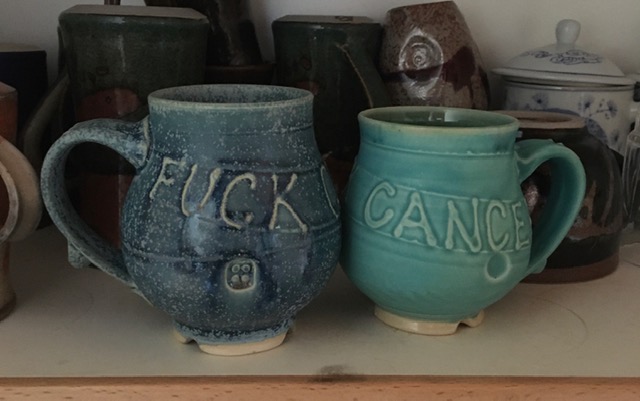
Fuck Cancer mugs

[WARNING: this post contains references to visualizations some might consider offensive, and I regress to being a potty-mouth. Be forewarned.]

I’m not feeling particularly creative, effusive or positive today. In fact, I’m feeling hard done by, angry and unhappy. Hence the title of this post. In fact, I’m feeling fucking crappy, as crappy as ever, or even more so, because for the last three weeks or so I’ve had a cold to compound the effects of my myeloma and the chemo meds I’m taking. Most of the time all I’ve been able to do is sleep, or stare out the windows.

We just came back from the hospital an hour or so ago. Carolyn had to shovel huge piles of snow blocking our driveway and covering our truck just to get us there. Carolyn is my warrior! At the hospital, I got an injection of bortezomib (a proteasome inhibitor) into my abdomen and an infusion of zoledronic acid (a bone strengthening drug that has not-so-fun consequences for my kidney). They gave me 4 grams of zoledronic acid rather than the 3.5 I got last time. I have no idea why. They have a complex formula for deciding how much to give me including my weight and my lab results. Now, I’m just waiting for the chemo meds to kick the shit out of me as they surely will. At least dexamethasone gives me a bit of a boost of energy allowing me to carve a few words onto this ‘page’ out of my weary brain. The sculpture I’m carving I don’t feel is particularly elegant or fine, but my tools are dull so it’s what you get.

Do you like the mugs? Carolyn had them made by a very talented potter in the Valley who had previously made a set of mugs we bought from her that resemble these a lot except for the swear words.

Yeah, fuck cancer! I’m so sick and tired of being sick and tired! And now, to compound my shit, I have to worry about peripheral neuropathy. [I have complained about this before, but read about it again for fun.] I’ve had peripheral neuropathy for some time, many years actually. Peripheral neuropathy (PN) is a condition where the peripheral body parts, arms and legs to be precise, get to feeling numb, painful, and full of weird sensations like having bugs crawling all over them (something I’m feeling a lot at the moment). One of the side effects of the cocktail of chemo meds I’m taking is peripheral neuropathy. Left untreated it can lead to immobility, loss of sensation and life in a wheelchair. This is one of the nasty side effects of my meds, one that has forced a friend of mine who also has myeloma off this particular cocktail that’s often referred to as CyBorD. I’ve written about this before. I have to keep a close watch to determine whether or not the symptoms of PN are getting worse or not. It’s just one more thing to keep my mind occupied with my illness. Fuck cancer!

Did I say Fuck Cancer? Right, I did. And I mean it. I’m not sure what else I would prefer to die from, but cancer is not the companion I would have wished for on my way to the crematorium. Maybe a six-ton weight falling from the sky onto my head would be preferable, I don’t know. I have no way to assess the quality of various means of dying nor the means of communicating the results of any research I might do on the subject to you after the fact.

I may have already written about this…remember that brain fog is a classic side effect of anemia and myeloma, repetitiousness and forgetfulness probably are too… I read somewhere that an artist was asked if he wanted to be cremated or buried after he died. Instead of answering as you or I might he replied: “Surprise me!” Yeah, that’s the way I feel about it. I won’t be around to give a shit one way or another, but I have said I want to be cremated. I have had too many nasty dreams about being buried to want that as an option. Now, though, I’m starting to have moments when I visualize the crematorium attendant pushing my body into the furnace and my skin starting to cook like a pig on a spit as the fire gets hotter and hotter. I know, it’s gross and morbid. Sorry for bringing it up.

So, to change the subject, I’ve had a few moments of lucidity lately between bouts of feeling really nasty because of this cold, and I’m reading (in bed) about my ancestors here in Canada. My family goes back a long way as immigrants to Canada, back to early in the 18th Century actually on both my maternal and paternal sides. I’m finding out that my Norman ancestors called LeGuerrier (the warrior in French) were very likely actual warriors. A thousand years ago the Normans were highly trained and fierce warriors. They not only conquered England in 1066, but (I’ve just read) also became rulers in Sicily after they were invited there to help deal with an enemy. According to a book I’m reading they were often called on as mercenaries. One of the Norman rulers in Sicily was called Roger. His son Roger II took over after Roger I died and he was not known for his tender generosity. Roger that! In any case, the first Leguerrier in Canada can be traced back to 1748. He came earlier than that, but that date is the first mention of him in ‘the books’. He died a fairly old man. Infant mortality was very common then but so was death at any age. From what I’ve been reading living to reproductive age almost seems to have been the exception rather than the rule. These days I’m thinking about my ancestors, their lives and their deaths, and my place in the lineage. My grandpa Leguerrier died at the age of 76 in 1975 from stomach cancer if I remember correctly. My father died in 2007 at 96 years of age. We all come and go. Some of us live longer that others of the same generation but in the case of my grandpa Leguerrier and my father who were only fourteen years apart in age, I think I prefer to follow my grandpa’s lead because my father died after years of very poor quality of life, unable to feed himself because his hands were so distorted by arthritis. He was deaf, had been for years, and he was either in bed or in a wheelchair. To make matters worse, my mother had severe dementia and didn’t even recognize him on his deathbed. She was heard to point to him and say: “Who is that old man in the bed there anyway?” My mother died two years ago at 94 years of age. I can’t imagine she knew she was dying at the time. I’m not sure she knew that she was alive. Hey, wait a minute…

18 Looking in the Mirror.

When I look in the mirror I see an old man. I don’t see an old man with cancer. I just see an old man with a white beard, not much hair, and wrinkly skin. Melanoma (skin cancer) often leaves visible, sometimes unsightly and disfiguring lesions. I don’t have melanoma, although my father did. No, I have myeloma (bone marrow cancer) and its damage is all done on the inside, invisibly. So, I guess I can keep expecting people who see me say: “Wow, you’re looking good!” I guess I DO look good! Now, the last thing I want is to discourage people from telling me how good I look, so keep it up! However, the invisibility of my condition is deceiving. I remember when I was a kid my friends and I used to work on our cars. That was still possible when I was a kid. Often we’d stand around looking into the engine compartment (often of my 1956 Pontiac four-door hardtop) wondering what could possibly be wrong as if just staring at the engine would give us some kind of clue. The engine was always sparkly clean and there was nothing obviously gone awry. If I had money by some quirk of circumstance I might take the car to a mechanic. If not, we might borrow my dad’s tools and start taking things apart. That usually ended up badly. Yes, the most undesirable conditions in life are often on the inside, impossible to see or diagnose by just looking at the person or car in question. I find it best to consult mechanics when our car shows signs of disfunction. I find it best to consult medical specialists for treatment related to my body. I guess I could try to treat myself using any number of the ‘cures’ available on Dr. Google, but I would like to live a while longer, thanks. Besides, I’m not that desperate.

Speaking of medical specialists, we saw my local oncologist today. I see him every five weeks. The result of our visit is that I will carry on with a second course of chemotherapy. We’ll evaluate how well it went in five weeks. My first course of treatment seems to have gone as well as could be expected. The little excavator in my bone marrow is slowly running out of gas and my red blood cell garden is growing again. I’m still exhausted and that won’t change for some time yet, but things are certainly going in the right direction for now. I think I just might be a model patient. So, where does this all leave me?

Well, I may be on my way towards remission. If and when I do go into remission, and that’s by no means guaranteed at this point, that would buy me some time. By that I mean that I may have a few years more to live, though inevitably, either the myeloma will kill me or some other condition will. I won’t be walking away from this situation, brush the dust from my sleeves and carry on. No, I’m on a one way street. So are you, of course, but I can see that damned barrier at the end of the street. I’m hoping that you’re still far enough away from it that you can live in blissful denial for a while longer. I don’t have that luxury. So now what do I do with my life?

That question came up in a recent Facebook thread, albeit expressed in a different way, but with the same effect, I believe. The question comes down to this: If you knew that you had a given amount of time left to live (six months, two years, whatever), what would you do with your time? Would you to be seized by an overwhelming sense of urgency? Would you be determined to cram as much activity and experience into your remaining time as possible? Or would you curl up in a fetal position in a corner of your bedroom quivering and whimpering while you await your inevitable demise? If you have the money and the energy you might want to get out there and travel the world. If you have a spouse, that might complicate things more or less because they may not want the same things you do and may not want to get caught up in your sense of urgency. The last thing you need when facing terminal cancer is marital discord. I think there’s a lot to be said for just carrying on with life as before.

If you have the energy and the money then good on ya. If you travelled a lot before your diagnosis then travel after. Your eventual energy deficits will tell you when to stop. If you were fairly sedentary, more into being at home and puttering around the yard, then that would be something you might want to continue doing. The stress of travel may not be that good for you. Looking around the Cancer Centre at the North Island Hospital this morning I didn’t see a lot of people with obvious enough vigour to engage in a lot of physical activity. In any case, back to my situation.

My exhaustion prevents me from doing much in the way of physical activity. If I do go for a walk I pay for it later. Travelling is impossible. At one point I thought it might be possible, say, to take a direct flight to Puerto Vallarta back and forth from Comox, but there are a number of contingencies that make that next to impossible that have more to do with arthritis and disk degeneration than cancer. Besides, I take chemo drugs once a week orally but also by injection at the hospital. For three or four days after I take my meds I feel crappy, really crappy so the chances of enjoying myself on a beach somewhere are slim to none.

So what do I want to do, and what do I actually do? Well, I want to work on our canoe, finish some paintings, do odd jobs around the property and visit family and friends in Vancouver and further afield. What I actually do is sit and lie down a lot. As I sit and lie down, I read, and sometimes I even write. At the moment I’m reading social history around the Middle Ages and doing a bit of research on my family roots in Normandy. That’s something I would have done anyway, but I do miss working in my shop and studio and going for long walks with Carolyn and our imaginary dog. My oncologist thinks I will regain my energy, at least as much as an old man can expect. If so, that would be great. I’d love to get back to canoeing, camping and puttering.

When I get closer to dying I will know it, and I expect I will have time to think about it, but there really isn’t much thinking that is productive about dying, at least not for me. I’ll know when it’s time for palliative care. I don’t want to live as long as the oncologists might want to keep me alive. I’ll make the decision when the time comes. I don’t think it will be a really hard decision. I know that beginnings are impossible without endings. My ending is a lot closer now than my beginning! That’s fine. Frankly, I’m much more concerned with my family than I am with myself. They are the ones left behind to mourn. But both of my parents are dead and we got on with life after their deaths. My family will do the same when I’m gone. That’s what we do as humans. Like it or not, accept it or not, rage against it or cower in a dark corner, the end result is the same. Don’t sweat it.

17 Welcome to CancerLand* AND Happy Birthday to me!

Well, another festive season is in the books. This one was no different than many in the past with family, food, and drink (in moderation, of course) along with the requisite tree and lights. This year, however, the family arrived on the weekend prior to Christmas and stayed much longer than usual. That’s because our daughters, their husbands and children (one of our daughters carries the full responsibility for the production of our three grandchildren) wanted to stick around to spend some time with us. I love that they wanted to be with their sick old dad. They are such a delight to have around and I was very sad to see them go back home to Vancouver.

Wow, has my life ever changed over the past few months. I was diagnosed with multiple myeloma in early October, 2019, and since then I’ve been brought slowly yet inexorably into CancerLand. There’s no doubt that I had multiple myeloma long before the official diagnosis. The symptoms were clear in hindsight. It’s probably been well over five years. But it’s been only since November, really, that I’ve gotten my passport to CancerLand. I’m fully a resident now, brought into the institutional fold. That means frequent visits to the lab and to the hospital with calls to oncology nurses interspersed. I mean, I have a diagnosis! I’m legit! I have my badge and my pass to the ER.ª  I’m not just another whiny patient going to see my doctor to complain about being tired. I’m a CANCER PATIENT!

Speaking of being a cancer patient, I’ve now completed my first course of chemotherapy. It lasted about a month. My stomach is bruised from subcutaneous injections of bortozemib and my brain is bruised by weekly oral doses of cyclophosphamide and dexamethasone as well as zoledronic acid infusions once a month. I’m subject to a true cocktail of poison. Oh well. I used to drink more scotch than was probably good for me on occasion and people sometimes refer to alcohol as poison so, there ya go. Poison for poison.

Now we wait. We wait for the results of lab tests on Monday and what the oncologist will tell us on Wednesday based on those results. Will I be continuing with this same cocktail? Are the numbers going in the right direction? Can I realistically expect remission in the next few months? What? What? What?

Tomorrow is my seventy-third birthday. That means I start working on my seventy-fourth year tomorrow. For a guy who thought at twenty years old that he’d never live to be twenty-six, I’ve done pretty well. I can’t complain about my life. I must say, though, that there are a few things I might do differently if I had to do them over again, but I don’t dwell on those things anymore. I don’t have time. I didn’t have time when I was twenty-six either, but I didn’t know that back then. Time has passed so quickly, it’s frightening. If I had been able to really understand when I was twenty years old how in the blink of an eye I would be seventy-three I might have taken some things more seriously and dismissed other things as unimportant. But that’s the way it goes. There may be some twenty year olds out there who understand how fleeting life is, but I haven’t met them. Trying to convince them of that fact is not going to be very fruitful so meh…

I haven’t put together a New Year’s resolution. Should I? Maybe I can resolve to stay alive this year. Is that good enough? I’ve realized that in my state of being, committing to a long-term project to save the world is probably overly optimistic, but a resolution to stay alive in 2020 is reasonable, I think. I just might be able to see it through too. Wish me luck!

_________________________________________________________________

*”Welcome to Cancerland.” (from “Bright-sided: How the Relentless Promotion of Positive Thinking Has Undermined America” by Barbara Ehrenreich). The title of this post is taken from this book. Ehrenreich uses this title as an introduction to the way she became medicalized after having been diagnosed with breast cancer. Start reading it for free: http://a.co/3h6SgyT

ª I do have a pass to the ER. I have a letter of introduction to the ER staff from the BC Cancer Centre telling them that if I show up to the ER they have a number of tests to do stat! If my temperature goes over 38˚ C, I need to get myself to the hospital ER for a possible antibiotic infusion. An elevated temperature indicates an infection of some kind, something I don’t need right now.