
This is not about sex.

I think that the reality is that most of the judgments we make of other people and how we may ‘gaze’ at them  are not specifically about sex or their fitness for procreative success. They may be unconscious moral judgments about their fitness to be part of the in-group. 


http://www.cbc.ca/radio/q/schedule-for-monday-march-14-2016-1.3490076/photographer-captures-the-dirty-looks-strangers-give-her-1.3490082

So, I listened to the CBC’s Q this morning while waiting in the car for Carolyn to come out of appointment with her optometrist. The interviewee Haley Morris-Cafiero is a fine arts professor at an American University and she’s just recently published a book called Watchers. Obviously, listening to the radio, I couldn’t see what she looked like, but the host, Piya Chattopadhyay’s questioning made it obvious she was trying to get Morris-Cafiero to admit that she was fat and that’s the reason people were glaring at her askance.

The book and the interview are revealing for a number of reasons. I’ll deal with a couple here. For one, people judge each other constantly. It’s a part of being a human being. If a person stands out in any particular way, is a statistical outlier by being super tall, super small, super thin or super fat, tattooed all over the place, a different colour or ethnic group than everybody else in a group, then there will be stares or at least oblique glances or gazes. This we cannot avoid. Morris-Cafiero’s documenting of the oblique glances at her because she’s fat, is what’s interesting here. She is unapologetic for being fat and why should she apologize? Well, some of us see obesity as a moral failure for which we need to apologize. Others see it as just a problem of overeating: we should just stop eating so much. We make fun of fat people. The internet is full of blogs and commentary objecting to obesity. Morris-Cafiero actually reports that there are blogs set up just to make fun of her size. She’s now chasing them down to mock how they look if she can find photos of the bloggers and commentators. Morris-Cafiero claims to be perfectly happy with herself and the way she looks. I have no reason to doubt her.

Her book is not about the issue some women have of being stared at because they are ‘attractive’ to someone or other. They may not be beautiful in any normative sense, but they can and do attract the carnal attention of some men or women. Beauty is in the eye of the beholder. Of course the fashion industry has no qualms about deciding for all of us who is attractive and who isn’t.

On another CBC item this morning I heard a comment about women’s bodies being a battle ground. Men stare. Men comment. Men catcall. Men, men, men. Of course we do. Some of us are stupid and have no moral or social brakes, so we catcall and make rude remarks. Some of us admire from a distance and would be mortified if a women called us out for staring at her. Some of us get caught on the odd occasion stretching out a glance at a particularly attractive woman and we’re soon reminded of our misdemeanour. Some of us are not attracted to women at all so we only admire feminine beauty from an aesthetic place. But most of us look and assess. We check out people. We watch. We undress people we find attractive with our eyes only. Sex is sex is sex. We may be offended by people looking at us with a carnal look in their eye, but we may be just as upset if they didn’t look. Of course men get looked at too. This is a two way street.

Dress often makes things interesting too. It’s easy to dismiss a focus on dress as just a side issue to the real issue which is physical attraction. Women and men in their dating years often dress provocatively if they can. When they do, it’s hard to feel sorry for them if people look a little too long or too closely. That said, I’m not making any apologies for sexism and discrimination based on sex. It’s just that us humans are geared for sex and that’s a two way thing. Sexism and sexual discrimination mean treating people unequally because of their genitals, not their brains.

Thankfully, us older people are less subject to the overheated, pheromone soaked dating world younger people are subject to. In fact, I think that us older types are more easily capable of thinking of people of the opposite sex in terms of their qualities and characteristics other than their sexuality and sensuality. That said, even as an old man, I can appreciate the aesthetic qualities of a younger member of the female sex. Those inclinations don’t just disappear overnight. I’m sure the same goes for women.

I think that the reality is that most of the judgments we make of other people and how we may ‘gaze’ at them  are not specifically about sex or their fitness for procreative success. They may be unconscious moral judgments about their fitness to be part of the in-group. I think that goes for most people, young and old. We even look at children in strollers and unconsciously assess them for their future potential. We just do.

Being human is pretty funny if you can figure out how to get under our common prejudices and ‘see’ other people for what they are. It’s not easy because we have sexuality, procreation and morality all vying for attention and complicating things no end.

 

Deep down, are we all racist?

Deep down, are we all racist and xenophobic?

In my last two posts I wrote about a book by Dom Benoit published in 1904 about the Catholic missions in the mid 19th Century in the Canadian West.  The book is a biography of Mgr. Taché, second archbishop of St. Boniface (1853-1894).

Was I unfair in singling them out for a special call-out for being racist?  Yes and no.

It’s pretty obvious that the missionaries understood that the indigenous peoples of the area were human, but that they were significantly different from themselves, especially in the fact that they weren’t ‘children of God.’ The derogatory manner in which they describe indigenous peoples, especially plains peoples, would immediately label them racist in most people’s books.

Their mission’s objective was to make ‘savages’ into ‘children of God’. They may have thought they had accomplished that by baptizing as mahy as possible, but that apparently still didn’t make them equal to white folk in the eyes of Canadian governments, all of which had institutionally racist practices and values regarding indigenous people. There is no doubt that Sir John A. Macdonald’s government was racist to the core. It’s hard not to conclude that most Canadian governments over the decades, both federal and provincial have been racist. Their policies prove it, the Indian Act proves it, all their actions prove it.

So, along with the missionaries of the mid 19th Century, are they special in their racism? Are governments racist, along with a few bad individuals, or are we all racist, deep down? Some of us may deny it vehemently, but the impetus, the imperative, the drive to characterize ‘other’ groups of people and their institutions as inferior or undeserving because of some national or group trait is pervasive. Can we avoid being racist and xenophobic? Can we avoid labelling groups (gender, age, colour, etc.) and nations with sweeping generalizations that deny human individuality and capacity for free thought?

The short answer is that I think we can, but it takes a lot of effort and thought. It means letting go of a lot of ‘isms’ some of which we love dearly, like patriotism.

If we believe that our society, our way of life is the greatest thing on earth, it makes it difficult to just accept others as they are and not to try to convince them, by ideology or coercion, that they should change. The Catholic missionaries of the Canadian West obviously thought that their religious beliefs and practices were the only ones that could lead to salvation, that is to eternal life in the presence of God. It seems to me that they would feel a holy obligation to try to ‘convert’ as many ‘savages’ as possible to save them from being condemned to an eternity in pergatory or hell. One could argue that their drive to ‘save’ the indigenous people is no different from a compulsion we might have to pull someone out of the way of a speeding train in order to save their lives. It’s just something ya gotta do.

So, yes, if we feel we have the only road to heaven, or to salvation, the good life, prosperity or whatever you might want to call it, it’s hard not to want to share it or conversely, to prove to others that ours is a superior way by kicking their asses just to prove it. If, however, we can express some humility in the face of the diversity of human (and other) life on this planet, we can begin to overcome prejudice and ignorance. It’s not easy and it’s not even likely to happen on any scale until the structural and historical conditions in place currently on the planet that make prejudice and ignorance possible and even inevitable are still dominant. 

My rant here is not intended to make you feel guilty or bad because you may harbour secret prejudices or make sweeping generalizations about people. It’s more of an invitation to humility and to critical thought about your world and how it works.

If you ever get a chance, watch a 2003 documentary film called Flight From Death: The Quest for Immortality. It does a beautiful job in visually summarizing my argument above. You can do that, or you can rummage around the archives on my blog to find references to Ernest Becker’s work Escape From Evil. The film is based on his work.

Prime Directive: Save Them Savages.

Without the benefit of anthropology and archaeology it would be difficult indeed to come to North America from Europe in the 19th Century and not wonder where the indigenous people originated. In fact, Europeans imbued with Christian principles and values must have wondered, wherever they went outside of Europe, what could be the origins of all the strange and wondrous human beings they encountered. The clues had to be in the Bible or as logical extensions of ideas expressed in the Bible. They tried hard, but it was tough to deny that indigenous people were not human because they readily mated successfully with European explorers and colonizers all the time. The following is my translation of an excerpt from La Vie de Monseigneur Taché by Dom Benoit. I find it fascinating how the author grapples with the descent of the indigenous people and how these ‘savages’ became so ‘degenerate’. Read on:

On page 47*:

“From  whom do the savages descend? They are men therefore they are descendants of Adam. I might add: Noah was their ancestor and Sem their father as the red or American race is mongoloid, differing less from them as Noah’s three sons differ amongst themselves. It is clear that America was populated by peoples from Asia or even from Northern Europe. Everybody knows how easy it would have been to migrate to America from Asia even if the distant wanderings of these travellers were not supported by means any more sophisticated than those of today. This last proposition seems improbable to me; I am convinced that the savages were more civilized at one time than they are now, that they abased themselves by turning away from traditions that connected them to God, just as they will redeem themselves by accepting the teachings that bring them closer to their maker and to their end.

So, the author concludes that the ‘savages’ were no doubt more civilized at one time but because they turned away from the traditions that kept them attached to the teachings of the Church, they became lost to God. Seems reasonable, I guess, but I’d like to see even just a little evidence. Nevertheless, the only rational way that ‘savages’ could be brought back to God, obviously, is by missionary work. What a job they were tasked by God and the Church to do: bring back the godless savages to the bosom of the Church and to God. Further in the book, the author also warns that the situation is urgent and critical because their work could be thwarted by the ‘methodist’ missionaries who were eager to have the ‘savages’ turn against the Church of Rome. Tough competition required urgent measures and an army of priests had to be deployed as soon as possible between the Red River settlement and the Mississippi. That’s when the archbishop of St. Boniface at the time, Msg. Provencher, appealed to Monseigneur de Mazenod, the bishop of Marseilles and founder of the Oblates of Mary Immaculate to send as many ‘troops’ as possible for the battle ahead. This was in the middle of the 19th Century, before 1853. Travel was treacherous. It took roughly 8 or 9 weeks depending on the weather to cover the 1400 miles from Montréal to St. Boniface by canoe before the railroad was build a few decades later. War can be hell and there is no doubt that the Oblates were tough and disciplined in their urgent mission to save as many ‘savages’ as they could.

*From: La Vie de Monseigneur Taché, Archevêque de St. Boniface by Dom Benoit, Superior of the Regular Canons of the Immaculate Conception of Canada. Published in a limited edition in 1904 by the Librairie Bauchemin, Montréal, Québec.

Savages Among Saints.

Years ago while rummaging through a used book store in Victoria I ran across and bought a two volume biography of the archbishop of St. Boniface, Manitoba who was installed in 1853. His term ended with his death in 1894. The biography was written by Dom Benoit, Superior of the Regular Canons of the Immaculate Conception of Canada after 1894 and was published in 1904. Dom Benoit’s story is worthy of a blog post in and of itself but his recounting of the life of Mgr. Taché is truly monumental, running to over 1400 pages. Much of it is based on Taché’s letters and reports but Benoit’s research is far-ranging and comprehensive. Of course this isn’t a critical biography. It’s definitely written by someone who admired and respected his subject. Still, the work that went into producing this work is impressive.

That said, when I first opened the pages of La Vie de Mgr Taché, Archevêque de St-Boniface I was struck by the narrative’s accounts of travelling long distances in birch bark canoes with very few of the comforts most of us would find necessary on a modern camping trip. It was about how saintly and long-suffering the missionaries were. I was also struck by the depictions of the First Nations people the missionaries encountered on their travels. They were at best condescending and at worse blatantly racist towards them. But, it’s complicated. We should not feel superior to the missionaries Dom Benoit follows in his narrative. In fact, the default setting in our relations with people we encounter in the world who are not like us is racism and/or xenophobia. It’s the rare person in our culture who can see beyond the blanket prejudgments of others that is pervasive in our workplaces, our communities, our playgrounds, our restaurants and our homes. Beyond the overt racism,which I expected, in the excerpt you are about to read , there is another message that I found even more interesting.

First, read the following:

From: Vie de Monseigneur Taché, Archevêque de St. Boniface by Dom Benoit, Superior of the Regular Canons of the Immaculate Conception of Canada. Published in a limited edition by the Librairie Bauchemin, Montréal, Québec, 1904.

On page 44, Benoit quotes a book by Mgr Laflèche the title of which is Etat général des Missions de la Rivière Rouge.  This is the text in my translation. It’s not clear when this quotation was written but it was around 1850.

“From the moral point of view, a distinction must be made between  the woods and the prairie savages. The prairie savages, who are the Blackfoot, the Assiniboine, the Cree and a large part of the Saulteux, are the worse type and I do not believe it is an exaggeration to say that these people occupy the lowest rung of the human ladder. This state of degeneration and wickedness derives from their way of life; they can be found in large camps of 60 to 80 lodges and often more, and they lead a wandering and lazy existence following the innumerable herds of bison that feed and clothe them. When we witness the disgusting lives of these savages we understand that the penance of toil imposed upon man by his sin has been for his happiness and not for his misfortune…If the prairie tribes have become the bilge of all the vices that degrade man, that is, when theft, murder and everywhere terrible debauchery have become daily practice for a large number of these barbarians, it is because work is unknown to them.”

Benoit continues:

“The woods savages, who are the Montagnais, some Cree, Maskegons and Sauteux, have a way of life much different from the former. The poor quality of the lands they occupy forces them to live apart from each other and the land is sparsely populated: on first coming to this land one would be tempted to believe that mankind had yet to settle since there is so little evidence of its presence. They do not have, like the former, herds of bison to feed them when they are hungry or to clothe them when they are cold. They prey on somewhat rare and wary deer. They sometimes fall upon roaming herds of cariboo, but it takes time and patience to kill one. Fishing in certain rivers also offers them a resource to fend off hunger. It is such that these nations must live a much more active existence than the others if they do not wish to disappear. It is rare to find more than two or three families together and these families are always related to one another. It is to this active and remote existence that we must attribute the different morals between the woods and the plains savages. They are generally at peace with the world, are horrified at the thought of theft and murder, just like white people. Although they practice polygamy they are nowhere near as debauched at the others and we do not encounter crimes against nature as is evident on the plains.”

Alright, so it’s obvious the writers have no time for the plains nations. They are much more sympathetic towards the woods nations. Why? Well, according to them, the plains nations are idle, ‘lazy’ and indolent. They (only applying to the men, of course) only ‘work’ intermittently when in need of food or clothing. The woods nations on the other hand had to work hard to make a living.  Their lives were not easy. Laflèche’s argument, echoed by Benoit, is that the problem with the plains ‘savages’ is that they didn’t understand that their fate for original sin was toil. According to the Bible, when Adam and Eve were thrown out of the Garden of Eden, what was their fate? They now had to work for a living. Apparently the plains people just didn’t get the memo. Their bad.

It’s easy to argue that the writers here are racist, but John A. Macdonald, the first Canadian Prime Minister said some equally racist things about aboriginal people many times and completely unapologetically. So did my parents, and they are not exceptional. I don’t believe that people today are, on average, any less racist or xenophobic than the people of the mid-nineteenth century. We may express it differently today, but generally, we are no less racist than we were 150 years ago. Times have not changed much.

In my next post, more of Dom Benoit.

Comox Valley Land Trust – Check it out

We were at the annual General Meeting of the Cumberland Forest Society last evening. Carolyn and I were named Legacy Members because of our volunteer work acting as quiz masters for the biannual quiz night in Cumberland as well as our donations of money and time over the years. That was very nice!

At the end of the evening we had a great presentation by Tim Ennis, the new executive director of the Comox Valley Land Trust. He just took over the job from an old friend and former student of mine, Jack Minard. In his talk Ennis outlined briefly the many ecosystems in the Comox Valley that are endangered or worse. He reports that we have only 1% of old growth forest remaining on the island and the logging companies have their eyes on that too. Many ecosystems in the Valley are in danger of disappearing as well as a number of animal species associated with those ecosystems.

Many people (me included) have a mistaken impression that here on Vancouver Island we live in a rainforest. Not so. We live in a dry zone, actually, what Tim called a shadow zone. If I’m not mistaken it’s the Coastal Western Hemlock (CWH) biogeoclimatic zone and extends along the east coast of Vancouver Island, along the mainland coast and up the Fraser Valley for some distance. Tim needs to correct me on this or I need to do more research and report things accurately.

To me it’s unbelievable how much we have altered the natural landscape by building houses, towns, and infrastructure such as roads, dams and sewer systems. Logging continues apace with thousands of hectares of private forest lands cut down every year. Most people have no clue that most of the forests from Campbell River to Victoria are owned by private forest companies. They restrict access and have pretty much free rein on the lands that were essentially given to them or that they acquired dirt cheap through the sale of the original Dunsmuir land grant. We are in danger of losing much of our biodiversity in the Valley and beyond forever.

The Land Trust works with other organizations on the Comox Valley Conservation Strategy.

From the Land Trust’s website:
The main purpose of the CVCS is to prioritize sensitive ecosystems, create linkages over time via expanded riparian strips and designated recreation and biodiversity corridors and to create a new and exciting watershed-based, regionally collaborative land use planning framework. The current process has us working together with
CAVI, Regional and Municipal planners, engineers and politicians to develop a new way of doing business.

Check out the Land Trust’s website:

Comox Valley Land Trust

More later when I’ve done more research!

Why do 99% of movies follow the same formula?

Why do 99% of movies follow the same formula?

Because they address our most basic anxieties, our fear of death and our drive to deny it.  Denial of death is what I call a meta-institution. That means an institution (defined by Veblen as a crystallized habit of thought or life) that is globally dominant and pervasive. No place, country, society, culture or whatever group is immune.  We all create and nurture death-denying institutions. Sometimes they involve religion, sometimes not. Business is as good at death denial as religion is. There is no way that the film industry can escape our basic drive to deny death.

Death doesn’t necessarily mean what happens to you when your brain and body stop functioning. It can mean poverty or social death and isolation. In this sense death denies us the good life but leaves us, zombie-like, to live out our physical lives with not much of anything interesting to experience or for which to look forward.

The film industry barters in death, social or physical, worldly or eternal. So, you’ll often see a person die in movies but generally that’s considered a sacrifice for the survival of our favourite death-denying meta-institution, the one that promises us eternal life of one kind or another. The hero, that person or group that personifies the triumph over death, occasionally dies in a movie, but always with the proviso that what they’ve fought and died for lives on. From war movies to romantic comedies, the formula is always the same as is the outcome. Of course there is a lot of variation in how the formula plays out and how long an individual movie spends on any particular part of the formula, but that doesn’t negate the existence of the formula itself.

Triumph over complacency, attack from various quarters (earthly or otherwise), disease, rejection, isolation, poverty, or what-have-you, is the bread and butter of the film industry.

Want to produce a blockbuster movie? This is what you gotta do.

The  eight part formula you must follow if you want to create a blockbuster movie.

Create a world where there is nothing much going on (at least for a short time). It may be a purely internal world. It may be on a space ship. It may be under the sea. It may be a battlefield, on POTUS’s airplane, in small town USA, wherever. It doesn’t matter much what kind of world you create. Set it in the past, present or mythical future, or a mix of all three (Terminator). Everybody is going about their business and although it’s not essential that everybody be happy, they should at least be leading fairly straightforward lives even if they’re in prison or on a planet penal colony in the Andromeda galaxy. In fact, their lives may be a shitpot, but that doesn’t matter as long as there isn’t much going on. Play innocuous music in this part.Terminator

Have something dire happen in your world. Shit happens so make it happen. It might be the world coming to an end, a dam busting, a war, a famine, running out of water, going crazy, an alien attack, a whoever attack, needing to tell your parents that you’re gay, having a spouse cheat on you or die, go to jail, get out of jail, having your superpowers sapped by some evil genius, having disreputable people move next door. You get the idea. Get the big Japanese drums going. Big music has to happen here unless your movie is about coming out of the closet or unrequited love (Her), then you can play Adele.

The poor helpless schmucks in your world are at a loss for what to do (Dirty Dancing). Don’t make it easy for them, it would make a silly movie to do that. Make them suffer.  Some might even die because of what happens in 2 above, but that’s not important. The important characters must live. This is where you make sure people know that traditional leadership has failed schmuck world. The mayor is an ass, the boss absconds with the cash, the adults dismiss any action and seem to just want to lie down and die. Things look very bad, very bad indeed.

Then make the situation really bad, so bad that the world is coming to an end. Don’t pull any punches here (Mad Max). Sadness is great here. Lots of sadness, mayhem, bad shit. There’s no logical expectation of survival for the good guy(s).

But, aha! all is not lost! One special, kind of a nobody schmuck gives a speech to rally the troops, or ‘digs down deep’ to find the courage to do something. He or she or both or even a group become(s) the hero(es). This is the defining moment in your movie. Don’t blow it. Don’t get maudlin or sappy.

The schmucks get organized. Watch out bad guys. Training often happens at this point and equipment is gathered to take on the enemy. Play upbeat music in this part and keep dialogue at a minimum.

The climax. Very important. You need a climax where the good and bad are caught in deadly battle. This has got to be good. No holding back here. Time is of the essence. It’s preferable if someone dies here especially the villain unless you’re planning a sequel. It may be that you just knock off one of your lead character’s many personalities, that can be fun). Whatever happens you need resolution here.

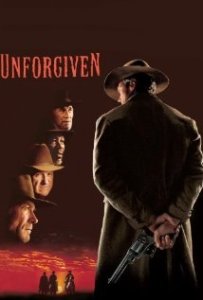
The dénouement. This is when all the action is done, people are back to ‘normal’ or at least they know what’s up and the imminent danger has passed.  The good triumph although sometimes it’s hard because there’s a ‘bad’ guy acting good (Unforgiven).  Explanations happen at this stage. We have to know about Darth Vader after all. We can all go home knowing the world is set to right, at least until the sequel.

Unforgiven*

I challenge you to name a movie that doesn’t follow this formula. Well maybe one or the other of Wes Anderson’s movies or some obscure low-budget indie effort.

So why are movies so formulaic? I address that in my next post. Stay tuned.

This formula also happens in TV shows, even sitcoms. Professional sports tries to emulate this formula as much as it can, not always successfully although it does try hard to create the us/them dichotomy culminating in ‘real’ rivalries (Canucks and Flames).

  • images from IMBd

Getting old, damn it!: A meeting to address the implications.

Actually, I shouldn’t write ‘getting old’. What I should write is ‘being old’. Well, I’ve never thought of myself as old, but looking in the mirror reminds me every day that, yes indeed, I am getting on. But growing old is quite strange for me as it probably is for most of us. I think that as a species we have a built in system for blocking the impact of the passing of time on the way we live our lives. We are obviously aware of the passing of time, but we don’t think about it much if at all. Then one day we can’t help but notice that old age has crept up on us and bitten us hard on the rear end. The back hurts. The hairbrush pulls up tufts of grey hair where there is some left and the bladder, well, the bladder has its own agendum.

Of course the reality is that I have plenty of company in this getting old business. Born in 1947, I am one of the leaders of the post-war baby-boomer parade. The number of people in Canada over 65 years of age is higher than it’s ever been and it will trend higher yet until around 2040 when most of us boomers will be down for the count. My gawd, if I last that long I’ll be 93 years old which is my mother’s current age. My father lived to be 96 so I may just make it. I just hope I’m healthier than both my parents were as they passed into their 80s. My mother, born in 1924, has severe dementia and my father was deaf and  almost completely immobilized by arthritis when he died in 2007. I don’t think he died a happy man. My mother cannot know what happiness is.

It’s a wonderful thing that my mother who lives in a care home in Coquitlam has a few of my many sisters who live nearby visit her most every day. She doesn’t recognize us anymore, hasn’t for a long time. Still, my sisters, the angels that they are, visit her and feed her lunch while ensuring that she is well cared for by the staff. I haven’t seen my mother for many months. No excuses, except that we live on Vancouver Island and she lives on the mainland. Still, truth be told, even when we go to Vancouver to visit my daughter and her family we never get around to visiting my mother (or anyone else in the family for that matter). I feel guilt about that, but not enough apparently to change my behaviour towards her (and them). In my defense, with 3 brothers and 10 living sisters, it would take weeks to get around to seeing them all. I do love every one of them and some of us are in communication via Facebook, but it’s not logistically possible to see them all.

Well, the above is just a way of getting around to the point of this blog post, which is a day long meeting/study session I attended yesterday of around 40 or so people who work for the provincial ministry of health, Island Health, some front line seniors’ support workers, various and sundry nursing types and people like me, members of the non-profit sector with an interest in seniors and their quality of life. The topic of the meeting was seniors’ isolation.

Mary Everson from the K’ómoks First Nation welcomed us to the K’ómoks territory. She’s a year older than I am but is now looking after a 6 year old and a 13 year old. I can’t imagine what that would be like although I do get a taste of it when the grandkids come to visit. Mary Everson is a very articulate spokesperson for her nation and for her age group too. She emphasized the importance of treating seniors with dignity, especially frail seniors who have travelled to the hospital from remote communities. She suggested that many seniors isolate themselves and don’t ask for support or assistance in any way. Not all seniors crave company or want help. Later in the meeting we would hear those seniors referred to as stoic seniors. She emphasized that being satisfied with life is most important, old or not.

Daryl Plecas, the Parliamentary Secretary to the Minister of Health (Terry Lake) for seniors attended the meeting and emphasized in his remarks the importance of quality of life for seniors but also of their caretakers and families. Too often we forget that family members and caretakers are seniors themselves and their lives can be seriously affected by their need to look after their frail kin or clients.

The keynote speaker was Norah Keating from the University of Alberta who has a long resumé and who has written a book on the social isolation of seniors. Her talk was nuanced and careful. She noted the importance of thinking about seniors and their lives from both an individual and community perspective emphasizing the need for agencies and governments to think about seniors’s needs from their point of view. She categorized seniors as stoic, disengaged, marginalized and frail. The meeting attendees were not so much interested in me as a senior, but in the marginalized and frail seniors. They do make up a significant proportion of seniors although less than 10% of seniors live in care facilities. Many live in their own homes and like it that way. As they age they may lose their spouses, their driver’s licences and much of their mobility. Many as driven by pride and/or shame and don’t easily ask for help. Neighbours, family and friends are all important in keeping seniors from being too isolated.

Keating noted that the view that successful ageing means having great family support, being lucky, having money and living in a beautiful home just doesn’t fit the life experience of the vast majority of seniors. Agencies and governments have to recognize that a compromised quality of life affects individual seniors obviously but it also impoverishes us all.

We did not spend much time during the day discussing death, dying, hospice or palliative care. Many of those in attendance are well aware of these issues but the point of the meeting was not in end of life issues, but rather in the quality of life seniors have in coming to what we all hope will be a good death.

The group assembled struggled over challenges, solutions and ideas around dealing with seniors’ isolation. A report will be forthcoming. Enough for now.


No, I’m not a grammar nazi, but damn it!

Alright, I know that language evolves and that contemporary expressions and idioms displace older ways of communicating using language. Still, some words and terms currently in use are just illogical, never mind that they’re not in conformity with the rules of the language.

I know, I know, rules are made to be broken but damn we insist on misusing some words so consistently and wrongly that we need to give our collective heads a shake. 

I want to give you just a few examples of the more egregious misuses of language so that maybe you, at least YOU, will not fall into the pit of folly and ever misuse these words again. 

First, a tenant is someone to whom you rent a house or an apartment. A tenet is a principle, belief or dogma generally held to be true by a group of people, an organization, movement or profession. A tenet of the Catholic faith is the three aspects of God, Father, Son and Holy Ghost. Get it? The Catholic church may rent out apartments and spaces here and there in which case they would have tenants to go along with their many tenets. The difference between the two words is minimal if you look at the letters involved, but maximal if you consider their meanings.

I’ve experienced professionals, using overhead projectors and powerpoint presentations use tenant when they meant to use tenet. Not cool folks! Don’t do it! Ever!

Here’s another one of my very favourites: storey and story.

You could tell a story to someone while standing on the second storey balcony of your apartment, but don’t get the two mixed up.

Damn, I’ve seen architects use story when they meant to use storey once too often. They should know better. People in general use story when they mean storey all the time. I’ve got some glaring examples, but I don’t want to embarrass the circus in question. 

Data, damn it, is a plural noun. The character on Star Trek should have been called Datum, which is the singular form of data. Now this one is becoming mainstream. People, many of them scientists, even statisticians who really should know better, now commonly use data when they actually mean to use datum, but never the other way around. How often have you heard: “the data tells us blah, blah, blah…” It should be the data tell us. Truth be told, most people don’t even know the word datum exists, but that’s what five years of studying Latin got me. Got that one? Let’s move on to a couple more examples like it.

Media is a plural noun but is generally used as a singular noun.  The singular form of media is, wait for it… medium! Television and radio are communications media. The internet is another medium of communication. Please avoid using the phrase: “the media delivered the news today that it was not interested in how to use the word, medium, not even on the national news.” Well, you can use that phrase, but you get my drift.

Same goes for continua, continuum, agenda and agendum. Yes, I know that the world is changing, blah, blah, blah. It doesn’t mean I have to like it. 

The use of the word quality without qualification drives me crazy. No, you don’t sell quality cars, you either sell high quality, midlin quality or, frankly, poor quality cars. Got that? Stop telling me you sell quality anything. You don’t! Even college administrators get this wrong, some even deliberately!

Read Zen and the Art of Motorcycle Maintenance by Robert Persig, for God’s sake. It’s all about quality.

Alright that’s enough. I’ve got a cold and I think ranting helps me clear my sinuses. Thanks for indulging me, but I’ll be back!

By the way, post your own pet peeves when it comes to the misuse of language in response to this, on Facebook, Twitter, or even on here, WordPress. 

A meditation on Fifteen Dogs by André Alexis

I don’t often review books on this blog. That’s because I seldom read fiction and my reading of non-fiction runs to extreme esoterica, sociological monographs and art books few of which inspire me to produce reviews. Too much explaining to do. Too much I have to leave unsaid or to the reader’s initiative. 

Upon the urging of my widely read Carolyn spouse, I relented and read a novel, Fifteen Dogs by André Alexis, published this year by Coach House Books. It won the Giller Prize and Carolyn said to me: “Read it, I want to discuss it with you.” Well, that’s not the first time she’s said that, but for some reason I relented this time, partly because she said the book was about death, a long time scholarly interest of mine. It’s not a long book either, another reason why I decided to read it. 

That said, I can’t say that this is a review of the book. It’s more of a meditation on it.

The book’s premise is simple enough. Hermes and Apollo, both gods in the ancient Greek panoply of gods find themselves in a bar in Toronto when at some point Hermes muses: “I wonder what it would be like if animals had human intelligence.” Thereupon, Apollo responds with: “I’ll wager a year’s servitude that animals, any animal you like – would be even more unhappy than humans are, if they were given human intelligence.” 

Sometime later they encounter fifteen dogs in a kennel at the back of an animal clinic nearby. They had found the subjects for their experiment. I’m not going to go into any detail describing the chains of events that constitute this novel, but you can see where this might lead. Dogs don’t have the vocal apparatus to speak human language, but they can, given human intelligence, develop a language of their own which they do in this case. 

One major issue is that physiologically these dogs are still dogs and they still have dog wants and needs as well as dog perceptions of things. Now, with human intelligence, complications inevitably arise. Deaths ensue. Let’s not forget that one of the primary distinctions in this novel is between mortals (dogs and humans) and immortals (Hermes, Apollo and Zeus). Us planetary beings are all mortal, something we have in common. Dogs and humans die. We all do. We all must. Moreover, dogs and humans often have reasons to kill. The dog/humans in this novel are no exception to this rule. 

Here we have a mix of dog/human politics as if human politics weren’t complicated enough. Dog politics are generally straightforward based on brute strength, physical size and cleverness when it comes to intra-pack politics and no mercy when it comes to extra-pack relations. Not much different than human politics, it seems. 

Much of the book is taken up with discussions about morality, mortality and making it through the day in hostile, and sometimes friendly but constricting, environments. Fifteen Dogs is full of the unexpected yet explainable. It does not shy away from visceral descriptions of death but it also revels in the more uplifting connections we make between ourselves as humans as well as those between humans and dogs. I’ve loved all of our dogs as family members. I can certainly relate to this book on that level, but I can also find basic truths in Alexis’ musings on the inevitability of mortality and what it means to live well and die well.

I recommend this book to you all. It’s a  quick read and one that could give rise to great book club conversation. 

One question I have: how would this book read if the gods in question were not so mythical? What if there was only one god in question, the Christian god? How would that change the colour, tone and texture of the book? How would it change the book?