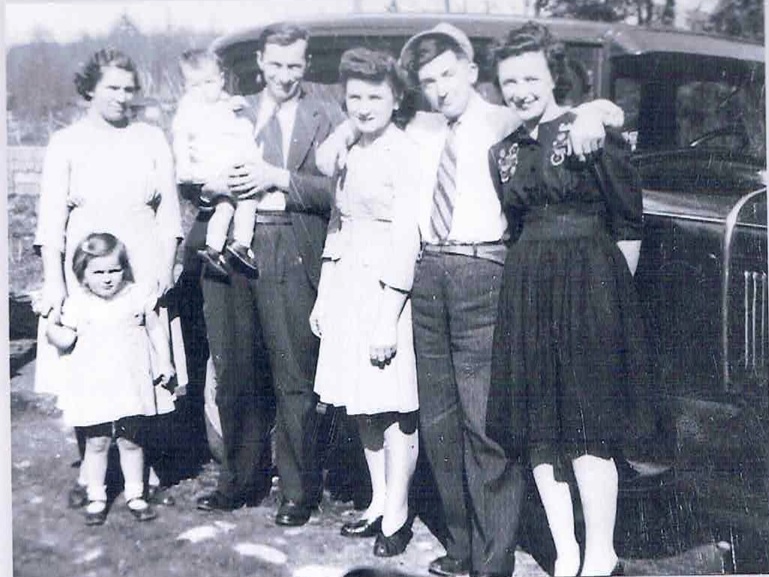
The photograph

Rushing to print is often a mistake and I do believe I rushed to print with my last couple of posts. I think that was a mistake. Research can often turn up evidence from the past that makes a lie out of what we thought was true. Does this really matter? Maybe. Not certainly. It depends on what we want to depict, on what we want to understand and have understood. I could write fiction, drawn from my imagination, enriched by my experience. How would that be different than what I am doing here? The ‘truth’ of fiction is in how believable it is, how sympathetic the characters are and how ‘realistic’ the scenes. In turning my gaze on my family, I enter a very different realm than I would occupy writing fiction. Of necessity, family histories are mostly fiction, the details of lives lived drowned in a sea of unrecorded continuity just as one tree can be made insignificant standing in a forest. Moments that stand out get into the history books. Sometimes, they are recorded in a photograph. More often not. When writing about family, the truth sometimes comes out slowly, not always in one go. Even the ‘truth’ of a photograph, objective as it might seem, can be revealed more fully in all its complexity when the past, present and future of the depicted scene are entertained.
When I look at the picture I analyze in my last post, I am struck by the innocence of the scene, the mundane aspect of it. The full impact and relevance of the scene cannot be appreciated at first glance. The scene is nothing outside of its living context. The people depicted in the photograph have no idea what awaits them in the near future, the death, panic and sorrow that they will suffer, as well as the love and sacrifice that will energize life and make it livable for them. What can I see in their faces? Nothing that belies their future. My mother would never have dreamed when this picture was taken that within 3 years she would be having a baby with the man standing next to her in this picture, a man married to the woman who stood just on the other side of him, both of whom had been her family’s close friends for years.
Now, I must make a correction to my previous post where I suggest that Yvonne died on June 22nd, 1945, because it was rumoured my father couldn’t afford a transfusion which would have saved Yvonne’s life. That may still be true, but I now know that my father had asked my mother and aunts to give blood to save his wife. Cecile donated blood sometime after midnight on June 22nd, but it was too little too late. I learned this by looking through calendars my sister Claudette created for us over the years which contain pages from a diary my mother kept for a few years during the 1940s. It may be that my father had to find blood donors himself because he didn’t have the money to buy blood from the usual sources. I find this difficult to believe because St. Mary’s was a Catholic hospital and I can’t imagine they would let someone die who couldn’t afford a blood transfusion, but no one lives who can set the record straight. That makes the photo I introduce in my last post even more compelling to me because now, Cecile, my wonderful older aunt, standing on the far right in this picture, is also intimately involved in the final stages of the drama that was to unfold at St. Mary’s Hospital on June 22nd, 1945. Death in childbirth was not as common in 1945 as it had been in previous generations but everyone knew that it was a dangerous time. Yvonne was 29 years old, a mother of five daughters. Such a tragedy.
It seems my mother and her family were very close to my father and his family for some time before they were married. There was much socializing between the families starting in Alberta around Bonnyville and continuing in and around New Westminster in British Columbia. My mother’s diary is full of references to visits to my father’s home in the years leading up to June, 1945. She writes on Sunday, January 7th, 1945: “My day off [from work at St. Mary’s Hospital]. Went to Zenons for supper and a party. Stayed until 3 AM. Had lots of fun…” On Sunday, March 11th, “I went to Zenons for supper then to a card party. I won $1.50 first prize womens. Zenon won $10.00 door prize…had lunch at Fraser Café with Albert and Gill, Mrs. Lagrange and Zenons.” The close familiarity between the Alberts and Leguerriers is evident in the photograph and it waits patiently, silent in the background to give added meaning to the scene for those who wish to know. The events to unfold in the following few months can only be understood in light of the tight bonds that existed in the community of ‘ex pats’ from Alberta now living in British Columbia.
A photograph can hide as much as it shows. It can give us the impression of time stopped for an instant, frozen in a way that allows us to return to contemplate the moment, to relive the essence of a snapshot, lingering and maybe meditating on it. It’s an illusion, of course, but that doesn’t prevent us from taking pictures, from trying to momentarily pause the clock. But clocks are stubborn things. They stop for no one.
I have another photograph. This one was probably taken on June 25th, 1945, the day of Yvonne’s funeral. She was buried along with her son, Roger, in St. Peter’s Catholic Cemetery in New Westminster. It shows my father kneeling before Yvonne’s grave which is covered in flowers, his five daughters by his side. The same day, my father asked my mother to quit her job at St. Mary’s Hospital, come work for him and look after the girls.
I don’t usually have people edit my work before publishing. I probably should because every good writer needs a good editor. With regard to my last post, my five older siblings are my half-sisters not my step-sisters. My daughter, Arianne, was kind enough to point that out.
 Roger Albert - Always a Sociologist: Now Living With Myeloma
I have an old photograph. I don’t know who took it and I’m not sure exactly when it was taken, but it must have been sometime in 1944 because in the picture my father is holding in his arms my step-sister, Denise, who was born on January 10th, 1943. In the photograph she appears to be a year old or so, which would mean the photo would have been taken sometime in mid 1944. Given that my father’s first wife, Yvonne, died on June 22nd, 1945, it stands to reason that the photo was taken sometime in 1944. It doesn’t look like Yvonne was pregnant at the time with Roger, but she may have been.
There is no obvious way to tell where the photo was taken, but the ground is dry and there’s no snow. I’m guessing it was taken somewhere in or close to…
View original post 617 more words
I have an old photograph. I don’t know who took it and I’m not sure exactly when it was taken, but it must have been sometime in 1944 because in the picture my father is holding in his arms my step-sister, Denise, who was born on January 10th, 1943. In the photograph she appears to be a year old or so, which would mean the photo would have been taken sometime in mid 1944. Given that my father’s first wife, Yvonne, died on June 22nd, 1945, it stands to reason that the photo was taken sometime in 1944. It doesn’t look like Yvonne was pregnant at the time with Roger, but she may have been.
There is no obvious way to tell where the photo was taken, but the ground is dry and there’s no snow. I’m guessing it was taken somewhere in or close to New Westminster, British Columbia. Actually everyone in the photo is dressed for a nice, warmish spring day, and they’re all standing in front of my father’s 1929 Ford Model T.
In the photo, my father’s first wife, Yvonne, is farthest on the left. She is standing just behind my step-sister, Lucille, who at that time was two years old or so and she has her hands resting on Lucille’s shoulders. Next to her on her right is my father and he, as I said, is holding Denise. Standing next to him is my mother, Lucienne Leguerrier at the time. Next to her is Rémi Leguerrier who married my father’s older sister, Isabelle, and farthest on the right is my aunt, Cécile, mother’s older sister. Uncle Rémi, standing between them, has his arms around the shoulders of my mother and my aunt. He’s smiling too. The children are not smiling, neither is Yvonne although she may have been suffering from morning sickness and that might explain why.
Who could know when this picture was taken that my father’s first wife would be dead within the year and my mother, Lucienne Leguerrier would be his new wife within two years. So, here we have my father flanked by his wives. Never would he have guessed at that moment, smiling for the camera, holding his youngest daughter, that Yvonne would be gone and that he would be scrambling to find a way to look after his five daughters while still going to work. The picture tells nothing of the sorrow to come.
As it turns out, my father and Yvonne had over the years since moving to British Columbia in 1936 made friends with the nuns who ran St. Mary’s hospital in New Westminster where all their children would be born. Apparently my mother had worked there for a time and it was they who suggested, after Yvonne died, that my father ask my mother to come help look after the children while he went to work in local sawmills. That wasn’t a stretch, because the Albert family knew the Leguerrier clan when everyone was still living in the vicinity of Bonnyville, Alberta a few years before. So, my father knew my mother’s family before a number of them migrated to BC during the Depression looking for work. My father was resourceful and capable of doing various kinds of mill-related work so he was able to find employment. My mother too.
When Yvonne died, my father asked my mother if she would help and she agreed that she would. Months later, actually it wasn’t too many months later, my father had my grandfather and grandmother come to New Westminster to look after the children because my mother had returned to Alberta unexpectedly it seemed. It turns out that she had returned to Alberta anticipating that my father would join her shortly so they could be married in Alberta at Fort Kent and both return to New Westminster as husband and wife.
Now my step-sisters had a new mom. My mother was only twelve years older than my oldest step-sister, Hélène. That caused minor friction to start with because when Yvonne died my father had told Hélène that she would now have to be mommy to the four younger ones. Now, she was being displaced as mother of the family but that animosity soon dissipated because my mother had lived with them for a few months already giving time for attachments to grow between them.
I cannot imagine that my father was not steeped in pain and sorrow during that whole time, but he had no other choice but to carry on. Sorrow must give way to children and their needs.
I don’t mean this series of posts to be or become an exposé of my family’s little secrets. I have not discussed this series with my family members at all. I’m sure they would have very different memories and impressions of the lives we shared than I do. I use some of the incidents and events I know about or have some impression of as a means of expressing my sense of the complexity of life and especially of relationships both personal and social.
______________________________________________________________________
Life is complicated. Relationships are complicated. People are complicated. Take my father, for instance. He was intelligent, generous, level headed and kind hearted, but at times he had fits of anger that were shocking because they were so out of character for him. He teased us mercilessly, sometimes to distress. He could be, and was, physically violent on rare occasions. We never spoke of such things so I have no way of knowing what were the deep-seated causes of his rare bouts of uncontrollable anger. He was never violent towards my mother that I know of, but he beat my older sisters one time that I recall very vividly. From what I remember, my sisters were whining and complaining about doing the dishes or some such thing, probably yelling and screaming, fighting amongst themselves when my father, for some reason had had enough of it. He let fly with a pot that was handy, hitting them with it repeatedly until they were all cowered on the floor, weeping and in shock. I might have been six or seven years old at the time and I remember cowering myself in the hallway, by the bathroom door wondering what could possibly be going on. To this day as I think about it, I can still feel the sense of fear that overwhelmed me at the time. I don’t recall anyone discussing it much after the fact, but it was traumatic and definitely left an impression. That I do recall.
He hit me too on the odd occasion for various reasons. I was no angel as a child and I may not always have conducted myself with the propriety and reasonableness that should, of course, inform the actions of all well-behaved five year old boys. I remember one time when at about six years of age, maybe seven, I smacked a kid (accidentally, of course) over the head with a garden hoe drawing a substantial amount of blood. No serious damage done, but you know how head wounds can bleed. I got ‘the strap’ for that one. When my father got home from work that day and my mother had conferred with him telling him of all the sordid details of my great misdead, his duty (I presume he saw it as that) would be to clinically administer several blows to my open hand with a rubber and leather strap he had gotten from his workplace and which he kept on a kitchen shelf for just such occasions. He did not draw blood, but in his mind I had to learn that there were consequences for what I had done. The logical course of action was for him to hit me, a perfectly acceptable and even expected thing to do at the time.
My father was driven by a sense of duty to his church, his family, and French-Canadian tradition. He did not question his duty to have as many children as God expected of him and he took great joy in each of us. He was ill-educated in the formal sense. He never learned to read nor write although he could do rudimentary arithmetic. He might have made it only to grade four in school but it was not because he was incapable of schoolwork, but because he was needed to work on the farm in Alberta and for other reasons not of concern here for the moment. He seldom drank alcohol and didn’t smoke but he did gamble every once in a while. He was what most people would have called “a good man” in the day. He worked hard and rose to management positions in lumber mills around the Lower Mainland in spite of his illiteracy.
I don’t know if what I am about to write is true or not, but it may very well be given the time. It was 1945, June 22nd. The war would be over soon. Normally this day would be a time for celebration, but this day would not be one of those. This day my father’s wife, Yvonne, would die in childbirth. She was an otherwise healthy 29 year old woman who had already given him five daughters. This day, something would go horribly wrong in the delivery room and Yvonne would bleed to death. Her newborn son would also die in the deIivery room. I heard it said that Yvonne died because my father couldn’t afford a blood transfusion that would have saved her life. I don’t know that to be true, but just imagining what he had to go through with his wife dying in childbirth and five young daughters to look after at home I expect that he was wrought with anger, panic and despair no matter how his wife had died. He may have believed that it was God’s will. I’m certain my father thought about that wretched day in 1945 every subsequent day of his life.
I know where I was conceived. It was in a small rickety, squeaky bed in a small room at the end of a small corridor, door on the right. I’m quite convinced all nine of my younger brothers and sisters were also conceived there although I can’t be absolutely certain. I’m not at all sure of where my older siblings were conceived. They are my father’s children but not my mother’s. They shared this house with the rest of us but the details are not important for now. The small room where I was conceived was also the room where the baby of the family slept. There was always a baby in the family as I was growing up.
The house containing this small room was also small, and it was always full of children. It no longer exists. The small room and the small house are gone now, torn down and replaced by a large brown duplex not so many years ago. No one driving by on the inconspicuous street on which it fronts would ever know that the house in which I grew up had ever existed. Yet there was life there, lots of life. There still is life on that same place, in the brown duplex, but the people living there now would have no idea of the life that preceded them in that very location years before, just as I have no idea of the life that goes on in that duplex now. We share the experience of a place those duplex dwellers and I, not that they are aware of that. Why would they be?
January 29th, 2015, marked the 69th anniversary of my parents’ wedding day. My father has been dead since April, 2007 but my mother lives on in body if not in mind. She no longer recognizes the faces nor the voices of any of her family members and every moment of her life now is disconnected from her past and even from the very moment preceding it. She spends most of her days in a state of catatonia, as a result of years of dementia, she cannot feed herself and three years ago she was beaten up by another resident of the home in which she lives, but that’s mostly forgotten now.
In days gone by, when I was born, say, there was much life in my mother. She was a young, beautiful, strong twenty-one year old woman, twelve years younger than my father. In her time, she bore ten children, five daughters and four sons. I’m the oldest of my mother’s children but the sixth oldest of my father’s. He had five daughters from a previous marriage before his wife died in 1946 in childbirth bearing her sixth child, a son they were to call Roger. He shares a coffin with his mother.
…to be continued sometime.
Thorstein Veblen, the controversial American economic historian and philosopher who died in 1929, just before the Great Depression, understood the capitalist mode of production better than most. He wrote extensively on Karl Marx’s work (in The Place of Science in Modern Civilization) and found it to be internally logical but based on the moral premise that workers deserve to receive the full value for their participation in the productive process. According to Veblen’s interpretation of Marx, work is a social activity but the output of that activity is appropriated privately. We know that workers do not receive the full benefit of their participation in the work process, their employers pay them only part of the value workers create. Otherwise, surplus value and profit could not be possible.
Just as a quick aside, Marx understood that workers did not share in the value they produced except in the receipt of wages, a value pre-determined in the productive process by and large. Workers sell their labour-power (that is, their capacity to work) to the capitalist in the labour market. A capitalist has to have all the elements of productive capacity in place before production begins and that includes labour. So, labour is part of the cost of production determined before production can begin.
It’s interesting how screwed up we are about our place in the world, particularly around our role in the productive process. So, business evolved historically as a means to satisfy certain human needs and wants. It’s a method by which production and distribution are organized. Ironically, as business capital came to dominate industry more and more, we, as members of societies in our capacities as productive beings, came to serve business rather than the other way around. Of course, we have the idea that we all live as citizens in democratic society, free to move around from employer to employer if we want. In other words, we have the illusion of having some control of our lives, but that’s just what it is, an illusion. The fact is that we are supposed to be served by business but we are essentially the servants of, and work at the whim of, business. The world has been stood on its head. Make no mistake about it though, business cannot exist unless we offer ourselves up as workers to it in the labour market. (I’ll deal with public sector work and small business in the next post.) We are workers, citizens and consumers but it is our role as worker that is the most important in our world.
Business is becoming more and more global in scope and reach. With some exceptions it used to be that businesses hired workers locally for local production and distribution and for local consumption. That all changed starting in the 15th Century but the 19th Century was when this movement increased dramatically. Workers in the Canadian forest industry (employed by British companies) produced timber for British manufacturing plants and to build tall ships. Later workers in BC produced lumber predominantly for the American housing market. In truth, Canada has always been a source of raw materials intended for processing elsewhere as much as possible. That’s not entirely true, but as a basic thrust and overall aim, it is accurate.
In the 1920s the British Empire was losing power over its colonies including Canada while the United States was growing stronger and more influential on a global scale. In that period of time, the Canadian government succeeded in negotiating the Auto Pact with the US whereby cars sold in Canada must be made in Canada. Since that time, the US has been on a mission to erode those early gains by Canadian workers, and the Auto Pact has been unravelling for at least a couple of decades now helped along, I may add, by free trade agreements.
This is all to argue that business, and us as workers, used to live primarily under the banner of citizenship. It made sense to think of Canadian business and American corporations. (This is also true for union, by the way) That’s no longer true for the largest global corporations. More than ever, capital dominates industry and production on a global scale but it still has certain national ties that make it seem as though it serves national interests, including those of ordinary citizens. That is no longer true and is getting to be a more and more dangerous illusion.
The seemingly miraculous rise of China as a global economic power must be understood as arising from a massive shift of capital by Canadian, American and European business to productive capacity on (for example) Chinese soil in factories using cheap labour. “Canadian” business has no loyalty at all to Canadian workers. That’s clear. Its business logic and primary mission is to accumulate capital. If that means shutting down factories in Oshawa, Windsor, Hamilton and Montreal and opening them in export processing zones in China or by creating “Chinese” contractors to manufacture consumer goods, so be it. Now, work is also becoming obviously global with the shift of manufacturing capacity to China (and other countries like India, Sri Lanka, Viet Nam, etc.) and the rise of the new class of ‘temporary’ workers in Canada. Things are shifting all over the place. It’s hard to keep track of it.
The problem with modern capitalism is that it’s completely anarchistic. There’s nobody in charge. Corporations are all in it for themselves and countries are becoming increasingly powerless to do any planning that does not put corporate profits first, that is, if they were ever really interested in doing so in the first place. Citizenship counts for very little anymore in a world where corporations like Monsanto, Nestlé’s and Exxon call the shots and politicians serve them in any and every way they can. This includes looking hard to find every way possible to shift wealth from public to private hands including public-private partnerships (P3s) and the systematic dismantling of government services and their replacement with private contractors doing the same work.
To use a business metaphor, the bottom line is that we are in the throes of a massive shift in the global distribution of capital and labour. For the foreseeable future, it doesn’t look good for us as workers or as consumers. As we lose our jobs we will not be able to afford the products produced in China by corporations based in North America, Europe and Australia, even if they are getting relatively cheaper and cheaper. That can’t be good for businesses that rely on us buying their products made in China but they aren’t going to change the way they do business because they are caught in the treadmill of needing more and more profit and accumulated capital in order to survive. And they’ll do anything to survive including encouraging global fascism while dismantling democratic institutions (what’s left of them) as a means of ensuring the ongoing concentration of capital in fewer and fewer hands, while pushing harder than ever using advertizing to convince us to spend, be individualistic, mistrust government, oppose taxation, and ‘get ahead’ by ‘working hard’.
Click to access GTI-Perspectives-Global_Corporate_Charters.pdf
So, I’ve been researching and teaching about the expansion of the global capitalist system for decades. From all the research I’ve done, it strikes me as just about inevitable that business will soon break away from its national charter licence system to one that is supra-national.
International law as it now stands is virtually toothless, but it won’t be long before a global justice system with enforcement capabilities will be necessary. When large business corporations no longer operate nationally, but have their headquarters in one country, research and development in another and production in several others with no one country able to legislate their activities, it’s time for a change. The Canadian Manufacturers and Exporters Association, formerly the Canadian Manufacturers Association, has no problem representing businesses who produce nothing (or virtually nothing) in Canada. Businesses that formerly produced (manufactured) refrigerators, stoves and other appliances in Canada but who now produce them in China in their own factories or under licence to Chinese companies or in other countries with low wages and virtually no health and safety standards for workers are still considered Canadian manufacturers. To me that’s pretty odd.
As business corporations become more and more global they will need to be regulated more and more globally if we have any hope at all of avoiding becoming nothing but fodder for the creation of obscene corporate profits. Of course, it’s much more complicated than I’ve stated it here. I’ll have more to say about this in subsequent blog posts. In the meantime, have a look at the article for which I’ve included a link above. Check out its provenance, the Tellus Foundation. What they propose in this article is a new global charter system for business corporations.
We Need To End The Stigma Around Mental Illness VIDEO.
Way to go, Rick Mercer! I’ve been dogged by depression my whole life, but that hasn’t immobilized me and I think I get along quite well most of the time. It does make daily activities a challenge at times and it is a constant struggle. The top administrator at St. Joseph’s hospital in Comox told me a few days ago that anxiety and depression are the leading reasons for hospitalization. We often think of illness as a quality of the individual. We think of it as idiosyncratic. We acknowledge that environmental degradation can cause illness, but we seldom think that illness can have social roots. There is a lot of evidence to suggest that much illness is social in origin, ‘mental’ illness particularly so. We drive each other crazy all the time and the anxiety caused by uncertainty over mundane aspects of our lives combined with the certainty of death is a killer. I think that the incidence of mental illness, distress and anxiety is highly underreported. After all, no one wants to be labelled mentally ill. That label carries with it profound consequences as the video shows. Who wants to face the rejection and opprobrium that comes with a diagnosis of mental illness?
Roger
Mental Illness, Homelessness, Drug Addiction: Do These Sound Like Crimes? | BillMoyers.com.
Bill Moyers gets it right. We call it ‘mental’ illness when people display erratic, unusual or abnormal behaviour but most of us don’t believe it’s ‘really’ an illness and our governments act accordingly. No. Most of us believe, in our heart of hearts, that mental illness is really a moral failing and if people just got their shit together they would be fine. Would we tell that to a cancer patient? Well, yes we would, and we do. (If you hadn’t smoked, you wouldn’t have lung cancer, so there!) What’s really sick here? I think our social values are, that’s what.
 Roger Albert - Always a Sociologist: Now Living With Myeloma