Who to believe? Duffy and Wallin or Harper and Lebreton? Poll!

So, things are getting interesting in the otherwise staid capital of Canada.  It’s focal point, Parliament Hill is ablaze with accusations, gossip and all forms of ridiculousness.  Mike Duffy and Pamela Wallin both protest that they are the aggrieved in this debacle.  Harper on the other hand claims exactly the same thing.  His argument is that these two former news reporters for CTV and current members of the esteemed Upper Chamber, have violated rules of conduct around their expenditures as members of the Senate.  Wallin and Duffy say they have done nothing wrong and are being hung out to dry because Harper doesn’t want to offend his ‘base.’

I must say that I wonder about Duffy and Wallin.  They got to sit in the Senate only because they served the Conservative Party.  If fact the Senate is full of political appointees who are all beholden to the Party that put them there.  No problem whipping them for a vote!  So, just for fun, I invite you to answer this simple question: 

Deer, deer, me…ultimate ignorance.

I need to share with you this entry in The Comox Valley Record’s have your say opinion section (page A22, October 10, 2013) where people spout off about whatever they care to.  “Have an opinion?  Feel strongly about an issue?  Share something special…”  This is the place for you.  So here it is:


Over the past few years we personally experienced a total of four accidents with deer at large on the B.C. highways.  The last one which occurred a few months ago fortunately only damaged our vehicle; however, under slightly different circumstances it would have cause the loss of both of our lives and many others.  For these reasons mentioned I am wondering what other people’s thoughts are about animals that cause severe damage to our vehicles and bodily harm.  When I read about cougars attacking humans, I cringe.  We also know that when apple season arrives we can expect bears at our property as it is on the shopping list.  I don’t know what the total yearly damage is by just deer alone, but what I do know is that our damage over a period of seven years is about $6,800 paid by ICBC.  I am thinking of a large fenced wildlife area, maybe like our provincial park up north.  I know my thoughts are out of the box but not so long ago “No Smoking” was an out-of-the-box issue, too.  Maybe it’s worth thinking about, because some of our loved ones might not be as fortunate as we were.  [All the submissions to this opinion section of the paper are unsigned so we have no idea who wrote this.]


OK.  Well, where do I start?  Before posting this I made sure I wasn’t really reading a piece from The Onion, the satirical online ‘news magazine,’ but no, it was the Comox Valley Record alright. Then I thought, maybe this is thoroughly tongue-in-cheek.  But it just doesn’t ring true as tongue-in-cheek.  It’s too, ah…sincere.  So, what can we make of this absolutely insane piece?  That may be a harsh judgment, but who in their right mind would produce such a piece of utter nonsense?  Does this person have the right to vote?  If so, no wonder our ‘democracy’ is in such terrible shape.  Don’t get me wrong, I’m not outraged by this piece.  But I am slightly bemused and amused by it. 


So, let me get this straight whoever wrote this piece.  You want to put all deer, bear, and cougars in a large fenced enclosure so they don’t bother you anymore?  What the hell are ‘deer at large?’  Deer ARE at large.  Deer are not domesticated.  They LIVE out there and have lived out there for much, much, longer than you can imagine. They were around long before roads, ‘properties,’ cities, towns, apple trees, you and your precious vehicle.  Damage to your vehicle?  How do you think the deer felt?  Do you think the deer deliberately set out to damage your vehicle?  Maybe they are suicide deer, like suicide bombers, bent on destroying human civilization.  Just for one second think about all the vehicle collisions that don’t involve ‘wild’ animals but only humans.  Maybe WE need to be put in a large fenced enclosure and let all the other animals run free and unimpeded by our roads and stupid, frightened attitudes. But I don’t really want to get nitpicky here. 


What the attitude underlying this piece belies is a profound disconnect with the planet and stunning ignorance of basic ecology.  It is so utterly self and human-centered as to be comical.  However, we have ‘wildlife preserves’ in Africa and large zoos everywhere so it may be just one stupid step further to convince people that this could just work.  Of course we’d have to kill on sight every animal that left the ‘large fenced area,’ but that’s ok as long as they don’t damage our vehicles. 


I’m not going to go on about this.  I could, could I ever.  As I said, I’m amused and bemused by this, but I’m also saddened by the arrogance and ignorance displayed by this piece of silliness.  What do you think about it? 

Just for you I’ve posted a picture of a deer at large. I have no idea who took it.  I got it from ‘the web.’  This is a four point buck. There aren’t many four pointers around.  They don’t usually live long enough to get that many points.  We see a few 2 pointers around but I haven’t seen a 4 pointer in a long time.  


 Image

Stanley Milgram and his very controversial experiments.


So, I just heard a CBC DNTO interview with Gina Perry, an Australian writer who just published a book on the Milgram experiments called Behind the Shock Machine.  I haven’t read the book yet, but I’ll be buying a Kindle copy in a moment.   I’ll review it after reading it.  Perry says in the interview that she had thought that Milgram’s work was brilliant and provided incredible insight into the human condition, especially in light of the Holocaust but that upon reading Milgram’s extensively archived notes and research reports, she realized that he had largely fudged  his conclusions, or at least that his conclusions were not justified based on the evidence provided by the experiments.  If you want the official version of what happened during Milgram’s ‘obedience’ research, have a look at this video: http://www.youtube.com/watch?v=BcvSNg0HZwk.  I don’t want to take any time here to outline Milgram’s experiments.  Suffice it to say that in his mind they proved that people are willing to inflict pain on others if they are told to do so by an authority figure, lethal pain in the majority of cases.  His work was inspired by his outrage at the Holocaust.  He wanted to show how such a thing could happen and how easily people can be coerced into conforming to the will of authority.  People, Milgram concluded, easily descend into barbarism because they have no will of their own, no resistance to authority and have a deep need to conform.  Perry argues that Milgram had no right to draw these conclusions from his work.  This is a very damning indictment of Milgram himself but it throws into question the now taken-for-granted (in every textbook I’ve ever seen) conclusions of his work.  She argues that if Milgram had been honest, he would have reported that the subjects of his experiments were creative, determined to subvert the experimenter, sometimes understood the ‘set-up’ of the experiment and toyed with the experimenter.  In fact she concludes that more people resisted the experiment’s goals and defied the experimenter than conformed to his authority.  But before I go on here I want to read Perry’s book and a couple of articles on the subject that also throw light on Milgram’s work, and the work of others like Philip Zimbardo who conducted the now famous Stanford Prison Experiment.  See for yourself what this was all about:


See you in a follow-up post after I read Perry and you get a chance to view the videos.

Frosh silliness and all that…a sociological take.

In Canada.com, Laura Strapagiel writes on September 18, 2013,

Although there is no evidence that student leaders were directed to lead first-year students in a chant endorsing rape, it was part of the oral traditions of UBC’s Commerce Undergraduate Society (CUS), according to a report released today.

The University of British Colombia tasked a fact-finding panel with investigating an offensive frosh-week chant recited during bus trips by first-year Sauder School of Business students and activity leaders.

The chant, which also caused controversy at Halifax’s Saint Mary’s University, went like this: “UBC boys we like them young. Y is for your sister. O is for oh-so-tight. U is for underage. N is for no consent. G is for grab that ass.” In some variations, “G” stands for “go to jail.”

In addition to releasing the panel’s report, UBC announced Wednesday that CUS will be making a voluntary contribution of $250,000 over three years to help fund a “professional position to provide student counseling and education on sexual abuse and violence.”

“After serious consideration, we believe it is essential that the C.U.S. and all FROSH leaders make tangible amends,” said UBC President and Vice-Chancellor Stephen Toope in a statement. “At the same time, the whole UBC community needs to embark upon deeper, transformative and lasting change that would make such chants entirely and obviously unacceptable in our community.”

So, can we come to some (sociological) understanding of what this is all about?  Yes, we can, but it’s not simple.  First thing, there is the chant itself and it’s two variants.  The first variant must be considered as an outright invitation to first year male students to go find an even younger female student to rape.  The second variant is more complex and can be read as a cautionary tale as in ‘if you rape my underage sister you will go to jail.’  Second thing, there is the issue of the UBC administration’s reaction to the events.  Punish the students and embark on a “deeper, transformative and lasting change that would make such chants entirely and obviously unacceptable in our society.”  I’d like the reporter who wrote the piece in Canada.com to follow up in a few months to see just what UBC’s president has come up with to undertake this “deeper, transformative and lasting change.”  I’ll bet nothing comes of it.  I’m sure the UBC administration is hoping the whole thing blows over and soon.  Well, there may be a token attempt at something, maybe a forum or some workshops, but nothing more.   Frankly, I expect most people will forget about this within a very short period of time.

So now what?  Well, the social dynamics that underpin this whole scenario are really quite fascinating.  There are a number of avenues of investigation here.  For instance, the chant itself and its implied assumptions about the nature of sex between young men and women, that is, that men must overcome, forcibly if necessary, a young woman’s need to protect her virginity.  Then there’s the fact that these are young people and young people have always done things that piss off their elders as a way of ‘carving their own path’ in life.  Any talk of rape, especially in a tight-assed university setting is bound to piss off a lot of older people, especially ones with young daughters (I’m still one of those).  Mission accomplished here as evidenced by UBC’s response, which is another issue all in itself. Using the chant to ‘do something naughty’ and create solidarity among students is a related issue and an important one.  I’ll address these issues in blog posts over the next few days.  I’m not offering any solutions here, like Toope is, but rather observations on the nature of morality, ours and others, as it relates to sexuality, in particular, but also to business in a limited sense.  However, this is not a rant about the evils of capitalism, of business or about the evils of anything else.  What I want to do here is comment on the moral context in which such events can occur and how they are treated by the ‘morally upstanding’ among us.  It’s just a bonus for me that the students in question at UBC are business students because today business and the market occupy the moral high ground in our world.  We judge so much of what we do by its effects on the ‘bottom line.’  So, I’ll start with the nature of sexual relations in our world and then move on to other issues like the need for students to stand out yet fit in, and the need for those who occupy positions of moral ‘leadership’ in our world to make sure our world is morally clean and upstanding allowing no breaches of the moral wall that surrounds us all.

Sex.  Much has been written about it.  Confusion abounds.  Procreation by the process of coitus is fairly straightforward to understand.  We ‘have’ sex, we may very well make babies, that’s if we’re a male and a female.  Sex between gays and variations thereof is not procreative sex.  That’s pretty clear, I think.  Procreative sex is about biology, penises, vaginas, sperm and eggs.  That said, procreative sex is regulated in very complex ways and has been ever since we’ve been writing things down and probably way before too.  We’re not the only sexually reproducing species that regulates sexual behaviour, that is who can have sex with who, when and how.  Many species have mechanisms for regulating sex.  We speak of ‘instinct’ when we refer to sex among non-human species, but nonetheless, sex is regulated.  Often, the physically and socially dominant individuals of a species are the only ones to procreate as in wolves and African wild dogs.  Among primates, sex generally goes to the dominant members of the troop, but there is a lot of sex on the side type behaviour.  Among Bonobo chimps, sex seems to be recreational but it also serves a purpose of keeping peace in the troop.  It also serves a procreational function, of course, but paternity is not an issue among bonobos.

There are many problems that arise with human sexuality. One is that we have a long gestation period and it takes a very long time to raise an infant to self-determination and adulthood.  Procreative sex has its consequences and can be very expensive in time, effort and resources.  That problem is compounded by the fact that men and women can be attracted sexually to a number of other men and women.  There’s no evidence to suggest that human beings are naturally monogamous and a lot to suggest otherwise.  Another thing is that closeness, physical contact, nasty experiences with members of the other sex, neurological wiring and many other factors mean that humans, like bonobos, are often quite happy to have sexual relations with members of the same sex or with whatever comes along, animal, vegetable or synthetic.  Some of the most popular porn sites on the internet are bestiality sites.  A popular practice among some men is to have life size sex dolls.  Is sex with a sex toy still sex?  Well, we sure talk in those terms.  So, humans are, let’s say, open to possibility when it comes to using their sexual organs.  I coined the term ‘monosex’ when I taught a course on love and sex a few years ago, to describe masturbation and the fact that many people prefer it to anything else.  Apparently we don’t even need partners.

Of course it’s very important here to separate love and sex.  Love is a sentiment of emotional attachment that can, but needn’t have anything to do with sex.  Romantic sex is not always loving sex, although we generally think of romance and love as intertwined.  Love can exist in many social situations and describe relationships between mothers and children, men and women, men and men, women and women, men, women and flags, football, sausages, cars, sunsets, pets, forests and a pretty close to infinite number of other things.  We ‘love’ all kinds of things.  Sex describes one way of expressing love, but it also goes way beyond that and often has nothing to do with love.

So, sex is all over the place and procreative sex is a particular variant that ends up producing offspring and those little guys are essentially considered property.  Randall Collins in his book Sociological Insight refers to offspring as generational property.  Other forms of property he identifies that are regulated by marriage contracts are domestic property and erotic property.  Erotic property is exclusive rights over another’s body for sexual purposes.  Domestic property refers to pots and pans, houses and cars.  The point here is that sex is regulated in our world or rather what derives from sex is regulated.  For as long as we know, sex has been regulated to achieve certain social ends.  Who one can have sex with, when, where and how are all regulated by mores and laws in our society and in one way or another in all societies now and historically.   Morality is the context in which sex is regulated.  Although it’s clear that sexual mores are broken all over the place all the time, we still feel the pressure of sexual ‘propriety.’  Although things are changing we know that extramarital or extra-relational [my new term, I think] sex (cheating) is bad.  We know that pre-marital sex is bad.  We know that children are not supposed to be sexual, neither are old people (yuck!).  Most important, we know that children and adults are never to engage in sexual relations under any circumstances.  We know that sex in public is bad.  We also know that people do it for the ‘thrill’ of it.[1]  We know that both parents have a responsibility to raise their offspring.  We all know these things but we also know that these things don’t count as much in real life as they do in ideological terms.

So, I’ve put this off long enough.  Young men and women are sexual by nature.  Biology gives them the tools to have sex pretty early in life.  In our world, however, it’s not morally acceptable for them to engage in sex until they’re told it’s OK.  We have rules around how young people are to behave sexually and celibacy is it!  We don’t know when exactly it’s ok to have sex as a young person.  Waiting until marriage doesn’t cut it anymore.  It’s now a matter of ‘let’s discuss it when it happens.’  We’ll make the best of it.

However, the crux of the situation for me is the moral responsibility that is placed on young women to protect their virginity at all costs or at least to avoid the label of ‘promiscuous’ or ‘slut.’  Young women are supposed to suppress their sexual drives and be ‘responsible.’  This automatically sets up an adversarial relationship between young men and women.  Women must protect their virginity.  Young men must respect that and suppress their own sexuality.  But, for many young men, the challenge is that of a safe-cracker. Conquest is big on their minds!  They’re supposed to be real men, after all, aren’t they?   Can I get into her pants?  Young male bodies are telling them to carry on, get it going.  Damn the torpedoes!

I can’t imagine how rape and other variant of sexual assault are not more common under these circumstances and why young people in the prime of their youth at university would not want to challenge the moral prescriptions that define their sexuality.  Young men and women chanted the Y.O.U.N.G. chant at St-Mary’s university and at UBC (and on many other campuses, no doubt).  This is, in my mind, a protest against contradictory social mores.  The reaction of the university administration as protectors of the dominant moral code in our society underlies the seriousness of the proscriptions we impose on young people and their inherent sense that there are serious issues with them.

Obviously not all young men and women are conflicted about sexual mores.  Some of them are staunch defenders of social proscriptions against extra-moral sexual relations.  There is a lot of diversity in the population.  That said, all youth are pressured to conform to social mores under the threat of rejection, opprobrium and shunning.  Young people have a strong need to ‘fit in.’ That may mean going along with the Y.O.U.N.G. chant or opposing it depending on what group is strongest in its pull to conformity.  But I’ll leave that to another time.


[1] There are porn sites dedicated to public sex.

What the hell is ‘quality of life?’ Part 3

So, I’m back at it.  Lately I’ve been reading a book called The Truth About Art: Reclaiming Quality by Patrick Doorly.  Doorly refers to Zen and the Art of Motorcycle Maintenance by Robert Persig in very flattering ways.  Persig’s book is all about quality and what it means.  For Persig, quality is in the interface between things.  It’s not a thing itself.  As an aside, nowadays we’ve perverted the concept of quality to the point where quality only means ‘good’ or ‘high’ quality.  Apparently poor quality doesn’t exist anymore.  Now, when we speak of quality goods we always mean good quality goods.  That’s pretty stupid, in my mind, but that’s the way language seems to evolve.  Returning to my point, there is no question in my mind that quality exists in the interface between things.  I, being a thing, can find another person, also a thing, either good or bad, of high quality, or of questionable character and quality.  Quality is in the judgment I make about something even if that judgment is largely socially constructed.  I may find a Mercedes of higher quality than a Toyota Tercel but ‘society’ has already made that judgment for me by reference to the price of the vehicles in question.  The value of the vehicles, strangely enough, may have little to do with price.  But I’ll leave that seeming contradiction for a discussion at another time, after I’ve finished reading Doorly and re-read Persig.  Again, back to my story.

So, quality of life is partly an individual thing, a judgment about how a life is lived, but it’s also about the ‘price’ and ‘value’ of that life itself and how it can be lived.  Life implies mobility. Dead things don’t move. The more we have ‘life’ in us, the more we move.  In our world, personal, individual mobility is gotten by having money and good health, of course.  No money, no mobility, no life. Poor health equals poor mobility.  So, having money means to be alive and to be poor means to be immobilized and socially dead in the eyes of the majority of people in our world, including poor people themselves when they (generally) buy into the moral assumptions about quality and value that drive us in our daily lives.  So, what is a high quality of life in our (moral) world?  Well, it’s having some mobility and the ability to make choices the immobilized cannot make.  The poor and unhealthy are essentially stuck, blocked and unable to move in the marketplace or in just plain physical terms.  Being stuck/blocked is essentially the definition of guilt.  Guilt here is a social concept, addressing just how well one ‘fits’ within the moral wall of the ‘community,’  large or small.  In our world, being guilty is not being mobile, without wealth or health.  We [as a pronoun here used in the broadest and most inclusive of terms] generally have no great sympathy for the poor or the ill.  We speak sympathetically of the poor and the ill but culturally we have institutionalized suspicions that the poor are that way because they are morally weak and people who are ill have only themselves to blame or their families, who should look after ‘their’ ill because they are often responsible for whatever family illnesses there are.  Never mind that most ‘poor’ people are that way not out of any moral weakness but because of circumstance, family history, and the fact that there are rich people in the world.  ‘Poor’ people are as necessary to a ‘properly’ functioning society as wealthy people but we can’t let them think they are important or necessary.  We need to make them feel guilty for not being wealthy.  After all they are poor because they are morally weak.  Let’s be clear about what it means to be morally upstanding in our world.

To be morally upstanding in our world is to be wealthy, healthy and male above everything else.  If you aren’t those things, it’s your duty to give the best impression that you actually are those things.  Drive a car you can’t afford, live in a house you can’t afford because you need to give others the impression that you are a morally upstanding member of society.  It’s no surprise that most of our laws centre around private property. It lives at the core of our morality.  But so does business entreprise, the factory-system, individualism, hard work and maleness to name a few.  To test this view, just think of the things ‘we’ hold dear and the things ‘we’ loathe, fear, detest or for which we have little regard or esteem.  Need I make a list?  How about a couple of examples.  In our world, individualism is a ruling moral force to such an extent that labour unions are scorned by many people even those who would benefit from their existence because they are collective organizations.  We hold individualism to be of such importance these days that business corporations are now considered legal individuals.  Even though corporations are made up of groups of people aligned together to produce a result, that is to make money, they are considered legal individuals.  Unions are not considered legal individuals, rather they are thought to be evil because they contradict

the global love we have for individuality and it’s ideology, individualism.  So, we live in a world circumscribed by a more or less well defined moral wall.  Imagine a place, say an old English castle, surrounded by a high wall with the king’s residence in the middle and the rest of the people living in concentric circles around the middle depending on how close they are to the king in moral terms.  You have to know where the poor live.  Yes, right up against the wall and maybe even outside the wall.  It’s no wonder we struggle so much trying to look wealthier or healthier than we are.  We are constantly testing each other, trying to determine where we reside in our moral world.  Go to a party where you don’t know a lot of people and the first question you will be asked is “So, what do you do (for a living)?  If you say you’re retired then be expected to be asked “Planning any trips abroad?  Our daily conversations are laced with attempts to determine where we stand in relation to others around us on the moral spectrum.  How close to the king do you live?

So, to get back to my original concern here with quality of life, I have to say that quality of life is judged finally on where we ‘reside’ in our moral world.  The closer we are to the king’s domain in our world, the better we think of our quality of life.  But that’s not the end of the story.  There is a social dimension to the quality of life and a responsibility we have as a community to respect all people who reside within our moral walls.  The king could never keep his castle without the help of ‘his’ people.  The wealthy in our world are the same.  No poverty, no wealth.  The wealthy need the poor, not only to make their lattés but to collect their garbage, repair their roads and cars and to buy the products they sell.  The wealthy 1 percenters in our world would be lost without the buying power of the rest of us.  Yet they have little or no respect for us.  Well, why should they?  The poor have no moral standing in our world.  They deserve their lot in life, don’t they?

You’re doing weddings now?

Well, yes.  I officiated at a wedding yesterday.  It was my first time so, like the first time I had sex, it was a little awkward.  However, I think it went well enough.  The groom seemed to be happy enough about the way the ceremony unfolded and that’s really all that counts.

I’m not at all qualified to conduct weddings, at least not legal ones.  When one of my former students approached me to do this,  I explained that I couldn’t legally marry him to his love.  He said that he didn’t care about that, that he didn’t want any preachers or government person marrying him and that he wanted me to do it.  He said I was suave and well-spoken and that he wanted me to do it.  I had my doubts about my suavity (is this a new word?) and about my well-spokenness (again, my term).  Still,  he insisted that this is what he and his partner (I don’t like this word) wanted.  OK.  So I accepted to do it but I wasn’t sure how to do it.  In the end, I explained to those present, many of who had no idea what they were about to witness, about why I was officiating not being able to actually legally marry them.  I said that because my former student and his love (for lack of a better word) had been living together for some time and already had a baby together that the state already considered them married, so why be redundant and have some unknown marriage commissioner come and ‘legalize’ their marriage relationship?  I argued that this wedding was not about legalities, but about community, about the coming together of two people I consider ‘naturally’ in love.  When they are together it’s obvious how much they love each other.  There’s no strain there, no tension, just acceptance.  Now that’s something to celebrate!  That’s the idea I tried to convey to those present.  I’m not sure everybody at the ceremony ‘got it,’ but that’s to be expected.  This wedding was a mixture of conventional and not so conventional features.  It would not be surprising for some people to be a little confused. No signing papers afterwards but there were vows, people sat in rows in front of the three of us, standing by a small gazebo close to a beautiful beach in an amazing setting in Royston, BC.  There were mothers, grandmothers, assorted brothers, sisters, children and other family members and friends there doing what they would do at any church wedding.  Still, nothing legal about this ceremony.  It’s not uncommon these days to have a wedding on the beach or at some park-like outdoors venue of some sort.  It is uncommon to have a former sociology teacher with no obvious credentials or qualifications to do it, officiate.

This wedding ceremony is a first to my knowledge.  Nothing legal about it and in that I think it marks a new way of getting married.  Because of current law in this province, people living common-law are considered married for all intents and purposes after a very short time, especially if they have children.  So, the legal aspect of the conventional wedding ceremony is somewhat redundant, yet people still want their union to be legitimate and recognized by their community.  This ceremony provided the legitimacy and the community recognition of this wonderful relationship without the redundancy that would be there if a marriage commissioner had presided over the event.  In that sense it was more ‘real’ than most conventional wedding ceremonies and I was quite proud to be a part of it.

Forget Your Face

This is very different from what I ordinarily post.  Music from the 90s.  I’m quite close to one of the band members and guys are pretty cool too!  Some of you will definitely remember this band.  Many of you won’t but have a listen.  I like their music, always have.

It’s February 11th, 1961

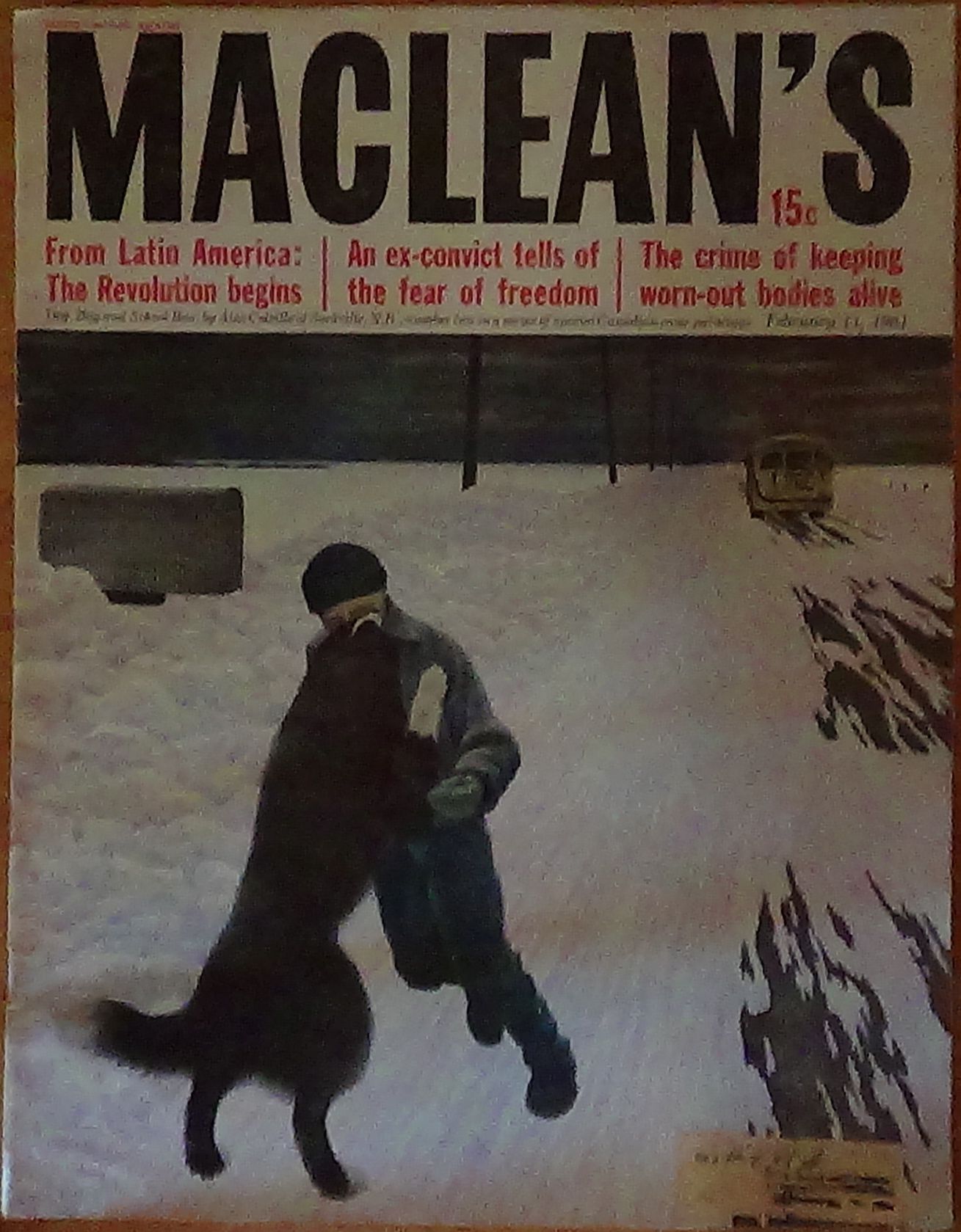
ImageIt’s February 11th, 1961.  Maclean’s publishes a photo of an Alex Colville painting as its cover.  It’s called Dog, Boy and School Bus.  “Colville’s paintings…bring in as much as $2,000 each; he is almost certainly the most successful of the Canadian painters who draw what other people see.”[1] He is 40 years old. He dies on July 16th, 2013 a rich and famous old man of 92.  Peter C. Newman is the Ottawa editor of Maclean’s.  Peter Gzowski and David Lewis are Preview editors.  I’m fourteen years old and attending College St-Jean in Edmonton.  I’m in grade 9.  I’ve never heard of Alex Colville, Peter Gzowski, David Lewis or Peter C. Newman.  Knowing of them would come later when they would all go on to greater things and I would go to university.

On November 22nd, 1963, in Dallas, Texas, President of the United States, John F. Kennedy is assassinated, but in the winter of 1961 that is not an event anyone would have anticipated except the planners of that event.  He had been elected in 1961 and sworn in as President on January 20th, 1961.  Kennedy was not in office a month when Maclean’s wrote: “Watch for John and Jackie Kennedy – in store windows.  A U.S. mannequin manufacturer has started a line of store dummies modeled on the new president and his wife – and their famous hairdos.”[2]  It’s the only mention of the Kennedys in the February 1961 edition of the magazine.

The headlines (on the cover) for the February 1961 edition of Maclean’s are: From Latin America: The Revolution begins; An ex-convict tells of the fear of freedom; and The crime of keeping worn-out bodies alive.  Cuba, led by Fidel Castro, had successfully fought against Fulgencio Batista, the then president of Cuba and a great friend of the American corporations who were finding Cuba a great place to do business.  The nasty revolution thing was about to spread all over South and Central America, Africa, the Middle East and other countries here and there.  Viet Nam was about to explode.  The French colonialists had been kicked out in 1954 but there still raw materials to be had there and the Americans were interested.  So were the Chinese.  The Maoists were firmly in power in China.  Capitalism eventually won in China mostly by attrition and bribes but that would take the death of Mao and great changes in the Chinese leadership.   Maclean’s is greatly worried about South America and the nasty Venezuelan students bent on overthrowing president Betancourt.  The tanks are on the streets of Caracas and surrounding the university where the ‘hothead’ students don’t really understand what’s going on and are challenging the authorities.  They get clobbered but things eventually change as they must and old dictatorships fall grudgingly, slowly, but paving the way to the future with corpses of the poor piled deep.  Maclean’s is nonetheless worried.

It’s also worried about Belgium where there are riots in the streets.  The Flemish north is dominant but the French-speaking Walloon southern part of the country is angry and seething.  The headline reads: BELGIUM: the violence is racial and religious.  Canada be warned.  Belgium is not unlike Canada and there could be trouble with those French speakers here too.  Well, yes, but Trudeau took care of that when he replaced the mild mannered Lester B. Pearson as the 15th Canadian prime minister.  The Front de la liberation du Québec (FLQ) put up a bit of a fight in the early 1970s, but nothing much came of it.  Nothing much came of the ‘manifestations’ in Belgium either.  It’s a nice little European country today without any colonies, but you win some you lose some.  The beer is still good and the cafés full.  What more could an American tourist ask for?

There are more stories in the February 1961 edition of Maclean’s.  The one about the fear of freedom is a bit self-serving and strange as is the one about euthanasia.  They shoot horses don’t they?  Aside from the fact that there are cigarette ads in the 1961 copy and none in my 2013 copy as well as no ads for smart phones in 1961, the issues are still somewhat the same, just framed differently.

I love looking through old copies of popular magazines.  They remind me of how strident we got about issues 40 or 50 years ago, how morally outraged we got and how little things have changed to make us calmer and more accepting.  Well, capital accumulation proceeds apace and the problems of the 50s and 60s, although nasty in their own way are just a part of a process that is leading to some much nastier times before things get better and they will.  I promise you that.


[1] No author mentioned, Maclean’s, February 11, 1961, page 33.

[2] No author mentioned, Maclean’s, February 11, 1961, page 1.

Fine art and all that: just another case of marketing and self-aggrandizement?

Fine art and all that: just another case of marketing and self-aggrandizement?


So, I’ve been an amateur artist for decades.  Because I had full time work teaching sociology at a community college, I couldn’t indulge my predilection for painting, drawing and other forms of artistic expression except during summer breaks, but even then only sporadically.  I did find the time to read art books though, both how-to books and books on art history and about individual artists especially the Renaissance greats, the Dutch and Flemish masters, the Spanish painters Goya and Valasquez, the Impressionists and German and Austrian Expressionists like Egon Schiele.  I’ve only been marginally interested in North American painters, printers and sculptors.  I do have a lot of respect for Rothko, Diebenkorn, O’Keeffe, Rivera, Kahlo, Moore, Henri, Close and some of the Canadian Group of Seven as well as Colville and the Pratts.  But I probably shouldn’t name drop.  It can quickly get undignified and there are too many  artists I would undoubtedly miss mentioning.


Whatever we can say about art, it’s as much about who the buyers are as who the producers are.  Otto Rank (in Truth and Reality) argues that art is the expression of a strong ego although he’s also quick to point out its superego dimensions. I think that social institutions (summarized by the term ‘superego’) not only drive artistic expression, but the buyers of ‘art,’ to a large extent, dictate content.  Virtually none of the great Renaissance artists did work for the sheer pleasure of it although there must have been an element of joy, accomplishment and personal satisfaction in the work.  They were more often than not commissioned and if they strayed at all from the vision that church leaders had, as Caravaggio did in a depiction of Saint Matthew[1], his work was rejected and he had to start over again with a work more in line with their ideas of how Saint Matthew should be portrayed. In other words, they were constrained by the superego.  Of course if artists didn’t get commissions they starved.  And who commissioned their work?  Well, it sure wasn’t the poor. 


In the Middle Ages and much of the Renaissance, the Church was the principle source of income for artists.  Some wealthy politicians and merchants were able to commission self-aggrandizing works, but it was mainly the Church that was interested in art.  Much of the artistic production of the great masters was designed to respond to the Church’s need to glorify God, the saints and other sundry notables.  When the city-states dominated Italy, the masters of those cities were able to spend their fortunes on paintings of themselves and their families as long as the artists were willing to portray them in very flattering ways, eliminating annoying blemishes and poorly curved noses and chins.  When the aristocrats and especially the monarchs of Europe eclipsed the Vatican’s power then the painters and sculptors produced the most lavish and spectacular marketing-type works.  David’s work is a great example of this.  His monumental works are political statements in their own right.  His The Coronation of Napoleon, which hangs in The Louvre, is a blatant glorification of political power.  David was Napoleon’s ‘official’ painter and neither men did things in a small way.  David was Napoleon’s marketing department. 


Real, significant changes in the content of paintings accompanied the rise of merchant capital in but not really until well past the Reformation when the shine went off the Protestant shunning of ostentation especially in Italy and Holland.  Then merchants had their portraits painted by the likes of Rembrandt, Vermeer and Hals.  Van Dyck was plugged into the aristocratic world and worked in England a great deal.  I’m not interested here in setting out a detailed or even general art history of the Western World.  I’m not at all qualified to do such a thing in the first place.  But I have studied history extensively, particularly political economy and that’s my perspective.


My point here is that artists and their patrons are caught up in a dance of power wherein the former want to freely express their egos while the latter want to shackle those very egos to their own superegos.  The world of art in Flanders and Holland was incredibly diverse and millions of paintings were produced in the late 17th and early 18th centuries in several genres.  However there was a conspicuous absence of ‘religious’ art during this period.  There was no market for it so none was produced.  There were great markets where paintings and art works were sold; they ended up in the hands of the burgeoning middle class to decorate their homes.


Now, the situation has been altered such that art supplies are easily purchased by millions of people and art training is everywhere.  There are thousands of YouTube videos on every aspect of art imaginable.  Millions upon millions of paintings and sculptures, sometimes quite good ones, flood local markets and the internet alike.  This is all ‘stuff.’  We seem to be producing more ‘stuff’ just for the sake of it, art works included.  Needless to say, I’ve left out whole areas of artistic expression here like the theatre and music but I’ll leave that for another day.  Suffice it to say that the same ideas I’m applying to visual art are also generally applicable to the performing arts.  There’s always been ‘high’ art and ‘folk’ art.  The former seems to get into the history books more easily. 


I’m vulnerable to a lot of fault-finding here, of course, because my sweep has been very general and I haven’t at all taken account of some of the very important transition periods in the history of art where tensions between artist and patron are intensified and artists search for new patrons.  I’m thinking here specifically of the mid to late 19th century and the advent of the Impressionists.  Most of them never really made a lot of money while they were alive.  Their egos overpowered the superego of the time and they were thus shunned for their self-aggrandizement and their lack of humility. 


I’ve set down a little over 1000 words here, barely an excursus into the subject but I think that there is a palpable tension around ‘art’ now that needs to be explored.  Some people have already explored the domain and have laid down some stones of understanding along the pathways therein, but as I like to produce ‘things’ like paintings and sculptures, I also want to explore the significance of that travel in writing.  I’m particularly interested in exploring the role of ego development within the context of a weakened ‘community.’ I’m thinking that with the hyper-individualism that plagues the world today we may end up producing ‘art’ for an audience of one, ourselves.  And so what if that happens?


[1] See the introduction of E.H. Gombrich’s The Story of Art, the Phaidon pocket edition.