I’m dying?

Funny, but I don’t feel like a dying man, nor am I eager to find out what that’s like. No matter what the medical experts think, I don’t feel as though I’m dying. 

All the indicators are there: I’m dying. I’m old and I have myeloma. Myeloma is incurable and I’ve probably had it for at least a decade, but I was only diagnosed with it in the fall of 2019. At that point I already had lytic lesions (caused by myeloma) in my femurs, especially my right femur. I suffered through chemotherapy for almost three years before abandoning that course of action in September, 2022. Now, I’m palliative. That means that I have a medical team that aims to reduce my pain to tolerable levels. As soon as they hear ‘palliative’ many people immediately assume end-of-life, but the two don’t necessarily equate. I’m still mobile. I just had my driver’s licence renewed (although I rarely drive), I’m getting back into drawing and watercolour. I’m writing, obviously. I’m not bedridden. 

We are all so different. Myeloma is especially idiosyncratic. In fact, there are several types of myeloma affecting individuals in various ways. One of the distinct problems with oncology today in an outback like British Columbia is that there are few resources that are dedicated to dealing with cancer. It can look like there are lots of resources, but there aren’t really when it comes to dealing with diseases like myeloma and its treatments. If you check out the BC Cancer Agency’s (BCCA) website, you’ll learn that almost 30,000 new cases of cancer were reported in 2019, the year I was diagnosed. It would take an inordinate amount of money and other resources to deal with that number of new cases, let alone the number of people already identified with cancer in the years before 2019. The numbers are staggering. The challenge daunting. 

When I was diagnosed in 2019 I was put on a standard chemotherapy protocol. That didn’t work. It caused a rash around my midsection that was incredibly itchy. Considering the failure of the first protocol, I was put on another protocol, this time with three drugs. Anyway, over the next few months, the protocol failures outnumbered the successes so that, eventually, just a couple of months ago I quit chemo altogether. There may have been another drug I could have potentially used, but it would have required very close, ongoing, and individualized care. An oncologist at BCCA told me that they just didn’t have the resources to deal with that kind of individualized need, that is, for me. So, here I am, palliative. 

I want to write about Jim Carr for a paragraph or two. He was a Canadian Federal Minister of International Trade Diversification elected in Winnipeg, Manitoba, first in 2015, then again in 2019 at which time he was diagnosed with multiple myeloma. He was in his late 60s at the time and received a stem cell transplant and dialysis along with chemotherapy. He died on December 12th, 2022. He gave his last speech to the House of Commons on December 6th. I can’t be certain about this, but it may be that Carr had a form of myeloma that specifically attacks the kidneys. His early treatment with dialysis indicates to me that his kidneys were failing, probably the thing that ultimately led to his death. So, was it myeloma or kidney failure that killed him? I have no information about any of his symptoms. I only have what was reported in the news. Still, a few things come to mind about his case. The news reports indicate that he was diagnosed in the fall of 2019, just as I was. It appears the chemo treatments didn’t work for him any more than they worked for me. In fact, I strongly suspect that had I not had any chemotherapy I’d be no worse off for it now. Chemotherapy must not have worked for Carr either otherwise he would have shown more positive results and lived longer. 

The fact that Carr was up and about giving a speech to the House of Commons on December 6th and died on the 12thindicates to me* that kidney failure ultimately precipitated his death. The oncologist we spoke with at the BC Cancer Agency after I had decided to quit chemotherapy insisted that I would not likely die precipitously but would experience a slow degeneration of my health over a period of months if not years. The fact is that people die of myeloma for a number of reasons and over various periods of time between diagnosis and death. As I’ve noted before, myeloma is notoriously difficult to diagnose so people like me might have myeloma for years before being officially diagnosed. That might have been the case for Jim Carr too. For all I know he might have been one of those people who doesn’t easily talk about how he feels and would want to ‘tough it out’. 

One observation around the news reports of Carr’s myeloma diagnosis is that Carr could fight this.  Of course, people want to say ‘the right thing’, at times like this. Commentators from Trudeau to Joly to any number of politicians, federal and provincial stated things like: Carr has been “a leader in many fights, and this one is another one [he] will win.”** Well, no, he could not win the fight, nor can any of us. Besides, it’s not a fight. Myeloma is incurable. It can be treated to some extent, but even in the face of all the positive talk from the oncology community, nobody walks away from myeloma alive, and ultimately, no one walks away from life alive. 

__________________________________________________________________________________________________

*a rank medical outsider to be sure but a keen observer nonetheless of my own illness and that of others.

**https://www.ctvnews.ca/politics/trade-minister-jim-carr-diagnosed-with-cancer-says-spirits-are-high-1.4655348
61 Apprehensive,Wistful, and Tansy* bugs.

A couple of issues have been dogging me lately and are crying to be released into the blogosphere. One is the fact that I am no longer on chemo and what that means, particularly with regard to my future treatments and my relationship with ‘my’ medical team. The other is a nagging, recurring introspection around my death and dying. Let me start with my limbo between chemo and remission.

Apprehensiveness

So, I’m not on chemo, at least not for now. Since October of last year I’ve been carefully supervised by a local GP oncologist and the Cancer Care Centre at the North Island Hospital in the Comox Valley. What happens now that I’m not on a regular regime of chemotherapy? I really don’t know, yet.

I called the Cancer Care Centre last week and they told me to contact my oncologist at the BC Cancer Agency (BCCA) in Victoria. Well, I contacted the BCCA to find out that the oncologist I thought I had is no longer employed at the BCCA and hasn’t been for two months or so. (Gee, thanks for letting me know.) It turns out I’ve been assigned a ‘new’ oncologist, one who has recently come here from Alberta. I have not met him but I’m scheduled to go to Victoria for an appointment with him in late October. His assistant told me to contact my local GP oncologist in the meantime. I get the sense that I’m getting a bit of a run around. I don’t think anyone is out to deliberately mess with me, but I’m feeling a little apprehensive about what happens now. It looks like I’ll have to be the squeaky wheel to get any answers. Let the squeaking begin.

I’ve noted this before, but one thing I am very grateful for is a great palliative care team. I can now report that my pain levels are going down steadily. That said, the weakness in my legs has not abated and that’s my main worry. That means that the neurological damage is not being affected by the meds I’m taking for pain. The pain is attenuating but the weakness is not. I’m still walking with two canes. I DO expect my strength to improve. Patience is the name of the game right now but I’m not that good at being patient.

Wistfulness

Yes, I am a bit wistful, longing for a more settled, less precarious, state of life. Of course, life is never settled but that doesn’t mean I can’t wish for it. Life means movement and change but we are not alway happy with that state of affairs. We resist change by getting into routines and habits. We can delude ourselves into believing that life is stable when we do the same things day after day, week after week. The fact is, life is only finally settled when it reaches its destination.

In France in 2007, Carolyn and I boarded a fast train (TGV) from Paris to Montpellier in the south not far from the Spanish border. Arianne and Tim were living in Montpellier at the time doing post-graduate work at the university there. The train was incredibly fast (TGV is Très Grande Vitesse), moving at an average speed of over 300 kilometres per hour. Yet it was the smoothest train ride I had ever experienced (and I had experienced many in my youth). There was no clickety-clack, that most familiar sound I had heard on every train trip I had ever taken in Canada between New Westminster and Edmonton (where I attended boarding school). Lengths of track in France are welded together making for a single track running for hundreds of kilometres. No seams, no clickety-clack. Frankly, I found it a bit surreal but amazing at the same time. I had filmed part of the trip just as I had filmed other events on our six week visit to France that year, but I had a hard drive crash later and all my recordings from our 2007 trip were lost. What I have not lost, however, are my memories of that trip and our whole time in France that year. I still have vivid memories of catching the train in Paris, almost missing it, boarding without the requisite documents, settling down in first class (we decided to treat ourselves), and relishing this unique experience.

In bed a few nights ago after turning off the light by my bed my mind wandered again as it often has in the last few months to my death and dying. I had been looking for a metaphor I could use to make sense of my death, to give me some relief from the constant reminders of my demise. The reality is that I’m on borrowed time with the inevitable outcome of my death looming. My brain wants to keep coming back to that. It’s determined that I will be relentlessly reminded of my death and it will make sure that that reminder holds pride of place in my frontal cortex, not content with having it stay in the back of my mind where denial is so easy. We live by metaphors so I figured it should not be too difficult to come up with a good one. But I’m not sure a metaphor can win a contest with my brain when it comes to the ominous death watch I’m experiencing.

Then, our French TGV trip came to mind. The more I considered it, the more it made sense to me as a metaphor for life. That conviction was further reinforced as I read the article I link to below on our fear of death. The message in that article is simple: life is finite so make the best of it.

How to not fear your death by Sam Dresser

Using a somewhat questionable syllogism in this article Dresser asks us to consider whether or not we are afraid of the time before we were born, when we didn’t exist. If we aren’t afraid of that time, then why should we be afraid of death which is simply a time of non-existence much like our time pre-birth?

Yes, I suppose so, but it’s not that simple. Before being born, in that time of nothingness, there is no accumulation of life’s memories, of hugs, orgasms, loves, hates, good meals, accomplishments, and regrets. There is no possibility of loss or even the conception of loss. The anticipation of death, by contrast, involves facing the loss of everything, including experiences and all things material and immaterial.

Of course there is no perfect metaphor, but thinking of our TGV trip as a metaphor for life (actually any trip will do), it’s obvious that before boarding the train there was anticipation but no knowledge of the imminent experience. Once on board, there is full knowledge that eventually the trip will come to an end but the passing scenery, the food, the weird passengers on the other side of the aisle, all consume our attention. Eventually, of course, time is up, the train pulls into the station and we are compelled to disembark. We may not want to leave the train, having enjoyed the trip so much, but that’s not an option. We must leave the train and its memories behind. Yes, coming into the station and dying are comparable I suppose. Both are inevitable, both are necessary.

Yeah, maybe that works, but I have to think about it some more.

____________________________________________________________________________

Tansy!

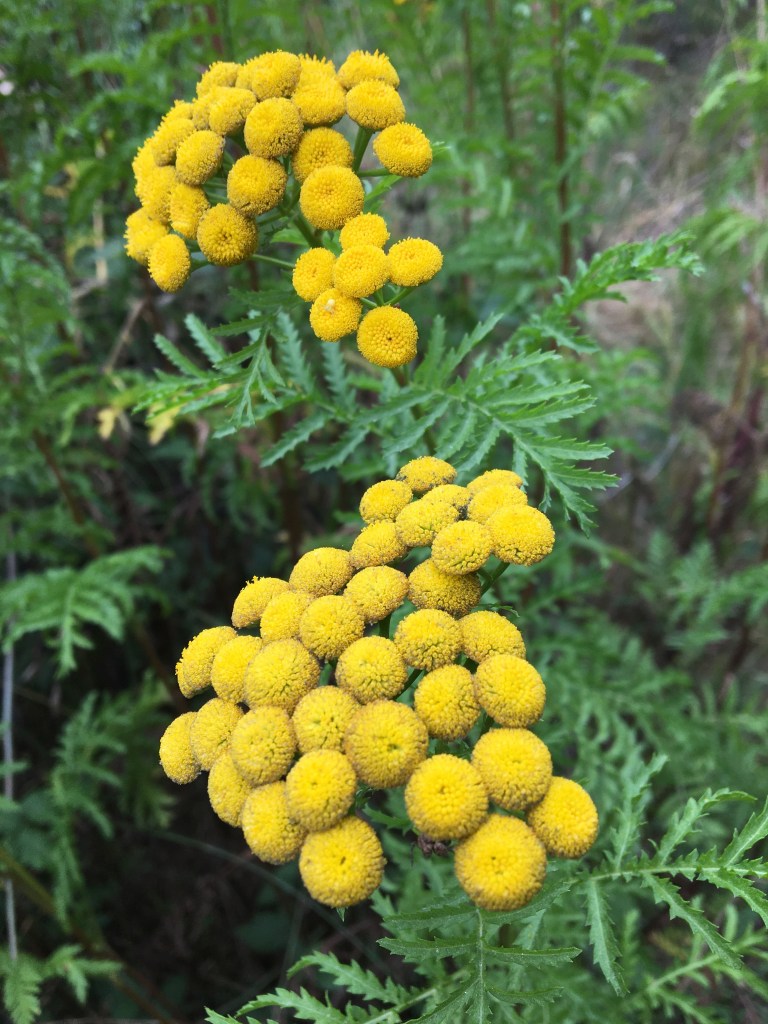
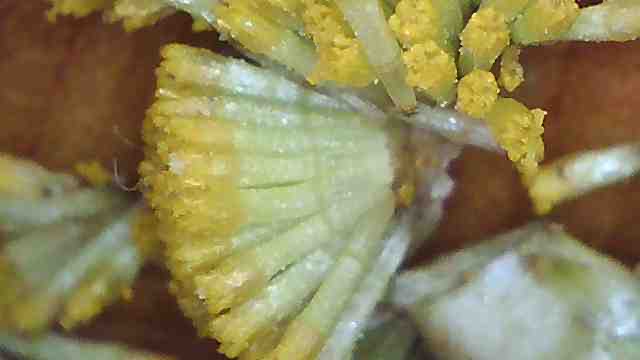
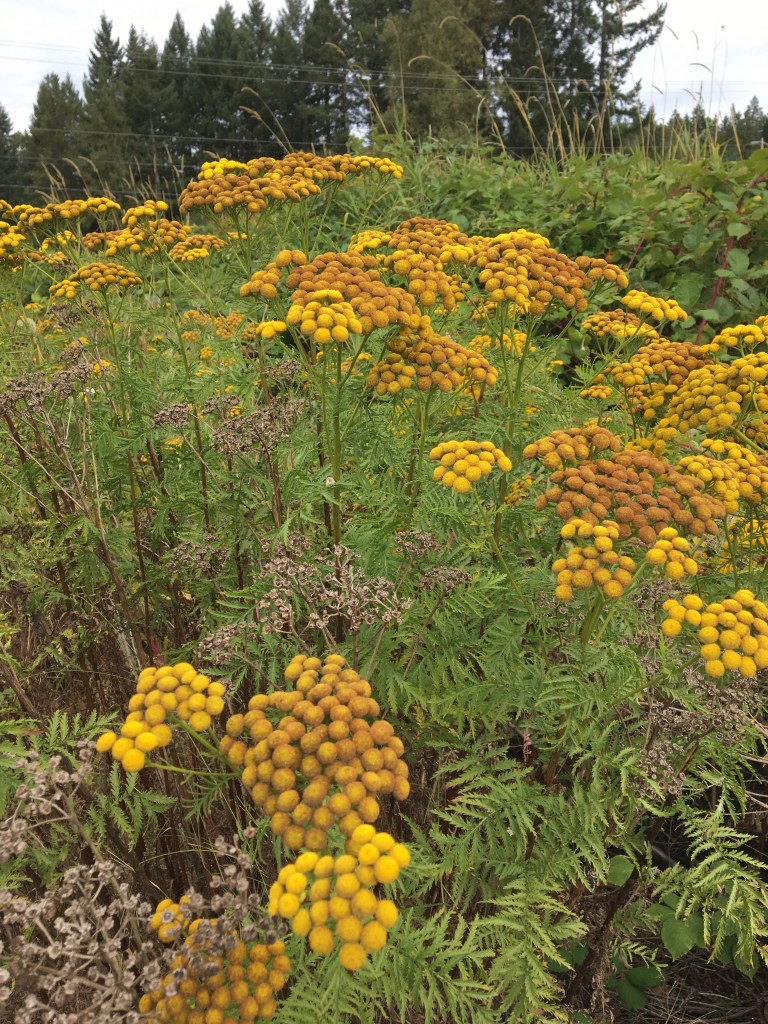
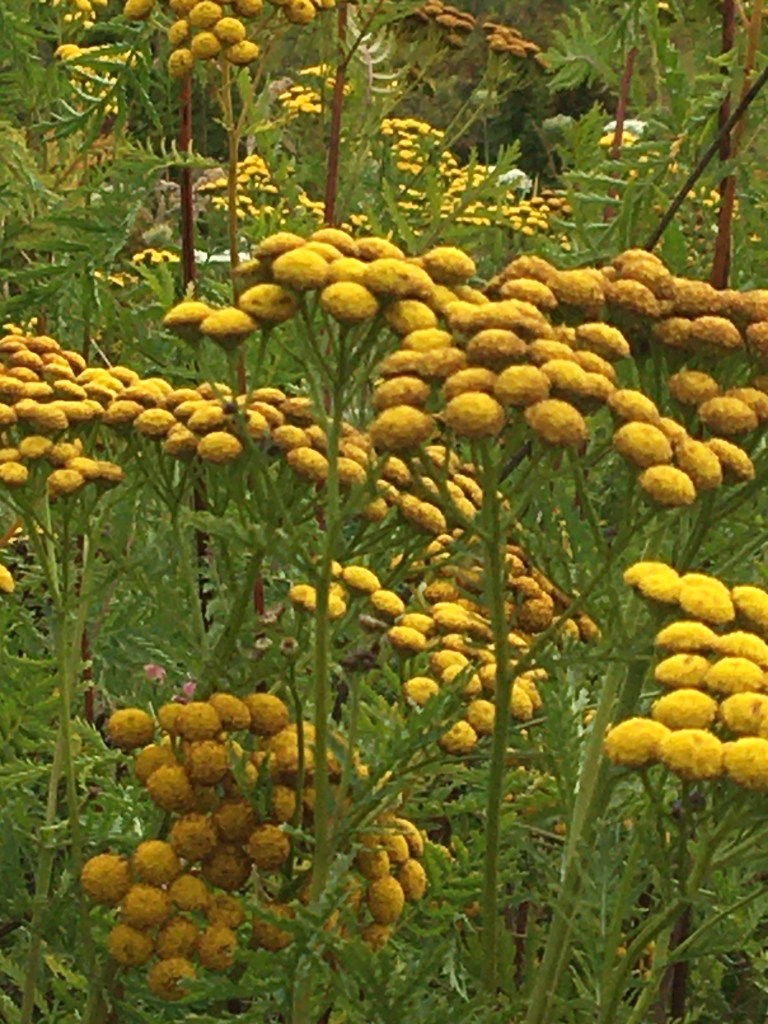
You might have seen tansies at one time or another. They aren’t super common but can often be found on vacant lots. In fact, the tansies in images 1 through 3 were photographed in an otherwise empty lot in our neighbourhood (by Carolyn). I sequenced the photos below to go from a wide to a tight view. The 4th image is one I took with the WiFi microscope at full magnification. Every one of the tansy flower heads is made up of over a hundred of the compacted cone/shafts you see in the 4th image. So, in image 1 you look over a minor sea of flowers. In image 4 you get close and personal.

What you don’t see in any of these images is what you see in the video that completes this gallery of images, namely the army of insects that populate tansy flower heads. You may be seeing only flowers when you look at images 1 through 3, but you’re also looking at bugs, lots of bugs, bugs invisible to the naked eye. The number of microscopic bugs out there is staggering. I won’t speculate on how many of them you had for dinner or are living in your eyebrows. That may be something you’d rather not be reminded of. Sorry.

I find it fascinating that we miss so much when we see the world with our limited eyesight. Truth is we see a narrow slice of the world, and that, unfortunately I think, also limits our appreciation of vast unseen, yet important to us, aspects of the world.

Tansy flower at full magnification with thrip (we think). Click twice on this image to activate it.

_____________________________________________________________________________

*a plant of the daisy family with yellow flat-topped button-like flower heads and aromatic leaves, formerly used in cooking and medicine.