34 To live and to die.

Yesterday we went to the lab for the nth time so that the tech might gather some of my mucky blood for analysis. My last trip to the lab was fine, but the results were incomplete. Apparently there was a problem with one of the samples that had to be shipped to Victoria so the results weren’t available to us. Samples requiring electrophoresis in their analysis are sent to Victoria. Apparently there have been some issues with the transport of samples. Maybe the samples coagulate on route, maybe they get lost. Who knows. All I know is that the results of these lab tests tell me how I’m doing and can give me confidence in asking the right questions of my oncology team. It’s okay this time because I just got a new set of tests. They’d better come back readable, that’s all I have to say about that. Hear me VIHA? Now, on to more important things.

I wrote this at the end of my blog post entitled Overdiagnosis? I promised to get back to it so here we go.

In my view, my destiny is to die. Like all other living things on this planet, living and dying are the same process and life depends on death for its continuation. No death, no life. I feel that in my very bones! That’s where my oncology team is doing battle with my own body to try to keep me alive a while longer. Of course, eventually whatever the oncology team will do won’t be enough and I’ll die.

So, how exactly does the body shut down as it’s dying? Cancer may very well be one (a very important one) of the mechanisms that is ‘natural’ in its role in having us die. Maybe cancer is not the pathological evil that it’s made out to be. What would happen if cancer did not exist? How would we die then? What does it mean to die of natural causes? How can we figure that out?…I think science and medicine have a lot to learn about us yet.

So, let me address one question at a time. Our bodies are ephemeral things, programmed to ‘die’, which means programmed to return them to the pool of raw material available to other organisms as they organize matter into various structures, themselves programmed to ‘die’. The body ‘shuts down’ in a number of ways depending on circumstance at the time of death. If you get shot in the heart, the process is quick, but immediately cells ‘know’ what’s going on and act accordingly. When my mother died, the nurse in the care home where she lived explained that staff can tell when a person is close to death by looking at their feet and legs. The weaker the heart gets, the less it can pump blood to the extremities. That means that the feet, then the legs show progressive signs of blood loss, losing colour and tone. Maybe that will happen to me. Whatever the circumstances, our bodies are prepared for the moment of death and ‘know’ what to do. Our minds are another thing. I’ll get back to the mind in my next blog post.

Cancer is as natural a process as muscle building. In my case, the likely culprit in triggering my myeloma is an oncology gene, not a factor exterior to my person like an environmental carcinogen, and my immune system was likely complicit in making sure myeloma spread to all of my bone marrow. My bone marrow, it seems, just got tired of producing marrow and started to produce myeloma protein instead, crowding out the cells that produce hemoglobin and other healthy blood cells. I really don’t think that that is a pathological process. Pathology implies that there’s something wrong with the body breaking down and dying. There isn’t. Dying is as natural to us as being born. The problem is that our big brains have a hard time letting go so they unleash our minds in a futile battle against entropy. Ultimately, they deny death itself. We’ll get back to that next post.

I think it’s reasonable to ask the questions I pose above: What would happen if cancer did not exist? How would we die then? What does it mean to die of natural causes? If cancer and other ‘deadly diseases’ didn’t exist we’d die from other causes. Simple as that. So, if medicine eventually ‘cures’ cancer or heart disease, or stroke, it will just have to move on to do battle with whatever other cause is determined to kill us. Scientific medicine is based on a pathology model so is organized to do battle with disease and death. That means that it assumes that there are normal ways to be a human and pathological ways. The idea is to ‘fix’ the pathological ways to bring the human back to ‘normality’. Unfortunately, there is no way to fix death, although there are a variety of ways of conceiving of death (but that’s the subject of my next blog post.). So what would happen if science gave up on the pathology model? It would have to study what is ‘normal’ human development, and not be fixated on correcting what “goes wrong”. It would have to cease thinking of disease and death as evil. Of course, evolutionary models are gaining in importance and they aren’t pathologically based. Furthermore, I’m sensing glimmers of the recognition of the weaknesses in the pathology model in the medical clinic, but pathology is a strong draw and won’t likely go into abeyance anytime soon as a favourite basic framework for the practice of medicine. I figure that until science and medicine face reality, the suffering sometimes caused by attempts to prolong life will have to be closely scrutinized along with the Hippocratic oath, and we won’t be able to deal with death as a natural part of life. So where does that leave me?

I can tell you that I’m not convinced that chemotherapy is the best course of action for me. Yes, it will likely allow me to live longer, but how long? And in the meantime, I get obsessed by my lab results and Carolyn and I reckon time by where I am in my chemo cycle and how that makes me feel. Not sure that’s such a good thing.
23 When Death Comes Calling

Don’t worry. I haven’t gone completely morbid or so focussed on death I’m forgetting how to live. However, I’ve been fascinated my whole career on the overwhelming but often covert death denial we have built into so many of our institutions and which is at the core of much of our morality.

That’s one reason I was amused, yes, amused, when I came across this YouTube video of a long retired philosopher who in his 97th year of life, after a career writing about death and dying in an abstract sense often poo-pooing our personal fear of dying, come around and admit that he was scared. He was scared of dying. He’s dead now, but in this video we get a pretty good sense of what he was going through in the last few weeks of his life. It’s not about cancer. I figured I’d give you a bit of a break from that for one blog post.

So, Herbert Fingarette, author, teacher, husband of 70 years to the same woman (who died seven years earlier), devoted rationalist and philosopher (Stoic I expect), writes about death and dying in an almost flippant manner, virtually sniggering at the weakness of being fearful of death. Then, he’s ninety-seven years old and on his way out. He knows that, and now he’s scared. He still has time to be scared. His question is: “What is the meaning of all of this?” Well, that’s a legitimate question, one that Tolstoy asked himself about his life and work as he lay dying. Truth is, there is no meaning. No cosmic meaning that’s for sure.

I also wrote some (no books, mind you) about death and death denial from sociological, psychosocial, and anthropological points of view mainly through the work of Ernest Becker, the author of several books, the last one being entitled Escape from Evil. I do a detailed review of Escape from Evil in the early days of this blog. You can do a search for several posts on Becker by using the ‘search’ function on the right scrolling menu of this blog. Here’s an example:https://rogerjgalbert.com/2017/11/

One of my favourite BBC documentary presenters is Brian Cox who is an astrophysicist and has a beautifully produced series of documentaries on the cosmos, entropy, life and death. For him, everything, every structure comes into being using materials in the environment, grows, matures, then decays into its constituent parts and dies. Ocean floors are pushed up into mountains, sharp at first then eroded finally into plains and flatlands. Galaxies come and go. The whole universe is destined to die. For us, following Ernest Becker, death and disease are the twin evils of our world. Of course, we need death because we usually eat dead things. We need death to live. It’s when our own lives are at stake that things go messy in our heads. We don’t mind death at all and we’re quite willing to inflict it on anything we wish to shove down our gullets or we think might be a threat to our continued existence. The movies these days are full of death and destruction, but it’s always of the good kind, when threats to our existence are defeated. It’s a lot more complicated than I’m portraying it here. There’s a lot more explanation in the archives of this blog.

We don’t mind killing things, other animals, including humans. Some of us glory in the idea. As Becker points out, war is a venue for the creation of heroes. Some people trophy hunt to show how tough they are. So, it’s not death that bothers us so much, it’s death with insignificance.

I have no evidence of this, but it strikes me that most of us don’t think about death and dying on a regular basis, we have way too many other things to think about, like where the next rent payment is coming from or how can I confront my cheating husband or wife, or whether to get a latté or mocha on the way to work. Decisions, decisions. Way too many to be meditating on death. It’s true, the closer we get to dying the more immediate the threat, the more we sit up and take notice. Some of us deny the terminality of our own lives until our kidneys stop working in the last few hours of life. Some of us, if not most of us, push the thought of death and dying so deeply into our subconsciousness that it barely has time to surface even at the moment of death. “What, I’m dying? Nah, must be a mistake! Check my numbers again.”

Right now, I’m trying to conjure up my last moments on earth. It’s not coming easily. Sometimes I get scared, but mostly I’m curious about the process. I’ve been thinking of talking to a death doula to see how they approach coaching someone who’s dying. See, I can still intellectualize dying, but before I know it, I’ll be face to face with it and no denial will be possible anymore. Will I be like Herbert? I don’t think anyone of us knows for sure how it’s all going to do down. I certainly don’t, and it’s the uncertainty that is probably the most frightening thing of all.

19 Fuck cancer!

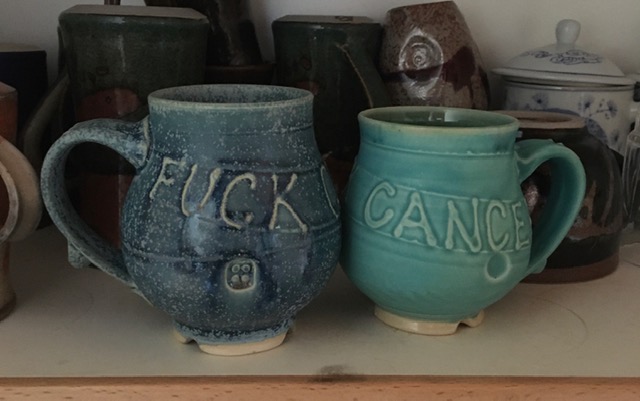
Fuck Cancer mugs

[WARNING: this post contains references to visualizations some might consider offensive, and I regress to being a potty-mouth. Be forewarned.]

I’m not feeling particularly creative, effusive or positive today. In fact, I’m feeling hard done by, angry and unhappy. Hence the title of this post. In fact, I’m feeling fucking crappy, as crappy as ever, or even more so, because for the last three weeks or so I’ve had a cold to compound the effects of my myeloma and the chemo meds I’m taking. Most of the time all I’ve been able to do is sleep, or stare out the windows.

We just came back from the hospital an hour or so ago. Carolyn had to shovel huge piles of snow blocking our driveway and covering our truck just to get us there. Carolyn is my warrior! At the hospital, I got an injection of bortezomib (a proteasome inhibitor) into my abdomen and an infusion of zoledronic acid (a bone strengthening drug that has not-so-fun consequences for my kidney). They gave me 4 grams of zoledronic acid rather than the 3.5 I got last time. I have no idea why. They have a complex formula for deciding how much to give me including my weight and my lab results. Now, I’m just waiting for the chemo meds to kick the shit out of me as they surely will. At least dexamethasone gives me a bit of a boost of energy allowing me to carve a few words onto this ‘page’ out of my weary brain. The sculpture I’m carving I don’t feel is particularly elegant or fine, but my tools are dull so it’s what you get.

Do you like the mugs? Carolyn had them made by a very talented potter in the Valley who had previously made a set of mugs we bought from her that resemble these a lot except for the swear words.

Yeah, fuck cancer! I’m so sick and tired of being sick and tired! And now, to compound my shit, I have to worry about peripheral neuropathy. [I have complained about this before, but read about it again for fun.] I’ve had peripheral neuropathy for some time, many years actually. Peripheral neuropathy (PN) is a condition where the peripheral body parts, arms and legs to be precise, get to feeling numb, painful, and full of weird sensations like having bugs crawling all over them (something I’m feeling a lot at the moment). One of the side effects of the cocktail of chemo meds I’m taking is peripheral neuropathy. Left untreated it can lead to immobility, loss of sensation and life in a wheelchair. This is one of the nasty side effects of my meds, one that has forced a friend of mine who also has myeloma off this particular cocktail that’s often referred to as CyBorD. I’ve written about this before. I have to keep a close watch to determine whether or not the symptoms of PN are getting worse or not. It’s just one more thing to keep my mind occupied with my illness. Fuck cancer!

Did I say Fuck Cancer? Right, I did. And I mean it. I’m not sure what else I would prefer to die from, but cancer is not the companion I would have wished for on my way to the crematorium. Maybe a six-ton weight falling from the sky onto my head would be preferable, I don’t know. I have no way to assess the quality of various means of dying nor the means of communicating the results of any research I might do on the subject to you after the fact.

I may have already written about this…remember that brain fog is a classic side effect of anemia and myeloma, repetitiousness and forgetfulness probably are too… I read somewhere that an artist was asked if he wanted to be cremated or buried after he died. Instead of answering as you or I might he replied: “Surprise me!” Yeah, that’s the way I feel about it. I won’t be around to give a shit one way or another, but I have said I want to be cremated. I have had too many nasty dreams about being buried to want that as an option. Now, though, I’m starting to have moments when I visualize the crematorium attendant pushing my body into the furnace and my skin starting to cook like a pig on a spit as the fire gets hotter and hotter. I know, it’s gross and morbid. Sorry for bringing it up.

So, to change the subject, I’ve had a few moments of lucidity lately between bouts of feeling really nasty because of this cold, and I’m reading (in bed) about my ancestors here in Canada. My family goes back a long way as immigrants to Canada, back to early in the 18th Century actually on both my maternal and paternal sides. I’m finding out that my Norman ancestors called LeGuerrier (the warrior in French) were very likely actual warriors. A thousand years ago the Normans were highly trained and fierce warriors. They not only conquered England in 1066, but (I’ve just read) also became rulers in Sicily after they were invited there to help deal with an enemy. According to a book I’m reading they were often called on as mercenaries. One of the Norman rulers in Sicily was called Roger. His son Roger II took over after Roger I died and he was not known for his tender generosity. Roger that! In any case, the first Leguerrier in Canada can be traced back to 1748. He came earlier than that, but that date is the first mention of him in ‘the books’. He died a fairly old man. Infant mortality was very common then but so was death at any age. From what I’ve been reading living to reproductive age almost seems to have been the exception rather than the rule. These days I’m thinking about my ancestors, their lives and their deaths, and my place in the lineage. My grandpa Leguerrier died at the age of 76 in 1975 from stomach cancer if I remember correctly. My father died in 2007 at 96 years of age. We all come and go. Some of us live longer that others of the same generation but in the case of my grandpa Leguerrier and my father who were only fourteen years apart in age, I think I prefer to follow my grandpa’s lead because my father died after years of very poor quality of life, unable to feed himself because his hands were so distorted by arthritis. He was deaf, had been for years, and he was either in bed or in a wheelchair. To make matters worse, my mother had severe dementia and didn’t even recognize him on his deathbed. She was heard to point to him and say: “Who is that old man in the bed there anyway?” My mother died two years ago at 94 years of age. I can’t imagine she knew she was dying at the time. I’m not sure she knew that she was alive. Hey, wait a minute…

18 Looking in the Mirror.

When I look in the mirror I see an old man. I don’t see an old man with cancer. I just see an old man with a white beard, not much hair, and wrinkly skin. Melanoma (skin cancer) often leaves visible, sometimes unsightly and disfiguring lesions. I don’t have melanoma, although my father did. No, I have myeloma (bone marrow cancer) and its damage is all done on the inside, invisibly. So, I guess I can keep expecting people who see me say: “Wow, you’re looking good!” I guess I DO look good! Now, the last thing I want is to discourage people from telling me how good I look, so keep it up! However, the invisibility of my condition is deceiving. I remember when I was a kid my friends and I used to work on our cars. That was still possible when I was a kid. Often we’d stand around looking into the engine compartment (often of my 1956 Pontiac four-door hardtop) wondering what could possibly be wrong as if just staring at the engine would give us some kind of clue. The engine was always sparkly clean and there was nothing obviously gone awry. If I had money by some quirk of circumstance I might take the car to a mechanic. If not, we might borrow my dad’s tools and start taking things apart. That usually ended up badly. Yes, the most undesirable conditions in life are often on the inside, impossible to see or diagnose by just looking at the person or car in question. I find it best to consult mechanics when our car shows signs of disfunction. I find it best to consult medical specialists for treatment related to my body. I guess I could try to treat myself using any number of the ‘cures’ available on Dr. Google, but I would like to live a while longer, thanks. Besides, I’m not that desperate.

Speaking of medical specialists, we saw my local oncologist today. I see him every five weeks. The result of our visit is that I will carry on with a second course of chemotherapy. We’ll evaluate how well it went in five weeks. My first course of treatment seems to have gone as well as could be expected. The little excavator in my bone marrow is slowly running out of gas and my red blood cell garden is growing again. I’m still exhausted and that won’t change for some time yet, but things are certainly going in the right direction for now. I think I just might be a model patient. So, where does this all leave me?

Well, I may be on my way towards remission. If and when I do go into remission, and that’s by no means guaranteed at this point, that would buy me some time. By that I mean that I may have a few years more to live, though inevitably, either the myeloma will kill me or some other condition will. I won’t be walking away from this situation, brush the dust from my sleeves and carry on. No, I’m on a one way street. So are you, of course, but I can see that damned barrier at the end of the street. I’m hoping that you’re still far enough away from it that you can live in blissful denial for a while longer. I don’t have that luxury. So now what do I do with my life?

That question came up in a recent Facebook thread, albeit expressed in a different way, but with the same effect, I believe. The question comes down to this: If you knew that you had a given amount of time left to live (six months, two years, whatever), what would you do with your time? Would you to be seized by an overwhelming sense of urgency? Would you be determined to cram as much activity and experience into your remaining time as possible? Or would you curl up in a fetal position in a corner of your bedroom quivering and whimpering while you await your inevitable demise? If you have the money and the energy you might want to get out there and travel the world. If you have a spouse, that might complicate things more or less because they may not want the same things you do and may not want to get caught up in your sense of urgency. The last thing you need when facing terminal cancer is marital discord. I think there’s a lot to be said for just carrying on with life as before.

If you have the energy and the money then good on ya. If you travelled a lot before your diagnosis then travel after. Your eventual energy deficits will tell you when to stop. If you were fairly sedentary, more into being at home and puttering around the yard, then that would be something you might want to continue doing. The stress of travel may not be that good for you. Looking around the Cancer Centre at the North Island Hospital this morning I didn’t see a lot of people with obvious enough vigour to engage in a lot of physical activity. In any case, back to my situation.

My exhaustion prevents me from doing much in the way of physical activity. If I do go for a walk I pay for it later. Travelling is impossible. At one point I thought it might be possible, say, to take a direct flight to Puerto Vallarta back and forth from Comox, but there are a number of contingencies that make that next to impossible that have more to do with arthritis and disk degeneration than cancer. Besides, I take chemo drugs once a week orally but also by injection at the hospital. For three or four days after I take my meds I feel crappy, really crappy so the chances of enjoying myself on a beach somewhere are slim to none.

So what do I want to do, and what do I actually do? Well, I want to work on our canoe, finish some paintings, do odd jobs around the property and visit family and friends in Vancouver and further afield. What I actually do is sit and lie down a lot. As I sit and lie down, I read, and sometimes I even write. At the moment I’m reading social history around the Middle Ages and doing a bit of research on my family roots in Normandy. That’s something I would have done anyway, but I do miss working in my shop and studio and going for long walks with Carolyn and our imaginary dog. My oncologist thinks I will regain my energy, at least as much as an old man can expect. If so, that would be great. I’d love to get back to canoeing, camping and puttering.

When I get closer to dying I will know it, and I expect I will have time to think about it, but there really isn’t much thinking that is productive about dying, at least not for me. I’ll know when it’s time for palliative care. I don’t want to live as long as the oncologists might want to keep me alive. I’ll make the decision when the time comes. I don’t think it will be a really hard decision. I know that beginnings are impossible without endings. My ending is a lot closer now than my beginning! That’s fine. Frankly, I’m much more concerned with my family than I am with myself. They are the ones left behind to mourn. But both of my parents are dead and we got on with life after their deaths. My family will do the same when I’m gone. That’s what we do as humans. Like it or not, accept it or not, rage against it or cower in a dark corner, the end result is the same. Don’t sweat it.

17 Welcome to CancerLand* AND Happy Birthday to me!

Well, another festive season is in the books. This one was no different than many in the past with family, food, and drink (in moderation, of course) along with the requisite tree and lights. This year, however, the family arrived on the weekend prior to Christmas and stayed much longer than usual. That’s because our daughters, their husbands and children (one of our daughters carries the full responsibility for the production of our three grandchildren) wanted to stick around to spend some time with us. I love that they wanted to be with their sick old dad. They are such a delight to have around and I was very sad to see them go back home to Vancouver.

Wow, has my life ever changed over the past few months. I was diagnosed with multiple myeloma in early October, 2019, and since then I’ve been brought slowly yet inexorably into CancerLand. There’s no doubt that I had multiple myeloma long before the official diagnosis. The symptoms were clear in hindsight. It’s probably been well over five years. But it’s been only since November, really, that I’ve gotten my passport to CancerLand. I’m fully a resident now, brought into the institutional fold. That means frequent visits to the lab and to the hospital with calls to oncology nurses interspersed. I mean, I have a diagnosis! I’m legit! I have my badge and my pass to the ER.ª  I’m not just another whiny patient going to see my doctor to complain about being tired. I’m a CANCER PATIENT!

Speaking of being a cancer patient, I’ve now completed my first course of chemotherapy. It lasted about a month. My stomach is bruised from subcutaneous injections of bortozemib and my brain is bruised by weekly oral doses of cyclophosphamide and dexamethasone as well as zoledronic acid infusions once a month. I’m subject to a true cocktail of poison. Oh well. I used to drink more scotch than was probably good for me on occasion and people sometimes refer to alcohol as poison so, there ya go. Poison for poison.

Now we wait. We wait for the results of lab tests on Monday and what the oncologist will tell us on Wednesday based on those results. Will I be continuing with this same cocktail? Are the numbers going in the right direction? Can I realistically expect remission in the next few months? What? What? What?

Tomorrow is my seventy-third birthday. That means I start working on my seventy-fourth year tomorrow. For a guy who thought at twenty years old that he’d never live to be twenty-six, I’ve done pretty well. I can’t complain about my life. I must say, though, that there are a few things I might do differently if I had to do them over again, but I don’t dwell on those things anymore. I don’t have time. I didn’t have time when I was twenty-six either, but I didn’t know that back then. Time has passed so quickly, it’s frightening. If I had been able to really understand when I was twenty years old how in the blink of an eye I would be seventy-three I might have taken some things more seriously and dismissed other things as unimportant. But that’s the way it goes. There may be some twenty year olds out there who understand how fleeting life is, but I haven’t met them. Trying to convince them of that fact is not going to be very fruitful so meh…

I haven’t put together a New Year’s resolution. Should I? Maybe I can resolve to stay alive this year. Is that good enough? I’ve realized that in my state of being, committing to a long-term project to save the world is probably overly optimistic, but a resolution to stay alive in 2020 is reasonable, I think. I just might be able to see it through too. Wish me luck!

_________________________________________________________________

*”Welcome to Cancerland.” (from “Bright-sided: How the Relentless Promotion of Positive Thinking Has Undermined America” by Barbara Ehrenreich). The title of this post is taken from this book. Ehrenreich uses this title as an introduction to the way she became medicalized after having been diagnosed with breast cancer. Start reading it for free: http://a.co/3h6SgyT

ª I do have a pass to the ER. I have a letter of introduction to the ER staff from the BC Cancer Centre telling them that if I show up to the ER they have a number of tests to do stat! If my temperature goes over 38˚ C, I need to get myself to the hospital ER for a possible antibiotic infusion. An elevated temperature indicates an infection of some kind, something I don’t need right now.

3 What? I’m giddy about seeing an oncologist?

Well, giddy might not be exactly the correct word to use here but it’s close. I’ve known for a month or so now that I have multiple myeloma, an incurable bone marrow cancer, but I have also been told that it’s treatable and some people live for some years after their diagnosis. But I’m not sure about anything yet because I have yet to see an oncologist. That changed yesterday, at least the anticipation part.

Yesterday, around 1 PM I got a call from the BC Cancer Agency in Victoria, telling me that I have an appointment with an oncologist at the clinic on Thursday, the 31st of October, Halloween morning, at 10:30 AM. I have no idea what to expect because I have no idea at what stage my cancer is at nor what treatment options there are. Oh, I can make up stories based on Dr. Google research, but that’s a futile pursuit. This disease is idiopathic. No two patients are alike. I guess that’s true for most cancers. There are commonalities and there are individualities. The only reason they can be treated at all is because of the commonalities. Without pathological patterns no illness could be treated. Still, the idiopathic aspects of this disease make it hard to compare experiences with others facing the same disease. We can commiserate, but that’s about as far as it goes. That said, there is comfort in commiseration.

So, this morning at 7:45 I attended the medical lab in Cumberland so they could take a dozen vials of blood and some urine (boy, did I have to pee when I got there) in anticipation of my appointment with the oncologist, but also with a nephrologist in Nanaimo on November 7th. On Saturday I have a CT scan and on Sunday I do a twenty-four hour urine collection for the nephrologist. I might already have told you this, but I am taking prednisone now and I’ve had an infusion of some drug the name of which I forget. So, in effect, my treatment has already started. I can’t wait to see what the oncologist has in store for me come Halloween morning.

1 I Have Cancer. Damn!

I was recently diagnosed (late September) with multiple myeloma or bone marrow cancer. My bone marrow has gone buck wild and is producing way too much of a particular substance the pathologist euphemistically calls ‘muck’. I’ve probably had it for some years, but the symptoms are very similar to those of other diseases and conditions making it difficult to diagnose. I’ve not been well for years. The past two years have been especially difficult and the last four months almost unbearable. I’m still functioning, but at a much-reduced level than I’m used to. 

This isn’t the first time I’ve had cancer. I had kidney cell cancer in 2002 and had my left kidney removed in an operation that left me with one (fully functioning) kidney. Now my remaining kidney is compromised because of the multiple myeloma so things aren’t looking particularly good for me. There are still tests to be performed and a prognosis to be arrived at, but as soon as the test results are in the BC Cancer Agency in Victoria will give me a call and arrange an interview and set a course of chemotherapy. A lot will depend on the stage of my myeloma. Some people do very well with chemotherapy and new drugs are being developed every day to target the specific pathogen that’s attacking my blood. I still may squeeze a few more years out of this old body of mine yet, but the next few weeks will tell the tale. Multiple myeloma is not curable, but it is treatable. 

I’m not afraid of death. I’ve often written about death and the cultural systems we’ve created to deny death, which actually build on our natural, biological aversions to disease and death. As you can easily ascertain by reading my blog this has been my main focus over the past few years. Dying is another matter altogether. I’m not particularly afraid of that either, but it is full of unknowns. I’m going through the various stages people do when faced with this kind of diagnosis: grief, anger, sadness, self-pity although these feelings are fleeting, and I soon get on to more positive emotions. I feel some guilt too. Yes, guilt. Guilt that’s impossible to escape in this culture. Guilt for succumbing to disease and death, the twin evils that we’ve identified as the greatest threats to us. In moral terms, and culturally, we abhor weakness, physical or social. Sick or poor people are to be feared in our culture. We tend to marginalize both if we can, but that’s not always possible because the world is not as simple as that.  

I know I’m on my last legs. I’m almost 73 after all and have had a great life. Nobody gets through life avoiding death except in novels and movies. I have no idea how long I have to live, but whatever time I have I just hope that my quality of life improves enough so that I can finish some paintings I’ve been working on, maybe re-canvas our canoe and continue writing this blog. In fact, I’ll use this blog as a kind of journal chronicling the process of being ill, then diagnosed, then treated. Stay tuned. 

Please don’t suggest any treatments or diets or whatever. I won’t be going to Mexico for any heroic treatments. (If and when I feel better we may go to lie on a beach though.) I’m not desperate. I won’t be buying a juicer either and I’ll continue to eat the great, wholesome mostly unprocessed food that I currently eat but my body will follow, as it must, the second law of thermodynamics. I’m okay with that.

I’m a Cancer Survivor but I won’t be a Life Survivor.

It seems odd for me to describe myself as a cancer survivor. Oh, I had cancer, alright. In 2002, very early in the year, I was diagnosed serendipitously with kidney cell cancer. I had gone to see my GP about acid reflux so he sent me to to the hospital to have an ultrasound to check it out. The ultrasound tech wasn’t looking for anything in particular is my guess, but she zeroed in on my left kidney and sure enough there was a lesion there that they strongly suspected was kidney cell cancer. The techs didn’t tell me that, of course. They don’t discuss the results of a scan with patients in my experience. My GP was the one to break the news to me. His office called me to tell me the doctor wanted to see me at 5:30 the following day. I didn’t think much of it at the time, but in hindsight, that was an unusual thing for my GP to do. In any case, he broke it to me and said that the best chance of a full recovery for me was surgery as soon as possible. Then he sent me off to see the urologist who would perform the surgery. They didn’t perform a biopsy they said because of the fear of spreading the cancer which at that point was restricted to my left kidney. Fair enough.

So, after all the preliminary tests were done and I had seen the surgeon and the anesthesiologist my surgery was scheduled for the third week of February. Normally, of course, I would have been teaching at that time, but that wasn’t going to happen so the college arranged for subs on very short notice, one of whom was to die of cancer a few years later. The thing is that there are no obvious symptoms with kidney cell cancer. As far as I know, it doesn’t usually affect kidney function, so my kidneys didn’t show any signs of stress or disease. I felt fine. I did some work around the property. It so happened that we were just in the process of buying a new place in Cumberland, BC when I was diagnosed. There was a lot to do. We had an acre of property with the house and several outbuildings. It was a good thing that I wasn’t particularly debilitated. That was to come later.

Needless to say, a cancer diagnosis is traumatizing for everyone involved. I was concerned for my family as much, if not more, than for myself. Strangely, I was convinced that this cancer wouldn’t kill me so I was pretty upbeat about the whole thing. Why I felt this way I have no idea. It could be I was in denial. We humans are great at denial, even me.

Finally, I had my day in the operating room. I arrived at the hospital with Carolyn early in the morning with hardly anyone around. We said our goodbyes and I was taken to the pre-op area. They didn’t waste any time getting me ready and into the operating room. That I remember. My GP was in attendance and assisting, although I didn’t see him in the operating room at the time. Later, my GP told me that the surgeon had cut me in half laterally on my left thoracic area so that the kidney could be gently lifted out helping to keep the cancer contained. He said it was quite daunting. That’s what happened. Since then I’ve made do with one kidney. One of my former students was a nurse in the OR. We joked around until the anesthetic kicked in. Having a former student in OR isn’t unusual because many of my students were in the nursing program and were taking my sociology courses as electives. It happened again last year when Carolyn went in to have her appendix removed. My former students are everywhere!

I tell you all of this so you get a sense of what I mean when I say I’m a cancer survivor, but I find it hard to describe myself as such. I think of cancer survivors as people who have had to struggle for weeks, months or years on chemo and/or radiation, losing their hair and being in horrible pain the whole time. I have known many people who have succumbed to cancer, but I also know a number of people who have fought it, and fought it valiantly for long periods of time and survived. My cancer recovery was not at all long and drawn out. The surgery put an end to it. Done. Well, mostly done. My surgery was seventeen years ago and my left thoracic area has been a source of constant pain since then, aggravated often by the slightest movement. The pain in my side never lets me forget about the cancer that almost claimed my life. It gets pretty tiresome at times and saps my energy, but I carry on because what else is there to do? No, suicide is not an option.

So, I guess I’m a kind of cancer survivor, but I won’t be a life survivor. No one has ever been, nor will anyone ever be a life survivor. Nothing can ‘cure’ us of death. My surgery has allowed me to live longer and that’s fine, but I’m still in line for dying. And that’s fine. I don’t have any illusions about life and death. Life demands death. Life cannot happen without death. Denying that gets us nowhere. So, every day is one more day to enjoy and struggle over. When it’s done it will be done. That’s it. I know that some of you might think it odd that I say it, but if I had died on 2002, that would have been fine too. Carolyn and my family would have been sad and would have mourned my loss, but they would have gotten on with their lives. That’s what we do when people close to us die, we get on with our lives until our turn comes.