
It’s about time I publish a new post!

Not much action on this blog lately! Truth of the matter is that I got very ill early in March and stayed that way for most of the month. Nasty flu. Then I confess that I’ve had outrage overload for a bit and find myself uninspired to write. So, what I’ve decided to do is leave current affairs alone for a while. I’ve got over 50 posts on current affairs and I want to give that interest of mine a break. [We’ll see how long that lasts!] Instead, in this blog, I want to address some issues around evolution, particularly the notion of evolution as it applies to social institutions. As Harold Innis (1894-1952), the economic historian and political economist who spent most of his career at the University of Toronto after getting a PhD from the University of Chicago, was quick to point out, following many others including Thorstein Veblen, that empires come and go. There is no example to the contrary. Every empire in the history of our species on this planet is either deceased or moribund. Go back as far as you like. Empires don’t last forever, So the question is not whether or not an empire – say, the U.S.-centered finance corporate empire – will survive, the question is how will it die? How did the Roman Empire wane and die, for instance? Or the British Empire? Are there patterns in these events or processes? Indeed there are. Imperial overreach is a concept used to try to explain why empires fail. There are different versions of it (http://www.mmisi.org/ma/32_03/lankevich.pdf) as these two reviews of Paul Kennedy’s book The Rise and Fall of the Great Powers: Economic Change and Military Conflict from 1500 to 2000 make clear. But for me, it’s fairly straightforward, say in the case of Rome. Here’s how it works.

An empire is born in the ruins of previous failed and exhausted quasi-states. Said empire begins to grow slowly by conquest. In that it faces sometimes strong external opposition but also domestic strain because the more military conquest is the favoured instrument of international relations, a ‘thinning’ of the young males in the population is inevitable. As well, there is the stress of volatile consumer markets caused by military conquest. But wait! The empire grows stronger. Conquest brings wealth and new recruits. Military success fuels more military activity and the armies get spread farther away from home. In order to maintain conquered lands, military leaders from the Empire’s armies become governors and bureaucrats of far-flung provinces. There aren’t enough Romans to keep this machine in play so one strategy is to free trusted slaves or not enslave some of the opponents of the Empire, the really nasty ones (warlords, really) in what we now know as France, Germany, and Britain, negotiating with them instead entry into the Empire’s sphere of trading activity while allowing them to maintain land holdings of their own. Once this practice becomes commonplace, there is an internal threat to the Empire and that is the erosion of slavery, the real economic base of the Roman Empire. Rome grew too widespread geographically to control all of its subject peoples from Rome. Communications strategies just can’t keep up with the logistical and military demands of maintaining an empire like Rome, keeping enemies at bay and conquering new territories. That’s imperial overreach. The American Empire won’t fail for the same reasons because essentially there is no ‘American’ Empire.

The prevailing empire in the world today is not based in any country or nation state and it’s not geopolitical. It’s financial. As Thorstein Veblen was keen to point out, states are creatures of higher order institutions like private property and class power. Capital rules. In our times (for the last 700 years or so) merchant capital slowly gained in power at the beginning of the feudal period and held on to power pretty well into the early 19th century in Europe. It was replaced as the dominant form of capital by industrial capital which itself slowly gave way to finance capital in the second half of the 20th century. This is an evolutionary process. Marx sees the driver of this as the process by which capital replaces labour in production. Of course this is too simple a presentation of a very complex process, but essentially, that’s it. Of course all capital is a product of human labour, but capital has had a smaller and waning use for labour in the productive process as automation, Fordism and technology become prevalent. The price of labour-power varies in different parts of the world and for different occupations, but there is a long-term tendency for the value of labour to fall everywhere.

My point is that countries are not in charge, nor are politicians. Capital is and has been for some time. For centuries it’s been in a struggle with labour, the only reason capital exists, to gain a larger part of the value produced by human labour. For centuries now, capitalists have tried and largely succeeded in reducing the value of labour with the help of the state. In the US now we have the spectacle of corporate business leaders and politicians openly sharing the same bed, seemingly without any guilt or shame whatsoever. And we have the pathetic spectacle of vast numbers of people completely ignorant of how they are being manipulated by the state and its communications corporations blithely going about their lives in the belief that the American (and in my case, Canadian) government acts on their behalf. Flags fly everywhere. Patriotism is a powerful force. However, it’s not powerful enough to counter the despair and angst that will drive many marginalized and disempowered people from turning on each other and others in a desperate search for meaning in their lives in the absence of a good, well-paying job and a sense of social security.

The end of the finance capitalist empire will come only when it has reached and dominated every nook and cranny on the planet and when it has exhausted itself in trying to eliminate labour. Finance capital is well on its way to dominating the entire planet. Countries are still based on land and borders and are thus restricted in their activities. Corporations have few restrictions now and want even fewer in the future. Countries and their citizens don’t stand a chance against finance capital because they operate within an old paradigm. That paradigm is based on the false assumption that countries have economies, trade with one another and are the basic global unit of analysis. Yes, countries can still go to war with one another, but the more finance capital and production infiltrate every corner of the planet it makes less and less sense to bomb the hell out of your own factories in the target countries because chances are that where you’ve located them to take advantage of low wage costs. Global war is a thing of the past as global production drives us and our labour-power into a global market. That doesn’t mean that threats of war and local military operations aren’t useful to reduce domestic dissent by targeting a foreign enemy. We’ve experienced over the last hundred years or so the consolidation of states into larger and larger units. The European Union is an example of this type of consolidation but so are the plethora of free trade agreements that are part of the geopolitical map these days. And why this expansion? To help in the free flow of capital and labour. Globalization is foremost a process of freeing up capital to move as it sees fit unencumbered by elected parliaments and other political institutions. It’s also about the control of labour by the free movement of production. If a ‘Canadian’ forestry company moves one of its sawmills to the Philippines to take advantage of cheap labour there, it’s effectively controlling labour in Canada.

After decades of study and observation of geopolitics and capitalist production I can’t help but conclude that the future will be fraught with uncertainty as governments give up power to finance capitalists and we are left with no democratic way of deciding anything about our lives. Politicians have sold us out for a pittance and now we’re increasingly at the mercy of the big banks and business corporations that are psychopathic by their very nature, unrestricted in their expressed need to pollute the planet at will, dominate our lives with pharmaceuticals aimed a lot less at making us healthy than to making corporate profits, and privatizing all public lands and services. Profits rule. Who gives a shit if they serve to help us or kills us.
Marx predicted that the end of the capitalist mode of production will come when labour has been largely replaced by capital in human production. Machines don’t buy commodities so by eliminating workers and replacing them with machines, the capitalist class is eliminating itself. What’s the fate of countries like the US and Canada? Well, before it gets better it will get much worse. There is bound to be class war in the US and all over the world, it’s just a matter of time. Throw enough people out of work and out of their homes, make cities impossible to live in and see what happens. We haven’t suffered enough yet to push us into precipitating a revolution, but we’re headed in that direction. What can stop the momentum?
The new globalized assault on labour

The first link below is to a CBC news article about the influx of Chinese miners in Canada and the second is about ‘right to work’ legislation in Michigan, but in other American states too.   Both stories are from yesterday’s National.  These stories may not seem to be linked at first glance, but they are.  They point to the internationalization of labour and the degradation of its value.

http://www.cbc.ca/news/canada/british-columbia/story/2012/12/10/chinese-miner-investigation.html

http://www.cbc.ca/news/world/story/2012/12/10/f-rfa-macdonald-right-to-work.html

I’ve written about this in previous posts, but it’s worth repeating Thorstein Veblen’s observation that countries are subservient institutions to private capital accumulation, which is currently our dominant mode of production along with it’s modus operandi, business entreprise and the factory system.  The concept of private property is the legal expression of power over commodity production and accumulation.  I repeat: countries are now and have always been subservient to the capitalist mode of production.  Initially, they were created in Europe as a way of opening up markets for commodities and to ‘free up’ labour to move around beyond the confines of their feudal estates.  Countries are just another step in the historical trend towards the global consolidation of political power.   Still, countries have often been a focus of group loyalty, nationalism or patriotism.  This is not always pro-capitalism.  The problem for capitalism is that once countries are created they become more than what was first intended.  People soon consider them home.  They fall in love with them.  They aren’t entirely sure why, but they do.  Well, we’ve been told forever that countries are the way the world is organized.  Our citizenship defines us.  We are proud to be Canadians, Americans, Australians, Indians, etc… We don’t question this, it’s just the way the world is.  So we get upset when we find out that our governments seem to be doing things that we perceive as harmful to us and to our country.  We can’t figure out why our politicians would do such things.  Why, when the unemployment rate in Canada is fairly high, it would encourage the importation of labour?  Why would the state of Michigan attack collective bargaining, guaranteeing a reduction of average wages there, like it has done in other states?  It’s not that surprising, really.  Some governments, not all, are more business oriented than others.  The Canadian government, for example, is extremely pro-business.  As pro-business, it buys into the argument that lower wages are generally good for business.  The cost of labour is a large part of what it means to do business, so any way of reducing the costs of labour becomes government policy.  Attacking collective bargaining rights, as in the US, is a way of reducing average wages, and it will eventually reduce the costs of labour globally, so will importing cheaper labour from other parts of the world to developed countries.  Ironically, reducing average wages will reduce our capacity to buy commodities, the essence of the capitalist mode of production.  So, go ahead boys, cut our wages, cut our pensions. By doing so you’re cutting your own throats.

So, Canada came into existence officially in 1867.  When do you think it will die?  There’s no question that it will. When and how are the questions, not if.  Will the death of Canada come from the outside, from invasion?  Not at all likely, unless it’s the US over water.  No, Canada will come apart at the seams, much like the US will, bit by bit.  Omnibus bill by omnibus bill.  Harper decree by Harper decree.  But don’t worry, it won’t happen for a few years yet.  A hint might be though that 95% of the petrochemical business in this country is foreign controlled.  Now with the Nexen and Progress deals paving the way, outright ownership is on the way.  And don’t believe a word Harper utters about tightening the rules.

Labour has always been a necessary part of the capitalist mode of production, but labour is being replaced by capital (by the use of technology and automation) or cheapened by the same process.  The inevitable result locally and globally will be a few very rich people and the rest of us.  How far do you think we are away from that outcome?

Is Canada a Capitalist Country?

This is a script I presented on a Knowledge Network sociology telecourse in the early 90s.  Still relevant today, maybe even more so than then:

Is Canada a Capitalist Society?  Interesting question and not as simple to answer as it seems, I think.  Generally, when this question comes up, people immediately think about Capitalism and Socialism or Communism.  Canada isn’t communist, that’s clear…but is it socialist?  Well, what does socialism mean?  Many people think of socialism as government ownership and control.  For some, socialism means no more free enterprise, no more freedom of choice and no more good life!   For others it means Medicare, UIC,  Canada Pension and Social Services.  If socialism means government takeover of private business, then the W.A.C. Bennett Social Credit government of  B.C. was one of the first socialist governments in Canada.  It took over B.C. Electric and made it into B.C. Hydro, took over responsibility for ferries in the province and monopolized the sale of alcohol.  Well, most people would never think of the Socreds as socialists, but there you have it…  Just kidding of course…  But it still leaves us with the problem of coming up with a way of deciding whether or not Canada is a capitalist society.  Is it mostly capitalist with some socialist policies?  Can we talk of shades of pink, or is it one or the other?  Well, maybe there’s another way of approaching the whole question.


Let’s stand way back and check out the view from there.  We are very accustomed in this part of the world to seeing things from the perspective of our countries.  I’m not saying that we’re nationalists, necessarily, but that our frame of reference is our country.  We think of “Canadian” society, the Canadian educational system, the Canadian political system, the Canadian legal system, the Canadian transportation system, etc.  We view Canada as an entity, a thing in itself.  We use Canada as “containing” our society.


There is another way of thinking about these things.  It is very difficult, though, because we take our conventional view of things completely for granted.  We have difficulty even conceiving of another way of seeing things.   It requires a real perceptual shift.  But let’s try this on.  Think of the concept of Capitalism as a basic reference point rather than the idea of Canada. In this conceptual scheme capitalism has time and space dimensions but I want you to think about it more as a set of institutions or way of doing things, organizing ourselves and thinking.  The primary institutions of modern capitalism are private property, business enterprise, the machine-process, the class system, wages, the division of labor, the market and the price system.   Taken together, these institutions, along with others, make up what we might call the economic basis of capitalist society.  I’m not talking about people here, but about the ways that have evolved by which we relate to each other in society.  The primary institutions are those concerned with how we organize ourselves to make a living…that being the basis for the rest of social organization.  We have to make a living as societies before we can do anything else.   In order to survive…and this is an evolutionary perspective…capitalism generates a whole range of other institutions, or it appropriates them, borrows, begs or steals them historically from previous societies.  These institutions  we usually define as being political, social, legal, educational, etc… And they evolve  themselves and together…like all the organs of your body evolve together.


From this perspective, the way we organize official learning, in classrooms with the teacher as authority and children conceived of as empty vessels to be filled with standardized knowledge is a basic educational institution of modern capitalism.  Whole organizations, plants and facilities we call  schools, colleges and universities are created to service this institution which itself serves to ensure the survival of capitalism.  What kids learn in school is more important than just math and social studies.  In the way the school is organized, in the way they are regimented and disciplined, kids learn their eventual place as workers within a capitalist society. It could hardly be otherwise.  An educational institution that would contradict the basic way that we organize ourselves to make a living wouldn’t last long.


Countries as we know them are political institutions that arose in conjunction with the rise of capitalism in Europe.  They are the products of the growth of capitalism:  they exist to regulate the flow of capital and labour; to provide infrastructures such as roads for the movement of capital and labor (not always successfully); to defend capitalism, or sometimes the interests of a group of capitalists in competition with another group; to provide a context for law and order and the right “climate” for investment, etc… Once in existence along with the institution of citizenship, countries tend to legitimize the notion that citizenship is a status more important than that of worker.    Citizenship, with all of its caveats and rights,  is the political/legal expression of your right to sell your labour on a market.


Canada, then, is by definition a capitalist institution.  It “fits” into a now global system of political institutions that exist to perpetuate capitalism…and make no mistake about it, capitalism is the more fundamental institution here.  It makes little sense to speak of “Canadian” capitalism or even of “Canadian” society, for that matter.  Canada, the political institution, is part of a global capitalist society.  It makes much more sense to speak of the role of the Canadian state in the perpetuation and  survival of the growing capitalist global system.  If the government takes over the operations of a losing propositions such as B.C. Electric, then it does so to ensure that capitalism can still grow and prosper.  Capitalism needs cheap power.  There’s no money in it, but it is nonetheless necessary.  Why not get workers, as citizens and taxpayers, to subsidize it?    If the government sets up systems to train potential workers (i.e., the school system), to support unemployed workers, to nurse them back to health, to provide them with pensions upon retirement, it relieves the pressure from the capitalist to do so, a pressure that the slave master or the lord of the manor had in totality with regard to the well-being of his slaves or serfs.  So, in a big way, the governments in our country help to manage the working class.  And through the tax system arrange to have the working class cover the expenses for its own management and even cover the costs of capitalist risk-taking itself, again through the tax system.


This may sound cynical and negative, but I don’t think it is.  Nor do I think that the system stinks and that all capitalists and politicians are lying, good for nothing exploiters of the working class.  I’d rather be a worker with only half of my waking life in the service of someone else than a slave with my whole being and life in the service of someone else.  Besides, capitalists and politicians are harnessed to the needs of capitalism as we all are…much as all the cells in a human body are harnessed for the survival of the body as a whole…and the whole thing will live just as long as it has not exhausted all the resources it has to keep it alive.  Countries are one of those resources that serve the ends of capitalist survival.  Canada is one of those resources.

A Commie I’m not. A crusty old Marxist, maybe.

So, we had a big party at the homestead recently and I was lovingly described as a communist by my son-in-law. I appreciate the sentiment behind this remark.  For him, it’s a term of endearment.  There were many ‘left-leaners’ in the crowd who would have appreciated the comment because in some senses we share many moral precepts.  Oh, I’ve been described as a commie before.  It wasn’t the first time, nor will it be the last in all likelihood.  I really don’t mind all that much.  Whether or not people actually believe that I’m a communist is another matter and I hope to set the record straight here for anyone who cares.  If people read this blog posting,  and few will, they will know my position on the matter.  For my own sense of self, for myself, I want to set the record straight once and for all.

When I state that I’m not a commie, that doesn’t mean for one second that I’m a proponent of ‘capitalism.’  Many people see communism and ‘capitalism’ as opposites, as alternate ways of organizing ‘the economy’ and ‘society.’   I don’t, nor did Karl Marx when he got old enough to think straight.  As an aside, Harold Adams Innis, the brilliant Canadian political economist and historian said, in a moment of particular lucidity, that one cannot make a contribution to the social sciences before one reaches the age of 50 and he’s probably correct.  He was 58 when he died and his best work happened in the last 5 or 6 years of his life.  Marx was born in 1818 and died in 1883.  It wasn’t until the late 1860s that he really got his shit together, hunkered down in the British Museum and started writing Capital.  Yes, yes, he wrote the Economic and Philosophical Manuscripts earlier, but he really got serious later.

The reason I say I’m not a communist is that I’m not a proponent of communism.  For me, or anyone else, to be labeled a communist or anything else for that matter implies a certain level of advocacy, of ‘proponency.’  It’s not necessary to be proponent of something that will eventually happen no matter what we think or wish.  It’s like being described as an old-agist.  I know that old age will happen to all of us, but that doesn’t mean I’m a proponent of old age.  I’M getting old, but that doesn’t mean that I advocate old age. That would be ridiculous.  A communist mode of production will inevitably replace the capitalist one because the internal contradictions within the capitalist mode of production dictate it in the same way the feudal relations of production replaced slave based ones and the capitalist mode of production replaced feudal ones.  The change will happen gradually, just as old age creeps up on us.  Before it’s clear what’s happening, the old bones get brittle, the arteries plug up and the organs just can’t cut it anymore.  The resiliency of youth is past, old solutions no longer get the same results they used to.  Life inevitably brings on death, they are different sides of the same coin.  What that means for me as an individual is clear, what it means for ‘society’ or for the ‘capitalist mode of production’ is also clear.  Nothing is forever, nothing.  Not the capitalist mode of production, not our beloved countries, not our cities, not our towns, not our fabulous wealth.  The question is not whether or not the capitalist mode of production will live on forever, but when it will die.  It’s not even a question of how.  That’s also been clear for a long time.  Still, classical economics is still in classical denial over the whole thing, a fact which is made clear on virtually every page of The Economist which is a proponent of capitalism.

For what I’ve written above I could be branded with the sin of determinism, one of scholarship’s seven deadliest.   If saying that one day I will die makes me a determinist, well that’s ok by me.  Call me whatever name you want.  Furthermore,  what I write above does not mean that life is completely meaningless to me.  We live life on many levels, a day at a time.  My life is full of activity and that means that every day I make many moral decisions most having nothing or little to do with my eventual death.  I don’t  live life as though my life is about to end (I didn’t do that even when I had cancer and the possibility of my quick exit from this life was very real).  I DO things, there is nothing else to do.  I read the papers, listen to the radio and watch TV.  I play with my grandkids.  I can’t help but get outraged by the blatant bullshit and crap that comes out of the government in Ottawa on a daily basis.  Yet I understand  the role that national governments play in the capitalist mode of production and their essential collaboration in making it possible for capital to flow with greater and greater ease globally  and for controlling labour by keeping tight reins on migrations and regulation.  I haven’t lost my moral compass.  I even get angry on one level…say, at incivility, at stupid driving, at poor highway engineering…while understanding that at other levels, the picture is much different and anger makes no sense.  As I write above, we live life on many levels, many planes.  They are all connected although not always in obvious ways.  Even otherwise highly educated people don’t see the connections.  The connections, interconnections and interweavings become visible only after a sustained gaze upon them.  To see them requires special training.  Somewhere, Norbert Elias got that training, as did many other thinkers who have had a sustained influence on me over the decades.

And Capitalism Begat Communism

In my last post I may have given the impression that the capitalist mode of production will implode in a cataclysm or apocalypse.  An Armageddon, if not a Christian type of end story, still an end story.  Well, maybe I was feeling a little conspiratorial in my last blog.  Marx was right, of course, in his prediction of the end of the capitalist mode of production, but a child could have done the same.  It’s obvious that all things come into ‘existence’ at some point and then leave at another point, although ‘come into existence’ is misleading.  None of us is made of ‘new’ material.  We are made of recycled material.  I can’t remember who said it but it seems to be true (http://www.zyra.tv/lbreath.htm) that every  breath you take, you take in some molecules from Julius Caesar’s last breath.  That notion was brought home to me today as I walked through Mountain View Cemetery in Vancouver and saw the smokestack spewing smoke out of the crematorium.  Yes, breathing the ‘air’ means breathing all kinds of molecules, many of which previously inhabited people, some just now literally going up in smoke not 30 metres from me.  Doesn’t sound particularly appealing, but it’s true. No, all things come and go, but not completely or finally.  We just get recycled.  I tell me students every year that they are probably eating bits of their ancestor’s molecules when they eat their McDonald’s burgers.  Grosses them out.  The capitalist mode of production is no exception to this rule.

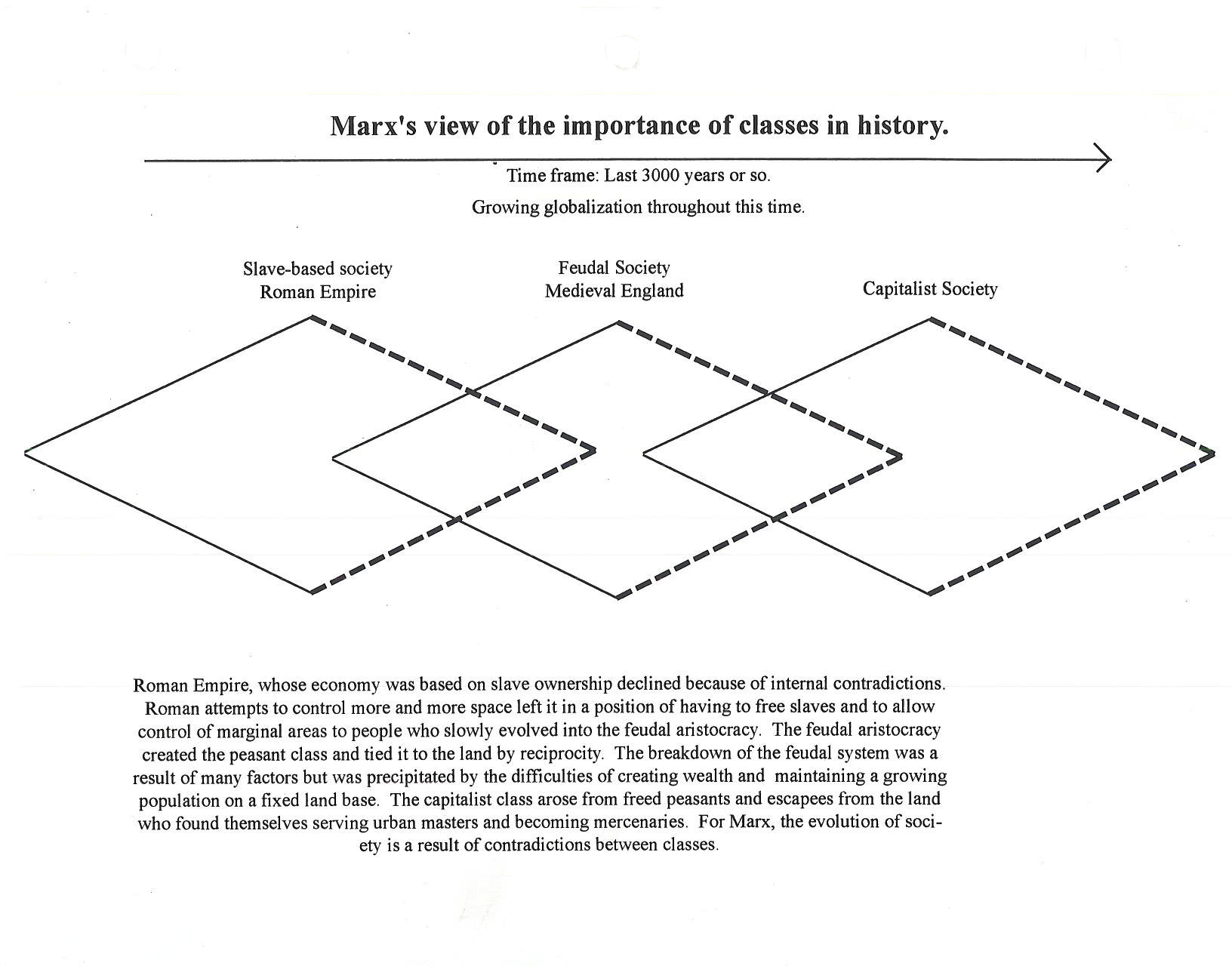
The capitalist mode of production was born in the contradictions between the ruling feudal aristocracy and the peasant classes.  The feudal system of governance was born in the dissolution by internal contradiction  of the Roman empire.  Revolution is a process, not an event. As you can see from the graphic I attach here, European history is based on a series of transformations that take decades if not centuries to complete if they ever really ‘complete.’  Feudalism is long dead, but some of the old monarchies still persist if only symbolically and for hegemonic reasons.  The concentration of capital in commodities rather than in land as had been the case if feudal times, began during the flowering of Medieval society but it didn’t become the predominant mode of production until political and economic forces combined to unleash fettered commodity production and exchange in the law courts, parliaments and government bureaucracies all over Europe.  The move of capitalist exploitation into North America and elsewhere through colonialism accelerated the process.  My point here is that ‘revolutions’ take time.  They are not events, although they often engender massive violent events and social upheavals much as volcanoes do.  The ‘French Revolution’ was less a revolution than an episode in a process of the creation of the French ‘nation’ as a vehicle for capitalist expansion into manufacturing and finance.  We all are born, grow into adulthood, decay and die.  This isn’t rocket science, but we live as though it weren’t true and much of what we call science in the social sciences is based on the denial of this fact.  The capitalist class at the moment can be smug in its virtual total control of all national governments, even that of China.  But it’s time will come.  When it puts us all out of work, it will have no way of creating surplus value and profit.  It will be unable to sustain itself and grow.  However, the legacy of technique and technology, that ‘labour-saving technology’ we were all ga-ga over a few years ago is what will provide the basis for a future communistic mode of production, one that will not lead to the concentration of capital in individual hands, but, instead will remain in the public trust.  We will be truly ‘public’ then, but don’t hold your breath, we have some time to go before the end of capitalist concentration of wealth.  A ‘communistic’ mode of production cannot dominate the world’s productive forces until all the forces of capitalist production are exhausted.  And exhausted they will become.  Again, more on that later although I can say that my next post will be about communism and lies, lies on every which side.   Communism has never existed on this planet except as an ideological rallying point.  Never as a real productive, predominant force.

Click on Image to EnlargeImage

The collectivity that is ‘I’

After reading Norbert Elias’ What is Sociology and having taught the subject for 36 years myself, I’m struck by what it takes to make a person(ality) and reminded of the complexity of the task.  As the symbolic interactionists among us are quick to point out, we, as individuals, are a product of our interactions with ‘others.’  Charles Horton Cooley even refers to the ‘looking glass’ self in emphasizing the notion that our person(alities) are socially created.  Thinking about it for even a moment makes that fact clear.  What language would you speak if you weren’t ‘created’ socially?  What kinds of things would you believe?  So, given that we have a certain bio-genetic reality which is  itself socially created (what is the sexual act if it’s not a social one?), we are ‘constructed’ in our interactions with others.  ‘Others’ here must be taken quite broadly to include not just people close to us, but also people (and I would also include other species of animal and even ‘things’ very broadly determined) far removed from us in time (grandparents, relatives, etc.) and space (neighbours, local people, etc.).  In fact, ‘others are no less socially created than we are, of course. Our person(alities) are virtually collective realities that wouldn’t exist outside of the collectivity or collectivities.  So, we probably shouldn’t refer to ourselves as ‘I’ but as ‘we.’ Of course the Queen does that when she refers to herself using the royal ‘we.’  She does it because she represents the state and so she includes all citizens of the Commonwealth when she refers to herself in the third person.  If I were to use ‘we’ to refer to myself, I would include all the people, including myself, in all of our interactions and interweavings, who had a hand in ‘raising’ me and making me what I am.  Which would mean that if I were diagnosed with bipolar disorder or any of the other thousands of ‘disorders’ that are found in the DSM-5, the psychiatric bible of disorders, I would have to say that ‘we’ have bipolar disorder.  Sounds strange, doesn’t it?  But what other conclusion can I reach?  This is the conclusion R.D. Laing and Thomas Szasz (both psychiatrists) came to with regards to schizophenia and they were soundly criticized for it and symbolically beaten up by their ‘colleagues’ for even suggesting such a heresy.

And heresy it is.  The reason that this is such a heretical idea is that we have clung to the idea for a long time now that we, as individuals, are the agents of our own destiny.  We have individual ‘free will,’ not collective free will.  [I’ll switch to I now for emphasis.]  I am responsible for my own actions.  That way if I work hard and get rich, I can say it was all my doing, and if I fail, I must feel the shame of it all by myself.  Others can do the same when they think about me.  They can judge me as a success or failure and they can (without a doubt) attribute that to my own actions.  If I commit a crime, it’s my responsibility and not a collective one.  After all we don’t send families to jail for the crimes of one family member, we send just that one person to jail.  This is an ideology, a way that we justify and explain ourselves to ourselves and to others, based in the early days of the capitalist mode of production when the ‘individual’ was created, a crucial state of being for entering into contractual agreements.  Fernand Braudel argues this in his awesome three volume tome on early capitalism as does George Duby in his introduction to A History of Private Life, a book he edited that was published in 1988.  Others too have taken up the challenge of putting our individuality fetish into a social, historical and political context.  C. B. Macpherson’s The Political Theory of Possessive Individualism, published in 1962, traces our love affair with individualism to Locke and Hobbes (I would throw in Descartes too) but anchors his views in a clearly dialectical framework, with material life still leading ideas in the end.

I could go on for a long time on this topic.  In fact, I want to turn this discussion to Durkheim and Collins in my next post.  They argue (along with many others) that God is a symbol for society.  So, when we say that we are created by God, we are really saying that we are created by society.  Let’s see where that takes us.

Countries are about to lose their reason for being (Part 1).

Some of us, many of us, really have the sense that our country is one of the most important things that give us our identity as individuals and as cultures. But what is the origins of this thing we call ‘country’ or ‘nation-state?’ Does it ‘deserve’ our undying loyalty, love and respect?  I wrote a script for The Knowledge Network many years ago (1992 to be precise) in which I address these questions and other related ones with regard to Canada.  If I were to write it today, I wouldn’t change much, but I will update this commentary in a new post soon.  Now, read on and comment if you like.

Is Canada a Capitalist Society?  Interesting question and not as simple to answer as it seems, I think.  Generally, when this question comes up, people immediately think about Capitalism and Socialism or Communism.  Canada isn’t communist, that’s clear…but is it socialist?  Well, what does socialism mean?  Many people think of socialism as government ownership and control.  For some, socialism means no more free enterprise, no more freedom of choice and no more good life!   For others it means Medicare, EI,  Canada Pension and Social Services.  If socialism means government takeover of private business, then the W.A.C. Bennett Social Credit rabidly free enterprise government of  B.C. was one of the first socialist governments in Canada.  It took over B.C. Electric and made it into B.C. Hydro, took over responsibility for ferries in the province and monopolized the sale of alcohol.  Well, most people would never think of the Social Credit Party as socialist, but there you have it.  Just kidding of course…but it still leaves us with the problem of coming up with a way of deciding whether or not Canada is a capitalist society.  Is it mostly capitalist with some socialist policies?  Can we talk of shades of pink, or is it one or the other?  Well, maybe there’s another way of approaching the whole question.


Let’s stand way back and check out the view from there.  We are very accustomed in this part of the world to seeing things from the perspective of our countries.  I’m not saying that we’re nationalists, necessarily, but that our frame of reference is our country.  We think of “Canadian” society, the Canadian educational system, the Canadian political system, the Canadian legal system, the Canadian transportation system, etc.  We view Canada as an entity, a thing in itself.  We use Canada as “containing” our society.


There is another way of thinking about these things.  It is very difficult, though, because we take our conventional view of things completely for granted.  We have difficulty even conceiving of another way of seeing things.   It requires a real perceptual shift.  But let’s try this on.  Think of the concept of Capitalism as a basic reference point rather than the idea of Canada. In this conceptual scheme capitalism has time and space dimensions but I want you to think about it more as a set of institutions or way of doing things, organizing ourselves and thinking.  The primary institutions of modern capitalism are private property, business enterprise, the machine-process, the class system, wages, the division of labor, the market and the price system.   Taken together, these institutions, along with others, make up what we might call the economic basis of capitalist society.  I’m not talking about people here, but about the ways that have evolved by which we relate to each other in society.  The primary institutions are those concerned with how we organize ourselves to make a living…that being the basis for the rest of social organization.  We have to make a living as societies before we can do anything else.   In order to survive…and this is an evolutionary perspective…capitalism generates a whole range of other institutions, or it appropriates them, borrows, begs or steals them historically from previous societies.  These institutions  we usually define as being political, social, legal, educational, etc… And they evolve  themselves and together…like all the organs of your body evolve together.


From this perspective, the way we organize official learning, in classrooms with the teacher as authority and children conceived of as empty vessels to be filled with standardized knowledge is a basic educational institution of modern capitalism.  Whole organizations, plants and facilities we call  schools, colleges and universities are created to service this institution which itself serves to ensure the survival of capitalism.  What kids learn in school is more important than just math and social studies.  In the way the school is organized, in the way they are regimented and disciplined, kids learn their eventual place as workers within a capitalist society. It could hardly be otherwise.  An educational institution that would contradict the basic way that we organize ourselves to make a living wouldn’t last long.


Countries as we know them are political institutions that arose in conjunction with the rise of capitalism in Europe.  They are the products of the growth of capitalism:  they exist to regulate the flow of capital and labour; to provide infrastructures such as roads for the movement of capital and labor (not always successfully); to defend capitalism, or sometimes the interests of a group of capitalists in competition with another group; to provide a context for law and order and the right “climate” for investment, etc… Once in existence along with the institution of citizenship, countries tend to legitimize the notion that citizenship is a status more important than that of worker.    Citizenship, with all of its caveats and rights,  is the political/legal expression of your right to sell your labour on a market.


Canada, then, is by definition a capitalist institution.  It “fits” into a now global system of political institutions that exist to perpetuate capitalism…and make no mistake about it, capitalism is the more fundamental institution here.  It makes little sense to speak of “Canadian” capitalism or even of “Canadian” society, for that matter.  Canada, the political institution, is part of a global capitalist society.  It makes much more sense to speak of the role of the Canadian state in the perpetuation and  survival of the growing capitalist global system.  If the government takes over the operations of a losing propositions such as B.C. Electric, then it does so to ensure that capitalism can still grow and prosper.  Capitalism needs cheap power.  There’s no money in it, but it is nonetheless necessary.  Why not get workers, as citizens and taxpayers, to subsidize it?    If the government sets up systems to train potential workers (i.e., the school system), to support unemployed workers, to nurse them back to health, to provide them with pensions upon retirement, it relieves the pressure from the capitalist to do so, a pressure that the slave master or the lord of the manor had in totality with regard to the well-being of his slaves or serfs.  So, in a big way, the governments in our country help to manage the working class.  And through the tax system arrange to have the working class cover the expenses for its own management and even cover the costs of capitalist risk-taking itself, again through the tax system.


This may sound cynical and negative, but I don’t think it is.  Nor do I think that the system stinks and that all capitalists and politicians are lying, good for nothing exploiters of the working class.  I’d rather be a worker with only half of my waking life in the service of someone else than a slave with my whole being and life in the service of someone else.  Besides, capitalists and politicians are harnessed to the needs of capitalism as we all are…much as all the cells in a human body are harnessed for the survival of the body as a whole…and the whole thing will live just as long as it has not exhausted all the resources it has to keep it alive.  Countries are one of those resources that serve the ends of capitalist survival.  Canada is one of those resources.