Ernest Becker 2: Oh, Our Lovely Tummies

Ernest Becker 2: Oh, Our Lovely Tummies

So, following yesterdays post, Becker argues that we are animals.  Well, what else?  I know, I know, we think of ourselves as humans not animals, but that’s not a distinction that makes much sense.  Science has gone way beyond thinking of things on this planet as being exclusively plant, animal or mineral.  It’s not as simple as that.  However, for the moment, I hope you’ll accept my argument (and Becker’s) that we aren’t rocks or minerals or grapefruit.  No, we are animals.  We share genes with grapefruit and we need some minerals to survive, but we aren’t plants or minerals in any obvious sense.  That’s Becker’s opening argument:  we’re animals.  We behave very much in animal ways although we also very much deny it with all of our best efforts.  We have a lot in common with most animals, more with some than with others, of course.  So carrying on from where we left off in the last post Becker writes:


Beyond the toothsome joy of consuming other organisms is the warm contentment of simply continuing to exist – continuing to experience physical stimuli, to sense one’s inner pulsations and musculature, to delight in the pleasures that nerves transmit.  Once the organism is satiated, this becomes its frantic all-consuming task, to hold onto life at any cost – and the costs can be catastrophic in the case of man…For man…this organismic craving takes the form of a search for “prosperity” – the universal ambition of human society…In man the search for appetitive satisfaction has become conscious: he is an organism that knows that he wants food and who knows what will happen if he doesn’t get it, or if he gets it and falls ill and fails to enjoy its benefits.  Once we have an animal who recognizes that he needs prosperity, we also have one who realizes that anything that works against continued prosperity is bad.  And so we understand how man has come, universally, to identify disease and death as the two principle evils of the human organismic condition.  Disease defeats the joys of prosperity while one is alive, and death cuts prosperity off coldly.


Tomorrow we’ll see where Becker takes us from here.  But from what he’s established in the first two or three pages of his book in a chapter called The Human Condition: Beyond Appetite and Ingenuity we know that for us humans, death is a final insult to an organism that is warm and feels so wonderful with a full stomach.  We love our tummies.  How could they possibly melt away into insignificance?

What the hell is ‘quality of life?’ Part 3

So, I’m back at it.  Lately I’ve been reading a book called The Truth About Art: Reclaiming Quality by Patrick Doorly.  Doorly refers to Zen and the Art of Motorcycle Maintenance by Robert Persig in very flattering ways.  Persig’s book is all about quality and what it means.  For Persig, quality is in the interface between things.  It’s not a thing itself.  As an aside, nowadays we’ve perverted the concept of quality to the point where quality only means ‘good’ or ‘high’ quality.  Apparently poor quality doesn’t exist anymore.  Now, when we speak of quality goods we always mean good quality goods.  That’s pretty stupid, in my mind, but that’s the way language seems to evolve.  Returning to my point, there is no question in my mind that quality exists in the interface between things.  I, being a thing, can find another person, also a thing, either good or bad, of high quality, or of questionable character and quality.  Quality is in the judgment I make about something even if that judgment is largely socially constructed.  I may find a Mercedes of higher quality than a Toyota Tercel but ‘society’ has already made that judgment for me by reference to the price of the vehicles in question.  The value of the vehicles, strangely enough, may have little to do with price.  But I’ll leave that seeming contradiction for a discussion at another time, after I’ve finished reading Doorly and re-read Persig.  Again, back to my story.

So, quality of life is partly an individual thing, a judgment about how a life is lived, but it’s also about the ‘price’ and ‘value’ of that life itself and how it can be lived.  Life implies mobility. Dead things don’t move. The more we have ‘life’ in us, the more we move.  In our world, personal, individual mobility is gotten by having money and good health, of course.  No money, no mobility, no life. Poor health equals poor mobility.  So, having money means to be alive and to be poor means to be immobilized and socially dead in the eyes of the majority of people in our world, including poor people themselves when they (generally) buy into the moral assumptions about quality and value that drive us in our daily lives.  So, what is a high quality of life in our (moral) world?  Well, it’s having some mobility and the ability to make choices the immobilized cannot make.  The poor and unhealthy are essentially stuck, blocked and unable to move in the marketplace or in just plain physical terms.  Being stuck/blocked is essentially the definition of guilt.  Guilt here is a social concept, addressing just how well one ‘fits’ within the moral wall of the ‘community,’  large or small.  In our world, being guilty is not being mobile, without wealth or health.  We [as a pronoun here used in the broadest and most inclusive of terms] generally have no great sympathy for the poor or the ill.  We speak sympathetically of the poor and the ill but culturally we have institutionalized suspicions that the poor are that way because they are morally weak and people who are ill have only themselves to blame or their families, who should look after ‘their’ ill because they are often responsible for whatever family illnesses there are.  Never mind that most ‘poor’ people are that way not out of any moral weakness but because of circumstance, family history, and the fact that there are rich people in the world.  ‘Poor’ people are as necessary to a ‘properly’ functioning society as wealthy people but we can’t let them think they are important or necessary.  We need to make them feel guilty for not being wealthy.  After all they are poor because they are morally weak.  Let’s be clear about what it means to be morally upstanding in our world.

To be morally upstanding in our world is to be wealthy, healthy and male above everything else.  If you aren’t those things, it’s your duty to give the best impression that you actually are those things.  Drive a car you can’t afford, live in a house you can’t afford because you need to give others the impression that you are a morally upstanding member of society.  It’s no surprise that most of our laws centre around private property. It lives at the core of our morality.  But so does business entreprise, the factory-system, individualism, hard work and maleness to name a few.  To test this view, just think of the things ‘we’ hold dear and the things ‘we’ loathe, fear, detest or for which we have little regard or esteem.  Need I make a list?  How about a couple of examples.  In our world, individualism is a ruling moral force to such an extent that labour unions are scorned by many people even those who would benefit from their existence because they are collective organizations.  We hold individualism to be of such importance these days that business corporations are now considered legal individuals.  Even though corporations are made up of groups of people aligned together to produce a result, that is to make money, they are considered legal individuals.  Unions are not considered legal individuals, rather they are thought to be evil because they contradict

the global love we have for individuality and it’s ideology, individualism.  So, we live in a world circumscribed by a more or less well defined moral wall.  Imagine a place, say an old English castle, surrounded by a high wall with the king’s residence in the middle and the rest of the people living in concentric circles around the middle depending on how close they are to the king in moral terms.  You have to know where the poor live.  Yes, right up against the wall and maybe even outside the wall.  It’s no wonder we struggle so much trying to look wealthier or healthier than we are.  We are constantly testing each other, trying to determine where we reside in our moral world.  Go to a party where you don’t know a lot of people and the first question you will be asked is “So, what do you do (for a living)?  If you say you’re retired then be expected to be asked “Planning any trips abroad?  Our daily conversations are laced with attempts to determine where we stand in relation to others around us on the moral spectrum.  How close to the king do you live?

So, to get back to my original concern here with quality of life, I have to say that quality of life is judged finally on where we ‘reside’ in our moral world.  The closer we are to the king’s domain in our world, the better we think of our quality of life.  But that’s not the end of the story.  There is a social dimension to the quality of life and a responsibility we have as a community to respect all people who reside within our moral walls.  The king could never keep his castle without the help of ‘his’ people.  The wealthy in our world are the same.  No poverty, no wealth.  The wealthy need the poor, not only to make their lattés but to collect their garbage, repair their roads and cars and to buy the products they sell.  The wealthy 1 percenters in our world would be lost without the buying power of the rest of us.  Yet they have little or no respect for us.  Well, why should they?  The poor have no moral standing in our world.  They deserve their lot in life, don’t they?

Hitler’s Willing Executioners meet your Potential Modern Inheritors

Yes, the title is a wee bit provocative but let me explain.  In 1996, Daniel Jonah Goldhagen published Hitler’s Willing Executioners: Ordinary Germans and the Holocaust.  This book, from the back cover on my edition, “…lays to rest many myths about the Holocaust: that Germans were ignorant of the mass destruction of Jews, that the killers were all SS men, and that those who slaughtered Jews did so reluctantly.  Hitler’s Willing Executioners provides conclusive evidence that the extermination of European Jewry engaged the energies and enthusiasm of tens of thousands of ordinary Germans.”  Goldhagen systematically addresses many conventional explanations for The Holocaust: 1) the perpetrators were coerced, 2) that they were merely following orders, 3) that they were under very severe psychological pressure, 4) that they were petty bureaucrats needing to perform whatever tasks assigned them for the sake of their own career advancement, and 5) that people performed isolated and fragmented tasks so that they couldn’t appreciate the significance of their actions.  He then addresses each of these explanations and rejects them categorically.  He argues that a great deal of horrifying brutality and genocide was exercised not by insane people, but by ordinary people carrying out their sacred duty to The Fatherland.  This may be hard to believe, and the only real antidote to this scepticism is a thorough reading of Goldhagen’s book, but he is very convincing in his argument.  His book is carefully researched and highly insightful.

For Goldhagen, The Holocaust was not the result of aberrant individuals, bureaucracy, indifference, ignorance or individual pathology of any kind and it was only possible because Germany and Germans, ordinary Germans, were systematically changed  into anti-semites in very large numbers well before the war started. It was, he argues, the culmination of a process by which the German people, ordinary Germans, were convinced over decades that the biggest impediment to Germany’s apotheosis, its rise to true glory, was the Jewish people.  Over decades before the war, Jews were portrayed as the greatest evil that Germany faced as a nation.  So, it seems that Germans in their passionate love of The Fatherland were not only willing executioners of Jews (and other groups of people seen as a threat, either to The Fatherland, as in the case of Jews, or the Aryan race as in the case of people with mental or physical disabilities, the Romany, etc.), but enthusiastic, gleeful, inventive, proud and patriotic perpetrators of unbelievable brutality towards Jews.  There is a photograph in Goldhagen’s book of a German soldier, an ordinary German soldier, shooting in the back of the head a young mother while she holds her child in her arms.  He did it in front of the camera, proud of his patriotic deed.  Obviously, human beings are capable of incredible personal barbarism but that barbarism is more often than not released against ‘the other,’ the perceived source of all evil and danger to the group, whether it be the marriage, family, community, town, city, province, country or ideology (pick any one).  The soldier who shot the young mother did not see his deed as barbaric, but rather as patriotic, as one more step in the elimination of the Jewish evil infecting glorious Germany and threatening to weaken the Aryan race.  From this viewpoint, every time a German kills a Jew, man, woman or child, Germany gets stronger.  Essentially, the Jewish people were offered up as a sacrifice to ensure the future prosperity of the German nation. From here on, my argument gets a little complex and much of it arises in Ernest Becker’s work summarized in his posthumous book Escape From Evil (1975) in which he writes:

…the psychology of the Nazi experience, […] served as a grim refresher course on the metaphysics of mass slaughter.  Leo Alexander, in his outstanding paper on the SS, points out how much the Nazis were animated by what he calls a ‘heathen concept’: they had a whole philosophy of blood and soil which contained the belief that death nourishes life.  This was ‘heathen’ indeed: we recognize it as the familiar archaic idea that the sacrifice of life makes life flow more plentifully…Goering, for example, made a statement early in the war that ‘with every German airman who is killed by the enemy our Luftwaffe becomes stronger. (p.103)

So the logic of mass murder becomes clear. The ‘cleansing’ of Germany of the ‘dirty’ Jews was supposed to make Germany stronger, an idea that had been brewing for a long time in the German mind.  In essence, Goldhagen’s insistance that Germany was infected long before the Nazi era with a profound antisemitism fits in perfectly with Becker’s observation that The Holocaust was not an ‘event’ in history, but a consequence of a profound and longstanding insecurity that ordinary Germans had regarding the state of Germany.  Relief from this insecurity culminated in the execution and torture of masses of Jewish people.  It became the duty of all right-thinking, patriotic and heroic citizens to participate fully in the elimination of the Jewish evil, an evil inherent in every sub-human Jewish man, woman and child, the evil that threatened, in their minds, the very source of their life and power, The Fatherland.  Of course, the whole enterprise was a lie.  No amount of killing could save the German nation.

So, what can we now make of Goldhagen’s contention that it was ordinary Germans who were the perpetrators of Hitler’s program to eliminate Jews from Germany (and everywhere else given enough time)?  What we can say is that most evil in the world is not the result of the actions of aberrant individuals -although they definitely express their aberrance when permitted  to or encouraged by the state – but of ordinary people expressing their love for country or idea (racial purity, the uselessness of the poor, God, the glory of money, etc…).  As Becker states it, “…evil comes from man’s urge to heroic victory over evil.” (p.136)

What lesson can we learn from Goldhagen (and Becker – but more on that later)?  That blind nationalism and unquestioning faith in God and country have, and can still, lead ordinary people into committing the most atrocious, genocidal actions possible.  The Rwandan massacre of 1994 is an example of just such a thing and let us not think for a moment that it will never happen again.  From the vitriol I’ve been reading in comments following articles on the Idle No More movement, I expect that ordinary Canadians could be led into the same genocidal frame of mind as ordinary Germans were during the Nazi era.  Canadians are not anywhere close to becoming genocidal now, but systemic racism, scapegoating and a profound ignorance of the actions of their own government towards aboriginal people can set the stage for popular descent into crass racism and incivility.  When the government’s agenda are dominated by the private accumulation of capital, any perceived impediment to economic growth such as treaty negotiations will be seen by some as a threat to Canada as a nation and it’s sovereignty.  Once aboriginal people are openly scapegoated and blamed for a poor economy we will have to be doubly vigilant to ensure that the situation does not get out of hand and degenerate into widespread and open hostility towards First Nations.
A Commie I’m not. A crusty old Marxist, maybe.

So, we had a big party at the homestead recently and I was lovingly described as a communist by my son-in-law. I appreciate the sentiment behind this remark.  For him, it’s a term of endearment.  There were many ‘left-leaners’ in the crowd who would have appreciated the comment because in some senses we share many moral precepts.  Oh, I’ve been described as a commie before.  It wasn’t the first time, nor will it be the last in all likelihood.  I really don’t mind all that much.  Whether or not people actually believe that I’m a communist is another matter and I hope to set the record straight here for anyone who cares.  If people read this blog posting,  and few will, they will know my position on the matter.  For my own sense of self, for myself, I want to set the record straight once and for all.

When I state that I’m not a commie, that doesn’t mean for one second that I’m a proponent of ‘capitalism.’  Many people see communism and ‘capitalism’ as opposites, as alternate ways of organizing ‘the economy’ and ‘society.’   I don’t, nor did Karl Marx when he got old enough to think straight.  As an aside, Harold Adams Innis, the brilliant Canadian political economist and historian said, in a moment of particular lucidity, that one cannot make a contribution to the social sciences before one reaches the age of 50 and he’s probably correct.  He was 58 when he died and his best work happened in the last 5 or 6 years of his life.  Marx was born in 1818 and died in 1883.  It wasn’t until the late 1860s that he really got his shit together, hunkered down in the British Museum and started writing Capital.  Yes, yes, he wrote the Economic and Philosophical Manuscripts earlier, but he really got serious later.

The reason I say I’m not a communist is that I’m not a proponent of communism.  For me, or anyone else, to be labeled a communist or anything else for that matter implies a certain level of advocacy, of ‘proponency.’  It’s not necessary to be proponent of something that will eventually happen no matter what we think or wish.  It’s like being described as an old-agist.  I know that old age will happen to all of us, but that doesn’t mean I’m a proponent of old age.  I’M getting old, but that doesn’t mean that I advocate old age. That would be ridiculous.  A communist mode of production will inevitably replace the capitalist one because the internal contradictions within the capitalist mode of production dictate it in the same way the feudal relations of production replaced slave based ones and the capitalist mode of production replaced feudal ones.  The change will happen gradually, just as old age creeps up on us.  Before it’s clear what’s happening, the old bones get brittle, the arteries plug up and the organs just can’t cut it anymore.  The resiliency of youth is past, old solutions no longer get the same results they used to.  Life inevitably brings on death, they are different sides of the same coin.  What that means for me as an individual is clear, what it means for ‘society’ or for the ‘capitalist mode of production’ is also clear.  Nothing is forever, nothing.  Not the capitalist mode of production, not our beloved countries, not our cities, not our towns, not our fabulous wealth.  The question is not whether or not the capitalist mode of production will live on forever, but when it will die.  It’s not even a question of how.  That’s also been clear for a long time.  Still, classical economics is still in classical denial over the whole thing, a fact which is made clear on virtually every page of The Economist which is a proponent of capitalism.

For what I’ve written above I could be branded with the sin of determinism, one of scholarship’s seven deadliest.   If saying that one day I will die makes me a determinist, well that’s ok by me.  Call me whatever name you want.  Furthermore,  what I write above does not mean that life is completely meaningless to me.  We live life on many levels, a day at a time.  My life is full of activity and that means that every day I make many moral decisions most having nothing or little to do with my eventual death.  I don’t  live life as though my life is about to end (I didn’t do that even when I had cancer and the possibility of my quick exit from this life was very real).  I DO things, there is nothing else to do.  I read the papers, listen to the radio and watch TV.  I play with my grandkids.  I can’t help but get outraged by the blatant bullshit and crap that comes out of the government in Ottawa on a daily basis.  Yet I understand  the role that national governments play in the capitalist mode of production and their essential collaboration in making it possible for capital to flow with greater and greater ease globally  and for controlling labour by keeping tight reins on migrations and regulation.  I haven’t lost my moral compass.  I even get angry on one level…say, at incivility, at stupid driving, at poor highway engineering…while understanding that at other levels, the picture is much different and anger makes no sense.  As I write above, we live life on many levels, many planes.  They are all connected although not always in obvious ways.  Even otherwise highly educated people don’t see the connections.  The connections, interconnections and interweavings become visible only after a sustained gaze upon them.  To see them requires special training.  Somewhere, Norbert Elias got that training, as did many other thinkers who have had a sustained influence on me over the decades.

Death Denial

If there’s a constant in human history, it’s death denial.  Ernest Becker, in the last book he published just before his death in 1974, The Denial of Death, explores and explains the pervasiveness of death denial in all cultures all over the globe.  I cannot recommend this book highly enough for anyone interested in trying to come to grips with their own death, but also with the death of cultures, ways of life and all cultural artifacts.  According to Becker, individual death is a given, at least in the physical sense, but as human beings, we can’t accept that inevitability, so we devise sometimes very elaborate systems of death denial.  For Becker, cultures themselves are immortality projects designed to deny death.  The Christian idea of the soul is a great immortality project.  The body dies, the soul lives on forever.  Take that, death!  Life 1, Death 0.  So, Christians can live thinking that when they die, they live.  That’s comforting, I guess, if it’s possible to really believe that.  My sense is that doubt is hard to cast aside.  Is there really an afterlife?  After all, it’s just promises, no proof.  It’s also my sense that one way to assuage guilt over doubt is to affirm the death denying ideology of the soul more firmly than ever.  I’m not picking specifically on Christians here, everybody else does it too.  There are atheistic religions like Buddhism but they also have mechanisms that promise some form of immortality.

None of this is surprising.  In the simplest of biological terms, living organisms, particularly the sentient ones, ‘want’ to continue to live.  It’s a basic drive.  Becker’s book, Escape From Evil, published shortly after his death by his wife, Marie, and his publishers, expresses this beautifully in its first few pages.  We are driven to fight the two pillars of evil in life: disease and death.  Disease injures our potential to enjoy life, to revel in a good meal, an excellent glass of wine, or a particularly spectacular sunset.  Death takes away everything, all enjoyment, all time, all everything.  What greater evil can there be?  So we devise elaborate schemes to make us feel like none of this will ever happen to us?  Not to humans.  We are the chosen species.  We are not like other animals.  We are special under the sun.  And if anyone dares say otherwise, well, that’s most unfortunate for them.  They must be dealt with in the harshest of terms because if our death-denying ideologies are proven to be weak or just plain lies, then we die…forever.  Aboriginal cultures everywhere, when faced with the power of colonialism, abandoned their traditional practices and took on the beliefs of their captors and colonizers.  Why continue to put faith in an immortality-ideology that failed to protect them in their most trying moment?

Now, of course, the most powerful immortality-ideology is capital accumulation and wealth.  But we know that this kind of ideology, no matter how powerful cannot promise us immortality.  Still, there are many people today who live and die for ‘freedom’ to accumulate capital to get rich.  They are, in fact, willing to kill the very planet they occupy so that they might live forever.

This short post barely scratches the surface of the importance of Becker’s work.  I’ll come back to Becker over and over again in posts to come.


Death is necessary for life…

Try eating live things.  They don’t like it and usually put up a fight.  The fact is that we normally like to eat our food dead.  There are situations where we like to get close to the line between life and death, say when we boil lobster or crab alive, or when we go to a restaurant featuring live fish in large tanks and pick out our dinner as it swims by.  But by and large we like to be assured that our food is nicely and fully dead.  Vegetables are no problem.  We hardly consider them alive in the first place although they are of course.  Not everyone likes their veggies, but their dislike is generally not based on whether or not they are dead.  With animals, it’s another matter.

We ‘relate’ to animals, animate things, especially if they’re young, cute and cuddly.  When we in the West find out that some people in China and Korea eat young dogs, preferably St-Bernards, we find it hard not to gag or throw up.  We know that ‘veal’ really means baby cow but we try not to think about it. Lamb is the same, baby sheep.  So are weaner pigs, that is, pigs that have just been weaned.  We know killing happens.  We wouldn’t be able to eat steak, bacon, roasts or ham without the killing. It’s just not right to think about it or bring it up in polite conversation.  The fact is that humans slaughter millions if not billions of animals every year (for food or as ‘pests’), sometimes by specialists like in the West, but by lots of non-specialists in Africa and other ‘poor’ parts of the world too.  People all over the world realize that they like to eat their food dead and somebody has to do the dirty deed.  Now, isn’t that an interesting way of putting it: do the dirty deed?  Of course you’ve heard that.  To do a dirty deed…ultimately means killing someone or something. The reference to dirt we’ll come back to.  But for now, let’s face it.  Although we don’t like to admit it, death is really important to us.  But of course death is important to us not just in terms of the food we eat.

If things didn’t die, things couldn’t live. If people didn’t die, there would be standing room only on the planet in very short order.  We think there’s a lot of people on the planet now!  If people didn’t die, I’m not sure how they would be born, but that’s an issue for another post.  So our underlying unquestioned assumption that life is good and death is bad is patently ridiculous.  Not that we’ve ever shied away from espousing ridiculous ideas.  No, people need to die so others may live.  The problem is all about the quality of death and dying.  We know that we are born at one point, grow up, mature and then die, at least on a ‘normal’ trajectory.  There’s lots of variation in the length of time we live.  For instance, in some parts of Africa an individual is lucky to live to be 37 years of age.  Here in Canada we’re looking at a normal life span getting into the eighties.  In the ‘poor’ countries, many children die very young.  We think that’s a shame, really. But we don’t like to think about it too much.  We see the starving children in the OxFam or whatever commercials and cringe a little, but it’s not really our problem.  Distant death is barely death at all whether we are talking about time (as in death centuries ago) or space, (as in death in Somalia or Mali, far away in Africa).  We have some vague sense that many people die in Canada every year, but we don’t really know how many, nor are we particularly interested.  But death gets more interesting the closer it gets to us, especially so close that we just can’t deny it.

When my cousin’s daughter was murdered on Halloween night last year, I was shocked and angry.  She was just at high school graduation age.  Some very disturbed young man -who’s since been caught and faces first degree murder charges – killed her that night and she’ll never be coming home. Many other thousands of people died that same day all over the world, but that doesn’t matter.  What matters is that someone in the family met a very tragic, unnecessary death.  I didn’t know Taylor Van Diest personally.  She lived a long distance from where I live on Vancouver Island.  My uncle Denis (my father’s brother) moved his family (including Taylor’s mom) to the Okanagan Valley decades ago.  He’s since passed away.  That broke the tie that kept our families in close contact.  Since then we’ve had large family reunions, but I haven’t attended many of them.  Too busy working most of the time.  Families drift apart.  There’s nothing wrong with that.  It’s just the way it is in a world that encourages radical insularity and downplays family except for ideological purposes.  Still, when a family member meets such an untimely death, it hurts.  For the immediate family the pain must be almost unbearable and it doesn’t wane.  The passage of time does little to heal the still gaping wound that is the absence of Taylor.  But, like I said, death is only meaningful to us when it’s close and it’s importance to us is inversely proportional to it’s distance to us in time and space.  What I’ve found in my career is that there isn’t just one kind of death.  There are many kinds of death just as there are many kinds of life.  Taylor’s death is not the same kind of death as the death of the pig that made it possible for me to eat bacon this morning.  One seems senseless, the other necessary.  We are horrified by Taylor’s death, rightly so.  When my father-in-law lay dying at Burnaby General Hospital twenty-three years ago, I was struck by the traffic noise, the talk in the hallway, the realization that death matters little to most of us most of the time.  The world doesn’t stop every time a person dies even though we think it should when that person is close to us.  No, we are really little affected by death.  Our systems of death denial are very  strong indeed making it all the more horribly distressing when the experience of death is so personal that our usual systems of death denial no longer work and we have to face it unmediated by ideology.  The experience is soul destroying and extremely isolating.  The visceral reaction of most people in this situation is to reach for meaning anywhere it can be found.  No search for meaning is entirely satisfactory.  There is always a residual emptiness.

To finish this up, I want to just say that death is not the opposite of life.  Living and dying are one in the same thing.  Distinguishing between the two is the result of a feeble attempt on humanity’s part to deny death.  To be blunt about it, the moment we are conceived we are on a death trajectory. How can we live with that realization without effective ideologies of death denial?  More on that in the next post.

And Capitalism Begat Communism

In my last post I may have given the impression that the capitalist mode of production will implode in a cataclysm or apocalypse.  An Armageddon, if not a Christian type of end story, still an end story.  Well, maybe I was feeling a little conspiratorial in my last blog.  Marx was right, of course, in his prediction of the end of the capitalist mode of production, but a child could have done the same.  It’s obvious that all things come into ‘existence’ at some point and then leave at another point, although ‘come into existence’ is misleading.  None of us is made of ‘new’ material.  We are made of recycled material.  I can’t remember who said it but it seems to be true (http://www.zyra.tv/lbreath.htm) that every  breath you take, you take in some molecules from Julius Caesar’s last breath.  That notion was brought home to me today as I walked through Mountain View Cemetery in Vancouver and saw the smokestack spewing smoke out of the crematorium.  Yes, breathing the ‘air’ means breathing all kinds of molecules, many of which previously inhabited people, some just now literally going up in smoke not 30 metres from me.  Doesn’t sound particularly appealing, but it’s true. No, all things come and go, but not completely or finally.  We just get recycled.  I tell me students every year that they are probably eating bits of their ancestor’s molecules when they eat their McDonald’s burgers.  Grosses them out.  The capitalist mode of production is no exception to this rule.

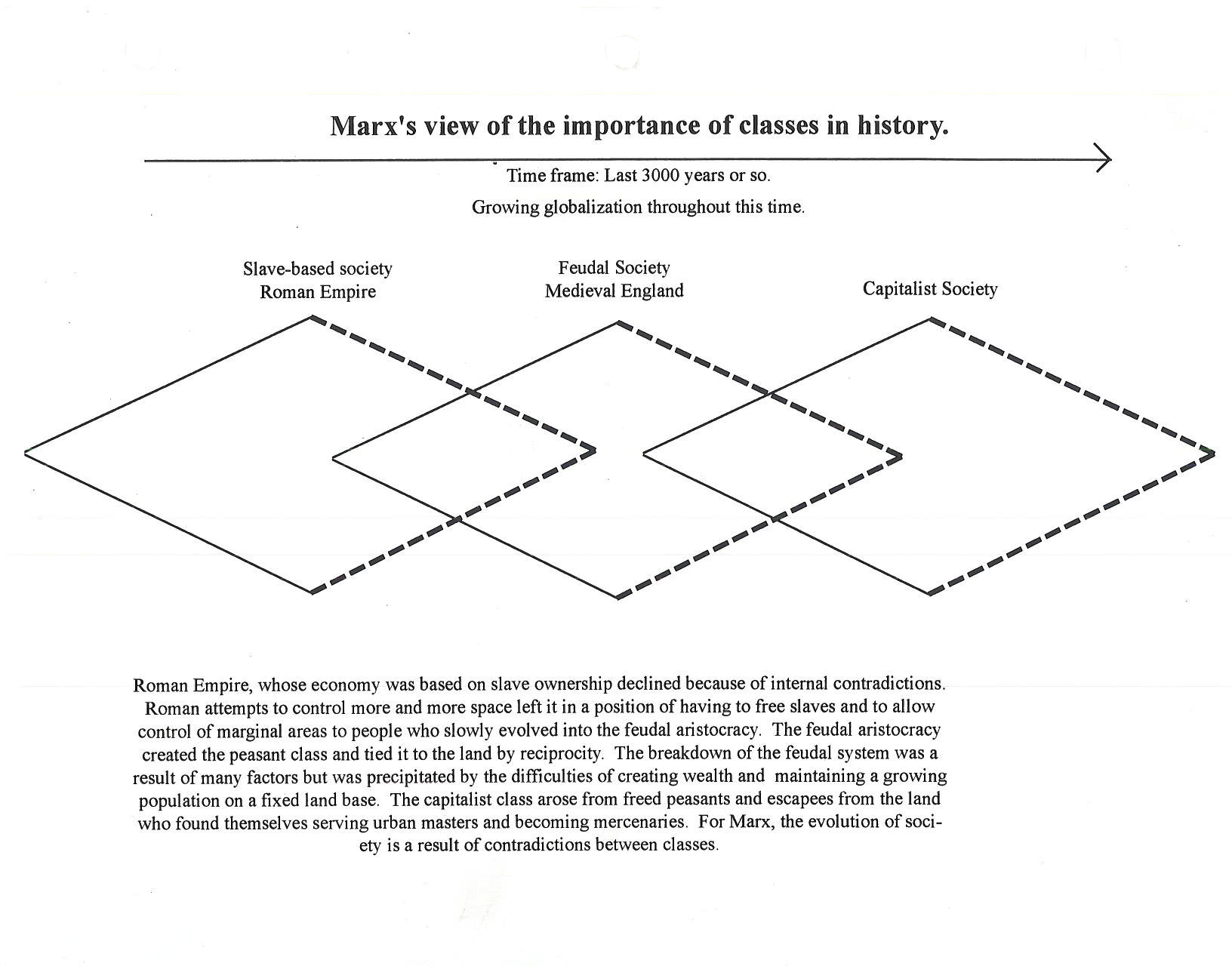
The capitalist mode of production was born in the contradictions between the ruling feudal aristocracy and the peasant classes.  The feudal system of governance was born in the dissolution by internal contradiction  of the Roman empire.  Revolution is a process, not an event. As you can see from the graphic I attach here, European history is based on a series of transformations that take decades if not centuries to complete if they ever really ‘complete.’  Feudalism is long dead, but some of the old monarchies still persist if only symbolically and for hegemonic reasons.  The concentration of capital in commodities rather than in land as had been the case if feudal times, began during the flowering of Medieval society but it didn’t become the predominant mode of production until political and economic forces combined to unleash fettered commodity production and exchange in the law courts, parliaments and government bureaucracies all over Europe.  The move of capitalist exploitation into North America and elsewhere through colonialism accelerated the process.  My point here is that ‘revolutions’ take time.  They are not events, although they often engender massive violent events and social upheavals much as volcanoes do.  The ‘French Revolution’ was less a revolution than an episode in a process of the creation of the French ‘nation’ as a vehicle for capitalist expansion into manufacturing and finance.  We all are born, grow into adulthood, decay and die.  This isn’t rocket science, but we live as though it weren’t true and much of what we call science in the social sciences is based on the denial of this fact.  The capitalist class at the moment can be smug in its virtual total control of all national governments, even that of China.  But it’s time will come.  When it puts us all out of work, it will have no way of creating surplus value and profit.  It will be unable to sustain itself and grow.  However, the legacy of technique and technology, that ‘labour-saving technology’ we were all ga-ga over a few years ago is what will provide the basis for a future communistic mode of production, one that will not lead to the concentration of capital in individual hands, but, instead will remain in the public trust.  We will be truly ‘public’ then, but don’t hold your breath, we have some time to go before the end of capitalist concentration of wealth.  A ‘communistic’ mode of production cannot dominate the world’s productive forces until all the forces of capitalist production are exhausted.  And exhausted they will become.  Again, more on that later although I can say that my next post will be about communism and lies, lies on every which side.   Communism has never existed on this planet except as an ideological rallying point.  Never as a real productive, predominant force.

Click on Image to EnlargeImage