Misogyny: What the Hell? Okay, Let’s Do This.

So, I’ve been putting off writing this post. The reason is that I’ve been reading, reading, and reading some more. There are hundreds if not thousands of books on misogyny and countless more scholarly articles, never mind the (probably) millions of newspaper, magazine, websites, blogs, and other sources I can’t think of right now, that try to understand misogyny or point out it’s catastrophic consequences especially for women, but also for all of us. And there are original sources to be evaluated including religious texts, philosophical works, and ethnographies. I’ve barely scratched the surface of the literature in reading and teaching a course on love and sex, but there are themes that re-occur again and again so it’s not necessary to read every piece of writing on the topic. What I have read is depressing enough.

I want to say that I have no intention of offending anyone by writing these words today, but some people will inevitably take exception. That I cannot control. Like Copernicus, Galileo, and the more contemporary Charles Darwin (although I’m not in the same category of eminence as they are), I must write what I see as the truth based on decades of study and reflection. That said, let’s do this.

As I wrote in my last post, misogyny started when the animal became the human. Of course, we’ve always been animals, subject to all the vagaries and uncertainties that that entails including the challenges associated with survival, including getting enough to eat and drink, protecting ourselves from threats (floods, droughts, volcanoes, rock slides, predators etc.,) as well as replenishing the species by making babies. However, when we evolved sufficiently to become self-aware, which took millions of years, we were able, with our now bigger brains, to try to deny that we were ever animals in the first place. Or rather, we didn’t specifically deny our animality, we just tamed it by making it subject to control by our ‘self’.

Language has long fascinated me and there is plenty of evidence in our languages of the attempted denial or taming of our animality. If I say to you: “My body is really sore from that workout yesterday,” to what does the ‘my’  in that sentence refer? What is it that can claim ownership of the body? This linguistic turn had profound impacts on humanity long before English evolved. Virtually everywhere I look in the anthropological ethnographic literature, we’ve determined that ‘we’ are in fact not just our bodies, but ‘we’ are much more than that. We’ve managed to convince ourselves via our dreams (awake and asleep), our growing imaginations and probably through trances brought on by drugs, dancing or fasting) that we must be a very special animal indeed. This process led Ernest Becker to argue that it’s our ingenuity and not our animality that “has given [our] fellow creatures such a bitter earthly fate.” (EFE, p.5) As we developed selfhood and  our brains grew bigger and more capable, we convinced ourselves through ritual that we were able to control heaven and earth. We invented rituals and projects like the zodiac to convince ourselves that the heavens were in constant intimate relations with us and we read chicken entrails and runes to determine how we might control natural forces that threatened us. We created culture to oppose nature, as Becker argues, and our cultures are more or less elaborate and sophisticated projects to deny our animality and, consequently, our death.

We always knew that animals died and we were not oblivious to the fact that we all eventually meet the same fate. What to do? Oh, what to do? Well, the ‘forces of nature’ were always overwhelming and difficult to handle but we determined that if we pursued the right rituals, we could affect the course of our lives and of nature. We began to bargain with the forces of nature. “You back off and give us good crops and we’ll sacrifice a bunch of sheep to you. Sound fair?” But the forces of nature (gods) were never satisfied and needed constant reassurance that we would feed them. Kingship developed as a way of having a god present at all times to take our gifts and keep us safe. We, however, the weak, vulnerable species that we are also needed constant reminders that we mattered and that the gods were paying attention and were on our side. So, we split our societies into ‘moieties’ or (literally) halves so that we might have someone to compete against to show the gods how worthy we were. That process is still extant in modern society. We tirelessly set up competitions to prove our worth, our value and we do it most frequently for the glory of our God (gods) or, now, our secular god, our country, that institution that ensures us survival beyond our animal lives. Religion has always promised us eternal life. Why else would it exist? Thousands of religions over the course of history have given people thousands of ways of gaining eternal life. Problem is, in a competitive world, if my way to eternal life promised by my religion is the right way, your’s cannot be. Sorry about that.

Now comes the part where the most momentous invention ever to come from the human species was wrought. That’s the notion that if our bodies are mortal, then the only thing we can do is deny them their due. Because we were now connected to the forces of nature we could pretend that we had an inside track on immortality. Gods were immaterial and immortal, we could be too. If we performed the rituals just the right way, we could ensure our eternal survival. Our rituals became increasingly aimed at chastising the flesh, piling corpses upon corpses to assuage the gods. We needed to put emphasis on our selves, our souls, that immaterial aspect of ourselves that would not die if we performed the proper rituals at the proper time. Our bodies became our enemies. The body became associated with death, the spirit with life. Norman O. Brown states that in fact, the earth is the devil’s domain. Disease and death became the twin pillars of evil for us. Life on this earth was transitory, just a preparation for the immortality we could achieve upon our corporal death if we lived right, did the right things. Our denial of death led to our denial of our bodies and our lives. So, in order to live eternally, we were prepared not to live fully in our animality.

So, why do we associate faeces with dirt? Why must we avoid getting dirty? “We read that the men of the Chagga tribe wear an anal plug all their lives, pretending to seal up the anus and not to need to defecate…The body cannot be allowed to have the ascendency over him.” (Becker, The Denial of Death, p. 32) The Chagga men’s denial is our denial. In another post, I address this fact more fully, but for now, what of women?

Well, women were never the primary class of people who presided over ritual. They were much too busy having babies and being domestic. The first class divide then is between men and women, a mostly natural divide to start with, but with time, the most important class divide was between most men and the priestly class. Women need not apply. Not then, not now. (Yes, you can contest this point if you want.)

In fact, for men, their bodies are traitors to them because of their animal nature, their death instinct. When men and the priestly class came to dominate human societies, women were increasingly seen as the epitome of animality. Men ‘othered’ women for their sexuality, their attractiveness to men, for dragging men into a depraved and animal world. Sex became dirty unless it was sanctioned by the priestly class using the proper rituals. Sexual attraction had to be denied at all costs so that it couldn’t infect men’s spirits, their souls. Problem is, of course, we are a species that reproduces sexually so there was a need for a massive investment in ritual to ‘cleanse’ women especially during menstruation and in the regulation of the female being, of the female world which by it’s very nature condemned men to death. Sins of the flesh are a great way to eventually find yourself in hell. (Of course, things are changing and I’ll deal with that too in another post.) Dante’s hell isn’t as present as it used to be in Abrahamic consciousness but we have other ‘hells’ to replace it.

Enough for today. I will follow this set of blog posts with a list of the materials I used in researching this topic, at least the most important ones.

Without getting into too many specifics, my next post is about how women have been treated throughout history and labelled unclean and a threat to men’s ascension to eternal life. For that we need to visit the Old Testament, especially Leviticus, but other sources as well, including Aristotle, Thomas Aquinas and others partly through Jack Holland’s work, but also through many others including Ernest Becker, Norman O. Brown, Otto Rank, Umberto Eco, Uta Ranke-Heinemann and Carol F. Karlsen. Simone de Beauvoir also figures prominently here.


Misogyny: What the Hell?

On this International Women’s Day, it’s a good time to introduce my next series of blog posts. I don’t intend these short posts to exhaustively cover the topic, but to serve as an introduction and to stimulate discussion and dialogue. In a future post I’ll explain the title above. Much of the significance of this post and those that follow on this topic is summarized in the title.

I’ve scanned a significant sample of the anthropological, historical, sociological, philosophical and theological literature and I’ve done so over decades and there is this stark truth that consistency reveals itself therein: There is no time in history that I can uncover when women were not treated as inferior to men. There is no time, nor place. Oh, there have been matrilineal, matrilocal, and matrifocal societies, but no matriarchal ones, nor have there been ones where women and men have shared power equally other than in Marx and Engels’ concept of primitive communism wherein women had supremacy over domestic life and men over social life, hunting and defence. If it did exist, it didn’t last long.

In response to the pervasiveness of this uneven relationship between men and women, some people might argue (and have they ever) that women are naturally inferior to men and should just accept their place in creation. In fact, this notion has dominated many treatises on the nature of humanity over history. It’s probably more common, even today, than some of us would like to admit.

I reject this notion out of hand, of course, because it’s patently false and the evidence is before our eyes every day. Constitutionally, women are not inferior to men any more than poor people are inferior to rich ones. Differences between the sexes exist of course but they are not grounds for discrimination or prejudice. As Simone de Beauvoir writes in The Second Sex, women have been ‘othered’ not because of any inherent weakness, but because of what they represent to men.

Women have inordinately suffered at the hands of men in history, of that there is no doubt, but many men would argue that women have inflicted their share of suffering onto men too. I’ve known some men who have expressed a profound hatred of women. They seldom can give reasons other than that they were treated unfairly, taken advantage of, abused and rejected. Still, it’s rare to read that a woman has killed her husband or partner during outbursts of domestic violence, while it’s common to read of men killing their wives or partners in the same situations. Men kill women much more frequently than women kill men.

However, for this blog post, I’m not primarily interested in exploring the individual, idiosyncratic expression of misogyny. Rather, I want to explore misogyny as an ideology of very deep-seated human institutional experience, experience that rules our lives as humans of whatever sex and determines to a large extent how we relate to one another in groups throughout history.

Misogyny is defined, for the purposes of this post, as a systemic, overarching and deleterious characteristic of human relations. It divides us. It denies us. It obviously has consequences for all individuals. None of us can escape it’s reach. Women can even be as misogynistic as men (for reasons I will explore later). Men who resist misogyny have a tough go of it because it reaches into every pore or our cultures. It will not be ignored. Still, for humanity to enter a new phase of history, one not characterized by brutality and ignorance, misogyny will have to give way. In the next few thousand words, I explore why that’s the case.

From the time the animal became the human, women have been paying dearly for our flight from death and our longing for immortality. This idea is from Norman O. Brown’s Life Against Death, but it is repeated by other authors in various publications. It’s not often stated in these terms and some explanation of what Brown means here is necessary. Strangely, women are seldom included explicitly in analyses of the human condition and the statement by Brown above is unusual. For Brown, to be human means to be an animal that knows death in a way that no other animal does. Of course animals have a fear of death, that’s very easy to ascertain from simple observation, but animals, unlike humans, don’t make a fetish of it. If they face death as in a predator bearing down on them with intent to kill, they experience fear and flee. If they survive, it takes them very little time to go back to their routine life and the threat to their life is forgotten. Not us humans. No, we carry that fear around, relive it, dream about it, let our imaginations expand on its every detail and we, above all, need to explain it. So far, we haven’t done a great job explaining it. Instead, we’ve spent a great deal of our collective energy denying it, ‘it’ here meaning the death that inevitably catches up to each and every one of us and we’ve been very creative in our denials.

So, at the moment (maybe it took thousands of years) when our ancestors finally ‘became human’ and became self conscious, they realized that their wonderful tummies and the amazing sensations that they felt could not possibly come to an abrupt end. They faced danger on many fronts from predators, natural disasters, feuds and illnesses. They found their loved ones crushed by boulders during a landslide or drowned during a flood. Their bodies were obviously their weakness. They needed a way of transcending their main weakness, their bodies, to convince themselves that they, in fact, did not die although their bodies obviously did. Oh, their bodies might be toast, but not ‘them.’ So they set about creating any number of fantastical immortality-projects to convince themselves that even if their bodies rotted away that ‘they’ would not because they were not just their bodies, not even essentially their bodies, that they had within themselves an immaterial self that survived the end of their bodies. The anthropological literature is replete with descriptions of the incredible number and richness of ways in which peoples have imagined their immaterial selves. These imagined selves are the Yanomamo hekuru and our common variety soul. “Sure, body, you go ahead and rot. I’ll be around forever though. I don’t need you.”

So, what this leads to is essentially and inevitably the systematic cultural denial of the body. As Becker says in Escape From Evil, disease and death are the twin pillars of evil for us. Disease prevents us from enjoying life fully and death cuts it off permanently. Now, that’s no fun.

But what of women in all of this? Well, I’ll get to that in my next post. Suffice it to say here that a major part of our bodily lives is our sexual lives, procreative or not. For men who want to emphasize their immaterial, immortal selves, sex represents a big problem for them. It’s all about body, the great traitor to our immortality strivings. Men could eventually convince themselves that women were essentially body but that they were essentially soul. Now what are the consequences of that?


It turns out we die from the feet up.

[Disclaimer: Don’t read this post if you are sensitive around the topic of death and dying up close.]

It turns out we die from the feet up. Well, that’s not strictly true in every circumstance, some people die from a bullet to the head,  but it has an element of truth to it. As I noted in a previous post, my amazing mom died last week, on the 13th, very near midnight. She would have been 94 on April 4th. I wrote before that she died a good death, but that’s not what this blog post is about.

For three days or so before mom died, we held a vigil by her side. I have many siblings but two of my sisters were especially attentive towards our mom and visited her virtually every day at her care facility in Coquitlam. They were especially present during this vigil, but most of my other siblings showed up at one time or another as did some of their children and even grandchildren. We spent many hours in mom’s room and out in the hallway. Some of my sisters (and a brother-in-law or two) spent nights by my mother’s side too.

My mother was 93 when she died. Her story is really astounding and is one of sacrifice, caring, selflessness and dedication. She married my father on January 28th, 1946. He had 5 daughters from his first marriage. His wife died in childbirth as she was giving birth to her first son. Because my father had to work to support the family I assume he put out the call for help and my mother, 21 at the time, answered that call. She moved into dad’s house to look after the 5 children and to do all the housework too. Long story short, my mom soon after married my father and they proceeded to have 10 more children, I being the oldest. I’m 71. I was born in 1947, a year after my parents were married. My eldest sister from dad’s first marriage is about to turn 83.

Well, it turns out that although we are a loving and caring family we are also prone to irreverence. We love to laugh and tease each other but we also care about and respect each other, despite our differences. As my mother lay dying, we got to wondering just how the staff knew that she was in fact near death. We asked questions and the nurses and care aides responded in very matter of fact ways. How can we tell when someone is near death? I had heard that when the kidneys shut down that’s a sure sign that the end is near but in this case, mom had not had food or liquids for 2 or 3 days. It would be difficult to tell if and when her kidneys shut down. All this time, mom’s pulse appeared to be quite strong and although her breathing was irregular, it seemed to be consistent.

One of the nurses then told us that it’s possible to roughly assess how long it will be before someone takes their final breath by looking at their legs. When the toes and feet get cold and a line of blotchy skin appears, that means that it won’t be long. Now, nurses and care aides have a lot of experience with having people die on their watch. It would be foolish to ignore what they have to say.

After that, we proceeded to periodically lift the blankets off of mom’s feet to see how her toes and feet were doing. We didn’t notice any special coldness at first. Even on the day of the 13th, it didn’t look as if her feet had changed much in colour or temperature. We often checked on mom’s feet to see if they were getting colder or if the line of blotchy skin was going up her leg. The nurse said that when the line gets to the knee, that’s it. Death slowly creeps up our legs. Of course, there was no question of mom coming out of this crisis alive, so it was just a waiting game now.

I left the care facility around 4:30 PM on the 13th so I could have dinner with my daughter and her family in Vancouver. We half expected mom to still be alive in the morning when we returned to the care facility. I was getting exhausted too and needed a good night’s sleep. As it turned out, that day was the last one I would see my mother alive. In the early morning minutes of the 14th I got calls from one of my sisters and a brother-in-law telling me that mom had passed away, but my phone was on vibrate and I missed their calls. At breakfast, I learned that my mother had passed away a few hours earlier. Within two hours of her death, the people from the funeral home came around and took her body away. Shortly after that, some of my family members cleaned out her room of all of her personal belongings leaving no trace of her ever having been there.

I called my sister and we talked about what happened as mom got closer and closer to taking her last breath. It so happens that the nurse was correct. Mom’s legs had indeed gotten cold and blotchy as her heart became too weak to pump blood to her extremities. By the time she died, her legs were cold up to her knees and her legs were blotchy.

So, along with the grief and sadness that we all felt as we watched our mother/grandmother/great grandmother/mother-in-law die, we learned about how the process evolves.

Right up to her last moments our wonderful caring mother had something to teach us.

My back is hooped! I need a new one.

My lower back is permanently damaged because of an industrial injury that I had when I was around 20 years old, followed by a disc removal in my lumbar region. Over the decades that injury and surgery have often left me incapacitated and practically immobilized at times. The pain spikes up to a 10 at times although if I lie still it’s manageable. Dare I try to move and I get gut wrenching debilitating pain spikes. In 2002 I was diagnosed with kidney cell cancer so a surgeon removed my left kidney leaving a 14 inch scar from my abdomen in front to close to my spine at the back. Gladly, the cancer had not metastasized and I’m cancer free 16 years later. The pain from the surgery, however, has not abated much and it has joined up with the pain from my disc surgery and injury to create a crazy nexus of pain on my left side from my hip  to my upper thoracic area. Joining this happy little pain scenario is a B12 deficiency that has left me feeling constantly hung over and exhausted. Add to that a couple of other injuries to my right knee and both shoulders makes life very interesting. So, what have I done about this and what can I do now about this?

Through all of this I’ve tried to maintain some normalcy in my life. At times it was impossible and I had to take months off of work on three occasions. Now that I’m retired I can’t take time off anymore! Such a drag.

Over the years, I’ve tried a number of ways of dealing with my back pain and I’ve had scores of very well meaning people suggest ways that they’ve tried and found effective  in dealing with back pain including any number of varieties of physiotherapy, exercise, massage, acupuncture, yoga, meds, diet, etc., etc., etc. I have availed myself of most of the remedies recommended. Nothing seems to work for any length of time although I have gotten stretches of pain-reduced time over the years and I have been able to paint, sculpt (even using a chainsaw), printmake and putter in my shop. I cherish those times, and I want them back.

A couple of days ago, we (my family and I) attended my mother’s funeral in Maillardville. Before leaving my daughter’s home in Vancouver to go to the church for the ceremony I thought I would reach down and tie my shoes. Big mistake. That triggered a pain reaction in my back that almost had me passing out. The ceremonies at the church and later at the cemetery were very difficult because of the pain, never mind the grief. Yesterday, I drove home and although I was not entirely pain free, I was more or less comfortable. That’s the way this pain syndrome works. It comes and goes. This morning I did a stupid thing again. I tried to tie my shoes. Not too bright, this old man. I was aiming to go with Carolyn to walk the dog. Instead, I lay on the couch hopped up on T3s. I’ve got some pain relief right now and can sit and type this on my computer, but I have no idea how long this will last. Tomorrow, I call my M.D. I doubt he can do anything, but maybe prescribe some more T3s. I see a neurologist at the end of February. I hope he will be able to help me with the pain, the exhaustion, the dizziness, etc.

I tell you this not because I want sympathy. Maybe a little understanding would be good, but that can only come with knowledge. Hence this blog post. One problem is that most of the time I look pretty normal and healthy. People assume that I am and I don’t blame them. I do, however, find it a little frustrating when people ask me how I’m feeling. I don’t know what to say. It’s complicated. I have normal blood pressure, my pulse is good. In fact all my vital signs are good. I’ve just had an MRI that told me that my brain is in pretty good shape. So, yeah, it’s complicated. It might be good for those of us who experience debilitating pain to have a gauge implanted under the skin of our forearms indicating the level of pain we are experiencing at any given moment. I’m joking, of course, but…

Being at my mother’s funeral a couple of days ago was sobering to say the least. I couldn’t help but think about my own mortality and morbidity. My eldest sister is 82, almost 83 years old. She’s in good shape and could easily live well into her 90s. Most of my siblings are in good shape although MS and other autoimmune issues run in the family and I expect most of us will live long lives. It’s in our genes. But my parents’ generation is almost all gone. It’s our turn now to leave this mortal coil, and we will, one after the other, it’s just a matter of time.

More about my take on life and death in my next post coming soon.

My mom died last night.

As a blogger, I will blog. That’s just the way it is. My mother died last night at around midnight. She lived for 15 years or so in a care facility called The Dufferin, in Coquitlam, BC. She was almost 94 years old.

Her room is quiet now, but really, it’s no longer her room. Soon, someone else will occupy it and there will be no trace of my mother’s time there except in the memories of the care aides and nurses who looked after her. I can’t say enough good things about the care my mother received at The Dufferin. Part of that is because of the dogged persistence of my sisters Lucille Haveland and Claudette Friesen but it’s also because of the caring attitudes of the people who looked after mom every day. They had way more contact with my mother in the last few years than I did. In fact, I rarely saw my mother over the last few years. We live on Vancouver Island, a 5 hour trip including a ferry ride from The Dufferin and when we did go to Vancouver over the years we always stayed with my daughter and her family. We just didn’t see my mother or many of the rest of my family either for that matter. For probably 17 years before her death, she carried a heavy burden of dementia and she was certainly not the woman I knew as a young boy growing up. It was hard to see her like that. I do wish I had made more time to see mom over the years, but I can’t change that now. Still, she was my mother, changed as she was. She was gentle, warm and tender. She loved her family. She loved all of us.

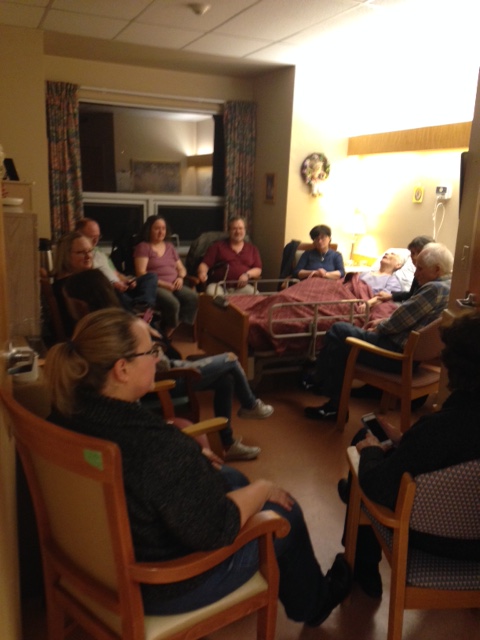
Over the last few days, her room at The Dufferin was anything but quiet.

IMG_2902

As you can see she was surrounded by family. Not all of us could fit in the room at the same time so we would leave the room now and again and spend time out in the hallway. At any one time there could be as many people in the hallway as in her room. That’s no surprise because she raised 15 children, only three of which could not make it to the Dufferin in the last few days to bid farewell to their mother(one being deceased and the other two living far away with health issues of their own). Husbands, wives, grandchildren, great grandchildren rounded out the group along with a steady procession of care aides.

My mother is gone. The people who do these things took her body away in the middle of the night not two hours after her last breath. That’s how fast and efficiently these things get done. What they couldn’t take away though was the laughter and the love that was palpable in the hours and days before her death and that saturated the room. We can be an irreverent group at times and we proved to be just that over the last few days, but that irreverence was always tinged with love and trust. Our mother’s death has brought us together again. We feel her in our love for each other.

I’ll have more to say in the coming days. For now, I’m home in Cumberland, on Vancouver Island, resting and awaiting news about when the funeral will happen.

Take care, all of you and hug your loved ones.


My death

I’ve been thinking a lot about my death lately. I know most people would not approve of this seemingly morbid preoccupation but I find it keeps me focussed on my life and what I have left of it.

Speaking of death goes against a most important moral precept we have, one of our most cherished ideals: health. A focus on health along with wealth and happiness is supposed to keep us in a good mental state and thinking positively about our lives and our activities. Given our obsession with health, it’s not surprising that we don’t want to hear about death. Death is the ultimate failure of health, now isn’t it? We seem to love to speak about our healthy lifestyles and post comments on Facebook about our healthy diets. We are constantly bombarded with ads and opinions about how to stay healthy. We are admonished for not eating healthily, drinking too much booze or engaging in activities that could ‘damage’ our health.

Don’t get me wrong, I’m not against being healthy. I’m just saying that it’s immoral in a world that glorifies health to be unhealthy. Now before you go off telling me I’m full of crap, think about it. Think of how we speak in hushed tones when someone is found to be ill and the words we speak to the relatives of the sick and ailing. Think of how we are uncomfortable around people who are obviously ailing or seriously ill. We equate illness with weakness and mygawd we must stay strong!

Disease and death as Ernest Becker so eloquently put it are “the two principle evils of the human organismic condition. Disease defeats the joys of prosperity while one is alive, and death cuts prosperity off coldly.” (EFE, page 3)

So, why do I think about my death? Why do I anticipate the moment of my last breath? Well, I know my death is tomorrow. I was 20 years old yesterday although I’m now 70, so how far down the road can my death be? It will be on me in a moment just as old age has come in a blistering flash. Time truly does fly. So, in thinking about my death, I give my life some meaning, some urgency. Life and death are one in the same thing. One cannot exist without the other so in denying death we are denying a crucial part of what makes us alive.

Our denial of death is a great cultural conspiracy to keep us feeling guilty and to keep us in line, conforming to the moral ideals that rule our world. Yes, like most animals, we have a primordial will to live, but unlike most animals we have wreaked havoc on the world in our ill-fated attempts at guaranteeing our immortality. Anyone who dares oppose our chosen path to immortality beware because you will soon be targets of our wrath.

Tomorrow I tackle morality and wealth. If you’re poor you might as well be dead in our world.


Shall we have veal for dinner, dear?

From a blog post on January 28th, 2014. The following two paragraphs in italics are a long quote from Ernest Becker’s 1975 book, Escape from Evil, which I used extensively when I was teaching college sociology courses. The language may be somewhat crass and shocking, but it gets the message across.

“Man is an animal…Whatever else he is, is built on this…The only certain thing we know about this planet is that it is a theater for crawling life, organismic life, and at least we know what organisms are and what they are trying to do.

At its most elemental level the human organism, like crawling life, has a mouth, digestive tract, and anus, a skin to keep it intact, and appendages with which to acquire food.  Existence, for all organismic life, is a constant struggle to feed – a struggle to incorporate whatever other organisms that can fit into their mouths and press down their gullets without choking.  Seen in these stark terms, life in this planet is a gory spectacle, a science-fiction nightmare in which digestive tracts fitted with teeth at one end are tearing away at whatever flesh they can reach, and at the other end are piling up the fuming waste excrement as they move along in search of more flesh. I think this is why the epoch of the dinosaurs exerts such a strong fascination on us: it is an epic food orgy with king-size actors who convey unmistakably what organisms are dedicated to.  Sensitive souls have reacted with shock to the elemental drama of life on this planet, and one of the reasons Darwin so shocked his time – and still bothers ours – is that he showed this bone-crushing, blood-drinking drama in all of its elementality and necessity: Life cannot go on without the mutual devouring of organisms.  If the living spectacle of all that he had organismically incorporated in order to stay alive, he might well feel horrified by the living energy he had ingested.  The horizon of a gourmet, or even the average person, would be taken up with hundreds of chickens, flocks of lambs and sheep, a small herd of steers, sties full of pigs, and rivers of fish.  The din alone would be deafening.  To paraphrase Elias Canetti, each organism raises it’s head over a field of corpses, smiles into the sun, and declares life good.”

I post this in light of an online petition I signed recently opposing the practices of the veal production industry to take newborn calfs, separate them from their mothers and isolate them in veal fattening pens. These are often dome like plastic structures hardly big enough for the calf to turn around. The idea, I presume, is to allow the calf as little physical activity as possible so as to fatten them up and keep their meat nice and tender. Many farmers who send calves off to the slaughterhouse to become veal are humane and treat their animals with a degree of kindness (I actually have no proof of this, only second hand reports). I think the way we treat the animals we intend to eat reflects our values and assumptions about their intelligence and even whether or not we think they feel pain.

I once saw a video of a ‘scientist’ claiming that animals don’t feel pain. In the video he was standing beside a row of beagles with wires implanted through their skulls and into their brains. The fact that the argument is ongoing astounds me. It’s clear from the scientific evidence that animals feel pain, and they have emotional lives. There is a lot of scientific evidence to support this claim yet there is still controversy over it. Carl Safina in a National Geographic article is quoted as saying:

It is incredible to me there is still a debate over whether animals are conscious and even a debate over whether human beings can know animals are conscious. If you watch mammals or even birds, you will see how they respond to the world. They play. They act frightened when there’s danger. They relax when things are good. It seems illogical for us to think that animals might not be having a conscious mental experience of play, sleep, fear or love. 

Safina goes on to say later in the article that:

Many people simply assume that animals act consciously and base their belief on their own domestic animals or pets. Other people do not want animals to be conscious because it makes it easier for us to do things to animals that would be hard to do if we knew they were unhappy and suffering.

Safina singles out lab scientists as a particular group in denial about animal suffering and pain. He is quoted as saying: “However, in laboratories the dogma persists: don’t assume that animals think and have emotions–and many scientists insist that they do not.”

I am going to assume for the rest of this blog post that many animals species feel pain and experience emotional lives. If that’s the case, we have to address how we feel about that and think hard about how we treat non-human animals, especially the ones destined for our dinner tables. More importantly, what can we make of Becker’s argument in the quotation above given what we know about animal pain and suffering?

The vast majority of us have never experienced what goes on in a slaughterhouse. Slaughterhouses are sites of killing on an industrial scale. I can’t imagine anyone working in the killing line of a slaughterhouse not having been effectively desensitized to animal fear, pain and suffering. Obviously, the terror (and I don’t use this word lightly) that a bull feels on entering a slaughterhouse is very temporary. Stunning and then killing takes moments. Does that justify the slaughter in the first place? Should we all be vegetarians or vegans and avoid eating animals at all thus putting all slaughterhouses out of business?

Some people have definitely accepted the argument that a vegetarian or vegan life is much more ethical than the carnivorous life. They don’t eat animal flesh although they may indulge in the consumption of animal products such as eggs and milk. But is the vegetarian or vegan life possible for the majority of humans? Are humans inherently omnivorous or can we give up our animal flesh diets?

In my next blog post I address more directly the issues presented by Becker’s quote above. Are we not carnivorous by nature? How valuable is life? How valuable is death?


Nothing lasts forever.

I have pernicious anemia and I have been bad about taking my B12 vitamin which I have to inject into my thigh. I don’t have any problems doing that and don’t ask me why I didn’t carry on with my injections, but I stopped doing them at least a year ago. Consequently, I have lived in an anemic fog including cognitive impairment, vertigo, tingling in my hands and feet, severe itching and other symptoms for the last few months along with full body pain and overarching fatigue. For some reason I didn’t connect the fact that I had ceased injecting B12 with my ongoing debilitating symptoms. After having admitted to being a great cautionary tale, I am now resuming my injections and I hope the fog lifts soon. I seem to be improving a bit so we’ll see how things go. At the very least, I hope that the fog dissipates sufficiently so that I can put together a decent post here.

Pernicious anemia can be deadly if not treated but for some reason I was in denial of that fact. I know I’m mortal, of course. If pernicious anemia doesn’t kill me something else will  and I’m okay with that.  As my  title above says, nothing lasts forever. My personal mortality is assured. Fact is, the universe paved the way for it a very long time ago.

We watched a program on television last night called Wonders of the Universe with Brian Cox that explained the arrow of time and the fact that the universe will eventually die out to nothing. That certainly had not been my understanding of how things would turn out.* Cox argues that life depends on the arrow of time and would not be possible without it. Death is the inevitable consequence of life. In fact life and death are not opposites at all but integral elements in the process of time. Cox also argue that this time in the course of the universe is the only time life will be possible. By ‘this time’ he includes billions of years along the staggeringly long life of the universe which started thirteen billions years ago according to scientific calculations. Our sun will die in a billion years or so and will explode in six billion. You won’t have to cover your head and hide under your desk when it ends though because by then, life on earth will be completely obliterated.The universe itself will die in several trillions of trillions of trillions of trillions of years.  So, life is meaningless and insignificant in the vastness of space and time. Sorry to have to remind you of that.

That said, we humans have decidedly taken sides on this issue and we favour life over death. To hell with the arrow of time! Well, sort of. We pay lip service to life, but we love to kill each other it seems (or just stand by as others kill each other)  and we kill other animals with glee, piling up their corpses on our dinner plates. So death has a certain attraction for us, but only if it happens to someone else. I know that some people take death in their stride and don’t feel any sympathy for animals they see squashed by a truck on the highway or on an assembly line waiting to give up their lives so that the trucker can have his chicken wings at the next bar down the road. They couldn’t care less either about hundreds of thousand of Rwandans massacred in the mid 1990s internecine war or the countless others who die daily in skirmishes in many parts of the planet. Conversely, they may just feel that death is necessary for life and they don’t sweat it. They may understand that we all have to eat dead things and for that to happen whether it’s animal or mineral, something has to die so that they will continue to live for a while longer. Whether or not they think about it in these terms or not, for some of them, killing an animal themselves is a more honest way of doing what has to be done than having a surrogate do the killing for them in an abattoir or other kind of killing factory. I eat animal flesh on occasion but I don’t kill the animals myself that I eat. I leave that up to someone else, someone in a factory out there somewhere by people I don’t know. Honestly, I sometimes feel guilty about that. I realize that isn’t a rational sentiment, but rationality has little to do with life and death.

How we feel about life and death, especially of domestic animals, depends largely on how inclusive we think about community belonging. We share many traits with other animals yet we deny any affinity with them. On the CBC News last evening Peter Mansbridge introduced a segment on chimera. Chimera are animals that have cells from other animals implanted in them. In his introduction, Mansbridge, with obvious horror, noted that pigs, animals that is,  were being implanted with human cells in order to make transplant organs for humans in the process. He spoke as if there are humans and then there are animals. He separated animals from humans in a way that would suggest that humans are not animals. Of course, that’s preposterous, but it’s a  widespread perspective. In separating us from other species we ‘other’ them and make it easier for us to kill them for whatever reason, often for food. But, as you read above, nothing lasts forever and who is to say what a good death is? Is animal extinction a bad thing? Not according to the arrow of time, by which measure everything goes extinct.

Have you ever watched another animal (human or other) die? Have you ever been  a witness to their light being extinguished permanently, the sentience that was there no longer existent? I have a number of times and every time, it gives me pause. I think this sensation of unease with the extinction of the momentous thing called life is inescapable for the majority of us.  I think that it is deep seated and relates to our instinct of self-preservation. So, are we doomed? Of course we are. The arrow of time proves it. Does that make us any more accepting of our fate? I don’t think so.

_______________________________________

*I have a book by Stephen Jay Gould called Time’s Arrow, Time’s Cycle: Myth and Metaphor in the Discovery of Geological Time published in 1987. I’ve had it for years. I will begin to re-read it this evening to see what I can make of Cox’s argument in light of it.


Why do we so often refer to sex as dirty?

My next post was supposed to be about morality and that will be the subject of a number of future posts, but I was listening to the CBC this morning and the guest host of the morning program was interviewing a comedian and talking about his upcoming show. That tweaked my interest as I sipped my coffee. The host asked the comedian if his show was going to be clean. The comedian responded that for the most part it would be but that it would also be dirty at times. Well, I just had to weigh in. Morality will just have to wait a bit.

By dirty I know, and you know, that the host and the comedian were referring to the use of  swear words like fuck and shit and piss in his routine. He was not, however, going to make specific reference to the sex act and have some fun with that. That would be too raunchy. After all, you’ve got to keep it safe for a regular audience or they won’t come back to see you again. Swearing, it seems, is fair game. It’s okay to make fun of your wife or yourself in a comedy routine, but it’s not okay to talk explicitly about what went wrong or right the last time you had sex. That will be okay in the not-too-distant future, I expect.

It’s quite telling that in English swearing is almost exclusively sex based or has to do with genitalia or bodily functions of one sort or the other. In French Canada, swearing is entirely different, or at least it was when I was a kid. In French swearing relates to religious things although it can stray into combining sex or bodily functions with objects or persons of religions significance. For instance, a great swearing line in French refers to the ‘holy cream of an old nun.’ It’s probably changing now to a more ‘cleanly’ sex-based expression. Tell me if you know. I’m not up on Québecois swearing behaviour these days. In English, of course, fuck is the word or choice in a number of expressions not at all related to sex, but the word clearly relates to coitus or the sex act. For instance we might exclaim upon seeing a cute cat video: “Wasn’t that just the cutest fucking thing you’ve ever seen?” Or, listen to George Carlin classify people into three categories. He says that there are stupid people, people who don’t give a shit and people who are just fucking nuts!

So, what about this sex is dirty thing? Well, Ernest Becker (in his many books, but especially The Denial of Death and Escape From Evil, concludes that it all goes back to our fear or terror of death,* which also has a lot to say about how women are so often poorly treated in our world and in times past.  So what does considering sex as dirty have to do with our fear of death and the way women are so often (mis)treated?

It’s a bit of a truism to say that we all live and die. Yes, we do, but we don’t necessarily like the dying part so we concoct all sorts of cultural mechanisms to help us deny  that fact. One way we do that is to separate ourselves linguistically from other animal species by referring to ourselves as ‘human’ and to those other things as ‘animals.’ Of course, we are animals and it’s hard to deny that because we’re obviously not plants or rocks, but that doesn’t matter. We deny anyway. That kind of attitude allows us to treat animals in all kinds of nasty ways, because, well, they aren’t human and God did say that he put them here on earth for us to have dominion over. We are spiritual beings, animals aren’t. Enough said.

More significantly however we also take great care to separate ourselves into male and female classes. Yes, I say classes because that’s what’s happening. Just as we consider ourselves spiritual beings and animals as spiritless, we have also contrived historically to consider men as spiritual beings and women as physical beings. In many parts of the world in every time in history women have been considered a lesser species than men.

There’s a simple, yet devastating reason for this. Women remind men at every turn that they are mortal. Women exude blood on a regular basis. Babies are born between shit and piss in an orgy of blood. You lose blood, you die. Men have gone to extraordinary lengths to deny their physicality, their animality, and emphasize their spirituality to the detriment of women. Men in some cultures wear anal plugs to show that they don’t need to shit. They are above that. Menstruating women are often shunned for fear that they might contaminate something or other. Men denigrate women at every turn. Not all men, of course, but our culture and many in the past have built massive institutions that denigrate women. The pornography ‘industry’ is a good example of that. It’s popularity attests to how important sex is to us, but how important it also is to objectify women and treat them as sexual objects and as not quite human. Generally speaking, women are way more important to men for their genitals than for their brains. Hillary Clinton is facing this fact right now in the U.S. Many men just can’t see the president of the United States being fucked. Tell me it ain’t so.

Sin, in Christian, Muslim and Judaic mythology often refers to succumbing to the temptations of the flesh, female flesh that is. The flesh is the territory of the devil. If you want to live forever  in the light of God then stay clear of unauthorized sexual pleasure. “Unauthorized’ here is a critical element in the preceding sentence. Although constantly being revised and rethought, when and how sex gets authorized and becomes okay is strictly defined in cultural precepts. That’s fodder for another blog post.

Oh, we take sex very seriously in our culture, in our time, but we have very contradictory ideas about it. Yes, the sex act is fun and all that, but it also brings us clearly into the physical world and that’s a dangerous place to be if you want to be immortal.

In my next post, I’ll consider how sex and our animality fit into our broader moral world.
Continue reading