Our Fleeting Lives.

I have two photographs to show you. The first one is of 634 Alderson Avenue in Coquitlam, British Columbia.
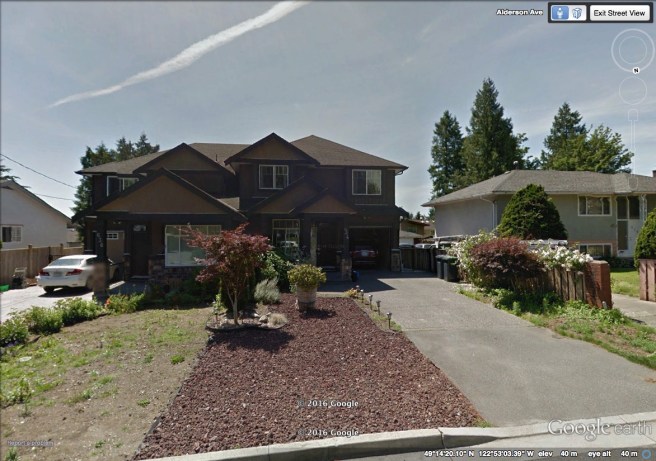
634now
Picture 1

The second is also of 634 Alderson Avenue in Coquitlam, British Columbia but this house no longer exists. It stood on exactly the piece of ground now occupied by the duplex in picture 1. It was my family home.
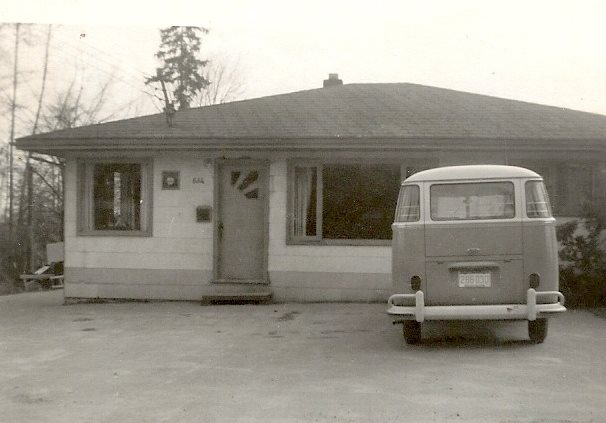
634then
Picture 2


Just so you know, the first image I downloaded from Google Earth street view. The second one I got from one of my sisters. I don’t want to relive my family’s life in the home depicted in the second photograph, the one I would call my family home but it would be an interesting journalistic exercise. After all, it was a very important place in my life for years. No, what I want to do is dwell upon another reality. But first a little background.


Look at photograph 1 and you see a relatively new duplex between a home on the right and a fourplex on the left. The fourplex has been there some time and existed when the house in photograph 2 was there. It was built after a very dilapidated home was torn down sometime in the sixties if memory serves me right. The house on the right stands on a lot my family sold after our property was subdivided into a number of parcels. It was built sometime in the sixties too. The photo is unexceptional in just about every way. The unit on the left of the duplex is 636 Alderson Avenue and the unit on the right is 634.


That (634) was the address of my family home for a long time. I’m not sure exactly for how long because I don’t really know when my father and his first wife moved into it. I think it was sometime in 1937. When my parents moved out of the house you see in picture 2 one of my sisters bought it from them, sometime in the 1980s, the house was still in the family for a period of time. Later, after my sister sold the house it was eventually demolished and the duplex in picture 1 was built to replace it. By the time it was demolished, the house in picture 2 had undergone extensive renovations. Although the house was ‘serviceable’ that mattered not, it was demolished. That’s just the way it is. I lived there for 12 years with my many siblings starting in 1947 before I went off to boarding school in Edmonton in 1959, then on and off for a few more years. Actually the details aren’t important except as background information.


What I want to focus on here is something that has been a preoccupation of mine throughout my academic career and even earlier, I’m thinking, and that’s the fleeting aspect of our lives, their finiteness within a field of infiniteness.  It’s a cliché to say that the generations come and go, that each of us is born and dies. That’s certainly true, but what interests me here is the substance underlying the cliché, how we think about these things, explain them to ourselves, reconcile them with the natural cycles of matter and energy and attempt to derive some kind of meaning for our existence.

The house I lived in, the house my family occupied for decades is gone. All the activity, all the sorrow, the happiness, the sadness, the love that permeated that place are gone. All gone. Yes, my sisters and brothers have many memories of life there. Stories abound. Yet the house is gone, forever. Poof! In a flash of time.

I’m thinking that the people who currently live at 634 Alderson Avenue in Coquitlam, BC, have no sense at all of what may have stood on the very spot they now occupy. To them, the property is what it is. Their lives are ongoing. They move easily from room to room. They have things to do, people to see, work to go to. They eat and sleep without ever thinking about the people who lived there previously. They may not even know that people lived there previously.

Yet, people did. I did. My brothers and sisters did. My parents did. There was life there, there was drama. There was tedium. The current residents don’t know that my father had the front yard paved over. I know that he did, but I’m not sure exactly why except to get rid of the patchy lawn that was there before and to increase parking spaces. They have no idea of the tons of laundry my  mother did every week, of the piles of soiled diapers that she cleaned, the Sunday pork and beef roasts my father used to put on the stove in the morning and the many loaves of bread my mother baked every three or four days. They don’t know about the laughter, the tears, the pain and the joy that characterized that home. They have no sense of anything that was there before them. Fair enough of course. I wouldn’t expect them to.

What is interesting, I think, is that the same kind of experience of things exists in cities, towns and villages everywhere. The current Rome is built on several past Romes that keep turning up in archeological digs. The same thing goes for Paris, Beirut and London and every other human occupied place on earth. I’m quite sure that the house I lived in at 634 Alderson Avenue was the first one built on that piece of property. I’m guessing trees, brambles and bushes stood on the homesite before the house was built. In Rome there are buildings raised on the debris and remains of several other generations of houses and homes previously erected there. Of course, at one time there were no man-made structures on the planet at all. Then, as a species, we moved like a fungus across the planet and occupied large tracts of land, building structures on them, some with a degree of longevity, some with none. It seems solid. It all seems so real, yet it’s all fleeting. Nothing is forever, not 634 Alderson Avenue, not Rome. We move silently through time glancing backward now and then but catching only glimpses of what went before.

We, as a species, will evolve right out of existence. No doubt at all about that. But that’s nothing to be sad about, nothing to fear. That’s just the way it is. Fighting it has gotten us nothing but pain and grief.

We try to hang on to the past in many ways. We write history.  We practice archaeology and anthropology. We study how biological forms change and evolve. We measure tectonic action and we track the movements of stars and the galaxies.

We try to hang on to some sense of what we were. We take photographs. We write diaries in the hope of remembering something from the past. I have some journal writing from the 80s and 90s and when I look at them and read about what I was doing on a specific day in February, 1989, I’m not actually remembering those experiences. I’m not reliving them. I have an idea of what I was doing, getting a coffee, for example, but I’m not reliving that moment.

We record action, events, scenes of all kinds. We record human conversations and whale vocalizations. We film political speeches and we have buildings full of archives, artifacts, petrified bones and old art works. We try to hang on to the past. But all of it is fleeting.


As I approach my 70th birthday in January, 2017, I guess my death is more of a reality to me than it’s ever been. I’m not sad about that. I’m not depressed about that. My death will happen momentarily because life passes by that quickly, but that’s fine. Some of you will mourn my passing but don’t spend too long grieving. As I watched my father-in-law dying in a hospital bed in Burnaby General Hospital in 1989, the traffic outside just passed on by. Not many people took notice of his death. We did, of course, and we were sad. Same for when my father died in 2007. He as 94 years old and ready to go. His body was determined to go back into the pot of organic matter that makes our world go around. One day he was there, kissing babies, working his ass off trying to feed his many children, and the next moment he was gone. That’s our truth.

That’s our lives. I often think about my father these days. He was a man of tradition but he was also an excellent craftsman and inventor. After I got to be 14 years old or so we often worked together. He was my boss on many occasions, and he was a good one too. I don’t know why this is still with me, but I vividly remember the first time I heard him say ‘fuck’. My, I was shocked but impressed. I was 9 years old and with him on a Saturday visit to the sawmill he worked at on Lulu Island. As we left the plant in late afternoon he talked briefly to the watchman and that’s when he uttered the infamous word. Shocking and revealing. My father was human! I remember when he and I flew to Winnipeg to pick up my Austin Healy Sprite, a car I left there after a youthful infatuation with a young woman in St-Norbert, who at that time I would say was way above my station in life. He was great. He put up with my whining and snivelling. He was so forgiving and caring. I must say that I could be a jerk as a kid. But I wasn’t a complete waste of skin. We had some wonderful times as kids building forts, digging tunnels and just farting around. I was mouthy and bratty and that got me into trouble on occasion. As a teen, I was often sullen, thoughtless and miserable. Par for the course.  I smashed up the Volkwagen van parked in front of the house in picture 2. Damn near killed myself along with a friend of mine. I was careless. I was irresponsible, and after that crash, I was brain-damaged for years, something that didn’t improve my outlook on life. Eventually, I grew out of it and up, went back to school and the rest is history. The people who now live at 634 Alderson Avenue know nothing of this and I’m sure they wouldn’t care if they did. That’s the way it is.

We look for continuity in our lives, we look for meaning. We even crave immortality and have created countless ways of convincing ourselves that our bodily deaths aren’t real and that our ‘souls’ will live on. I know people, irreligious people even, who at celebrations of life, still insist that the deceased loved one is somewhere up there, looking down and waiting for us to follow. It’s so hard to find any meaning in the minutia of life, in the fleeting memories and impressions we have of past events. So we look elsewhere and we create elaborate cultural schemes to convince ourselves that our lives have ultimate meaning and that there is life after death. It’s kind of a natural reaction, I’m thinking, that our big brains have devised to deal with death, the ultimate evil. Of course it depends on what we think life is and what death is.

Enough for now.


My personal statement from 1990 on the Knowledge Network.

Why not post a video I did in 1990. That’s only 26 years ago! Frankly, what I say in this 7 minute clip I still relevant to me today. I think it’s a good way to start off my new set of blog posts. Hope you enjoy it, although ‘enjoy’ may not be the best word to use here. The clip was filmed in Vancouver with a Knowledge Network crew over a 12 hour period in one day. It was part of my North Island College tele course on the Knowledge Network that ran from 1986 until 1992. Interesting times.

Roger

Why do 99% of movies follow the same formula?

Why do 99% of movies follow the same formula?

Because they address our most basic anxieties, our fear of death and our drive to deny it.  Denial of death is what I call a meta-institution. That means an institution (defined by Veblen as a crystallized habit of thought or life) that is globally dominant and pervasive. No place, country, society, culture or whatever group is immune.  We all create and nurture death-denying institutions. Sometimes they involve religion, sometimes not. Business is as good at death denial as religion is. There is no way that the film industry can escape our basic drive to deny death.

Death doesn’t necessarily mean what happens to you when your brain and body stop functioning. It can mean poverty or social death and isolation. In this sense death denies us the good life but leaves us, zombie-like, to live out our physical lives with not much of anything interesting to experience or for which to look forward.

The film industry barters in death, social or physical, worldly or eternal. So, you’ll often see a person die in movies but generally that’s considered a sacrifice for the survival of our favourite death-denying meta-institution, the one that promises us eternal life of one kind or another. The hero, that person or group that personifies the triumph over death, occasionally dies in a movie, but always with the proviso that what they’ve fought and died for lives on. From war movies to romantic comedies, the formula is always the same as is the outcome. Of course there is a lot of variation in how the formula plays out and how long an individual movie spends on any particular part of the formula, but that doesn’t negate the existence of the formula itself.

Triumph over complacency, attack from various quarters (earthly or otherwise), disease, rejection, isolation, poverty, or what-have-you, is the bread and butter of the film industry.

A meditation on Fifteen Dogs by André Alexis

I don’t often review books on this blog. That’s because I seldom read fiction and my reading of non-fiction runs to extreme esoterica, sociological monographs and art books few of which inspire me to produce reviews. Too much explaining to do. Too much I have to leave unsaid or to the reader’s initiative. 

Upon the urging of my widely read Carolyn spouse, I relented and read a novel, Fifteen Dogs by André Alexis, published this year by Coach House Books. It won the Giller Prize and Carolyn said to me: “Read it, I want to discuss it with you.” Well, that’s not the first time she’s said that, but for some reason I relented this time, partly because she said the book was about death, a long time scholarly interest of mine. It’s not a long book either, another reason why I decided to read it. 

That said, I can’t say that this is a review of the book. It’s more of a meditation on it.

The book’s premise is simple enough. Hermes and Apollo, both gods in the ancient Greek panoply of gods find themselves in a bar in Toronto when at some point Hermes muses: “I wonder what it would be like if animals had human intelligence.” Thereupon, Apollo responds with: “I’ll wager a year’s servitude that animals, any animal you like – would be even more unhappy than humans are, if they were given human intelligence.” 

Sometime later they encounter fifteen dogs in a kennel at the back of an animal clinic nearby. They had found the subjects for their experiment. I’m not going to go into any detail describing the chains of events that constitute this novel, but you can see where this might lead. Dogs don’t have the vocal apparatus to speak human language, but they can, given human intelligence, develop a language of their own which they do in this case. 

One major issue is that physiologically these dogs are still dogs and they still have dog wants and needs as well as dog perceptions of things. Now, with human intelligence, complications inevitably arise. Deaths ensue. Let’s not forget that one of the primary distinctions in this novel is between mortals (dogs and humans) and immortals (Hermes, Apollo and Zeus). Us planetary beings are all mortal, something we have in common. Dogs and humans die. We all do. We all must. Moreover, dogs and humans often have reasons to kill. The dog/humans in this novel are no exception to this rule. 

Here we have a mix of dog/human politics as if human politics weren’t complicated enough. Dog politics are generally straightforward based on brute strength, physical size and cleverness when it comes to intra-pack politics and no mercy when it comes to extra-pack relations. Not much different than human politics, it seems. 

Much of the book is taken up with discussions about morality, mortality and making it through the day in hostile, and sometimes friendly but constricting, environments. Fifteen Dogs is full of the unexpected yet explainable. It does not shy away from visceral descriptions of death but it also revels in the more uplifting connections we make between ourselves as humans as well as those between humans and dogs. I’ve loved all of our dogs as family members. I can certainly relate to this book on that level, but I can also find basic truths in Alexis’ musings on the inevitability of mortality and what it means to live well and die well.

I recommend this book to you all. It’s a  quick read and one that could give rise to great book club conversation. 

One question I have: how would this book read if the gods in question were not so mythical? What if there was only one god in question, the Christian god? How would that change the colour, tone and texture of the book? How would it change the book? 

Follow up on yesterday’s post on the Ernest Becker Legacy Conference at SFU

In my last post I mentioned some of the conference speakers, among them Sheldon Solomon and Jack Martin. I quite enjoyed both of their talks which together summarized Ernest Becker’s thought and his biography. To generalize beyond caution, I dare say that every one of us is an ever changing individual confluence of experiences, actions, achievements, ideas, values, etc., bounded by a sac of flesh and bone and  wrapped in a social weave of interdependencies. Solomon and Martin ‘gave’ us the confluence that was Ernest Becker in as much complexity as was possible in a short time.* Of course, the conference title implied that Ernest Becker’s legacy would be the focus of discussion. In Becker’s case the legacy in question refers to the range of ways and means his ideas have informed those of others who have followed him. It’s what he left behind for others to use and build upon. That’s a staggering amount of information, ideas and insights to put it mildly. 

Most people who have used Becker’s work have focussed on this or that aspect of it. There’s too much of substance in Becker’s work spread over too many disciplines, making it close to a unified theory of social and biological life on a grand scale, to use the whole thing as a starting point for further analysis. We can gnaw away at the details and go from there, but it’s most difficult to follow Becker on the grand scale of things. A person would have to share his confluence of influences at the very least. I mean, he described his last book as a synthesis of Marx and Freud. Well, who is competent to judge whether or not he actually did that? Someone who at least shares his reading list and sees the world in ways that he did. Was he referring just to Marx and Freud or were these two names rallying terms for a huge number of writers and authorities that he also used? His Freud also included Rank, Jung (to a lesser extent), Adler, Brown, Jones and many others. His Marx included Frankfurt School types, the more humanistic Marxists like Fromm. In fact, I don’t see a lot of classical Marxism in Becker’s work so he must not have meant Marx,  but Marx-ists.  Becker’s confluence is complex and massive and  hardly matches anyone else’s so I think that we literally cannot follow Becker in the entirety of his thought. In fact, a prerequisite for reasonable commentary on Becker’s overarching thought, I  think, is a familiarity with the bulk of his reading list. You’ll need a few years to get through it.  You’ll also need an openness to his interpretation. 

I’ve already written that people have settled on aspects of Becker’s work to elaborate. It’s probably safer and necessary to do that in any case as I have just argued. So, we come to David Loy, a very nice man if I’ve ever met one, a Buddhist scholar, an activist one by all accounts. Google his name. He’s written a few books. His talk was interesting, but not so much for me because I just don’t easily go to ‘religious’ places in my thinking. Of course I’m probably doing Loy an injustice and I wouldn’t want to do that. Still, I probably wouldn’t read any of his work but I would love to sit and watch a beautiful sunset with him.

Larry Green was another of the conference speakers and a big part of the organizing crew. I have so much respect for all of the organizers and the participants in this conference and Larry is right up there. He earned my respect for whatever that’s worth (I have no illusions about the insignificant space I take up on this planet, so what would he do with my respect? I do not mean this in any kind of self-deprecating way.). He is a long time psychotherapist (44 years) and teaches the odd course at City University Canada. The blurb in the conference document states “His contribution will focus on alternatives to “in-group” identification as a source of ontological security.” That’s a tall order. Becker’s discussion of the moiety in Escape From Evil would be enough to scare me away from suggesting an alternative to how things have been organized socially on this planet for thousands of years with people dividing themselves into competing groups all the better to prove how wonderful and worthy a winning group is in its barter with the gods for immortality. For me, the problem is that Green is focussed on individual accommodation to life on this planet and not on the overall ontological issues around  group formation and social conflict. But that’s not meant to be a criticism, just a problem for me…as a sociologist who taught Canadian history, French, Anthropology and Sociology at a freshman level. Notice, there’s no Psychology in there. That doesn’t mean that I don’t have the utmost respect for a number of psychologists, psychoanalysts and even psychiatrists (one even still living). I just don’t follow them around into theory very far. I’m too much of a social evolutionist and Marxist for that.

Speaking of Marxists, Brad Hornick was one of the speakers. He used his time to talk about his own life and what he thought was necessary for the creation of social change great enough to reverse the insane course we’re on destroying the planet as fast as we can. Becker, in the closing paragraphs of Escape From Evil mentioned that if we could come up with a new immortality project, say one that was aimed at climate change, that we could just change the course of history and maybe save ourselves in the process. I don’t think he was all that confident if would happen, but he threw that in as a possibility. Hornick argued that capitalism has to go in order for any positive advances can be made to this planet’s climate. Commodity fetishism is not going to allow us to easily let go of our obsession with possessing goods, so we have to get rid of commodity fetishism. Frankly, I don’t hold out a lot of hope for humanity, but Hornick isn’t giving up and I respect him for that. He’s a grad student at SFU in my old S&A department there. I wish him all the best. It’s a tough row he’s decided to hoe. I doubt if many people at the conference had any idea of what he was talking about but it may have challenged them a little and prodded them to think of how Becker’s work can be used to address some of the fundamental social issues of our time. 

The last speaker I  took in during the conference was Andrew Feldmár. I’ll save my comments on him for tomorrow. I’ll also discuss briefly a couple of other speakers not yet mentioned. Tomorrow it is.


  • Confluence means flowing together, as in rivers and such things. The idea of a person as a confluence, that is, the sum total of ideas, values, experiences, influences, etc., all come together in a sac of flesh and bone surrounded by, interweaving and interdependent with others in a social maelstrom came to me in the shower the other day. It’s what accounts for what we call our individuality. No two people share perfectly the same set of ideas, values, experiences, etc., but some of us  overlap in those areas and we form communities on the basis of those overlaps (sometimes voluntarily, sometimes by accident or necessity, sometimes by circumstance).
  • I could not have come up with this idea if I had not read widely in sociology and other related disciplines. It’s only on the basis of my reading list that I can even conceive of such strange things. Some of you may shudder a bit while reading this as you try to make sense of it from the point of view of your own confluence. The more you read the same kinds of ideas I did (and do) and share the same class background, etc., the more you may be able to parse my meaning. Very few people on the planet share my reading list or yours for that matter, that is if you have a reading list. Most people don’t. That in itself is neither here nor there. I can say though that having an extensive reading list in certain disciplines is definitely not a prerequisite for a happy life. In fact it can complicate life beyond salvage resulting in an inability to enjoy the simple things. But aren’t I getting serious now? Time to lighten up a bit. 
  • © Roger J.G. Albert 2015

Rushing to print is often a mistake.

Rushing to print is often a mistake and I do believe I rushed to print with my last couple of posts. I think that was a mistake. Research can often turn up evidence from the past that makes a lie out of what we thought was true. Does this really matter? Maybe. Not certainly. It depends on what we want to depict, on what we want to understand and have understood.  I could write fiction, drawn from my imagination, enriched by my experience. How would that be different than what I am doing here? The ‘truth’ of fiction is in how believable it is, how sympathetic the characters are and how ‘realistic’ the scenes. In turning my gaze on my family, I enter a very different realm than I would occupy writing fiction. Of necessity, family histories are mostly fiction, the details of lives lived drowned in a sea of unrecorded continuity just as one tree can be made insignificant standing in a forest. Moments that stand out get into the history books.  Sometimes, they are recorded in a photograph.  More often not. When writing about family, the truth sometimes comes out slowly, not always in one go.  Even the ‘truth’ of a photograph, objective as it might seem, can be revealed more fully in all its complexity when the past, present and future of the depicted scene are entertained.

When I look at the picture I analyze in my last post, I am struck by the innocence of the scene, the mundane aspect of it.  The full impact and relevance of the scene cannot be appreciated at first glance. The scene is nothing outside of its living context. The people depicted in the photograph have no idea what awaits them in the near future, the death, panic and sorrow that they will suffer, as well as the love and sacrifice that will energize life and make it livable for them. What can I see in their faces? Nothing that belies their future. My mother would never have dreamed when this picture was taken that within 3 years she would be having a baby with the man standing next to her in this picture, a man married to the woman who stood just on the other side of him, both of whom had been her family’s close friends for years.

Now, I must make a correction to my previous post where I suggest that Yvonne died on June 22nd, 1945, because it was rumoured my father couldn’t afford a transfusion which would have saved Yvonne’s life. That may still be true, but I now know that my father had asked my mother and aunts to give blood to save his wife. Cecile donated blood sometime after midnight on June 22nd, but it was too little too late.   I learned this by looking through calendars my sister Claudette created for us over the years which contain pages from a diary my mother kept for a few years during the 1940s. It may be that my father had to find blood donors himself because he didn’t have the money to buy blood from the usual sources.  I find this difficult to believe because St. Mary’s was a Catholic hospital and I can’t imagine they would let someone die who couldn’t afford a blood transfusion, but no one lives who can set the record straight.  That makes the photo I introduce in my last post even more compelling to me because now, Cecile, my wonderful older aunt, standing on the far right in this picture, is also intimately involved in the final stages of the drama that was to unfold at St. Mary’s Hospital on June 22nd, 1945.  Death in childbirth was not as common in 1945 as it had been in previous generations but everyone knew that it was a dangerous time.  Yvonne was 29 years old, a mother of five daughters.  Such a tragedy.

It seems my mother and her family were very close to my father and his family for some time before they were married.  There was much socializing between the families starting in Alberta around Bonnyville and continuing in and around New Westminster in British Columbia.  My mother’s diary is full of references to visits to my father’s home in the years leading up to June, 1945.  She writes on Sunday, January 7th, 1945: “My day off [from work at St. Mary’s Hospital]. Went to Zenons for supper and a party.  Stayed until 3 AM.  Had lots of fun…”  On Sunday, March 11th, “I went to Zenons for supper then to a card party. I won $1.50 first prize womens. Zenon won $10.00 door prize…had lunch at Fraser Café with Albert and Gill, Mrs. Lagrange and Zenons.” The close familiarity between the Alberts and Leguerriers is evident in the photograph and it waits patiently, silent in the background to give added meaning to the scene for those who wish to know. The events to unfold in the following few months can only be understood in light of the tight bonds that existed in the community of ‘ex pats’ from Alberta now living in British Columbia.

A photograph can hide as much as it shows.  It can give us the impression of time stopped for an instant, frozen in a way that allows us to return to contemplate the moment, to relive the essence of a snapshot, lingering and maybe meditating on it.  It’s an illusion, of course, but that doesn’t prevent us from taking pictures, from trying to momentarily pause the clock. But clocks are stubborn things.  They stop for no one.

I have another photograph.  This one was probably taken on June 25th, 1945, the day of Yvonne’s funeral. She was buried along with her son, Roger, in St. Peter’s Catholic Cemetery in New Westminster.  It shows my father kneeling before Yvonne’s grave which is covered in flowers, his five daughters by his side.  The same day, my father asked my mother to quit her job at St. Mary’s Hospital, come work for him and look after the girls.

I have an old photograph.

I have an old photograph. I don’t know who took it and I’m not sure exactly when it was taken, but it must have been sometime in 1944 because in the picture my father is holding in his arms my step-sister, Denise, who was born on January 10th, 1943. In the photograph she appears to be a year old or so, which would mean the photo would have been taken sometime in mid 1944. Given that my father’s first wife, Yvonne, died on June 22nd, 1945, it stands to reason that the photo was taken sometime in 1944. It doesn’t look like Yvonne was pregnant at the time with Roger, but she may have been.

There is no obvious way to tell where the photo was taken, but the ground is dry and there’s no snow. I’m guessing it was taken somewhere in or close to New Westminster, British Columbia. Actually everyone in the photo is dressed for a nice, warmish spring day, and they’re all standing in front of my father’s 1929 Ford Model T.

In the photo, my father’s first wife, Yvonne, is farthest on the left. She is standing just behind my step-sister, Lucille, who at that time was two years old or so and she has her hands resting on Lucille’s shoulders. Next to her on her right is my father and he, as I said, is holding Denise. Standing next to him is my mother, Lucienne Leguerrier at the time. Next to her is Rémi Leguerrier who married my father’s older sister, Isabelle, and farthest on the right is my aunt, Cécile, mother’s older sister. Uncle Rémi, standing between them, has his arms around the shoulders of my mother and my aunt. He’s smiling too. The children are not smiling, neither is Yvonne although she may have been suffering from morning sickness and that might explain why.

Who could know when this picture was taken that my father’s first wife would be dead within the year and my mother, Lucienne Leguerrier would be his new wife within two years. So, here we have my father flanked by his wives. Never would he have guessed at that moment, smiling for the camera, holding his youngest daughter, that Yvonne would be gone and that he would be scrambling to find a way to look after his five daughters while still going to work. The picture tells nothing of the sorrow to come.

As it turns out, my father and Yvonne had over the years since moving to British Columbia in 1936 made friends with the nuns who ran St. Mary’s hospital in New Westminster where all their children would be born. Apparently my mother had worked there for a time and it was they who suggested, after Yvonne died, that my father ask my mother to come help look after the children while he went to work in local sawmills. That wasn’t a stretch, because the Albert family knew the Leguerrier clan when everyone was still living in the vicinity of Bonnyville, Alberta a few years before. So, my father knew my mother’s family before a number of them migrated to BC during the Depression looking for work. My father was resourceful and capable of doing various kinds of mill-related work so he was able to find employment. My mother too.

When Yvonne died, my father asked my mother if she would help and she agreed that she would. Months later, actually it wasn’t too many months later, my father had my grandfather and grandmother come to New Westminster to look after the children because my mother had returned to Alberta unexpectedly it seemed. It turns out that she had returned to Alberta anticipating that my father would join her shortly so they could be married in Alberta at Fort Kent and both return to New Westminster as husband and wife.

Now my step-sisters had a new mom. My mother was only twelve years older than my oldest step-sister, Hélène. That caused minor friction to start with because when Yvonne died my father had told Hélène that she would now have to be mommy to the four younger ones. Now, she was being displaced as mother of the family but that animosity soon dissipated because my mother had lived with them for a few months already giving time for attachments to grow between them.

I cannot imagine that my father was not steeped in pain and sorrow during that whole time, but he had no other choice but to carry on.  Sorrow must give way to children and their needs.

Life is complicated.

I  don’t mean this series of posts to be or become an exposé of my family’s little secrets. I have not discussed this series with my family members at all.  I’m sure they would have very different memories and impressions of the lives we shared than I do.  I use some of the incidents and events I know about or have some impression of as a means of expressing my sense of the complexity of life and especially of relationships both personal and social.

______________________________________________________________________

Life is complicated. Relationships are complicated. People are complicated. Take my father, for instance. He was intelligent, generous, level headed and kind hearted, but at times he had fits of anger that were shocking because they were so out of character for him. He teased us mercilessly, sometimes to distress. He could be, and was, physically violent on rare occasions. We never spoke of such things so I have no way of knowing what were the deep-seated causes of his rare bouts of uncontrollable anger. He was never violent towards my mother that I know of, but he beat my older sisters one time that I recall very vividly. From what I remember, my sisters were whining and complaining about doing the dishes or some such thing, probably yelling and screaming, fighting amongst themselves when my father, for some reason had had enough of it. He let fly with a pot that was handy, hitting them with it repeatedly until they were all cowered on the floor, weeping and in shock. I might have been six or seven years old at the time and I remember cowering myself in the hallway, by the bathroom door wondering what could possibly be going on. To this day as I think about it, I can still feel the sense of fear that overwhelmed me at the time. I don’t recall anyone discussing it much after the fact, but it was traumatic and definitely left an impression. That I do recall.


He hit me too on the odd occasion for various reasons. I was no angel as a child and I may not always have conducted myself with the propriety and reasonableness that should, of course, inform the actions of all well-behaved five year old boys. I remember one time when at about six years of age, maybe seven, I smacked a kid (accidentally, of course) over the head with a garden hoe drawing a substantial amount of blood. No serious damage done, but you know how head wounds can bleed. I got ‘the strap’ for that one. When my father got home from work that day and my mother had conferred with him telling him of all the sordid details of my great misdead, his duty (I presume he saw it as that) would be to clinically administer several blows to my open hand with a rubber and leather strap he had gotten from his workplace and which he kept on a kitchen shelf for just such occasions. He did not draw blood, but in his mind I had to learn that there were consequences for what I had done. The logical course of action was for him to hit me, a perfectly acceptable and even expected thing to do at the time.


My father was driven by a sense of duty to his church, his family, and French-Canadian tradition. He did not question his duty to have as many children as God expected of him and he took great joy in each of us. He was ill-educated in the formal sense. He never learned to read nor write although he could do rudimentary arithmetic. He might have made it only to grade four in school but it was not because he was incapable of schoolwork, but because he was needed to work on the farm in Alberta and for other reasons not of concern here for the moment.   He seldom drank alcohol and didn’t smoke but he did gamble every once in a while. He was what most people would have called “a good man” in the day. He worked hard and rose to management positions in lumber mills around the Lower Mainland in spite of his illiteracy.


I don’t know if what I am about to write is true or not, but it may very well be given the time. It was 1945, June 22nd. The war would be over soon. Normally this day would be a time for celebration, but this day would not be one of those. This day my father’s wife, Yvonne, would die in childbirth. She was an otherwise healthy 29 year old woman who had already given him five daughters. This day, something would go horribly wrong in the delivery room and Yvonne would bleed to death. Her newborn son would also die in the deIivery room. I heard it said that Yvonne died because my father couldn’t afford a blood transfusion that would have saved her life. I don’t know that to be true, but just imagining what he had to go through with his wife dying in childbirth and five young daughters to look after at home I expect that he was wrought with anger, panic and despair no matter how his wife had died. He may have believed that it was God’s will. I’m certain my father thought about that wretched day in 1945 every subsequent day of his life.

I know where I was conceived.

I know where I was conceived. It was in a small rickety, squeaky bed in a small room at the end of a small corridor, door on the right. I’m quite convinced all nine of my younger brothers and sisters were also conceived there although I can’t be absolutely certain. I’m not at all sure of where my older siblings were conceived. They are my father’s children but not my mother’s. They shared this house with the rest of us but the details are not important for now. The small room where I was conceived was also the room where the baby of the family slept. There was always a baby in the family as I was growing up.


The house containing this small room was also small, and it was always full of children. It no longer exists. The small room and the small house are gone now, torn down and replaced by a large brown duplex not so many years ago. No one driving by on the inconspicuous street on which it fronts would ever know that the house in which I grew up had ever existed. Yet there was life there, lots of life. There still is life on that same place, in the brown duplex, but the people living there now would have no idea of the life that preceded them in that very location years before, just as I have no idea of the life that goes on in that duplex now. We share the experience of a place those duplex dwellers and I, not that they are aware of that. Why would they be?


January 29th, 2015, marked the 69th anniversary of my parents’ wedding day. My father has been dead since April, 2007 but my mother lives on in body if not in mind. She no longer recognizes the faces nor the voices of any of her family members and every moment of her life now is disconnected from her past and even from the very moment preceding it. She spends most of her days in a state of catatonia, as a result of years of dementia, she cannot feed herself and three years ago she was beaten up by another resident of the home in which she lives, but that’s mostly forgotten now.


In days gone by, when I was born, say, there was much life in my mother. She was a young, beautiful, strong twenty-one year old woman, twelve years younger than my father. In her time, she bore ten children, five daughters and four sons. I’m the oldest of my mother’s children but the sixth oldest of my father’s. He had five daughters from a previous marriage before his wife died in 1946 in childbirth bearing her sixth child, a son they were to call Roger. He shares a coffin with his mother.

…to be continued sometime.

Why are we afraid of people in wheelchairs?

[This is a bit of an exploratory post.  I have ideas here that I want to develop further, but rather than trying to refine them now to a publishable state, I’m putting them out there in a somewhat disjointed and unrefined state so that I can think about them further and get your comments on them if you are so inclined].


A couple of days ago I posted a comment here about an injury I suffered last Thursday evening to my ribcage after a bad fall resulting in a hospital visit and a great deal of pain to an area of my body that had already been traumatized by cancer surgery.  Well, that personal story was just a way of leading into today’s post.  Of course, everything about the report I made a couple of days ago was true.  I’m still in a great deal of pain.  I haven’t driven our vehicle since my injury and I’m not sure when I will be able to again.  Maybe later this week sometime.  The good news is that I do feel some improvement in my pain levels already and some improved mobility.

That said, there are many people with immobility issues that cannot look forward to any improvement whatsoever in their conditions.  I feel temporarily humbled by my lack of mobility in a mobility driven world, but they must only feel permanently humbled and even humiliated.  Someone I am acquainted with has muscular dystrophy.  He’s my age, a little older actually.  He lived a ‘normal’ life for decades before being diagnosed with muscular dystrophy, but his mobility has continuously declined since his diagnosis.  He is now confined to an electric wheelchair and a scooter that allows him a certain degree of mobility.  He can even visit me in Cumberland from Courtenay (8K) although not in my home because it is not wheelchair accessible. There’s actually very few locations in the Comox Valley accessible to wheelchair bound people, homes or businesses.  As an educated guess I would say that about 1% of Valley homes are wheelchair accessible.  The big box stores are all accessible, but not many of the businesses along 5th Street or anywhere downtown are. I know other wheelchair bound people in the Comox Valley with varying degrees of immobility, but all have very mobile and agile minds.  Of course, like the rest of us, not all wheelchair bound people have agile brains and some have difficulty communicating with ‘normal’ folks.  I’ll get back to that in a bit.

My point is that we treat people immobilized by various kinds of physical ‘disabilities’, ‘abnormalities’, or whatever other qualification we might use in describing them, with a curious dismissiveness.  We don’t take them seriously and don’t expect anything intelligent to come out of their mouthes.  Mainly, we don’t address them at all and if we must, we’d rather do it through an intermediary, like a caregiver or companion. I use ‘we’ here because this is a generalized social reaction with few people being self-aware enough to realize what they are feeling and why they are feeling that way.

What I am arguing here is not that individuals in our society are insensitive or uncaring about people who are ‘differently-abled’ as they sometimes describe themselves, but that we have a very deep-seated fear of immobility because of its association with death and we are culturally programmed to shun it.  If you think about it for a moment you’ll soon realize that we unconsciously equate mobility with freedom and wealth, immobility with death and confinement, either, for example, in a wheelchair or in prison.  We punish people in our society by removing their mobility.  We laud people who are mobile.  I can’t tell you how often I’ve been asked since I retired from college teaching where I’ve travelled to (nowhere, actually) or what travel plans I have.  Our obsession with mobility is virtually universal, goes a long way back and is deeply embedded in our cultural fabric.

Colin Turnbull in his 1960s ethnography of the BaMbuti tribe of the Ituri Forest in Central Africa described how the BMbuti had developed a system of describing how dead a person was.  If a person was unable to speak because of a stroke or such ailment, that person would be described as partially dead.  The greater the inability to keep up with the group, communicate and contribute to tribal life, the more dead a person was considered to be.  There was always a danger that a person might be considered dead even though they still had a pulse.  I can’t remember which anthropologist it was, writing at about the same time as Turnbull, who described in his notebooks a tribe in the New Guinea highlands that buried people alive because they had lost the ability to speak. For this tribe, he wrote, an inability to communicate verbally was a sure and certain sign that the person was dead. Burial would follow no matter how much movement was evident in the rest of the affected person’s body.

So, part of our common human cultural heritage seems to associate immobility and its various manifestations in individual human beings with death, the ultimate evil (in Ernest Becker’s words).  It doesn’t seem to matter what part of the world we are from, what language we speak or what tribe we belong to.  If we cannot speak, have various ailments that confine us to a wheelchair or we are somehow immobilized in body or mind, we are somehow lesser human beings no matter what other qualities we may have.  If we are on crutches because of an injury caused during a hockey game we will face a wait-and-see attitude.  If we are playing hockey again in a reasonable period of time all is forgiven but if we fail to get back to the game in a timely manner or are prone to injury and hence immobilized too frequently we will be considered a slacker and not really a good team player. Hero status goes to the player who plays on despite being injured, flaunting pain and immobility.  If we are in a wheelchair with obvious mobility limitations there in no wait-and-see-attitude, there is just ostracism and sometimes revulsion.

This all takes me back to wheelchair bound people, ‘mobile’ and agile brains.  My friend with muscular dystrophy has a very active mind, is from a professional background, is community-minded and involved in various social groups and activities. He is articulate and fully capable of expressing himself. His scooter is quite impressive and commands respect, but even he has commented to me that on more than one occasion when he was in his wheelchair accompanied by one of his caregivers that a clerk or other frontline worker would address the caregiver rather than him even though it was his business that was being discussed.  They often behaved as if he weren’t even present and, without asking him directly, would address his caretaker with:”…and would he like a drink with that?”    He reported on these occasions of feeling somewhat humiliated and disrespected, even if it was just for a moment.

We seem unwilling to tolerate immobility in any of its manifestations.  As noted above, we find physical immobility disconcerting and we feel uncomfortable around people in wheelchairs.  People who are ‘mentally’ immobile are particularly scary for us because they cannot move a conversation forward in a predictable manner.  We feel afraid or disdainful of people ‘talking to themselves’ while walking down the street. And while we are fine with immobility on vacations, lying around beaches reading novels, it must only be as a temporary interlude in a busy work schedule.  We heap scorn on ‘lazy’ people.  We find the immobility brought on by poverty particularly vexing and distasteful.   We describe children and retired people as ‘unproductive’ because they fail to contribute to the forward mobility (growth) of the entire community.  Combine any number of physical and mental immobilities and the disdain and fear we experience are compounded.

One mental struggle I’ve had for decades now is determining just how much of our fear of immobility is driven by our biological built in urge to avoid death like every other animal species and how much by culturally specific imperatives, including learning and education.  It’s hard to dispute the idea that over our history on this planet (and even now) individuals might at any moment have had to flee a predator or fight for survival.  The ‘fight or flight’ reaction would have been severely impaired by individual immobility.  Obviously, anyone who was immobile for whatever reason might put a whole family or tribe in danger.  The consequence of being immobilized by injury, hunger or any number of other conditions could be catastrophic.  How many times in the movies have you seen a war scenario where there was great gnashing of teeth over whether to flee and leave behind a wounded colleague or endanger the whole group by dragging him along and slowing everybody down.  Of course, if the wounded colleague was a hero he might just commit suicide, thereby releasing the group of its obligation to him and ensure the safety of the whole group.

There’s no denying that we are animals and have animal preoccupations around sex and survival.  However, that doesn’t mean that our behaviours are forever destined to be driven by our animal natures.  Ernest Becker argued that it’s our ingenuity and not our animal nature that has pushed us into perpetrating more evil on this planet than ever before.  Is it our destiny to always fear immobility and death?  Is it possible for us to ever develop cultural and moral principles and imperatives that strive to accept immobility and death rather than to fight them at every turn?  Will we ever be at peace with the fact that we are a weak, vulnerable, finite animal that has limitations or are we driven inexorably to apotheosis and hubris?  Will we ever treat each other with respect no matter what our level of mobility?  I’m afraid I’m not very optimistic about our chances of answering any of these questions in the affirmative, at least not in the short term.