Congratulations on your retirement…wtf!

So, I’m on vacation waiting for my retirement at the end of this month.  I’ve worked long and hard and most people wouldn’t begrudge me some rest.  Still, I’m not sure why people congratulate me on my retirement.  What is there to be congratulated about?  Managing to stay employed for so long?  Staying alive until 65?  Getting irretrievably older?  Not having to go to work anymore?  Being able to ‘do what I want?’  I’ve asked some people why they just congratulated me on my retirement and they sometimes pick one of the above reasons or they just shrug their shoulders.  It’s just something people do.  I’m sorry, but I find it annoying, but also very instructive.

Since the ‘industrial revolution’ there’s been a strong desire among our handlers, the ruling class, to get us to work without complaining, and even, maybe, to like it and, of course, to shit all over anyone who doesn’t share this ‘work ethic.’  Protestantism was essentially created as an ideological support for the idea that working hard and without complaining at our ‘calling’ was next to godliness.  Of course, a lot of people don’t work at their ‘calling,’ nor are they especially happy about their work unless they’re heavily sedated or medicated.  Work is pretty much a drag and we all know it.  Oh, some people get to do what they want in life, but they’re pretty scarce.  If you ask people if they would do what they do for a living without getting paid for it, a precious few would say yes.  After all, we work to live and not the other way around.  I always made a point of asking my students where they live.  None gave me their work address.  We don’t ‘live’ at work, we ‘live’ at home.  We work at work and don’t think of it as part of our lives.  Now, I’m writing here about life in the ‘industrialized’ countries.  What goes on in a rice field in Thailand is anyone’s guess.  A lot depends on who owns it and whether or not it actually sustains life in any meaningful way, I presume.

But to get back to the issue, work is a four-letter word.  A clue to how we really feel about our work ‘life’ is to congratulate people when they exit it.  “Geez, how does it feel to get off the ol’ treadmill, eh?”   The answer is supposed to be: “Aw, yeah, feels great.”  [Silently: “if I only had enough money now to enjoy it.”]  But, of course, I’m generalizing here.  Some people are quite happy and wealthy in their retirements.  But I’m not referring here only to retirement, which is a permanent retreat from work.  I’m also writing here about vacations.  If work is so great, why do we constantly need a vacation from it?  How often do you hear people saying “Boy, do I need a vacation.”  All the time.  Everywhere.

But there’s more.  Not only do we congratulate people who retire and long for vacations when we work, we are really ignorant about it. We call people lazy who lay about watching TV, we deride people who go on state-sponsored ski vacations, we treat the unemployed like crap…yet we yearn to be just like them.  We crave the idle life.  We long for leisure.  Work is this must thing we do, like taking bad tasting medicine for a cold.  Not surprisingly, either, because for most of us we have no control over our work, who we work with, the equipment we use, or the products or services we produce. [Again, this isn’t true for everyone, but it is for the vast majority of us.]  The only real interest most of us have in our jobs is our paycheque (and benefits, if we’re lucky enough to have them).  Take that away and there isn’t much left.  Still, all is not lost, as Karl Marx argued, in ancient Rome where slavery was the vehicle for the accumulation of wealth, slaves were 100% owned and controlled by ‘the ruling class.’  In the Middle Ages, when peasants were indentured to their masters, they had about 20% of their time to themselves and for themselves.  During the more recent ‘capitalist, industrial’ era, we spend roughly a third of the 168 hours a week we have at our disposal at work (as well as getting to and from work).  I’m talking averages here.  In the following era when people will all (for all intents and purposes) be unemployed (replaced by automated tools, factories, etc.) we’ll be 100% without masters. [Don’t laugh, it’s not that far down the road]  Strange as it may seem.  When the capitalist mode of production succeeds in eliminating employment as we know it, life will be a lot different.  We’ll still ‘work,’ but not for a wage.  Now we think of this idea as absolutely outrageous and dumb, but then it will seem quite normal, just as normal as it would have been to be a slave in ancient Rome.

So, in the end, we’ll get what we want: a job free world.  Retirement starting at birth!  Permanent vacation!  Yeah!  Because efficiency to business means the elimination of workers.  The ultimate efficiency is a factory that employs no one, not even maintenance personnel (that can be handled remotely, by robots, etc).  Problem is, who will they sell the products they make to?  It’s the ultimate business conundrum…and most business people don’t even know it exits.
A Commie I’m not. A crusty old Marxist, maybe.

So, we had a big party at the homestead recently and I was lovingly described as a communist by my son-in-law. I appreciate the sentiment behind this remark.  For him, it’s a term of endearment.  There were many ‘left-leaners’ in the crowd who would have appreciated the comment because in some senses we share many moral precepts.  Oh, I’ve been described as a commie before.  It wasn’t the first time, nor will it be the last in all likelihood.  I really don’t mind all that much.  Whether or not people actually believe that I’m a communist is another matter and I hope to set the record straight here for anyone who cares.  If people read this blog posting,  and few will, they will know my position on the matter.  For my own sense of self, for myself, I want to set the record straight once and for all.

When I state that I’m not a commie, that doesn’t mean for one second that I’m a proponent of ‘capitalism.’  Many people see communism and ‘capitalism’ as opposites, as alternate ways of organizing ‘the economy’ and ‘society.’   I don’t, nor did Karl Marx when he got old enough to think straight.  As an aside, Harold Adams Innis, the brilliant Canadian political economist and historian said, in a moment of particular lucidity, that one cannot make a contribution to the social sciences before one reaches the age of 50 and he’s probably correct.  He was 58 when he died and his best work happened in the last 5 or 6 years of his life.  Marx was born in 1818 and died in 1883.  It wasn’t until the late 1860s that he really got his shit together, hunkered down in the British Museum and started writing Capital.  Yes, yes, he wrote the Economic and Philosophical Manuscripts earlier, but he really got serious later.

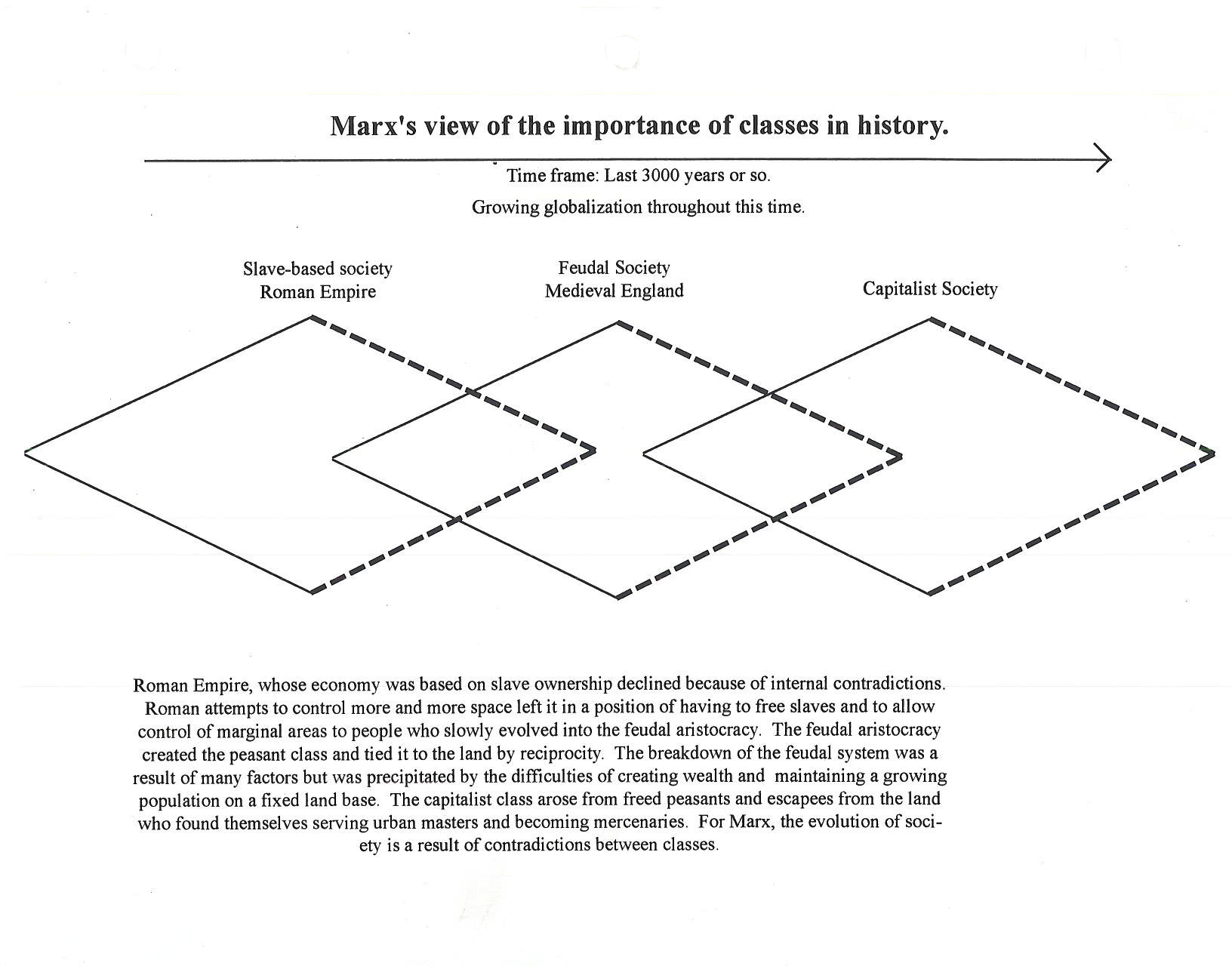
The reason I say I’m not a communist is that I’m not a proponent of communism.  For me, or anyone else, to be labeled a communist or anything else for that matter implies a certain level of advocacy, of ‘proponency.’  It’s not necessary to be proponent of something that will eventually happen no matter what we think or wish.  It’s like being described as an old-agist.  I know that old age will happen to all of us, but that doesn’t mean I’m a proponent of old age.  I’M getting old, but that doesn’t mean that I advocate old age. That would be ridiculous.  A communist mode of production will inevitably replace the capitalist one because the internal contradictions within the capitalist mode of production dictate it in the same way the feudal relations of production replaced slave based ones and the capitalist mode of production replaced feudal ones.  The change will happen gradually, just as old age creeps up on us.  Before it’s clear what’s happening, the old bones get brittle, the arteries plug up and the organs just can’t cut it anymore.  The resiliency of youth is past, old solutions no longer get the same results they used to.  Life inevitably brings on death, they are different sides of the same coin.  What that means for me as an individual is clear, what it means for ‘society’ or for the ‘capitalist mode of production’ is also clear.  Nothing is forever, nothing.  Not the capitalist mode of production, not our beloved countries, not our cities, not our towns, not our fabulous wealth.  The question is not whether or not the capitalist mode of production will live on forever, but when it will die.  It’s not even a question of how.  That’s also been clear for a long time.  Still, classical economics is still in classical denial over the whole thing, a fact which is made clear on virtually every page of The Economist which is a proponent of capitalism.

For what I’ve written above I could be branded with the sin of determinism, one of scholarship’s seven deadliest.   If saying that one day I will die makes me a determinist, well that’s ok by me.  Call me whatever name you want.  Furthermore,  what I write above does not mean that life is completely meaningless to me.  We live life on many levels, a day at a time.  My life is full of activity and that means that every day I make many moral decisions most having nothing or little to do with my eventual death.  I don’t  live life as though my life is about to end (I didn’t do that even when I had cancer and the possibility of my quick exit from this life was very real).  I DO things, there is nothing else to do.  I read the papers, listen to the radio and watch TV.  I play with my grandkids.  I can’t help but get outraged by the blatant bullshit and crap that comes out of the government in Ottawa on a daily basis.  Yet I understand  the role that national governments play in the capitalist mode of production and their essential collaboration in making it possible for capital to flow with greater and greater ease globally  and for controlling labour by keeping tight reins on migrations and regulation.  I haven’t lost my moral compass.  I even get angry on one level…say, at incivility, at stupid driving, at poor highway engineering…while understanding that at other levels, the picture is much different and anger makes no sense.  As I write above, we live life on many levels, many planes.  They are all connected although not always in obvious ways.  Even otherwise highly educated people don’t see the connections.  The connections, interconnections and interweavings become visible only after a sustained gaze upon them.  To see them requires special training.  Somewhere, Norbert Elias got that training, as did many other thinkers who have had a sustained influence on me over the decades.

And Capitalism Begat Communism

In my last post I may have given the impression that the capitalist mode of production will implode in a cataclysm or apocalypse.  An Armageddon, if not a Christian type of end story, still an end story.  Well, maybe I was feeling a little conspiratorial in my last blog.  Marx was right, of course, in his prediction of the end of the capitalist mode of production, but a child could have done the same.  It’s obvious that all things come into ‘existence’ at some point and then leave at another point, although ‘come into existence’ is misleading.  None of us is made of ‘new’ material.  We are made of recycled material.  I can’t remember who said it but it seems to be true (http://www.zyra.tv/lbreath.htm) that every  breath you take, you take in some molecules from Julius Caesar’s last breath.  That notion was brought home to me today as I walked through Mountain View Cemetery in Vancouver and saw the smokestack spewing smoke out of the crematorium.  Yes, breathing the ‘air’ means breathing all kinds of molecules, many of which previously inhabited people, some just now literally going up in smoke not 30 metres from me.  Doesn’t sound particularly appealing, but it’s true. No, all things come and go, but not completely or finally.  We just get recycled.  I tell me students every year that they are probably eating bits of their ancestor’s molecules when they eat their McDonald’s burgers.  Grosses them out.  The capitalist mode of production is no exception to this rule.

The capitalist mode of production was born in the contradictions between the ruling feudal aristocracy and the peasant classes.  The feudal system of governance was born in the dissolution by internal contradiction  of the Roman empire.  Revolution is a process, not an event. As you can see from the graphic I attach here, European history is based on a series of transformations that take decades if not centuries to complete if they ever really ‘complete.’  Feudalism is long dead, but some of the old monarchies still persist if only symbolically and for hegemonic reasons.  The concentration of capital in commodities rather than in land as had been the case if feudal times, began during the flowering of Medieval society but it didn’t become the predominant mode of production until political and economic forces combined to unleash fettered commodity production and exchange in the law courts, parliaments and government bureaucracies all over Europe.  The move of capitalist exploitation into North America and elsewhere through colonialism accelerated the process.  My point here is that ‘revolutions’ take time.  They are not events, although they often engender massive violent events and social upheavals much as volcanoes do.  The ‘French Revolution’ was less a revolution than an episode in a process of the creation of the French ‘nation’ as a vehicle for capitalist expansion into manufacturing and finance.  We all are born, grow into adulthood, decay and die.  This isn’t rocket science, but we live as though it weren’t true and much of what we call science in the social sciences is based on the denial of this fact.  The capitalist class at the moment can be smug in its virtual total control of all national governments, even that of China.  But it’s time will come.  When it puts us all out of work, it will have no way of creating surplus value and profit.  It will be unable to sustain itself and grow.  However, the legacy of technique and technology, that ‘labour-saving technology’ we were all ga-ga over a few years ago is what will provide the basis for a future communistic mode of production, one that will not lead to the concentration of capital in individual hands, but, instead will remain in the public trust.  We will be truly ‘public’ then, but don’t hold your breath, we have some time to go before the end of capitalist concentration of wealth.  A ‘communistic’ mode of production cannot dominate the world’s productive forces until all the forces of capitalist production are exhausted.  And exhausted they will become.  Again, more on that later although I can say that my next post will be about communism and lies, lies on every which side.   Communism has never existed on this planet except as an ideological rallying point.  Never as a real productive, predominant force.

Click on Image to EnlargeImage

Society is God: Addendum

If society is God and, as a Christian, say, I give myself fully to God, I am giving myself fully to ‘society.’ At least that’s what Durkheim would argue.  But if I throw into that argument the idea that ‘my’ personality is really ‘our’ personality as I argue in a previous post on this blog following Norbert Elias, and it’s my intertwined and interconnected web of relations that is me, then to give myself fully to  God is to engage in an apotheosis, an entry into divine life.  I become one with God.  Cool, eh?  If there’s anything that turns me on its trying to figure this shit out.

So, Norbert Elias, meet Emile Durkheim.  I know, this is pretty nerdy stuff, but trying to figure out how we ‘operate’ as human beings is a daunting task at the best of times.  I’ve come to appreciate a myriad of theorists and writers in my quest.  Emile Durkheim, Karl Marx and Frederich Engels, Max Weber, Freidrich Nietzsche, Sigmund Freud, Otto Rank, Ernest Becker, Marvin Harris, Pierre van den Berghe, Norbert Elias, Daniel Jonah Goldhagen, Harold Adams Innis, Thorstein Veblen, Michel Foucault, Pierre Bourdieu, Erving Goffman, Joseph Campbell,  Fernand Braudel, Joseph Geis, Boyd Richerson, Robert Sapolski, Edward O. Wilson, Donald T. Campbell,  Patricia Marchak and Dorothy Smith to name just a few.  In future blogs, I will engage each of these authors and many more in a quest to understand the meaning of life.  No less.  Why not be bold and adventurous.  There’s nothing for me to lose.

Privatization, Apple and Wealth Beyond Imagination

John’s question: Isn’t it fair to say that “capital” (as in, portable property not necessarily tied to wealth in the form of land) is inherently about privatization? If so, a capitalist society can do little other than drift toward further privatization, no?

My answer: Capital is a complex concept and Marx defines it in many ways including relating to it as crystallized labour.  Marx argues that more and more capital derived from human productive activity is finding its way into the coffers of the ruling class.  As Marx notes, the capitalist mode of production is based on the exploitation of labour-power by which surplus value is produced.  Profit comes from surplus value and becomes capital. This applies to individual capitalists but Marx intends that it should apply principally to the ruling class as a whole.  So, privatization, as much as anything means that the working class is getting less and less of ‘its’ share of the proceeds of social production.  It’s being appropriated by the ruling class which, for Marx, includes capitalists, of course, but also the state.  [The nature of the state and the ruling class is not by any means agreed upon by all Marxists. I may go into this in another post later.]  But that’s not how we’ve come to understand the concept these days, at least not entirely.  

Nowadays, we consider privatization as the simple movement of assets from the government to ‘private enterprise’ or business as in the case of the privatization of prisons.  The transfer of public land, formerly ‘tree farm licenses’ (TFLs) to business corporations is another example.  That kind of activity is proceeding apace.  Harper is smacking his lips, there’s so much potential here and, believe me, we’re nowhere near seeing the end of it.  But that’s not the whole story.

Essentially, capital is capital and it does not have to be concentrated in the ruling class, in the hands of a few, so to speak.  It can and will be collectively controlled according to Marx.  The irony for ruling classes throughout history has been that the more wealth gets concentrated in their hands, the harder it is for them to continue to accumulate capital. The margins get smaller and smaller the greater the concentration becomes.  Where are we now?

Well, the concentration of capital is proceeding apace globally.  Apple, my favourite computer company, has so much capital (in the form of cash) that it has to seriously consider what to do with it.  It’s giving a lot to shareholders.  It could lower its prices or pay its workers more in the sweatshops they work in all over the globe, but that would just be wrong…it would not be keeping the wealth in the right hands.