#67 Remission!

I spoke with my new BC Cancer Agency oncologist yesterday. We had a nice chat about our alma mater and the weather, but we also discussed my myeloma. Of course we did!

He told me that I am effectively in remission. There is no trace of the myeloma protein in my serum. That, I would say, is great news. That doesn’t mean that I don’t have cancer anymore. Myeloma is incurable but it is treatable. The hope is that I can go some time without needing chemo.

While I don’t have any trace of the myeloma paraprotein in my serum, I still have issues related to myeloma and I have to live with the side effects of the chemotherapy I was on between December 2019 and June 2020. I have lots of peripheral neuropathy or nerve induced pain and weakness in my legs. I also have back pain for which I need to take opioids. My oncologist has ordered a spinal MRI to see if we can pinpoint the specific cause of the pain. I do have residual pain from surgeries I had on my lumbar disks and from the removal of my left kidney in 2002 because of kidney cell cancer. To help us figure it all out I have pain specialists (palliative care doctors) on the job. With them, we’re trying to determine what kinds of medication I need to take and how much.

It’s complicated because there is some pain that is muscular in origin, other pain that comes from problems with connective tissue and then there’s nerve-induced pain. Different meds are required for the different types of pain. For example, opioids aren’t much good against neurological pain but they work on muscle-based pain and to some extent on connective tissue pain. Right now I’m on two main pain medications and a couple more on standby. Hydromorphone isn’t much good for neurological pain but it works for my back pain although the dose is critical. My age is working against me too. It’s normal in ageing to have weakened muscles and degenerative connective tissues. My body is ganging up on me! But I’m fighting back!

One thing I aim to do is increase my physical exercise as much as I can. That means walking more. I have to be careful because my balance isn’t great, but I can walk maybe two kilometres a day using one or two canes. I can also, on rainy days, use our semi-recumbent bike for twenty minutes a day. We also have light weights I can use and stretchy cables (?).

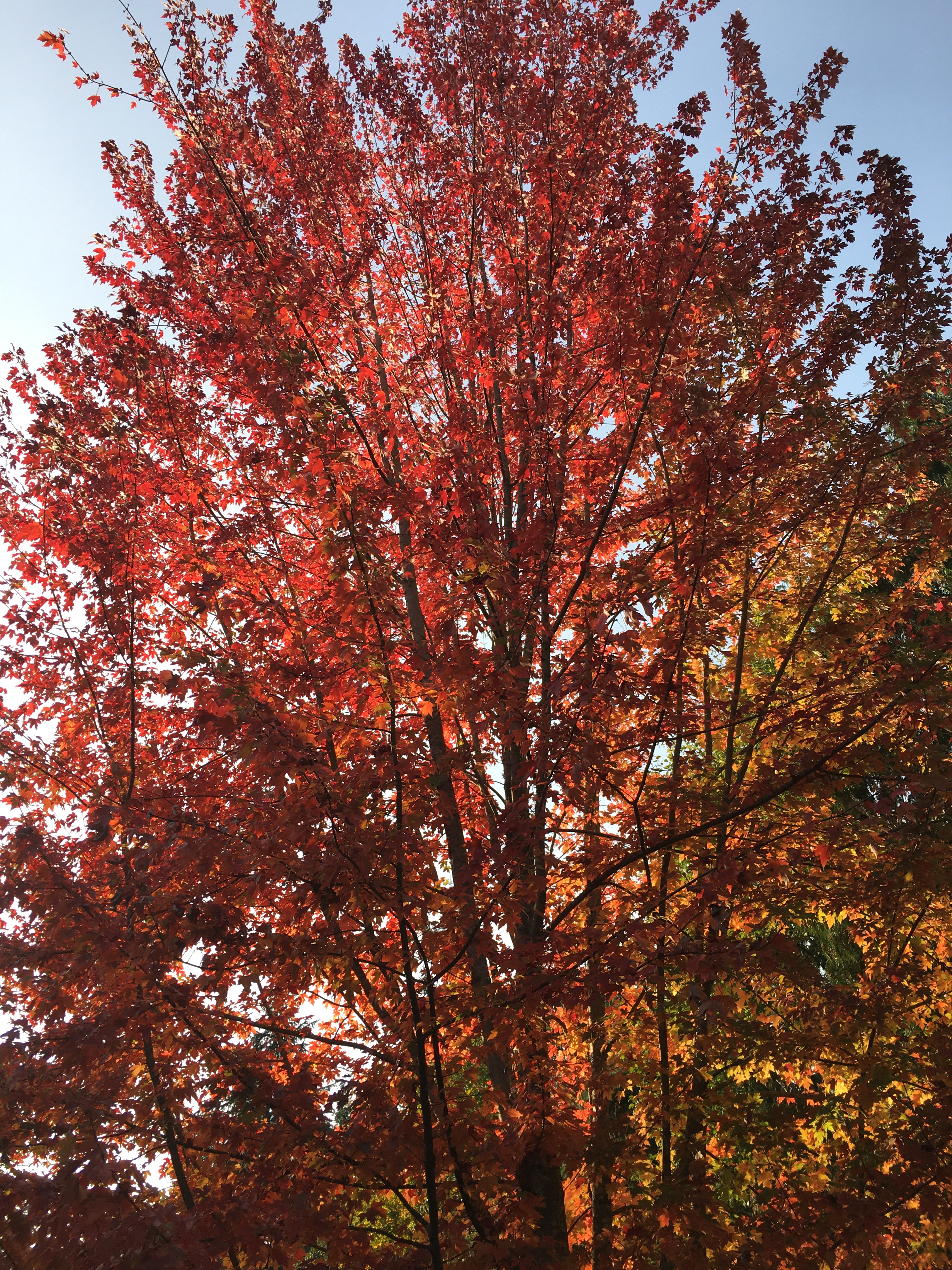
That’s enough for now. I just wanted to give you the good news. Today is such a great fall day. This red maple in front of the house is living up to its name. Every day it gets redder, then it seems like overnight all the leaves are on the ground.

img_4543

AND, haha…there’s a snowfall warning for tonight and Friday morning at higher elevations (which could mean Cumberland). ❄️🌨❄️❄️❄️⛄️ Sleep tight!

# 66. Pain for Gain, Fall Colours in the Garden, and Under the Microscope.

Pain For Gain

Re: the art of tying knots on the scourge so as to experience the most exquisite pain so as to deny our bodies and bring us closer to God.

When I was twelve years old in 1959 my parents sent me off to a private Catholic boarding school in Edmonton, the Collège St. Jean. I boarded a CN train with some forty boys from British Columbia destined to make up a substantial minority of boarders at this school. No way I was going to be left behind. I’m sure I begged my parents to allow me to join my peers in Edmonton. The College was run by Oblate priests (Oblats de Marie Immaculée), a Catholic missionary order founded in France in 1816. 

In this post I don’t focus on my attendance at this school although that is a topic deserving of its own exploration. No. My interest here is to highlight aspects of the life and activities of one of the Brothers who worked at the College from its inception in 1908-11 until 1947, the year of his death. His name was Frère Antoine Kowalczyk. He was born in Poland in 1866, moved to Alberta in 1897 and died in Edmonton in 1947 after serving the College for some thirty-six years. During his tenure at the College he was one of two Oblate Brothers.

Oblate Brothers acted as custodians, gardeners and caretakers. They did the grunt work around the place along with a contingent of nuns from the congregation of Les Soeurs de la charité d’Evron who fed us, did our laundry (poor women), and looked after the infirmary. Oblate priests were our professors (with the odd exception) and served as the College administrators.

Brother Anthony (Frère Antoine) died in 1947, a few months after I was born so there was no chance I would ever meet him. The good Brother would not be alive to see the major expansion of the College in the 1950s, but the College did everything it could to keep his memory alive because Brother Anthony was special. Normally, he would have received a nice funeral and would be buried in the Oblate cemetery in St. Albert, not far from Edmonton, and then all but forgotten. That was not to be for Brother Anthony. Yes, he did have a nice funeral and yes, he is buried in St. Albert but he has not been forgotten.

Because of his exemplary life, Frère Antoine is being considered for sainthood and has been for quite some time. The local Catholics would love to have a real honest-to-goodness saint come out of their community. We all want our heroes. Brother Anthony was to become one of Edmonton’s Catholic heroes and saints-to-be.

I recall reading a number of extremely laudatory tracts about Frère Antoine when I was a student at the College and I still clearly remember the grotto that he built to the Virgin Mary which probably still stands next to the College’s administration building. Some of his personal effects were on display in the main College building. They are what interest me the most about Frère Antoine along with the efforts to have the Vatican declare him a saint.

The glass encased display of his personal effects included his rosary and breviary along with more mundane items such as his cassock, candle holders, and some tools. For me, the most striking item in the display was his scourge, the whip he used for self flagellation. When I first laid eyes on the scourge at age 12 or 13 I was astounded as to why anyone would want to inflict pain on themselves as Frère Antoine obviously had. How could that be? Pain was a bad thing, wasn’t it? Well, maybe not always.

Pain is important as a signal that something isn’t quite right in the body. People who cannot feel pain may hurt themselves in a myriad of ways without knowing it. The condition called congenital analgesia is extremely rare. Less rare is the situation in which people deliberately hurt themselves. People, mostly youths, cut themselves with razors, knives, and other sharp things for a myriad of reasons. I don’t think Brother Anthony whipped himself for the same reasons ‘cutters’ do.

For Brother Anthony, whipping himself or self-flagellation was a means of punishing or mortifying the flesh. Why? Because the flesh is weak now isn’t it? Succumbing to its many potential delights in eating, sex, and just plain moving is considered by Catholic theology as a (if not the) most important source of sin in the world. The seven deadly sins are, in fact, mostly about denying the pleasures of the flesh. After all, the flesh dies while the spirit lives for eternity as the story goes. Most religions in fact promote the spirit as the vehicle for eternal life. I guess it’s just an easy step from avoiding sin to actively ‘mortifying’ the flesh, that is to punish it physically for being the source of death.

But Brother Anthony wasn’t content with a wee bit of self-flagellation during Lent. He spent time with his scourge. What I remember of it, his scourge consisted of several leather strands with knots tied carefully at intervals to intensify the pain and help to cut the flesh. The story is that he whipped himself regularly as he fought with his devil flesh.

I refer to Brother Anthony here specifically because he is a flagellant of my past, but the institution of self-flagellation is not just a Catholic thing. It’s also a practice of Shia Islam and Judaism although in no religion is it standard practice. It’s generally practiced by the over-zealous as is certainly the case in the Philippines and elsewhere. Brother Anthony certainly was zealous and it strikes me that the aim to canonize him is partly based on his zeal.

Reading about the myriad ways in which people deliberately cause themselves pain has not led me to reconsider my attitudes towards pain. For me pain is not something I experience with joy. It is a reminder to me of the weakness of the flesh for sure and of my mortality. That’s fine. I accept that.

If there’s one thing that is common to all human culture it’s the denial of death, and consequently, the promotion of the spirit as the essence of being and as our way to immortality. That’s not a universal value to which I subscribe so my pain and I have to live with each other ’til death do us part.

Fall Colours in the Garden

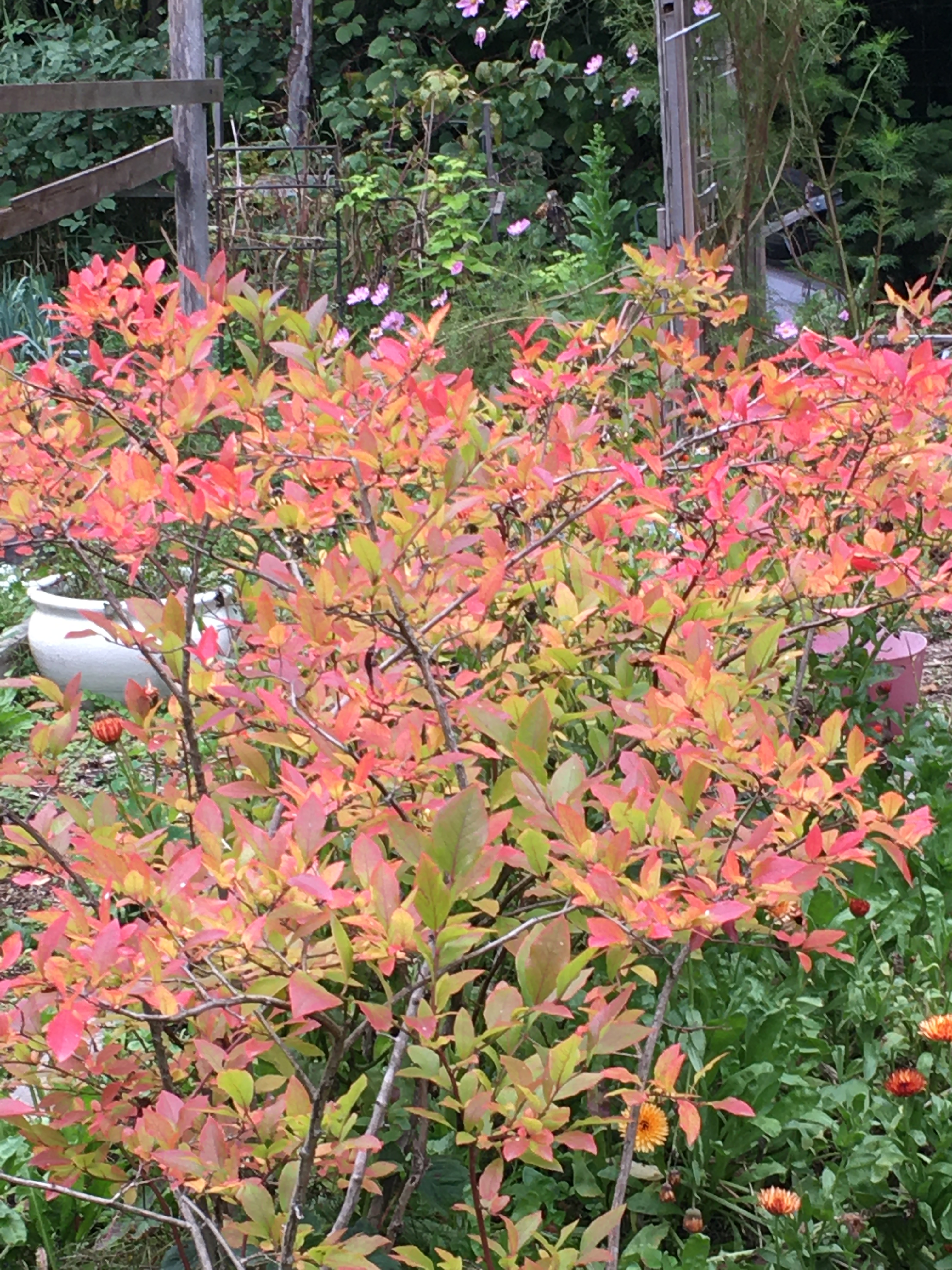
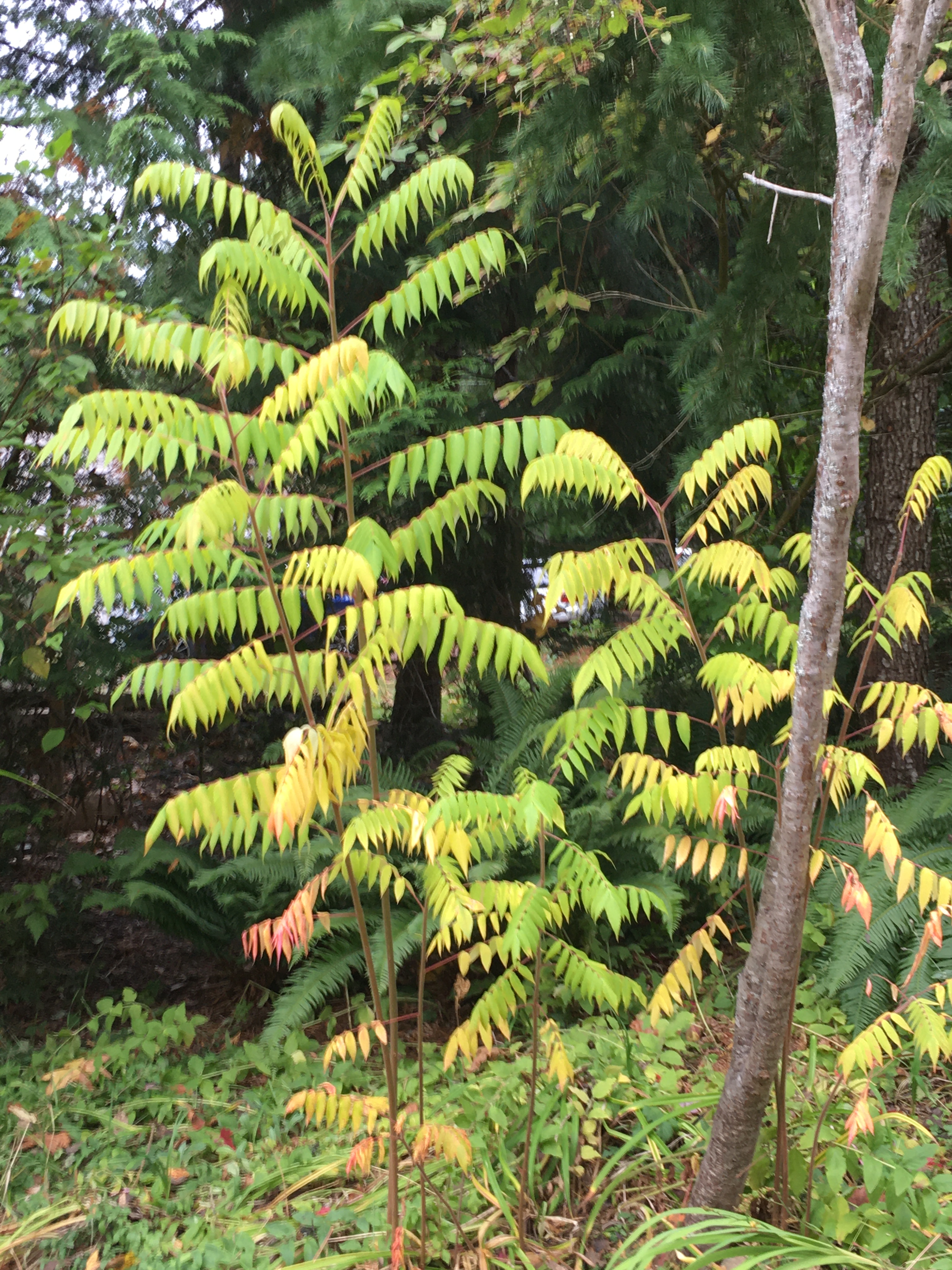
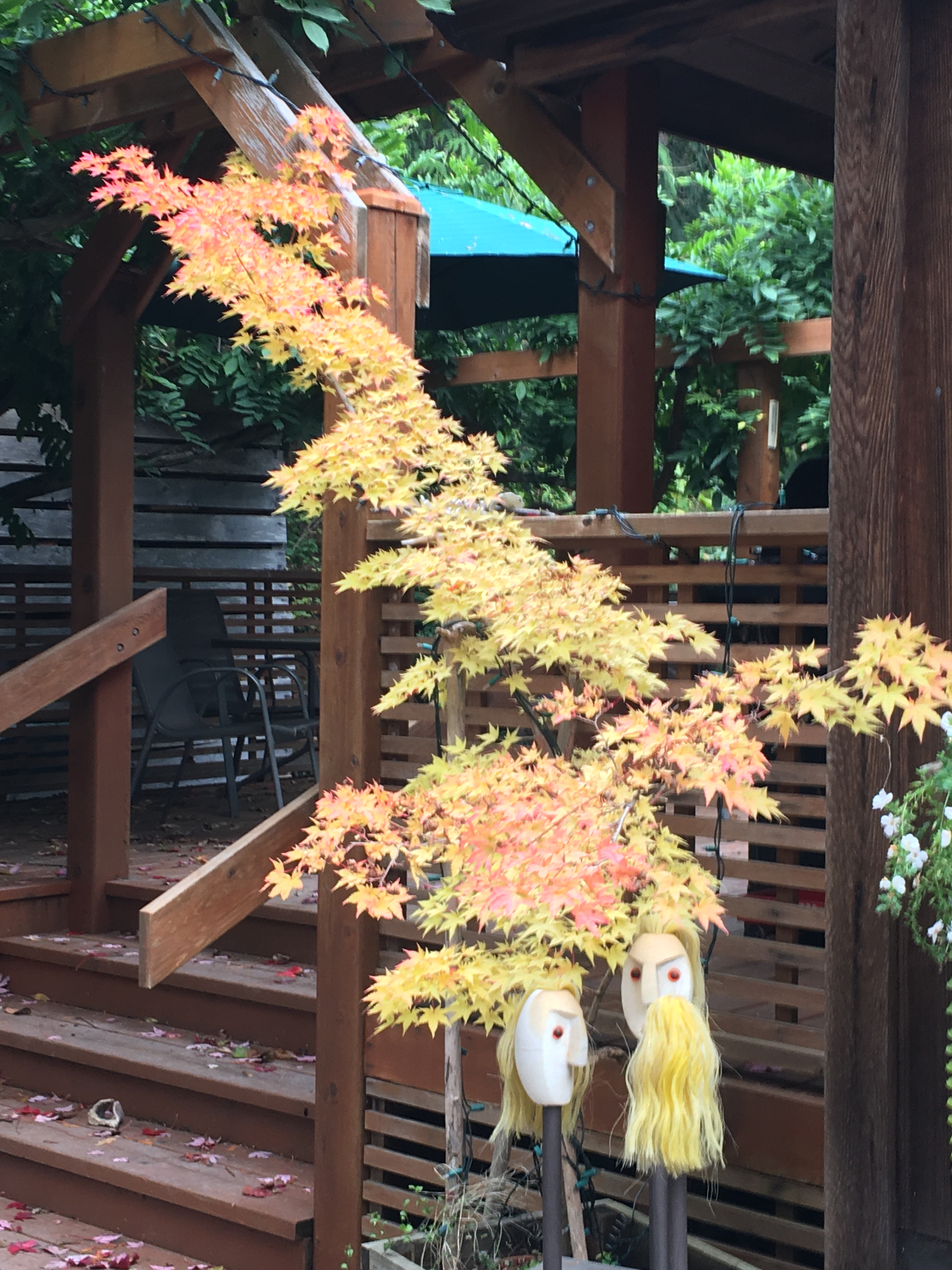
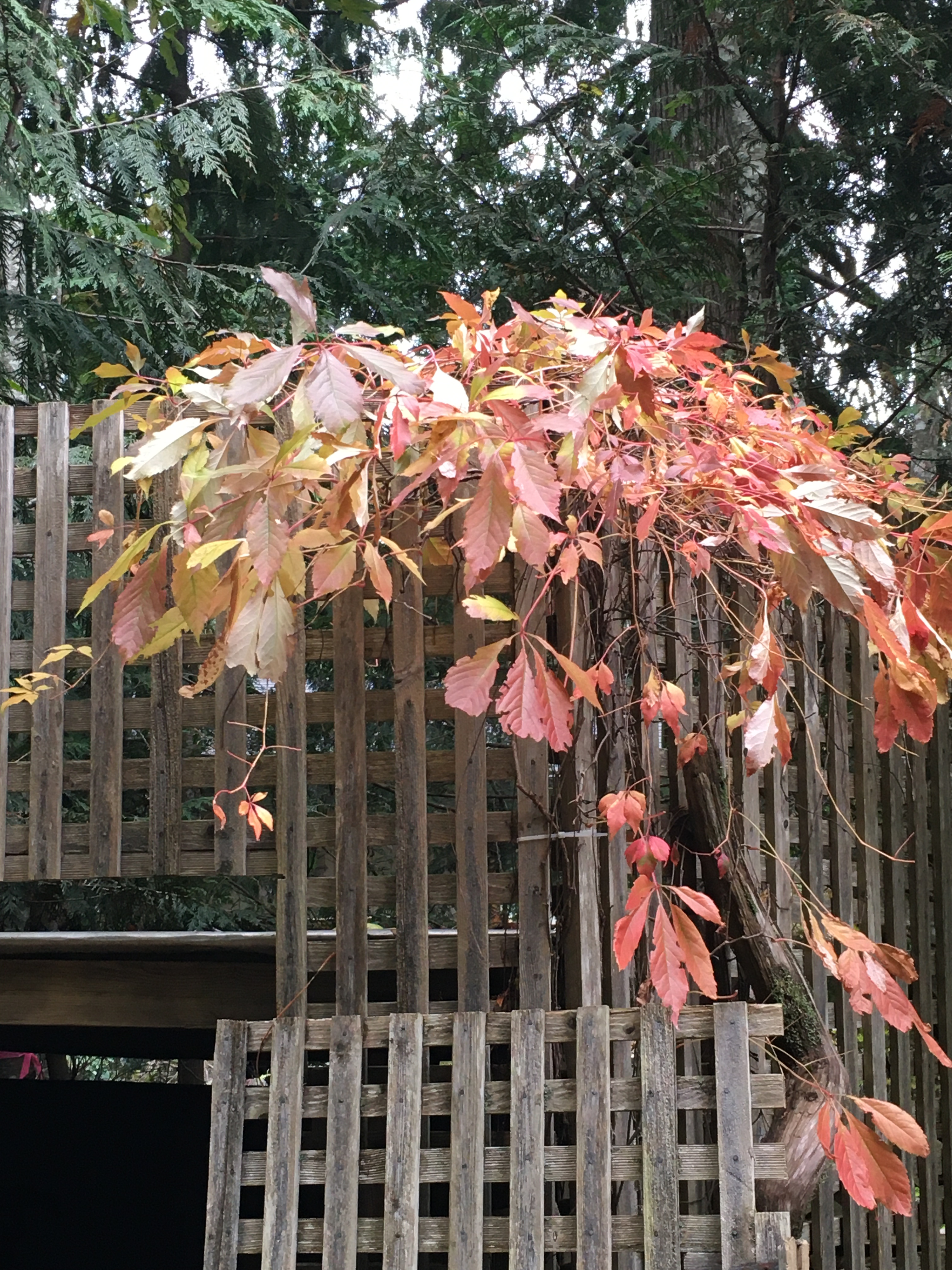
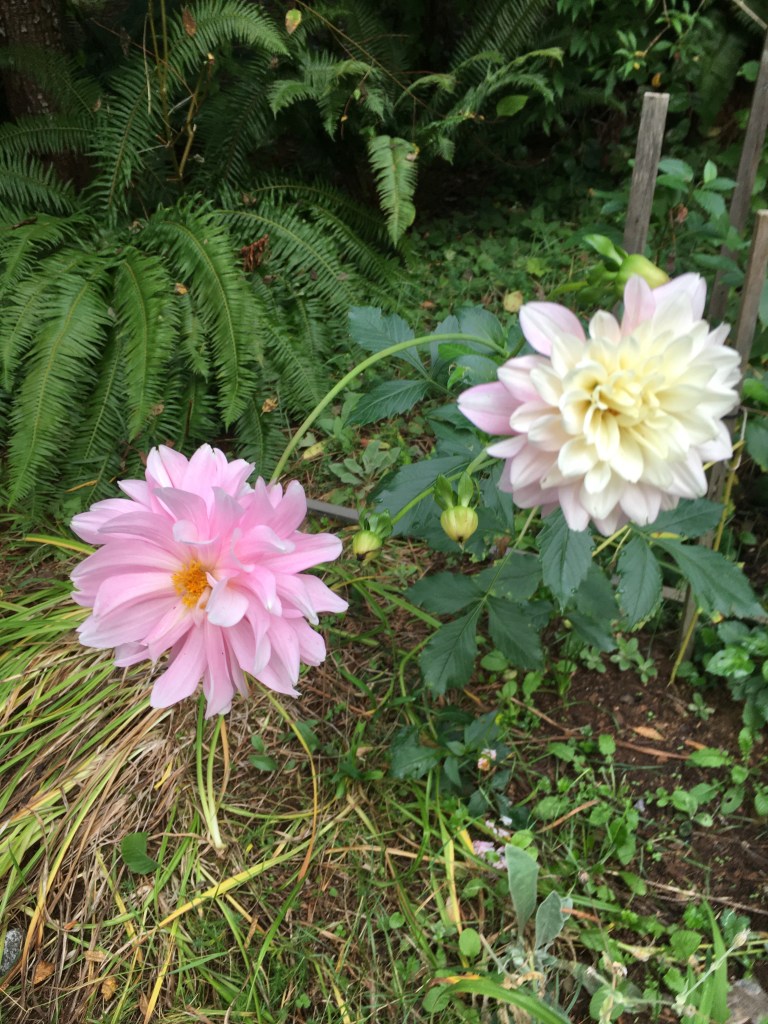
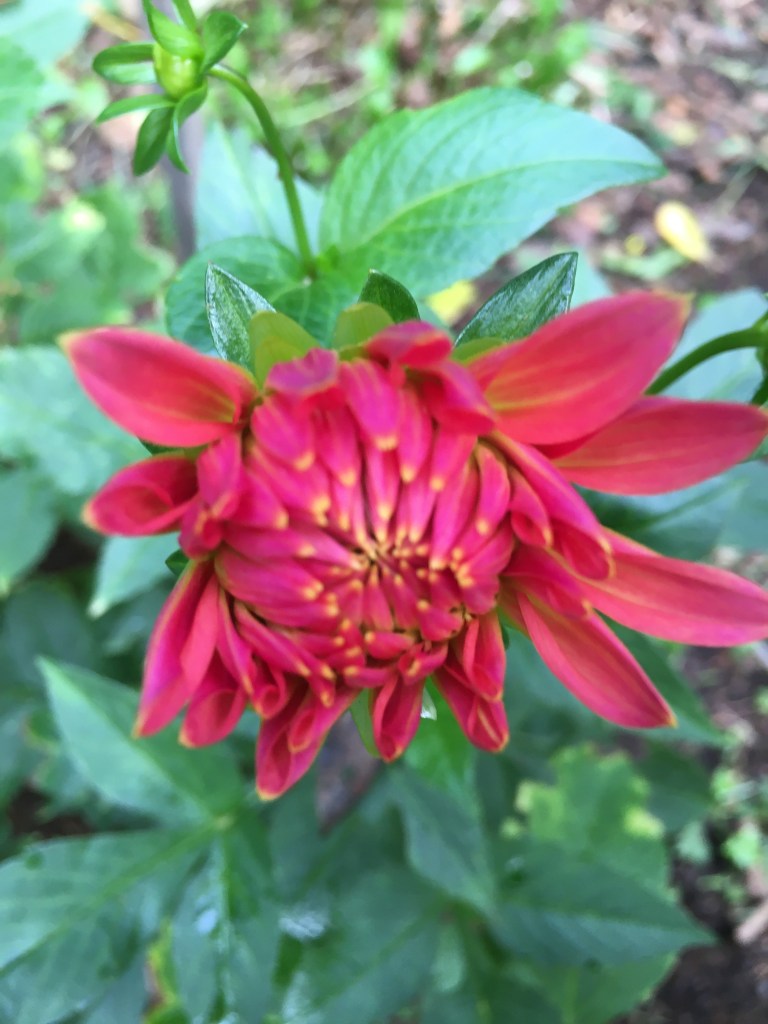
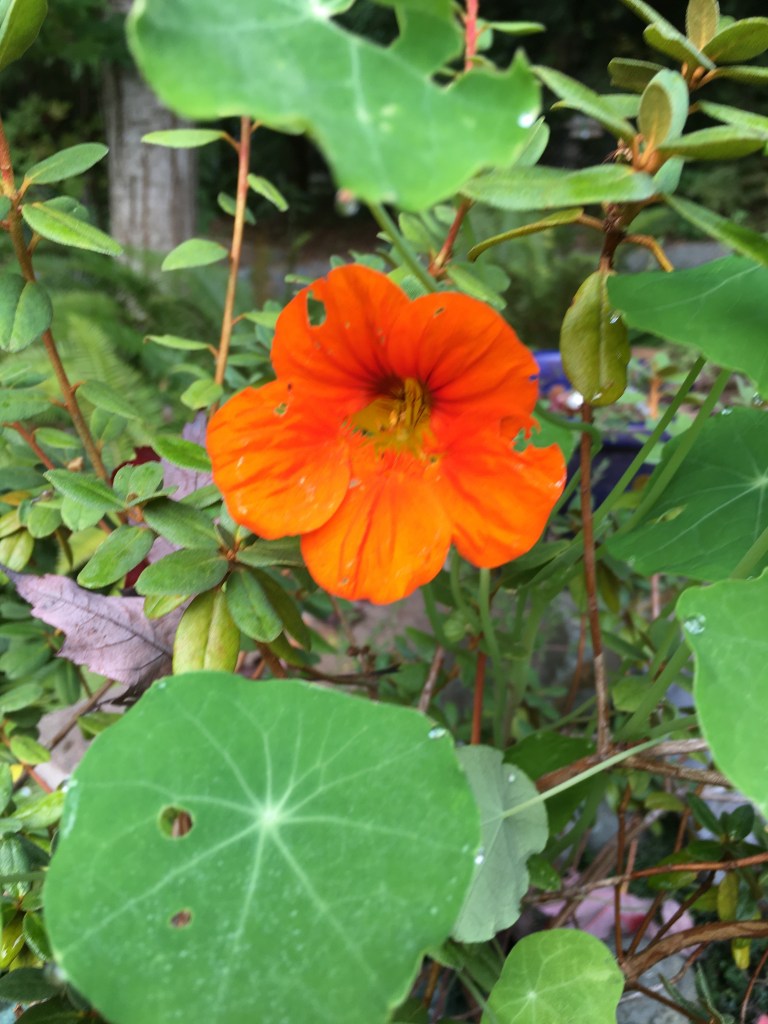
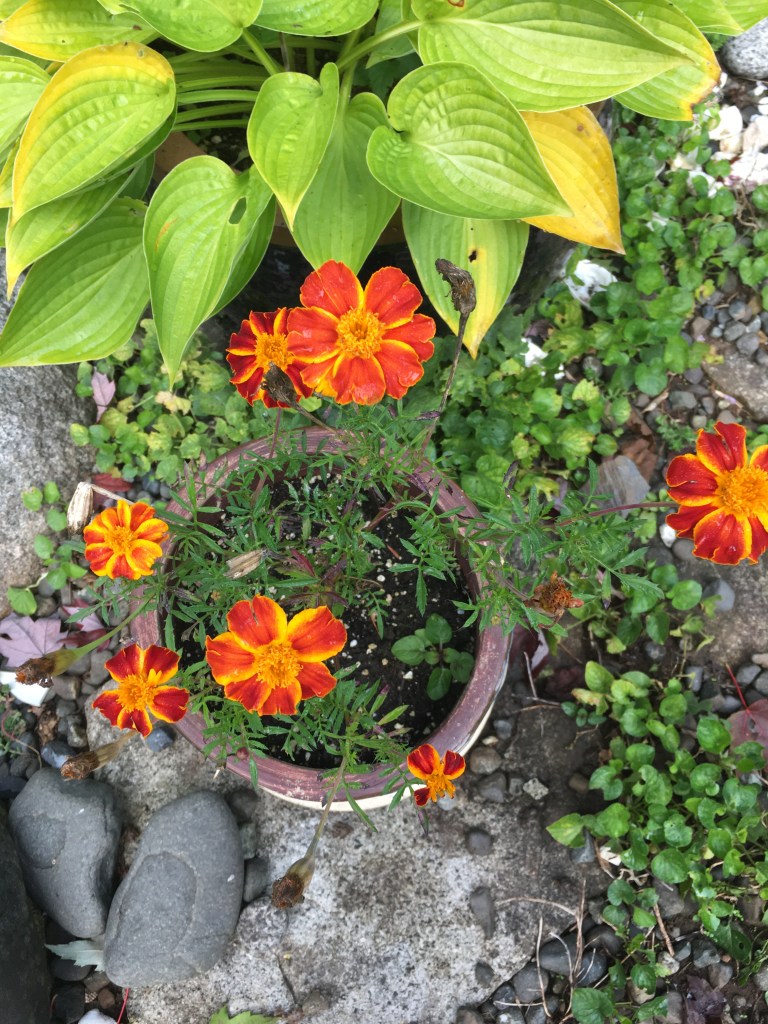
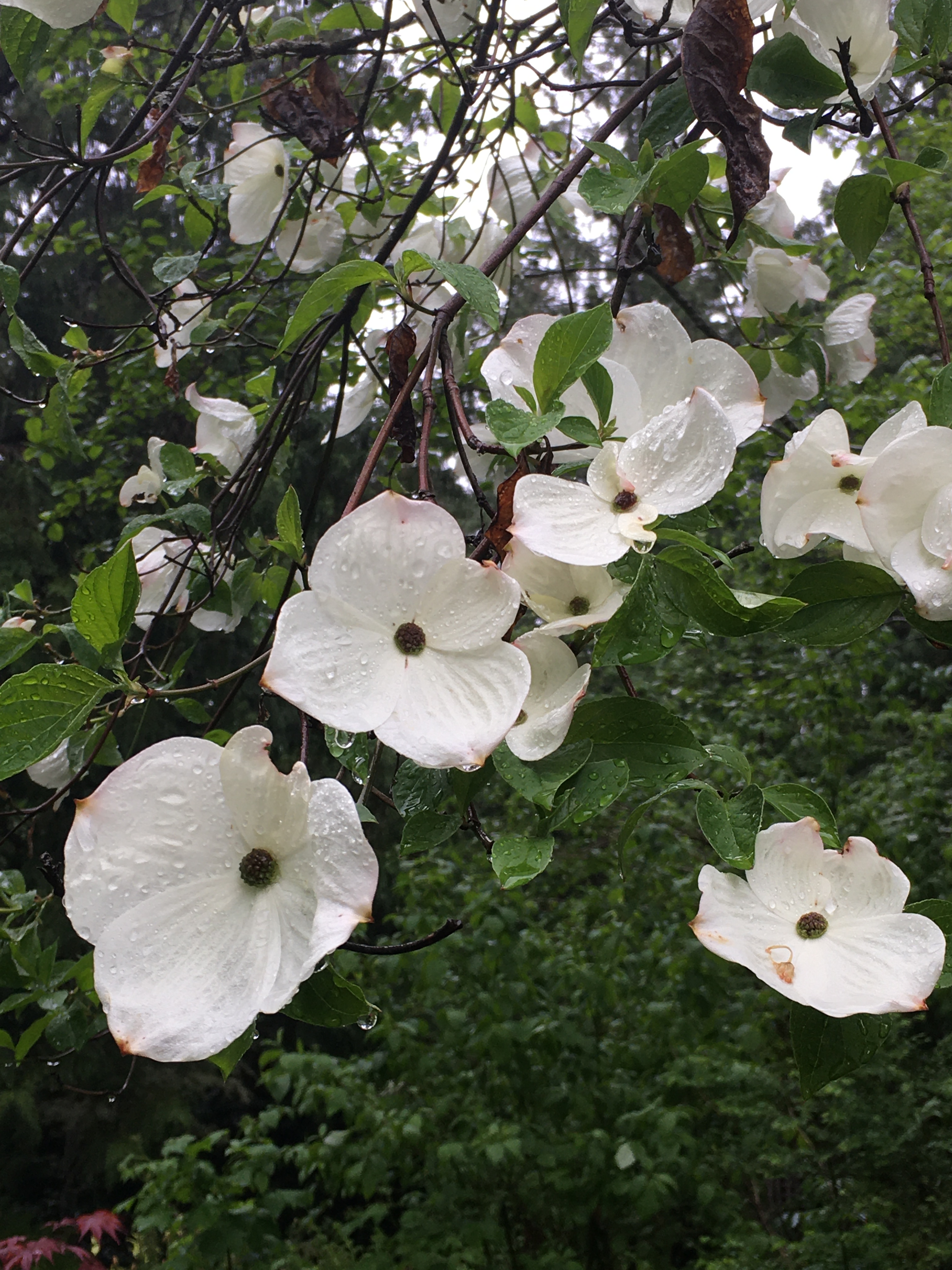
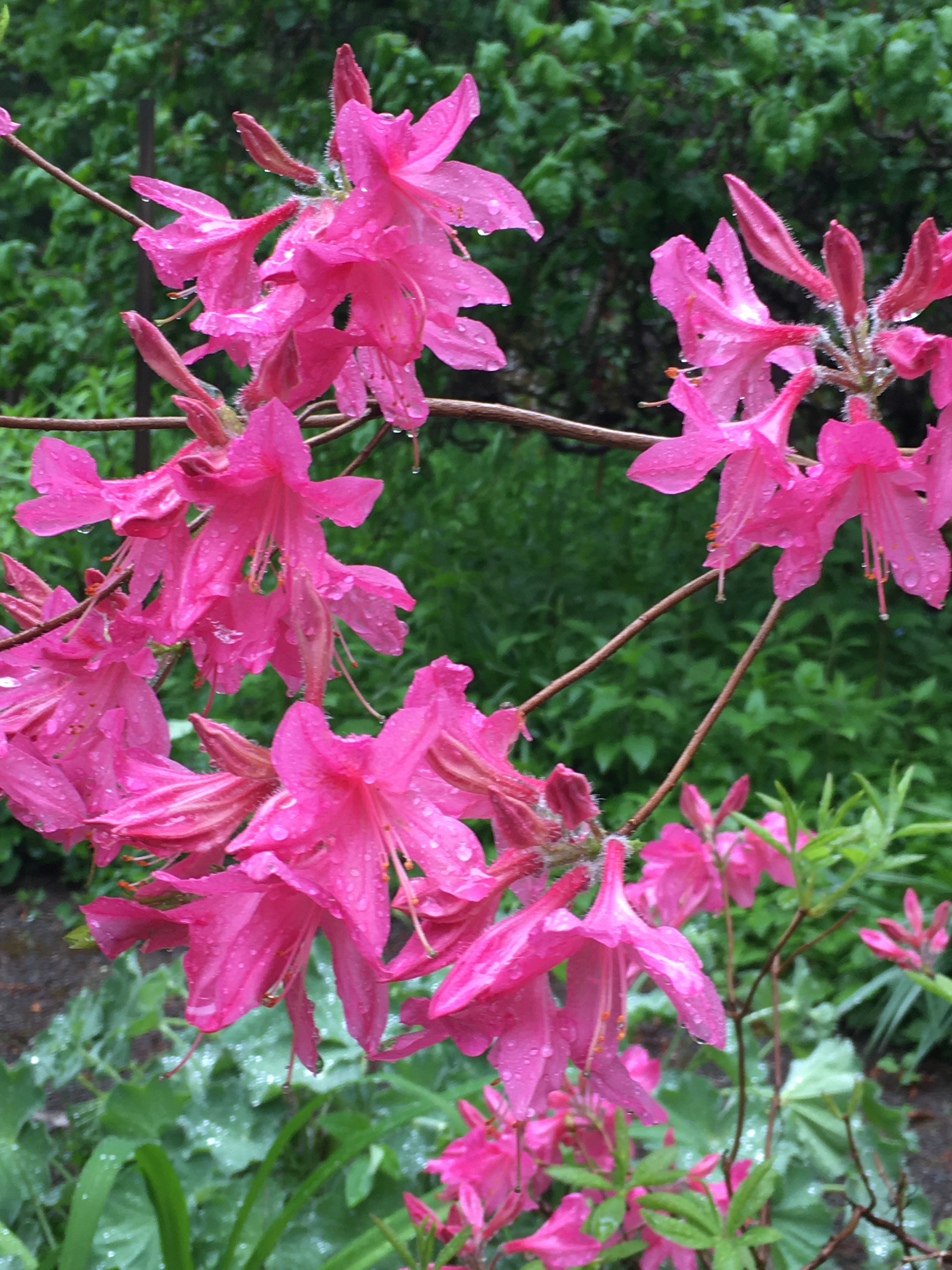
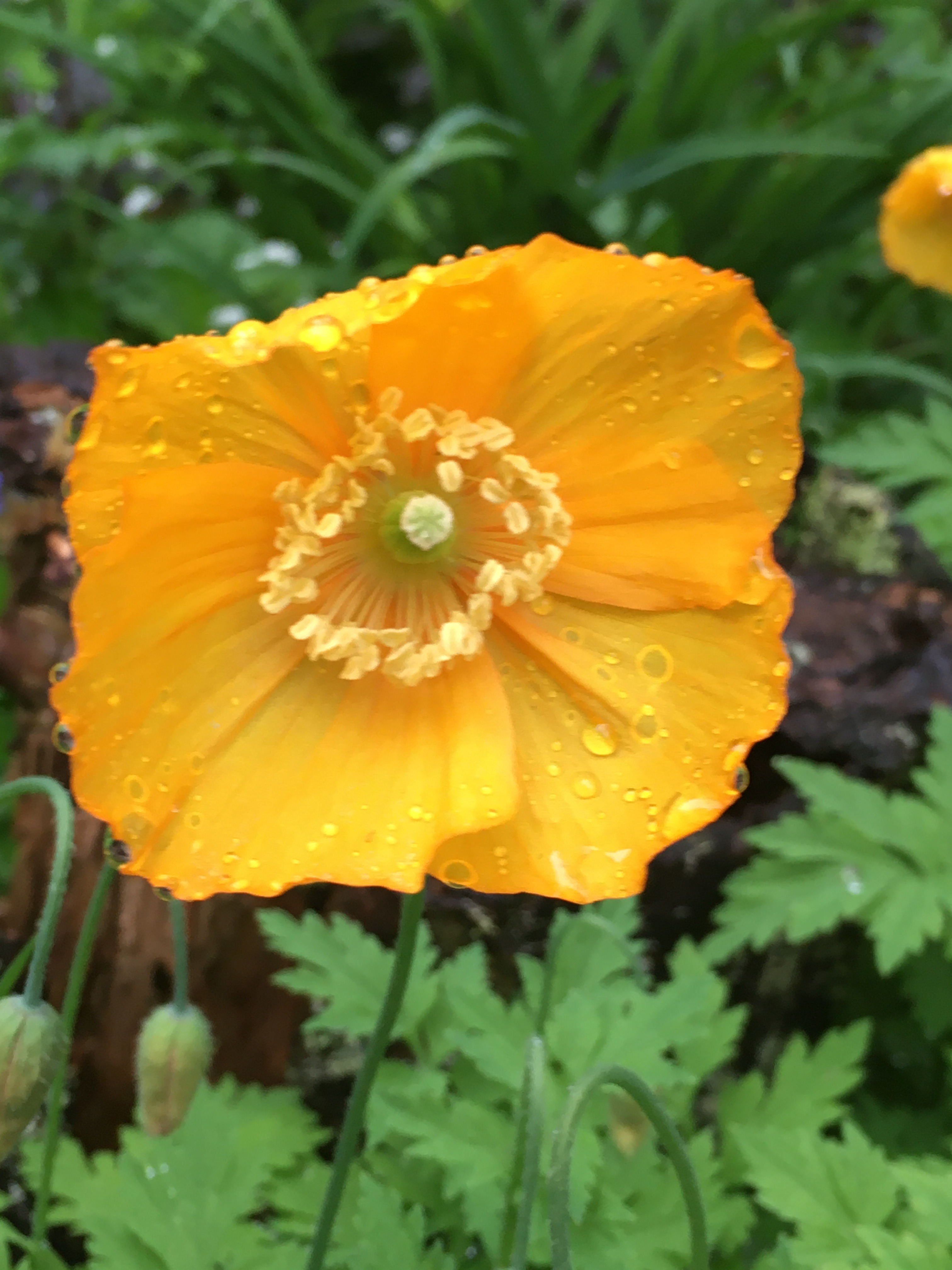
Our garden is flush with colour from the earliest days of spring and well into the Fall. Now is the time for dying and dead leaves to put on a show, extending the dominance of colour before bare branches impart a new dynamic to the garden along with some evergreen trees and shrubs that are just that, ever green. Below you can see pictures of blueberry bushes in full Fall splendour along with some maples, red and Japanese, Virginia creeper, and sumac.

Under the Microscope

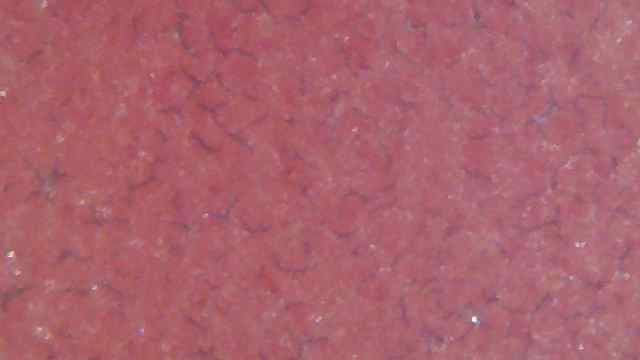
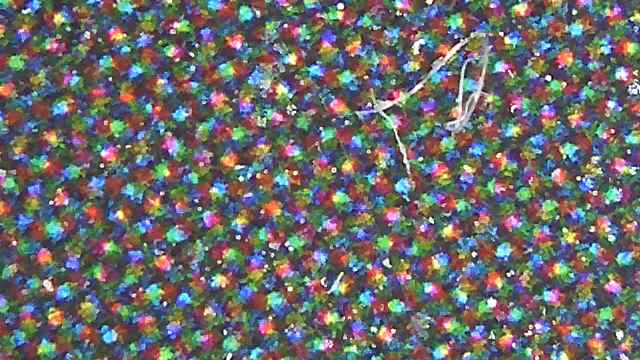
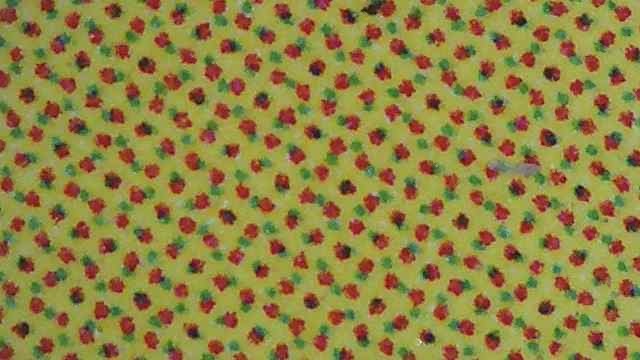
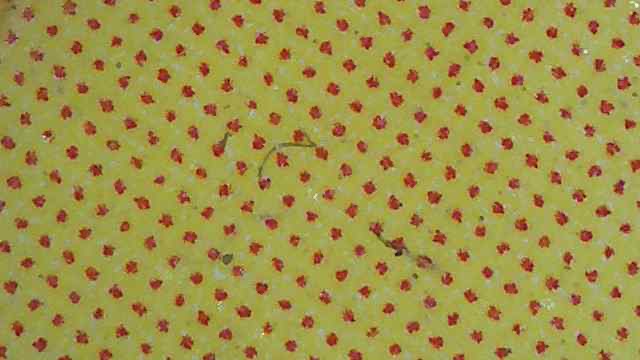
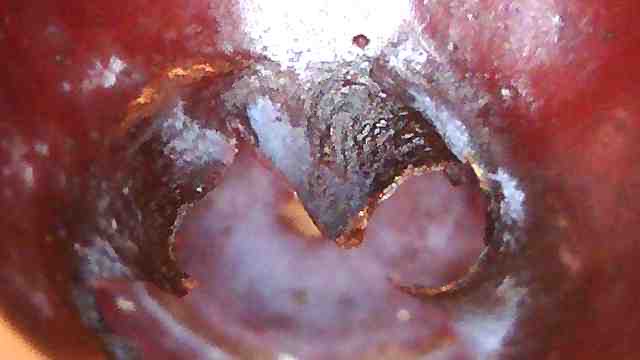
Nothing extra special about this set of images. The first one is of my blood. It’s red, not surprisingly. The blue is a photo of a rough blue paper. The other three are yellow and black. The multicoloured one is in fact black to the naked eye, black being the sum of all colours. The one with only red dots is a light yellow and the one with red and green dots is a darker yellow.

#65. Musings, Flowers, and In Memoriam.

Musings

It’s October 5th, 2020. That means it’s pretty much a year since I was diagnosed with multiple myeloma. I expected that this month would be my last one in my first course of chemotherapy. As it turns out it was not my last month because I decided a couple of months ago to forgo my last two cycles of chemo treatments because of the neurological damage I was experiencing. Chemo was doing away with the myeloma protein in my blood but it was also killing me. That’s not good, so we decided to stop.

Who knows what happens now. I went to the lab last week for some blood tests in anticipation of visits with oncologists later this month. I have the results: they show that my Lambda Free Light Chains (a type of blood protein that is used as a marker for myeloma) are trending up, now out of the zone the medical profession has decided is the reference (some would say, normal) zone. That is not good news, in my opinion. The increase in my Lambda Free Light Chains hasn’t been dramatic, but it sure concerned me.

I contacted Dr. Malcolm Brigden’s office in Victoria. Brigden is the oncologist assigned to me by the BC Cancer Agency. His assistant, after consulting with the good doctor, advised that there was no clinical reason for me to have my meeting with said Dr. Brigden brought forward as I had requested because Light Chain numbers go up and down all the time.

That’s not what I’m seeing in the test results but I’m no oncologist. Still, I’m seeing a definite trend in one direction.

So we wait until October 21t to drive to Victoria for a fifteen minute appointment with said Dr. Brigden. The issue for me (for us, including the family) is where I’m at in terms of treatment. Brigden will decide what to do now that I’ve been off of chemotherapy for three months. He may decide to do nothing and wait for my next set of blood tests. He may decide to get me started on another course of chemo. I expect he’ll choose the former, that is he’ll choose to do nothing and wait for test results three months down the road. Whatever. I have some research to do about how Lambda Free Light Chains react in remission but before a new course of treatment is initiated. You may detect a note of cynicism in my composition here. If you did, you’d be right. I’ve read a fair bit about oncology, both the research and clinical aspects of it and I can’t help but feel that clinicians are all over the map in terms of treatment options and approaches. There are no real standards in the field. That is partly due to the idiopathic nature of myeloma. There is no one treatment option for patients in relapse.

I guess I need to be patient. I find patience a little difficult to achieve these days, but I need to cultivate a ‘letting go’ approach to this ‘problem.’

________________________________________________________________________

In Memoriam. Thinking of you.

Sarah Kerr died on October 3rd after maybe six years of suffering with colon cancer. In 2018 she gave an interview to the Comox Valley Record in which she claims to have had over 60 chemo treatments over the previous five years. That’s just not the way it works for myeloma. I got one over the last year. In the same interview she reports on various different alternative therapies she tried including vitamin C infusions (@$200/week). Her quality of life was severely affected by her chemo treatments.I didn’t know Sarah very well. She was more of an acquaintance than a friend. I knew her from my pre-retirement North Island College days with Sarah making pots and just generally being around the Art Department. She was a Facebook friend too. We had a large number of FB friends in common.

The last time I spoke with Sarah was a few weeks ago on my way into the Cancer Care Centre at the hospital here. She was just heading out after a treatment. Neither of us had much time to chat. Sarah was obviously much distressed. I don’t know anything about colon cancer but I know she suffered tremendously from it. It was unrelenting. No more, Sarah.

Dennis Renaud died on September 30, 2020. He worked for many years at the Courtenay Return-it Centre. I got to know him a bit over the years partly because we were both French-Canadians from outside Quebec. He had Joseph in his name too. Many French-Canadians of a certain generation do. The women have Mary somewhere in their name.

The thing I noticed about Dennis was the way he worked. I’m always impressed by people who work in jobs that could be seen as extremely mundane and boring, but who seem to try to get the most out of every action they undertake as they work. It was obvious to me watching Dennis work that he was always looking for the most efficient way of moving cans and bottles along from the desk to the roller conveyers behind him. He could count bottle and cans very quickly and he never lost a beat. He was one of the most efficient workers I knew.

I didn’t know Dennis socially. He was a FB friend for some time, but he wasn’t that active on social media. In April of this year he was diagnosed with Stage 4 lung cancer. Five months later he was dead. He was two years younger than me. A good, former Catholic, sort of French Canadian kid, like me.
In a way I envy you Dennis. No lingering around with chemo treatment after chemo treatment with shit for quality of life. I think Sarah might just agree with me and in a way she might envy you too.

__________________________________________________________________________

Flowers.

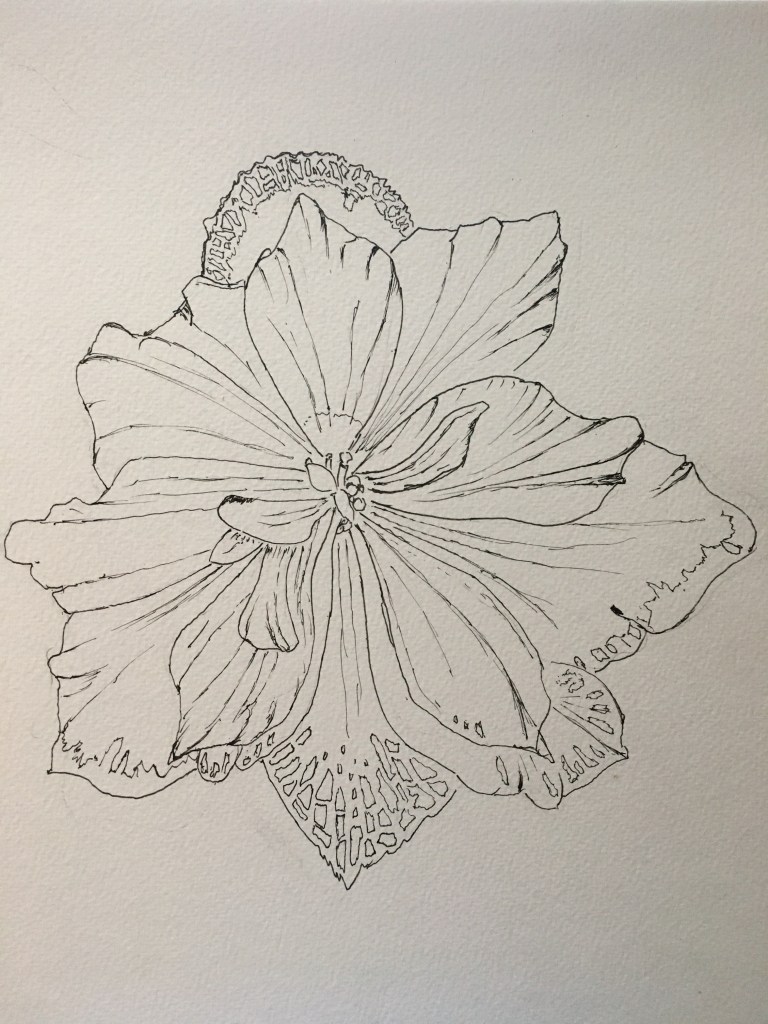
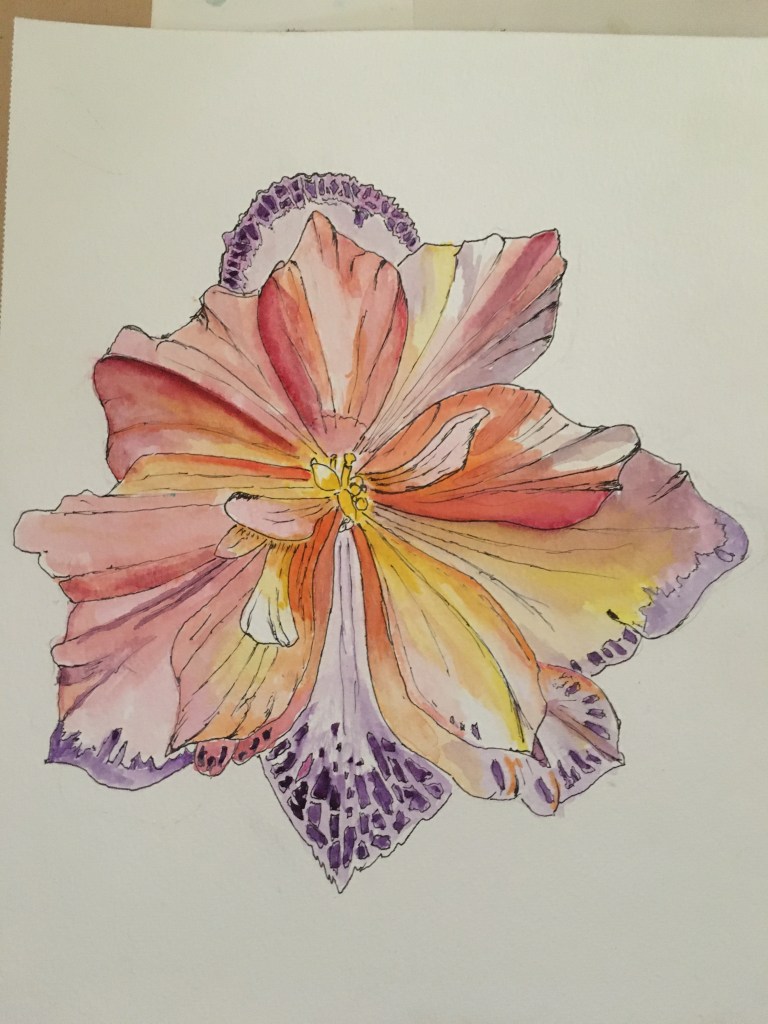
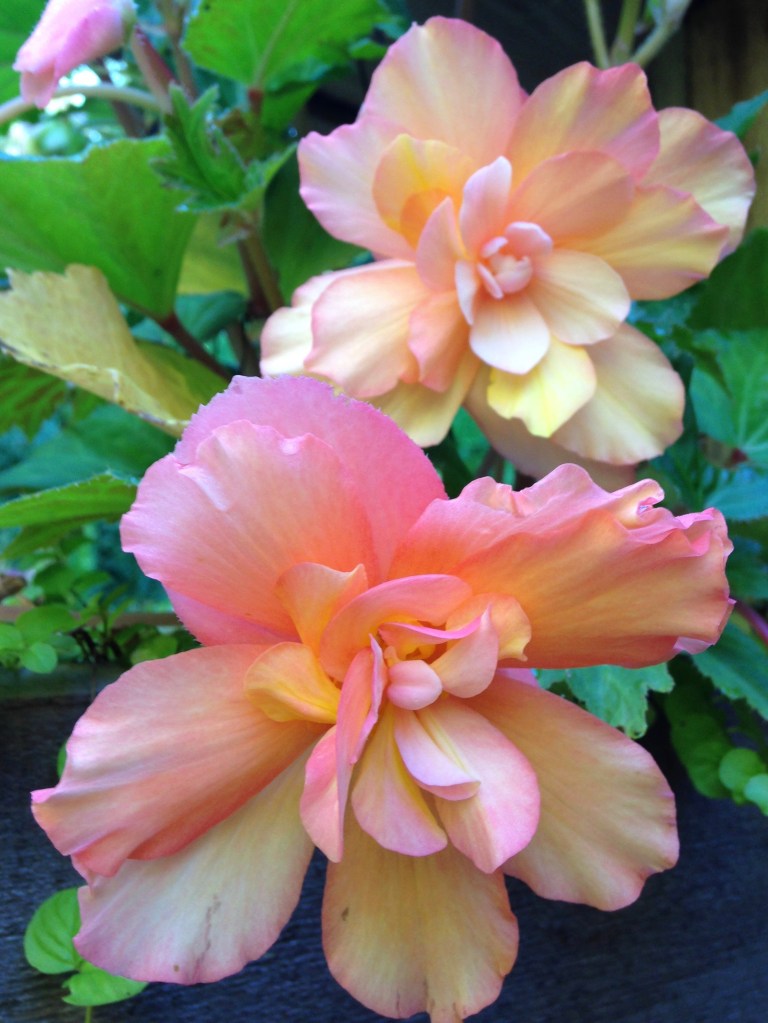
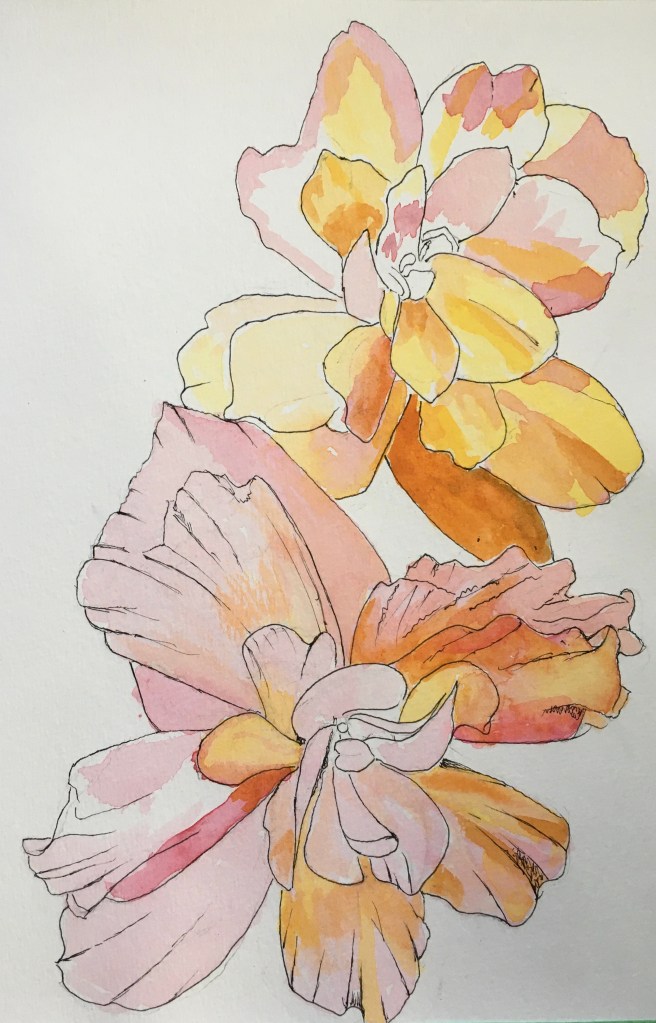
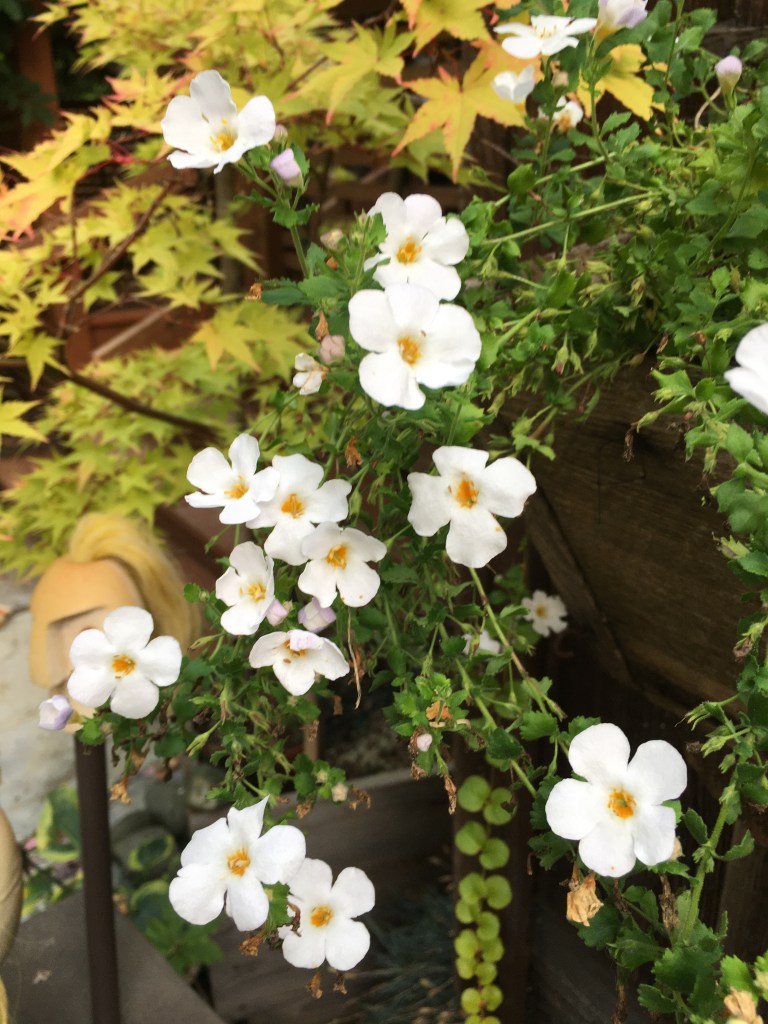
I love begonias. Carolyn grew these in a hanging pot just outside the back door. I saw the every time I walked to the back yard, a half dozen times a day. These flowers are deadly difficult to render realistically. I need a lot more practice to do them well. I’m learning, though. In ‘nature’ there are no lines but drawing this flower requires that I draw lines. The trick is to make the lines disappear into the contours of the subject. It’s not possible with ink, at least it’s not easy. Besides I love the effect ink gives a piece and if I want to look at a begonia not translated via the synapses of my brain I just look at the photo. The begonia I draw tells me as much about my synapses and my brain as it does about the subject matter.

This is quite impressionistic. Definitely not ‘realistic.’

The begonias below, one behind the other are stunning in my mind.
I draw them using a .3 copic pen and then use watercolour on them. This time I use a wet watercolour technique. I haven’t finished this piece yet as you can see. The next one I do will be done with no ink, just watercolour directly on paper with no preparatory drawing. We’ll see how that goes.
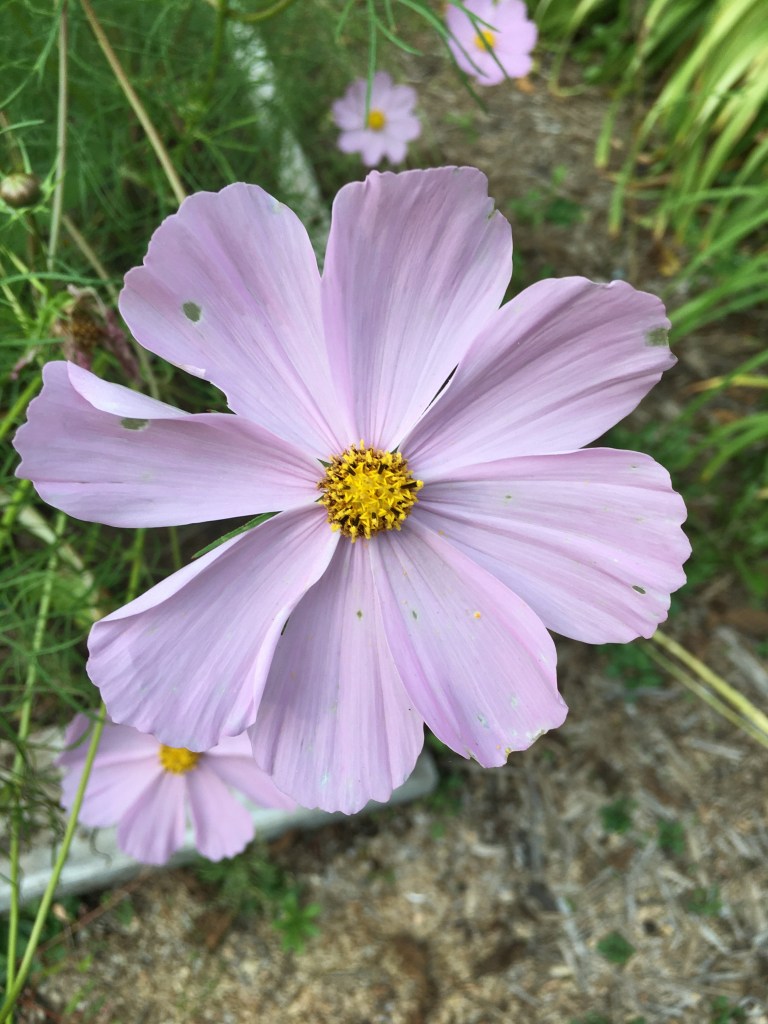
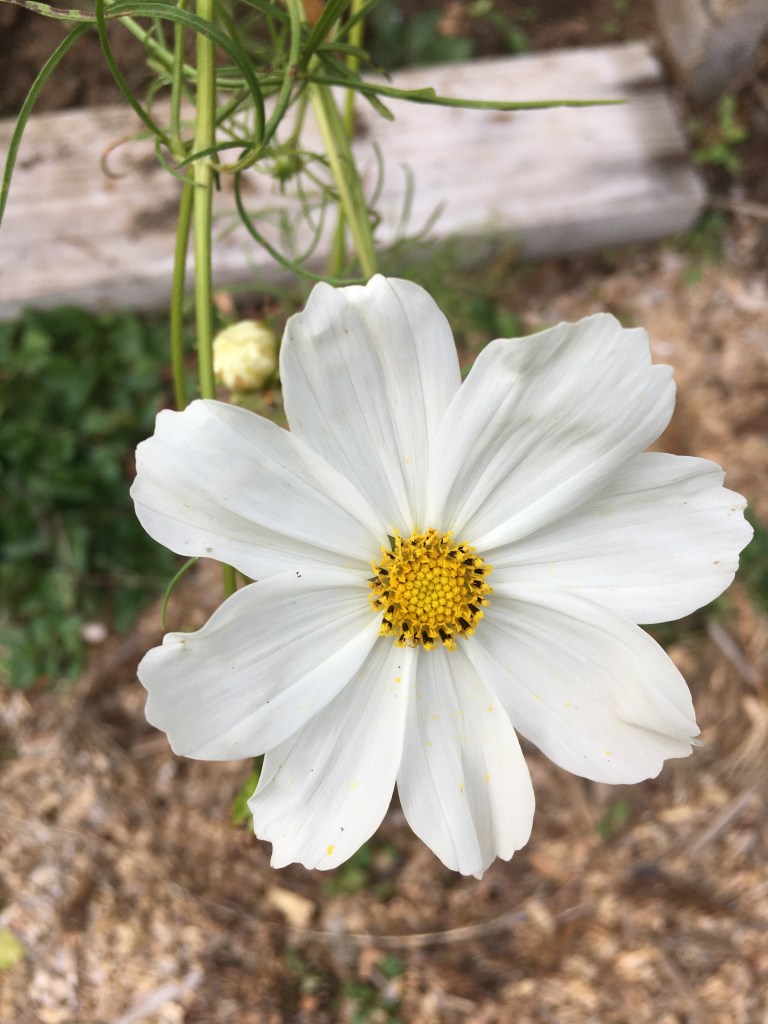
And now just look at all the other beautiful flowers that are still blooming in the garden in early October!

If you feel so moved you might just want to ‘like’ my post!

60 So now what? (…and microscopic events)

Thursday, August 13th is the second Thursday since early October, 2019 that I have not taken Bertezomib or cyclophosphamide, the two main chemo meds that I’ve been taking for months. I’m still on a low dose of dexamethasone and now nortriptyline, along with low doses of hydromorphone. My palliative care team is now fully involved in my case because of the Bortezomib induced neuropathy I am experiencing. Oncologists know very little about pain and make no bones about it, as I’ve noted before, nor do most GPs, so it’s up to the palliative care doctors to do what they can to relieve pain. GPs are often left to deal with the pain their patients experience but it’s often a guessing game finding the right palliative. It’s best left to the experts.

As it turns out, hydromorphone may not be the best opiate for me. In fact, it may be exacerbating my pain issues. So, back to the drawing board. We’ll be modifying my pain med regime one step at a time to ascertain the impact of whatever it is we do without crowding the issue by changing more than one med at a time. I can tell you one thing: I’m sick and tired of being in mind-numbing pain all the time.

Frankly, I’m feeling somewhat adrift. I was so used to the chemo regime and now that it’s gone, I’m struggling with what to make of it. So many unknowns as I slide into a time without chemo but with no promise of remission or relapse. I’m sure I’m not alone in this living purgatory, somewhere between chemo and remission. My GP oncologist told me that he would be in touch in six weeks or so to see how I’m doing and, I suppose, to set up a schedule for follow-up blood work. I should be getting blood tests every three months or so to ascertain the state of the myeloma proteins in my blood. Once the proteins start increasing, it’s time to make a decision again about chemo. Sheesh.

Whatever, the bottom line (to use a business metaphor) is that I’m getting ever closer, as we all are, to the moment of my final breath. The closer I get the harder it is to deny it. The difference between you and me might be that I’ve been issued my ticket to ride, stamped and ready to go in the form of multiple myeloma.

No, I’m not immune to the lure of death denial. I’m not anxious to die. I don’t have a death wish. In fact, I have a life wish. But wishing and hoping aren’t going to get me past this one. It’s just so hard to fathom being dead although I can see that it would be a relief from American politics.

Lots of people urge me to be positive and/or stay strong. Well, I’m not curled up in a fetal position in a corner of the living room wailing and gnashing my teeth waiting to die. Still, it’s a bit daunting thinking that, like my parents, grandparents, and all ancestors, I will also be relegated to the dustbin of history, and in the not-too-distant future.

Yes, I stay positive. I’m registered for a webinar organized by the Multiple Myeloma Foundation set for this Saturday at 1 PM. I wouldn’t be doing that if I weren’t positive! The webinar is to inform us about the latest treatments for myeloma and the progress that’s being made to find a cure. Yes, some researchers and scientists are actively looking for a cure. Problem is they’ll never find a cure for death.

Yes, I stay strong, whatever that means. Sometimes I just want to scream about the injustice of it all, but I don’t. I stay calm, but I seethe inside quietly with my teeth clenched. Maybe that isn’t staying strong. I don’t know. One thing for sure is that when worse comes to worse, I won’t hesitate to get zonked on morphine. Suffering is highly overrated. I’m not sure what the virtue is in suffering. You tell me. Is there a reward?

______________________________________________________________________

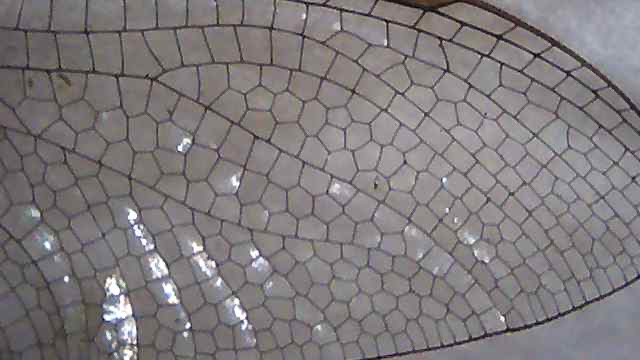
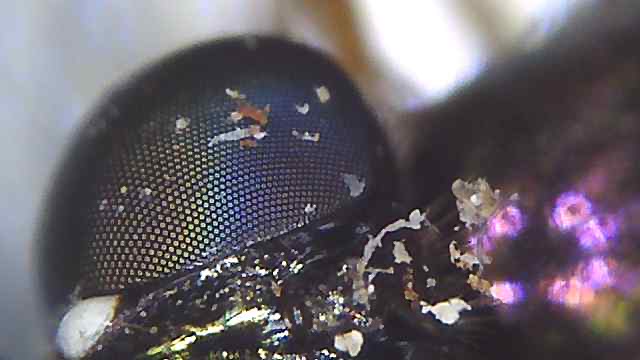
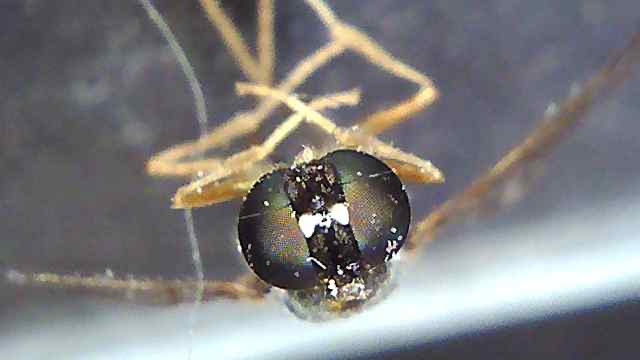
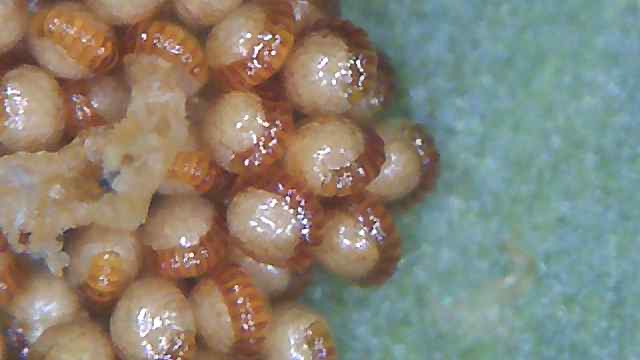
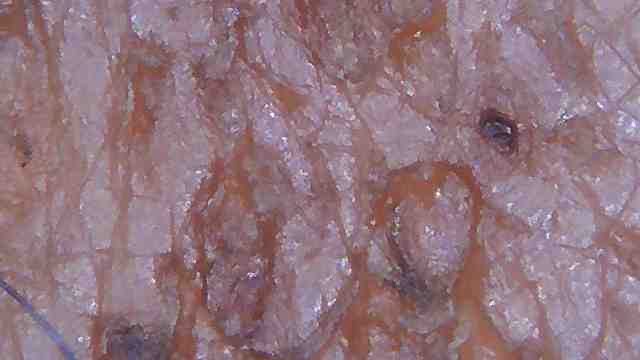
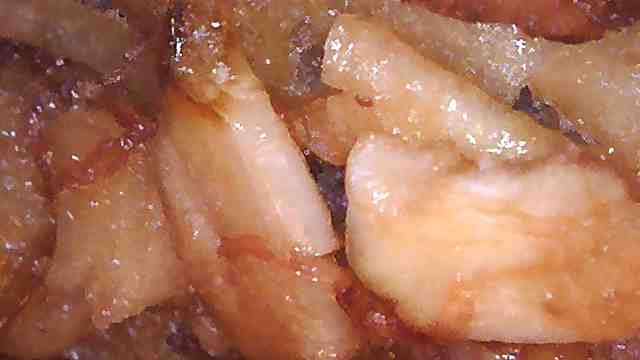
Okay, so now for something completely different. Some of you will know that a couple of weeks ago I got a microscope that I can use in conjunction with my iPhone. I get some great pictures and video with it. I also have a standard lab microscope that is actually more powerful than my Wi-Fi microscope, but it’s not easy getting pictures with it. The pictures below were all taken with the Wi-Fi microscope and my iPhone. The first three images are pretty straightforward. The others not so much. The first image (1) is of a dragonfly wing. The second is a photo of the eye of a tiny fly. Number 3 is a larger image of 2. Image 3 is of the spore sack of a fern. The 5th is much different.

Don’t get grossed out now, but the 5th image is a very enlarged view of a mole on my back! I know…eweeeew. Weird, eh? You might want to keep microscopes away from your body after seeing this. Number 6 looks very flesh like, but it’s a highly enlarged view of a plant part. I can’t remember which plant or which part. Number 7 is…I have no idea. I don’t recall taking this image, but it’s of some plant part. Reminds me that I have to more carefully document these things, not that I’m doing a systematic study of anything. It’s just interesting to do while I wait for my myeloma to return.

I’m finding some great inspiration for abstract paintings here.

54 Describing Pain can be a Pain.

But first, how about a very short video of Princess drinking from the ‘fountain’ next to the deck? And how about following that with a picture of our new puppy? She comes home Saturday. Coming soonish, a second video about gardening and plant sales. Stay tuned.

Princess and the Fountain.
Puppy. No name yet.

So, I’ve written about this before, but it’s such an important part of my life right now that I can’t let it go. I, more than most people, understand that social convention governs a great deal of our behaviour. The study of social convention is on the curriculum of most introductory Sociology courses, so my familiarity with it goes a long way back. Convention and habit colour if not drive a lot of human interaction and that is true of our conversations as well as many other types of behaviour. We’ve come up with a number of conventions that, in my mind, work fine, but only if we don’t question them. For instance, asking “How are you?” is not really a query into the state of my health even though it does literally inquire about my wellbeing, doesn’t it? Needless to say, “How you doin’?” is a conventional and very common greeting. It’s not a question inquiring about pain now is it? The conventional answer to this greeting/question is “Fine.” “Hi, how are ya?” seems like the asker is interested in an answer, but mostly, that’s not the case. We’re supposed to say “Fine.” That’s it.

I don’t ask people how they are doing anymore. I mostly just say “Hello,” and get on with a conversation. For a while there, I would answer the question as though it were a real question. “How are you?” “Well, today, not so good,” I’d say. Or I’d say, “It depends.” That is not a satisfactory answer. I can tell that from the look on the asker’s face when I dare utter such an unconventional and unexpected riposte. Sometimes I would carry on with an extended answer, but I knew from the glaze over the asker’s eyes that that wasn’t a satisfying answer. Eventually I would say, “It’s okay, I’m fine.” After that we could all get on with our ‘normal’ lives. The thing is, I deal on a weekly basis with medical personnel of all kinds. Of course, they are as gripped by social convention as the rest of us, but it still throws me off with an oncologist asks me: “How are you, today?”

Just like everyone else, they seem to expect “Fine” as the appropriate answer. Of course, if I were fine, what the hell would I be doing talking to an oncologist about my chemo treatments? Obviously, “fine” is not appropriate as a response under the circumstances, but nor is asking “How are you?”

One time, a few months ago, I had a Zoom type meeting with an oncologist and he asked me “And what can I do for you today?” Well, that question kind of left me speechless, something that is quite an accomplishment if you know me. Of course, it’s a completely appropriate question if I’m in a retail store, walking up to a counter and a clerk asks me “And what can I do for you today?” or “What can I get for you today?” Yes, in that circumstance, this convention works for me, but when an oncologist asks me that question, I get flummoxed. In my usual smart ass way I get tempted to blurt out: “Well, you can tell me I’m cancer-free. How about that doc?” But then, things get awkward and embarrassment takes centre stage and nothing good comes of it.

So, being a sensitive kind of guy and always interested in having conversations go smoothly, my response to the oncologist that day was quite measured. He wasn’t prepared for the appointment, so all he did for the five minutes of the conversation was look at his computer screen, just glancing up every few seconds the camera in an uncomfortable way. He was probably having a bad day. In his line of business, bad days probably happen often, so I don’t take these things personally. In any case, I steered the conversation to my lab results, prognostications about future treatments, and about pain and exhaustion. As an aside, my experience so far is that oncologists don’t like to talk about pain. It seems to make them uncomfortable and fidgety. Tellingly, they leave pain management to GPs.

Well, to finally get to the topic of this post, I can understand their reluctance to talk about pain. It’s a ridiculous thing to talk about. It’s invisible, subjective, and it’s measurement borders on the hilarious. “So, Mr. Albert, on a scale of 1 to 101, how bad is your pain right now? Well, shit. Where do I go from here? Do I just tell them what they want to hear: “Oh, it’s about a 5.” “Okay, thank you, Mr. Albert. So the pain isn’t too bad right now then.” Note that last comment is made as a statement, not as a question. Asked as a question, I could answer something that is more akin to the truth than the bullshit conventional responses we are expected to give at these times. So I could say something like this, bear with me:

Well, at the site of my nephrectomy, the pain varies from 3 to 8 and in duration depending on my activity at the time. It can spike to 9 at times, just not right at this moment. My lower back is fine as long as I don’t move too quickly but that’s because of arthritis and disk degeneration. As you know, my Bortezomib induced peripheral neuropathy (BIPN) is neuralgic pain that is untouched by pain meds designed to deal with muscle or joint aches and pains. Right now, it’s at about a 7. My back starting just below my arms, and my legs down to my knees are burning. My left thigh is painful to the touch. I don’t know how to measure that. It’s a new thing for me. It seems that my BIPN somewhat attenuates during the day and I may actually be able to go to bed with it not bothering me much. At other times it’s excruciating and ridiculous. The pain at my right kidney is nasty at the moment, spiking up to a 7 at times. Lab tests tell us my kidney is fine so it’s the Bortezomib that’s the culprit, it seems.

Anyway, you get the picture. Describing pain simply and easily is impossible for someone with chronic and/or chemo-induced pain. No one can possibly understand how much pain I’m in or how much pain people with inflammatory illnesses and many other conditions suffer. It’s impossible for me to describe the various levels and types of pain I experience daily unless you’ve experienced it yourself in the same contexts that I have. Now, my GP takes my word for it. What else can he do?

_____________________________________________________

1The 1 to 10 pain scale: I thought I understood it somewhat until I had a talk with a palliative care physician who told me that a 10 is pass out time. I have never passed out from pain as far as I can remember although I may have passed out from deliberately taking a pass out dose of meds on occasion, the only strategy. There were times when I assumed that a 10 was severe pain, but not pass out quality. So, if I said I was at an 8 or 9, that meant that I was sorely distressed by it, but I was tolerating it. A 5 meant that the pain was bad, but not completely distracting. A 4 or below meant I was in some pain, but not too nasty, maybe a nagging, throbbing, but fairly mild headache. After talking to the palliative care doc, I had to revise my scale. Now a 5 is “I’m in pain and it’s no fun. Do something about it!” A 4 is “It still hurts pretty bad!” A 2 might be: “Okay, I can deal with this, but it’s still bugging me.” I haven’t seen a 0 very often, but it does happen periodically for a short time when I’m lying down and not moving at all.

49 Covid-19 has me tongue-tied. But flowers have me blossoming!

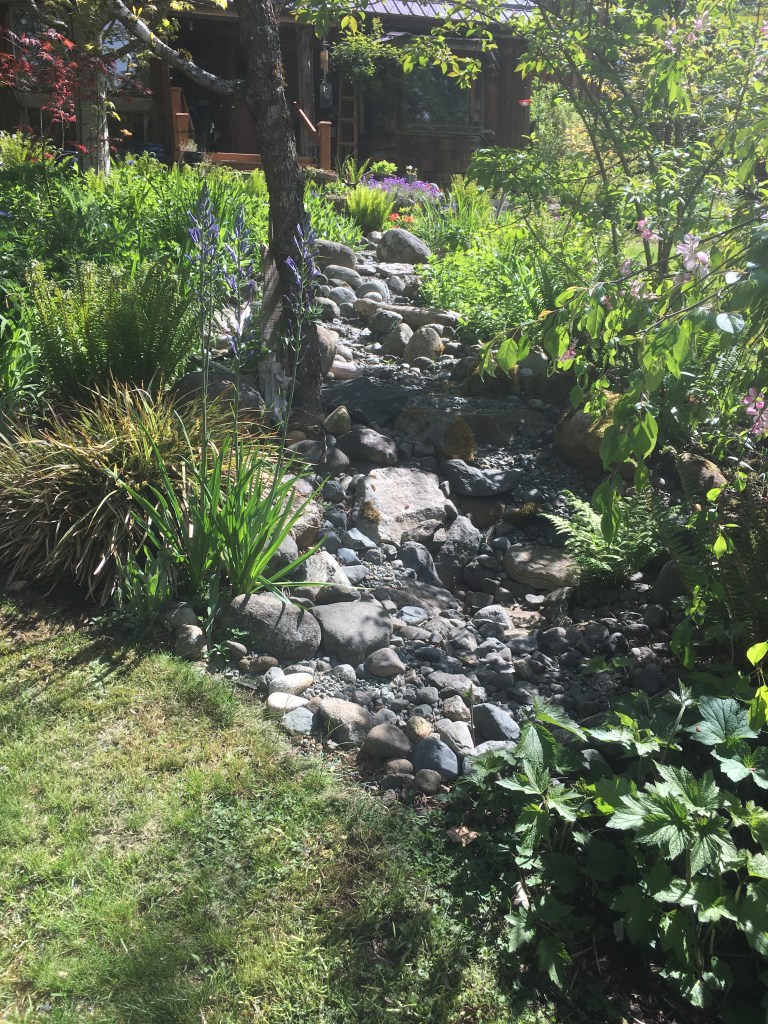
Carolyn’s dry creek bed. Tim, our son-in-law helped put this together. This greets us as we walk up the driveway towards the house. I love this scene. It always makes me smile.

Some of my artist friends have remarked that over the past month or so that they haven’t raised a brush to canvas, or engaged in any other art practice. It seems that gardening and cleaning have taken precedence over art production in the past while. For many, isolation, the cancellation of art shows, and slow sales have dampened creativity. That’s been my experience too. I’ve done a little drawing, but the bulk of my time recently has been taken up with cleaning my studio and workshop and doing maintenance projects around the property to the extent that my energy and pain levels allow. I have not written anything in quite some time. My last blog post was about our gardens here and not so much about my myeloma or Covid-19. Carolyn’s gardens have been so uplifting!

That said, Covid-19 certainly has me tongue-tied at least as far as talking about my cancer goes. The myeloma that I’m plagued with seems to have more or less evaporated, at least according to my lab results. It’s still incurable, but it’s likely that I will go into remission by the end of the summer and thankfully get a break from chemotherapy, I’m hoping for a long break. Of course, the oncologists promise nothing and I can understand that. So, it seems, myeloma is not the cause of my current health deficits, rather, the chemo drugs are largely responsible for the many side-effects that I experience every day. Old age, of course, has slowed me down. As Robert Sapolsky writes:

“we are now living well enough and long enough to slowly fall apart. The diseases that plague us now are ones of slow accumulation of damage—heart disease, cancer, cerebrovascular disorders.” (from “Why Zebras Don’t Get Ulcers: The Acclaimed Guide to Stress, Stress-Related Diseases, and Coping (Third Edition)” by Robert M. Sapolsky)

Yeah, that’s me. But, strangely enough, about a month ago I started feeling better. I suddenly got more energy. I could use my shop again and do things I have been unable to do for months. I seriously doubted that I would ever be able to handle tools again, especially chainsaws and the like, but I am. It’s wonderful! It makes life worth living again. I think my improvement is in part the fact that my body is adapting to the chemo drugs.

For some time I seriously wondered if I was not destined for a few more years of moderate to severe constant pain, low energy, dizziness, peripheral neuropathy, bowel issues, irritated eyes, headaches, and various other unpleasant bodily sensations. Death seemed preferable, frankly, although the thought of dying never did appeal to me at all. I may be able to intellectually accept the idea, but the reality of end times is another thing entirely.

Feeling better was such a relief. Then Covid-19 assaulted our lifestyles and sociality to an extreme, and we’re still trying to figure out where we go from here. Confusion reigns. What will the summer be like? Will the kids be going back to school in the Fall? Will we be able to get out canoeing at all this year? These are all open questions with no definite answers.

For a sociologist, Covid-19 and other potential future pandemics are an unintended consequence of globalization and are inherently interesting by that fact. The world has shrunk substantially over the past forty or fifty years in ways that are not readily obvious or apparent. Manufacturing businesses only incrementally moved their production operations off shore. The changes were, and still are almost imperceptible. It’s hard to pinpoint the exact time when refrigerators, car parts, computers, tools, etcetera were no longer produced in North America, even though they are still largely designed here by corporations that still control their manufacture and assembly in places like Wuhan, China sometimes in plants they own and sometimes by Chinese contractors.

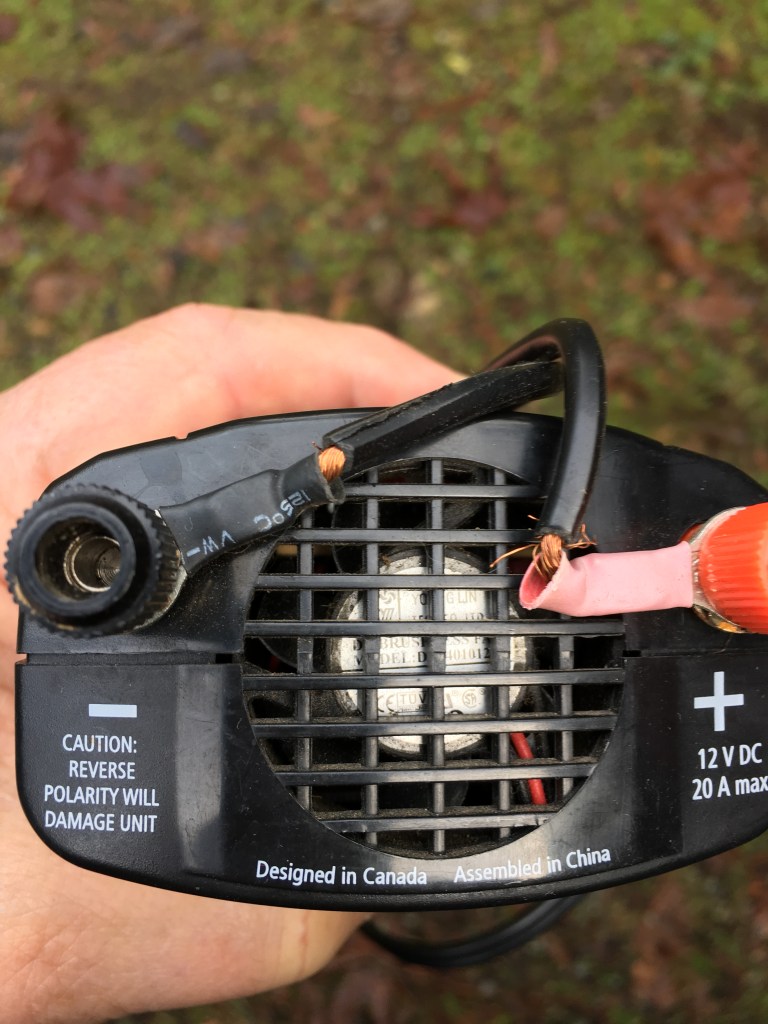
This inverter tells the story of globalization. Designed in Canada by a Canadian corporation which owns the product, assembled in China but not made in China (from parts manufactured all over the place).

China has made it easy for them by establishing export-processing zones free of taxes, health and safety regulations and with low wages.

We know the container ships are out there. We know the airlines blanketed the earth with flights carrying both cargo and passengers at rapidly rising rates, and the internet has made just-in-time (Japanese-type) production possible along with the easy flow of finance capital. I can’t imagine there’s any turning back the clock on globalization, but the pandemic has exposed one very serious Achille’s heal of global corporate capitalism. When commodities and people move so easily and necessarily all over the globe in such immense volumes, it’s no big deal for viruses to hitch a ride on unknowing and unsuspecting travellers. The price of cheap commodities is exposure to viral threats that were previously contained in specific geographical areas. Smallpox was not the first pandemic but when it was introduced to North America hundreds of years ago now it killed tens of millions of indigenous people in wave after wave well into the Nineteenth Century. The Black Death in 14th Century Europe probably originated in China and arrived in Europe via new trade routes. It also killed tens of millions of people. We open up long distance trade at our peril. History has taught us that, but we haven’t learned anything from it. Seems we failed the exam.

So now what? Well, a friend (an anthropologist) and I discussed this last Monday evening and we concluded that although corporate America and Canada would love to control the process and the narrative, the more likely issue for business profits will be whether or not individuals like you and I gather up enough confidence to get out there and spend money on services and commodities. If we don’t, or are slow on the uptake thanks to successive waves of Covid-19, business will flounder and will have to rethink a globalist strategy that for decades has laid a golden egg for them. That won’t be easy for a number of reasons, one being that productive capacity has escaped national containment and it’s near impossible to produce a Ford motor car these days without assembling over four thousand parts made all over the world in factories from Mexico to China to Sri Lanka and India. It used to be that Ford produced cars in Dearborn, Michigan from scratch, bringing in all the raw materials necessary in the production of a car and making all the parts on site. Those days are long gone. Can they ever return? Maybe, but the price of vehicles and everything else is bound to rise if the nationalization of production were to be successful, possibly making most vehicles and most other commodities unaffordable to an increasingly impoverished workforce. Catch-22 is real. We’re living it right now.

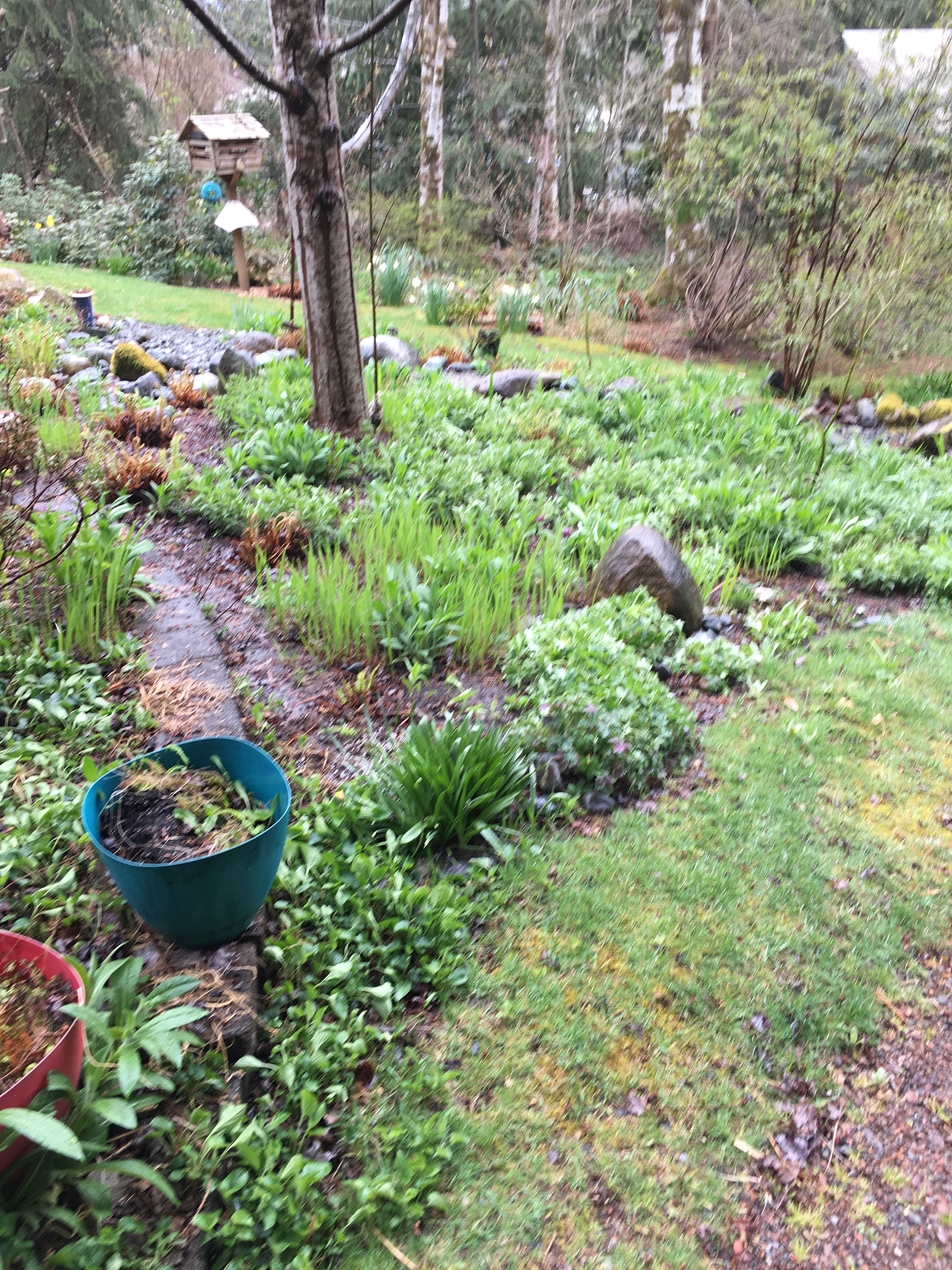
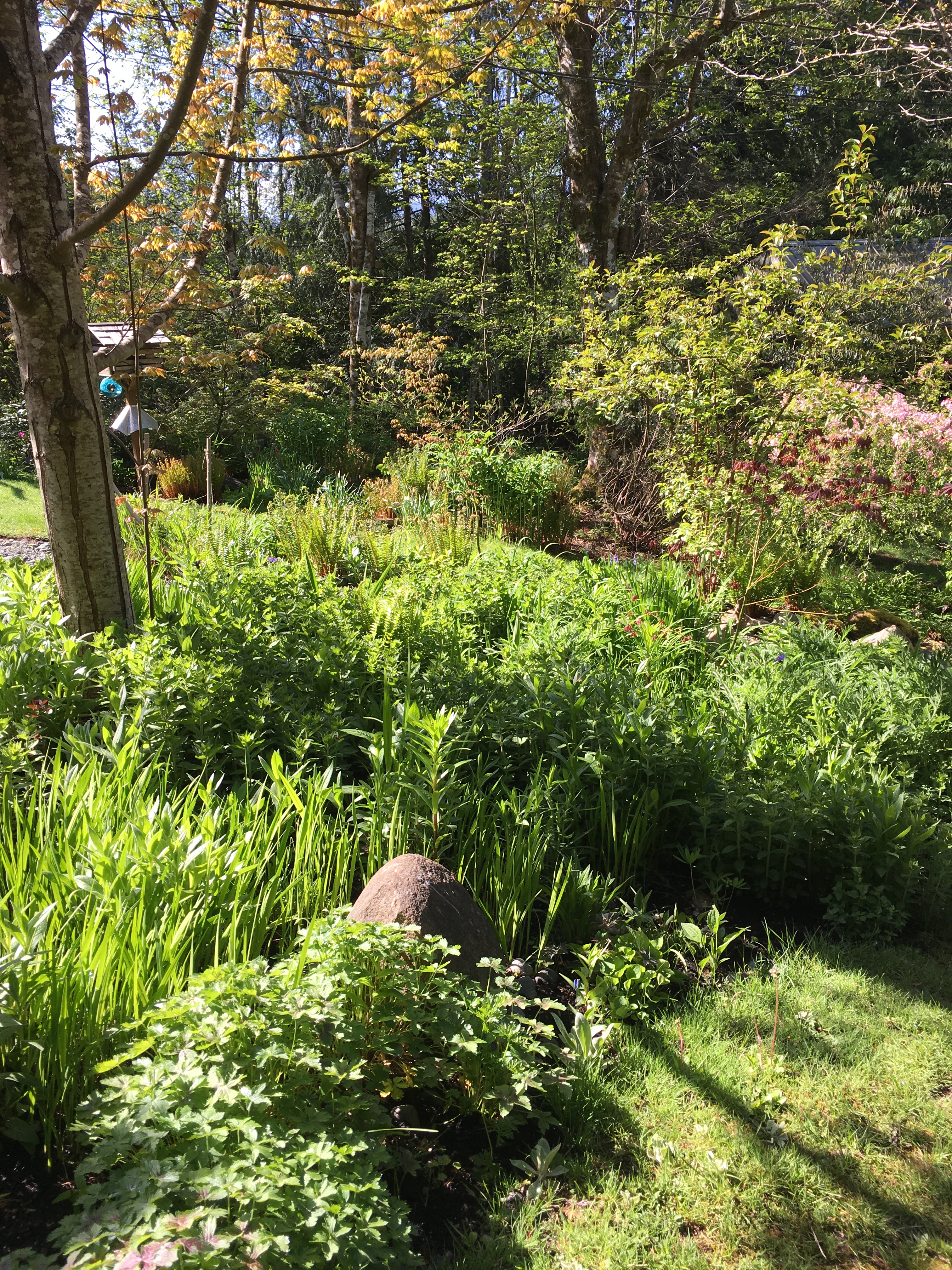
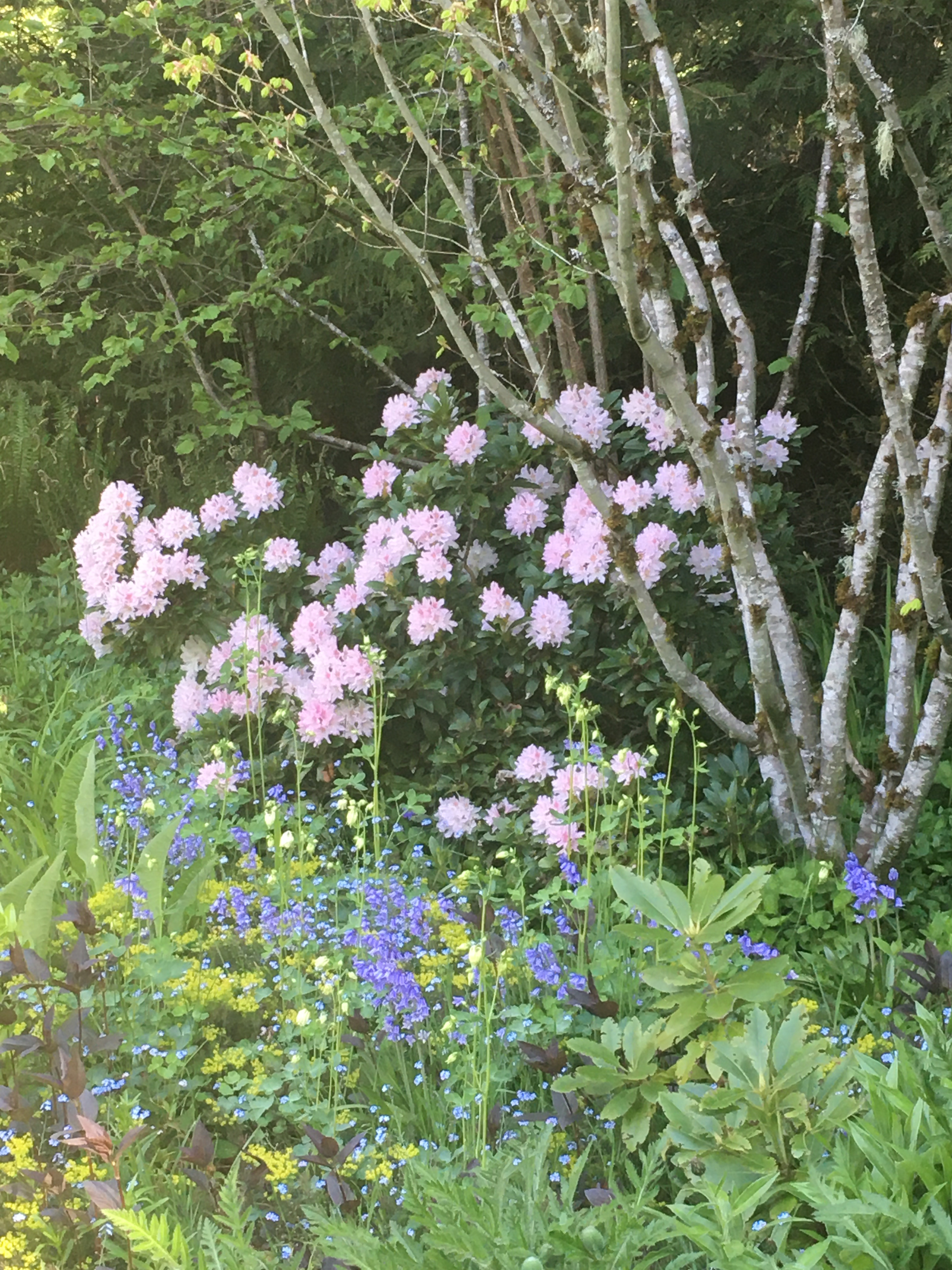
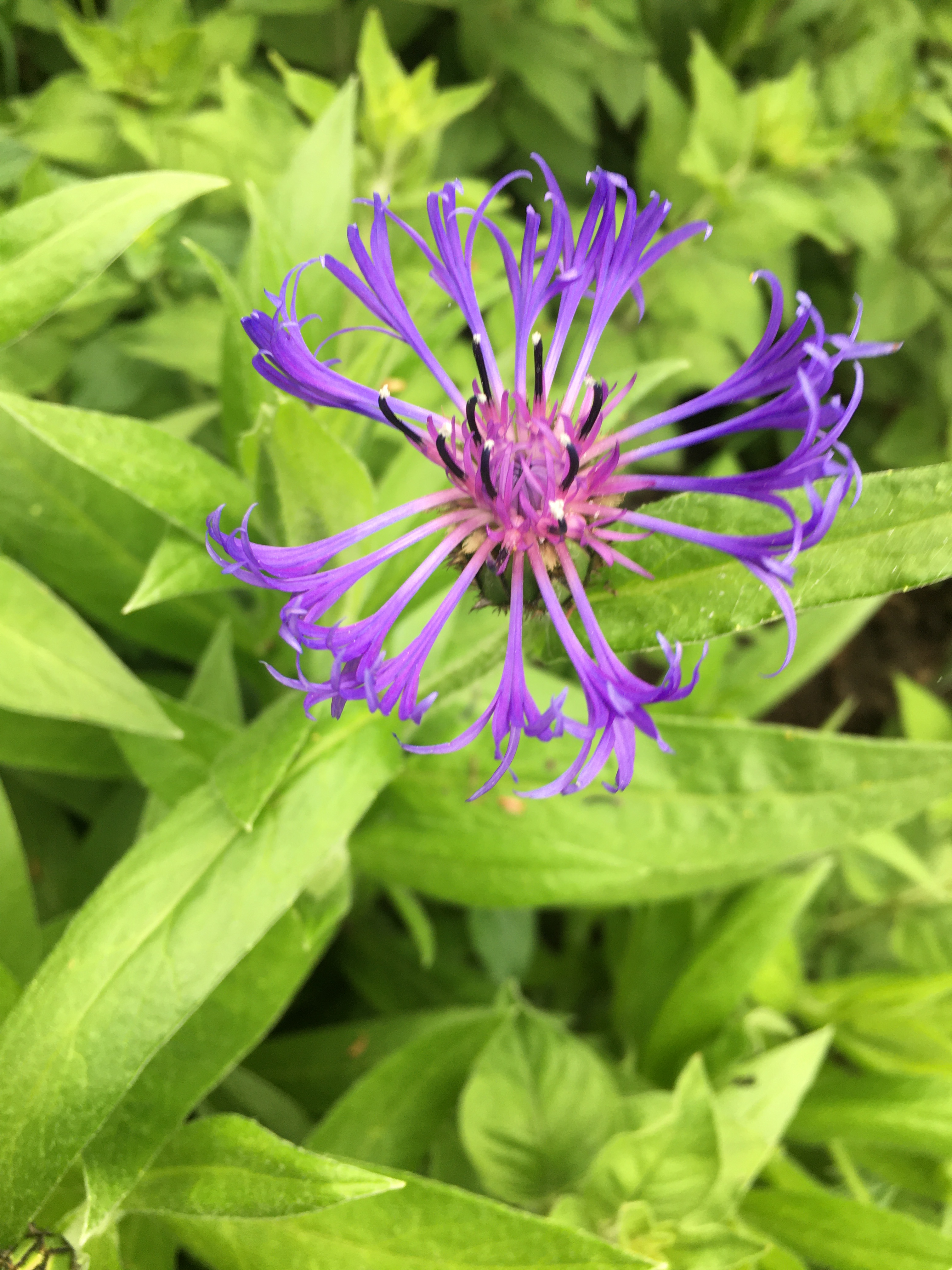
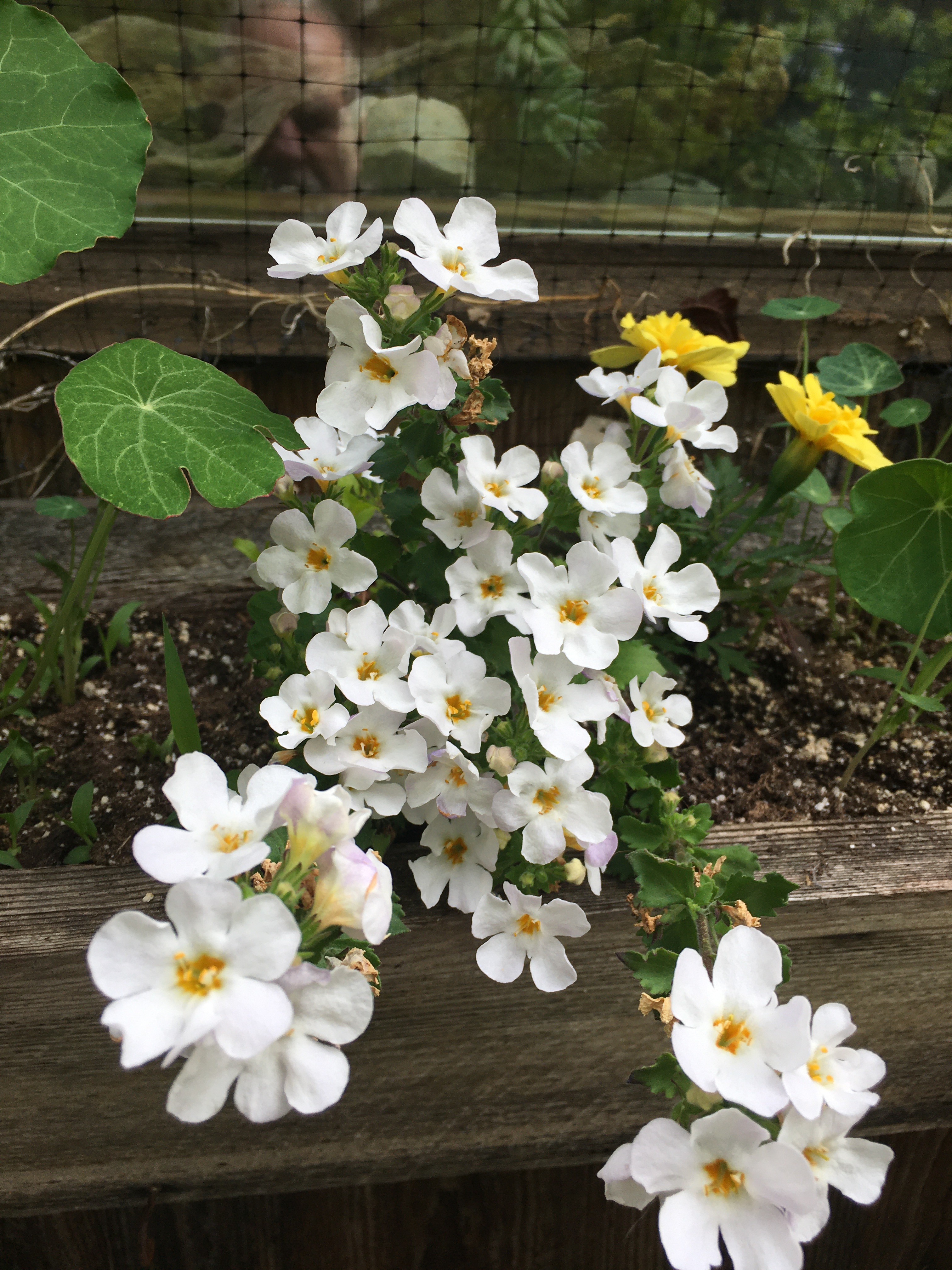
Thankfully we still have our garden. Here are some pictures for you: The first three images are of the same scene taken a week to ten days apart. The greening has been very fast thanks to ideal growing conditions. The others are just a collection of pictures of flowers I chose at random. Enjoy!

41 Beware of Dr. Vendedor de Aceite de Serpiente.

On my very first post in this series on my experience with cancer, the last paragraph reads:

Please don’t suggest any treatments or diets or whatever. I won’t be going to Mexico for any heroic treatments. (If and when I feel better we may go to lie on a beach though.) I’m not desperate. I won’t be buying a juicer either and I’ll continue to eat the great, wholesome mostly unprocessed food that I currently eat but my body will follow, as it must, the second law of thermodynamics. I’m okay with that.

I still feel that way. I’ve clearly decided to go the chemotherapy route so I won’t, in desperation, try on some homeopathic ‘treatment’ or ‘cure’ for the myeloma that is my curse for the rest of my life. Neither will I do anything to boost my immune system. It’s my immune system that is partly responsible for spreading my bone marrow cancer to distal regions of my body by facilitating the movement of the myeloma protein in my blood via macrophages (if I read that right). No. My immune system is fine for dealing with outside sources of infection, but it can’t do anything about preventing internal insurrection by oncogenes and the like.

Lately, I’ve had a couple of other bloggers read my posts, bloggers with agenda. Barbara Gannon has a blog called Cancer is not A Death Sentence and another is by Brian Shelley and it’s called CANCER WARRIORS. I believe both Gannon and Shelley are sincere and well-meaning. Not only that, they display a passionate belief in what they’re doing. Gannon has found alternative dietary and medicinal ways of dealing with cancer. Shelley found God. The battle metaphor is the same for both bloggers. If you’ve been following my blog you’ll know that I am not likely to be convinced by either approach to dealing with my cancer. For one, we are all individuals with very different bodies, different genetic makeups, at different ages, with different genders, and different underlying physiological and anatomical dynamics. Cancer, although it is basically pathological mitosis, is expressed differently in each of us. What works for you in response to any given cancer at whatever stage it’s at may not work for me. Some people argue that cancer is cancer and it can be beaten no matter what. I don’t subscribe to that perspective. Some people may be misdiagnosed so it’s no big surprise when their situation improves. It was probably nothing to start with. Some cancers in certain people may go into spontaneous remission. Cancer and its various treatments are highly complex and I’ll go with science in dealing with it as much as I can. Anecdotal evidence just doesn’t cut it for me.

That said, conventional Western research science, medicine, and pharmacology are not perfect. Scientists, medical doctors, and pharmacologists are human and have human ambitions, needs, and varying moral standards. Some even cheat. Still, I think the scientific research protocols are the best way of finding out what’s going on in the world. All claims of miracle cures for cancer that I’ve run across are based on anecdotal evidence: The “I beat cancer. You can too.” type of thing. I’m not saying these claims aren’t real, only that they can’t be generalized and applied to everyone who has cancer. One problem I find difficult to deal with is the absence of ongoing scrutiny of the claims of miracle cures. I had a friend and colleague who tried everything to survive his cancer a few years ago, including juicing and trips to Mexico, but nothing worked and he died. But, again, that’s anecdotal evidence pertaining to one case only.

Of course there are huge ethical issues when doing double-blind scientific research on the effectiveness of treatment protocols. Siddhartha Mukherjee in his book The Emperor of all Maladies deals with many of the ethical issue in oncology. Recruiting people with cancer for a clinical trial, then assigning half to a treatment group and half to a placebo group is ethically charged. The placebo group is definitely at a disadvantage if the treatment works. The question then is when to switch them into treatment while still maintaining the integrity of the research project.

Nutritional studies are notoriously difficult to conduct in any kind of scientific way. This website addresses that issue and notes that some nutritional studies have been very successful, like the one finding that sailors died of scurvy because of vitamin C deficiency. But, overall, nutritional studies are notoriously difficult to carry out and are almost impossible to conduct using the standard double-blind protocol. The website ends with a statement garnered from a meeting of several nutrition researchers who find that a balanced diet is the best diet. They also note that: “Anyone who tells you it’s more complicated than that — that particular foods like kale or gluten are killing people — probably isn’t speaking from science, because, as you can see now, that science would actually be near impossible to conduct.” More on nutrition below.

Naturopathic cures and treatments.

I have no problem with naturopathy for some kinds of issues and treatments, but I have been highly sceptical of some of their diagnostic protocols, especially things like vega testing. This website debunks all kinds of naturopathic and other diagnostic protocols. The website Science Based Medicine is always a good place to check out whether or not a claim for this or that treatment is effective from a scientific perspective. Noting that here may betray my bias for science, but I have no issues with that. However, I also acknowledge that science based medicine is now being challenged more and more by what’s called evidence-based science. There are huge issues with evidence-based research, not the least of which a lot of it is funded by industry with serious conflict of interest consequences.

My interest is mainly in cancer research and treatments. This article from the Fred Hutch Cancer Research Centre provides a fair analysis of how oncologists can address patients who are reluctant to undergo chemotherapy because of the side effects. It argues that if a patient wants to go an alternative route they should still maintain contact with an oncologist who can monitor their ‘progress’.

This website called Nature Works Best highlights the research and findings of Dr. Colleen Huber, a naturopath who’s clinic offers alternative cancer treatments. I read her article detailing her work with 379 individuals with cancer. She claims a very high rate of success from 92% for the low-hanging fruit (as I call it) and as low as 29% for patients in advanced stages of certain types of cancer. She seems to have the most success with breast cancer patients who have already had surgery. It’s hard, then, to figure out where to ascribe responsibility for remission. Thirty-two of her patients died after following her protocols. She claims that many of the other ‘failures’ (deaths) are due to patients not following her advice, especially to not eat sugar, which she claims feeds cancer cells. Her table looking at each of the 379 patients is telling. I read it very carefully, and frankly I can’t see how she can boast a 92% success rate. One of the problems is that there are twenty or so varieties of breast cancer. She doesn’t tell us which or these varieties she’s actually treating. And ‘treatment’ like I said is often post-surgery.

She has had four myeloma patients and one MGUS (describing a sort-of pre-myeloma condition. She claims that one of those patients travelled a lot and eventually died of pneumonia. Another died after leaving treatment against her best advice. A third she reported in remission but now having problems (“R, then recent elevated blood labs”). This patient reported extreme fatigue with no change due to treatment. The fourth, she reported is in apparent remission (“AR Imp quickly; could not afford to continue treatment. Then recurrence; then stem cell tx. R”) So, the stem cell transplant seems to have done the trick. I can’t see how her treatments helped at all. Myeloma is incurable by all reports so it’s disingenuous to not be clear on that point in her documentation. Her table doesn’t mention the age of the patient. That’s a critical piece of information, in my mind.

Snake oil salespeople and over-the-top woo.

You could always get a coffee enema. There are clinics nearby. Read all about it! Then you can read what Science Based Medicine has to say about it. Or you can try medical marijuana as a treatment. Here’s what the American National Cancer Institute has to say about that. It suggests that there is no evidence that cannabis or any cannabinoids can treat cancer. It does note, however, that THC may be useful for advanced cancer patients in dealing with pain and issues around appetite. Alternatively, you could try an alkaline diet. See what Robert David Grimes has to say about this in a 2017 article in The Guardian. Grimes has a lot to say too about other alternative therapies too. Check out his article if you’re interested. You can always try juicing, but even the alternative of alternatives, the Oasis of Hope hospital in Tijuana, Mexico, doesn’t advocate juicing carrots: too high in sugar. To be clear, the Oasis of Hope does use chemotherapy as a treatment, but it’s much better known for alternative therapies.

What I’m not arguing here.

I’m not suggesting here that a proper diet, not smoking, drinking in moderation, etcetera are not important. They are. However, nutritional or dietary strategies for cancer treatment are largely unfounded.

I know that there are herbalists who have a strong commitment to assisting us in our drive for healthy living and I respect that. But when it comes to cancer, the Cancer Council of Victoria in Australia has assessed the contribution of herbs in cancer treatment and says:

Herbal medicines are often used to help with the side effects of conventional cancer treatments, such as lowering fatigue and improving wellbeing. Evidence shows they should be used in addition to conventional therapies, rather than as an alternative. AND

Although herbs are natural, they are not always safe. Taking the wrong dose or wrong combination or using the wrong part of the plant may cause side effects or be poisonous (toxic). Also, herbs used with chemotherapy, radiation therapy and hormone therapy can cause harmful interactions. All herbs should be prescribed by a qualified practitioner.

I was cautioned not to drink green tea as it counteracts the effects of bortezomib, one of the meds I’m on. There are other contraindications too. And just because indigenous people have used some plants to treat all kinds of ills, it’s probably not a good idea for us to apply indigenous strategies willy-nilly. For example, cedar tea although very high in Vitamin C can be very toxic but people are drinking it and I expect they are not always in full knowledge of its effects on the short or long term. Carolyn and I have used products from Harmonic Arts and from a local herbalist to good effect but not specifically for treating my myeloma. That said, there is ongoing promising research. There is evidence that curcumin, a compound found in turmeric, can act as a proteasome regulator, and could work with drugs like bortezomib to suppress the growth of cancer cells in some types of cancer. A report in MyelomaCrowd notes that curcumin needs to be modified to stay in the body longer if it is to be effective against cancer cell proliferation.

I’m all for caution when it comes to my cancer treatment. I’m not happy being on chemotherapy but I don’t see any alternatives out there that are trustworthy or based on more than anecdotal evidence. I think I’ll stay the course. That said, I will continue to eat well, have the odd beer, rest but also get some exercise (as much as my condition allows me to).

Stay safe out there!

39 Two Days in my Diary

8:00 AM Thursday, March 19th.

On Wednesday we went to the hospital to see my local oncology GP. We reviewed my lab results and my progress to date and he was very positive about how things are going. It looks like more chemo for me until at least September, then off of them for three months after which I get bloodwork done again to see how things are going. If everything is okay we carry on for another three months. If the myeloma is again active, they’ll put me on another course of chemotherapy. He said that we should consider my disease more like a chronic disease, diabetes say, rather than as a virulent, deadly one. So, that’s all good, but I still have lots of chemotherapy ahead of me and that’s no cake walk.

In this post, I want to give you a blow-by-blow idea of what happens to me after I take my chemo meds on Thursday and Friday. I would love to hear from any of you who have had chemo so as to compare our experiences.

I have just made it so that anyone can comment on my posts. You don’t have to be a registered WordPress user to comment! Yay! Give it a try please!

Today is a good day so far. That will change in a while when I get my chemo meds. Oh, I have some joint pain and fatigue, but that’s my new normal anyway.

11:15 AM

Off to the hospital to get my chemo meds for the next four weeks along with a bortezomib shot.

1:20 PM

This time they wouldn’t let Carolyn come with me to the Cancer Clinic so she waited for me in the car. That’s because she had a cold and they’re rightfully paranoid about Covid-19. We drove home from the hospital carrying my load of pills to take for the next four weeks. I take 13 cyclophosphamide and 5 dexamethasone once a week on Thursdays. We had a bit of lunch a while ago and I’m starting to feel the effects of the meds, but not intensely yet. Tingling body is always where it starts. Today I decided to sleep off the afternoon hoping to cut off some of the worse effects of the meds.

4:30 PM

I’m actually feeling pretty good after sleeping for most of the afternoon. I’m lightheaded, that’s for sure, more than yesterday, so it’s started. The dexamethasone is starting to take effect. I’m feeling tingly all over. It’s still too early to assess how dex will affect me today. The dex effect has changed over the past few weeks. My body seems to be tolerating it better. I’m not getting the crazy twenty coffee high I was getting earlier during the first two cycles of treatment. My stomach is unsettled as it has been for the duration of my treatments. It’s a very odd sensation. Urination is still a problem although not as severe as early on in my treatments, so we’re thinking that the antibiotic might have done something, but we’re not sure. I checked to numbers from my last blood tests and my ferritin levels have dropped from over a thousand to now under six hundred. That’s great news because it does indicate that any inflammation I have had is decreasing. That said, my Lambda Free Light Chains (you have them too) are increasing and I’m not crazy about that. We’ll see what my next lab tests show. If they go up some more, I’ll be really pissed.

8:00 PM

Dex is starting to do its thing. ‘Sleep’ will be interesting tonight. I just took my usual bunch of pills but I’m taking two Benadryl tablets to counteract the usual itching and swelling around my bortezomib injection site. I’m also taking a Dulcolax tablet to counteract the constipation that comes with hydromorphone. That seems to be working. The burping has started but isn’t severe yet. That will come tomorrow. I’ll save more entries here until tomorrow. I’ll be in bed soon in any case.

8:00 AM Friday March 20th

So, last night was a dex sleep meaning that it’s a sort of sleep or at least a state akin to sleep. It’s hard to explain. I feel that I haven’t slept at all. Looking at the clock every fifteen minutes or so seems to confirm that but I may be dreaming all of that. I don’t know. I think the Benadryl is helping me counteract the dex, but I can’t be sure. I’m wide awake this morning having got up at 6:45 after Princess (the cat) came to me screaming for food. I ignored her, but it was too late. No point in staying in bed. I’m having very interesting experiences with pain lately too and this morning is no exception. I have pain spiking here and there but nothing constant. It usually comes when I move so I just sit still a lot! I know I have to get up and move around, and I do, but I then pay for it later. Last night I had no issues with my peripheral neuropathy (extremity pain and numbing) which is unusual. Usually peripheral neuropathy keeps me awake or tossing and turning. I’ll do more stretching today to see if that helps with that in the coming week. I’ve been doing a fair bit of stretching for my neck and back pain and that seems to help my peripheral neuropathy. Burping has resumed. Fuzzy head…not too severe yet, blunted by the dex. I find it fascinating to observe what’s happening to my body as I go through cycle after cycle of chemo. The effects change every time, sometimes drastically, sometimes almost imperceptibly. The interactions between the various meds I’m taking make it difficult to trace drug to effect. I’m trying to relax as much as I can. Stress doesn’t help. I think I’m doing okay on that front.

10:30 AM

The dex is starting to really kick in now. Elevated pulse rate and feeling very lightheaded. Overall, though, because I know what to expect I’m not getting stressed out. I feel it’s so important for people in chemo to very carefully track the effects. It’s so important to read the information sheets that come with the various drugs we take. In the case of my urinary issues, I called my GP with what are classic urinary tract infections (UTI) symptoms but only after Carolyn read the information sheets urging us to call in if we have signs of UTIs. We have to keep on top of it because I can’t afford to get an infection of any kind. Now I’m getting the shakes too. Par for the course. Time for tea.

12:25 PM

Well, the dex has kicked in with a vengeance. My cheeks are flushed, I’m hyper yet exhausted, unsteady on my feet, but we’re going to have lunch up by our pond. Yes! I can still write, but who knows about later today or tomorrow. Then, I may be good only for watching YouTube videos about people rebuilding their old sailboats, or doing woodwork, sometimes both. It’s all very exciting. I haven’t seen any videos yet on watching paint dry, but it came close on a video about somebody applying bottom paint to their sailboat a couple of hours before it was to go back in the water after being on dry land for weeks.

8:00 PM

Dex is still with me but now I’m feeling really exhausted so I may sleep better tonight. I generally sleep quite well. Dex nights (Thursday nights) are exceptional. I’ll be taking my meds now: Hydromorphone, Benadryl, and Dulcolax. It still burns when I pee and I have to pee often. My eyes are burning but that’s probably as much an effect of age as it is of the chemo. I’ve got the shakes still, probably until well into tomorrow. Pain is manageable. Exhaustion inevitable. I’ll go to bed in an hour or so, do a bit of reading then sleep (I hope). Goddamn burping! So annoying.

AND please comment! Especially those of you who have had chemo treatments in the past. You can do so now without being a WordPress user.

38 While Covid-19 has me bottled up…

Covid-19 has the whole world in an anxiety attack. The appearance of this special strain of Coronavirus is a direct but obviously unintended consequence of globalization. I spoke with Marika and David this morning and we collectively concluded that the appearance of Covid-19 in particular is pretty much due to the rapid expansion of global air travel some forty years ago created partly by the needs of globalization. The shipping container was a major factor in globalization as was the internet, but air travel brought warm human and humid bodies from one end of the planet to the other ripe for the spread of this kind of virus. Wow!

What a world transforming situation we are in at the moment. I don’t think it will have a long term effect on global capitalist production because it would cost hundreds of billions of dollars to re-tool ‘Western’ countries that have for some time now created a commodity-production system based on a complex of independent, unconnected factories producing individual parts for products that are then assembled in a factory designed to do just that. Wuhan, in China is a place where thousand of contractors and factories work for American and Western corporations in general making bits and pieces of everything to then be assembled in factories there or here for our consumption as hardware such as drills, heaters, washing machines, television sets, baby cribs, etcetera, as well as clothes, blankets, and sundry other wearables and that sort of thing. Of course, China isn’t the only place where this happens. Name a country in South Asia or South East Asia and the same thing is happening there. Viet Nam actually specializes in nails and fasteners for the construction industry, or to put it differently, Western corporations have chosen Viet Nam for this role. Bangladesh does clothes, so does Sri Lanka. But they all dabble in a range of products depending on the deals they can arrange with corporations who crave the absence of taxes, low wages and the dearth of health and safety regulations in the export processing zones set up specifically for this purpose in these countries.

As far as I’m concerned, Covid-19 has just made it so that I’m even more isolated than I was before. I’m at the pinnacle of vulnerability. I’m over sixty-five, I’m immuno compromised, I have an underlying illness and I’m fighting off some kind of bacterial infection at the moment that the docs are still trying to identify. If I get Covid-19, my chances of survival are slim to none. Well, something’s going to kill me. I’d like to wait a bit though to find out what that will be and I hope it’s not this virus.

I have a lot on my mind at the moment. I mean, what else have I got to do with my time but sit here and think? The reality of my own death is always close to mind and is stimulated constantly by programs like the recent one on the CBC White Coat Black Art program that deals with end of life care and how we as a society deal with it, or more precisely, don’t deal with it. Check it out here.

Most of you are way too young to have seen the movie Fantastic Voyage when it first came out in 1966, but this movie with Raquel Welch and Stephen Boyd was an inspiration for a generation of special effects techs to come. So, get this: a famous scientist is sick. He has a problem with his brain. A group of intrepid (they’re always intrepid) colleagues of his and some other brave adventurers get themselves shrunk in a special ‘ship’ that then is injected into the bloodstream of said sick doctor. Mayhem ensues of course as well as the necessary redemption. The trailer says it all.

The movie is hugely fantastical, but intriguing too. I imagine a little ship in my own veins going into my bone marrow to see what all the fuss is about and maybe do battle with the evil forces that are invading my body intent on killing me. It’s all fun to think about. The movie is a hoot. Thinking about what’s going on in my bone marrow, not so much.

I’m also thinking about life and death in general, following the last three blog posts I put out there for your reading pleasure. Serendipitously, Maria Popova, the immensely creative force behind the website ‘brain pickings‘ put out a piece on the work of John Muir (1838-1914). It’s well worth having a read through. It pretty much expresses in highly poetic prose what I wish I had written about the way I see the universe and our place in it. Popova quotes Muir:

One is constantly reminded of the infinite lavishness and fertility of Nature — inexhaustible abundance amid what seems enormous waste. And yet when we look into any of her operations that lie within reach of our minds, we learn that no particle of her material is wasted or worn out. It is eternally flowing from use to use, beauty to yet higher beauty; and we soon cease to lament waste and death, and rather rejoice and exult in the imperishable, unspendable wealth of the universe, and faithfully watch and wait the reappearance of everything that melts and fades and dies about us, feeling sure that its next appearance will be better and more beautiful than the last.

It’s only the last line I have any issue with because I don’t think there is any guarantee that the new will be better and more beautiful than what came before. But that’s really a quibble. The continuity of the biological world, and of the social world, make them seem eternal, immortal. No wonder we tend to deify them. For the BaMbuti of the Ituri forest (as reported by Colin Turnbull in the book The Forest People) before colonialism completely annihilated them, the forest was their mother. They didn’t deify the forest but they recognized that life emanated from her every pore. For other cultures, those living under the threat of imminent disaster, deification was common, something that Weber recognized in his Sociology of Religion a hundred years ago as did many others before him and since then.

Well. that’s all I can squeeze out of this poor brain of mine for the moment. Enjoy your social distance and get out into the sunshine.

37 Me, my Body and I: Part 3

It’s time to wrap up this diatribe. Like I said at the end of my second post in this series, I’ve strayed a long way from the usual content of this blog. After this post I have to reconsider my work here. I’m getting into the long stretch of road in my chemotherapy treatments. I’m getting tired and you must be getting tired of reading this stuff. The end of this part of my road is at least six months away. Things are looking good according to my lab results, but who knows. Every day brings something new which may be fodder for this blog, maybe not. Whatever. I do have to tell you about a recent weird experience I’ve been having, but that will be for my next post.

In this post, the third in the series about what will happen to ‘me’ after “I” die, I want to suggest that our conception of our selves, especially our idea that we are beings composed of mind, body and soul, is socially-constructed. In a sense though, it matters not where these ideas come from if they have a real impact on my life.

By way of an example, if I have a stroke, for instance, I may attribute it to a curse put upon me by a disgruntled recently past relative for a purported wrong that I did him. However, it’s far more likely that my stroke was brought on by a busted artery in my brain. Nonetheless, the stroke and its consequences are what they are never mind their provenance. Durkheim stated that no religion is false. By that he meant that, in my example above, the stroke is real no matter where and how we think it originated. A more contemporary sociologist who wrote extensively on religion, Peter Berger, argues that much of what we call religious behaviour and even religious thinking and hypothesizing cannot be understood by deduction or reduction. He proposes that we use induction to figure out the ‘reality’ of religious experience, that we start with how we feel and experience in real terms, in our living beings, and acknowledge those feelings as real before we attempt any kind of explanation of them. This kind of fits with Unamuno’s views, although Berger is much more prosaic than Unamuno the poet-philosopher.

The provenance of the ‘soul’ is interesting and there is much speculation about it as originating in our dreams, for instance, or during hallucinogenic experiences, but once a belief in the ‘soul’ is socially established it, it has real world consequences.

Today, I intended to address the work of Emile Durkheim and Ernest Becker with maybe a little Max Weber, Karl Marx and Norbert Elias thrown in for good measure but I’ve decided not to do that in any formal sense. I have come to accept the futility of trying to summarize very complex arguments from a number of writers and how they interconnect at least in a relatively short blog post. I’m not here to convince you that I’m right anyways.

That said, all the above characters were sociologists except for Ernest Becker and he would definitely qualify as an honorary sociologist. They all conclude that religion and all ideas concerning souls, demons, angels, gods, and various other supernatural beings originate in society (i.e., in the family, school, church, law courts, governments, etcetera) defined very broadly. However, whatever their origin, religious, metaphysical ideas have real world consequences according to these guys. That’s clear.

Before getting any further into this post, I want to tell you a little story. You might be shocked to learn that I wasn’t always the model son. Sometimes I could be downright annoying and troublesome for my mom, and she didn’t deserve any bullshit from me. But she got some anyway. I remember one time (of several) when I was particularly obnoxious and teased my poor mom relentlessly.

I said to my mom: “Ma, if you had been abandoned on a desert island as a baby and were raised by monkeys, would you still be the same person you are now.”

“Yes,” she says, “of course.”

I retorted: “But what language would you talk? Would you talk monkey talk? What things would you believe? Would you believe in God?”

She replied something along these lines: “I would believe in God and I’d be the same person I am today. I don’t know any other languages besides French and English and why would I believe anything different than I do now?”

That was my mom. She wasn’t stupid by any measure, but she was ignorant in many ways mostly because she was busy raising a pack of kids and she was way too tired to be very curious and she couldn’t read metaphysics. By her answers to my questions she demonstrated a naïveté that ran deep but that allowed her to live her life in relative contentment. If my mom was ignorant in some ways, she was very knowledgeable in others. She raised tons of children, made bread like a pro and was a dedicated member of her church (although she didn’t know much about Catholic theology beyond what was in the Sunday missal). Later in her life she took up woodworking and was good at it, that is until my dad decided to sell the house and the shop from under her. After that, she fell into dementia and never recovered. I think she lost her appetite for life at that point. I loved my mom, I really did, and I regret teasing her. That’s one of my big regrets in life.

So, what was it about my mother’s responses that is significant for me here? I guess I was shocked by her very strange idea of her personhood and her unstated notion that ‘she’ was an unchanging, unchangeable being regardless of her surroundings and upbringing. It’s plain to me and I expect to most people that everything we know we’ve learned from others, either directly from other people in our homes, schools, churches, and from books or from any number of other sources. Of course, that includes any kind of ‘spiritual’ ideas we may have as well as our sense of immortality. Elias argues that we are not the individualists we think we are. He says humans are really interdependencies and interweavings. No human ever stands alone given the richness of the sources of our ‘selves’. The language(s) we speak, our gender, our cognitive skills, intelligences, values, religious/spiritual beliefs, etcetera are all learned, that is, socially derived.

It’s clear to me that my mother denied the influence of any possible ‘foreign’ source of her personhood. Obviously, there is no way my mother could know of her Catholic God if she was raised by monkeys on a desert island. The concept of God, like of language, and table manners is learned. How would my mom learn about the Catholic God? Many societies have concepts of God or gods or some such supernatural beings. There are hundreds (and there have been thousands) of religions on the planet, each with its own unique conception of immortality and supernatural beings (if they conceive of any). Babies born into those societies learn the rules and values of their specific communities. Why would my mother not realize that her position was untenable? I would suggest that her commitment to her beliefs outweighed any sense she might have had about the logical inconsistency of her position. She was like a Trump supporter in that sense. She may have been yanking my chain, but I doubt it.

Which god do you worship (if any)? Well, if you do still worship a god, probably the one your parents do (or did). These days, however, there is a movement towards more individualistic, personal forms of spirituality, a trend which fits in nicely with capitalist morality, individualism and consumerism while allowing people to retain a belief in the immortality of the ‘soul.’ It’s also true that significant numbers of people are now defaulting to atheism or agnosticism in greater numbers than ever before, a movement also compatible with capitalist morality. There is still a great deal of intergenerational retention going on today even if there are obvious exceptions. So the frontier mentality of rugged individualism and fending for yourself is still a thing in the Twenty-first Century. Of course, as individuals, we can be creative, and come up with new ideas and ways of doing things but we always do so using materials, processes and relationships that already exist. How else could it happen?

The truth is, we, none of us, can conceive of anything absolutely new under the sun. Everything we invent, think about, or imagine has roots in our interactions and interdependencies with other people via our social relations, past and present. The present is always built on the past. Inventions are generally new conceptions of how to use and combine already existing technologies or ideas. That means that new religious denominations or churches are invariably modifications on past ones. How many variations on Christianity are there? Lots…I haven’t counted them. Which one is the ‘true’ variant?

As I note above, one perspective all the writers and thinkers I mention above have in common is that they all agree that religion and our ideas of personhood originate in society as does the belief in immortality. Durkheim, for example, argues that the concept of God is actually a personification of society, a personification that can then be used to judge the behaviour of adherents still living. Elias in his book What is Sociology? builds a conception of individual/societal interaction by using a metaphor of a card game. In his metaphor, a card game is happening with four or five players. The game has rules, of course, to which all players must adhere. Then, one person decides to leave the game and another person joins in. That change of players does not affect the game, nor the rules. The new player must adhere to the rules like the drop-out did. The game is a metaphor for society. We are born into society, learn all the rules, then leave (die). Society goes on. The game goes on. Society, seen from this perspective, is supra-human. It exists above and independently of any individual yet has control over all individuals and circumscribes the parameters of possible ideas and decisions individuals can make. No wonder we come to think of it as divine.

Because society is supra-human and veritably invisible to most people, it’s not a stretch to understand why people ascribe to it a supernatural existence disconnected from their individual lives. Because it IS disconnected to their individual lives in a real sense. As Elias would say, the game goes on no matter what individuals do as players. To which Durkheim would add: the individual ‘soul’ is in the game but is actually a piece of the collective, social SOUL. Therein lies our idea of its immortality. Society exists before us and after us. It’s virtually immortal. Our souls are immortal because they are a piece of the greater social SOUL.

Durkheim defines religion as: “a unified system of beliefs and practices relative to sacred things, that is to say, things set apart and forbidden — beliefs and practices which unite into one single moral community called a Church, all those who adhere to them.” (from Elementary Forms of Religious Life, 1912) For Durkheim, sacred things are by definition social things and the sacredness of things can change with changing social conditions.

Ernest Becker goes much further than Durkheim when he argues that culture as a whole is sacred. For Becker there is no distinction between profane and sacred. It’s culture as a whole that promises people immortality. In fact, he argues that “Each society is a hero system that promises victory over evil and death.” (from Escape From Evil, 1975, page 124)* Of course, no society can promise such a thing. Becker writes:

But no mortal, nor even a group of as many as 700 million clean, revolutionary mortals, [in reference to China] can keep such a promise, no matter how loudly or how artfully he protests or they protest, it is not within man’s means to triumph over evil and death. For secular societies the thing is ridiculous: what can “victory” mean secularly? And for religious societies victory is part of a blind and trusting belief in another dimension of reality. Each historical society, then, is a hopeful mystification or a determined lie. (EFE, page 124)

Marx would have agreed with Becker here but he concluded that religion was the opium of the people, a salve to soothe the savage treatment that most people received under capitalism (as one might find depicted by Charles Dickens.) He found that religious beliefs were instrumental in mollifying the masses and having them accept class inequality under capitalism. Weber also recognized the class basis of religion although his definition of class was not the same as Marx’s. Weber, in his Sociology of Religion, addresses the early rise of religious behaviour in human interaction with drastic natural events like floods, volcanic eruptions, hurricanes, tornadoes, etcetera, the ‘soul’ in its various iterations and manifestations, and ritual. He argues that the forms of gods varies depending on natural and social conditions.

In conclusion, I just want to re-emphasize the notion that according to the sociologists I mention here as well as countless other sociologists and social scientists I don’t mention, ‘society’ is the source of our beliefs about the immortality of our person by way of our ‘souls.’ There is no ‘supernatural’ teacher that teaches us our values around immortality, and any ideas we have around these notions come from notions already just laying about out there waiting to be picked up and incorporated into our world view. In other words, our ideas around the immortality of the ‘soul’ do not result from perceived connection to an immortal God or gods, but from the immortality of society.

______________________________________________________________________

*There is no substitute for reading Becker because his argument forms a cohesive whole. Pulling a quote out of his book, although provocative, is probably not helpful although I do it. I can’t help myself. If it spurs people to go read Escape From Evil so be it. Many of my early posts on this blog constitute a review of EFE. That would be a place for you to start in trying to understand his work. Just type Becker in the search box in my blog and you’ll find the relevant posts all numbered and everything or you can start here: https://rogerjgalbert.wordpress.com/wp-admin/post-new.php?post_type=post&jetpack-copy=874. You can then work your way through the archives on my blog site.

Durkheim (Elementary Forms of Religious Life) and Weber (The Sociology of Religion) both have sections of their books on the soul. Do a bit of research if you’re curious. Dr. Google is full of stuff on these guys and I’ve got all the books for local people to borrow if you’re interested. Elias is great. His book The Civilizing Process is well worth the read.