I taught university level courses in sociology and criminal justice for over 30 years but now I'm retired and at 72 was diagnosed with multiple myeloma, bone marrow cancer. This site is now a chronicle of my journey with myeloma.
That means that, regrettably, I’m no longer in remission. Myeloma is back doing its destructive thing in my bones. Well, technically, myeloma never went away and as my local oncologist often repeats myeloma is incurable but treatable. As he says, we can beat it down but we can’t beat it to death.
I really wish I had more psychic energy to put together these posts. Right now it’s very difficult partly because I have low physical energy levels but I also have to deal with the reality of being 74 years old with a cancer that won’t go away and that takes up a fair bit of brain space.
So, next week I’m back on chemotherapy. This course of therapy is very different from the first course I went through last year. The very first primary chemo drug I was on is called lenalinomide. I was on it for less than a month before I broke out in a nasty rash around my midsection. At that point my oncologist pulled the plug on it and put me on another med called Bortezomib. I was on it for 7 months or so before I ended it. I was supposed to be on it for 9 months but after 7 months I was in such pain and had such loss of mobility that I felt I had no choice but to stop the therapy. It took a few weeks for the symptoms to partially dissipate, but I felt a lot better soon enough. I always wondered though, in the back of my mind. when the myeloma was going to reactivate because I knew that it would. Now we know.
I start chemo on Feb. 3rd. I’ll be on an IV for most of the day. I’ll return the next day for a repeat performance, then once a week after that. The main med star for this course of therapy is Daratumumab. It’s a very different drug than I’ve previously been on and we’re very hopeful that it will perform well. In addition to the Dara, I’ll be getting a very low dose of lenalinomide. Although it gave me a huge rash the first time around my oncologist decided to give it another try starting at a very low dose. They’ll also closely monitor any allergic reaction I have to the lenalinomide. I’ll also get a regular dose of dexamethasone, which is a corticosteroid. It produces some strange effects, but I’m accustomed to them and I’m sure I’ll get along well with dex.
Along with my regular chemo meds I’ll be taking an assortment of other drugs to help with allergic reactions and to help prevent blood clotting.
One complication I’m now facing for the first time is the possibility that I’ll need radiation treatment on my jaw. Myeloma is a disease of the bones. I have some fairly large lesions in my femurs. They’ve been well monitored. Now, however, over the past while I’ve been getting some very strange feelings in my lower left jaw. I’m losing feeling in it and if I touch it in the wrong (right?) place, I get an electrified stabbing pain. I have a phone interview with a radiation oncologist on February 17th. I’m not sure what she can determine over the phone, but we’ll see.
One thing for certain is the fact that I’ll be spending a lot of time at the hospital over the next six months. After that things will slow down and I’ll have to go into the hospital only once a month for as long as this course of meds works.
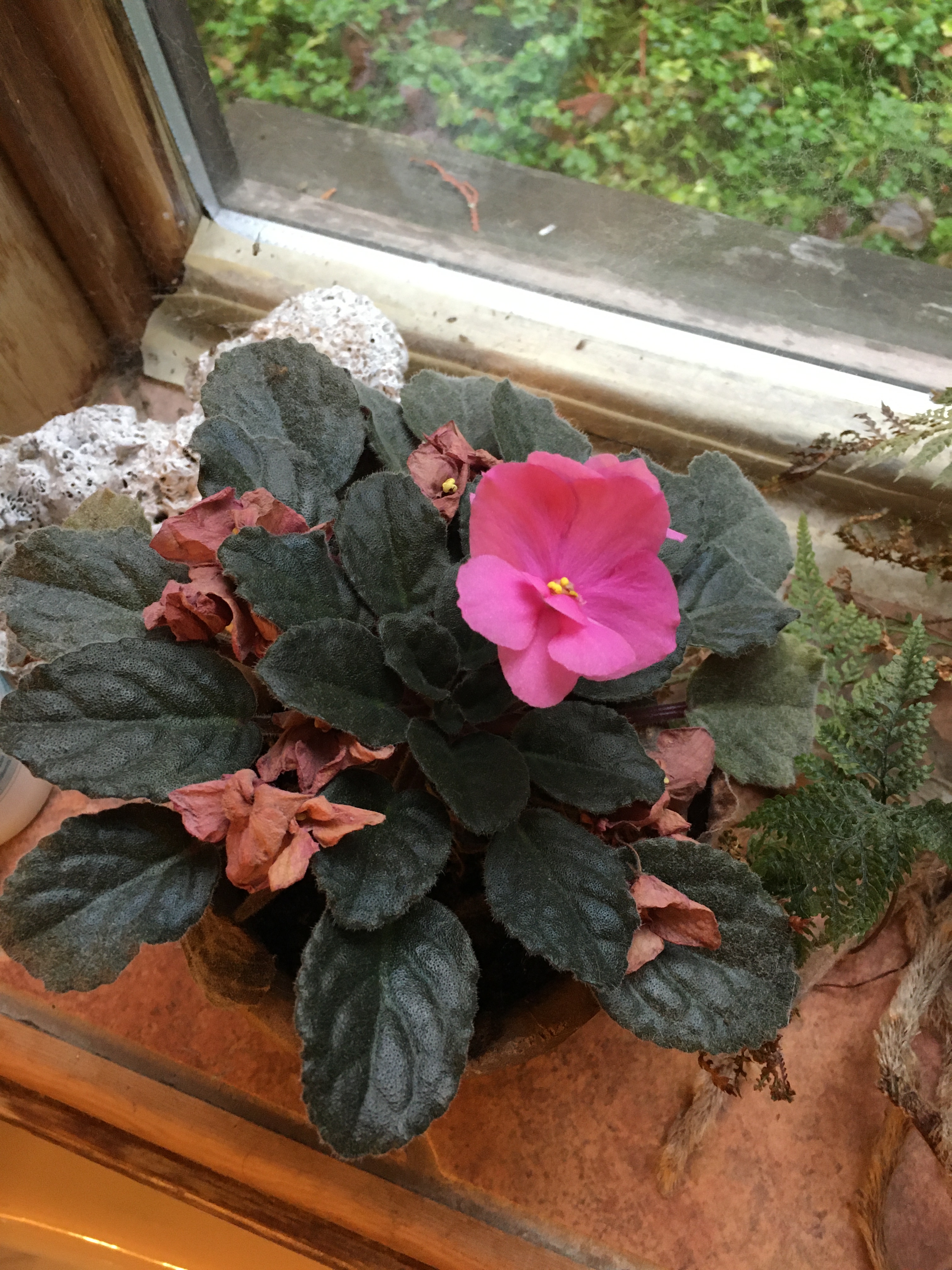
African violet
Now, look at this African violet. She is a wonder! I never expected her to bloom as long as she has. She actually put out more petals over the past few weeks. What an inspiration she is!
It’s been tough keeping my shit together over the past few weeks. I’m having trouble just sitting here composing this on my computer. Part of my problem is physical and part is a growing psychological ennui. I’m exhausted most of the time. Oh, I can get up and walk around a bit but sometimes that’s even too much.
Obviously myeloma has a lot to do with my unease even though I’m in remission, or I think I’m still in remission. I have a chat with my oncologist on the 22nd to confirm my status. It’s hard to know what to think anymore. My usual myeloma symptoms, peripheral neuropathy, itchiness, fatigue and weakness in my legs, are still evident, but now, I have something new to report to him.
I saw a dental specialist on December 21st. After I came to see him because of pain in my jaw, my regular dentist suggested I would probably need to have a tooth pulled and a cyst at the base of it cleaned out. Well, it turns out that the specialist I saw in Parksville figures that the pain and numbness in my jaw is not dentally related. It’s more likely myeloma induced and that the ‘cyst’ is more likely a lytic lesion. I’m still waiting for a call from him letting me know what the situation is. He has a connection with the BC Cancer Agency in Victoria so I expect he has better access than most of us to oncologists. I expect he’ll suggest radiation treatment, something we discussed on our December 21 consult, but my oncologist will decide on therapies.
Right now, I’m on a rollercoaster of symptoms and I can’t predict one day to the next how I’ll be or how much extra hydromorphone I’ll need to take to deal with the pain. My jaw is sucking up the hydromorphone, that’s for sure, but so is my back and a recurring, baffling pain in my left heel that forced me into a wheelchair at one point late last year. I can’t tell you how sick and tired I am of the pain. It leaves me physically and psychologically drained. Thank goodness I usually sleep quite well and Carolyn is envious of my ability to nap at a moment’s notice.
The title of this post is A Triple Whammy of Crap. Well, I’ve written about the pain and distress brought on by myeloma and its treatments. Myeloma and its related poop is the first part of my triple whammy. Now it’s time to move on to the other two elements of the triple whammy. First, a definition:
An online dictionary of idioms describes a triple whammy as “a combination of three different elements, circumstances, or actions that results in a particularly powerful force, outcome, or effect.”
I’ve already alluded to one element of my triple whammy, the myeloma and its treatments I deal with daily. The other two are the pandemic and American politics. So, myeloma, the pandemic (and associated restrictions) and American politics together contribute to generating in me a profound funk. With crap falling on us from all sides it’s hard to keep the smell of shit at bay.
The Pandemic
These days, we all have some sense of what it was like to live in 1918. The Spanish Flu was a powerful killer and didn’t discriminate except that wealthy people were better able to protect themselves from crowds than the poor could. That’s still the truth in 2021. The coronavirus COV-2 is adept at making many of us in the population very sick and puts a lot of pressure on the medical system as it forces hospitalizations.
One way the government and chief provincial medical officer in British Columbia have decided to combat COV-2 is by keeping us apart from each other so as to prevent the spread of the virus. Isolation is hardly ever good for a social species like us. There is a lot of evidence for what happens to people who are forced into isolation like solitary confinement in prison. They go wingy after a while. Children forced into isolation, say in an orphanage, die at much higher rate than children born and raised in poverty or in prison with their mothers.
So, in order to relieve the stress of isolation, people here find all kinds of ways of bending the rules, traveling to nearby destinations, or just getting on a plane to a warm destination because the government hasn’t outright banned travel, now has it? It just strongly recommends against it. Many politicians have decided to travel in any case, arguing that they haven’t broken any rules in doing so. Outraged commentators on social media have found all kinds of reasons to criticize them including their flouting of moral standards. Whatever.
I guess the bottom line here is that we are asked to wear masks and to keeping a physical distance from others whenever we step out of our homes. No hugs. For us that means no contact with our children and grandchildren. That sucks! We will follow the guidelines as we go along, but that doesn’t mean we’re happy about it.
American Politics
So, why would I include American politics as the last element in my triple whammy of crap? What the hell has American politics got to do with us? With me?
Well, apart from the fact that I have friends and relatives living in the United States and who have to live with the lies, the betrayals and the crap everyday, the profound disfunction of the American political system creates uncertainty for us, for all of us. The moral degeneracy in the US so easily spreads to the rest of us, especially those of us living close to the 49th parallel, and is impossible to avoid. The disrespect for democracy and the ready acceptance of oligarchy evident in the US could spread to us like a virus and infect our own fragile political systems.
Besides, the uncertainty is stressful as is the insanity. We get up in the morning not knowing what the hell Trump or his cronies in the Republican Divided Party are likely to conjure up and take up as a tool to wreck confidence in the American voting system or in any drive to greater social equality. I can tell you that I’ve had my critical judgments around the American voting system and the Electoral College in particular. That said, destroying the ship plank by plank as it sails off into the sunset may not be the best strategy for reform especially for everyone aboard.
Done.
Any one of the three elements of the triple whammy I outline above can cause inordinate stress (and does!) but the three of them together leaves a trail of discomfort and uncertainty multiplied threefold. We’ll carry on, but it’s not easy. Thankfully there are countervailing forces to help balance things out a bit.
A nap in the afternoon for one. An African violet blooming its little heart out in December and January for another.
I’ll be backing off writing here for a time. I’m not sure for how long. I’ve got to get a sense of balance back into my life (if I ever can). The truth is I’m 74 years old and sick with myeloma. Many days all I want to do is sleep.
Many people tell me that the power to heal is within me. I just need to harness it, to think positively, and to ignore negative influences in my life. At 74, that’s easier said than done. It’s usually younger, healthier people who urge me to get my power pack in motion. Of course, nobody messes with death, positive thinking or not.
I was thinking of writing a timely, thoughtful blog post for my last one of the year, then the pain around my jaw went a long way to discouraging that. Yes, I feel that there is something quite wrong with my jaw, a wrongness likely associated with myeloma.
I went to see my dentist a while before Christmas because I thought the pain in my jaw and the increasing numbness there was tooth related, but it turned out on closer inspection by a specialist that the lesion there is probably myeloma related. Such a ducky way of ending 2020.
Interesting! This is my seventy-fourth post on my experience with myeloma and it turns out that Monday is my seventy-fourth birthday. Coincidence? Of course. There’s no way I could engineer my life that closely.
I suppose I’m happy that I made it to my seventy-fourth birthday although with everything that’s going on these days, it’s hard for me to get too celebratory around my birthday.
Frankly, I’m much more concerned with what happens on January 5th, the day after my birthday. That’s when I get my blood tested for the presence of myeloma protein and other noxious nasties whose only goal in life is to kill me. I was found to be in remission when my blood was last tested three months ago. Now, we go at it again. We wait and see what the verdict is. I must say that this is getting somewhat irksome.
Oh well. So far this post has been about me and my problems. No sociology and no profundity. Just a little whining and sadness. I think I’ve earned it. But it does stop here.
BTW…I hope for your sakes that 2021 is at least twice as good as 2020.
I just finished reading Deaf Sentence, a novel by David Lodge. Carolyn tells me it isn’t Lodge’s best work, but I quite enjoyed it. I really should review it sometime on Amazon. In any case, finishing a novel for me is quite something. I don’t usually read books until I go to bed, and that’s usually around 9 PM. At that point I may read a few pages, but usually I fall asleep after a few minutes with book still in hand or Kindle on but with light out. I was about half way through the book a couple of days ago after reading it for a couple of months. For some reason, I went to bed as usual but unlike most nights, there’s no way I could fall asleep. I had no hint of sleepiness. So, I started reading the book at around 9:15 and, except for pee breaks, I didn’t put the book down until 5 AM. Now that’s a marathon reading session for me. Completely unpredictable and not particularly welcome, but after I realized that there was no way I was going to sleep I relaxed and enjoyed the book. Finished it too!. Damn the clock!
In the book, when the main protagonist’s father dies at age 89, he takes it as an opportunity to muse about death in general. He quotes Wittgenstein, probably the most famous of all 20th Century philosophers who died in 1951, and who wrote: ” Death is not an event of life. You cannot experience it, you can only behold it happening to others with various degrees of pity and fear, knowing that one day it will happen to you.” Having myeloma I can assure you that death is never far from my mind.
Still, life goes on. I certainly don’t think about death all the time. Every once in a while I’ll remember that I have incurable cancer and I say to myself: “Yeah, I’m on my way out. But then I think I might not face death for another ten years. There have been many other myeloma patients who have lived over ten years. It’s not at all uncommon. I really don’t dwell on it. Dealing with pain on a daily basis takes up much more brain power than contemplating death. Thankfully, I have some dedicated palliative care docs who talk with me every week so as to constantly tweak my meds. It seems to be working better than it has been. I can usually sleep these days without taking ‘breakthrough’ hydromorphone. The gabapentin seems to be doing its job but I wouldn’t swear to that in court.
Most days I spend in my recliner although I do get up now and again for a bout of exercise. We have a semi-recumbent bike in my studio. I use that occasionally although it’s not my favourite way of getting exercise. I really enjoy walking on the River Walkway but I don’t get there that often. It may be that I’ll have to drive myself down there two or three times a week. Carolyn usually walks the dogs in the morning on the trails in Cumberland. I really can’t join her because of the distances she walks, the pain in my legs, and the uneven walking surfaces. I’m not complaining, just thinking out loud trying to figure out a way of getting a little more exercise without too much danger to myself or others. I drove the truck the other day without too much trouble so I think I can do it more regularly. Carolyn is doing an important job walking the mutts, so she needs to be free to do that. It’s true that I don’t need as much looking after than I did a few weeks ago. I still have moments of excruciating pain, but Carolyn can’t do anything about that. She is already very attentive and an excellent caregiver. I am so fortunate.
A few days ago, feeling chipper, I went out into the yard to do a few chores, like chop firewood. Yes, we still burn wood. In fact, we just got a new wood stove that is rated at 1.8 gr/hr. It’s a Pacific Energy wood stove made in Duncan, same brand as we had before, but with many upgrades from our old stove. You won’t see smoke coming out of our chimney 98% of the time, only for a few minutes when we first get it going in the morning. We burn only dry wood, down at least 14 months. We check the humidity of our firewood with a humidity gauge. I expect we’re among the most responsible wood stove users in the Valley. I’m sure people will still object to us burning firewood. So be it.
My recliner is close to the stove. I like it. Keeps me warm inside and out.
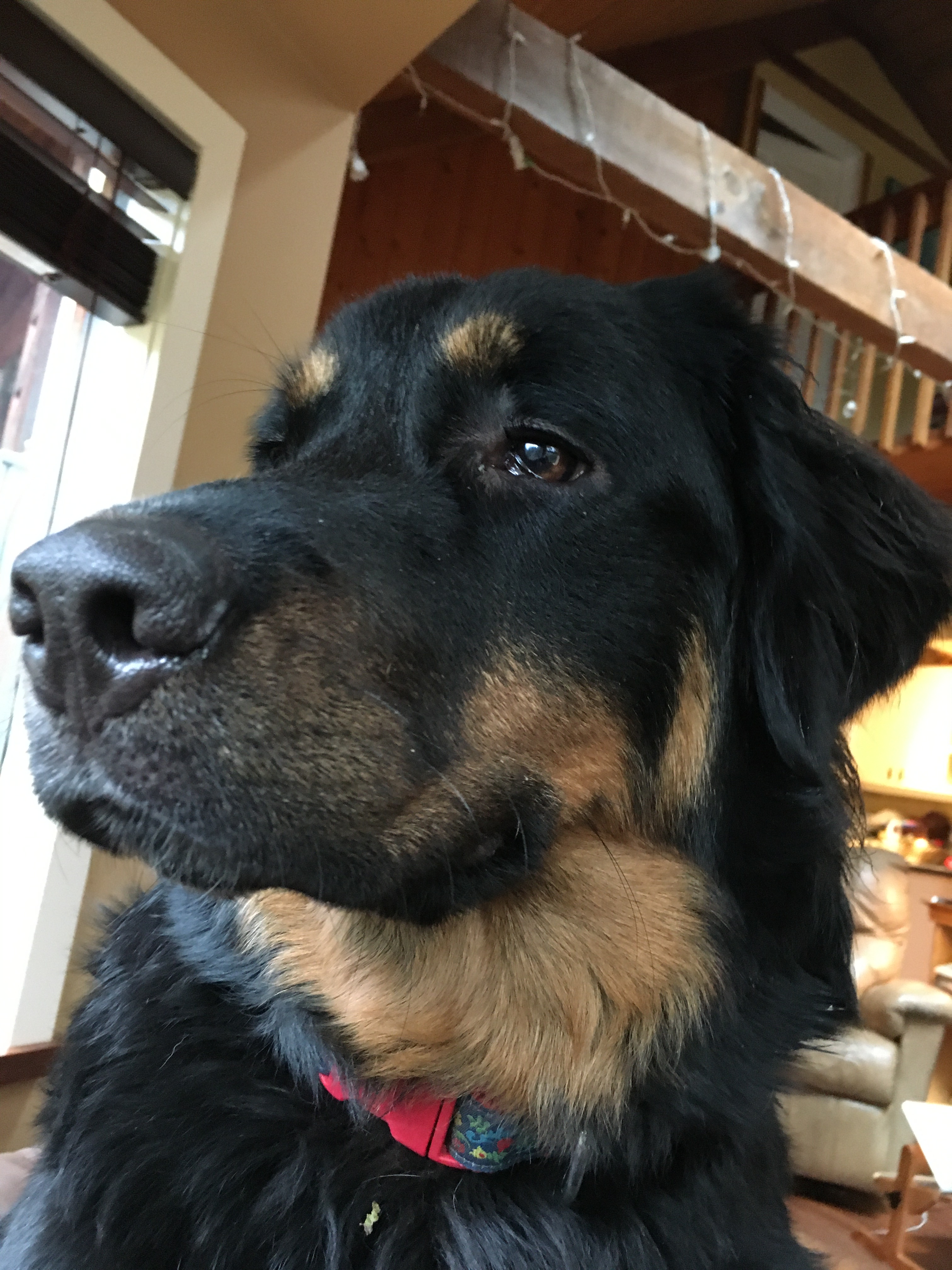
Tilly is getting so big. Seven months old, well over 70 pounds now. Not only that but she’s losing her puppy ways and is becoming a really sweet dog. Carolyn has posted recent pictures of her on Facebook. She’s big buddies with Cooper, the neighbour’s dog. He’s ‘intact’ and was getting very interested in Tilly’s butt so we thought it wise to have her spayed. She got through that very well. Now, she and Cooper fly around the yard wrestling and playing tug-o-war with a toy or a stick. They’ve destroyed so much of the garden with their antics but Carolyn just shrugs knowing that things will recover and will thrive come spring. We can only hope the dogs get more relaxed as time goes on and are less apt to run around the property like gilly-galoos. We expect they will get mellower and mellower as they age. That’s generally the way it works with dogs. Tilly always gets treats from me first thing in the morning. She might even get some later in the day if she’s a good dog, and she is most often a good dog. She gives us lots of kisses.
Re: the art of tying knots on the scourge so as to experience the most exquisite pain so as to deny our bodies and bring us closer to God.
When I was twelve years old in 1959 my parents sent me off to a private Catholic boarding school in Edmonton, the Collège St. Jean. I boarded a CN train with some forty boys from British Columbia destined to make up a substantial minority of boarders at this school. No way I was going to be left behind. I’m sure I begged my parents to allow me to join my peers in Edmonton. The College was run by Oblate priests (Oblats de Marie Immaculée), a Catholic missionary order founded in France in 1816.
In this post I don’t focus on my attendance at this school although that is a topic deserving of its own exploration. No. My interest here is to highlight aspects of the life and activities of one of the Brothers who worked at the College from its inception in 1908-11 until 1947, the year of his death. His name was Frère Antoine Kowalczyk. He was born in Poland in 1866, moved to Alberta in 1897 and died in Edmonton in 1947 after serving the College for some thirty-six years. During his tenure at the College he was one of two Oblate Brothers.
Oblate Brothers acted as custodians, gardeners and caretakers. They did the grunt work around the place along with a contingent of nuns from the congregation of Les Soeurs de la charité d’Evron who fed us, did our laundry (poor women), and looked after the infirmary. Oblate priests were our professors (with the odd exception) and served as the College administrators.
Brother Anthony (Frère Antoine) died in 1947, a few months after I was born so there was no chance I would ever meet him. The good Brother would not be alive to see the major expansion of the College in the 1950s, but the College did everything it could to keep his memory alive because Brother Anthony was special. Normally, he would have received a nice funeral and would be buried in the Oblate cemetery in St. Albert, not far from Edmonton, and then all but forgotten. That was not to be for Brother Anthony. Yes, he did have a nice funeral and yes, he is buried in St. Albert but he has not been forgotten.
Because of his exemplary life, Frère Antoine is being considered for sainthood and has been for quite some time. The local Catholics would love to have a real honest-to-goodness saint come out of their community. We all want our heroes. Brother Anthony was to become one of Edmonton’s Catholic heroes and saints-to-be.
I recall reading a number of extremely laudatory tracts about Frère Antoine when I was a student at the College and I still clearly remember the grotto that he built to the Virgin Mary which probably still stands next to the College’s administration building. Some of his personal effects were on display in the main College building. They are what interest me the most about Frère Antoine along with the efforts to have the Vatican declare him a saint.
The glass encased display of his personal effects included his rosary and breviary along with more mundane items such as his cassock, candle holders, and some tools. For me, the most striking item in the display was his scourge, the whip he used for self flagellation. When I first laid eyes on the scourge at age 12 or 13 I was astounded as to why anyone would want to inflict pain on themselves as Frère Antoine obviously had. How could that be? Pain was a bad thing, wasn’t it? Well, maybe not always.
Pain is important as a signal that something isn’t quite right in the body. People who cannot feel pain may hurt themselves in a myriad of ways without knowing it. The condition called congenital analgesia is extremely rare. Less rare is the situation in which people deliberately hurt themselves. People, mostly youths, cut themselves with razors, knives, and other sharp things for a myriad of reasons. I don’t think Brother Anthony whipped himself for the same reasons ‘cutters’ do.
For Brother Anthony, whipping himself or self-flagellation was a means of punishing or mortifying the flesh. Why? Because the flesh is weak now isn’t it? Succumbing to its many potential delights in eating, sex, and just plain moving is considered by Catholic theology as a (if not the) most important source of sin in the world. The seven deadly sins are, in fact, mostly about denying the pleasures of the flesh. After all, the flesh dies while the spirit lives for eternity as the story goes. Most religions in fact promote the spirit as the vehicle for eternal life. I guess it’s just an easy step from avoiding sin to actively ‘mortifying’ the flesh, that is to punish it physically for being the source of death.
But Brother Anthony wasn’t content with a wee bit of self-flagellation during Lent. He spent time with his scourge. What I remember of it, his scourge consisted of several leather strands with knots tied carefully at intervals to intensify the pain and help to cut the flesh. The story is that he whipped himself regularly as he fought with his devil flesh.
I refer to Brother Anthony here specifically because he is a flagellant of my past, but the institution of self-flagellation is not just a Catholic thing. It’s also a practice of Shia Islam and Judaism although in no religion is it standard practice. It’s generally practiced by the over-zealous as is certainly the case in the Philippines and elsewhere. Brother Anthony certainly was zealous and it strikes me that the aim to canonize him is partly based on his zeal.
Reading about the myriad ways in which people deliberately cause themselves pain has not led me to reconsider my attitudes towards pain. For me pain is not something I experience with joy. It is a reminder to me of the weakness of the flesh for sure and of my mortality. That’s fine. I accept that.
If there’s one thing that is common to all human culture it’s the denial of death, and consequently, the promotion of the spirit as the essence of being and as our way to immortality. That’s not a universal value to which I subscribe so my pain and I have to live with each other ’til death do us part.
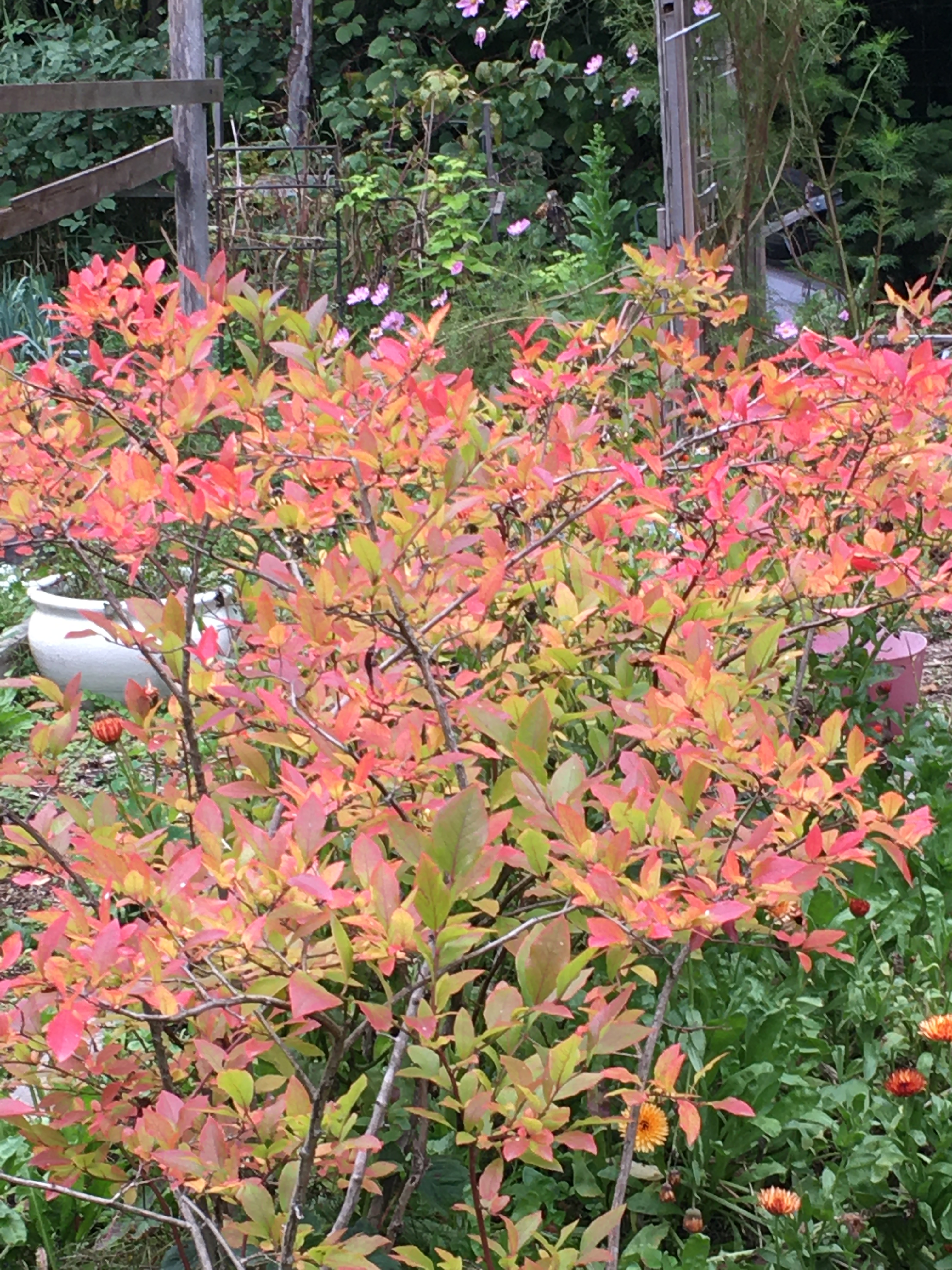
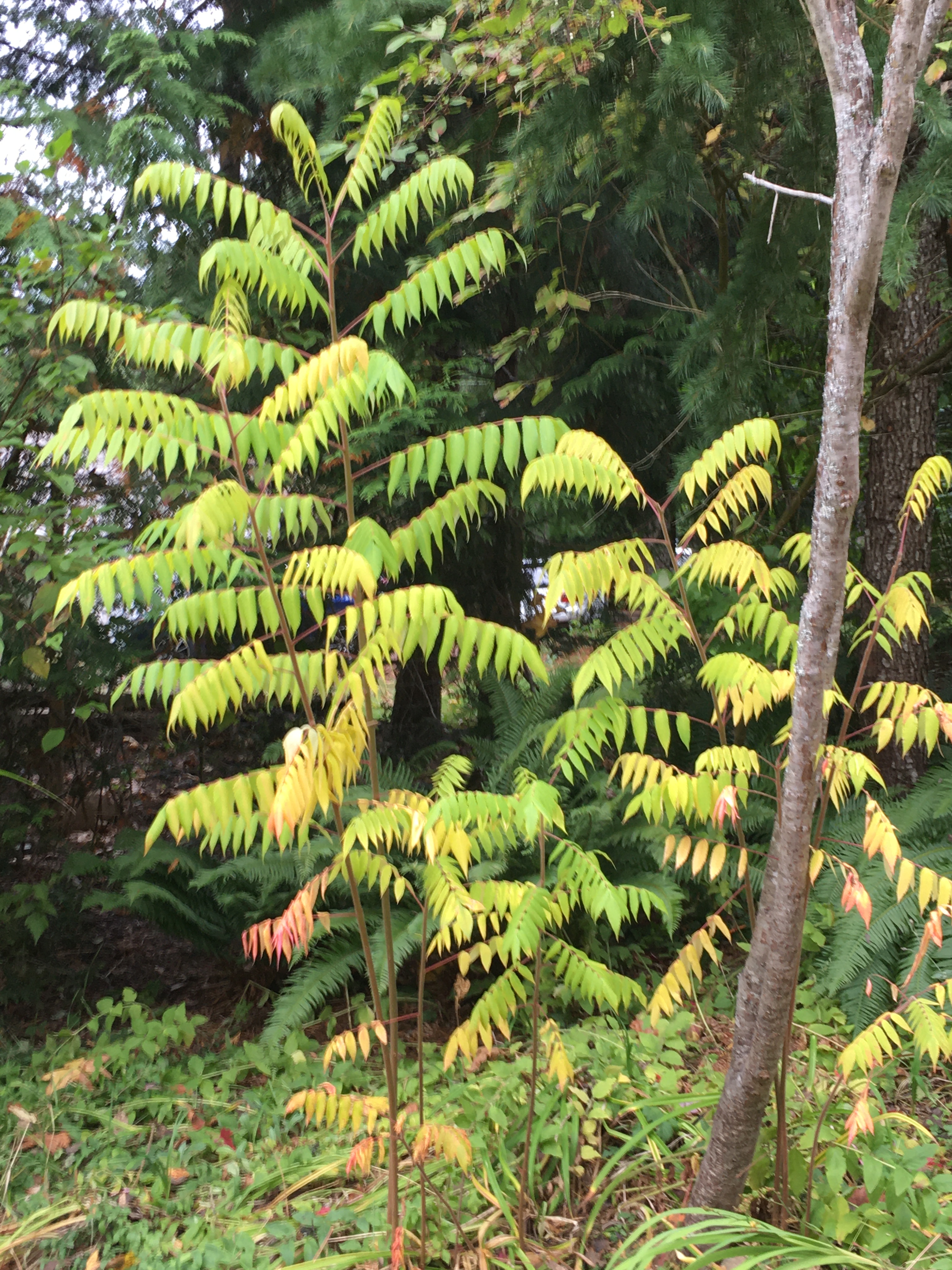
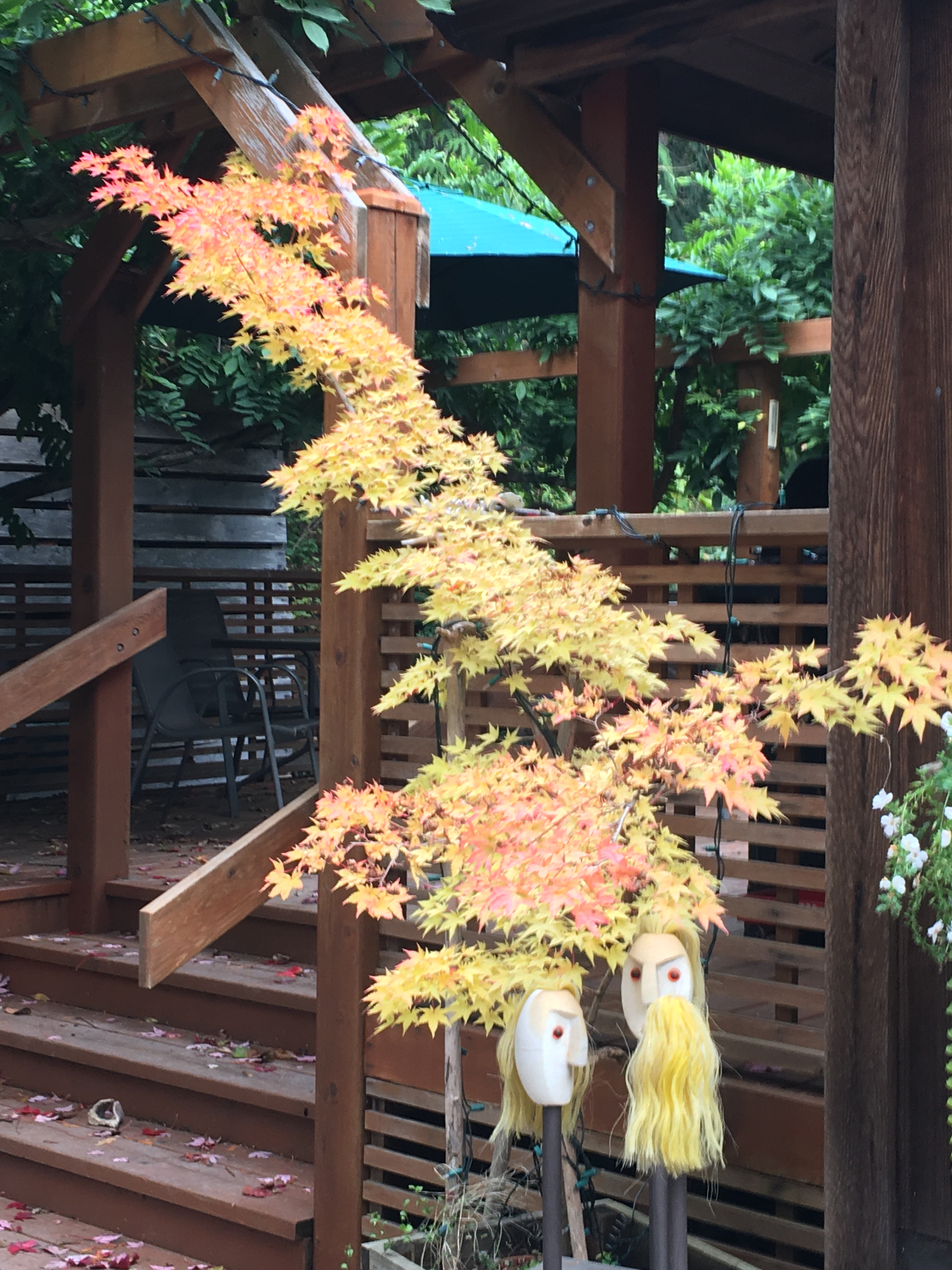
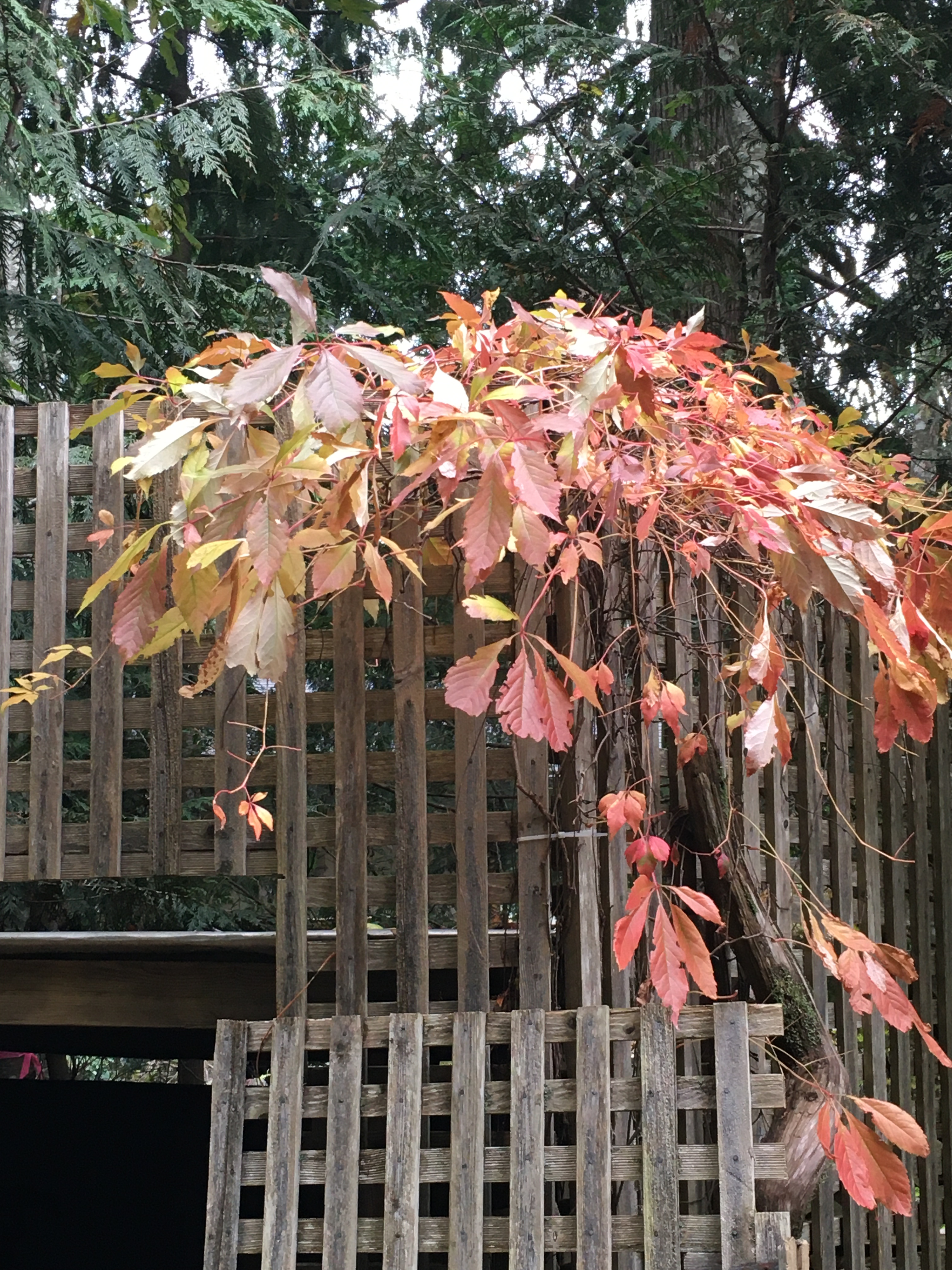
Fall Colours in the Garden
Our garden is flush with colour from the earliest days of spring and well into the Fall. Now is the time for dying and dead leaves to put on a show, extending the dominance of colour before bare branches impart a new dynamic to the garden along with some evergreen trees and shrubs that are just that, ever green. Below you can see pictures of blueberry bushes in full Fall splendour along with some maples, red and Japanese, Virginia creeper, and sumac.
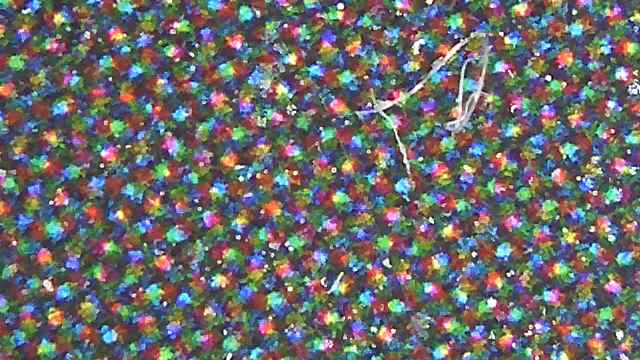
Under the Microscope
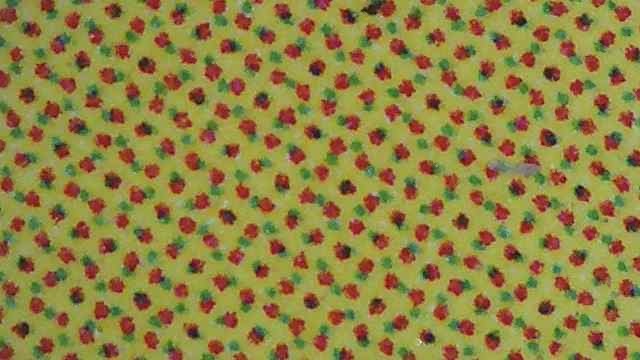
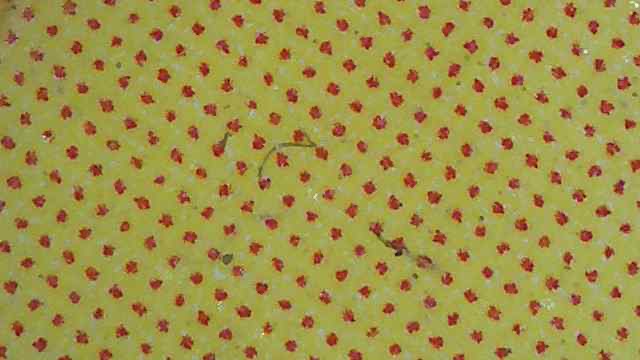
Nothing extra special about this set of images. The first one is of my blood. It’s red, not surprisingly. The blue is a photo of a rough blue paper. The other three are yellow and black. The multicoloured one is in fact black to the naked eye, black being the sum of all colours. The one with only red dots is a light yellow and the one with red and green dots is a darker yellow.
Not much motivated to write about my myeloma journey right now. My last post was on August 23rd. Today is Monday, September 14th. For some time I tried and succeeded in putting out a blog post almost every week but lately with the uncertainty around my treatment, I’ve lost interest. So, it’s been three weeks since my last post.
I talk to my local oncologist in a couple of days for fifteen minutes or so but he doesn’t make the major decisions around my treatment. I have a meeting scheduled for the consulting oncologist next month, but I have no expectations around that consultation. It will be the first time I talk to this guy. He’s new in town. I’ll be just another file to him.
From my last set of blood tests I know that my blood is pretty much normal. That will change. Technically, if I’m considered in remission they’ll do more blood tests every three months and reconsider my situation then. But right now, I don’t know if I’m in remission or not.
I already told you that I decided to cut my chemotherapy short about six weeks ago now because one of my chemo drugs was playing havoc with the way my muscles are supposed to respond to the neurological signals controlling them. My thigh muscles are particularly affected by bortezomib (trade name: Velcade), the offending drug, to the point where I experienced severe pain and weakness in my legs, especially in my thighs. That situation seems to be improving slowly. I’m taking some good pain meds and they are helping the situation, and I’m seeing a physiotherapist, but I think just being off chemo is making a big difference.
It’s been a roller coaster ride over the last few months. I’m tired of it. Thankfully, being off chemo is giving me some respite although I still have great fatigue and restricted mobility. I am doing better and I’m happy about that. Lately I’ve been able to draw and paint a little and use my microscope, telescope, and iPhone to put together some interested projects. I can’t do anything for more than a couple of hours at a time, but that’s infinitely better than staring at the ceiling all day long. I’m actually enjoying myself. I have a secret dream, however, that I shared with my physiotherapist. I shouldn’t tell you because if it doesn’t happen I’ll be sadly disappointed, but I’m determined to get into (and out of) our canoe next month and paddle around for an hour or so without assistance and without dropping like a heap on the ground unable to get up. That would be cool. I also want to drag the trailer to Strathcona Park next month for a couple of days of camping. My real secret though is that I want to restore our canoe. I can’t face that task right now, but maybe later this year, who knows. Over the past while I’ve accumulated most of the materials and tools needed for the job. Now I just need energy and strength in my legs.
In any case, while I wait to see what will become of me and how much time I have to live, I’ve been able to occupy my time productively within the limits of my illness. Well, it wouldn’t do to just idle away my time now, would it and just passively wait to die? No! In our world idleness is the work of the devil! Can’t have that.
Wait, I can see it now. I’m on my death bed, hours if not minutes from expiring permanently, but I think that I’ve left something unfinished. No! Can’t do that. Must…live…long…enough…to finish…this…blog…post. And I do. And I die happy.
Of course worrying about a bucket list or unfinished projects or missed communications is all moot. After we’re dead, there is nothing. Concepts like regret are irrelevant. Even if one believes in an afterlife, I can’t imagine anyone thinking that afterlife would be taken up with regrets about things left undone or unaccomplished in life. What a drag that would be.
One thing that’s given me a lot of pleasure lately, as I note above, is exploring the microscopic world with my microscopes and iPhone. And I’ve discovered that I can use my iPhone to record an image on my spotting scope. I’ve posted those images on Facebook so I won’t post them again here. However I will post here a couple of videos I did of sword fern sporangia. I posted a video here of an exploding sporangia some time ago while it was still attached to the leaf. This time I scraped the sporangia off of the fern leaf and that provoked them to open up en masse. The videos are at two levels of magnification. There’s a close-up one and one at a lower level of magnification.
The spores are quite visible after the sporangia have evicted them. They’re the little beige dots littering the area not covered by sporangia. I want a microscope powerful enough to have a closer look at spores, but what is interesting to me even at this level of magnification is that we normally associate movement with animal life and here we have a plant that is moving…with purpose.
I love that as I look at the world through a microscope it’s obvious that all living things on this planet have a lot in common. Carolyn and I watched a YouTube video (NOVA) the other night on DNA called What Darwin Didn’t Know. It really reinforced the fact that DNA is ubiquitous and that life is much more unitary that we think. We really are all in this together. It would be awesome if we could develop respect for all life, all of us that is, including Monsanto and Bayer executives, oil company boards, politicians and all of us. Of course, respect for life also means respect for death, because they are not separable. Life depends on death. We don’t respect death now. We fear it. What would respect for death look like?
PS: I hope the videos work for you. If not, please let me know. For those of you receiving email notifications of my blog posts, you may need to go to the blog site to see them rather that stay on your email to view them.
PS2: My next blog post will be completely different from what you’re accustomed to read here. It’s about a brother I would have had if he had survived childbirth.
A couple of issues have been dogging me lately and are crying to be released into the blogosphere. One is the fact that I am no longer on chemo and what that means, particularly with regard to my future treatments and my relationship with ‘my’ medical team. The other is a nagging, recurring introspection around my death and dying. Let me start with my limbo between chemo and remission.
Apprehensiveness
So, I’m not on chemo, at least not for now. Since October of last year I’ve been carefully supervised by a local GP oncologist and the Cancer Care Centre at the North Island Hospital in the Comox Valley. What happens now that I’m not on a regular regime of chemotherapy? I really don’t know, yet.
I called the Cancer Care Centre last week and they told me to contact my oncologist at the BC Cancer Agency (BCCA) in Victoria. Well, I contacted the BCCA to find out that the oncologist I thought I had is no longer employed at the BCCA and hasn’t been for two months or so. (Gee, thanks for letting me know.) It turns out I’ve been assigned a ‘new’ oncologist, one who has recently come here from Alberta. I have not met him but I’m scheduled to go to Victoria for an appointment with him in late October. His assistant told me to contact my local GP oncologist in the meantime. I get the sense that I’m getting a bit of a run around. I don’t think anyone is out to deliberately mess with me, but I’m feeling a little apprehensive about what happens now. It looks like I’ll have to be the squeaky wheel to get any answers. Let the squeaking begin.
I’ve noted this before, but one thing I am very grateful for is a great palliative care team. I can now report that my pain levels are going down steadily. That said, the weakness in my legs has not abated and that’s my main worry. That means that the neurological damage is not being affected by the meds I’m taking for pain. The pain is attenuating but the weakness is not. I’m still walking with two canes. I DO expect my strength to improve. Patience is the name of the game right now but I’m not that good at being patient.
Wistfulness
Yes, I am a bit wistful, longing for a more settled, less precarious, state of life. Of course, life is never settled but that doesn’t mean I can’t wish for it. Life means movement and change but we are not alway happy with that state of affairs. We resist change by getting into routines and habits. We can delude ourselves into believing that life is stable when we do the same things day after day, week after week. The fact is, life is only finally settled when it reaches its destination.
In France in 2007, Carolyn and I boarded a fast train (TGV) from Paris to Montpellier in the south not far from the Spanish border. Arianne and Tim were living in Montpellier at the time doing post-graduate work at the university there. The train was incredibly fast (TGV is Très Grande Vitesse), moving at an average speed of over 300 kilometres per hour. Yet it was the smoothest train ride I had ever experienced (and I had experienced many in my youth). There was no clickety-clack, that most familiar sound I had heard on every train trip I had ever taken in Canada between New Westminster and Edmonton (where I attended boarding school). Lengths of track in France are welded together making for a single track running for hundreds of kilometres. No seams, no clickety-clack. Frankly, I found it a bit surreal but amazing at the same time. I had filmed part of the trip just as I had filmed other events on our six week visit to France that year, but I had a hard drive crash later and all my recordings from our 2007 trip were lost. What I have not lost, however, are my memories of that trip and our whole time in France that year. I still have vivid memories of catching the train in Paris, almost missing it, boarding without the requisite documents, settling down in first class (we decided to treat ourselves), and relishing this unique experience.
In bed a few nights ago after turning off the light by my bed my mind wandered again as it often has in the last few months to my death and dying. I had been looking for a metaphor I could use to make sense of my death, to give me some relief from the constant reminders of my demise. The reality is that I’m on borrowed time with the inevitable outcome of my death looming. My brain wants to keep coming back to that. It’s determined that I will be relentlessly reminded of my death and it will make sure that that reminder holds pride of place in my frontal cortex, not content with having it stay in the back of my mind where denial is so easy. We live by metaphors so I figured it should not be too difficult to come up with a good one. But I’m not sure a metaphor can win a contest with my brain when it comes to the ominous death watch I’m experiencing.
Then, our French TGV trip came to mind. The more I considered it, the more it made sense to me as a metaphor for life. That conviction was further reinforced as I read the article I link to below on our fear of death. The message in that article is simple: life is finite so make the best of it.
Using a somewhat questionable syllogism in this article Dresser asks us to consider whether or not we are afraid of the time before we were born, when we didn’t exist. If we aren’t afraid of that time, then why should we be afraid of death which is simply a time of non-existence much like our time pre-birth?
Yes, I suppose so, but it’s not that simple. Before being born, in that time of nothingness, there is no accumulation of life’s memories, of hugs, orgasms, loves, hates, good meals, accomplishments, and regrets. There is no possibility of loss or even the conception of loss. The anticipation of death, by contrast, involves facing the loss of everything, including experiences and all things material and immaterial.
Of course there is no perfect metaphor, but thinking of our TGV trip as a metaphor for life (actually any trip will do), it’s obvious that before boarding the train there was anticipation but no knowledge of the imminent experience. Once on board, there is full knowledge that eventually the trip will come to an end but the passing scenery, the food, the weird passengers on the other side of the aisle, all consume our attention. Eventually, of course, time is up, the train pulls into the station and we are compelled to disembark. We may not want to leave the train, having enjoyed the trip so much, but that’s not an option. We must leave the train and its memories behind. Yes, coming into the station and dying are comparable I suppose. Both are inevitable, both are necessary.
Yeah, maybe that works, but I have to think about it some more.
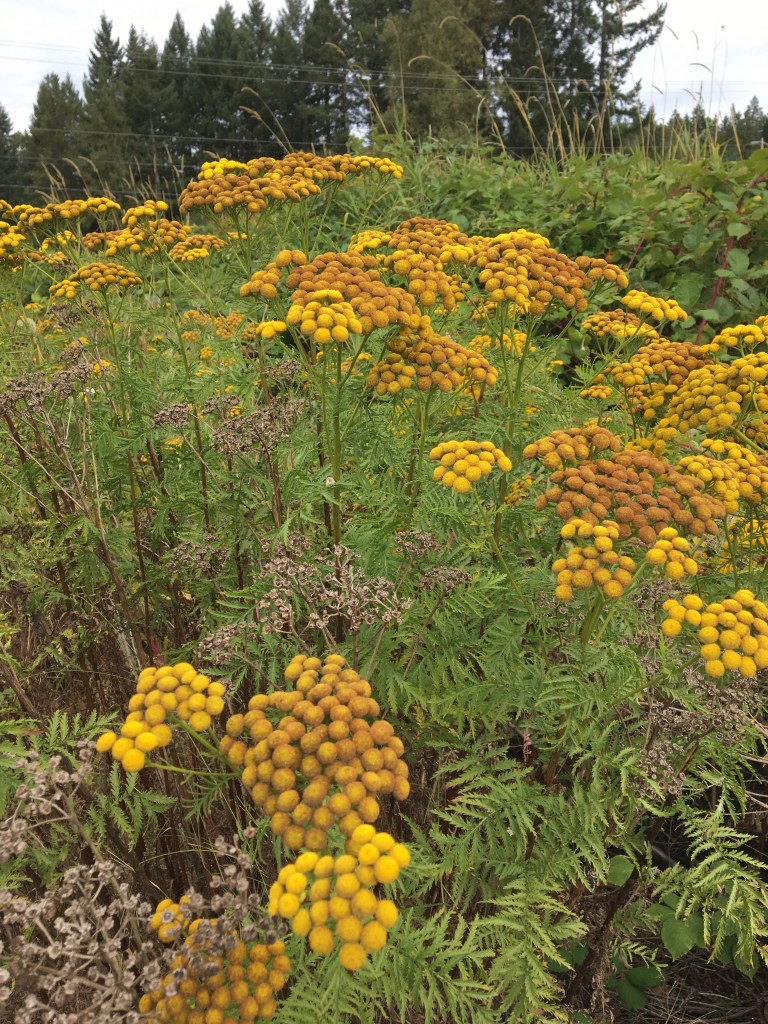
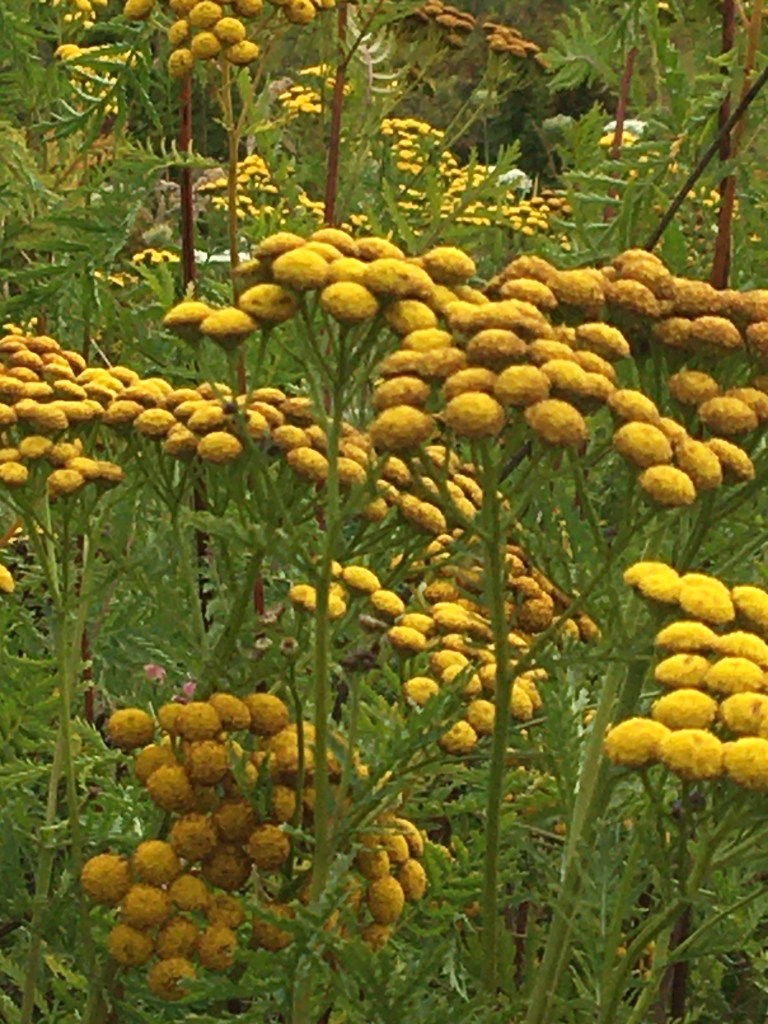
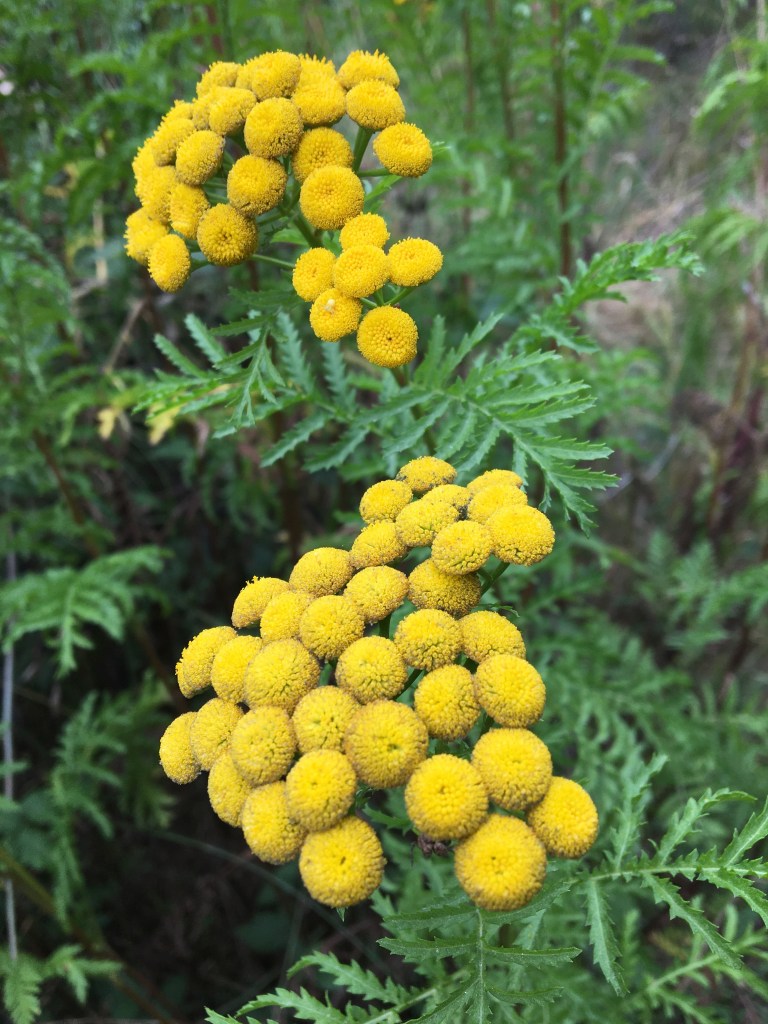
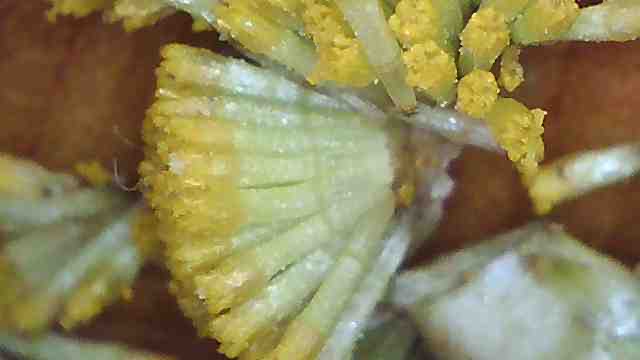
You might have seen tansies at one time or another. They aren’t super common but can often be found on vacant lots. In fact, the tansies in images 1 through 3 were photographed in an otherwise empty lot in our neighbourhood (by Carolyn). I sequenced the photos below to go from a wide to a tight view. The 4th image is one I took with the WiFi microscope at full magnification. Every one of the tansy flower heads is made up of over a hundred of the compacted cone/shafts you see in the 4th image. So, in image 1 you look over a minor sea of flowers. In image 4 you get close and personal.
What you don’t see in any of these images is what you see in the video that completes this gallery of images, namely the army of insects that populate tansy flower heads. You may be seeing only flowers when you look at images 1 through 3, but you’re also looking at bugs, lots of bugs, bugs invisible to the naked eye. The number of microscopic bugs out there is staggering. I won’t speculate on how many of them you had for dinner or are living in your eyebrows. That may be something you’d rather not be reminded of. Sorry.
I find it fascinating that we miss so much when we see the world with our limited eyesight. Truth is we see a narrow slice of the world, and that, unfortunately I think, also limits our appreciation of vast unseen, yet important to us, aspects of the world.
1
2
3
4
Tansy flower at full magnification with thrip (we think). Click twice on this image to activate it.
The weather has been so unpredictable lately. The meteorologists at the Weather Office must be gnawing their fingernails off. It’s been great for the garden overall except now it would be good to have more heat and sun to ripen the berries. We’re eating a lot from the garden now. Cucumbers, lettuce (so much lettuce), tomatoes, zucchini, broccoli, cauliflower, kohlrabi, and lots more. I fell kind of bad that we can’t support the farmer’s markets, but no. We can’t do that. Of course the farmer’s markets have way more than just veggies and fruit, but then there are other reasons I don’t go to places where people gather, at least not regularly and not willingly.
We sat on the porch today looking over the front of the property and off toward the village. The clouds came through at different elevations, the higher ones travelling west to east and the lower ones southeast to northwest. It was sunny at intervals. It rained a bit. It was around 20˚C most of the day. Not at all unpleasant. Tilly was her usual goofy self entertaining us with her antics on the patio. She really is a laugh a minute, that is, when she’s not biting us. Sometimes she just wanders over and sits at the top of the driveway surveying the yard below. I’d love to know what kind of puppy thoughts are going through her head.
As usual for a Thursday I took my chemo oral drugs on the early morning then went to the hospital for my Bortezomib shot at 10:30. When I went in, there was just a short wait for the lab (not that I was going there), but when I came out, there was a lineup outside going almost around the building, probably thirty people, some in wheelchairs, some with walkers waiting for clearance to even step into the hospital. Some were going to the lab (for a long wait) but others were going for imaging or to the Bone people, or wherever. You stand in line whether you have an appointment or not.
Everybody gets the standard Covid-19 song and dance: Have you travelled out of the country in the last 14 days? Have you been in proximity of someone who has tested positive for Covid-19? Do you have a fever, cough? Etcetera? I usually stack up the nos at the very beginning of the process and that usually works but not today. Today I got the full meal deal. Everybody was getting it. No wonder the lineup is so long. Of course it has to be done. I’m really not complaining. The Covid-19 protocols these days appear to be just as unpredictable as the weather. Oh well, we carry on.
Just as unpredictable as the weather is how my body is going to react to my chemo drugs. It’s been a nasty ride lately with Bortezomib creating havoc with my nervous system, making my skin on my legs and torso very sensitive to painful to the touch. Added to the pain is a weakness in my legs that is now making it very difficult to move in ways I always previously took for granted, like tying my shoes or picking something off the floor. That’s very distressing. I must confess that I’ve had moments when I have felt pretty sorry for myself. Fuck cancer!
Now I’m on a very low dose of amitriptyline, a drug that was developed for depression (at 100 mg/dose) but was also discovered to help with pain at a dose of 10mg, the dose that I’m on. It has side effects, like they all do. Pile side effects on top of side effects. What drug is doing what is anybody’s guess. The pain in my legs and back is so distracting, and along with the usual dizziness I experience all the time, I get a pretty constant brain fog. I can still put together a coherent thought, but I have some difficulty communicating those thoughts sometimes. Not always. My brain is like the weather right now. Some coherent thinking. Some stoned time. Some sleepiness. Not always in the right order. Unpredictable is what it is.
The fact that I can even write this is due to some momentary clarity induced by another of my drugs, dexamethasone. It won’t last long, so I had better hurry and get this done. I’m really wondering right now about this whole business of oncology. Like, how is it that a drug can be approved to treat a condition, in my case, cancer, yet produce side effects that are debilitating, potentially for the long term? What’s the goal here?
It’s pretty obvious after reading The Emperor of all Maladies by Siddhartha Mukherjee (2010) (a book review here), that the objective of oncology, both clinical and research is to prolong life. Many people have died because of the effects of chemotherapy. As far as drug trials go the Golden Chalice is survivability. If they get 5 months more survivability with a drug that’s considered a successful trial. Since Mukherjee wrote his book, lots of progress has been made and lots of animals have been sacrificed to the cause, but they still can’t engineer Bortezomib to do good work and to avoid beating the crap out patients just in order to keep them alive. Of course, the instinct of self-preservation is strong in most of us to the point where we are more often than not willing to sacrifice a lot just to get more life out of the deal.
My chemotherapy is really working well as far as the myeloma is concerned, but at what cost? It’s a straightforward cost/benefit analysis and I’m working on that right now. I have a strong will to live, and I’ve seen people in a lot worse shape than I’m on stick it out and squeeze the last bit of life out of their decaying bodies that they can. So far I guess my actions have betrayed my values as is the case for most of us most of the time. More on this in my next post.
But first, how about a very short video of Princess drinking from the ‘fountain’ next to the deck? And how about following that with a picture of our new puppy? She comes home Saturday. Coming soonish, a second video about gardening and plant sales. Stay tuned.
Princess and the Fountain.
Puppy. No name yet.
So, I’ve written about this before, but it’s such an important part of my life right now that I can’t let it go. I, more than most people, understand that social convention governs a great deal of our behaviour. The study of social convention is on the curriculum of most introductory Sociology courses, so my familiarity with it goes a long way back. Convention and habit colour if not drive a lot of human interaction and that is true of our conversations as well as many other types of behaviour. We’ve come up with a number of conventions that, in my mind, work fine, but only if we don’t question them. For instance, asking “How are you?” is not really a query into the state of my health even though it does literally inquire about my wellbeing, doesn’t it? Needless to say, “How you doin’?” is a conventional and very common greeting. It’s not a question inquiring about pain now is it? The conventional answer to this greeting/question is “Fine.” “Hi, how are ya?” seems like the asker is interested in an answer, but mostly, that’s not the case. We’re supposed to say “Fine.” That’s it.
I don’t ask people how they are doing anymore. I mostly just say “Hello,” and get on with a conversation. For a while there, I would answer the question as though it were a real question. “How are you?” “Well, today, not so good,” I’d say. Or I’d say, “It depends.” That is not a satisfactory answer. I can tell that from the look on the asker’s face when I dare utter such an unconventional and unexpected riposte. Sometimes I would carry on with an extended answer, but I knew from the glaze over the asker’s eyes that that wasn’t a satisfying answer. Eventually I would say, “It’s okay, I’m fine.” After that we could all get on with our ‘normal’ lives. The thing is, I deal on a weekly basis with medical personnel of all kinds. Of course, they are as gripped by social convention as the rest of us, but it still throws me off with an oncologist asks me: “How are you, today?”
Just like everyone else, they seem to expect “Fine” as the appropriate answer. Of course, if I were fine, what the hell would I be doing talking to an oncologist about my chemo treatments? Obviously, “fine” is not appropriate as a response under the circumstances, but nor is asking “How are you?”
One time, a few months ago, I had a Zoom type meeting with an oncologist and he asked me “And what can I do for you today?” Well, that question kind of left me speechless, something that is quite an accomplishment if you know me. Of course, it’s a completely appropriate question if I’m in a retail store, walking up to a counter and a clerk asks me “And what can I do for you today?” or “What can I get for you today?” Yes, in that circumstance, this convention works for me, but when an oncologist asks me that question, I get flummoxed. In my usual smart ass way I get tempted to blurt out: “Well, you can tell me I’m cancer-free. How about that doc?” But then, things get awkward and embarrassment takes centre stage and nothing good comes of it.
So, being a sensitive kind of guy and always interested in having conversations go smoothly, my response to the oncologist that day was quite measured. He wasn’t prepared for the appointment, so all he did for the five minutes of the conversation was look at his computer screen, just glancing up every few seconds the camera in an uncomfortable way. He was probably having a bad day. In his line of business, bad days probably happen often, so I don’t take these things personally. In any case, I steered the conversation to my lab results, prognostications about future treatments, and about pain and exhaustion. As an aside, my experience so far is that oncologists don’t like to talk about pain. It seems to make them uncomfortable and fidgety. Tellingly, they leave pain management to GPs.
Well, to finally get to the topic of this post, I can understand their reluctance to talk about pain. It’s a ridiculous thing to talk about. It’s invisible, subjective, and it’s measurement borders on the hilarious. “So, Mr. Albert, on a scale of 1 to 101, how bad is your pain right now? Well, shit. Where do I go from here? Do I just tell them what they want to hear: “Oh, it’s about a 5.” “Okay, thank you, Mr. Albert. So the pain isn’t too bad right now then.” Note that last comment is made as a statement, not as a question. Asked as a question, I could answer something that is more akin to the truth than the bullshit conventional responses we are expected to give at these times. So I could say something like this, bear with me:
Well, at the site of my nephrectomy, the pain varies from 3 to 8 and in duration depending on my activity at the time. It can spike to 9 at times, just not right at this moment. My lower back is fine as long as I don’t move too quickly but that’s because of arthritis and disk degeneration. As you know, my Bortezomib induced peripheral neuropathy (BIPN) is neuralgic pain that is untouched by pain meds designed to deal with muscle or joint aches and pains. Right now, it’s at about a 7. My back starting just below my arms, and my legs down to my knees are burning. My left thigh is painful to the touch. I don’t know how to measure that. It’s a new thing for me. It seems that my BIPN somewhat attenuates during the day and I may actually be able to go to bed with it not bothering me much. At other times it’s excruciating and ridiculous. The pain at my right kidney is nasty at the moment, spiking up to a 7 at times. Lab tests tell us my kidney is fine so it’s the Bortezomib that’s the culprit, it seems.
Anyway, you get the picture. Describing pain simply and easily is impossible for someone with chronic and/or chemo-induced pain. No one can possibly understand how much pain I’m in or how much pain people with inflammatory illnesses and many other conditions suffer. It’s impossible for me to describe the various levels and types of pain I experience daily unless you’ve experienced it yourself in the same contexts that I have. Now, my GP takes my word for it. What else can he do?
1The 1 to 10 pain scale: I thought I understood it somewhat until I had a talk with a palliative care physician who told me that a 10 is pass out time. I have never passed out from pain as far as I can remember although I may have passed out from deliberately taking a pass out dose of meds on occasion, the only strategy. There were times when I assumed that a 10 was severe pain, but not pass out quality. So, if I said I was at an 8 or 9, that meant that I was sorely distressed by it, but I was tolerating it. A 5 meant that the pain was bad, but not completely distracting. A 4 or below meant I was in some pain, but not too nasty, maybe a nagging, throbbing, but fairly mild headache. After talking to the palliative care doc, I had to revise my scale. Now a 5 is “I’m in pain and it’s no fun. Do something about it!” A 4 is “It still hurts pretty bad!” A 2 might be: “Okay, I can deal with this, but it’s still bugging me.” I haven’t seen a 0 very often, but it does happen periodically for a short time when I’m lying down and not moving at all.
Truth be told, I’ve always been a bit cranky. In the past though I was generally able to dampen my initial crankiness at what I perceived to be other people’s ridiculous behaviour, in the classroom, around town, in national and international politics, or on Facebook. I was able to step back, take a deep breath, and allow a sober second assessment of consequences and effects to take shape in my mind, making for a more measured response to the momentary ‘crisis’ whatever it might be. Oh, there were times when I reacted swiftly and even lashed out at people. I usually regretted those later. Ranting at the TV news was pretty common sport in the past when we still watched TV, a practice that I passed on to at least one of our daughters. I still rant like in the old days, but it’s more likely to be at a Facebook post or a news release posted online. However, ranting in private is different from personally and immediately striking out at someone for their perceived shortcomings.
Now it seems that my ability to generate a sober second thought is attenuating and my patience is wearing thinner. My private rants are turning into public displays of my impatience and I am now much less likely to bite my tongue when I think that people are being ridiculous or unreasonable. Of course that violates the first rules of teaching which, in my mind are patience and empathy. I feel really bad about that. My quick trigger reactions may be a consequence of my age and the fact that I have incurable cancer. It may be entirely idiosyncratic, but it could be that something else is afoot here.
Covid-19: the great disruptor
It could be that I’m not alone in my descent into more readily expressed displeasure at whatever affront, real or imagined, presents itself. Covid Times have created the conditions of uncertainty and disruption of habit that are hard for humans to take.
We, humans are creatures of habit and we don’t necessarily adapt readily or willingly to changes in our environment that require us to change the ways we live. We tend to react in our own ways to threats to our precious habits. Some of us hunker down even more deeply into already established patterns of social isolation. Others of us, like me, are more ready to express our pissedoffedness at the world. Now, more than ever seems to be a time of reaction rather than reflection.
It seems that people are now more than ever prone to stand on questionably acquired ‘knowledge’ rather than commit themselves to a course of study and learning that may lead to a more nuanced appreciation of economics, politics, current events, and other people’s actions both local and distant. And, since Trump, the ignorant minority is emboldened to speak out more often and vigorously. For us ‘experts’ who have spent a lifetime in study and reflection counteracting the tripe that comes out of YouTube and Facebook daily from people who have acquired whatever ‘knowledge’ they have from a marginal and peripheral relationship with analysis and evidence seems to be a lost cause. So, Covid-19 seems to have released some pent-up frustration at the world and our place in it and some people seem to be less reluctant than ever to stay silent in the face of it.
Covid-19 has definitely changed the goal posts in any number of ways, but life pre-Covid-19 wasn’t all that rosy either.
Pre-Covid-19, there were already serious cracks forming in the security and (often illusionary or delusional) stability of our lives. Personal debt dogged many of us to the point of financial ruin (and still does). Relationships were strained and addictions to alcohol and other drugs were on the rise as people self-medicated in attempts to deal with the emptiness that scoured their every wakeful moment and pitter-pattered through their dreams. Many of us were already leading precarious lives with no promises of a future with less stress and greater comfort and peace. General social distress was already reaching a breaking point when Covid-19 broke onto the international scene.
One thing I found particularly distressing was, and still is, the general ignorance of our global economic structures and their relationship to our nations, their sovereignty, and our individual choices. Very few people have any kind of a grasp on the intricacies of global supply chains and the interconnections of a myriad of corporations, factories and logistics experts on the conduct of business. The globally most powerful corporations have been masters at hiding the truth about mass production, distribution and sales. People think that ‘China’ is flooding our markets with cheap product and that our poor domestic corporations are suffering from this unholy competition. Nothing could be further from the truth.
Global corporations, many of them with very unfamiliar names, control global trade and often subject local businesses to rules and practices that benefit global finance capital rather than citizens. Look closely at the things you buy and more often than not these days you will not be able to locate where a product is manufactured. A label might tell you that a product was produced for such and such a retailer by such and such a manufacturer (with an address in Canada) by a factory in China, either owned by a ‘Canadian’ corporation or contracted by them, but it won’t tell you where a product was made. There is now a big silence about the true picture of global commodity production. But because no changes have been radical and the information to consumers has been accomplished slowly and inexorably completely under the radar with government complicity, it’s very hard for people to figure out what’s going on. Our lives are being orchestrated by forces hidden from us until something like Covid-19 comes along to expose some of the weak underbelly of globalization.
It seems many people now are worried about governments ‘taking away their freedoms’. Well, I have news for those of you who believe this: you have been slaves to the marketplace and an insidious capitalist morality for ages, but you don’t even recognize the bars that imprison you. You believe that a job is the one way to heaven. That no one should be given “free money” by government because that saps initiative. That individual action rather than community is the only thing that counts. You’ve bought into the tired, sick, libertarian agenda that feeds the globalist corporate agenda and leaves us poorer and fighting amongst each other. You believe that government is in charge and that its actions are the sole source of all the problems that you face in life. So delusional. So misguided. So sad.
There is no question that we need to be vigilant when it comes to government. With people like Jason Kenny, Doug Ford, mini-Donald Trumps at the helm of government, you can be assured that the global corporate agenda will be a high priority and the care and feeding of the citizenry will always take second place. Justin Trudeau and his Liberal Party are just a softer version of corporate lackeyism. Make no mistake though, Trudeau and his party are solidly behind the corporate agenda. It feeds them and they feed it with subsidies, grants, tax breaks, and with help cleaning up their messes when they decide to go strategically bankrupt or simply abandon ship. But enough of that.
Myeloma be gone…for now!
To change the subject, my cancer seems to be on the run for now. It will come back. Now I just have to deal with the side effects of all the drugs I’m taking, some of which I take to counteract the effects of others I’m taking. Virtually all of them have dizziness as a side effect. It’s a wonder I can even stand or walk ten feet on a good day. But I do walk, a bit wobbly I must admit, but still, I get out there and do things. It’s very gratifying. It’s wonderful. I didn’t think I’d ever be able to get out into the garden or into my shop or studio and do things, but I can. I know I’ve already told you this before, but I’m so happy about it, I just want to revel in it.
The garden
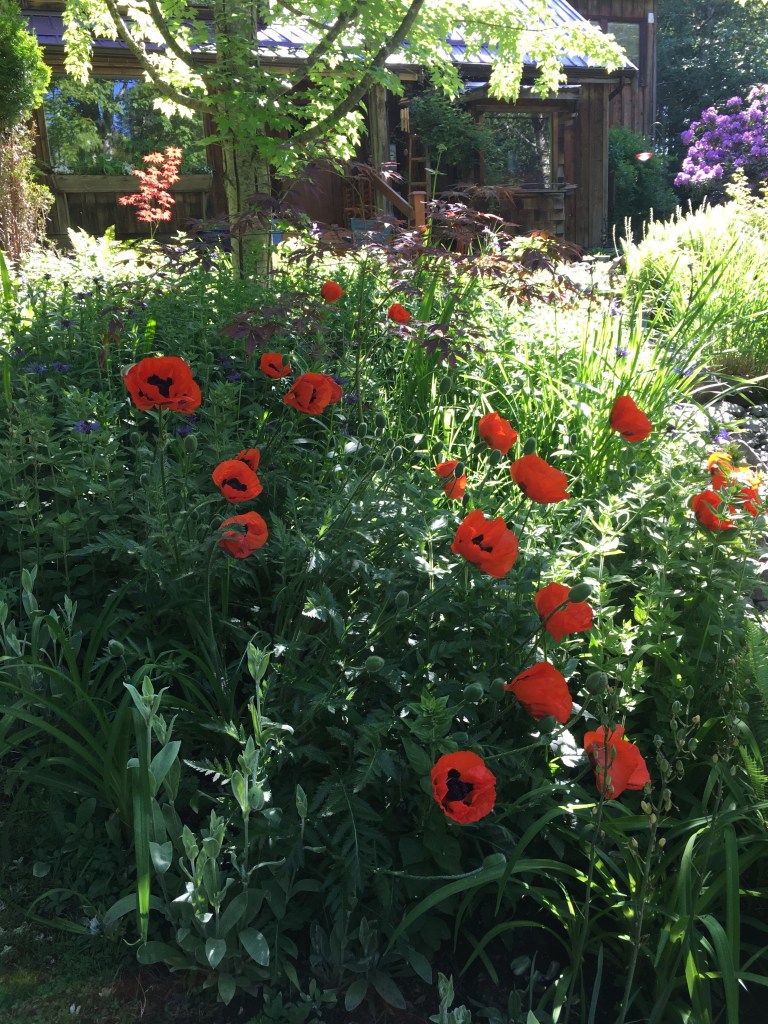
I also just want to revel in the garden. I’m working on a video right now of the gardens, but it’s a bit frustrating because things are growing so fast that I keep being tempted to re-video things that I’ve already recorded to give you a better sense of the beauty of the place, Carolyn’s own fabulous art project. Look at these amazing poppies. A couple of days ago there was only one or two blooms. Now look at them and there’s more to come, lots more! [since I wrote this more have opened!]
Poppies along the driveway.
Have a nice day, all of you! Keep your chin up! Don’t get too pissed off! Enjoy whatever you can (unless its murder or domestic abuse).






 Roger Albert - Always a Sociologist: Now Living With Myeloma