I’ve struggled a lot lately about whether my glass is half full or half empty. I’ve lived seventy-five years. Is that a good thing, a bad thing, or just a thing? 

Whatever. 

Lately, I’ve often mused nostalgically about my past. My present is not what I would have it be, but I’ll write about that below.

For now, I want to write about moments in my past that were particularly instructive for me. You all know that I have cancer. That’s not news. However, some of you may not know that I was diagnosed with kidney cell cancer in 2002. From what I was told, I had what they call a lesion on my left kidney. In this case a ‘lesion’ means a fairly large growth protruding from my kidney. They were loathe to do a biopsy because any puncture of the lesion or any attempt to remove the growth by aspiration was going to spread the cancer far and wide. So, they scheduled me for surgery. I was fortunate to have a very good local urologist perform the surgery with my GP attending (he’s an internist as well as a family physician).

My Nephrectomy

When my time came for my nephrectomy (removal of my kidney) on February 17th, 2002, Carolyn drove me to the hospital early in the morning and left me there to find my way to the surgical unit. I wasn’t there long before they ushered me into the operating room. I was set at ease to see so many people I knew there, including a nurse who was a former student, my GP and the surgeon. I didn’t know the anesthetist although I had met him earlier in the hospital for a pre-surgical interview. 

So, taking my kidney out would be a straightforward affair if you knew what you were doing! Thankfully, the urologist knew what he was doing. In order not to spread the cancer far and wide, he opted to open me up using a 35 centimetre incision between my ribs on underside of my left arm to my midsection but lower on my body. They essentially cut me in half so they could gently lift my kidney out of my body without messing with the surrounding tissue and risking metastasis. I heard later that my GP was humbled by the process of cutting me in half and putting me back together. 

After the kidney was removed and they made sure they hadn’t left anything in there that shouldn’t have been there, they stapled me shut and sent me off to a room upstairs. I was there for a few days. I had a morphine pump to make sure I had no pain but it did have a governor on it so I didn’t overdose. That was kind of them, I think. 

I went home after six or seven days. We had just moved to Cumberland on an acre. There was lots of work to do. I couldn’t do any of it. Thankfully a number of my family members came over. There was lots of help and Carolyn was healthy, as she still is so I watched as my family and some friends helped us move in and get the yard together. 

_____________________________________________________________________

Visit to Cancer Care Centre 

We saw my local GP/oncologist this morning. These meetings are always interesting. I’ve been off chemo for a month and I’ll be off again for another month so that we can more properly assess how I react while not on the chemo meds. I’m also off hydromorphone (opioid), having gone through the nasty process of withdrawal over the past few days. I’ve never taken a very high dose of it, but I have been on it a long time. That makes it a bit of a challenge to stop taking it. I’ve also cut way back on gabapentin, which is a drug initially used for epilepsy, but has been used for all kinds of ailments since (maybe overused). I really have no idea how it’s affecting me because I have had such a mix of medications over the past couple of years that there’s no way I can tell what med is having what effect. It’s supposed to help with my peripheral neuropathy. Maybe it is. Maybe it isn’t. I really don’t know. It’s just a bit confusing and frustrating. 

I was in the Cancer Care Centre at the hospital this morning, as I said, to meet my GP/oncologist, and I saw a few of the usual suspects getting treatment. There was an older woman (probably a bit older than me) getting an infusion in Chair #4. I’ve seen her a number of times before. This time she was with her husband (I presume) who sat in a chair beside her. We nodded to each other. A young woman came by us as we waited to see the doctor. She was in Chair #3 I think. She was dragging her IV pole along beside her as she made her way to the bathroom close by, something I’ve done many times. IV poles, with bags of meds hanging from them with a line entering the arm somewhere, are on casters but they still rattle away as they are dragged along. I thought to myself: “This is my life. I share it with people I don’t know and some I do know, people who share my struggle to one extent or other. What we share is cancer.” But we also share the care and love that the staff gives us. Notwithstanding, every one of us will die. We may survive a year, two, ten, or twenty, but we must die. I’m not complaining about that. It is what it is.

I’ve spent a good part of my life studying life and death. I’m a sociologist, but I’ve not contained myself within that discipline. I’ve struggled to see the big picture of life on this planet and how life cannot exist without death. I know it’s something I’ve brought up before, but it’s always on my mind. 

We’re coming on to spring. My favourite season. Plants spring up everywhere. They count on the decay from previous years to fuel their growth. Life is not a cycle. It’s more like a spiral, with an inevitable end. To think of the seasons as cyclical is a mistake, a comforting mistake, I guess. I’m thinking we have a built-in biological aversion to death. From what I’ve observed, we share that aversion with most other animals. Life is the big draw, death and disease are the ultimate enemy. Our whole culture is built on that false premise. Silly us. 

This spring for me is not like the spring of my tenth year, nor of my fortieth year. I’m hoping this is not my last spring. I’m thinking it won’t be, but the future is promised to no one. 
February 18 Update

[I’ve written about some of the issues I’m having with myeloma before, many times. Because it’s such a presence in my life I can’t help but write about it often. Sometimes, I write about it to provide an update on my treatments and side effects. That’s what this post is about. It’s somewhat technical, but you don’t have to know everything about the drugs involved to understand the thread of my story.]

I sit here in my chair warmed by our new(ish) mini-split HVAC that lives on the wall up to my left with it’s companion outside, visible from the large window just behind me. It’s just after nine in the morning and it’s cold today but clear with the temperature hovering around the zero Celsius mark. We have the wood stove on too because the electric heat just doesn’t cut it when the temperature gets near or below zero. 

Myeloma is always at the forefront of my mind, but now pernicious anemia, and my opioid dependency are butting in and taking up some space of their own in my consciousness. So, in this post I’ll discuss the challenges posed by these issues for me every day. 

I’m so conflicted these days I’m almost completely immobilized. My myeloma saga is putting me in a space where I’m not sure what to think. I’m off my chemo meds for at least one cycle, approximately a month. My local oncology GP as well as my consulting oncologist in Victoria can’t detect much myeloma protein in my blood, if any at all, so it seems logical to give my body a break from the meds. Fair enough. However, for the last 7 cycles the combination of chemo meds (lenalidomide and dexamethasone) along with the monoclonal antibody Daratumumab have effectively erased most, if not all, traces of cancer in my blood. I’ve come to appreciate the protection I get from these meds even though they produce some nasty side effects, peripheral neuropathy** in particular. Still, I know that myeloma will always return. The last time I went off chemo meds was some time ago. I was taking a lenalidomide* based cocktail at 10 mgs per cycle but then I got a severe abdominal rash and had to shut that down. 

After that, I was moved to a drug called bortezomib, along with dexamethasone, and cyclophosphamide. The bortezomib (Velcade is its trade name) had some horrendous side effects for me, threatening to put me in a wheelchair or worse. I quit taking these meds out of desperation, but found that soon my paraproteins were increasing rapidly in my blood. That scared the poop out of me. Time to make another move. 

That’s when I was switched back to lenalidomide (Revlimid is the trade name) but at a minimal dose of 2.5 mgs along with 12 mgs of dexamethasone and an infusion of some 500 mls of Daratumumab per cycle.  That’s the cocktail I just stopped taking. Next month I see my local oncology GP for another assessment. It will be interesting to see what my bloodwork reveals. I’d be lying if I said I wasn’t worried about it. 

To complicate matters, I’m trying to wean myself off hydromorphone (an opioid) and gabapentin , both are widely prescribed pain relievers. Opioid dependency is no picnic. I was first prescribed hydromorphone when I was diagnosed with myeloma in the fall of 2019. Since then the goal has been to fine tune my doses to get the maximum effect while leaving me more or less sentient. It’s been difficult. For some time now I’ve been taking two types of hydromorphone, a slow-release 3 mg capsule and a 2 mg ‘breakthrough’ dose. I’ve taken one 3mg capsule in the morning and two in the evening. Now, as I try to get off this medication, I’m restricting myself to one 3mg in the evenings and none during the day. Last night I thought I’d be tough and not take any meds at bedtime. Well, I soon got schooled by hydromorphone for trying to back off too quickly. By 11 PM I was downstairs into the medicine shelf getting a 3mg capsule to take. The thing is I was not prepared yet for a full withdrawal. My body let me know very quickly. The pain in my back returned with a vengeance, and I couldn’t stand to have anything against my skin. I was completely distracted by itchiness all over my body. Thoroughly unpleasant. I expect that as I restrict my intake of hydromorphone more and more, that I will have fewer pain issues. Ironically, opioids can contribute to pain, especially during withdrawal. 

The reason I’m trying to get off hydromorphone is because of the success we’ve had in dealing with myeloma. I’m thinking that with my myeloma symptoms under control, I may not need as much pain relief as when it was in full bloom. 

As far as the pernicious anemia is concerned, I should have my B12 up to acceptable levels. I’ve injected B12 (cyanocobalamin) eleven times now in the last six weeks. That should do it. However, it will take up to six months before I experience any kind of improvement to my health. It would be nice if I only had one issue to deal with but I think I have things more or less under control for the time being. 

_____________________________________________________________________

•For a list of common side effects of lenalidomide check out this website: https://www.drugs.com/sfx/revlimid-side-effects.html

**I am a member of a myeloma support group. We had a Zoom meeting last Thursday. We are all at different levels of treatment and on various medications but we pretty much all have one thing in common: peripheral neuropathy. The neuropathy in my left hand is now starting to interfere with my ability to type. Given that I write a fair bit, that’s not at all welcome.

75 UP

So, this post is about what’s up with me now. I’ve reconciled myself with the fact of my frailty, which I share with all living things. It stands to reason that my body is not as it was twenty or even ten years ago. All individuals of all species, plant and animal have a life course. We’re all born. Even trees, but some of those individuals die young (like the trees that are being cut in the hills above Cumberland), some trees live out what must be considered the outer limit of life’s potential, in the Carmanah Valley, for instance, no thanks to BC’s forest industry. Some of us humans die young. Some die hacked to death in a stupid race war in Rwanda in 1994. Others die horrible deaths in the ovens of Auschwitz. Still others, of all species, die of inborn problems, with their DNA or or whatever. In the end we are all frail, even the biggest and toughest among us, and vulnerable. For most plants and animals eventually, the soft, squishy material that we’re made of becomes increasingly brittle and inelastic as we age and approach our inevitable ends. My squishy material is definitely becoming worn out. It still has some bounciness in it, but nothing like it had years ago, and there’s no turning back. But on with the story.

Being one who kind of likes living (even given what I write above) I dutifully injected B12 into my legs (alternating left and right) once a day for a week mid-January and since then I’ve injected once a week.*That should replenish my B12 levels and keep me going. It may take some time for increased amounts of B12 in my blood to make a difference to my energy levels, but I can be patient as I know that results will come. Of course, I’m fighting a losing battle. We all are. Death will catch up with me regardless of how much B12 I inject or how many chemo drugs I take. I find it almost funny that we talk about medicine, police, firefighters, paramedics, etcetera as saving lives. The best they can do, in reality, is allow life to go on a bit longer, to postpone death. In any case, I have my B12 situation under control.

In terms of myeloma, I’m off chemo drugs for at least a month. Myeloma protein is barely detectable in my blood so this is a good time to lay off for a while and see how things go. It would be grand to get some relief from side effects for a time. Next month sometime they’ll check my blood again to see what the status of my paraproteins(myeloma proteins) are. I can easily go back on chemo if the bloodwork shows a rise in paraproteins. During our last phone call my local GP/oncologist uttered the word remission. I hope he’s right but only time will tell.

Another thing has come to plague me. It looks like it’s true that nastiness comes in threes. I’m getting a CT scan on Monday of my left jaw. I saw an endodontist a while ago because of excruciating pain in one of my left upper molars. He figures I need a root canal. Well, that’s probably true, but because I had a lesion in my left lower jaw that required radiation treatment earlier this year, I wanted some assurance that this issue with my upper jaw wasn’t also due to myeloma. It may be that I should be more trusting, but the symptoms caused by a myeloma lesion and a rotten tooth are similar so I just wanted a little reassurance. I got that when I spoke with an oncologist at the BC Cancer Agency in Victoria last month. She ordered the CT scan the results of which will determine whether I get a root canal or more radiation. My, my. Life can be complicated.

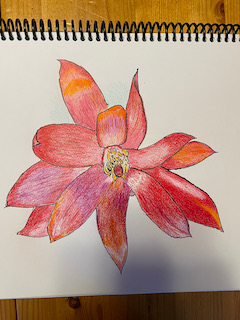
In the meantime, I’m back to doing some drawing. I got a very cheap but good set of coloured pencils for my birthday last month, so I did a couple of drawings. Here they are:

Christmas cactus head on view.
Christmas cactus side view.

I have one more I want to do with the coloured pencils using a different profile. Then I want to do a couple more in watercolour on proper paper, and maybe in acrylic on a large canvas. I’ll have to assess my level of energy before I undertake a large(ish) canvas, but I seem to be getting stronger every day now.

___________________________________________________________________

*If you haven’t read my post from January 13, 2022, you might want to do so now. It outlines my experience with B12 deficiency and pernicious anemia.

Pernicious Anemia and Multiple Myeloma: A link?

Well, well. I should have known. Sometime before I was diagnosed with multiple myeloma in October of 2019, I was diagnosed with pernicious anemia. That’s a vitamin B12 deficiency that cannot be corrected by just taking a supplement. With a B12 deficiency, a dietary supplement can fix the problem, but pernicious anemia is a situation where B12 cannot be absorbed into the blood by ordinary means because of a missing intrinsic factor, a protein which is produced in the gut by gastric parietal cells. For me to get vitamin B12 into my bloodstream I need to inject it intramuscularly. I do it myself because I can’t be bothered to go to the Nursing Centre or somewhere where someone can do it for me. It’s a simple jab in the leg. No big deal, but for me it’s a life saver. As Martyn Hooper, the Founder and President of the Pernicious Anemia Society (PAS) in Britain, says it regarding his own experience: “Consequently, should I stop receiving injections then I would once again be unable to make healthy red blood cells and would gradually become anaemic and eventually die”*. Hooper was undiagnosed for years and has suffered permanent neural damage because of the delayed treatment. It’s a question of life or death. Pernicious anemia is called pernicious because it’s deadly. Just to add a bit of fun to it, it’s also incurable, just like myeloma. Towards the end of this post I specifically address the link between pernicious anemia and myeloma, but for now I need to deal with pernicious anemia.

As it turns out, I had been on monthly injections of B12 for years before about six months ago I let it slide. I ran out of B12 and just didn’t bother asking my GP for another prescription. Truth be told, I didn’t really feel as though the monthly injections were doing any good. Of course, my whole body was thrown into chaos by myeloma making it very difficult to pinpoint the source of any given issue I may be having, and there were lots of those. Frankly, I should never have stopped injecting B12, but it’s not going to do me much good to beat myself up about it. I’ve already spent enough time doing that.

About three weeks ago, after feeling like I’d been going downhill for some time, I called my GP’s office and requested a B12 blood test and a prescription for a new supply of it. This past Monday I went to the lab for my regular monthly blood workup in preparation for my chemo appointment today, but this time B12 was added to the assay. On Tuesday I got the results. No wonder I haven’t been feeling well, the level of B12 in my blood was way below the recommended amount. I came in at 84 pmol/L when the reference range is between 150 and 600. The literature I’ve scoured is inconclusive, but it seems that 150 is way too low for most people and 1000 is recommended by some sources for seniors to maintain good cognitive and neural health. In any case, my GP’s office contacted me this morning and told me that for the coming week I should inject B12 daily, for the following month, every week, and thereafter once a month. I’ll have to make sure the docs add B12 to my monthly blood assay so that I can ensure that I have the requisite amount in my blood. I think I’ll aim for 1000 pmol/L. If I can’t maintain that with a monthly injection, I’ll increase it to bi-monthly, etcetera. 

I haven’t conducted a scientific poll, but I doubt that most people know about how important vitamin B12 is for good health. B12 is crucial for the production of red blood cells. B9 (folate) is also important as is D3 but these can be easily supplemented. It’s worth doing an internet surf to find out more about B12 especially if you’re feeling chronically tired for no reason. I think the PAS is a great source but there are others, lots of them. The challenge is to recognize the stupid sites and not use any of their stupid suggestions or offers of stupid products. Make sure that if a site makes specific claims like methylcobalamin is better than cyanocobalamin get a second opinion. Martyn Hooper injects methylcobalamin twice a week (5mg/ml). It’s available online but it’s not cheap. He offers only one source for his assertion that methylcobalamin reduces peripheral neuropathy whereas cyanocobalamin doesn’t, and that paperis about ALS and methylcobalamin in megadoses. I generally trust Hooper, but we all make mistakes and sometimes we get headstrong about our own health and how to manage it. Hooper has good reason to be pissed at the medical profession, and the medical establishment in Britain and if you read his very accessible books you’ll know why.

Now we get to the fun part…the one with no conclusive argument: the relationship of pernicious anemia with multiple myeloma. So far, very little research has been conducted on the links between pernicious anemia and myeloma. This article does address the issue but is ambivalent in its findings as you can ascertain from this quote:

For multiple myeloma, increased risk was seen only with pernicious anemia, an inflammatory condition in the stomach leading to vitamin B12 deficiency. This association was also demonstrated in two other large studies, which found few other autoimmune conditions associated with multiple myeloma.1617 Because of the lack of association with other autoimmune conditions, our finding may point towards the involvement of vitamin B12 deficiency. Indeed, vitamin B12 deficiency has been reported in patients with multiple myeloma and in patients with the precursor condition, monoclonal gammopathy of undetermined significance.161946 Although multiple myeloma may cause vitamin B12 deficiency by consuming stored vitamin B12,47 we speculate that vitamin B12 deficiency could promote the development of multiple myeloma by causing derangement of one-carbon metabolism, as proposed in other cancers.48 2

See citation below.

This study3 shows a more significant association between myeloma and pernicious anemia: “Using a large population-based dataset, we observed a 3-fold significantly increased risk of MM among subjects with a personal history of pernicious anemia, which has been found in previous studies.” Now, that got my attention. It’s clear that I had pernicious anemia before I had myeloma – at least that’s what I think. However, because I wasn’t diagnosed with myeloma for a long time before I contracted the disease it may be that I had both pernicious anemia and myeloma at the same time. 

All I know is that pernicious anemia and multiple myeloma share a whole load of effects and they are both incurable and fatal if not treated. I’ll let you know how my current B12 therapy goes. Right now it’s being affected by today’s injection of Daratumumab. Oh well. I always liked a puzzle.

_____________________________________________________________________________________

* from: What You Need to Know About Pernicious Anaemia and Vitamin B12 Deficiency by Martyn Hooper, Chris Steele)

1Izumi Y, Kaji R. Clinical trials of ultra-high-dose methylcobalamin in ALSBrain Nerve 2007:59 (10): 1141-1147.

2  Lesley A. AndersonShahinaz GadallaLindsay M. MortonOla LandgrenRuth PfeifferJoan L. WarrenSonja I. BerndtWinnie RickerRuth ParsonsEric A. Engels. Population-based study of autoimmune conditions and the risk of specific lymphoid malignancies. International Journal of CancerVolume 125, Issue2, 15 July 2009, Pages 398-405

3Ola LandgrenMartha S. LinetMary L. McMasterGloria GridleyKari HemminkiLynn R. GoldinFamilialcharacteristics of autoimmune and hematologic disorders in 8,406 multiple myeloma patients: A population-based case-control studyInt J Cancer 2006 Jun 15;118(12):3095-8.

Happy New Year (sort of)!

The conventional thing to do at this time of year is to reminisce about events of the past year and pick out highlights and possibly low lights, in this case, of 2021. Well, I would do that except that my brain is quite mushy right now. I’m not sure why. It may be the chemo meds. They have a variety of side effects that vary from week to week. This week my meds may have decided to afflict me with a sludgy brain to go along with my barely functioning legs. 

Then there’s the fact that 2021 was, to be charitable, less than a stellar year. Chemotherapy and monoclonal antibody infusions every four weeks for a morning at the hospital can put a damper on life. Part of the problem with the chemotherapy pills I take every day is that I experience a surprising range of side effects. While all this goes on, I have a lot of difficulty writing. I can’t seem to hold onto an idea or a train of thought for any length of time. I’ve tried to put together a couple of blog posts over the past three weeks, but they’ve turned out resembling alphabet soup rather than carefully crafted narratives. Right now, I seem to be experiencing a slight window of lucidity, but that may just be self-delusion on my part. I have no idea how long this window will be open. You be the judge. 

Today is January 1st, 2022. The first day of the year is supposed to be infused with positive thoughts, merriment, and optimism. I guess saying that 2022 will not be the year that I die qualifies as optimism, or maybe reckless self-delusion. I turn 75 years old in a few days. I know I’ve written it before on this blog, but I say it again: How in the hell did that happen? It seems to me that I was forty years old yesterday. Now seventy-five? WTF. Following Barbara Ehrenreich (who is my age) I have noted in the past that I’m old enough to die. That’s true, but still, I have confidence that people will not have to publish an obituary about me in 2022. 

My memory has gone for a crap. I don’t have dementia, that’s for sure. But still, I guess that’s to be expected of a person my age. I retired from twenty-nine years of teaching at North Island College in 2012, but I had been teaching in the Lower Mainland since 1976. Since my retirement, I have somehow mislaid recollection of so many things. I do have this blog to jog my memory. I started it in late 2012 and have produced over 300 posts since then. That’s a lot of bits and bytes engraved somewhere in a computer hard drive or on the cloud, whatever and wherever that is. I think that the number of words I’ve clicked out probably amounts to at least a five-hundred-page book. I know that since my cancer diagnosis in the fall of 2019 I’ve put together the equivalent of a three-hundred-page book chronicling my experience with myeloma, its side effects, and chemotherapy with its side effects. Now, I’m not sure what I’ll do with this blog. Unfortunately, I have very little energy to do much of anything physical. The oncologists in my life are very reluctant to tell patients what to expect of a life with cancer, especially one like myeloma. Gawande is clear on that:

“Studies find that although doctors usually tell patients when a cancer is not curable, most are reluctant to give a specific prognosis, even when pressed. More than 40 percent of oncologists admit to offering treatments that they believe are unlikely to work. In an era in which the relationship between patient and doctor is increasingly miscast in retail terms — “the customer is always right”—doctors are especially hesitant to trample on a patient’s expectations. You worry far more about being overly pessimistic than you do about being overly optimistic. And talking about dying is enormously fraught.” (from “Being Mortal” by Atul Gawande)

I have found that with old age and a crumbling infrastructure, and as I note above, a lot of physical activity is out of the question. Coming to terms with that reality is very difficult, I can tell you.  Carolyn and I have done some camping over the years since our retirement. Sometimes we were accompanied by family. Most often we were out there by ourselves. We spent most of our time camping in Strathcona Park. I hope to be able to go camping again, but I don’t have a lot of strength and energy. That’s something I have to work on so that I can DO STUFF this coming spring and summer. 

Now, I don’t have to think about physical activity. We have a blizzard outside and snow 50 centimeters thick. So, I read. I have five books on the go right now. I’ll discuss them soon in a post!

Time For Celebration

[I wrote this (slightly edited) post in 2017, a couple of years before I was diagnosed with myeloma. Time is a subject that has been on my mind for a very long time. I wrote my dissertation about the work of Harold Adams Innis (1894-1952). He was very much preoccupied with time and wrote extensively about it late in his career (and life it turns out). So have been hundreds of other philosophers, social theorists, physicists, biologists, etcetera. We think about time on many levels of analysis, from cosmic time to microseconds in productive processes. We think about it in social as well as personal terms. We are especially concerned with it when it begins to run out. Read on]

How do you experience the passage of time?

Time is a big subject and has been the focus of many philosophical and scientific ponderings and is, of course, a major preoccupation of the world’s religions and cultures. There is also the individual, institutional and cultural projects around time and its importance to our lives. We mark (as distinguished from experience) time in many ways. We use clocks and calendars. (The Maya had two calendars, that’s how important time was to them.) We carefully note the passage of the seasons with special celebrations, and we celebrate our birth days every year. We don’t celebrate the day we die, of course, we let others do that in the form of wakes, funerals, and these days, celebrations of life because we are no longer in any shape to celebrate anything ourselves.  We ask: “What time is it?” and we expect to get an answer: “Why, it’s two thirty in the afternoon.” We don’t expect “the anthropocene” as an answer although it would be technically correct.

But this blog post is not about any of this. It’s about how we experience time. In many ways, time and life are synonymous. As individuals we need to be conscious to experience time. In our dreams time is irrelevant or, at least, it can take on bizarre aspects, but we aren’t aware of that until we wake up and can reflect on our dream and its bizarre depiction of time. Writers, novelists in particular, distort time as a regular practice.

We experience time as past, present, and future although we live only in the present. The past and future are cultural constructs that have only the reality we give them. Our memories and our recollections of events are highly selective. There is no such thing as an objective past. We select events, actions, people, names, places, etc. and construct a cognitive map of them into a coherent picture, a picture that is congruent with our life as we experience it and build a store of impressions by which we then judge our actions and those of others. Recall is impressionistic, not realistic. It deceives us all the time as we ‘fit’ the past into our current views of things. 

We are most often not even aware that that’s what we’re doing. We drive, we brush our teeth, we pay taxes, we get on airplanes, we go to libraries, we bank, we vote and most often we don’t question these actions or even consider them a part of a consistent set of habits of life and thought that we learn from others as we live out our lives in networks of interdependencies. As Norbert Elias argues we are less individuals than interdependencies and interweavings. Our daily thoughts and desires, as they join collectively to express themselves as consciousness, make us more Borg than anything. Magically, however, we learn to believe that we control all aspects of our lives as individuals and sadly, people who have shitty lives can only blame themselves for that. That’s the classical economic view of things. Classical economics, according to Thorstein Veblen, uses what he calls the hedonistic calculus to describe how we make decisions in our lives. For him, classical economists (and I would add more contemporary trickle-down ones like Milton Friedman) think of us as ‘globules of desire’ who everywhere seek to maximize pleasure and avoid pain. Of course, life just doesn’t work that way. We do not judge every situation or opportunity we encounter in life as a calculation of pleasure or pain. There are numerous capacities and propensities we bring to our daily lives that have everything to do with the need to delay pleasure, accept pain or make decisions clearly not in our own interests. 

We interpret the past, the present and the future based on our ideologically constructed maps of how the world works. And, boy, do we love our maps. We hang on to them for dear life. Those ideas we cherish, those beliefs we idealize are created in a cauldron of the past, a past we had no hand in making and that starts presenting itself to us the moment we drop out of the womb. Of course, the ideas we pick up early in life we often reject later as we join more and more interdependencies and interweavings, some of which will have more appeal and relevance as the world changes around and in us. 

Christians and adherents to many other religions accept time as a concept, but deny its existence after death when, for them, eternal life kicks in. How could we experience time in a state of eternity? Time is change. What would happen in a place of eternity? I’m no theologian, but I’d be curious as to how a theologian would deal with the question of time in eternity.

Merry Christmas, all, and Happy New Year. 

Such a Mess.

I must admit that I’m a bit depressed these days. A substantial contribution to my depression is the amount of caution I need to exercise every day in the face of the coronavirus COV-2 and the cancer that I still harbour in my bones. Even though I’m triple vaccinated, I still need to be very cautious lest I contract the virus in my compromised state. Picking up an infection, any kind of infection could be deadly for me. Carolyn is also immunocompromised because of arthritis meds she is on, so we are somewhat reclusive these days. Carolyn still does virtually all the shopping, but I do get out with her now and again. In my younger days, I was a moderately social guy. Not anymore. Among many other things, I miss having a beer at the CBC with friends. 

As far as myeloma is concerned, there seems to be just minute traces of it in my blood. Of course, I’m still on chemotherapy. Who knows what would happen if I suddenly went off chemo. I may need some dental work requiring an antibiotic. My local GP/Oncologist figures that I shouldn’t be on chemo and an antibiotic at the same time. He suggested that I think about going off chemo for a while, at least during the time I need for the dental work. He also suggested I talk to ‘my’ oncologist in Victoria about it. I had an appointment with an oncologist in Victoria this coming Monday, but he cancelled, according to his assistant, because he was called away unexpectedly. Great. I haven’t had a meeting with an oncologist in Victoria for months, and now who knows for how much longer. I haven’t had an appointment with the same oncologist in Victoria twice in a row. They are specialists, of course, so I don’t expect to have the same kind of relationship with them as with my GP, but still, I don’t know how continuity of care happens in this situation. I feel a little abandoned. 

What I find as distressing as anything as a person with cancer is the absence of predictability. Well, I guess I can always predict that I won’t be able to predict how things will go. I can usually predict that I’ll be going to the hospital every fourth Thursday of the month for an infusion of Daratumumab, but even that is a toss-up. It all depends on my bloodwork. If it’s good, then I go. If not, then I don’t go, and things change quickly. What I mean by the absence of predictability is more the idea that when I get up in the morning, I have no idea whether I’ll have any energy, will be lucid, or how much pain I’ll be in, and in which part of my body. Right now, the peripheral neuropathy in my left hand is bad, especially if I sleep on it in a particular way. As I write this, I’m feeling very tired and ‘dizzy’, even disoriented. I feel like I have a hangover. I don’t like it. I’ll go down for a nap soon. I’ll see if that helps. There’s no predicting. 

______________________________________________________________________________________________________

Slip slidin’ away.

I know three people who have chosen MAID (Medical Assistance in Death). The reports from relatives (or from themselves) suggest that they went gently into the night under conditions of their own making. I know others who have either not had the time to set up MAID, or who, for whatever reason, chose to let things run their course and for whom the pain of dying was muted with the help of morphine or other pain killer.  After reading Barbara Ehrenreich, Brian Greene, Siddhartha Mukherjee, Atul Gawande, and Jason Fung, all authors I’ve discussed in this blog at times, it strikes me that slipping gracefully into death is not a fate most of us will share. I don’t know what the billions of people in the poorer parts of the world suffer as they approach death. I know that in some places where wars are still all too common, death by a bullet or a machete are a fate that await many people. Death by poverty is all too common. It’s true that death awaits us all, but the conditions of dying are not democratic. Considering all living things on this planet, dying is generally shunned. Yesterday, while shaving, I inadvertently disturbed a spider who was minding its own business in and around the vanity lights. It took off, scurrying like mad, wanting to live another day, I surmised. It did not want to die. 

As biological organisms we tend to cling to life for all it’s worth. Obviously, there are exceptions to this rule. Even for people who commit suicide, I suspect (with no hard evidence whatsoever) that it’s not life they are escaping, but unrelenting pain, physical and/or mental. I’m sure that they would gladly continue living if the pain would only go away. I think that’s true of people who choose MAID as well as those who commit suicide in any number of non-sanctioned ways. Of course, the people who I know chose MAID were older. As Barbara Ehrenreich wrote (somewhere, probably in Natural Causes) when she got to be seventy-five years old: “I’m old enough to die now.” I’ll be seventy-five next year, and I guess I’m old enough to die too, but I think I’ll endeavour to stay alive in 2022. 

18 Looking in the Mirror.

[This is a reprint of a post I wrote in January of 2020. I reproduce it here in honour of Elizabeth (Bunny) Shannon who was especially drawn to it. Bunny died of cancer last month. She was a friend and an extraordinary person. I am privileged to have known her]

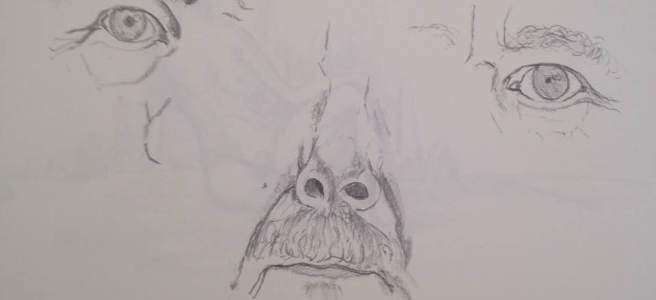
When I look in the mirror I see an old man. I don’t see an old man with cancer. I just see an old man with a white beard, not much hair, and wrinkly skin. Melanoma (skin cancer) often leaves visible, sometimes unsightly and disfiguring lesions. I don’t have melanoma, although my father did. No, I have myeloma (bone marrow cancer) and its damage is all done on the inside, invisibly. So, I guess I can keep expecting people who see me say: “Wow, you’re looking good!” I guess I DO look good! Now, the last thing I want is to discourage people from telling me how good I look, so keep it up! However, the invisibility of my condition is deceiving. I remember when I was a kid my friends and I used to work on our cars. That was still possible when I was a kid. Often we’d stand around looking into the engine compartment (often of my 1956 Pontiac four-door hardtop) wondering what could possibly be wrong as if just staring at the engine would give us some kind of clue. The engine was always sparkly clean and there was nothing obviously gone awry. If I had money by some quirk of circumstance I might take the car to a mechanic. If not, we might borrow my dad’s tools and start taking things apart. That usually ended up badly. Yes, the most undesirable conditions in life are often on the inside, impossible to see or diagnose by just looking at the person or car in question. I find it best to consult mechanics when our car shows signs of disfunction. I find it best to consult medical specialists for treatment related to my body. I guess I could try to treat myself using any number of the ‘cures’ available on Dr. Google, but I would like to live a while longer, thanks. Besides, I’m not that desperate.

Speaking of medical specialists, we saw my local oncologist today. I see him every five weeks. The result of our visit is that I will carry on with a second course of chemotherapy. We’ll evaluate how well it went in five weeks. My first course of treatment seems to have gone as well as could be expected. The little excavator in my bone marrow is slowly running out of gas and my red blood cell garden is growing again. I’m still exhausted and that won’t change for some time yet, but things are certainly going in the right direction for now. I think I just might be a model patient. So, where does this all leave me?

Well, I may be on my way towards remission. If and when I do go into remission, and that’s by no means guaranteed at this point, that would buy me some time. By that I mean that I may have a few years more to live, though inevitably, either the myeloma will kill me or some other condition will. I won’t be walking away from this situation, brush the dust from my sleeves and carry on. No, I’m on a one way street. So are you, of course, but I can see that damned barrier at the end of the street. I’m hoping that you’re still far enough away from it that you can live in blissful denial for a while longer. I don’t have that luxury. So now what do I do with my life?

That question came up in a recent Facebook thread, albeit expressed in a different way, but with the same effect, I believe. The question comes down to this: If you knew that you had a given amount of time left to live (six months, two years, whatever), what would you do with your time? Would you to be seized by an overwhelming sense of urgency? Would you be determined to cram as much activity and experience into your remaining time as possible? Or would you curl up in a fetal position in a corner of your bedroom quivering and whimpering while you await your inevitable demise? If you have the money and the energy you might want to get out there and travel the world. If you have a spouse, that might complicate things more or less because they may not want the same things you do and may not want to get caught up in your sense of urgency. The last thing you need when facing terminal cancer is marital discord. I think there’s a lot to be said for just carrying on with life as before.

If you have the energy and the money then good on ya. If you travelled a lot before your diagnosis then travel after. Your eventual energy deficits will tell you when to stop. If you were fairly sedentary, more into being at home and puttering around the yard, then that would be something you might want to continue doing. The stress of travel may not be that good for you. Looking around the Cancer Centre at the North Island Hospital this morning I didn’t see a lot of people with obvious enough vigour to engage in a lot of physical activity. In any case, back to my situation.

My exhaustion prevents me from doing much in the way of physical activity. If I do go for a walk I pay for it later. Travelling is impossible. At one point I thought it might be possible, say, to take a direct flight to Puerto Vallarta back and forth from Comox, but there are a number of contingencies that make that next to impossible that have more to do with arthritis and disk degeneration than cancer. Besides, I take chemo drugs once a week orally but also by injection at the hospital. For three or four days after I take my meds I feel crappy, really crappy so the chances of enjoying myself on a beach somewhere are slim to none.

So what do I want to do, and what do I actually do? Well, I want to work on our canoe, finish some paintings, do odd jobs around the property and visit family and friends in Vancouver and further afield. What I actually do is sit and lie down a lot. As I sit and lie down, I read, and sometimes I even write. At the moment I’m reading social history around the Middle Ages and doing a bit of research on my family roots in Normandy. That’s something I would have done anyway, but I do miss working in my shop and studio and going for long walks with Carolyn and our imaginary dog. My oncologist thinks I will regain my energy, at least as much as an old man can expect. If so, that would be great. I’d love to get back to canoeing, camping and puttering.

When I get closer to dying I will know it, and I expect I will have time to think about it, but there really isn’t much thinking that is productive about dying, at least not for me. I’ll know when it’s time for palliative care. I don’t want to live as long as the oncologists might want to keep me alive. I’ll make the decision when the time comes. I don’t think it will be a really hard decision. I know that beginnings are impossible without endings. My ending is a lot closer now than my beginning! That’s fine. Frankly, I’m much more concerned with my family than I am with myself. They are the ones left behind to mourn. But both of my parents are dead and we got on with life after their deaths. My family will do the same when I’m gone. That’s what we do as humans. Like it or not, accept it or not, rage against it or cower in a dark corner, the end result is the same. Don’t sweat it.

Trials and Tribulations

[Feeling a little disjointed today…]

If you’ve been reading this blog for any length of time, you’ll know that it’s all about me and my trials and tribulations around my experience with myeloma, old age, medicine, chemotherapy, and its side effects. Of course, I’m not completely self-absorbed, just mostly so. To be honest, it’s been a bit difficult to focus on anything else. Myeloma and its effects have taken over my (and my family’s) life. The pandemic hasn’t helped either. Both myeloma and the pandemic have severely restricted any social activity in which I used to take great pleasure. Driving is a challenge but not impossible. My neck seems to be getting somewhat better after the dexamethasone injection in my neck about six weeks ago. Now I fear that my time with Daratumumab may be coming to an end. I don’t know that for sure, but the neuropathy in my left hand is getting quite bad. Increased peripheral neuropathy is a side effect of Daratumumab and may be a signal that my body is rejecting the Dara. I talk to an oncologist in Victoria next month and we’ll certainly talk about my chemo treatments. On top of that I have a tooth that is dying if not completely dead. The endodontist I saw about that says I need a root canal and I should be on antibiotics for a bacterial infection just below that tooth. To be on antibiotics I probably need to cease chemotherapy treatments for a time. That’s another thing I need to talk to the oncologist about. So it goes. 

By the way, I’ve just finished reading The Cancer Code (2020) by Dr. Jason Fung. Aside from being a practicing nephrologist in Toronto, Fung is a prolific writer. This book on cancer is fine although Fung focusses on tumor-based cancers and mentions myeloma only in passing. I quite like his analysis and where he ends up suggesting that cancer is subject to evolution and natural selection like any organism. He argues that in the past cancer was seen as a mistake, then as a somatic mutation, but he writes: 

“Cancer had always been considered a single genetic clone, so evolutionary processes were considered irrelevant. But the realization that cancers evolve was electrifying. For the first time in decades, we had a new understanding of how cancer develops. The entire field of science known as evolutionary biology could now be applied to understand and explain why cancer develops mutations.” (from “The Cancer Code: A Revolutionary New Understanding of a Medical Mystery (The Wellness Code Book 3)” by Dr. Jason Fung)

Daratumumab is a monoclonal antibody. It worked well for a time. I hope it works for a while longer, but it is destined to fail when it no longer responds to myeloma’s mutations. He notes that cancer cells act like prokaryotes or single-celled organisms and not like eukaryotes or multi-celled organisms. According to Fung, we are on the cusp of a major paradigm shift in cancer treatment, but it will be expensive. What do we do about that? 

______________________________________________________________________

Just to remind myself that I’m still a sociologist, I’ve spent quite a bit of time lately reading and watching MSNBC, CNN, The Guardian, NPR, BBC, Al Jazeera, Ring of Fire, Beau of the Fifth Column, and other newsy YouTube videos. I check out some Canadian content, but the elephant next door is far more compelling than Trudeau’s antics or O’Toole’s foibles. I’ll come back to the US below, but before I go there, I just want to say that I’m reading a book by David Graeber and David Wengren published just last year called The Dawn of Everything. The book challenges everything we know about the “Western” version of history and is a refreshing read. For one thing it sheds value on indigenous ideas and ways of seeing as providing the real challenges to the philosophers (Locke, Hume, Hobbes, etc.) of the Enlightenment, Rousseau, and other incipient lefties. The authors reject the idea that indigenous peoples were the child-like innocents they are often portrayed as by European travellers and colonizers. They also challenge the idea that things can’t change, that we’re stuck with large scale, ridiculous, bloated states. Unfortunately, Graeber died on September 2nd, 2020, three weeks after this book was released. He was fifty-nine years old. That hardly seems fair.

I don’t know how many of you are interested in American politics. It can be a nasty, grubby place at times and unless you are steeled against media biases and distortions of reality, you might be left with all kinds of strange ideas about what’s really going on to the south of us. One thing is for certain, I’m getting just a little perturbed at the ignorance and stupidity of some American politicians in Congress who shout “socialism” every time Biden and the Democrats dare spend a dime on regular, run-of-the-mill citizens or on infrastructure. They want all the cash to go to the 1%. I’m still not sure how that benefits them personally unless they believe Milton Friedman’s ridiculous trickle-down theory by which if regular people as taxpayers give billionaires all the money that some of it will trickle down to them. That is such a bullshit theory. The proof of that is that it’s never worked and the concentration of wealth in the über-wealthy is clear evidence of that. 

Ted Cruz, Rand Paul, Josh Hawley, Marjorie Taylor Greene, Lauren Boebert, Jim Jordan, and their ilk in the Republican Party and sitting members of Congress obviously haven’t a clue what socialism is, or, if they do, they are being disingenuous about it. The truth is that it may be some of both. For these clowns, any money spent on bridges, highways, city roads, the electrical grid, wastewater systems, potable water, etcetera, is evidence of socialism. So stupid. They take the notion of individual initiative and investment to the extreme. But, of course, they just want to get re-elected and making outrageously false statements is the name of the game. They can always be retracted later when nobody is paying attention.  

I’d say that I follow American Congressional politics as entertainment, but it’s not funny. There is a fairly serious challenge to the status quo there from a far-right racist Republican cabal and some people seem to want to continue the Civil War of the early 1860s. I do take some comfort in the fact that there are over 300,000,000 people in the United States and that would be a hard ship to turn around. I have a lot more to say about the US, supply chains, the wane of capitalism, the rise of oligarchy (which is already close to the surface), and history. Stay tuned. 

I strongly recommend reading Heather Cox Richardson on Facebook. You’ll get a well-researched commentary on American politics from a classy historian. Check her out.

Sleepless in Cumberland

Yesterday was my day at the hospital for my monthly infusion of Daratumumab, the monoclonal antibody. It along with other flavours of monoclonal antibodies have changed a lot about how medicine thinks about and treats cancer, arthritis, and other nasty ailments of us fragile mortals. Along with my Dara, I also take some dexamethasone, only 12 mgs for the month, and a few other meds designed to protect me from viral infection. It’s the dex that keeps me awake as I’ve noted many times on this blog. 

So, instead of lying awake, allowing whatever thoughts I had rattle around in my brain causing no end of silly talk, I decided to read instead. Reading is a good way of filling in the night hours in what some people would call a ‘progressive’ way. However, I may need to revise the material that I choose to read at night. I haven’t read a lot of fiction in my life, focussing my reading time on sociology, anthropology, philosophy, and other sundry disciplines. I have read most of Kurt Vonnegut’s work, all of Emily St. John Mandel’s books and I did recently read several books by Kim Stanley Robinson, fictional accounts of the human colonization of Mars, New York under flood, and other similar topics. In his Mars trilogy one interesting commentary was on longevity. If people accepted a certain treatment, they could live hundreds of years instead of the paltry number of years generally allotted to our species. That fact, however, did not seem to mitigate the angst they felt about death and dying. In a book called Aurora, Robinson is at his most pessimistic about human excursions to other planets and their satellites in our solar system. His conclusions about the time it takes to travel from Earth to other planets are telling. Travelling to and back from a satellite of Venus, for example may take a hundred and seventy years or more with the need for cryogenic sleep. So, if you were one of the ‘lucky’ ones who won the lottery for space travel you would return to Earth after several decades of travel at a time when no one would know you, you would have no recognizable family and you would be relegated to the margins of society. I read Robinson at night. It was a bit hard to get to sleep after reading some of his stuff, but not impossible. Reading Barbara Ehrenreich and other non-fiction writers of her ilk is an entirely different story (no pun intended). Last night I finished reading her book Natural Causes: Life, Death, and the Illusion of Control. This book is firmly planted in reality. Problem is reality sucks sometimes. Ehrenreich is especially blunt when she writes about aging. Getting old is no cake walk. It’s not for the faint of heart although in our culture it’s not cool to ‘give in’ to the infirmities of age. Ehrenreich writes:

“But as even the most ebullient of the elderly eventually comes to realize aging is above all an accumulation of disabilities, often beginning well before Medicare eligibility or the arrival of the first Social Security check. Vision loss typically begins in one’s forties, bringing the need for reading glasses. Menopause strikes in a woman’s early fifties, along with the hollowing out of bones. Knee and lower back pain arise in the forties and fifties, compromising the mobility required for “successful aging.”” (from “Natural Causes: Life, Death and the Illusion of Control” by Barbara Ehrenreich)

And:

“Not doing anything is the same as aging; health and longevity must be earned through constant activity. Even the tremors of Parkinson’s disease can be seen, optimistically, as a form of health-giving exercise, since they do, after all, burn calories. The one thing you should not be doing is sitting around and, say, reading a book about healthy aging. There are bright sides to aging, such as declines in ambition, competitiveness, and lust.”*

So, we must always put a happy face on adversity, be positive about everything, and keep moving. I don’t think my nine hours a day sitting with my computer on my lap would be morally acceptable. But you know what? I’m finding it a wee bit difficult to feel positive about dying. A Cumberland friend, Howard Jones, who died recently spent his last few days in the hospital. He couldn’t breathe on his own much anymore. Months ago, over coffee he confided that he didn’t know how long he could continue on oxygen with a life very much reduced to sitting or lying in bed. He could no longer walk in his beloved forest. I meant to visit him in the hospital when I was there for my usual chemo treatment, but I was cautioned not to because of my compromised situation. I should have gone anyways. Now it’s too late. We did text each other, but that’s not the same as a face-to-face visit. One day, the day he died as far as I know, he was the one to make the decision to go off oxygen, thus ensuring his death. I think that Howard died a good death. 

The especially difficult decisions I know I will face in the near(ish) future will be whether I continue with the chemotherapy that has so far kept me alive. I will be thinking of Howard when the time comes. I expect that my (and my family’s) decision will hinge on the quality of life my treatments are now offering me and the intensity of their side effects. There is a question of how much benefit a few months of life can give in the face of much reduced quality of life. It will not be an easy decision. I love life, I love my family, my community and where I live. I am loathe to give that up, to know that the world will carry on without me. But it’s not like I or any of us have a choice in the matter. We all die. Some of us, however, are given the privilege of deciding when and how we die. 

______________________________________________________________________________________________________________

*I’m reading Ehrenreich as an ebook on a Kindle. The problem with that is that when I select a quotation to use on my post, it doesn’t give me a page number. I find that unacceptable and will see if I can find a work around.