Myeloma and Pernicious Anemia: My Constant Companions

Pernicious Anemia

In January of this year I published a post about the connections between myeloma and pernicious anemia. In that post I misidentified pernicious anemia as a B12 deficiency. It’s not. Pernicious anemia is actually an autoimmune disease that produces antibodies to a protein called intrinsic factor that is produced in the gut and that is required to ‘extract’ B12 from food. It’s a devilishly difficult condition to diagnose. Low levels of B12 are obviously an important indicator, but there are other reasons that a person might have low B12 levels. Probably the best accessible article on pernicious anemia can be found on the Pernicious Anaemia Society’s website. It’s well worth reading.

Now, I have assumed for some time that I have pernicious anemia but I’m no longer certain. It turns out that 50% to 70% of people who have a B12 deficiency, which I definitely have, will have that deficiency caused by pernicious anemia. I have not been tested for intrinsic factor antibody, a test that would definitively confirm a diagnosis of pernicious anemia, so I don’t really know if I have it or not.

Whatever, I know for a fact that I have a B12 deficiency. In order to treat that deficiency I inject B12 (cobalamin) into my thigh every two weeks. However, because of my mixed record of injecting B12 over the past twenty-five years I may have what’s called  Autoimmune Metaplastic Atrophic Gastritis (AMAG). That just means that my B12 symptoms may never go away, even after my regular injections. Then again they may dissipate, but I have no confidence that that will happen.

An International study is now underway initiated by the Pernicious Anemia Society to try to understand the extent of the disease and to track the problems people have had with getting a proper diagnosis. It may be that we will get some answers, but I’m not holding my breath. At seventy-five years of age, I have a limited amount of breath left in me in any case so maybe I should hold on to some of my breath!

Myeloma

Yeah, well, myeloma. As I noted in my January post, the symptoms of myeloma and pernicious anemia overlap considerably. So, I have no idea what’s driving me nuts with peripheral neuropathy, numbness and tingling in my hands and feet, fuzzy brain, poor balance, weakness, especially in my legs, and bone pain, to name just a few of the symptoms I’m experiencing. It could be both the B12 issues and the myeloma that are teaming up to keep me in my place, and the chemotherapy is also no doubt contributing to my now radically re-assessed quality of life.

___________________________________________________________________________________

So, that’s it. I’m old, I have a severe B12 deficiency that could be the result of pernicious anemia, and I have multiple myeloma, with its attendant chemotherapy.

As I lay in bed last night I harkened back to times in my life when I was still able to do things easily and effortlessly, things like canoeing, woodworking, building decks, garden structures, and a number of other physical things. I can still paint and draw, but with some difficulty. Writing is even getting to be an issue because I can barely feel the tips of my fingers on my left hand, my dominant hand.

It’s been difficult at times, not because of my physical abilities, but because of my attitude towards them. I’ve had challenges keeping the dark side away, the feeling that I can’t do things anymore like I used to, making me a lesser human being, somehow.

Carolyn and I both read the news and despair at the state of the world, but Carolyn seems to have a greater capacity than I do for keeping the dark side away and for maintaining a sense of perspective about the world. It’s true that the world is in a mess, but it’s always been in a mess if the press is to be believed. I have to keep reminding myself that the press, all of it, has a vested interest in propagating the dark side. That’s where the money is. Outrage and fear sells the goods. The bright side doesn’t.

That said, I don’t want to be captured by the dark side or the bright side. The world is a complex place. Life is finite and changes all the time. Mommy doesn’t have to change my diapers like she did seventy-three years ago, even if she were still alive. I don’t have to put a uniform on and go to elementary school. I never have to write a final exam or go on a job hunt ever again. Of course, I won’t experience the joy of the early days of fatherhood ever again either, of falling in love, nor of the thrill of discovering a wonderful, new camping spot.

I guess my point with all this rambling is that life is full of variety, both at the individual as well as at the socio-political level. Some things we call bad, some good. Those are judgment calls, which for us are adjudicated with reference to capitalist morality which itself is expressed in possessive individualism based on wealth and health. We look down on the poor and the unhealthy.

These judgments are not easy to counteract both at the individual and the political levels because they are so deeply rooted in our culture. They are so familiar to us that we consider them normal and reasonable. It’s easy to feel self-loathing for being poor or in ill-health. It’s almost expected of us. And those individual feelings are reinforced every day in a thousand ways by the vast majority of us as we compare ourselves to others, those with money or excellent health (mental and physical).

If I let myself I can easily be dragged onto the psychologically dark and barren landscape of blame and feelings of unworthiness. Enough of that now. I have a limited number of days, months, and years left to live. I cannot, I will not live them in fear and self-loathing.

Death is like a destination, one we have no choice in travelling towards. But, you know, some of the best trips I’ve taken have been at their finest and most exciting just before reaching our intended destination. Maybe that’s a good metaphor for the last bit of my life.
Ant Under Glass. Should I Kill It?

I’m finding it fascinating how I’m so unable to write at the moment. Well, of course I can write, but I’m flummoxed when it comes to writing a coherent blog post. My age may have something to do with it, but there’s more to it than that. In the past couple of weeks I’ve started writing a blog post four times and for pity’s sake, I can’t complete even one. I guess I’m losing it. That’s not something I want to accept, but as we get older we all lose multiple abilities. It’s inevitable. Eventually we lose all ability. That’s when we die. Dead people don’t have abilities. 

In some ways, I think I’m getting gun shy. People are dying all around me and I’m just here waiting for the sniper to pick me off. I’m keeping my head down, but that strategy will only be good for a time. The Sniper in Charge (SIC) will find me. I have no idea how long it will take for her/him to find me, but it will happen. That has me distracted, very distracted. You may find that this blog post reflects that distraction. It’s anything but coherent. But here goes anyway.

I learned the other day from a very young blogger and her father that mindset is everything in life. To some extent I agree. It’s self defeating to go into a project with the attitude that “I can’t do that.” Of course most of us can do that. Yes, we can. But that attitude is contingent on age and other characteristics we have that may make it impossible to have a ‘can do’ attitude. No matter how much I may want to, making babies is not possible anymore for Carolyn and I. We are both beyond that project. 

The young person I’m referring to here is female. She and her sister operate a small sawmill as part of the family’s logging, lumber, and firewood business. They are both still teens and are very active in life outside of their work. In many ways, they are exceptional. They work in a family business. I don’t know how common that is these days but they may very well be the only young women in North America operating a sawmill of any size. Most people would consider that Man’s work. Her father declared in an interview she did with him in a recent blog post that they come from a Judaeo-Christian tradition and are actively Christian, in that they pray to God and all that. That fact gives them access to a whole community of like-minded people giving them wide acceptance in the community for their business and other activities. That’s just life for them. I’m sure they don’t see their faith and status as God-fearing White Folk giving them any kind of advantage in life. They would argue that they have just made the right decisions in life and people who make the right decisions in life create advantage for themselves by their very actions. There are various interpretations as to the accuracy of this kind of view, but it seems to work for them. It doesn’t work for a very substantial part of the population as sociology has clearly demonstrated over decades of research. 

Well, I guess mindset is important for me too. I can either whine and complain about the fact I have a cancer that won’t go away and will eventually kill me, or I can just get on with things and ignore my ultimate demise. I’ve commented on a recent post that death is akin to a wall. I see it clearly on the horizon, but why focus on it? Actually, it’s hard not to focus on it, but it doesn’t make sense to do nothing else. It certainly is distracting, however. 

I just captured a carpenter ant. I’ve got it on my side table under a shot glass. I can observe it moving about. It really wants to get out of this predicament and constantly looks for ways out. When I tap the glass it goes absolutely still. It’s a winged ant which means that it is at a stage in its life when it is bound to search out a new home. At this time of year they come out of the woodwork, literally. This ant seems very confused. This small prison it’s in is thwarting its destiny, which is, along with its buddies, to eat our house, which is made of wood, so lunch is served. However, I’m not particular enamoured with its destiny because we have conflicting interests. So, what should I do with this ant? I could easily kill it, or keep it imprisoned until it dies, or I could release it so that it can start munching on my house. Even if I release it outside, it’s still liable to find a spot to have a nibble. Obviously it cannot eat us out of house and home, but we know from past experience that it can, along with its buddies, cause a lot of damage. So what do I do? 

Help me out here. What should I do?  

Ant Under Glass

I’ve struggled a lot lately about whether my glass is half full or half empty. I’ve lived seventy-five years. Is that a good thing, a bad thing, or just a thing? 

Whatever. 

Lately, I’ve often mused nostalgically about my past. My present is not what I would have it be, but I’ll write about that below.

For now, I want to write about moments in my past that were particularly instructive for me. You all know that I have cancer. That’s not news. However, some of you may not know that I was diagnosed with kidney cell cancer in 2002. From what I was told, I had what they call a lesion on my left kidney. In this case a ‘lesion’ means a fairly large growth protruding from my kidney. They were loathe to do a biopsy because any puncture of the lesion or any attempt to remove the growth by aspiration was going to spread the cancer far and wide. So, they scheduled me for surgery. I was fortunate to have a very good local urologist perform the surgery with my GP attending (he’s an internist as well as a family physician).

My Nephrectomy

When my time came for my nephrectomy (removal of my kidney) on February 17th, 2002, Carolyn drove me to the hospital early in the morning and left me there to find my way to the surgical unit. I wasn’t there long before they ushered me into the operating room. I was set at ease to see so many people I knew there, including a nurse who was a former student, my GP and the surgeon. I didn’t know the anesthetist although I had met him earlier in the hospital for a pre-surgical interview. 

So, taking my kidney out would be a straightforward affair if you knew what you were doing! Thankfully, the urologist knew what he was doing. In order not to spread the cancer far and wide, he opted to open me up using a 35 centimetre incision between my ribs on underside of my left arm to my midsection but lower on my body. They essentially cut me in half so they could gently lift my kidney out of my body without messing with the surrounding tissue and risking metastasis. I heard later that my GP was humbled by the process of cutting me in half and putting me back together. 

After the kidney was removed and they made sure they hadn’t left anything in there that shouldn’t have been there, they stapled me shut and sent me off to a room upstairs. I was there for a few days. I had a morphine pump to make sure I had no pain but it did have a governor on it so I didn’t overdose. That was kind of them, I think. 

I went home after six or seven days. We had just moved to Cumberland on an acre. There was lots of work to do. I couldn’t do any of it. Thankfully a number of my family members came over. There was lots of help and Carolyn was healthy, as she still is so I watched as my family and some friends helped us move in and get the yard together. 

_____________________________________________________________________

Visit to Cancer Care Centre 

We saw my local GP/oncologist this morning. These meetings are always interesting. I’ve been off chemo for a month and I’ll be off again for another month so that we can more properly assess how I react while not on the chemo meds. I’m also off hydromorphone (opioid), having gone through the nasty process of withdrawal over the past few days. I’ve never taken a very high dose of it, but I have been on it a long time. That makes it a bit of a challenge to stop taking it. I’ve also cut way back on gabapentin, which is a drug initially used for epilepsy, but has been used for all kinds of ailments since (maybe overused). I really have no idea how it’s affecting me because I have had such a mix of medications over the past couple of years that there’s no way I can tell what med is having what effect. It’s supposed to help with my peripheral neuropathy. Maybe it is. Maybe it isn’t. I really don’t know. It’s just a bit confusing and frustrating. 

I was in the Cancer Care Centre at the hospital this morning, as I said, to meet my GP/oncologist, and I saw a few of the usual suspects getting treatment. There was an older woman (probably a bit older than me) getting an infusion in Chair #4. I’ve seen her a number of times before. This time she was with her husband (I presume) who sat in a chair beside her. We nodded to each other. A young woman came by us as we waited to see the doctor. She was in Chair #3 I think. She was dragging her IV pole along beside her as she made her way to the bathroom close by, something I’ve done many times. IV poles, with bags of meds hanging from them with a line entering the arm somewhere, are on casters but they still rattle away as they are dragged along. I thought to myself: “This is my life. I share it with people I don’t know and some I do know, people who share my struggle to one extent or other. What we share is cancer.” But we also share the care and love that the staff gives us. Notwithstanding, every one of us will die. We may survive a year, two, ten, or twenty, but we must die. I’m not complaining about that. It is what it is.

I’ve spent a good part of my life studying life and death. I’m a sociologist, but I’ve not contained myself within that discipline. I’ve struggled to see the big picture of life on this planet and how life cannot exist without death. I know it’s something I’ve brought up before, but it’s always on my mind. 

We’re coming on to spring. My favourite season. Plants spring up everywhere. They count on the decay from previous years to fuel their growth. Life is not a cycle. It’s more like a spiral, with an inevitable end. To think of the seasons as cyclical is a mistake, a comforting mistake, I guess. I’m thinking we have a built-in biological aversion to death. From what I’ve observed, we share that aversion with most other animals. Life is the big draw, death and disease are the ultimate enemy. Our whole culture is built on that false premise. Silly us. 

This spring for me is not like the spring of my tenth year, nor of my fortieth year. I’m hoping this is not my last spring. I’m thinking it won’t be, but the future is promised to no one. 

Teaching on live TV, with Roger Loubert (RIP)on the phones.

So, sometime in 1986-87 I started teaching live-interactive telecourses on the Knowledge Network. The Network was very different then and North Island College had several telecourses telecast on it by a few instructors, me included. I’ve already posted a blog about my experience doing that work. You can check it out here:

One thing I didn’t mention in my 2018 post was the selfless dedication of one of my friends, Roger Loubert, to me and to my courses on the Knowledge Network. He “worked the phones” for the phone-in segments of the courses every two weeks during the academic year and he did it with no expectation of pay or reward. He died at Crossroads Hospice in Port Moody of complications from prostate cancer on July 3rd, 2021. He was just a little older than me. You can read one of his obituaries here.

Roger and I go back to the 1970s. He had come to BC from New Brunswick. I don’t recall any of the details of his migration, but he ended up in Maillardville, a small French-Canadian community in Coquitlam established in 1909. Fraser Mills, on the banks of the Fraser River needed sawmill workers who weren’t “Oriental” but were at least White and who could strike break if needed. The fact that they spoke French was a minor irritant, but they were also Catholic, and that proved a little more problematic because they wanted their own church building if they were going to stay.

Maillardville was were I grew up and it was to remain a French-Canadian community for many years, until the late 1970s. It has remnants of French culture and still has two French-based Catholic Churches. The assimilation rate is over 95% now so you’ll find that most people in the community speak English exclusively and intermarriage has made it more and more difficult to call families French-Canadian anymore. That’s not to be lamented, that’s just the way the world works.

Loubert (that’s what I always called him) thought Maillardville was special, a microcosm of Canada. He invented something called Information Maillardville and rented a room in a building at the busy corner of Brunette Avenue and the Lougheed Highway to store all of his Information Maillardville (stuff) documentation, and there was a lot of that right from the beginning. He eventually moved his stuff to a warehouse in Vancouver around Manitoba and 8th. He lived there too of course. No running water, no anything. Just lots of paper and stuff. He moved it again later to various locations in Coquitlam and environs. After he died, it was left to his friends to clean it up. He would never have given up or gotten rid of his stuff while he was still alive.

Loubert was certainly an eccentric. His eating habits back when I first met him were unusual. His girlfriend at the time was Dutch and she was more hippie than eccentric. I don’t think that veganism was as common then as now but they were both vegans. They cared not an iota about what anybody thought about them. He subscribed to the ‘mucusless’ diet, a diet originated by a German ‘naturopath’ and ‘alternative health educator’, Arnold Ehret, who died in October 1922 at age 56 from a fall and head injury while walking along a sidewalk. He had moved to Los Angeles by then to prey on gullible Californians, I assume. His diet has been thoroughly debunked as ridiculous although it’s sadly still around. Loubert swore by Ehret and carried his book around for some time. Loubert was crazy like that, but he was not insane.

At one point while living in the Port Coquitlam area he adopted ten husky dogs and named them after each Canadian province. I can’t remember how that turned out. I can assume that he fed them before he even fed himself. He was like that. Eventually he got a job driving a school bus. That would have given him time to devote to his cultural and social activities. He was involved in a number of organizations in Coquitlam and adjoining municipalities. As I note above, he died still in possession of his ‘stash’ of Information Maillardville stuff and whatever else he managed to accumulate, which was substantial by all accounts.

Loubert was big on festivals and celebrations, at least when I knew him. He was always trying to organize Festival Maillardville. It never did materialize from what I remember. He could never get buy-in from the parishes in Maillardville (with their parish halls), but there were other festivals in which he could participate like Le Festival du Bois held this year at Mackin Park in early April.

I was a student at Douglas College in New Westminster from 1971 until 1973 then at Simon Fraser University from 1973 until 1980. Loubert and I had intermittent contact after that, especially after Carolyn and I moved to the Comox Valley with the kids in 1983. In 1974 or so I took time off from my studies to work on a project called Plan Maillardville. I was in my third year of my Bachelor’s degree but I was hired to be the project sociologist because not only was I from the area, but I was bilingual. Loubert was delighted by my work on the Plan Maillardville. He was frequently in my office, chatting it up.

For a few years after 1983, Loubert and I, like I said, had only intermittent contact. However, when he found out that I was going to be on the Knowledge Network, that really piqued his interest again. He was always fascinated with radio and TV because of information, of course. So, we met and discussed his participation. He was delighted to be involved.

I had NO budget from North Island College for much of anything except props. Of course the College paid for my transportation and hotel costs, but not much towards the production of the telecourses. So Loubert’s offer to work for nothing was a godsend. During my broadcasts he sat in the control room to take the phone calls during the twenty or so minutes at the end of the hour program we allowed for that. That was every two weeks. He loved to talk on the phone and always used the occasion to chat people up. He was always very sociable on the phone from what I gather.

Loubert was always game to help out. I appreciated him for that. He was definitely one of a kind. Unfortunately I never had the opportunity to thank him again for his dedication to our work on the Knowledge Network. This is not a substitute for that, just a small token of my appreciation.

February 18 Update

[I’ve written about some of the issues I’m having with myeloma before, many times. Because it’s such a presence in my life I can’t help but write about it often. Sometimes, I write about it to provide an update on my treatments and side effects. That’s what this post is about. It’s somewhat technical, but you don’t have to know everything about the drugs involved to understand the thread of my story.]

I sit here in my chair warmed by our new(ish) mini-split HVAC that lives on the wall up to my left with it’s companion outside, visible from the large window just behind me. It’s just after nine in the morning and it’s cold today but clear with the temperature hovering around the zero Celsius mark. We have the wood stove on too because the electric heat just doesn’t cut it when the temperature gets near or below zero. 

Myeloma is always at the forefront of my mind, but now pernicious anemia, and my opioid dependency are butting in and taking up some space of their own in my consciousness. So, in this post I’ll discuss the challenges posed by these issues for me every day. 

I’m so conflicted these days I’m almost completely immobilized. My myeloma saga is putting me in a space where I’m not sure what to think. I’m off my chemo meds for at least one cycle, approximately a month. My local oncology GP as well as my consulting oncologist in Victoria can’t detect much myeloma protein in my blood, if any at all, so it seems logical to give my body a break from the meds. Fair enough. However, for the last 7 cycles the combination of chemo meds (lenalidomide and dexamethasone) along with the monoclonal antibody Daratumumab have effectively erased most, if not all, traces of cancer in my blood. I’ve come to appreciate the protection I get from these meds even though they produce some nasty side effects, peripheral neuropathy** in particular. Still, I know that myeloma will always return. The last time I went off chemo meds was some time ago. I was taking a lenalidomide* based cocktail at 10 mgs per cycle but then I got a severe abdominal rash and had to shut that down. 

After that, I was moved to a drug called bortezomib, along with dexamethasone, and cyclophosphamide. The bortezomib (Velcade is its trade name) had some horrendous side effects for me, threatening to put me in a wheelchair or worse. I quit taking these meds out of desperation, but found that soon my paraproteins were increasing rapidly in my blood. That scared the poop out of me. Time to make another move. 

That’s when I was switched back to lenalidomide (Revlimid is the trade name) but at a minimal dose of 2.5 mgs along with 12 mgs of dexamethasone and an infusion of some 500 mls of Daratumumab per cycle.  That’s the cocktail I just stopped taking. Next month I see my local oncology GP for another assessment. It will be interesting to see what my bloodwork reveals. I’d be lying if I said I wasn’t worried about it. 

To complicate matters, I’m trying to wean myself off hydromorphone (an opioid) and gabapentin , both are widely prescribed pain relievers. Opioid dependency is no picnic. I was first prescribed hydromorphone when I was diagnosed with myeloma in the fall of 2019. Since then the goal has been to fine tune my doses to get the maximum effect while leaving me more or less sentient. It’s been difficult. For some time now I’ve been taking two types of hydromorphone, a slow-release 3 mg capsule and a 2 mg ‘breakthrough’ dose. I’ve taken one 3mg capsule in the morning and two in the evening. Now, as I try to get off this medication, I’m restricting myself to one 3mg in the evenings and none during the day. Last night I thought I’d be tough and not take any meds at bedtime. Well, I soon got schooled by hydromorphone for trying to back off too quickly. By 11 PM I was downstairs into the medicine shelf getting a 3mg capsule to take. The thing is I was not prepared yet for a full withdrawal. My body let me know very quickly. The pain in my back returned with a vengeance, and I couldn’t stand to have anything against my skin. I was completely distracted by itchiness all over my body. Thoroughly unpleasant. I expect that as I restrict my intake of hydromorphone more and more, that I will have fewer pain issues. Ironically, opioids can contribute to pain, especially during withdrawal. 

The reason I’m trying to get off hydromorphone is because of the success we’ve had in dealing with myeloma. I’m thinking that with my myeloma symptoms under control, I may not need as much pain relief as when it was in full bloom. 

As far as the pernicious anemia is concerned, I should have my B12 up to acceptable levels. I’ve injected B12 (cyanocobalamin) eleven times now in the last six weeks. That should do it. However, it will take up to six months before I experience any kind of improvement to my health. It would be nice if I only had one issue to deal with but I think I have things more or less under control for the time being. 

_____________________________________________________________________

•For a list of common side effects of lenalidomide check out this website: https://www.drugs.com/sfx/revlimid-side-effects.html

**I am a member of a myeloma support group. We had a Zoom meeting last Thursday. We are all at different levels of treatment and on various medications but we pretty much all have one thing in common: peripheral neuropathy. The neuropathy in my left hand is now starting to interfere with my ability to type. Given that I write a fair bit, that’s not at all welcome.

Freedom

The word freedom is much bandied about these days particularly by people engaged in or supporting the “freedom convoy” now occupying downtown Ottawa. I thought I’d give a shot at defining it, because I don’t think most people have a clue as to what it means or implies. I invite you to think about what you mean by it, if in fact you use the term at all when it comes to your life. 

The online dictionary (the one living on my computer) defines freedom as:

The power or right to act, speak, or think as one wants without hindrance or restraint: we do have some freedom of choice | he talks of revoking some of the freedoms

  • • absence of subjection to foreign domination or despotic government: he was a champion of Irish freedom
  • • the state of not being imprisoned or enslaved: the shark thrashed its way to freedom
  • • the state of being physically unrestricted and able to move easily: the shorts have a side split for freedom of movement

• (freedom from) the state of not being subject to or affected by (a particular undesirable thing): government policies to achieve freedom from want

• the power of self-determination attributed to the will; the quality of being independent of fate or necessity. 

• unrestricted use of something: the dog is happy having the freedom of the house when we are out.

I also looked up liberty in the dictionary. Here’s what I found:

1 the state of being free within society from oppressive restrictions imposed by authority on one’s way of life, behavior, or political views: compulsory retirement would interfere with individual liberty.* 

• the state of not being imprisoned or enslaved: people who have lost property or liberty without due process

• (usually liberties) a right or privilege, especially a statutory one: the Bill of Rights was intended to secure basic civil liberties

• (Liberty) the personification of liberty as a female figure: the Statue of Liberty

2 the power or scope to act as one pleases: individuals should enjoy the liberty to pursue their own interests and preferences

  • • Philosophy a person’s freedom from control by fate or necessity. 
  • • Nautical shore leave granted to a sailor.

I don’t see a lot of difference in these definitions, at least not in substance. So, to distill these definitions some, it looks like that at the individual level, if you were free or completely at liberty, you would be able to do whatever you wanted to, whenever you wanted to do it.

 Let’s see if that works. Well, if you live in a society, as most of us do, this is a highly improbable and unacceptable idea. I mean, it’s possible, I suppose, for you to do whatever you want, whenever you want to, but you might end up in jail pretty quickly if you try it, or you might end up dead. Try lying in the middle of the freeway at rush hour. That’s something you might want to do, but I wouldn’t recommend it. Or you might want to ignore those pesky red lights at intersections all over the place. Again, you might get away with that a few times, but you may soon end up with a wrecked car or a traffic ticket. Do it again and you may have your license suspended. Driving in this province is a privilege, not a right, and that ‘freedom’ can soon be taken away from you. That would be a good thing for the rest of us who follow the rules because otherwise we would have anarchy. Then again, you might want to have sex with that gorgeous young barista at your local coffee shop, but you might want to ask her before you attempt it. She may not be as into it as you are. 

At another level, you might want to skip paying your mortgage or your rent for a few months because you want to spend the money on a new video game. You can do that if you want, but the consequences may be that you end up living in a cardboard box under an overpass somewhere. You may not want to do that, but we are not always happy with the consequences of our actions. You may be sick and tired of your job and don’t want to do it anymore. Yes, I can relate to that, but I don’t suppose you want to starve to death either, so you have to find some way of paying for groceries. I could go on, but I hope you get the idea. 

No matter who you are, where you live, or how much money you have, there will always be restrictions on your freedom. During the 1980s when Ronald Reagan, Margaret Thatcher and their ilk were the heads of government, they advocated the removal of regulation on business arguing that business wouldn’t do anything to hurt their bottom line so they would always do what their customers wanted. They argued (following the shill economist Milton Friedman) that corporations needed to be released from regulation and when that happened, we’d get the trickle-down effect because they would invest in ‘the economy’ and we’d all end up rich. In truth, give corporations the freedom to regulate themselves and you end up with the MAX 737 catastrophe, the mining disasters that keep showing up in the news (think Mount Polley for a recent example), buildings collapsing in Bangladesh killing hundreds of textile workers, plastic pollution, global warming, the depletion of global fish stocks, etcetera. I could go on. We know what happens now too when corporate tax rates are cut to almost nothing and they are freed from regulation. We get more social income inequality than ever.  Corporations need to have curbs on their freedom. They cannot be allowed to do as they please whenever they please. 

So, what does freedom actually mean when we live in a society with thousands if not millions of other people all wanting to do what they want, whenever they want to? Without rules and regulations limiting freedom you get a shitshow. It doesn’t make sense to allow people absolute freedom. We need a system to maintain order at least to some degree. You may not be happy about having to curb your desires and wants because of other people, but that just has to happen. You learned that as a child, or maybe you didn’t and that’s what’s making you unhappy now. Living in society means having to compromise and negotiate, and to temper our urge to always do as we please. 

So far I’ve considered freedom in the context of the individual and the potential for freedom in a social context. There are other contexts to think about freedom. 

Years ago, the convenience store chain 7-Eleven introduced a marketing slogan: Get your freedom at 7-Eleven! I was incensed! Not sure why except that I was quite convinced that there was no freedom for sale at the 7-Eleven in my town, just mostly fast food and other crap. So, is freedom these days just part of a marketing strategy? It seems so if we consider the evidence. The “freedom convoy” is not about freedom. Taking spokespeople for the ‘movement’ at their word it seems that they want no government interference in their lives. Or they want to become government so they can get rid of all the pesky rules and regulations governments impose on us. Good luck with that. 

It strikes me that we need to think of freedom and liberty on a continuum. Nobody is perfectly free nor is anybody completely unfree. When I taught the odd course at the Matsqui Medium Security ‘Correctional’ facility, I heard one kid saying he wanted to go into solitary confinement so he could have the freedom to work on his college assignments and study for his mid-term exams. This was a month before Christmas. He got his wish. I’m not sure how he did it, but he did. Freedom in captivity. Weird, eh? 

I concluded decades ago that I cannot be free unless we’re all free. If I enslave you, I’m captivated by the need to watch over you, by the need to punish you, by the need to keep you in your place. So the only way to maximize freedom is to do so for everyone. Perfect, absolute freedom is impossible. If someone tries to sell you on that idea, call bullshit on them. They are obviously deluded or disingenuous. Don’t stand for it. 

___________________________________________________________________________

*…and don’t try to convince me that Canada is an oppressive regime. Try living in North Korea.

75 UP

So, this post is about what’s up with me now. I’ve reconciled myself with the fact of my frailty, which I share with all living things. It stands to reason that my body is not as it was twenty or even ten years ago. All individuals of all species, plant and animal have a life course. We’re all born. Even trees, but some of those individuals die young (like the trees that are being cut in the hills above Cumberland), some trees live out what must be considered the outer limit of life’s potential, in the Carmanah Valley, for instance, no thanks to BC’s forest industry. Some of us humans die young. Some die hacked to death in a stupid race war in Rwanda in 1994. Others die horrible deaths in the ovens of Auschwitz. Still others, of all species, die of inborn problems, with their DNA or or whatever. In the end we are all frail, even the biggest and toughest among us, and vulnerable. For most plants and animals eventually, the soft, squishy material that we’re made of becomes increasingly brittle and inelastic as we age and approach our inevitable ends. My squishy material is definitely becoming worn out. It still has some bounciness in it, but nothing like it had years ago, and there’s no turning back. But on with the story.

Being one who kind of likes living (even given what I write above) I dutifully injected B12 into my legs (alternating left and right) once a day for a week mid-January and since then I’ve injected once a week.*That should replenish my B12 levels and keep me going. It may take some time for increased amounts of B12 in my blood to make a difference to my energy levels, but I can be patient as I know that results will come. Of course, I’m fighting a losing battle. We all are. Death will catch up with me regardless of how much B12 I inject or how many chemo drugs I take. I find it almost funny that we talk about medicine, police, firefighters, paramedics, etcetera as saving lives. The best they can do, in reality, is allow life to go on a bit longer, to postpone death. In any case, I have my B12 situation under control.

In terms of myeloma, I’m off chemo drugs for at least a month. Myeloma protein is barely detectable in my blood so this is a good time to lay off for a while and see how things go. It would be grand to get some relief from side effects for a time. Next month sometime they’ll check my blood again to see what the status of my paraproteins(myeloma proteins) are. I can easily go back on chemo if the bloodwork shows a rise in paraproteins. During our last phone call my local GP/oncologist uttered the word remission. I hope he’s right but only time will tell.

Another thing has come to plague me. It looks like it’s true that nastiness comes in threes. I’m getting a CT scan on Monday of my left jaw. I saw an endodontist a while ago because of excruciating pain in one of my left upper molars. He figures I need a root canal. Well, that’s probably true, but because I had a lesion in my left lower jaw that required radiation treatment earlier this year, I wanted some assurance that this issue with my upper jaw wasn’t also due to myeloma. It may be that I should be more trusting, but the symptoms caused by a myeloma lesion and a rotten tooth are similar so I just wanted a little reassurance. I got that when I spoke with an oncologist at the BC Cancer Agency in Victoria last month. She ordered the CT scan the results of which will determine whether I get a root canal or more radiation. My, my. Life can be complicated.

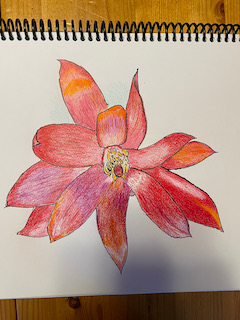
In the meantime, I’m back to doing some drawing. I got a very cheap but good set of coloured pencils for my birthday last month, so I did a couple of drawings. Here they are:

Christmas cactus head on view.
Christmas cactus side view.

I have one more I want to do with the coloured pencils using a different profile. Then I want to do a couple more in watercolour on proper paper, and maybe in acrylic on a large canvas. I’ll have to assess my level of energy before I undertake a large(ish) canvas, but I seem to be getting stronger every day now.

___________________________________________________________________

*If you haven’t read my post from January 13, 2022, you might want to do so now. It outlines my experience with B12 deficiency and pernicious anemia.

Happy New Year (sort of)!

The conventional thing to do at this time of year is to reminisce about events of the past year and pick out highlights and possibly low lights, in this case, of 2021. Well, I would do that except that my brain is quite mushy right now. I’m not sure why. It may be the chemo meds. They have a variety of side effects that vary from week to week. This week my meds may have decided to afflict me with a sludgy brain to go along with my barely functioning legs. 

Then there’s the fact that 2021 was, to be charitable, less than a stellar year. Chemotherapy and monoclonal antibody infusions every four weeks for a morning at the hospital can put a damper on life. Part of the problem with the chemotherapy pills I take every day is that I experience a surprising range of side effects. While all this goes on, I have a lot of difficulty writing. I can’t seem to hold onto an idea or a train of thought for any length of time. I’ve tried to put together a couple of blog posts over the past three weeks, but they’ve turned out resembling alphabet soup rather than carefully crafted narratives. Right now, I seem to be experiencing a slight window of lucidity, but that may just be self-delusion on my part. I have no idea how long this window will be open. You be the judge. 

Today is January 1st, 2022. The first day of the year is supposed to be infused with positive thoughts, merriment, and optimism. I guess saying that 2022 will not be the year that I die qualifies as optimism, or maybe reckless self-delusion. I turn 75 years old in a few days. I know I’ve written it before on this blog, but I say it again: How in the hell did that happen? It seems to me that I was forty years old yesterday. Now seventy-five? WTF. Following Barbara Ehrenreich (who is my age) I have noted in the past that I’m old enough to die. That’s true, but still, I have confidence that people will not have to publish an obituary about me in 2022. 

My memory has gone for a crap. I don’t have dementia, that’s for sure. But still, I guess that’s to be expected of a person my age. I retired from twenty-nine years of teaching at North Island College in 2012, but I had been teaching in the Lower Mainland since 1976. Since my retirement, I have somehow mislaid recollection of so many things. I do have this blog to jog my memory. I started it in late 2012 and have produced over 300 posts since then. That’s a lot of bits and bytes engraved somewhere in a computer hard drive or on the cloud, whatever and wherever that is. I think that the number of words I’ve clicked out probably amounts to at least a five-hundred-page book. I know that since my cancer diagnosis in the fall of 2019 I’ve put together the equivalent of a three-hundred-page book chronicling my experience with myeloma, its side effects, and chemotherapy with its side effects. Now, I’m not sure what I’ll do with this blog. Unfortunately, I have very little energy to do much of anything physical. The oncologists in my life are very reluctant to tell patients what to expect of a life with cancer, especially one like myeloma. Gawande is clear on that:

“Studies find that although doctors usually tell patients when a cancer is not curable, most are reluctant to give a specific prognosis, even when pressed. More than 40 percent of oncologists admit to offering treatments that they believe are unlikely to work. In an era in which the relationship between patient and doctor is increasingly miscast in retail terms — “the customer is always right”—doctors are especially hesitant to trample on a patient’s expectations. You worry far more about being overly pessimistic than you do about being overly optimistic. And talking about dying is enormously fraught.” (from “Being Mortal” by Atul Gawande)

I have found that with old age and a crumbling infrastructure, and as I note above, a lot of physical activity is out of the question. Coming to terms with that reality is very difficult, I can tell you.  Carolyn and I have done some camping over the years since our retirement. Sometimes we were accompanied by family. Most often we were out there by ourselves. We spent most of our time camping in Strathcona Park. I hope to be able to go camping again, but I don’t have a lot of strength and energy. That’s something I have to work on so that I can DO STUFF this coming spring and summer. 

Now, I don’t have to think about physical activity. We have a blizzard outside and snow 50 centimeters thick. So, I read. I have five books on the go right now. I’ll discuss them soon in a post!

Time For Celebration

[I wrote this (slightly edited) post in 2017, a couple of years before I was diagnosed with myeloma. Time is a subject that has been on my mind for a very long time. I wrote my dissertation about the work of Harold Adams Innis (1894-1952). He was very much preoccupied with time and wrote extensively about it late in his career (and life it turns out). So have been hundreds of other philosophers, social theorists, physicists, biologists, etcetera. We think about time on many levels of analysis, from cosmic time to microseconds in productive processes. We think about it in social as well as personal terms. We are especially concerned with it when it begins to run out. Read on]

How do you experience the passage of time?

Time is a big subject and has been the focus of many philosophical and scientific ponderings and is, of course, a major preoccupation of the world’s religions and cultures. There is also the individual, institutional and cultural projects around time and its importance to our lives. We mark (as distinguished from experience) time in many ways. We use clocks and calendars. (The Maya had two calendars, that’s how important time was to them.) We carefully note the passage of the seasons with special celebrations, and we celebrate our birth days every year. We don’t celebrate the day we die, of course, we let others do that in the form of wakes, funerals, and these days, celebrations of life because we are no longer in any shape to celebrate anything ourselves.  We ask: “What time is it?” and we expect to get an answer: “Why, it’s two thirty in the afternoon.” We don’t expect “the anthropocene” as an answer although it would be technically correct.

But this blog post is not about any of this. It’s about how we experience time. In many ways, time and life are synonymous. As individuals we need to be conscious to experience time. In our dreams time is irrelevant or, at least, it can take on bizarre aspects, but we aren’t aware of that until we wake up and can reflect on our dream and its bizarre depiction of time. Writers, novelists in particular, distort time as a regular practice.

We experience time as past, present, and future although we live only in the present. The past and future are cultural constructs that have only the reality we give them. Our memories and our recollections of events are highly selective. There is no such thing as an objective past. We select events, actions, people, names, places, etc. and construct a cognitive map of them into a coherent picture, a picture that is congruent with our life as we experience it and build a store of impressions by which we then judge our actions and those of others. Recall is impressionistic, not realistic. It deceives us all the time as we ‘fit’ the past into our current views of things. 

We are most often not even aware that that’s what we’re doing. We drive, we brush our teeth, we pay taxes, we get on airplanes, we go to libraries, we bank, we vote and most often we don’t question these actions or even consider them a part of a consistent set of habits of life and thought that we learn from others as we live out our lives in networks of interdependencies. As Norbert Elias argues we are less individuals than interdependencies and interweavings. Our daily thoughts and desires, as they join collectively to express themselves as consciousness, make us more Borg than anything. Magically, however, we learn to believe that we control all aspects of our lives as individuals and sadly, people who have shitty lives can only blame themselves for that. That’s the classical economic view of things. Classical economics, according to Thorstein Veblen, uses what he calls the hedonistic calculus to describe how we make decisions in our lives. For him, classical economists (and I would add more contemporary trickle-down ones like Milton Friedman) think of us as ‘globules of desire’ who everywhere seek to maximize pleasure and avoid pain. Of course, life just doesn’t work that way. We do not judge every situation or opportunity we encounter in life as a calculation of pleasure or pain. There are numerous capacities and propensities we bring to our daily lives that have everything to do with the need to delay pleasure, accept pain or make decisions clearly not in our own interests. 

We interpret the past, the present and the future based on our ideologically constructed maps of how the world works. And, boy, do we love our maps. We hang on to them for dear life. Those ideas we cherish, those beliefs we idealize are created in a cauldron of the past, a past we had no hand in making and that starts presenting itself to us the moment we drop out of the womb. Of course, the ideas we pick up early in life we often reject later as we join more and more interdependencies and interweavings, some of which will have more appeal and relevance as the world changes around and in us. 

Christians and adherents to many other religions accept time as a concept, but deny its existence after death when, for them, eternal life kicks in. How could we experience time in a state of eternity? Time is change. What would happen in a place of eternity? I’m no theologian, but I’d be curious as to how a theologian would deal with the question of time in eternity.

Merry Christmas, all, and Happy New Year. 

18 Looking in the Mirror.

[This is a reprint of a post I wrote in January of 2020. I reproduce it here in honour of Elizabeth (Bunny) Shannon who was especially drawn to it. Bunny died of cancer last month. She was a friend and an extraordinary person. I am privileged to have known her]

When I look in the mirror I see an old man. I don’t see an old man with cancer. I just see an old man with a white beard, not much hair, and wrinkly skin. Melanoma (skin cancer) often leaves visible, sometimes unsightly and disfiguring lesions. I don’t have melanoma, although my father did. No, I have myeloma (bone marrow cancer) and its damage is all done on the inside, invisibly. So, I guess I can keep expecting people who see me say: “Wow, you’re looking good!” I guess I DO look good! Now, the last thing I want is to discourage people from telling me how good I look, so keep it up! However, the invisibility of my condition is deceiving. I remember when I was a kid my friends and I used to work on our cars. That was still possible when I was a kid. Often we’d stand around looking into the engine compartment (often of my 1956 Pontiac four-door hardtop) wondering what could possibly be wrong as if just staring at the engine would give us some kind of clue. The engine was always sparkly clean and there was nothing obviously gone awry. If I had money by some quirk of circumstance I might take the car to a mechanic. If not, we might borrow my dad’s tools and start taking things apart. That usually ended up badly. Yes, the most undesirable conditions in life are often on the inside, impossible to see or diagnose by just looking at the person or car in question. I find it best to consult mechanics when our car shows signs of disfunction. I find it best to consult medical specialists for treatment related to my body. I guess I could try to treat myself using any number of the ‘cures’ available on Dr. Google, but I would like to live a while longer, thanks. Besides, I’m not that desperate.

Speaking of medical specialists, we saw my local oncologist today. I see him every five weeks. The result of our visit is that I will carry on with a second course of chemotherapy. We’ll evaluate how well it went in five weeks. My first course of treatment seems to have gone as well as could be expected. The little excavator in my bone marrow is slowly running out of gas and my red blood cell garden is growing again. I’m still exhausted and that won’t change for some time yet, but things are certainly going in the right direction for now. I think I just might be a model patient. So, where does this all leave me?

Well, I may be on my way towards remission. If and when I do go into remission, and that’s by no means guaranteed at this point, that would buy me some time. By that I mean that I may have a few years more to live, though inevitably, either the myeloma will kill me or some other condition will. I won’t be walking away from this situation, brush the dust from my sleeves and carry on. No, I’m on a one way street. So are you, of course, but I can see that damned barrier at the end of the street. I’m hoping that you’re still far enough away from it that you can live in blissful denial for a while longer. I don’t have that luxury. So now what do I do with my life?

That question came up in a recent Facebook thread, albeit expressed in a different way, but with the same effect, I believe. The question comes down to this: If you knew that you had a given amount of time left to live (six months, two years, whatever), what would you do with your time? Would you to be seized by an overwhelming sense of urgency? Would you be determined to cram as much activity and experience into your remaining time as possible? Or would you curl up in a fetal position in a corner of your bedroom quivering and whimpering while you await your inevitable demise? If you have the money and the energy you might want to get out there and travel the world. If you have a spouse, that might complicate things more or less because they may not want the same things you do and may not want to get caught up in your sense of urgency. The last thing you need when facing terminal cancer is marital discord. I think there’s a lot to be said for just carrying on with life as before.

If you have the energy and the money then good on ya. If you travelled a lot before your diagnosis then travel after. Your eventual energy deficits will tell you when to stop. If you were fairly sedentary, more into being at home and puttering around the yard, then that would be something you might want to continue doing. The stress of travel may not be that good for you. Looking around the Cancer Centre at the North Island Hospital this morning I didn’t see a lot of people with obvious enough vigour to engage in a lot of physical activity. In any case, back to my situation.

My exhaustion prevents me from doing much in the way of physical activity. If I do go for a walk I pay for it later. Travelling is impossible. At one point I thought it might be possible, say, to take a direct flight to Puerto Vallarta back and forth from Comox, but there are a number of contingencies that make that next to impossible that have more to do with arthritis and disk degeneration than cancer. Besides, I take chemo drugs once a week orally but also by injection at the hospital. For three or four days after I take my meds I feel crappy, really crappy so the chances of enjoying myself on a beach somewhere are slim to none.

So what do I want to do, and what do I actually do? Well, I want to work on our canoe, finish some paintings, do odd jobs around the property and visit family and friends in Vancouver and further afield. What I actually do is sit and lie down a lot. As I sit and lie down, I read, and sometimes I even write. At the moment I’m reading social history around the Middle Ages and doing a bit of research on my family roots in Normandy. That’s something I would have done anyway, but I do miss working in my shop and studio and going for long walks with Carolyn and our imaginary dog. My oncologist thinks I will regain my energy, at least as much as an old man can expect. If so, that would be great. I’d love to get back to canoeing, camping and puttering.

When I get closer to dying I will know it, and I expect I will have time to think about it, but there really isn’t much thinking that is productive about dying, at least not for me. I’ll know when it’s time for palliative care. I don’t want to live as long as the oncologists might want to keep me alive. I’ll make the decision when the time comes. I don’t think it will be a really hard decision. I know that beginnings are impossible without endings. My ending is a lot closer now than my beginning! That’s fine. Frankly, I’m much more concerned with my family than I am with myself. They are the ones left behind to mourn. But both of my parents are dead and we got on with life after their deaths. My family will do the same when I’m gone. That’s what we do as humans. Like it or not, accept it or not, rage against it or cower in a dark corner, the end result is the same. Don’t sweat it.