19 Fuck cancer!

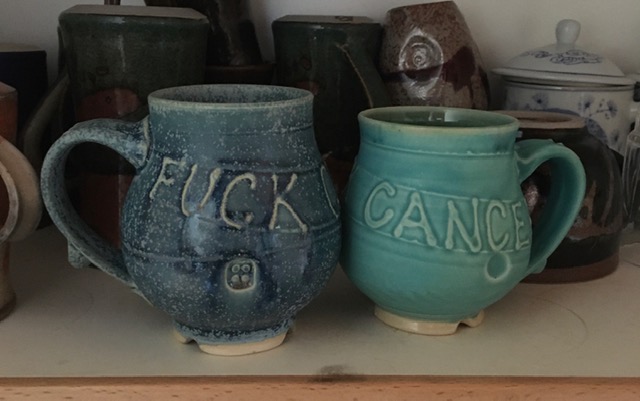
Fuck Cancer mugs

[WARNING: this post contains references to visualizations some might consider offensive, and I regress to being a potty-mouth. Be forewarned.]

I’m not feeling particularly creative, effusive or positive today. In fact, I’m feeling hard done by, angry and unhappy. Hence the title of this post. In fact, I’m feeling fucking crappy, as crappy as ever, or even more so, because for the last three weeks or so I’ve had a cold to compound the effects of my myeloma and the chemo meds I’m taking. Most of the time all I’ve been able to do is sleep, or stare out the windows.

We just came back from the hospital an hour or so ago. Carolyn had to shovel huge piles of snow blocking our driveway and covering our truck just to get us there. Carolyn is my warrior! At the hospital, I got an injection of bortezomib (a proteasome inhibitor) into my abdomen and an infusion of zoledronic acid (a bone strengthening drug that has not-so-fun consequences for my kidney). They gave me 4 grams of zoledronic acid rather than the 3.5 I got last time. I have no idea why. They have a complex formula for deciding how much to give me including my weight and my lab results. Now, I’m just waiting for the chemo meds to kick the shit out of me as they surely will. At least dexamethasone gives me a bit of a boost of energy allowing me to carve a few words onto this ‘page’ out of my weary brain. The sculpture I’m carving I don’t feel is particularly elegant or fine, but my tools are dull so it’s what you get.

Do you like the mugs? Carolyn had them made by a very talented potter in the Valley who had previously made a set of mugs we bought from her that resemble these a lot except for the swear words.

Yeah, fuck cancer! I’m so sick and tired of being sick and tired! And now, to compound my shit, I have to worry about peripheral neuropathy. [I have complained about this before, but read about it again for fun.] I’ve had peripheral neuropathy for some time, many years actually. Peripheral neuropathy (PN) is a condition where the peripheral body parts, arms and legs to be precise, get to feeling numb, painful, and full of weird sensations like having bugs crawling all over them (something I’m feeling a lot at the moment). One of the side effects of the cocktail of chemo meds I’m taking is peripheral neuropathy. Left untreated it can lead to immobility, loss of sensation and life in a wheelchair. This is one of the nasty side effects of my meds, one that has forced a friend of mine who also has myeloma off this particular cocktail that’s often referred to as CyBorD. I’ve written about this before. I have to keep a close watch to determine whether or not the symptoms of PN are getting worse or not. It’s just one more thing to keep my mind occupied with my illness. Fuck cancer!

Did I say Fuck Cancer? Right, I did. And I mean it. I’m not sure what else I would prefer to die from, but cancer is not the companion I would have wished for on my way to the crematorium. Maybe a six-ton weight falling from the sky onto my head would be preferable, I don’t know. I have no way to assess the quality of various means of dying nor the means of communicating the results of any research I might do on the subject to you after the fact.

I may have already written about this…remember that brain fog is a classic side effect of anemia and myeloma, repetitiousness and forgetfulness probably are too… I read somewhere that an artist was asked if he wanted to be cremated or buried after he died. Instead of answering as you or I might he replied: “Surprise me!” Yeah, that’s the way I feel about it. I won’t be around to give a shit one way or another, but I have said I want to be cremated. I have had too many nasty dreams about being buried to want that as an option. Now, though, I’m starting to have moments when I visualize the crematorium attendant pushing my body into the furnace and my skin starting to cook like a pig on a spit as the fire gets hotter and hotter. I know, it’s gross and morbid. Sorry for bringing it up.

So, to change the subject, I’ve had a few moments of lucidity lately between bouts of feeling really nasty because of this cold, and I’m reading (in bed) about my ancestors here in Canada. My family goes back a long way as immigrants to Canada, back to early in the 18th Century actually on both my maternal and paternal sides. I’m finding out that my Norman ancestors called LeGuerrier (the warrior in French) were very likely actual warriors. A thousand years ago the Normans were highly trained and fierce warriors. They not only conquered England in 1066, but (I’ve just read) also became rulers in Sicily after they were invited there to help deal with an enemy. According to a book I’m reading they were often called on as mercenaries. One of the Norman rulers in Sicily was called Roger. His son Roger II took over after Roger I died and he was not known for his tender generosity. Roger that! In any case, the first Leguerrier in Canada can be traced back to 1748. He came earlier than that, but that date is the first mention of him in ‘the books’. He died a fairly old man. Infant mortality was very common then but so was death at any age. From what I’ve been reading living to reproductive age almost seems to have been the exception rather than the rule. These days I’m thinking about my ancestors, their lives and their deaths, and my place in the lineage. My grandpa Leguerrier died at the age of 76 in 1975 from stomach cancer if I remember correctly. My father died in 2007 at 96 years of age. We all come and go. Some of us live longer that others of the same generation but in the case of my grandpa Leguerrier and my father who were only fourteen years apart in age, I think I prefer to follow my grandpa’s lead because my father died after years of very poor quality of life, unable to feed himself because his hands were so distorted by arthritis. He was deaf, had been for years, and he was either in bed or in a wheelchair. To make matters worse, my mother had severe dementia and didn’t even recognize him on his deathbed. She was heard to point to him and say: “Who is that old man in the bed there anyway?” My mother died two years ago at 94 years of age. I can’t imagine she knew she was dying at the time. I’m not sure she knew that she was alive. Hey, wait a minute…

18 Looking in the Mirror.

When I look in the mirror I see an old man. I don’t see an old man with cancer. I just see an old man with a white beard, not much hair, and wrinkly skin. Melanoma (skin cancer) often leaves visible, sometimes unsightly and disfiguring lesions. I don’t have melanoma, although my father did. No, I have myeloma (bone marrow cancer) and its damage is all done on the inside, invisibly. So, I guess I can keep expecting people who see me say: “Wow, you’re looking good!” I guess I DO look good! Now, the last thing I want is to discourage people from telling me how good I look, so keep it up! However, the invisibility of my condition is deceiving. I remember when I was a kid my friends and I used to work on our cars. That was still possible when I was a kid. Often we’d stand around looking into the engine compartment (often of my 1956 Pontiac four-door hardtop) wondering what could possibly be wrong as if just staring at the engine would give us some kind of clue. The engine was always sparkly clean and there was nothing obviously gone awry. If I had money by some quirk of circumstance I might take the car to a mechanic. If not, we might borrow my dad’s tools and start taking things apart. That usually ended up badly. Yes, the most undesirable conditions in life are often on the inside, impossible to see or diagnose by just looking at the person or car in question. I find it best to consult mechanics when our car shows signs of disfunction. I find it best to consult medical specialists for treatment related to my body. I guess I could try to treat myself using any number of the ‘cures’ available on Dr. Google, but I would like to live a while longer, thanks. Besides, I’m not that desperate.

Speaking of medical specialists, we saw my local oncologist today. I see him every five weeks. The result of our visit is that I will carry on with a second course of chemotherapy. We’ll evaluate how well it went in five weeks. My first course of treatment seems to have gone as well as could be expected. The little excavator in my bone marrow is slowly running out of gas and my red blood cell garden is growing again. I’m still exhausted and that won’t change for some time yet, but things are certainly going in the right direction for now. I think I just might be a model patient. So, where does this all leave me?

Well, I may be on my way towards remission. If and when I do go into remission, and that’s by no means guaranteed at this point, that would buy me some time. By that I mean that I may have a few years more to live, though inevitably, either the myeloma will kill me or some other condition will. I won’t be walking away from this situation, brush the dust from my sleeves and carry on. No, I’m on a one way street. So are you, of course, but I can see that damned barrier at the end of the street. I’m hoping that you’re still far enough away from it that you can live in blissful denial for a while longer. I don’t have that luxury. So now what do I do with my life?

That question came up in a recent Facebook thread, albeit expressed in a different way, but with the same effect, I believe. The question comes down to this: If you knew that you had a given amount of time left to live (six months, two years, whatever), what would you do with your time? Would you to be seized by an overwhelming sense of urgency? Would you be determined to cram as much activity and experience into your remaining time as possible? Or would you curl up in a fetal position in a corner of your bedroom quivering and whimpering while you await your inevitable demise? If you have the money and the energy you might want to get out there and travel the world. If you have a spouse, that might complicate things more or less because they may not want the same things you do and may not want to get caught up in your sense of urgency. The last thing you need when facing terminal cancer is marital discord. I think there’s a lot to be said for just carrying on with life as before.

If you have the energy and the money then good on ya. If you travelled a lot before your diagnosis then travel after. Your eventual energy deficits will tell you when to stop. If you were fairly sedentary, more into being at home and puttering around the yard, then that would be something you might want to continue doing. The stress of travel may not be that good for you. Looking around the Cancer Centre at the North Island Hospital this morning I didn’t see a lot of people with obvious enough vigour to engage in a lot of physical activity. In any case, back to my situation.

My exhaustion prevents me from doing much in the way of physical activity. If I do go for a walk I pay for it later. Travelling is impossible. At one point I thought it might be possible, say, to take a direct flight to Puerto Vallarta back and forth from Comox, but there are a number of contingencies that make that next to impossible that have more to do with arthritis and disk degeneration than cancer. Besides, I take chemo drugs once a week orally but also by injection at the hospital. For three or four days after I take my meds I feel crappy, really crappy so the chances of enjoying myself on a beach somewhere are slim to none.

So what do I want to do, and what do I actually do? Well, I want to work on our canoe, finish some paintings, do odd jobs around the property and visit family and friends in Vancouver and further afield. What I actually do is sit and lie down a lot. As I sit and lie down, I read, and sometimes I even write. At the moment I’m reading social history around the Middle Ages and doing a bit of research on my family roots in Normandy. That’s something I would have done anyway, but I do miss working in my shop and studio and going for long walks with Carolyn and our imaginary dog. My oncologist thinks I will regain my energy, at least as much as an old man can expect. If so, that would be great. I’d love to get back to canoeing, camping and puttering.

When I get closer to dying I will know it, and I expect I will have time to think about it, but there really isn’t much thinking that is productive about dying, at least not for me. I’ll know when it’s time for palliative care. I don’t want to live as long as the oncologists might want to keep me alive. I’ll make the decision when the time comes. I don’t think it will be a really hard decision. I know that beginnings are impossible without endings. My ending is a lot closer now than my beginning! That’s fine. Frankly, I’m much more concerned with my family than I am with myself. They are the ones left behind to mourn. But both of my parents are dead and we got on with life after their deaths. My family will do the same when I’m gone. That’s what we do as humans. Like it or not, accept it or not, rage against it or cower in a dark corner, the end result is the same. Don’t sweat it.

17 Welcome to CancerLand* AND Happy Birthday to me!

Well, another festive season is in the books. This one was no different than many in the past with family, food, and drink (in moderation, of course) along with the requisite tree and lights. This year, however, the family arrived on the weekend prior to Christmas and stayed much longer than usual. That’s because our daughters, their husbands and children (one of our daughters carries the full responsibility for the production of our three grandchildren) wanted to stick around to spend some time with us. I love that they wanted to be with their sick old dad. They are such a delight to have around and I was very sad to see them go back home to Vancouver.

Wow, has my life ever changed over the past few months. I was diagnosed with multiple myeloma in early October, 2019, and since then I’ve been brought slowly yet inexorably into CancerLand. There’s no doubt that I had multiple myeloma long before the official diagnosis. The symptoms were clear in hindsight. It’s probably been well over five years. But it’s been only since November, really, that I’ve gotten my passport to CancerLand. I’m fully a resident now, brought into the institutional fold. That means frequent visits to the lab and to the hospital with calls to oncology nurses interspersed. I mean, I have a diagnosis! I’m legit! I have my badge and my pass to the ER.ª  I’m not just another whiny patient going to see my doctor to complain about being tired. I’m a CANCER PATIENT!

Speaking of being a cancer patient, I’ve now completed my first course of chemotherapy. It lasted about a month. My stomach is bruised from subcutaneous injections of bortozemib and my brain is bruised by weekly oral doses of cyclophosphamide and dexamethasone as well as zoledronic acid infusions once a month. I’m subject to a true cocktail of poison. Oh well. I used to drink more scotch than was probably good for me on occasion and people sometimes refer to alcohol as poison so, there ya go. Poison for poison.

Now we wait. We wait for the results of lab tests on Monday and what the oncologist will tell us on Wednesday based on those results. Will I be continuing with this same cocktail? Are the numbers going in the right direction? Can I realistically expect remission in the next few months? What? What? What?

Tomorrow is my seventy-third birthday. That means I start working on my seventy-fourth year tomorrow. For a guy who thought at twenty years old that he’d never live to be twenty-six, I’ve done pretty well. I can’t complain about my life. I must say, though, that there are a few things I might do differently if I had to do them over again, but I don’t dwell on those things anymore. I don’t have time. I didn’t have time when I was twenty-six either, but I didn’t know that back then. Time has passed so quickly, it’s frightening. If I had been able to really understand when I was twenty years old how in the blink of an eye I would be seventy-three I might have taken some things more seriously and dismissed other things as unimportant. But that’s the way it goes. There may be some twenty year olds out there who understand how fleeting life is, but I haven’t met them. Trying to convince them of that fact is not going to be very fruitful so meh…

I haven’t put together a New Year’s resolution. Should I? Maybe I can resolve to stay alive this year. Is that good enough? I’ve realized that in my state of being, committing to a long-term project to save the world is probably overly optimistic, but a resolution to stay alive in 2020 is reasonable, I think. I just might be able to see it through too. Wish me luck!

_________________________________________________________________

*”Welcome to Cancerland.” (from “Bright-sided: How the Relentless Promotion of Positive Thinking Has Undermined America” by Barbara Ehrenreich). The title of this post is taken from this book. Ehrenreich uses this title as an introduction to the way she became medicalized after having been diagnosed with breast cancer. Start reading it for free: http://a.co/3h6SgyT

ª I do have a pass to the ER. I have a letter of introduction to the ER staff from the BC Cancer Centre telling them that if I show up to the ER they have a number of tests to do stat! If my temperature goes over 38˚ C, I need to get myself to the hospital ER for a possible antibiotic infusion. An elevated temperature indicates an infection of some kind, something I don’t need right now.

16 I meditate on my last breath.

Yesterday afternoon Carolyn tucked me into bed. The zoledronic acid infusion I got Thursday at the hospital has left me feeling like I have a nasty flu combined with a smashing hangover. I fell asleep almost immediately but when I woke up I could hear the rain beating on our metal roof. I love that sound. Today, the dexamethasone is kicking in and it’s leaving me in a state of nervous fibrillation. I’ve never done speed, but I expect the sensation must be something like that. Now is a good time to write because I have this bizarre energy that needs an outlet. However, the dex gives me the shakes making it difficult to keep my fingers singly on the keys of my computer.

So, getting back to yesterday afternoon. Like I said I slept for some time and woke to the sound of rain pounding the metal roof. I just lay there. I find that lying in bed staring at the ceiling is not a bad way to pass the time. I could never do that before. I had the work ethic really bad when I was still gainfully employed and long after truth be told. Now, my body has taken charge of my reluctant mind and has forced me to sit still, to lie down and not feel guilty about it. Cancer has its upsides I guess, but I’m not sure that I fully subscribe to its methods. One thing for sure: There is no normal in my life anymore: sleep times vary, meals are still on schedule as are the ritual pill taking, but I can’t count on feeling the same way during each new cycle of chemotherapy that I felt on the previous one. Dex is predictable but the intensity of its effect varies. I only have to take it one more time on this course of chemo lasting until January. I start taking it again in late January when I start my second course of chemo with my fifth cycle. A course of chemo lasts approximately four weeks, a cycle, one week. At least that’s the pattern now. But I digress.

I’m lying on my bed focussed on the cedar beam that crosses the ceiling in the middle of our bedroom, light pouring in from the three windows just behind me at the head of the bed. I close my eyes and think about death. Well, more about dying than death, actually. It’s the process of dying that is absorbing me, not death itself which for too long we’ve considered the opposite of life. Dying is another thing altogether. Dying is the separation of consciousness and body. Consciousness in my estimation comes to an end at the point of death but my body, this collection of matter brought together by processes millions of years old, will immediately begin to become unglued. It loses its integrity as a collection of cells and begins to decompose, that is, to lose its composition.

I don’t have to tell you this. It’s hard to live for any length of time without coming across at least one death in the family, among friends, or by reading the news or obituaries on the local papers. We know about death although we don’t quite know what to make of it or how it pertains to us. It’s strange that for most of us we take for granted that ‘we’ don’t exist before our conception and birth and that ‘we’ become ‘we’ by a combination of hereditary traits, learned behaviour, and environmental factors. ‘We’ or ‘I’ are constructs. We are not born fully operational. We become ‘I’ over time, slowly developing personality traits, habits, and idiosycracies that define us as unique individuals. But we resist very strenuously the idea that if we come we must also go. But I digress again!

So, I’m back in my bedroom, lying on my back on my bed in that state of half sleep, very relaxed and I meditate. I meditate on my last breath. I’m thinking that dying is not much different than living. When we fall asleep and lose consciousness we have no idea whether we will awaken or not, we just take if for granted that we will. I’ve had two brothers-in-law die this past year. One died during the night in bed next to my sister. We say he died in his sleep. True enough. He wasn’t conscious when he took his last breath. Neither was my mother who died nearly two years ago, but she had demential and was so hopped up on morphine that I can’t say she died in her sleep. My sisters were there at the moment of her death. I missed it by a few hours. I was in pretty bad shape myself two years ago with symptoms on myeloma that went undiagnosed at the time. I was perennially exhausted, in a great deal of pain, and I couldn’t stand the vigil as my family surrounded my mom’s death bed waiting for her to take her last breath. I prefer to think of my dying as just another falling asleep kind of experience. My last one of course, but still.

Needless to say, there are only one or two ways of being born that I know of, but millions of ways to die. I like to think that my last breath will be in the comfort of home or at least in a hospice, somewhere nice. Many, many millions of people worldwide don’t die under such benign circumstances. Violent death is common. Five thousand Canadians die in vehicle crashes a year, fifty thousand Americans meet the same fate. I don’t fancy that as a way of dying, but if it’s quick, maybe. I can’t imagine being hacked to death with a machete after watching my family meet the same fate in 1994 Rwanda, or being shot by a stray bullet in Aleppo leaving me wounded and watching the blood spill out of me. No, give me a peaceful, quiet place to die.

I’ve been diagnosed with an incurable cancer but I’m told that it’s more like a chronic treatable condition than a CANCER that kills fast and unannounced. I’ve got some time to think about my last breath. I’m not sure if that’s good or bad. Certainly, I’ll roll with it. I remember clearly when I was a kid of twenty or so. I had a fairly serious back injury while working at a sawmill on Lulu Island and I needed back surgery to remove a disk in the lumbar area of my back. I was a kid in search of meaning in my life, not such an unusual thing. I remember lying in my hospital bed after the surgery, hanging over the edge puking my guts out and thinking to myself. I can milk this for everything it’s worth. I could stay on Compensation for a long time then go on disability or something along those lines. Or I could get out of the hospital and use this time to get my shit together. And that’s what I did. I got my shit together. I enrolled in the liberal arts program at Douglas College in New Westminster and never looked back. My injury allowed me time to think about my future without the pressure of work. That was luxurious, and it worked.

Now, I don’t need to get my shit together. It’s been together for a few decades and I’m happy with my shit. My encounter with cancer, in a way similar to my experience with my back surgery, is giving me time to think about my last breath, but to also remember that every breath I take until my last one is worth paying attention to and celebrating. Whatever I do until I take my last breath is not so important. Of course, I can’t help but do something and I will do things that have always mattered to me. It’s impossible to do nothing and still be alive. Even lying on the couch ‘doing nothing’ is doing something. Whatever I do will be the right thing at the time because it will be what I do. In any case it won’t matter one iota after I’m dead because ‘I’ won’t be around to care or experience regret or any other sentiment.

14 Now we wait.

I started the second course of chemotherapy using the new cocktail of drugs called CyBorD: cyclophosphamide, bortezomib and dexamethasone. Ya just got to be impressed by that line-up of fancy Latin names for that nasty little prickly army of toxic chemicals that we have to wear gloves to handle and that I gleefully (albeit not without some trepidation) ingest every week. Next week they’ll also infuse me with zoledronic acid, a drug that is supposed to strengthen bones. So far, so good. I may have said this before, but I will reiterate that the staff at the Cancer Centre at the hospital here in the Comox Valley is really fine. I feel that I’m being looked after. I have a person I can reach on the phone if I have any issues or questions and they’ve given me a letter to take to the Emergency Department if for any reason I should need to go there.

We won’t know for a while yet what effects the chemo drugs are having on my myeloma. It’s a waiting game, but I suppose the whole process is pretty much of a waiting game. There are so many questions and very few answers at the moment. In my last post I told you that I was going to see an orthopaedic surgeon in Campbell River. Well, we drove up to CR on Monday (the 9th) to his clinic in Willow Point. His name is Dr. Deke Botsford and he is a specialist in hip and joint replacement surgery, but he’s also capable of dealing with the issue I have which is the lesions in my femurs. To be precise, the lesions are in what’s called the distal part of the femur which is the part of the femur closest to the knee. He told us that that was an unusual site for myeloma lytic lesions to form but he also said that there were treatment possibilities. So, the lytic lesions are the result of paraproteins in my blood excavating my bone marrow thereby weakening my bone and getting in the way of the creation of hemoglobin. The excavations are called lesions. It may be that the chemotherapy treatments I’m on will arrest the growth of these lesions but then again maybe not. Botsford could drive a rod up my femur from my knee all the way to my hip joint so as to stabilize the bone and keep pain at bay. Or, he figured I might benefit from radiation therapy. I expect my oncologist will want to wait for a while to see what the chemotherapy treatments are doing before launching into another therapy. I see Botsford again in early February at the hospital in Campbell River to get an x-ray of my right femur and to assess the state of affairs in my bones. It seems that my right leg especially is weakened by the paraprotein excavations, but it is not likely to spontaneously break. It could break if I fell, for instance, or banged it a little too hard on a door jamb or something. I’ll try hard to see that doesn’t happen.

As far as pain goes, I’m dealing with it. I’ve reduced my intake of hydromorphone, my main opioid line of defence, but things seem stable enough. The zoledronic acid has a nasty side effect in that it can create elevated levels of pain in the back so I won’t be trying to wean myself off of hydromorphone anytime soon. Besides, if I do back off a bit with the hydromorphone, something I’ve tried a couple of times, I can feel pain creeping back into my ribs and back so I don’t think I want that to happen.

I have been going out a lot, of course, to the lab, the hospital and to doctors’ offices, but late yesterday afternoon Carolyn and I went to the Cumberland Brewing Company to meet with some friends. That’s the first social outing I’ve been on in three months or so. It was taxing, and today I’m exhausted, but it was also good to get out amongst friends and sip on a bitter. Even though I’m very tired I still managed a visit from a good friend and former student now living in Nanaimo. We drank tea out of mugs she made and delivered to us three weeks ago. Everyone has been so kind and generous. Gifts of food and goodies keep coming. I really feel the love.

7 About pain, cold sweats, hallucinations, delayed chemotherapy, rashes and, other fun stuff.

[A note: I’m used to writing posts here of approximately a thousand words. Because I’m so fatigued with anemia and other conditions that affect my concentration, for the foreseeable future I’ll make my blog posts a little shorter. That way I will be able to continue writing and not tire myself out too much.]

I started the chemotherapy drugs, lenalidomide and dexamethasone last Thursday morning. I was to take one lenalidomide tablet and five dexamethasone, continue with the lenalidomide for three more weeks and five dexamethasone tablets every Thursday morning until they were done. Frankly, it was a relief to finally get going on a treatment for my multiple myeloma (MM), any treatment. Well, you know what they say about the best laid plans of mice and me. They never go according to plan, and this was not about to become an exception to the rule.

It must have been Saturday (I got a CT scan that day) when I noticed that my butt was getting really itchy. Well, naturally, I scratched it. I knew it isn’t a good thing to scratch an itch, but I just couldn’t help myself. The welts just got bigger and hotter and covered my whole midsection. I developed a slight fever. Carolyn, my very competent care aide spread some lotion on my backside and up under my armpits to relieve some of the itching. Damn good thing too because I was close to losing it.

Well, it turns out that the reason I developed this rash in the first place is that I happen to be allergic to my main chemotherapy drug, lenalidomide. Now, that’s not cool! Lenalidomide is an oral therapy drug, and for that reason is very convenient to take. So, it’s the weekend, I’m itchy as hell, but I persist in taking my chemo meds. On Tuesday, yesterday, I call the oncology nurse in Victoria who seemed quite concerned about the rash. She tells me that she would try to track down my oncologist to get some idea of what to do. My regular oncologist was out of the Cancer Centre at meetings but she tracked down his colleague who told the nurse to tell me to cease taking lenolidomide immediately. So, great. Here I am, not a week into taking my first course of chemo meds and now I can’t take them anymore! What the hell is that all about, universe?

I was pretty bummed out for a time there, but then I realized that this is not an uncommon turn of events in oncology. In fact, about 40% of people enrolled in the lenalidomide/dexamethasone regimen turn out not to be able to tolerate the drugs.

A Cancer Clinic receptionist called this morning to set up a telephone consultation with my oncologist for the 20th, next Wednesday. At that time I should learn more about my next course of treatment as well as what they learned from my last CT scan. Strangely enough, I also got a call from the hospital here in Courtenay telling my that I needed to call them and set up a second course of treatment. She mentioned lenalidomide and I said it’s unlikely that it would be for lenalidomide because in all likelihood, I’m allergic to it and I was told to stop taking it. I guess it takes a while for messages to get from Victoria to Courtenay and back. I soon learned to take all phone calls from the hospital or the Cancer Clinic with a grain of salt and usually wait for confirmation from a third source before moving on with anything.

In my next post I’ll address the fun topics of pain, hallucinations, and cold sweats.

I was going to write a post about the social triage that happens in emergency departments everywhere, and I will get around to that, but for now I have other more pressing issues to deal with. I’m intent on documenting my experiences with myeloma as completely as possible so, for the moment, that will be my priority for this blog. One strange thing that’s happened to me is that I have a recurring dream about the emergency department at the Royal Jubilee Hospital. More on that to come.

2 Multiple Myeloma Makes Me Special!

I’m always a sociologist so whatever happens to me triggers an instinct I have to do check it out, do the research, connect the dots. In my book, the more information we have the better. At the moment, we have an information deficit and that’s frustrating but, hopefully, that’s about to change.

In any case, one of my first research stops is Statistics Canada. What’s there to learn there? Well, for one thing, multiple myeloma (MM) is a pretty rare form of cancer and that makes me special, don’t you think? Stats Can reports that there will be about 3000 people in Canada diagnosed this year with it. That’s not a very high number. Stats Can also projects that from 2018 to 2022 only 70 men in BC will be diagnosed with MM in my age group every year. Because doctors seldom encounter it, it can be difficult to diagnose, but back to that in a bit.

I’m in good company too when it comes to MM. Jim Carr, the Liberal Member of Parliament for Winnipeg Centre and Minister of International Trade in the Federal Cabinet, was diagnosed with MM the day of the election (Monday, Oct. 21st) when he went into the hospital complaining of flu-like symptoms. By Tuesday he was receiving chemotherapy and dialysis and by Thursday the CBC was reporting that the Minister said he was doing fine, felt okay and was going to continue serving his constituents and the Canadian People. I’m so happy for him. He won’t be cured, but he will probably be able to function quite well for some time to come. By contrast, my doctors knew I had MM three weeks ago and I have yet to see an oncologist and will have to drive 225 kilometres to Victoria for the pleasure. Living in the boonies as we do, access to specialized health care can be spotty at best and will only get worse if the Vancouver Health Authority has its way. (That’s the subject of another blog post but DecafNation, George Le Masurier’s excellent blog, has been on to this for some time). It’s true that an oncologist in Victoria is on my case and has already prescribed medications for me and I got an infusion of a drug a couple of days ago at the hospital here to help with the pain and ‘strengthen bone’. Still, I feel that I’m not getting the level of care I would have gotten if I were a member of the Canadian political aristocracy or if I lived in a large metropolitan centre. My age likely has something to do with it too. I’m an old guy and not likely to live too long anyway and besides, I’m no longer a contributing member of the economy having retired from teaching at North Island College in 2012. Does that sound like sour grapes? It may be, but socio-economic status (class, gender, age, and geographical location, etc.) has a lot to do with health care provision whether we like to admit it or not.

Alright, so back to my situation. I’ve probably had MM for a long time. I have low B12 and was diagnosed with pernicious anemia at one time by a locum (temporary replacement for my regular doctor) , but my doctor didn’t really accept this diagnosis and prescribed B12 monthly injections (which I do myself). The thing is, I had been going to my doctor for years complaining of being tired, having brain fog, being in lots of pain, and suffering from peripheral neuropathy. To give my doctor credit, he ordered MRIs of my brain and spinal cord, lower back, ultrasounds, etc., because there is a history of Multiple Sclerosis and other immunological diseases in my family. To add to this, I has a kidney removed in 2002 because of renal cell cancer, leaving me with one kidney. For a long time we tested my creatinine levels to ensure my kidney was functioning properly and it did for years. In the last three or four years however my kidney showed signs of being very unhappy. Creatinine levels were rising and still are, and I was getting weaker and weaker all the time with worsening symptoms.

My social life was taking a huge hit. Over the past few years I’ve had to pretty much give up going out in the evening because I’m exhausted. I had to give up life drawing, printmaking and sculpting. I had to resign from the Village of Cumberland’s Homelessness and Affordable Housing Committee and I had to resign as Chair of the Board of the Comox Valley Art Gallery (although frankly I had been doing that long enough). I can no longer go on long walks with Carolyn, something that we both really enjoyed.

After a while, I think my doctor kind of gave up trying to figure out what was wrong with me and I was beginning to wonder if it was all in my head.

About a month ago, all that changed. We had gone camping in Strathcona Park in August. I was not feeling great, but well enough to get the canoe out and paddle/sail/motor around a bit. A couple of times, however, we got into bucking huge headwinds and were forced to paddle hard. Carolyn and I are seasoned paddlers and we know what to do. I felt pretty strong and we handled it fine. Of course we had some muscle pain, but scotch helped out with that a bit! Then my daughter and her family joined us. One day as I was sitting at the camp site doing nothing, my back started hurting something awful. By the time I decided to take some ibuprofen (not to be taken by anyone with any kidney issues) my pain was pushing 9 or 9.5 on a 10 point scale. I was taking T3s like they were candy. When it was time to go home, my son-in-law drove the truck and trailer. I rode shotgun. I have driven very little since and not at all for the last month.

A short time later, I made an appointment to see my doctor to let him know about the back pain and my use of ibuprofen. He figured we had better do some blood testing and we did. He was headed out on vacation for three weeks so I wouldn’t be seeing him again until Oct. 22nd or so. Well, he called me on Friday at around 5:30 and told me that my kidney was leaking protein into my urine and that he had referred me to a kidney specialist in Nanaimo. That was a bit of a shock. I didn’t quite know what to say so I left it at that.

Over the weekend, Carolyn and I sat down and wrote down all of my symptoms and questions to which we wanted answers. On Monday, I called the medical clinic and got an appointment to see a locum to ask questions about what a protein leak meant and to lay out my symptoms. Well, he ordered more blood tests and imaging. We saw him again on Thursday by which time he already had a strong suspicion that I had multiple myeloma. On Friday he called and pretty much confirmed the diagnosis. On Monday we saw another locum and she ordered more tests and imaging as well as a bone marrow biopsy. She also referred me to the Cancer Clinic in Victoria.

So, in less than ten days, the locums had figured out that I had cancer and were moving fast to get me treatment. Possibly all that it took was a fresh set of eyes on my case. Certainly, the referral to the kidney specialist would have got me some results but I’m not scheduled to see him before November 7th. I wondered what my regular doctor would say when he got back from vacation. I am definitely pissed off that I went so long undiagnosed, but I don’t really blame my GP entirely for that. I may not have impressed on him the real state of my distress and MM is not easy to diagnose because it shares symptoms with so may other ailments. Besides, raving about past injustices will get me nowhere. I need to focus my full attention on the present and the future.

So, in any case and in the meantime, I called the Cancer Clinic and a person there confirmed my referral, gave me an ID number and said that I would be seeing such-and-such a doctor. Well, my regular doctor informed me just this past week that there had been a mix-up in the referral and that I would be seeing another doctor at the clinic. We have yet to hear from the Cancer Clinic. If I don’t hear from them by tomorrow afternoon I’ll be calling them again. We need some goddamn answers and I need to get some goddamn treatment. Stay tuned.

Lose your job to automation: Mourn or celebrate?

The three links below of several hundreds that can be found on the internet news sources these days indicate clearly the rapidly accelerating advance of automated technology moving towards the elimination of jobs.

Walmart

Australia

Japan

So far, the action seems to be very widespread but is moving especially rapidly in retail as is clear from the evidence in Australia, Japan and the US. The rationale used to justify automation by Walmart management in the US is creative and ridiculous at the same time. Nobody in management wants to say that their companies are trying to reduce or eliminate their workforces altogether. But that’s exactly what’s happening.

Karl Marx predicted this very outcome in the mid-19th Century arguing that in their efforts to control or reduce their costs of production, businesses, after overproducing in the search for profits, turn to automation to control their labour force and return to profitability. The process has been going on for a long time.

It seems perfectly reasonable for businesses to try to become more ‘efficient’ by automating jobs that are tedious and repetitive, often dangerous. For individual businesses this seems like an effective strategy to control their costs and their processes. The problem is that there is anarchy in the business world, no coordination, and competition prevents cooperation between businesses in the same field of operations. The result is that there is a reduction in the aggregate number of workers in any given area and the reality is that bots don’t buy anything. Workers are also consumers so doing away with workers is doing away with your very own customers. Nobody I know in business is worried about taking customers away from their competitors, but if Walmart eliminates much of its labour force by automation that will inevitably also reduce its customer base.

So, the question is should you mourn or celebrate the loss of your job through automation? The answer is yes and no. The actual issue is not jobs, but income. You should definitely mourn loss of income. The loss of a job not so much. Jobs, i.e, employment, are not really in sync with the human capacity to work. Humans, as Veblen is quick to point out, are programmed to work, but if they are presented with meaningless, repetitive, boring work that is really to make someone else look good or get rich, they balk. So doing away with boring, stupid, meaningless jobs is a good thing in my mind. Several countries are now toying with a guaranteed basic income. It will take some time yet for the importance of this strategy to become more widespread.

We’re at a real crossroads at the moment. With the advent of advanced robotics, automation, and especially artificial intelligence, work will be required of fewer and fewer people for shorter and shorter lengths of time. There will be, in a very short period of time, a huge surplus of people as workers and a shortage of people as consumers. The elimination of tedious labour could result in an explosion of creative energy as people are freed to think for themselves and act according to their talents and abilities. However, they will need income to be able to do that.

One thing for sure, there will have to be a greater distribution of wealth because it does no one any good to hoard cash and take money out of circulation. It sure doesn’t help corporations involved in the sale of consumer goods. From this perspective, banks and financial institutions are at loggerheads with consumer driven businesses. There will have to evolve a very different ethic, one at odds with the current capitalist Neo-liberal one that I wrote about in my last blog post.

So much to write about: death, sex, stupidity, ignorance and all of the above together! Oh, and political economy too.

I have been fairly quiet on this blog lately. I got a cold brought to me by my grandson. I grudgingly have to say it was worth it because I saw my family in Vancouver, but I’m not a great fan of colds. I rarely get one, but when I do, it’s usually a doozy. They seem to trigger my immune disease too. Bacteria, viruses and whatnot are having a party in my arteries and veins. Sheesh. 

Anyway, I’m reading a few books at the moment, a couple on sexuality and one on universal myths around the birth of heroes in classical literature, including the bible. I’m a little slow reading right now. I tend to fall asleep after about 10 minutes, and reading in bed is a waste of time because I seem to forget most of what I’ve read by morning. Well, I do remember a lot, but not much detail. That’s fine. I can live with that. 

In any case, like I said, I have a list of topics I want to write about, but I’d sure like to hear from you about what topics you’d like me to address. If you’ve read any of my posts in the past you know that I’m all over the map. I’ve taught courses in introductory sociology, deviance, racism, love and sex, research methods, cultural and physical anthropology, Canadian history, Canadian Justice systems, study techniques, both basic and advanced. I’m an avid reader. I’ve done a lot of research in political economy, Marx, Veblen, Elias, Mills, psychoanalysis (Freud, Rank, Brown) , psychology, evolution, sexuality, nationalism, history, language, pain and mental ‘illness’, and classical studies including books on mythology, ideology, and heroism. Check out my archives. Anything you’d like me to explore further? 

I’ll tell you one thing. The post here that’s got the most hits by far is: Is Canada a Capitalist Country? Maybe I should comment on that issue a bit more. It’s one that is very difficult for people to figure out because it’s so difficult to break through the veil of ideology surrounding the relationship between nations (countries) and the capitalist modes of accumulation and production. Got any ideas?

Stop with the Categorical Thinking Already!

Robert Sapolsky is a Stanford University neuroscientist. In this video he introduces a course he taught (7 years ago at least) on human behavioural biology to a freshman class. As he explains in this video, students don’t need any prerequisites for this course. They don’t need a science background. 

Although the course is called Introduction to Human Behavioural Biology, it’s about avoiding categorical thinking in science but also generally in life. 

Sapolsky is one of the most talented and entertaining lecturers I’ve had the pleasure of listening to and watching. I would have loved to have taken his course. It’s well worth watching this video in its entirety (57 minutes). The second video in the series is  1 hour and 37 minutes long, but again well worth the time to watch and re-watch. Aside from these YouTube videos Sapolsky was featured in a 2008 National Geographic video called Stress (available on YouTube) which I used in my classes. It compares olive baboons in Africa with stressed out British bureaucrats in Whitehall, London, the seat of the British civil service. 

If you want, you could watch the YouTube video now and after watching it continue reading below to see why I suggest you watch it. 

I’ve recently had to think about categorical thinking because of a comment made by a commentator to my blog who suggested, very innocently I’m sure, that it’s probable that older people get set in their ways. She wasn’t denigrating that outcome as she saw it suggesting that it’s likely natural (as I interpret her meaning). I had to think: is categorical thinking inevitable as we age and am I a ‘victim’ of categorical thinking? My answer to both questions is a categorical no! Categorical thinking is not inevitable and if there’s anything I have spent my whole career trying to avoid, it’s categorical thinking. 

At the moment I’m reading a (1999) book by Ellen Meiksins Wood called The Origin of Capitalism. Well, over the years I’ve read dozens of books on this topic from various perspectives within various disciplines. Every time I pick up a book, any book, I’m open to having my mind changed and my ideas modified. Otherwise, why read anything? In this case, Wood is presenting me with a viewpoint on the subject I haven’t seen before and I’m still wondering what to make of it. I keep shaking my head because her perspective is quite foreign to me. For one thing, she is focussed on the origins of capitalism. Capitalism is a word Marx never used. At best it refers to a political-economic system. When Marx discusses capital or the capitalist mode of production, he’s not referring to a system, but to a period in history. I have to re-read Wood to ensure that I understand her notions of capitalism and especially her contention that capitalism originated in English agrarian life. Equally strange is her use of the terms revolution and class. 

Reading Meiksins forces me to rethink categories. I will assess her perspective and incorporate it wholly or in part into my worldview or reject it based on the evidence. 

I just received another book in the mail today. It’s by R.D. Laing, one of favourite rogue psychiatrists. It was written in 1976, the year I entered grad school, and is entitled The Facts of Life.  After I’m done reading these books and watching more Robert Sapolsky on YouTube, something which always helps buoy my spirits, I’ll re-read Chaos: Making a New Science by James Gleick. Sapolsky is really high on this guy so I have to read it again in light of the video posted above. 

Please, enjoy Sapolsky. Find his other videos on YouTube. He’s a delight!