Ho Hum.

I guess it’s not really ho hum, but my life is definitely just ticking along. The ‘injuries’ I’ve sustained via myeloma and chemotherapy have prevented me from doing a lot of physical activity, but I keep getting the medical people telling me to stay active! It’s a tightrope I walk. Well, not a real tightrope, but you know what I mean. Do exercise? Pay for it afterwards for days with pain and joints that do not want to move. Don’t do exercise? Shorten my life and make moving around increasingly difficult. This is no fun. Well, it’s true that it’s no fun. Pain is no fun. But who promised me that I would have fun all the time? Fun is for the young and healthy, or at least for the healthy (of all ages). I really don’t expect to have ‘fun’ anymore. Should I be having fun? What kind of fun should I be having? Is there more than one kind of fun I should be having? Is reading a book fun? What kind of fun can I have when my left knee keeps wanting to fold on me without warning? If I get down on the floor, I may not be able to get up again. That’s no fun…I guess, although it might be fun for somebody to watch me try to get up off the floor. Is betting fun?

I really like this time of year. It’s cool in the shade and warm in the sun. We walked on the River Walkway this afternoon. It was cool in the shade and warm in the sun. We had iced coffee. Yummy. Is having an iced coffee on a warm, sunny afternoon on the River Walkway fun? I don’t know. Maybe I was having fun. I’m not sure.

I was going to write about pain and death today, but then I decided to keep it light. Pain and death are heavy. Fun is light! Long live fun! I DO really want to have fun, to possess it, to keep it close to me and give it a big hug but I’m not sure that’s the way it works.

You might think that chemo is no fun. Well, you might be wrong. Being hooked up to an infusion machine for a couple of hours has its moments. There’s no pain involved, but being tethered to a ‘tree’ with bags of saline solution and meds flapping around presents certain challenges when the need for a pee break presents itself. Thankfully, the ‘trees’ we use have battery powered brains and can be unplugged from the wall sockets. That way we (I in particular) can wheel them around to the bathroom and pee while we hang on to them and try not to pee on the lines. It’s difficult because the lines hang down quite far, often right in front of my pant zipper. It’s fine for women because you sit down to pee but for us guys the danger is omnipresent. Of course I can sit down to pee, but my anatomy resists that. The issue is compounded because the toilet seat in the bathroom attached to the Cancer Care Centre won’t stay up. That means I either have to hold it up while I also hold up the lines and other things or pee on the seat. Yes, the damned toilet has a slot in the front/middle but I’m not that great at aiming my stream which is erratic at the best of times. I don’t have the straight-as-an-arrow powerful stream I used to have in my youth. I used to be able to control my pee stream with little effort. Now I’m just glad when I can pee at all. I’ve gotten very used to just standing in front of a urinal or a toilet for several minutes at a time just waiting for pee to happen. It always wants to come, it’s always right there…but no. It can get embarrassing if there are other people around also waiting to use the ‘facilities’. It’s especially bad in theatres when at half time break during a musical performance or a play when peeing is so important but I just stand there with ten guys in line behind me waiting. Damn! So embarrassing. But what a relief when it finally happens. Now that’s a lot of fun!

The nurses in the Chemo Centre are a lot of fun. We joke around as they try to find a vein in my arm to poke. My veins resist entry. They hide very well. It’s a challenge for the nurses to find a vein in my arm on the first try. It gets a bit messy if it goes to three tries. If it does go to three tries the first nurse generally gives up and lets another nurse have a go. Whoa. That’s a lot of pressure to perform! I freak them out by pointing to good possible spots then watch them stick the needle in. They think that’s weird. Most people look away when they get poked. One of the nurses gave me a soft ball the size of a tennis ball to squeeze all day long. That, apparently, makes the veins stand out. I think it may be working. She got it first try last time I was in.

I talk to my local oncologist next Wednesday. That will be fun. He’s a nice guy. We always have pleasant conversations. Did I say I like this time of year? Well, I do. Summer is almost over so I can get back to regular blogging. I must say, I’ve been lazy this summer and have been hooked on cat videos on YouTube. I’ve also gotten tired of writing about chemo and the life of a cancer patient. Oh, I’ll still write about those things, but I’ll also throw in lots of other bits of stuff. Stay tuned.

Happy birthday, David.

Moments in my life #2: Withdrawing from opioids

It’s now 5:11 AM on Friday, August 27th, 2021. I just came downstairs to my recliner/writing station. I’ve been awake since 2 AM in a dexamethasone induced insomnia and decided that it was unproductive to just lie there thinking about nothing in particular (or a multiplication of musings about my life and career) when I could be downstairs at my computer where I could retain in writing some of the musings that had come to mind as I was lying in bed with my hands behind my head in a position not particularly inducive to bringing on sleep. So, if I had no possibility in my Dex determined insomnia to fall asleep, I might as well come downstairs. Princess Pretty Paws seemed to have no objection so here I am. She does expect that if I come downstairs, I will give her some “kitty crack”, marketed as cat treats or whatever. She’s addicted to her treats and will not be denied so I obliged and before sitting down I laid out a few bits of her favourite crack to munch on. She was appreciative if I can deduce that from her silence and aloofness. She’s now sitting in the kitchen awaiting another few bits of crack, but they’re not coming. She isn’t complaining so I won’t pay any more attention to her. If she meows a lot I may get up and indulge her. Oh wait, she’s just come over and is threatening to march all over my keyboard, so I’d better get up and give her a few treats. So, that’s that. Now I can get to the topic at hand, that is, withdrawing from opioids.

Some readers of this post might consider this offering as a confession of failure. It may be viewed that way, I guess, but it’s more, in my mind, a reflection on the vagaries of life and responses to unintended outcomes and life-threatening events. I was first diagnosed with multiple myeloma (bone marrow cancer) in the fall of 2019. It was clear to Carolyn and me that I had been suffering from the effects of myeloma for many years and the resulting MRIs and CT scans confirmed that: for one thing, my femurs were being excavated by myeloma and my left femur had a ‘lytic lesion’ of 10 centimeters in length at the distal end closest to my knee and that the whole-body chronic pain I was dealing with which was clearly an effect of myeloma. That explained why I was in such constant pain all the time and increasingly unable to engage in the kinds of wonderful activities I had anticipated being able to engage in after my retirement in 2012. Of course, age plays a huge part in a body’s preparation for death, its entropy. We inevitably get weaker and have age-related physical symptoms that preclude strenuous activity. I don’t think that evolution had in mind (so to speak) that we would live so long. So now most of us over seventy have back and neck problems that tell us it’s time to slow down and forego the strenuous activities that were the hallmarks of earlier life. 

When I was finally diagnosed with myeloma, I was prescribed pain medications on top of the chemo meds I would be taking for the foreseeable future to deal specifically with my cancer. One of those meds was hydromorphone, a synthetic opioid much stronger than morphine. After some time, I was also prescribed other meds to deal with the neuropathic pain I was suffering brought on by myeloma. I was offered and take gabapentin. I was offered, took nortriptyline, then stopped taking it a few months back because I couldn’t stand the side effects it produced: unable to taste my food, enjoy eating, and I had dry mouth all the time. Enough of that. 

So, I’ve been taking a low dose of hydromorphone in two forms since late 2019. One form is a slow release 3 milligram tablet taken in the morning and 6 milligrams in the evening. It’s designed to produce ongoing relief from pain. I was also prescribed 2 milligram tablets of hydromorphone as a ‘breakthrough’ med if the pain got out of hand. I did take the breakthrough hydromorphone occasionally especially after I had indulged in some activity more strenuous than was good for me. It always worked if I took enough of it. The most I ever took was 18 milligrams, and that was only a couple of times. Taking the hydromorphone in that form eliminated some of the more egregious types of pain I endured, mostly in my thoracic area, lower back, neck, and legs, well in my whole body is what I’m saying.

Lately I’ve been feeling that I might be able to forgo some of my pain meds because I’ve been feeling pretty good. My neck pain is still nasty and prevents me from painting and drawing. Sculpting, especially with a chainsaw, is out of the question. I tried backing off gabapentin and soon realized that that was a mistake. My neuropathic pain returned with a vengeance. I’m now taking a bit more Gaba than I had been. The reality is that every med I take has side effects. None are purely capable of producing pain relief without negative consequences. Dexamethasone, for example, one of my chemo meds, is a powerful pain killer, but has huge negative consequences over time resulting in severe bone deterioration. It’s a glucocorticoid (Google it). It is not to be taken lightly although in my desperate state over the pain in my neck, I will go to the Pain Clinic at the Nanaimo Hospital in October and have some Dex injected into my neck. According to the doctor there, it may help, it may not. What have I got to lose at my age by giving it a try?

Anyway, getting back to hydromorphone. Of course, I knew that taking an opioid was fraught with issues, not the least of which is addiction. However, faced with severe chronic pain in most parts of my body, hydromorphone produced some relief and allowed me to resume some of my former activities. I can still write. Problem is that there is a balancing act when taking opioids for pain relief. Take too much and you become brain-addled and incapable of much in the way of coherent thought. Take too little and the pain relief objective is undermined.

In the face of the negative consequences of taking a powerful opioid like hydromorphone, I decided recently that I would try to withdraw from it. I knew that I shouldn’t try going cold turkey, so I decided to do the right thing and go cold turkey. Go figure! I stopped taking it last Sunday. I figured that since I was on such a low dose, how could I possibly be addicted? Well, I am addicted and the proof of that was how my body reacted to the withdrawal. I’ve never experienced in my life the effects of withdrawal. I didn’t experience some of the more horrific effects like vomiting and diarrhea, but after a while I just couldn’t stand the overall drastic body dysphoria that was the outcome of withdrawal. There’s no way I could sleep. I was agitated to the point of distraction. I could not relax or stay still. I paced. I sat down. I paced again. It was awful.

Consequently, Carolyn and I decided that I should probably resume taking hydromorphone in the usual way until my appointment at the pain clinic to see what my cortisone injections might produce in the way of pain relief. At that time, I will consult with my family doctor to develop a proper plan for withdrawal. I am prepared, though, for the possibility that I will not be able to live without some chemistry enabling a life with a modicum of relief from the grinding chronic pain that is my constant daily companion. My pain meds, so far, have proven effective. It may be that I’m suffering from some sort of moral panic. I’ve done some self-psychotherapy and have concluded that there is a distinct possibility that I may be in a moral existential crisis. How could a big, strong guy like me need opioids? The answer to that question is still blowing in my mind’s wind and may be the subject of another blog post. 


Moments in my life: Princess Pretty Paws

The cat, Princess Pretty Paws*, has been sleeping with me quite regularly lately.

She hasn’t always done so. At times I never saw her at night because she tended to hang out in the crawl space upstairs and only come out in the morning for breakfast. So, a few nights ago she and I had a talk and she told me that she was taking over half of the bed, the lower half. Well, I’m not averse to sharing my sleeping space with a cat but it would have been better, I think, if she had chosen to sleep on the right or left side of the bed. I like the left side so I would have gladly given over the right side. But, no, she was adamant that she would take the lower half of the bed. Fine. It’s a big bed, so why not? She wasn’t asking for exclusive use of the lower half, but predominant use. 

The first night of this new arrangement was okay. We got along quite nicely. I could stretch my legs all the way to the bottom of the bed, and she didn’t complain about that. She did sidle up to my legs though and slept pushed right up against them. This was fine because I still had lots of room to move my legs into a better position. 

The second night, a couple of nights ago now, she was determined to lay claim to the lower half of the bed. If I stretched my legs down to the bottom of the bed, she immediately and aggressively pushed up against them. If I moved, she moved. Soon, I found myself on the outer edge of the left side of the bed, she in possession of the whole queen size bed except for a small sliver of it on the left edge. 

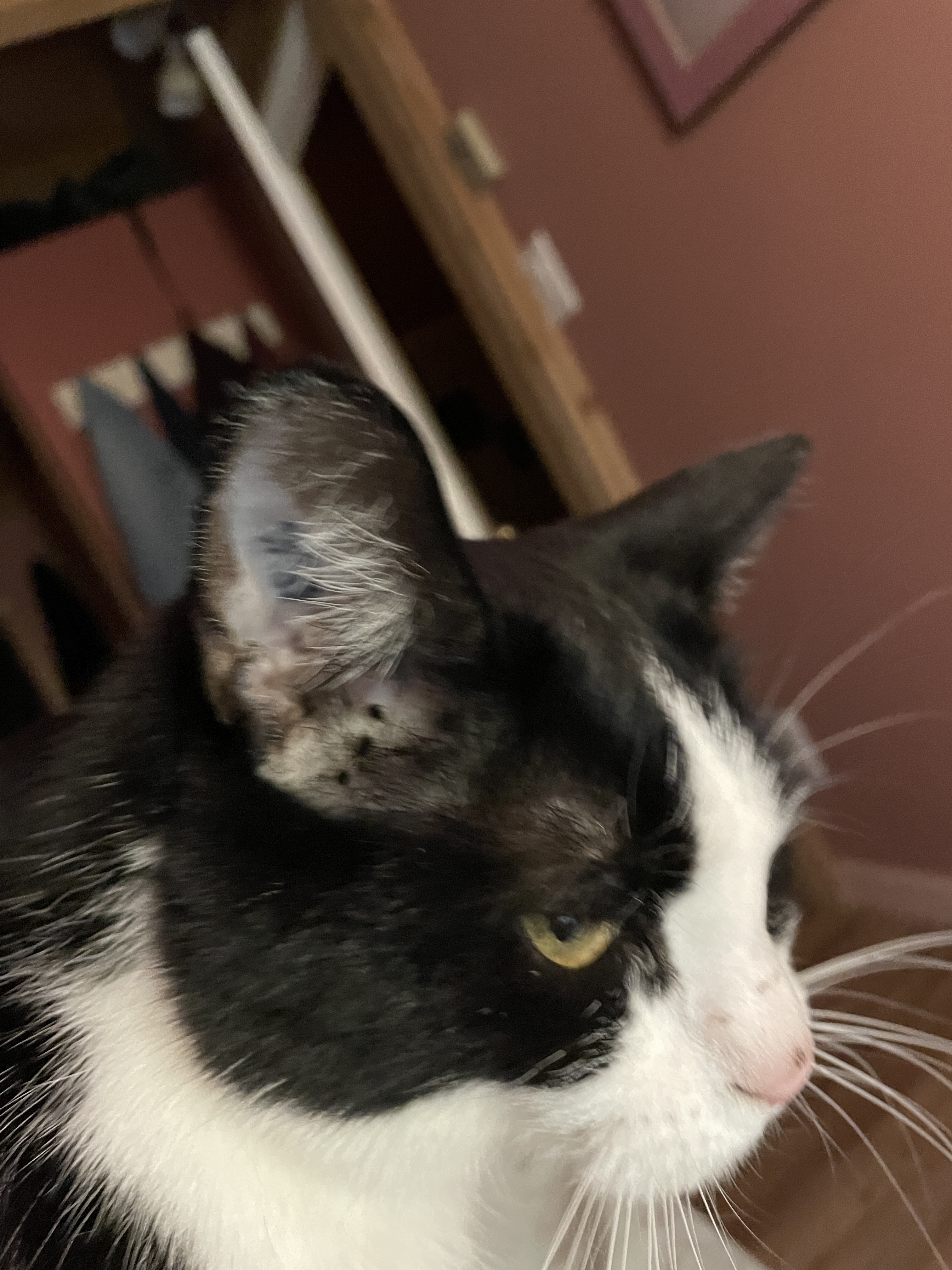
Look at this picture of her. She doesn’t look particularly nasty, does she? She’s quite sweet sometimes. She’s not a cuddler at all but she doesn’t mind being carried around if she’s in a good mood. However, she is prone to biting and clawing if she doesn’t feel things are going her way, or just to assert her dominance. 

She doesn’t get along with the dog (Tilly), but they haven’t really tried very hard. Tilly tends to want to chase Princess and that doesn’t go over very well with the Princess nor with me. I don’t know what Tilly would do if she caught Princess and I don’t want to find out either. It’s obvious that Tilly is afraid of Princess. 

Cats are generally weird and she’s a good representative of her species on this count. 
______________________________________________________________________

*Given this name by my granddaughter, Ailey Vines. 

The Kindness of Evolution.

Lately I’ve been reading books by Kim Stanley Robinson. He’s a contemporary science fiction writer who ranges freely into dystopia and utopia. I first read his Mars Trilogy and I’m now following that up with New York 2140. Imagine New York fifty feet deeper in water than it is now. Half the buildings in Lower Manhattan are partially submerged and roads are now canals. Flooding has not stopped the rapaciousness of capitalism, however, which has gotten worse in the next one hundred years. It may just get its comeuppance though. Robinson’s work, although not high literature, is prescient in my estimation and is a fun read.

Most people would consider the drowning of coastal cities a disaster, and it undoubtedly is, but we don’t have to wait until 2140 to find out what coastal flooding can do. We’re getting a taste of it now. We’re also getting a taste of what fire can do as well as tornadoes, hurricanes, volcanoes, etcetera. Reading the news these days, and you’ll be introduced to fires in British Columbia, dams bursting in China, and floods ravaging Germany. So, disasters are not uncommon, and the News media are only too happy to tell you all about them. 

Still, we don’t seem to be able to get prepared for natural disasters so as to mitigate the worst of the damage they cause. Recently, Angela Merkel, the German Chancellor, opined that they would have to do better in the future regarding disaster preparation. I might note that disaster preparedness is only going to happen if there is money to be made in doing it. That may seem cynical, but history bears me out, I think. 

One thing we have to recognize is that there are many kinds of disasters, and they don’t all unfold at the same rate. A volcano usually happens at a very fast pace, but climate change, which must be considered a high magnitude disaster, unfolds are a glacial pace although some of its effects unfold as quickly as any natural disaster because, in effect, that’s what they are.

Something very interesting about human psychology is the surprise or denial we all experience in the face of disaster. Flooding? Well, we didn’t expect that now did we. Cancer? Surprise, surprise! Why me? Climate change? Nah, it ain’t happening. 

Robinson has an explanation for our reactions to disaster or catastrophe:

“…you can’t really imagine a catastrophe will hit you until it does. People just don’t have that kind of mental capacity. If you did, you would be stricken paralytic with fear at all times, because there are some guaranteed catastrophes bearing down on you that you aren’t going to be able to avoid (i.e. death), so evolution has kindly given you a strategically located mental blind spot, an inability to imagine future disasters in any way you can really believe, so that you can continue to function, as pointless as that may be. It is an aporia, as the Greeks and intellectuals among us would say, a “not-seeing.” So, nice. Useful. Except when disastrously bad.” (from “New York 2140” by Kim Stanley Robinson)

So, Robinson argues that natural selection has kindly provided us with a “strategically located mental blind spot” when it comes to disasters, including death. Death for all of us is the ultimate, unmitigated disaster, but we deny that it’s coming, or we just turn the other way and hope for the best. We just can’t believe or accept that a disaster is happening. I expect that other species have much the same reaction to disaster that we do. It would be impossible to be anticipating disaster all the time. As Robinson points out above, if that were the case “you would be stricken paralytic with fear at all times”. 

As Robert Sapolsky notes in Why Zebras Don’t Get Ulcers*, zebras are stricken with fear when they are chased by a lion, but if they avoid getting killed, they return to grazing on the riverbank as if nothing had happened. Humans, on the other hand, can imagine future catastrophe, but not in a way we can really believe. For example, as I drive down the highway, I don’t expect that around every curve an oncoming car will skid into my lane and crash into me head-on. If that were the case, I think I’d have to give up driving. Same goes for death. If I thought about my death every minute of every day, I would be unable to function in life. 

Thanks to evolution, we have a “mental blind spot” when it comes to catastrophes and disasters. Life would be impossible without it. Still, we must deal with the generalized anxiety that the possibility of disaster engenders, hence our proneness for getting ulcers and/or visiting psychiatrists.

*Sapolsky, Robert. 2004. Why Zebras Don’t Get Ulcers, New York: Henry Holt.

Up, up in the air.

What do I want to do with this blog? The thought crossed my mind that just giving up on it would not be the worst-case scenario. I’ve been at it for a few years now so it wouldn’t be outrageous for me to either quit entirely or maybe just take a break over the summer. Mygawd, I’m not making any money writing it. Lots of bloggers make money on YouTube with their blogs. I don’t, so what’s the point? Maybe I could monetize my blog, attach it to a video log and turn it loose on YouTube. After all, we DO live in a capitalist society. Might work. Probably not. 

The weather has been wonderful lately if you want to lay about on a deck. I sit on the deck close to the rock/fountain and watch the birds come down for a drink. The one in the video here is a female goldfinch we think. She flits around avoiding direct contact with the fountain. It would probably knock her over if she did. 

The wisteria gives them some shelter and protection before they come down to the fountain, but they’re still wary. Smart birds. There are cats prowlin’ around here. Our princess is one of them and she’s a hunter sometimes, mostly mice, but we don’t want to tempt her with birds. She’s being such a brat lately. She seems to have figured out exactly when I’m just about to fall asleep, then she pounces on the bed, meowling like crazy and poking my face with her paw. 

Tilly has been hanging around the pond a lot lately. She patrols the perimeter sniffing around trying to get frogs to abandon their rocks along the shore. I don’t like the way she’s been fixated on frogs lately. She come close but she hasn’t caught any yet. I’d be very pissed off if she did. She spends most of her time under the deck these days where it’s cool. She’s got such a thick black coat she must really suffer in this heat, but she never complains.

Got a call from my Oncology GP this morning. He noted that my bloodwork is coming back from the lab within reference ranges (normal). Tomorrow I go to the hospital for another infusion of Daratumumab. After that, I don’t get another one until the end of August. As of this month, I’m down to once a month for the Dara. I keep taking my regular chemo meds, lenalidomide and dexamethasone, three weeks on, one week off. So, I’m in a weird space where I have no myeloma detectable in my blood, but I’ll be on chemo for the foreseeable future, that is, until the drugs don’t work anymore. At that point they’ll put me on another regime. That means that I must be vigilant around the side-effects of the chemo. It’s not always easy to tell chemo med side-effects from pain med side-effects. 

For an old man, I’m feeling pretty good these days for about fifty percent of the time. I’m sleeping moderately well most of the time, but I have wakeful nights periodically. My neck is what’s tormenting me the most these days. According to my Oncology GP I have OAD (Old Age Disease). I can’t turn my neck more than 3% left or right. Maybe 4%. Makes it hard to do shoulder checks when I’m driving. Of course, I still drive. What are you thinking? I just have to turn my whole body when I do a shoulder check. That’s fine.

Technically, I have degenerative disc syndrome and it’s common among older people. I’m getting a CT scan early next month to confirm the diagnosis. Once I get the scan, I can ask my GP for a referral to someone who might be able to do something for me. That would be good. If I do get some relief, I’ll be able to do more writing, and maybe some sculpting. I’d love to do a bit of printmaking too. Or maybe I could just lie on the couch more comfortably. That would be good.

The improbable may just be possible.

[This is a short blog post because I want to share the information contained therein. Other posts, much less optimistic, will follow.]

The IMF, not the International Monetary Fund, but the International Myeloma Foundation has for many years invested money in research into the prevention and cure of multiple myeloma. Every oncologist we’ve ever spoken with has assured us that multiple myeloma is incurable but treatable. Now, there is open talk about getting to a cure for myeloma. 

The video and documents below explain the incredible advances towards the prevention and cure of myeloma. Obviously, I have a personal interest in this research. The cutting-edge medications I am receiving are giving me a chance for long-term remission of my disease, but even greater advances are being made and it’s all very exciting especially for younger patients who, if in their 40s, face decades of chemotherapy, stem cell transplants, and monoclonal antibodies. One of my sisters has a grandson with multiple myeloma and he is in his forties. Any advances in the treatment of myeloma and prospects for a cure are exciting to hear about, particularly for patients of his age. Please take the 3 minutes to view the YouTube video I attach below on the Icelandic research push. If that interests you, there is more information from Dr. Brian Durie’s blog a link to which follow the link to the video explaining exciting research being conducted and coordinated on the prevention and cure of myeloma under the Black Swan research umbrella. 

The IMF’s iStopMM (Iceland Screens Treats or Prevents Multiple Myeloma) publishes its first paper. https://www.youtube.com/watch?v=LskOC39mYx8

https://www.myeloma.org/blog/black-swan-research-projects-forge-ahead-2020

And the beat goes on…

Yes, it does. Sonny and Cher knew what they were singing about what seems like a lifetime ago now. I don’t know why, but the fact that Sonny died slammed up against a tree on a ski slope in Lake Tahoe the day after my birthday (January 5th) 1998 has my current attention. I guess it’s because his is a good example of a quick, unpredictable, death. Sonny had no time to sweat it. Death just happened to Sonny. No time to ruminate about it. Go Sonny go! I must confess that in some ways I envy Sonny his quick release.

Moving on, in my last post I told you that there was no longer any trace of multiple myeloma in my blood. I’m happy about that, but I must attach a disclaimer to that fact. The multiple myeloma will return. As I’ve repeated over and over, multiple myeloma is incurable although it is treatable. My oncologists have suggested to me that myeloma is a lot like type 2 diabetes in the way that it is treated by the medical profession. 

So, I can reasonably expect to make it to my eightieth birthday, although, frankly, longevity is not the holy grail here. And, of course, the six years from now until my eightieth year are not years owed to me. They are purely hypothetical time, years I might live, and years I might not. Moreover, as far as I know, after I’m dead, I won’t be able to regret anything about my life, how I lived it and for how long. “I” will not be so it’s ridiculous to speculate on what “I” might do after “I” am no longer. After I’m dead, “I” enter my immortality stage. 

I was not going to explore the whole business of mortality in this post, but I changed my mind. Bear with me. I just want to introduce here some ideas that I’ll come back to it in an upcoming post. These are not simple concepts to grasp, but, if you make the effort, it may help you understand life and death as I see them. So, here we go:

Humans are mortal, but only as long as we’re alive. To be blunt about it, it’s only when we are alive that we can die. Once we die, we are no longer mortal, we now become immortal, that is, we no longer change, and we consist only of what others remember of us. Our lives are complete. Simply put, immortal means not mortal. Well, once we’re dead, we are no longer mortal, by definition. We’ve arrived! We’ve become immortal! That doesn’t mean that we will live on forever in some form or other as defined by most of the religions that exist on this planet. No. “We” exist, after our deaths, only in the minds of others. 

My definition of immortality is clearly not the one espoused by most religions. The Abrahamic religions, for example, get around the problem of death by coming up with the idea of the soul. According to Christianity, the soul is the immortal aspect of human existence and is continuous before and after death. The body may return to the planetary store of compounds, atoms, and molecules, but the soul, well, the soul lives on in some kind of ill-defined relationship with a deity, “God” in the case of Christianity.  My definition of immortality does not acknowledge the bicameral nature of the person as consisting of body and soul. I see no evidence for the existence of a soul. Therefore, it does not ‘fit’ into any explanatory scheme I concoct. 

I could go on and on about death and dying as most of you well know, and as I promised I’ll get back to it in a subsequent post, but for now I’ll drop the philosophizing about immortality, death and dying and take up an issue that I’m currently faced with given the fact that we’ve tamed my myeloma. 

A few months ago, while I was still struggling with active myeloma, the pain in my bones was severe, and it was compounded by peripheral neuropathic pain. At that time a priority for me was pain relief. It still is to a large extent, but now, my priority is to see how far I can go in weaning myself off pain medications that were crucial for me for the time I was under the full effect of myeloma.  Now, I’m on two prescription pain medications and I take acetaminophen when I think of it. I was on three prescription pain meds until just recently, but I quit one of the medications cold turkey. Along with several annoying side effects, one of the more insidious side effects of that medication is dry mouth. My sense of taste was affected. I could barely taste some of my favourite foods and some I could not taste at all. I was anxious to try life without this med and as it turns out I’m quite confident that I’ll be fine without it. 

That leaves me with two pain meds. Gabapentin is a med I take for neuropathic pain. I’m currently cutting back on it to see how it goes. I’m not going cold turkey on Gabapentin, but I am determined to eliminate it from my pantheon of drugs. Hydromorphone is the drug that is the backbone of my pain treatment. I take it in slow-release form twice a day to deal with the daily predictable pain I get from myeloma’s excavations of my femurs as well as from sciatica and degenerative disk disease. I can also take hydromorphone in what’s called a pain breakthrough mode. That is, if the slow-release form of hydromorphone isn’t doing the job, I can take a more fast-acting form of the drug in any amount I feel is needed. I have taken breakthrough hydromorphone, but only sporadically, and as a last resort. I take as little of this drug that I feel will do the job. Taking more than a few milligrams of breakthrough hydromorphone leaves me hallucinating, not something I enjoy.  

The problem is that I’m seventy-four and at my age, the degenerative process is well under way. There’s no stopping it, and it’s not satisfied until it’s done. At my age, just about everybody has back pain and sciatica. These are conditions endemic to the species. It serves us right to have evolved from an arboreal species to one that is bipedal and an upright walker. Monkeys don’t have back problems. 

So, my challenge at the moment is to reduce my intake of pain meds to the point where I get pain relief without experiencing all the negative side effects of the various meds involved. So far so good. We’ll see how it goes.

__________________________________________________________________________

I’m writing this post on one of the hottest days of the year so far with tomorrow promising to be even hotter yet. Thankfully we have air conditioning, so the house is staying at a very acceptable 24.5˚C. Outside today, according to our weather station, the temperature has topped out at around 40˚C. Tomorrow, the prognosticators have promised us temperatures of 40˚C at mid-afternoon, so the beat goes on. 

I’m not complaining about the weather. The weather is what it is. It doesn’t respond to our needs, but instead requires that we respond to it if we’re not happy with it. Good luck with that. On to the next post now. Maybe I’ll take less time to get it out than it took me to get this one out. No promises. 

Check out this article Carolyn found for me. It’s a great discussion of chronic pain:

https://www.theguardian.com/australia-news/2021/jun/28/sufferers-of-chronic-pain-have-long-been-told-its-all-in-their-head-we-now-know-thats-wrong?CMP=Share_iOSApp_Other

# 87. The Last Post in a Series.

Last Friday morning, we (Carolyn and I) had a meeting with my oncology consultant, Dr. Nicol Macpherson, at the BC Cancer Agency in Victoria. We meet with the oncologist in Victoria maybe three times a year. The rest of the time we have a local GP who specializes in cancer treatment. Our local GP oncologist is Dr. Bakshi. We’re quite happy with the service we get from the BCCA and from the local staff of nurses and Dr. Bakshi at the Cancer Care Centre at the Comox Valley Hospital. The meeting with Dr. Macpherson this morning was especially eventful. 

I knew that I was doing well with the chemotherapy and monoclonal antibody treatments I am getting. I started my current regime in mid-February of this year and the progress I made in a month was nothing short of stunning. We keep an eye on my frequent lab tests by logging into an Island Health website called MyHealth. On that site I get to see all the results of my lab tests, imaging results, and upcoming appointments. Obviously, we need to know what we’re looking at when we check out my blood serum profile including my paraprotein and Kappa Free Light Chain numbers which are of particular interest in my case. After some research and consultation, we now have a grip on what the lab results mean for my myeloma activity although the information is always incomplete and must be interpreted fully by someone who has better access than we do to the numbers. That someone is Dr. Macpherson in Victoria although Dr. Bakshi must also have access to my numbers, and my GP is probably copied on all the documentation coming from the hospital here and from Victoria. Now for the fun part:

So, Macpherson told us this past Friday morning that there is no trace of myeloma protein in my blood at the moment. No trace at all. He expects that that will be the case for the foreseeable future, years probably. 

We have been hoping for this result, but we had a bit of a setback late last year and early this year so we were doubtful that the zero myeloma protein in my blood would be an ongoing condition. It now appears that it is. The next few weeks will give us a definitive answer, but the situation looks very good. I have to keep reminding myself that myeloma is incurable but treatable. At the moment I’m in full remission. Inevitably the myeloma will make a comeback. We don’t know when, and that’s the frustrating part of this narrative. Still, we are in a good place right now and probably for some time to come. 

The situation with my cancer being resolved for the time being, I’ve had to rethink the focus of this blog. I have published well over four hundred posts but only eighty-seven addressing explicitly my experience with myeloma. Given the current situation I’ve decided to close the series of posts dedicated to myeloma and open up the blog for other topics and commentaries on current affairs, life and death. I started this blog in 2012, the year I retired. That’s quite some time. Maybe I’ll aim for a thousand posts. There’s no purpose in doing so but I can set up an arbitrary goal if I want. Whatever. 

Sometimes I’m tempted to shut the thing down completely but then I get the itch to write a commentary about current affairs, to get something off my chest, or just to post pictures of the beauty that surrounds me on our property here in Cumberland. We’re approaching the summer solstice. This time of year often brings unsettled weather and exponential growth in the garden which actually needs more heat and sun to ripen fruit and get the lilies to bloom. The lilies are coming up now, slowly, but soon they will colour the garden with splashes of red, yellow, orange, and white. The rhododendrons are still in bloom, at least some of them, but the dogwood and the wisteria have pretty much shed their blossoms and are moving on to create more branch and leaf structure. The weather prognosticators are suggesting that a warm, sunny trend is on the menu for next week. If that happens, we will again be able to sit out by the pond or on the deck next to the water feature there, drink tea and read. We will eat out on the deck again in warm comfort. 

Life is the weirdest thing, and I don’t mean just as it applies to humans. It seems a little perverse to me, actually. The whole thing does. The birth, growth, maturation, and then decay seem to be a waste of experience and a slap in the face to beauty which it prepares to annihilate in a short time in the last quarter of life. It celebrates renewal but only on the destruction of what went before. The death of one generation means life for the next one. For us humans the process of life is particularly insulting in that it promotes the growth and accumulation of knowledge, of piles of household goods, and property in general just as it prepares to shut it all down and make fodder out of it. Of what use is that? None that I can surmise. But, in any case, let’s not glorify usefulness. 

The concepts of use and purpose don’t apply to life or they apply completely to it. Death is necessary as a base for life. No death, no life. So, ultimately the purpose of death is to act as a basis for life. Life, in the spring, likes nothing more than a pile of shit or manure to drive new growth along. That may be true, but it doesn’t mean I have to like it. My death is not far off. According to the statistics, I have maybe five more years before I reach the average length of life in Canada for males. Given the success we’re having with chemotherapy and monoclonal antibodies I could just reach the average lifespan. Eventually, myeloma may well kill me, but whatever, something has to do the deed. I need to die, we all do, to make room for future life. Bring it on.

A picture containing tree, plant, flower, arranged

Description automatically generated
A nice picture of white, red, and orange lilies to end with.

#86. ???????

I woke up this morning at seven twenty three and got out of bed at seven twenty eight. In that five minutes between seven twenty three and seven twenty eight I had a couple of thinks1. These were little thinks, nothing momentous or earth-shattering. They were thinks about what I would do today. I decided on a couple of things to work on, writing a blog post is one and the other is going down to my studio to continue a clean up I started some time ago in preparation for some work I want to do.

Today is the day after my Daratumumab infusion at the hospital. That’s a bi-monthly event for me. We get to the hospital for a nine o’clock appointment. I grab a coffee after being logged in at the Wellness Centre then make my way to the Cancer Care Centre. After getting settled in they hook me up to an IV drip and then call the pharmacy to tell them I’ve arrived and that they can prep the Dara. Yesterday it took over an hour for the pharmacy to get the Dara to the Cancer Care Centre. I waited patiently but with a little frustration, I must admit. After about ten fifteen they released the Dara starting the infusion. I read my book for a bit but soon fell asleep. I woke up at eleven forty five. Cool. The infusion was almost done. It generally takes about one and a half hours. At about twelve twenty, Carolyn picked me up and we came home.

Along with the Dara, as you well know, I take dexamethasone and lenalidomide. These are the chemo drugs. Dara is not a chemo drug, but a monoclonal antibody. Click on the word Daratumumab in the paragraph above for some good information about Dara. Dex and Lena are very different drugs that do different things in the blood. Dexamethasone is a steroid and has some annoying side effects like interfering with sleep. That it did last night. I slept in fits and starts and got maybe four hours of sleep total. I won’t get much sleep until Monday.

My life these days is organized around my chemotherapy. Of course, my Dara infusions predominate, but the dex has the most immediate and dramatic effects aside from the hydromorphone. I most often go to bed before nine o’clock in the evening. I rarely go to sleep right away, however. Yesterday, I did fall asleep after going to bed at eight thirty. I woke up about forty-five minutes later with a start. I had gone to sleep with the cat laying between my legs. I dreamt that the cat had been joined by my brother. I woke up with nobody on the bed with me. I was startled when I woke up but relieved too because I find it uncomfortable to have the cat sleep with me. I mean, I could easily get her off the bed, but I’m a sucker for the cat. She rules.

A preoccupation I have these days relates to the purpose of life and how to determine what to do with the time I have left to live. I have all kinds of time every day to think about things so off I go. Obviously there will be some physical restrictions that hamper the kinds of activities I can do; after all, I am seventy-four years old. One serious big think I’m having these days is coming to grips with the kinds of activities I am still capable of doing amongst the many I did during my younger years. I don’t want to simply lay back and avoid any activities that would require of me exertion that might tire me or leave me incapable of doing anything for a couple of days afterwards. I’m still strong enough, but I’m not as well coordinated as I used to be. I’m learning that I have to strike a balance between what I want to do and what I’m really capable of doing. There is a slew of activities I did when I was younger that are beyond me now. I have to be realistic about these things. I cranked up the chainsaw the other day and chopped a bit of wood. That was fine. I could do that. But what I want to do in terms of sculpture would require that I use saws and chisels for a sustained period of time. I don’t know if I have the sustainability to sculpt, but I know I can paint and draw. Whether I have the desire to do these things is another question.

____________________________________________________________________________

1 This is a verb being used as a noun, but it’s probably not original.

The questionable quality of longevity.

Lately I’ve been reading books from the 90s. The books by Kim Stanley Robinson, especially the Mars Trilogy are, not surprisingly, set on Mars and span a period of several hundred years. It seems Robinson is not inclined to write about earthly events and characters, focussing his attention instead on Mars, her moons, and the asteroid belt that he has also transformed by technology to support human life. The book of his I’m currently reading is called Aurora and is about the travels of humankind outside the solar system for the first time. Their destination is the Tau Ceti e system some twelve light years from the Terran Solar System. It takes them many generations and 170 years to get there, a scenario packed with angst about life and death.

In an earlier work, Robinson confronts mortality straight on. He concludes about the characters in The Mars Trilogy that:

A long life is not necessarily a good life.

Their lives were long, very long indeed if they took “the treatment”. They could not yet know just how long they could live because few of them had died of causes relatable to an ordinary life, of ‘natural causes’ not that they were invincible. It’s true that most inhabitants of Mars were over two hundred years old. Two had died in an explosion, one had died by violence, another by being swept into a roaring river of ice into the depths of a swift moving glacier. In his Mars Trilogy Robinson has cleverly endowed his protagonists with very long lives. However longevity does not equal high quality and death will not be denied.

“There were all kinds of madness, evidently. Ann wandering the old world, off on her own; the rest of them staggering on in the new world like ghosts, struggling to construct one life or another. Maybe it was true what Michel said, that they could not come to grips with their longevity, that they did not know what to do with their time, did not know how to construct a life.”

from “Blue Mars (Mars Trilogy Book 3)” by Kim Stanley Robinson.

Mars colonists may not know what to do with their two hundred or more years of life. What about us? How do we decide what to do with our lives? How do we construct a life whether we have a month left to live or two hundred years?

This is really an unfair question given the vast range of possible answers along a plethora of trajectories. But it’s a question that can generate some critical thinking about our lives and how we live them. For that reason I feel justified in asking it. Still I think that narrowing the focus of the question could be valuable.

The questions that interest me the most concern our relationship with death and immortality. These are ‘intellectual’ questions that have nothing to do with the material requirements of life. Of course, no matter how we look at it, life means movement. Death implies stillness. That may be why so many of us are gripped with the need to do…something…anything. Doing justifies living. Stillness or inactivity reminds us of death.

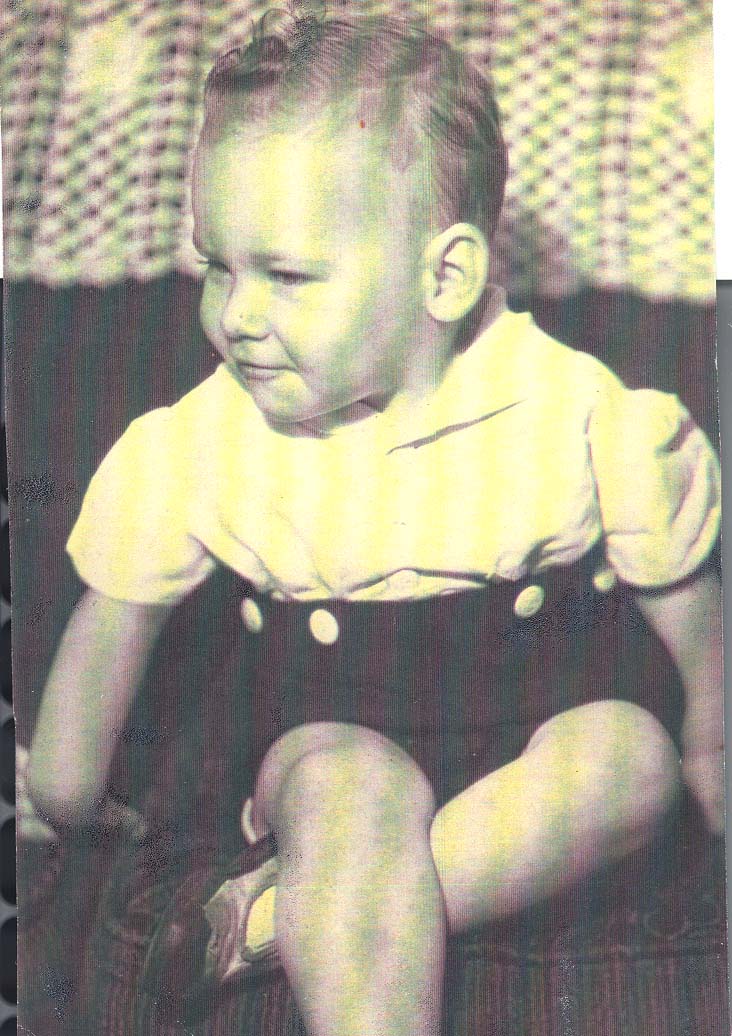
Me at a very young age. Don’t know exactly how old.

This photo is of me at a very young age, not sure exactly how old. That said, I am not the person you see in the photo. In fact, although arguably I am the person depicted in this photo, I have very little in common with that person. I could say that in the photo you see an embryonic version of me and that may well be true. We, the little dude in the photo and I, are obviously related; we share a life trajectory. But there is not one molecule in my body now that existed in the little dude back then. And the little dude hadn’t read Marx or Darwin. According to Milan Kundera in Immortality little dude would be in the happy first stage of life. The second stage is the preeminently active stage when we realize that death is real and that it is hounding us. To fend it off we must do, build a career, a family, a community. The trajectory in this stage is characterized by growth and the morality of the time expects material production from us. I am in the third and final stage of life, or at least I can be found transitioning into the final stage, the WTF stage, I call it. It’s the stage when strength is fast being replaced by fatigue and exhaustion. Kundera writes:

“Fatigue: A silent bridge leading from the shore of life to the shore of death. At that stage death is so close that looking at it has already become boring.”1

I’m bored, but only to tears, not to death. I’m just now standing on the crest of the bridge but I can easily make out the shore of death on the horizon which is becoming clearer and more distinct every day. According to Kundera, this third stage is where freedom can be found. If I knew what freedom was I might be more eager to actively pursue it. The third stage will come or I will die in angst fussing over the quality of my life experiences and my immortality which, of course, can only exist after my death.2

_________________________________________________________

1 Kundera, Milan. 1990. Immortality. New York: Harper Perennial. page 71.

2. Kundera considers immortality as that view that encompasses an entire lifetime but is also restricted to it. It is a fixed entity that has no place except in the memories of those left behind. It is not soul based unless you can think of the soul as the totality of what we leave behind. It is not eternal life but the memory of a whole life lived. Death completes my life.