Beaver Tales, Colonialism and Science Pub Nights. Part 2: Beaver fur makes nice hats especially after indigenous people have worn it for 15 months.

In my last post I wrote about the various biomes in North America and how Indigenous groups were adapted to the local conditions. It’s safe to say that we know very little about the thousands of years pre-contact in North America especially from the perspective of Indigenous people themselves. There are tons of accounts of European colonialism and the history of Europe is accessible to us all although it may not be as objective as some people think. The question is: Who gets into the history books? Why, kings and Queens, Knights, Bishops, and Popes. You’d think it was a giant chess game!

That said, and getting back to beaver, the trade in beaver fur was largely concentrated north of the 49th Parallel and in most cases, north of the 55th up to the barren lands of the Canadian Shield. In the south, beaver fur was of lighter and poorer quality that in the north and beaver were nowhere near as abundant. On the eastern seaboard, beaver were soon wiped out in the Hudson-Mohawk River system. By the mid-17th Century, the beaver were virtually wiped out along the eastern shores of North America they were so heavily trapped.

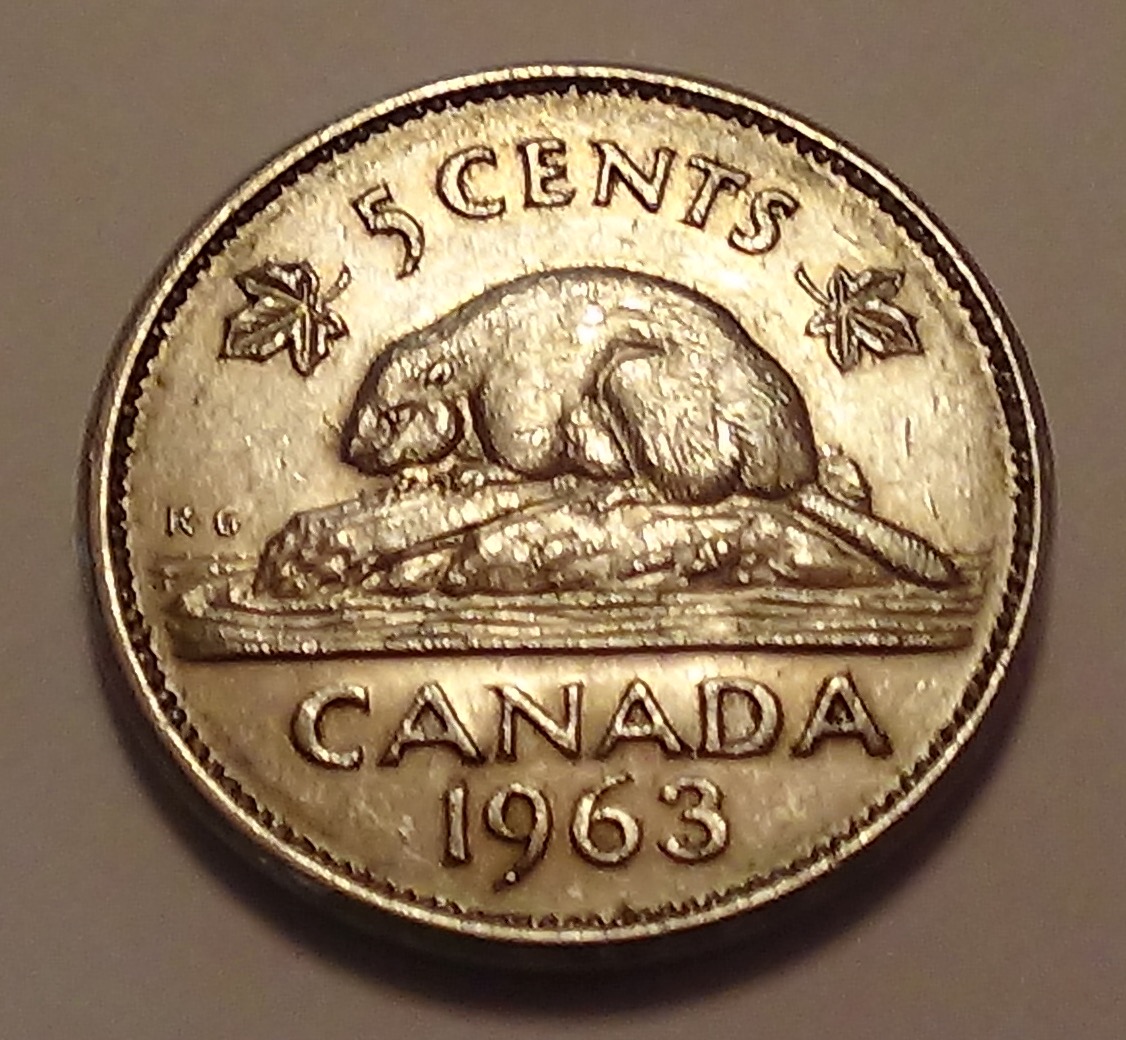
The hunt for beaver makes for a fantastic story because it is nowhere near as straightforward as it might seem. The image of a beaver graces our nickel in honour of its role in the creation of the country. See the beaver on the nickel:
It has a rightful place there, I believe, but it would be just as right to have it grace a one-pound British note or a Euro because the trade in beaver fur had as much of an impact on European economic development as it had in North America. During the 17th Century in Britain the mercantile capitalist elite and the gentry were able to capture the British government (we sometimes call it the Cromwellian Revolution) but the newly-created industrial capitalist class was just getting a full head of steam, and employed over fifty percent of the working population. The situation was not the same in France where the Absolutist Monarchy maintained a much higher grip on economic activity. The need in North America for European trade goods like knives, kettles, awls, guns and steel traps created a huge impetus for European industrial development and innovation. That impetus was the result of the North American Indigenous peoples’ desire or craving for tools that made their lives so much easier than they had been previously.

So, the beaver fur most sought after by European hat makers was called castor gras d’hiver or fat winter beaver which is also called coat beaver. It was fur that had been worn by indigenous people for fifteen to eighteen months, fur on the inside which tended to loosen the long guard hair leaving the soft, velvety ‘wool’. As I noted before, the early fur trade was incidental to the fishery on the St. Lawrence. Even in 1534 as Jacques Cartier sailed into the Gulf of St. Lawrence, Indigenes, probably Abenaki and other coastal groups he encountered, offered him coat beaver that they waved over their heads stuck on long poles. He traded with them in 1535 and 1541 meaning that they already had knowledge of the European market for beaver pelts before Cartier even showed up. No doubt Basque and other European fishing boats had landed on the coast and sailors had recognized the value of the clothes that the Indigenes wore and traded some European tools for a few skins. However, the fishers had no organization to exploit the fur trade so it stayed incidental to the fishery until well into the next century after the arrival of Samuel de Champlain in 1602 when he brought organization to the trade and build Québec in 1608. The Montagnais who lived north of the St. Lawrence traded with the Europeans at Tadoussac, having come down the Saguenay River fully clothed and leaving naked after trading the very clothes off their backs for European trade goods.

Another grade of beaver fur was called castor sec or parchment beaver. It was beaver that had not been worn but prepared immediately after the animal was killed, dried and readied for sale. Hat makers in Europe used both types of fur when making beaver hats like the ones below:
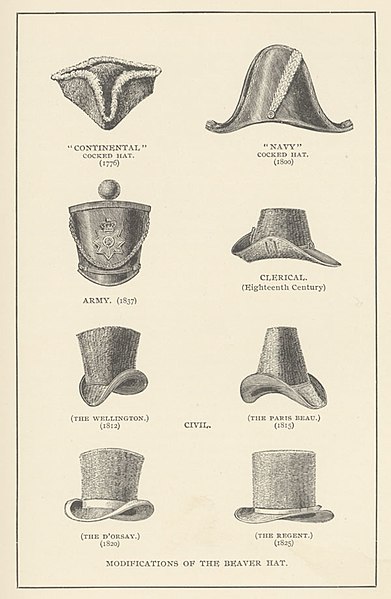
This photo is in the public domain.

Beaver hats were, for the most part, felted hats. That means that the beaver ‘wool’ was shaved from the beaver skin and then felted by a process of applying heat and moisture which causes the hairs to mat together to create a smooth ‘cloth’. Beaver hats in these styles were popular from 1550 until 1850 or so when Chinese silk became the fabric of choice in the making of hats for the well-to-do.*Incidentally, there is a Eurasian beaver (castor fiber) but it had been virtually wiped out in Europe by the mid-sixteenth century. The Russians were manufacturers of beaver hats too and they turned to new sources when the Eurasian beaver disappeared from their territories due to indiscriminate hunting and trapping. The Russian invasion of Siberia was largely due to the fur trade. My focus here, though, is on North America.

In my next post I trace the growth of the North American Fur trade as it spread across what we now know as Canada and its transformation of Indigenous groups into hunters and trappers or middlemen for the European trade.

____________________________________________________________________
*The story of the European hat making industry and market is intriguing in itself. Many of the hat makers were in Spain and Portugal but the hats in many grades were sold all over Europe although at times they fell out of favour and the North American Fur trade faltered.

Beaver Tales, Colonialism and Science Pub Nights

So, the other day I made a thirty minute presentation to a science pub night on beavers and colonialism in the Masonic Hall in Cumberland, British Columbia. Yes, I did that. I was one of four presenters and I was the only one to talk about dead beavers. All the others talked about beavers in wetlands, their role in water retention, their dams, their family lives and their newer reputation as troublemakers, especially for municipal infrastructure, highways, farmers and others.

My job was to talk about the role of beaver in colonialism. My emphasis was on how the political structure we call Canada came about as a result of the spread of Western Civilization into and across North America. It’s a sordid tale of violence, intrigue, greed, adventure, religious proselytization, and general ineptitude wrapped around a cloak of rapidly spreading mercantile and industrial capitalist expansion and the attractiveness of new European tools and technology for the indigenous populations of North America. The globalization we experience today had its major early impetus in 16th Century European economics and politics. Everyone in Europe and North America experienced massive transformation during the period 1500 to 1900 AD but, I daresay, it’s possible to say that about virtually every period in human history (if it’s even reasonable to talk about ‘periods’ of human history, it being a process rather than a series of ‘periods’). What makes this four hundred year timeframe distinctive is how life and work in North America were transformed. It’s impossible to outline here how the various indigenous groups in North America experienced that transformation because there were (and still are) a number of distinctive biomes that demanded of the indigenous groups various and different forms of work and life. For instance, in the eastern part of North America at the time of contact, the Haudenosaunee (Iroquois) were agriculturalists, who along with their northern cousins, the Wendat (Huron) and other groups to the west of them, grew corn, squash, and beans along with, in some cases, tobacco and other crops. The indigenous people of the prairies had very different lifestyles based largely on the bison herds that roamed all over the prairie regions of the continent. The northern indigenous peoples such as the Assiniboine, the Cree and the Chipewyan (Dene) had lifestyles based on hunting and trapping beaver, fox, wolf, and especially moose (although it’s true that some Cree lived on the prairies, some in the parkland and some in the boreal forest). This kind of lifestyle extends from just north of the Great Lakes to the Rocky Mountains on a diagonal from south in Manitoba to northern British Columbia and the Yukon. The lifestyle is dependent on wetlands, rivers, lakes, forests of birch and maple. The diet of forest peoples is largely animal protein from a large variety of fur-bearing animals and fish.

The wetlands of ‘Canada’.

The West Coast indigenous groups were, like the Haudenosaunee, longhouse dwellers because of their relatively sedentary lives based on a relatively stable source of animal protein, berries and other types of edible plants, roots and mushrooms. The northerly indigenous groups were not agriculturalists, but the ones in what is now California, Nevada, Arizona and New Mexico were. The Hopi especially lived in Pueblo villages and practiced agriculture much like the Haudenosaunee. The Apache, Comanche and Sioux lived in teepees, portable and easily erected. That said, getting the poles for teepee construction required yearly displacements to more forested areas. Living in villages and settlements requires very different social institutions than are required in forest dwelling indigenous groups.

Beaver fur, the staple product par excellence that drove the colonial exploitation of the northern half of North America was preceded in its importance to Europeans only by cod fish and other marine species both mammalian and fish. Hundreds of European fishing vessels occupied the Grand Banks off Newfoundland and in the Gulf of St. Lawrence in the 16th Century. The beaver trade was incidental to the fishery for most of 16th Century and it wasn’t until Samuel de Champlain arrived in ‘Canada’ in 1602 that the beaver trade became a force in its own right.

Next post will deal with the importance of beaver for the indigenous populations around the St. Lawrence and on the eastern seaboard in the 17th Century. The hunt for beaver was to change forever the lives of the peoples of North America and those of Western Europe creating Canada along the way in its pre-war configuration.

Stories are Us.

Like trees in a forest, we too are rooted in the living mesh of another organism—in a web of story. We give life to the stories we tell, imagining entire worlds and preserving them on rock, paper, and silicon. Stories sustain us: they open paths of clarity in the chaos of existence, maintain a record of human thought, and grant us the power to shape our perceptions of reality. The coevolution of humans and stories may not be one of the oldest partnerships in the history of life on Earth, but it is certainly one of the most robust. As a psychic creature simultaneously parasitizing and nourishing the human mind, narrative was so thoroughly successful that it is now all but inextricable from language and thought. Stories live through us, and we live through stories.

By Ferris Jabr

From: The Story of Storytelling: What the hidden relationships of ancient folktales reveal about their evolution—and our own

Harpers, March 2019 issue

Stories may not have any relationship with ‘the truth’ but they often, if they touch a common thread of love, connection, fear and loathing, are profoundly compelling and can affect our behaviour in many ways.

For instance, the story that we live in a democracy. We’ve been telling ourselves that story for so long and so compellingly that we’ve come to believe it unreservedly. Our love affair with the thought of democracy makes me think of the young man who falls in love with the idea of falling in love. When he finally meets someone he thinks he’s in love with he is so smitten by the idea of love itself that he can’t see his love object for what she truly is, a gold digger and thief.

It’s true that we can live our entire lives in a shallow pool of thought looking through rose-coloured glasses, never seeing the world for what it is. Some of our stories may turn out to be true, but some of the most important ones will turn out to be no more connected to reality than Little Red Riding Hood. Can you tell which of the stories you believe are true and which are fiction? Does it really matter?

MEH…

I can’t seem to write anything very serious right now. I’ve been researching democracy and capitalism for some time, reading like crazy, and I’ve come to a number of conclusions that I need to write about, but, it’s just not coming together for me right now. It will soon enough, but right now I have to entertain myself with something a little lighter.

Usually I write my blog posts in one go. I’ll research a topic for a while or one will drop itself into my lap…top (he,he) and I’ll sit down and write. Carolyn knows when I’ve been bitten by the writing bug because I go silent and withdrawn and my full attention is on the keyboard. When she tries to talk to me, I have to keep asking “What, Pardon me?” Then, she sometimes gets impatient. I can understand that. Problem is, I’m busy and concentrating on writing sentences, whole sentences that make sense. It doesn’t always happen, but I do make an effort.

I just finished writing an essay about Kurt Vonnegut and riding a ferry to Vancouver. It’s a two thousand word non-fiction piece. I’ve probably spent 40 hours on it all told. That’s an outrageous amount of time for me to spend on any writing project these days, since I’ve been retired from the work-a-day grind. I’m not sure what I’ll do with this essay yet, but I’ll decide soon. if you don’t see it posted here it’s because I’ve done something else with it.

I’ve read many of Kurt Vonnegut’s books. I’m re-reading Hocus Pocus right now then I’ll pick up Breakfast of Champions and read that again for the third or fourth time. The guy is fucking hilarious even if his novels are always tinged with at least a modicum of sorrow. Galapagos is one of my favourite novels of his. The premise of that book is that the human race has been infected with a virus or something that prevents reproduction so that the fate of humanity is sealed within a few decades. The only survivors are on the Galapagos Islands where they were safe from infection and a million years hence they look a lot like seals and live in the sea. It’s a fun read and I wouldn’t be at all too upset if the premise of this book became a reality. We as a species are right out of control.

So, what’s the connection between Vonnegut and riding the ferry to Vancouver? Well, ferry passengers often embody in a microcosm aa lot that is absurd about human life. Vonnegut would have a field day riding the ferry although I expect he might stay in his vehicle or take a plane instead of ever getting on a ferry.

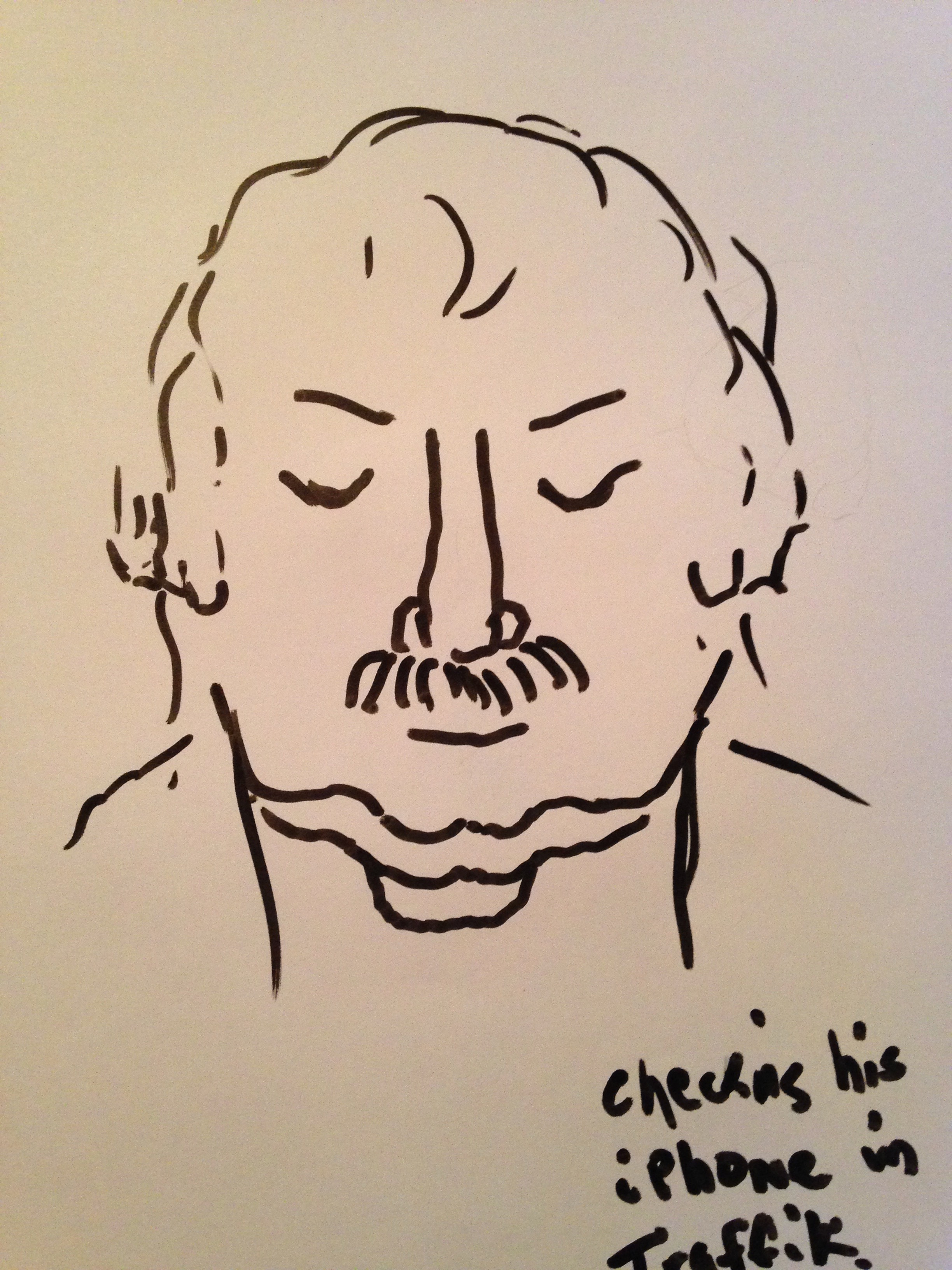
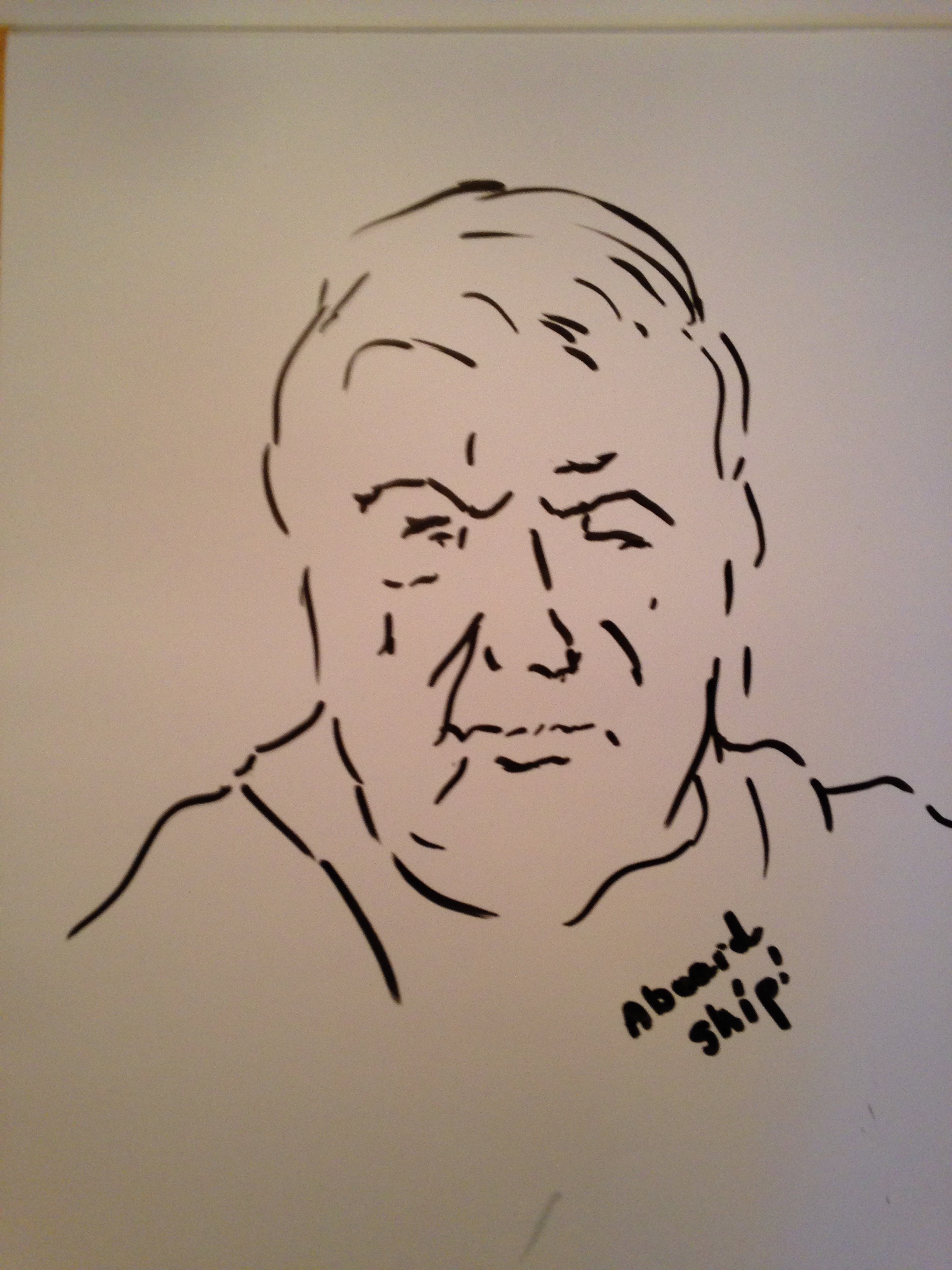
I find ferry passengers highly entertaining most of the time. Sometimes I just find them annoying. Sometimes, I draw them, like these guys:

Mostly I don’t, because it’s hard to be discreet when I’m drawing. I have to look closely at my subjects at times and if they figure out what I’m doing, it could get embarrassing. It may be, of course, that they would be delighted and offer to buy my little drawings of them but then again, probably not. They’d probably just want me to give it to them and I’m not into that so much anymore. Oh, I do give away a lot of my drawings and prints, but not in the wintertime. Don’t ask me why.

It’s certainly true that a lot of ferry passengers are hugely entertaining, and mostly not deliberately, I fear. Invariably, there are people who are outrageously dressed, at least from my perspective, and there are others who are just plain silly like young people full of themselves and too self-absorbed to care about how their behaviour is affecting others on the boat.

Given enough time, I could write little stories about every single passenger aboard any ship on any trip just based on their appearance and demeanour. I could then weave those stories into a collage of silly speculation about what ferry travellers are up to when they’re not on the boat.

For example, the guy in the second picture above was checking out his cel phone. He was on that thing for a long time. I have no idea what he was looking at, maybe it was porn, maybe he was checking his dating site, maybe he was just surfing Facebook. Who knows. I didn’t ask him. I drew him instead. He never looked up so I was in no danger of him finding out that I was drawing him. His double chin really stood out! Mine does too when I look down like that. I wish he would have had a call from somebody while he was looking at his phone. I can make up a lot of stuff about somebody by overhearing conversations. I love eavesdropping. It’s just part of what makes me a social scientist.

So, enough of this silliness for today. I’ll get downright serious soon enough and then you’ll learn a thing or two!

Computers:Woe is Me!

Sometimes I love my computers. Often I hate them. And I have mixed feelings about the networks and such that my computer consorts with. Yesterday, my early 2011 old MacBook Pro decided it was a good day to die. If that wasn’t bad enough, our internet connection decided it no longer wanted to play either. In the case of our internet connection, it’s probably the Shaw Hitron modem that’s the issue, at least that’s what the Shaw tech guy I talked to in Winnipeg thought when I called on Sunday. It’s not the first time we’ve had issues with our internet connection. A Shaw tech guy (no, not the guy in Winnipeg) is supposed to come out later today to look into the issue, I hope whoever it is can fix the damn thing. Trying to type emails on our phones is almost as frustrating as having the internet connection itself go down. At least we have some communication with the outside world using data on our phones. Our WiFi network is working fine, it just hasn’t found a way to dance with our internet modem.  Oh well. 

As far as computers go, my old MacBook Pro is certainly dead. I operated on it, took its hard drive into My Tech Guys in Courtenay, our local dealer, and were told that it was toast. I was hoping maybe it was just the video card or the mother board but no, the hard drive is kaput as is the battery. I already replaced the keyboard on the thing and a few other parts and that’s my third battery in there, so, now is the time to surrender. I’ve raised the white flag. I give up. No more money to be spent on expensive operations. 

So, what to do? Buy another computer of course. I’m pretty cheap when it comes to buying some things. I really feel that way about electronics. I expect my computers to last at least a tenth as long as me. That’s been the case so far. Our Macs have done very well, actually. We have one old blue iMac that came out in 2002 and it’s still working fine and we have another desktop model Mac that has three hard drives in it and has tons of storage capacity. It’s at least 10 years old. Problem is I can’t pack those around and I often want to pack a computer around. I’m not going to say I need to pack one around, because that wouldn’t be the truth, but I surely want to. I’m retired so needing is a bit of a stretch. I’m mostly in want mode these days. It’s like I need my sleep but I want my computer to be portable. 

Now I have a brand new Mac Air. It’s a solid state computer. No hard disk, just 128 gigabytes of storage. I’m used to more than that, my old MacBook Pro had a terabyte drive, but I can always store photos and videos on our external drives. Problem is, my old dead drive had a lot of files and passwords in it that I would dearly like to have access to now. I wasn’t too worried about it because I have a backup system, but I just tried to access that and wasn’t able to. Yikes! Is it time to panic? Well, maybe not quite yet. It may be that our whole computer universe is waiting for the Shaw tech guy to come and get us plugged back into the world. I hope so. Today will tell. 

Addendum: Josh, the Shaw guy came over yesterday and checked things out here. Turns out we had too many ethernet connections from the shaw modem to the Apple modem. Easy fix. My bad.

I was able to retrieve everything off my old computer. Now I just have to select the files I want to use. The others can stay on the external drive.

Fun and games.

GM Committed to Canada?

GM, on its website claims in very large text that it is committed to Canada and its employees in Oshawa.

Well, although I don’t doubt the sincerity of the person who actually wrote this material and even of the GM company itself, it’s obvious that GM is not and cannot be committed to Canada ahead of its commitment to itself and to profit. It will sacrifice whatever it needs to in order to stay alive as a viable company.

Be warned, the Oshawa layoffs are just the beginning of a trend in GM towards hiring new kinds of engineers, many out of Silicon Valley, with a plan of producing electric and self-driving vehicles. According to the company’s website and to industry analysts, GM sees Cadillac as its first electric car offering to compete with Tesla. Now that’s interesting! It proudly states that unlike European carmakers GM has not opened a factory in Mexico for 10 years. That may be true, but that doesn’t mean that its current plans don’t include bringing parts from all over the world to its assembly plants in North America where their cars are ‘made’. It’s future does include layoffs of over 20,000 workers. In that, GM is not much different from any other large global secondary manufacturing organization.

Obviously, GM is in the business of selling cars and trucks. It doesn’t help the company’s image among nationalists that it’s willing to put 2600 Oshawa workers out of work leaving the plant ‘unallocated’. Unallocated means they have no plans to produce anything in that plant after the plant closes in December or ever. So, to mollify the opposition, GM says that over half of its employees at Oshawa Assembly were due to retire anyway. Its website reports that:

  • GM Canada has committed millions of dollars to help our Oshawa Assembly employees transition and retrain – so our employees and their families know that if they choose not to retire on their GM pension (more than half of our hourly workers at Oshawa Assembly will be eligible for their GM pension when production ends at the end of 2019), there will be an opportunity for them to transition to one of 5,000 good available new jobs in Durham Region and GTA and GM will help fund the transition training for them.

It’s true that GM is making some generous offers to their outgoing employees. These include help transitioning to other jobs, allowing the continuation of employee benefits and even a $20,000 voucher towards a new car. So, even as they go out the door of GM’s Assembly plant, workers can drive away in a new GM car! What have the employees to complain about?

Well, they may have a lot to complain about, but I’m not sure a lot of people are going to listen to their complaints. They’ve had very ‘cushy’ jobs with good pay for decades now. No one promised you a rose garden, right? I can’t imagine a lot of Alberta oil sands workers being very sympathetic. “Let the Eastern bastards freeze in the dark!” “We’re losing our jobs, it’s only fair that you would lose yours too!” No, sympathy is not a quality we should expect to see expressed much anymore. Liberalism and libertarianism have conditioned us to believe that whatever happens to us is our own responsibility, our own fault, good or bad. Piss on all the rest of you!

Getting back to a point I alluded to earlier, GM is not committed to Canada, at least not per se. It will be committed to Canada as long as it serves its economic interests. GM’s economic interests and survival as a global corporation easily trump any commitment it might have to Canada or any other country for that matter, including the US.

In fact, Canada as a political organization is dedicated to providing the environment necessary for GM and other companies like it to continue to make a profit. Canada and the Ontario government have just invested $150 million in Algoma Steel, a company which is based in Sault St-Marie, now owned by an Indian company and is now called Essar Algoma Steel. To “Canada” it matters not who owns a company and where its head office is located as long as the government can claim that ‘Canadian’ jobs will be protected and saved. Inevitably, Canada cannot protect all of ‘our’ jobs all of the time. Business corporations are the ones to decide on jobs although government itself also creates a lot of jobs, many of them in agreements to help out ailing parts of the country, in policing and regulating our activities, in ensuring that we have the education business needs and in any other way to make us job ready, more or less healthy and well-fed.

The bottom line is that ‘Canada’ is the partner of global corporate capitalism for the maintenance and management of the labour force using coercion or ideology, as well as for ensuring a good environment for global business. It also serves to provide the political/legal framework for our individual liberty to sell our labour power to whoever we want and for any capitalist with money to buy our labour-power. All countries are to a varying extent. Canada is not a stand along political entity with its own economy, society, legal system, etc. In fact the only thing that holds this country together is not economy or society but our shared citizenship and residency (for the most part). Attempts to rally Canadians around economic or social initiatives are bound to fail. It’s only in sports that Canadians can get together when ‘our’ team plays against the ‘Americans’ in the World Cup of Hockey.

So, where to from here?

Well, it’s January 1st, 2019. It’s late in the afternoon here. It’s broken cloud overhead and about 4˚C. This morning Carolyn and I went for a longish walk of about 5.3k on a lovely forest trail that used to be a railway bed. It runs between Cumberland and Royston. The trains that ran on the tracks mostly carried coal but there was also a passenger train that used the tracks now and again, even into the 1950s. Now, the trail is wide and flat as you would expect from a decommissioned rail bed. Ideal walking for me. Carolyn, on the other hand, walks as fast as a demon even though she’s 66 years old. I can barely keep up with her, but she indulges me and slows down, which for her is tough, I know. We miss our old walking companion, Wilco, aka Mr. Sniffy the Brittany spaniel. He died in July last year so now we can only walk with his memory. But I digress.

Last week I decided that I would continue blogging on any number of topics including the ones Jack Minard suggested: capitalism, democracy, liberalism, etc. However, I’ve also decided to write a sketch of how my intellectual development unfolded from as far back as I can remember. I spent a lot of time in universities and colleges during my lifetime and my ideas and viewpoints changed significantly and frequently as I read and had to incorporate my readings into what I had already read and studied. Teaching had a huge impact on how I approached subjects of study, what attracted my attention intellectually and practically in terms of pedagogy. One reason is that when I started teaching at SFU and Douglas College in the mid -70s the colleges in BC were quite new and begging for instructors. At SFU I was a teaching assistant and worked for a number of profs. At Douglas I was the instructor for introductory sociology courses but I also got to teach a History of Québec course. I had no experience teaching history, so it was a steep learning curve for me, but well worth it. I learned so much. That drew me into a greater interest in Canadian history and the study of indigenous cultures, although at SFU I worked with Noel Dyck and he was instrumental in getting me interested in colonialism and what he calls coercive tutelage. But enough of that for now. The ‘sketch’ may become a kind of autobiography, but for now, I’m not calling it that.

In terms of the topics Jack suggested I’ve got a 5000 word blog post sitting here in draft form that I need to finish up but I may also break it up into smaller, more accessible chunks. In working on this post I’ve done a lot of reading, pulling books off of my shelves but also from the shelves of the internet archives and the Gutenberg project. I seem to be a little out of control. The post seems to want to grow exponentially. Well, I’ve got a lot to say…ask any of my former students. That means I have a lot to write about too.

Here’s a taste of where I’m going with democracy. It’s a quotation from a nondescript political science monograph that I have called Democracy in the United States, Second Edition, by William H. Riker (1965): …”democracy” is frequently used in the contemporary world without justification either in logic or in observation. It has, that is, become a stock and abused slogan in the vocabulary of propagandists for almost every system of government.’

Yes, indeed. In the next few weeks I’ll try to tease out some of the real from the propaganda, some of the essential from the silly.

Tyranny Springs from Democracy.

The long quote below is by Benjamin Jowett, one of the many translator’s of Plato’s Republic (1973). This is an ebook available free from Gutenberg: https://www.gutenberg.org/files/1497/1497-h/1497-h.htm

I won’t comment on this quote here. It speaks for itself and is cannily prescient. Read on.

Tyranny springs from democracy much as democracy springs from oligarchy. Both arise from excess; the one from excess of wealth, the other from excess of freedom. ‘The great natural good of life,’ says the democrat, ‘is freedom.’ And this exclusive love of freedom and regardlessness of everything else, is the cause of the change from democracy to tyranny. The State demands the strong wine of freedom, and unless her rulers give her a plentiful draught, punishes and insults them; equality and fraternity of governors and governed is the approved principle. Anarchy is the law, not of the State only, but of private houses, and extends even to the animals. Father and son, citizen and foreigner, teacher and pupil, old and young, are all on a level; fathers and teachers fear their sons and pupils, and the wisdom of the young man is a match for the elder, and the old imitate the jaunty manners of the young because they are afraid of being thought morose. Slaves are on a level with their masters and mistresses, and there is no difference between men and women. Nay, the very animals in a democratic State have a freedom which is unknown in other places. The she-dogs are as good as their she-mistresses, and horses and asses march along with dignity and run their noses against anybody who comes in their way. ‘That has often been my experience.’ At last the citizens become so sensitive that they cannot endure the yoke of laws, written or unwritten; they would have no man call himself their master. Such is the glorious beginning of things out of which tyranny springs. ‘Glorious, indeed; but what is to follow?’ The ruin of oligarchy is the ruin of democracy; for there is a law of contraries; the excess of freedom passes into the excess of slavery, and the greater the freedom the greater the slavery. You will remember that in the oligarchy were found two classes—rogues and paupers, whom we compared to drones with and without stings. These two classes are to the State what phlegm and bile are to the human body; and the State-physician, or legislator, must get rid of them, just as the bee-master keeps the drones out of the hive. Now in a democracy, too, there are drones, but they are more numerous and more dangerous than in the oligarchy; there they are inert and unpractised, here they are full of life and animation; and the keener sort speak and act, while the others buzz about the bema and prevent their opponents from being heard. And there is another class in democratic States, of respectable, thriving individuals, who can be squeezed when the drones have need of their possessions; there is moreover a third class, who are the labourers and the artisans, and they make up the mass of the people. When the people meet, they are omnipotent, but they cannot be brought together unless they are attracted by a little honey; and the rich are made to supply the honey, of which the demagogues keep the greater part themselves, giving a taste only to the mob. Their victims attempt to resist; they are driven mad by the stings of the drones, and so become downright oligarchs in self-defence. Then follow informations and convictions for treason. The people have some protector whom they nurse into greatness, and from this root the tree of tyranny springs. The nature of the change is indicated in the old fable of the temple of Zeus Lycaeus, which tells how he who tastes human flesh mixed up with the flesh of other victims will turn into a wolf. Even so the protector, who tastes human blood, and slays some and exiles others with or without law, who hints at abolition of debts and division of lands, must either perish or become a wolf—that is, a tyrant. Perhaps he is driven out, but he soon comes back from exile; and then if his enemies cannot get rid of him by lawful means, they plot his assassination. Thereupon the friend of the people makes his well-known request to them for a body-guard, which they readily grant, thinking only of his danger and not of their own. Now let the rich man make to himself wings, for he will never run away again if he does not do so then. And the Great Protector, having crushed all his rivals, stands proudly erect in the chariot of State, a full-blown tyrant: Let us enquire into the nature of his happiness.

In the early days of his tyranny he smiles and beams upon everybody; he is not a ‘dominus,’ no, not he: he has only come to put an end to debt and the monopoly of land. Having got rid of foreign enemies, he makes himself necessary to the State by always going to war. He is thus enabled to depress the poor by heavy taxes, and so keep them at work; and he can get rid of bolder spirits by handing them over to the enemy. Then comes unpopularity; some of his old associates have the courage to oppose him. The consequence is, that he has to make a purgation of the State; but, unlike the physician who purges away the bad, he must get rid of the high-spirited, the wise and the wealthy; for he has no choice between death and a life of shame and dishonour. And the more hated he is, the more he will require trusty guards; but how will he obtain them? ‘They will come flocking like birds—for pay.’ Will he not rather obtain them on the spot? He will take the slaves from their owners and make them his body-guard; these are his trusted friends, who admire and look up to him. Are not the tragic poets wise who magnify and exalt the tyrant, and say that he is wise by association with the wise? And are not their praises of tyranny alone a sufficient reason why we should exclude them from our State? They may go to other cities, and gather the mob about them with fine words, and change commonwealths into tyrannies and democracies, receiving honours and rewards for their services; but the higher they and their friends ascend constitution hill, the more their honour will fail and become ‘too asthmatic to mount.’ To return to the tyrant—How will he support that rare army of his? First, by robbing the temples of their treasures, which will enable him to lighten the taxes; then he will take all his father’s property, and spend it on his companions, male or female. Now his father is the demus, and if the demus gets angry, and says that a great hulking son ought not to be a burden on his parents, and bids him and his riotous crew begone, then will the parent know what a monster he has been nurturing, and that the son whom he would fain expel is too strong for him. ‘You do not mean to say that he will beat his father?’ Yes, he will, after having taken away his arms. ‘Then he is a parricide and a cruel, unnatural son.’ And the people have jumped from the fear of slavery into slavery, out of the smoke into the fire. Thus liberty, when out of all order and reason, passes into the worst form of servitude…

This lengthly quote is from the translator’s introduction to Plato’s Republic. https://www.gutenberg.org/files/1497/1497-h/1497-h.htm

Roger Albert: Always a Sociologist?

So, I’m thinking of changing the name of my blog from Roger Albert: Always a Sociologist to Let’s See What Happens

The fact is that I’m off on all kinds of tangents all the time and I deal with art as well as politics and I comment on a lot of things not sociological. What do you think? Does it make sense? Any other blog names you might suggest? This is probably the shortest post I’ve ever sent out or will ever send out. Whatever. 

So much to write about: death, sex, stupidity, ignorance and all of the above together! Oh, and political economy too.

I have been fairly quiet on this blog lately. I got a cold brought to me by my grandson. I grudgingly have to say it was worth it because I saw my family in Vancouver, but I’m not a great fan of colds. I rarely get one, but when I do, it’s usually a doozy. They seem to trigger my immune disease too. Bacteria, viruses and whatnot are having a party in my arteries and veins. Sheesh. 

Anyway, I’m reading a few books at the moment, a couple on sexuality and one on universal myths around the birth of heroes in classical literature, including the bible. I’m a little slow reading right now. I tend to fall asleep after about 10 minutes, and reading in bed is a waste of time because I seem to forget most of what I’ve read by morning. Well, I do remember a lot, but not much detail. That’s fine. I can live with that. 

In any case, like I said, I have a list of topics I want to write about, but I’d sure like to hear from you about what topics you’d like me to address. If you’ve read any of my posts in the past you know that I’m all over the map. I’ve taught courses in introductory sociology, deviance, racism, love and sex, research methods, cultural and physical anthropology, Canadian history, Canadian Justice systems, study techniques, both basic and advanced. I’m an avid reader. I’ve done a lot of research in political economy, Marx, Veblen, Elias, Mills, psychoanalysis (Freud, Rank, Brown) , psychology, evolution, sexuality, nationalism, history, language, pain and mental ‘illness’, and classical studies including books on mythology, ideology, and heroism. Check out my archives. Anything you’d like me to explore further? 

I’ll tell you one thing. The post here that’s got the most hits by far is: Is Canada a Capitalist Country? Maybe I should comment on that issue a bit more. It’s one that is very difficult for people to figure out because it’s so difficult to break through the veil of ideology surrounding the relationship between nations (countries) and the capitalist modes of accumulation and production. Got any ideas?