52 Garden Serenity Amidst Uncertainty and Rising Tension Everywhere.

Please view the video that is linked below following the map of the property.

It’s a video I produced of Carolyn’s garden over the past few days. I’m no pro. That will become obvious as soon as you start watching. However, I felt a real need to post something positive of something beautiful. Not only are we facing the difficulties and challenges of multiple myeloma at home as a family, but we watch the news and witness the social restructuring caused by Covid-19, and we see the US facing very difficult times, violent times. We have friends and family in the US and it gives us no pleasure to see that country embroiled in the kind of racist injustice and authoritarianisms that has led to protests and violence. The militarization of the police in the USA (and in Canada) which has been going on since 2001 can only be a sign that preparations are being made to go to war against the very people who pay the taxes that support the police and the increasingly totalitarian American government. It’s a very complicated, dangerous situation. It’s hard to figure out, and harder to predict what will happen next.

So, take a break, relax…

For a few minutes enjoy my amateurish attempt at video production. I made this video in part because the Cumberland Community Forest Society cannot hold a garden tour this year because of Covid-19. Mostly, I wanted to celebrate Carolyn’s artistry in the garden. This video is a poor substitute for a garden tour, but if you enjoyed this video, please consider donating the price of a garden tour ticket to the Forest Society. Here’s the website address: https://www.cumberlandforest.com/protect/

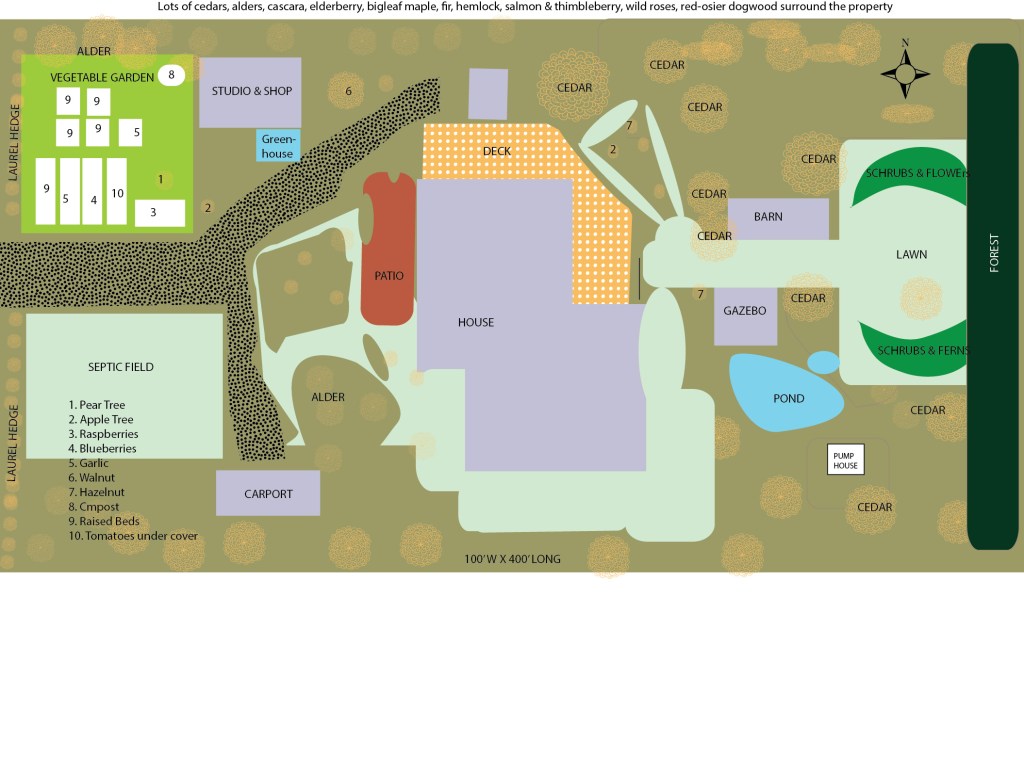
Map of Property

This map should help you get oriented to the property. Carolyn created it for a garden tour a few years ago and edited it just now.

Now watch Carolyn’s Fabulous Cumberland Spring Garden 2020

51 Cranky old man, Covid-19, and the garden.

Truth be told, I’ve always been a bit cranky. In the past though I was generally able to dampen my initial crankiness at what I perceived to be other people’s ridiculous behaviour, in the classroom, around town, in national and international politics, or on Facebook. I was able to step back, take a deep breath, and allow a sober second assessment of consequences and effects to take shape in my mind, making for a more measured response to the momentary ‘crisis’ whatever it might be. Oh, there were times when I reacted swiftly and even lashed out at people. I usually regretted those later. Ranting at the TV news was pretty common sport in the past when we still watched TV, a practice that I passed on to at least one of our daughters. I still rant like in the old days, but it’s more likely to be at a Facebook post or a news release posted online. However, ranting in private is different from personally and immediately striking out at someone for their perceived shortcomings.

Now it seems that my ability to generate a sober second thought is attenuating and my patience is wearing thinner. My private rants are turning into public displays of my impatience and I am now much less likely to bite my tongue when I think that people are being ridiculous or unreasonable. Of course that violates the first rules of teaching which, in my mind are patience and empathy. I feel really bad about that. My quick trigger reactions may be a consequence of my age and the fact that I have incurable cancer. It may be entirely idiosyncratic, but it could be that something else is afoot here.

Covid-19: the great disruptor

It could be that I’m not alone in my descent into more readily expressed displeasure at whatever affront, real or imagined, presents itself. Covid Times have created the conditions of uncertainty and disruption of habit that are hard for humans to take.

We, humans are creatures of habit and we don’t necessarily adapt readily or willingly to changes in our environment that require us to change the ways we live. We tend to react in our own ways to threats to our precious habits. Some of us hunker down even more deeply into already established patterns of social isolation. Others of us, like me, are more ready to express our pissedoffedness at the world. Now, more than ever seems to be a time of reaction rather than reflection.

It seems that people are now more than ever prone to stand on questionably acquired ‘knowledge’ rather than commit themselves to a course of study and learning that may lead to a more nuanced appreciation of economics, politics, current events, and other people’s actions both local and distant. And, since Trump, the ignorant minority is emboldened to speak out more often and vigorously. For us ‘experts’ who have spent a lifetime in study and reflection counteracting the tripe that comes out of YouTube and Facebook daily from people who have acquired whatever ‘knowledge’ they have from a marginal and peripheral relationship with analysis and evidence seems to be a lost cause. So, Covid-19 seems to have released some pent-up frustration at the world and our place in it and some people seem to be less reluctant than ever to stay silent in the face of it.

Covid-19 has definitely changed the goal posts in any number of ways, but life pre-Covid-19 wasn’t all that rosy either.

Pre-Covid-19, there were already serious cracks forming in the security and (often illusionary or delusional) stability of our lives. Personal debt dogged many of us to the point of financial ruin (and still does). Relationships were strained and addictions to alcohol and other drugs were on the rise as people self-medicated in attempts to deal with the emptiness that scoured their every wakeful moment and pitter-pattered through their dreams. Many of us were already leading precarious lives with no promises of a future with less stress and greater comfort and peace. General social distress was already reaching a breaking point when Covid-19 broke onto the international scene.

One thing I found particularly distressing was, and still is, the general ignorance of our global economic structures and their relationship to our nations, their sovereignty, and our individual choices. Very few people have any kind of a grasp on the intricacies of global supply chains and the interconnections of a myriad of corporations, factories and logistics experts on the conduct of business. The globally most powerful corporations have been masters at hiding the truth about mass production, distribution and sales. People think that ‘China’ is flooding our markets with cheap product and that our poor domestic corporations are suffering from this unholy competition. Nothing could be further from the truth.

Global corporations, many of them with very unfamiliar names, control global trade and often subject local businesses to rules and practices that benefit global finance capital rather than citizens. Look closely at the things you buy and more often than not these days you will not be able to locate where a product is manufactured. A label might tell you that a product was produced for such and such a retailer by such and such a manufacturer (with an address in Canada) by a factory in China, either owned by a ‘Canadian’ corporation or contracted by them, but it won’t tell you where a product was made. There is now a big silence about the true picture of global commodity production. But because no changes have been radical and the information to consumers has been accomplished slowly and inexorably completely under the radar with government complicity, it’s very hard for people to figure out what’s going on. Our lives are being orchestrated by forces hidden from us until something like Covid-19 comes along to expose some of the weak underbelly of globalization.

It seems many people now are worried about governments ‘taking away their freedoms’. Well, I have news for those of you who believe this: you have been slaves to the marketplace and an insidious capitalist morality for ages, but you don’t even recognize the bars that imprison you. You believe that a job is the one way to heaven. That no one should be given “free money” by government because that saps initiative. That individual action rather than community is the only thing that counts. You’ve bought into the tired, sick, libertarian agenda that feeds the globalist corporate agenda and leaves us poorer and fighting amongst each other. You believe that government is in charge and that its actions are the sole source of all the problems that you face in life. So delusional. So misguided. So sad.

There is no question that we need to be vigilant when it comes to government. With people like Jason Kenny, Doug Ford, mini-Donald Trumps at the helm of government, you can be assured that the global corporate agenda will be a high priority and the care and feeding of the citizenry will always take second place. Justin Trudeau and his Liberal Party are just a softer version of corporate lackeyism. Make no mistake though, Trudeau and his party are solidly behind the corporate agenda. It feeds them and they feed it with subsidies, grants, tax breaks, and with help cleaning up their messes when they decide to go strategically bankrupt or simply abandon ship. But enough of that.

Myeloma be gone…for now!

To change the subject, my cancer seems to be on the run for now. It will come back. Now I just have to deal with the side effects of all the drugs I’m taking, some of which I take to counteract the effects of others I’m taking. Virtually all of them have dizziness as a side effect. It’s a wonder I can even stand or walk ten feet on a good day. But I do walk, a bit wobbly I must admit, but still, I get out there and do things. It’s very gratifying. It’s wonderful. I didn’t think I’d ever be able to get out into the garden or into my shop or studio and do things, but I can. I know I’ve already told you this before, but I’m so happy about it, I just want to revel in it.

The garden

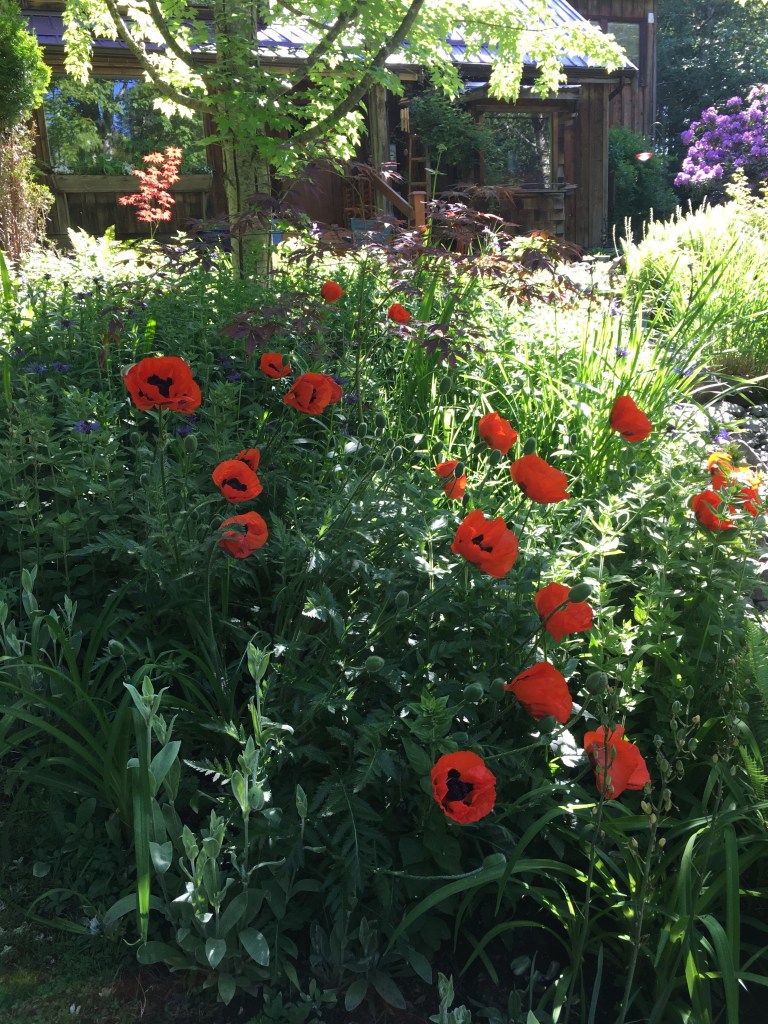
I also just want to revel in the garden. I’m working on a video right now of the gardens, but it’s a bit frustrating because things are growing so fast that I keep being tempted to re-video things that I’ve already recorded to give you a better sense of the beauty of the place, Carolyn’s own fabulous art project. Look at these amazing poppies. A couple of days ago there was only one or two blooms. Now look at them and there’s more to come, lots more! [since I wrote this more have opened!]

Poppies along the driveway.

Have a nice day, all of you! Keep your chin up! Don’t get too pissed off! Enjoy whatever you can (unless its murder or domestic abuse).

50 I Really Should Know Better…and Wisteria.

Yes, I really should know better. This is the pattern: I sense a marked improvement in my wellbeing. I start to do things. Maybe I do too much. I injure myself. Now I can’t do much again! Damn!

The problem is that I have myeloma, alright and I’m taking chemo meds, alright, but that doesn’t mean I will be distressed exclusively by cancer related issues. At the moment I’m experiencing pretty severe IT band pain. That means my left side, hip and upper leg are quite painful to the point of preventing me from sleeping. Of course I can take extra hydromorphone to alleviate the pain, but that has its consequences. If I take enough to get to sleep it’s like I have a hangover the next day. That’s not terribly pleasant and I don’t like it.

It’s so tempting, though, to do things! And there are lots of things to do. For instance, even though I shouldn’t be kneeling or getting down on the ground because of the lesions in my femur, I did that anyway while working to fix the irrigation in the garden a few days ago, just one of those things needing to get done. Now my back is chastising me for doing that, and it’s especially gleeful in its chastisements at 3 AM. As I sit here writing this, I can feel the pain slowly increasing in my lower back. I had surgery on my lower back about a hundred years ago, but the scar tissue still causes me pain now and again. Over the years I developed coping strategies to deal with lower back pain, but every once in a while my enthusiasm to get something done interferes with the caution I should be exercising in doing anything physical. I can still do things, but I just have to be smart about it. Unfortunately, sometimes my smarts abandon me and my frontal lobe meekly succumbs to the bullying from my amygdala. Brain wars. This part of my brain says “Yes, do that!” Another part says, “You know better than that!” Which brain part wins is sometimes a toss-up, but more often than not, the do-that part of my brain wins and my lower back sooner or later exacts the price. These days, as I get older and older, the price is exacted sooner than later and lasts way longer than I find reasonable.

I’m just coming to the end of my fifth chemo cycle. Today is a chemo day, but I only take one of the three drugs I normally take earlier in the cycle. So, no dex and no bortezomib. That means no dex high to counteract the cyclophosphamide downer that always happens on chemo day. Bummer. I got to looking forward to my dex days. I got a lot done on my dex days!

Today, I could barely do anything. We went out to the hospital lab this morning to prepare for my visits with doctors next week, then I waited in the car almost falling asleep while Carolyn did some shopping, first at Art Knapps (AK), then at Thrifty’s. I was pretty dozy, but I couldn’t sleep because I kept getting distracted by the parking lot antics of people coming and going from the stores. People coming and going from Art Knapp’s were quite entertaining. Apparently there is a number of people of all ages who shop at AK who can’t read or have attention-deficit issues. The new signage telling people that the former entrance is now an exit-only door flummoxed quite a few shoppers who couldn’t figure out the new rules.

Starbucks at Thrifty’s is still busy it seems. A number of people had coffees in hand as they got back into their cars. I was surprised at how many people came out of the store with only a couple of items in hand. One woman pulled up beside our car in a black twelve cylinder biturbo Mercedes hard top convertible, went into Thrifty’s just to come out a few minutes later with potted flowers, that’s it, just as a classy guy who parked his van across from us (clearly marked with his business name all over it) spit on the pavement every couple of steps he took as he walked towards the store, muttering to himself between spits. So much for shopping only once a week or being super cautious in Covid Times. How could I sleep with all this entertainment going on?

When we got home it was nap time. I slept for two hours. I hope I can sleep tonight after that.

Now, you can feast your eyes on this amazing forty year old wisteria that has a trunk at the front of the deck then snakes around along a structure about 7 feet off the ground for probably 10 metres. It’s beautifully aromatic and frames the table and chairs on the deck.

What better way to finish a blog post. Soon I will post a video of Carolyn’s amazing gardens. There’s no other way to show it off right now, so I’ve polished up my rudimentary video skills and enlisted my basic Sony video camera to put together a 20 minute video. I’m not a great narrator so I’m working on setting it up without talking too much. It’s Carolyn’s birthday on Monday so this video is partly a birthday present for her. Still in love after 47 years. It helps that we’re both a little crazy.

48 Pour vous, Les Jumelles!

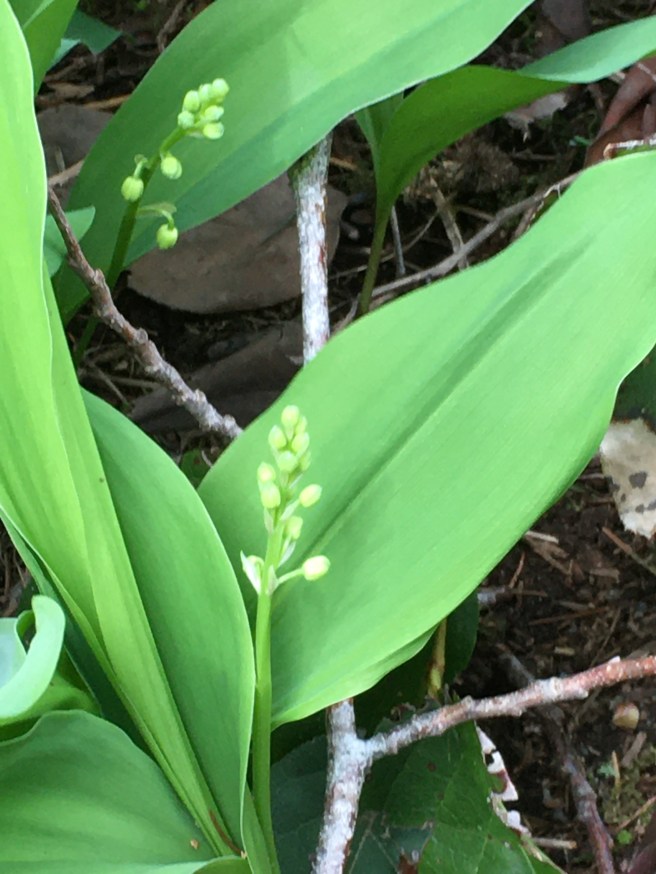
Voici des photos de muguets sortant dans notre jardin, qui, à ce temps de ‘année est un explosion de nouvelle vie. Nous avons environs un demi-hectare de jardins qui entourent la maison et qui sont certifiés comme refuge pour les oiseaux, surtout les passarines, les pinsons, les merles et leurs cousins. Nous soignons plusieurs genres de passarines y inclus des colibris ainsi que des moineaux, des piverts (qui adorent a graisse de rognon), des gros becs, et de temps en temps des Geais de Stellar. J’ai inclu dans le poste précédent celui-ci des photos de nombreuse fleurs qui sont présentement en évidence dans le jardin.

C’est évident que votre climat nous dépasse d’environ une semaine ou deux en ce qui attrait à l’arrivée des muguets . Ici sur la côte ouest du Canada, sur l’île Vancouver au 45,25 degrés de latitude nous jouissions d’un merveilleux climat passablement doux et nos jardins font preuve de la fécondité de la région.

Nous sommes fiers de nos jardins et nous encourageons des visites…malheureusement pas cette année tandis que nous somme tous en confinement.

Muguets sortant

La jardinière est l’artiste qui encourage son jardin à produire des tableaux de beauté et de vie.

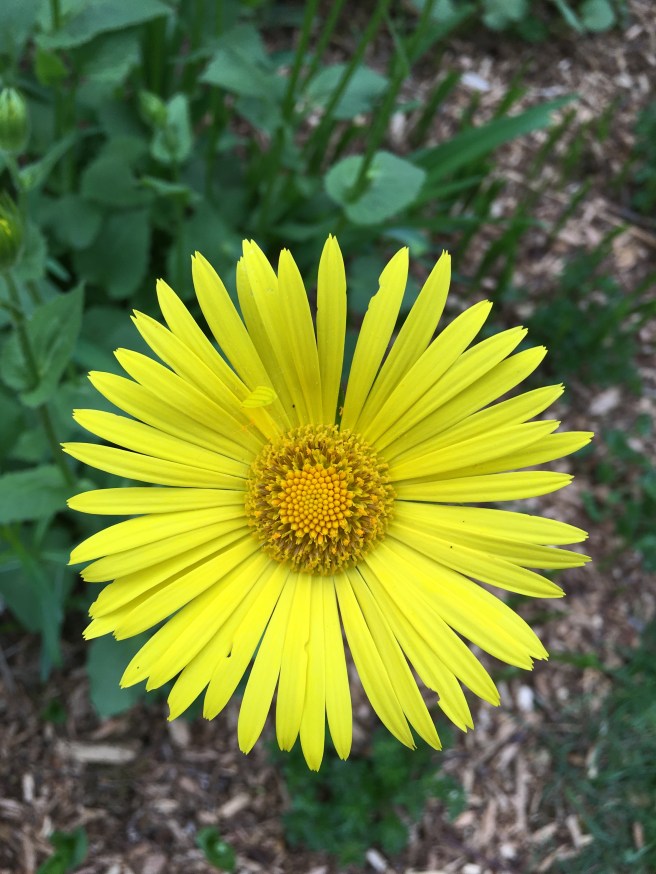
Leopard’s Bane (Fléau du Léopard ?)

46 I’m sick, but I’m well.

I’m writing today to let you know what’s up with me. I still don’t intend to embark on a regular program of blog posting, but things have changed for me over the past while and I thought I’d let you in on the changes to my situation. But first, a bit of a re-cap.

When I was diagnosed with multiple myeloma in early October of last year, I was in pretty rough shape. It became clear to us then that I had had myeloma for some time before, probably for years. Over the past few years I’d had to back away from a number of volunteering gigs because I was too exhausted most of the time to be of much help to anyone. I was not much help around the house and property either. I stopped painting and drawing, and sculpture was out of the question. It was no fun at all. I felt rather useless. And because there was no diagnosis for years, I questioned my own sanity and vitality. The cancer diagnosis was patently not what I had hoped for, but it was an explanation for how I felt and for the pain and exhaustion I had experienced for years before. In some ways, I felt a sense of relief.

Then, in November, 2019, I became a full-time cancer patient. Myeloma became the main focus of our lives. We read everything we could about it online. We went to Victoria for a consultation with the oncologist I was assigned to at the BC Cancer Centre. That trip turned out to be a disaster. Aside from the myeloma that was causing me a lot of pain and distress, during that trip to Victoria I had to deal with a flare-up of a chronic degenerative disk problem, and of the arthritis in my neck I’ve had for years. I can’t tell you how discouraging that was. I was practically an invalid to the point that we asked around to see if anyone had a wheelchair we could use because we figured I’d need one.

The chemo regime I was initially put on caused me to get a huge rash all around my midsection, so my oncologists decided on a different cocktail of meds. This was quite discouraging because I wondered if there was any cocktail of chemo drugs that would work for me. Finally, my oncology team settled on the set of chemo drugs I’m on now. I’ve just started my fifth five week cycle of chemotherapy. I’m scheduled to continue on this program at least until late summer.

At first the chemo drugs kicked the shit out of me. By that time, I was also taking a low dose of hydromorphone, a synthetic opioid, to deal with the pain, and I had to take Dulcolax to deal with the inevitable constipation brought on by hydromorphone. My peripheral neuropathy was extremely annoying in that my hands and feet would constantly go numb and tingly. My whole pelvic area seemed to be on fire at times.

The first three cycles of chemotherapy had me questioning whether or not I should just shut it down and deal with the consequences. I couldn’t see myself living for any length of time in this state of pain and exhaustion.

Then, something changed. I don’t know if it’s because my body has been getting used to the chemotherapy or that the meds have been very effective in dealing with the myeloma. Over the past while, my bloodwork has gradually indicated a complete attenuation of myeloma symptoms. My blood seems to be back to normal and the signs of myeloma have all but disappeared. That doesn’t mean I’m cured, by any means. It just means that I may be going into remission. How long that might last is anybody’s guess. When the myeloma comes back, my oncologist will put me on another course of therapy. That could carry on for years to come.

So, lately I’ve had a surge of energy and I’m now able to do things! Oh, I still have pain and I still get tired, but I can do stuff! For instance, I’ve been able to help Carolyn build boxes for her garden beds and yesterday we rebuilt part of the structure that holds up the massive wisteria we have that surrounds our deck. I even used my chainsaw! If you had told me in January that I would be using a chainsaw in April I would have laughed in your face.

So, yes, I’m still sick with myeloma, but I’m now without major symptoms of the disease, and the hydromorphone is dealing with the pain I still have and will continue to have for the rest of my life. I can live with that. Basically, I’m feeling well. My body seems to be tolerating the chemo drugs much better than over the past few weeks. Some of the side effects of the chemo drugs are quite nasty, but I know how to deal with them now. I’ve become a proficient cancer patient.

Now, if we could only get rid of MARS-Cov-2, I could, we all could, get back to some proper socializing and I could hug my grandchildren again. The truth is, however, that my life hasn’t changed much because of the pandemic. I’m highly susceptible to infection because of the chemo and I can’t be around sick people for that reason. Covid-19 has just made it so that we have to be extra careful.

So, I’m cleaning up my studio and my shop. I’m looking forward to doing some painting, printmaking, drawing, and sculpture. I’m working towards restoring our canoe. The fact that I can even contemplate these things has changed my life yet again. Overall, I’m pretty happy with the way things are going.

The situation in the world is another thing entirely. The irrationality of modern neo-liberalism in the face of climate change and the pandemic continues to cause me consternation and worry. I hope we, as humans, can collectively get our shit together and build a more modest future, one in which we are in tune with each other and the natural world of which we are a part. I know so many good, caring people, but the structures of global capital run deep and are highly entrenched. Ignorance and denial still characterize large segments of the population. Even with the majority of the population consisting of good, caring people, I have no idea how to fight these massive reactionary forces. Covid-19 has shown us that massive changes is possible and desirable for our quality of life, although it’s probably not a good idea to leave desired social change to the recurrence of deadly pandemics.

45 A hiatus and a recommendation.

I’m going to take a break from writing here for a while. I’m not sure for how long, but probably for as long as the pandemic has a chokehold on our attention. My life with myeloma seems to me pretty insignificant in the light of Covid-19. So sayonara. I may still pass along recommendations for your reading pleasure occasionally. The link below will take you to Charles Eisenstein’s website. The article highlighted here is called Coronation and is all about the Covid-19 pandemic and its ramifications. I could have written it myself but he beat me to it. If you’ve been reading my blog you’ll quickly see how closely many of his arguments are to mine. It’s a long piece, but you can handle it.

The Coronation

44 On art (poiesis) and the search for meaning in my life.

[I started writing this at 4:30 this morning. I don’t usually get up before 7:30, but my chemo meds keep me awake sometimes. I’m on a dexamethasone high. In other words I’m stoned. Let’s see how well this comes out. Well, I’m no longer stoned. It’s now 6 PM, and looking it over, I. think it’s fine, but I’ll let you be the final judge of that. It’s only a coincidence that this is the 42nd blog post in this series.]

Over the past few months, since I was diagnosed with cancer I have been on a search for the meaning of my life. I haven’t always recognized that in myself or acknowledged to myself that that’s what I was actually doing, but that is in fact what I have been doing pointedly and with urgency. There is probably nothing more capable of focussing the mind than facing a firing squad or a hearing a physician’s determination that one has an incurable cancer. The problem with the firing squad scenario is that there is no time for any reflection on the meaning of life before the bullets put an end to all reflection. At least with a cancer diagnosis, there is time for reflection. I have limited time left as a human expression in the biosphere, so I intend to use that time fully as a mortal in reflection on the meaning in my life, but more importantly as a generator of art, what Plato called poiesis.

In my life I was able to go to university and a get important post-graduate degrees in Sociology. Those years of study and reflection were exciting, stressful and tinged with contradiction at every turn and I got through them in spite of the system and not because of it, as I was fond of telling my students repeatedly over the years. I was able to learn many ‘things’ but the most important result of all of those years was my license to teach, to engage in an important aspect of my art.

Licenses are important. They are society’s way of legitimizing and concretizing in a title the fact that in the past one has acquired sufficient knowledge and capacity in a field of study or work to pass it on to others, operate equipment or on people, fix our plumbing and in a myriad of other situations. Over the years, my teaching was my art, although it was also my way of making a living and that contradiction was a constant source of irritation for me, and for people around me too, especially my long-suffering loved ones, Carolyn and the kids. During that time, though, I also engaged in the ‘plastic’ arts, in drawing, painting, and eventually in sculpture and printmaking. For most of my life I considered those latter pursuits the artistic part of my life. However, more recently, with my new sharpened mind engendered by my cancer diagnosis, I have been able to look back on my life and conclude that I was always an artist. I may have been born that way, but I think it was more an inadvertent result of my upbringing and the circumstances surrounding my birth and early years. I know now that my parents were also artists in their own ways. I know for a fact, because I worked with him at times, that my father struggled his whole working life with the contradictions he had to face every day having to earn a living doing things that were averse if not actually an insult to his inherent creativity. My father was a master craftsman, inventor, blacksmith and planerman. He was functionally illiterate too. My mother had a grade eight education and could read and write quite well. She had ten children, all still alive and kicking. Can we question her creativity? Definitely not her biological creativity, but she was creative in other ways too. She could sew up a storm and knit, cook like a pro and bake. Mygawd, could she bake! Later in life, after all the kids could look after themselves she took over my father’s workshop and started building all kinds of things out of wood. I still have a table by my bed that she built. It means a lot to me. Then, my father decided to sell the house and move into an apartment. That was the end of woodworking for my mother. She pretty much lost interest after that and it wasn’t long after she got Alzheimer’s dementia and that was that.

I feel I really need to explore in writing what my parents must have gone through during the time I was born and for some time after, and how that shaped who I became and am becoming still. I feel this exploration, my writing here, is part of my legacy, part of what I leave behind for you to learn from or simple contemplate as you would a painting on the wall in your living room, if you are fortunate enough to have a living room that is. My aim is that it engenders creativity in you, its beholders.✿

In any case, I was born on January 4th, 1947, which means I was conceived sometime in April of 1946. My parents were married on January 28th 1946. My father’s first wife, Yvonne Gaucher, died on June 22nd, 1945, seven months before my mother and father married. She died in childbirth after having five daughters. The baby, if it had survived, was to be called Roger, and I would not be. As the fates have it, he died and I was born 19 months later and they named me Roger. Can you imagine the stress my father was under? And my mother? My father had five daughters to look after. He made a call to my mother’s family in Alberta and my mother agreed to come help, look after the children and do all the domestic work. My mother and father had known each other in Alberta before he moved here with his family in 1937. Apparently my mother and dad’s first wife knew each other quite well. A short time later they were married. I can’t imagine what he was going through and we never talked about it.

Of course I was treated like a little prince. Not only was I the first boy in the family, but I had survived childbirth and so had my mother. I don’t really know what to make of my early days, not really. My mother soon had more children so my special status was soon eroded, but not much because my mother then proceeded to have four daughters in a row right after me leaving me the only boy with nine sisters. She had three more sons, interspersed with a couple more daughters.

So I have fourteen siblings in all, one of the older ones dying a few years ago of cancer. The rest of us are all still alive and kicking although a couple of my brothers-in-law have died last year. Many of my siblings are what I would call creative or artistic in work and in play. Five are afflicted with MS or another autoimmune disease. An altogether crazy bunch, but I love them all. What influence they’ve had in my life I can’t really say although they have been supportive when I needed it. And I really needed it when I was in my late teens and early twenties, depressed and suicidal. I could always count on my family. There was always a place for me at the table and a shoulder to cry on. Now I can say that I’m neither depressed, nor suicidal and I haven’t been for some time. Some people might argue that I have a right to be depressed, but I know now what depression is and it’s a waste of time. I don’t need it.

Alright, so what do I make of my life? Well, I’ve made it clear in a number of recent blog posts that I’m not chasing immortality. I’m a happy mortal kind of guy, but that doesn’t mean I’m looking forward to dying. My myeloma is being managed successfully and I may live for another ten years, who knows. When it’s my turn to die, that will be just fine. We all come to the end of the line. Songs have been written about it.

Still, it took a cancer diagnosis and what I thought was imminent death from an incurable cancer to ask the question: What meaning did my life have? What meaning does it have? In the face of death, is there any meaning? These are questions Tolstoy was preoccupied with. As Ernest Becker reports in Escape From Evil: “When Tolstoy came to face death, what he really experienced was anxiety about the meaning of his life. As he lamented in his Confessions: ‘What will come of my whole life…Is there any meaning in my life that the inevitable death awaiting me does not destroy?””

My answers to these questions came to me slowly at first over the last few weeks, then more pointedly only in the last few hours. I got answers by reading writers I knew would not fail in helping me answer these questions. The first was Ernest Becker and his book Escape from Evil (1974). Becker always knows the right words to say. He reminded me of the cultural significance of the fear of death and its significance for my personal encounter with death. Norbert Elias I read carefully. His book What is Sociology (1970) reacquainted me with my own discipline in a new, fresh way, a way of locating myself in time and space in a cultural project of criticism which clearly preceded me and will continue without me. But what of my career as a teacher? Recently I picked up a book that had been sitting in my library for thirty years untouched. It’s a book by James P. Carse called Finite and Infinite Games (see the note below). This is the book that triggered my recent reflections on my life as an artist. One section of his book deals specifically with art and culture and the relationships that we have with art as artists. I could have re-read Otto Rank’s Art and Artist but Carse does that for me. Rank’s book is always close to hand but it’s falling apart do to the handling it’s received over the years. Carse argues that the greatest struggle for any society is not with external enemies, but within itself. In society, we strive for titles, recognition for past achievements. But poietai (artists, inventors, storytellers, makers, etcetera according to Plato) are makers of possibilities. He writes (and this is a long quote):

The creativity of culture has no outcome, no conclusion. It does not result in art works, artifacts, products. Creativity is a continuity that engenders itself in others. [quoting Rank] ‘Artists do not create objects, but create by way of objects.’

Art is not art, therefore, except as it leads to an engendering creativity in its beholders. Whoever takes possession of the objects of art has not taken possession of the art.

Since art is never a possession, and always a possibility, nothing possessed can have the status of art. If art cannot become property, property is never art-as property. Property draws attention to titles, points backward toward a finished time. Art is dramatic, opening always forward, beginning something that cannot be finished.

Because it is not conclusive, but engendering, culture has no established catalogue of accepted activities. We are not artists by reason of having mastered certain skills or exercising specified techniques. Art has no scripted roles for its performers. It is precisely because it has none that it is art. Artistry can be found anywhere; indeed, it can only be found anywhere. One must be surprised by it. It cannot be looked for. We do not watch artists to see what they do, but to watch what persons do and discover the artistry in it.

Artists cannot be trained. One does not become an artist by acquiring certain skills or techniques, though one can use any number of skills and techniques in artistic activity. The creative is found in anyone who is prepared for surprise. Such a person cannot go to school to be an artist, but can only go to school as an artist.

Therefore, poets do not “fit” into society, not because a place is denied them but because they do not take their “places” seriously. They openly see its role as theatrical, its styles as poses, its clothing costumes, its rules conventional, its crises arranged, its conflicts performed, and its metaphysics ideological.

So, if my life has been about engendering engendering creativity in the beholder, I think I’ve done that, at least to my satisfaction. Obviously, the best judgments of my impact on people must come from them. Ask my former students and people who contemplate my art embodied in the works I have created and you’ll get varying answers. All I can say is my objectives in my classes and in my paintings, prints, drawings and sculptures have always been to engender a surprise and a new commitment to creativity. Therein lies some of the meaning in my life. I’ve been fortunate to have more. My children, grown women now, are the pride of my life and both creative in boundless ways. I could take credit for that, but Carolyn is largely responsible, I’m afraid, as I was absent a lot as they were growing up. Carolyn, in her own right, is a talented artist. She uses her garden as her main palette, but her skills as a cook are unsurpassed. I can’t take credit for anything they’ve accomplished as individuals, but as a family I think we rock!

That is all.

__________________________________________________________________

✿This concept comes from a book by James P. Carse entitled Finite and Infinite Games, (The Free Press, 1986). Carse is a great inspiration to me, a true artist. I will review his book and its significance for me in a separate blog post soon.
41 Beware of Dr. Vendedor de Aceite de Serpiente.

On my very first post in this series on my experience with cancer, the last paragraph reads:

Please don’t suggest any treatments or diets or whatever. I won’t be going to Mexico for any heroic treatments. (If and when I feel better we may go to lie on a beach though.) I’m not desperate. I won’t be buying a juicer either and I’ll continue to eat the great, wholesome mostly unprocessed food that I currently eat but my body will follow, as it must, the second law of thermodynamics. I’m okay with that.

I still feel that way. I’ve clearly decided to go the chemotherapy route so I won’t, in desperation, try on some homeopathic ‘treatment’ or ‘cure’ for the myeloma that is my curse for the rest of my life. Neither will I do anything to boost my immune system. It’s my immune system that is partly responsible for spreading my bone marrow cancer to distal regions of my body by facilitating the movement of the myeloma protein in my blood via macrophages (if I read that right). No. My immune system is fine for dealing with outside sources of infection, but it can’t do anything about preventing internal insurrection by oncogenes and the like.

Lately, I’ve had a couple of other bloggers read my posts, bloggers with agenda. Barbara Gannon has a blog called Cancer is not A Death Sentence and another is by Brian Shelley and it’s called CANCER WARRIORS. I believe both Gannon and Shelley are sincere and well-meaning. Not only that, they display a passionate belief in what they’re doing. Gannon has found alternative dietary and medicinal ways of dealing with cancer. Shelley found God. The battle metaphor is the same for both bloggers. If you’ve been following my blog you’ll know that I am not likely to be convinced by either approach to dealing with my cancer. For one, we are all individuals with very different bodies, different genetic makeups, at different ages, with different genders, and different underlying physiological and anatomical dynamics. Cancer, although it is basically pathological mitosis, is expressed differently in each of us. What works for you in response to any given cancer at whatever stage it’s at may not work for me. Some people argue that cancer is cancer and it can be beaten no matter what. I don’t subscribe to that perspective. Some people may be misdiagnosed so it’s no big surprise when their situation improves. It was probably nothing to start with. Some cancers in certain people may go into spontaneous remission. Cancer and its various treatments are highly complex and I’ll go with science in dealing with it as much as I can. Anecdotal evidence just doesn’t cut it for me.

That said, conventional Western research science, medicine, and pharmacology are not perfect. Scientists, medical doctors, and pharmacologists are human and have human ambitions, needs, and varying moral standards. Some even cheat. Still, I think the scientific research protocols are the best way of finding out what’s going on in the world. All claims of miracle cures for cancer that I’ve run across are based on anecdotal evidence: The “I beat cancer. You can too.” type of thing. I’m not saying these claims aren’t real, only that they can’t be generalized and applied to everyone who has cancer. One problem I find difficult to deal with is the absence of ongoing scrutiny of the claims of miracle cures. I had a friend and colleague who tried everything to survive his cancer a few years ago, including juicing and trips to Mexico, but nothing worked and he died. But, again, that’s anecdotal evidence pertaining to one case only.

Of course there are huge ethical issues when doing double-blind scientific research on the effectiveness of treatment protocols. Siddhartha Mukherjee in his book The Emperor of all Maladies deals with many of the ethical issue in oncology. Recruiting people with cancer for a clinical trial, then assigning half to a treatment group and half to a placebo group is ethically charged. The placebo group is definitely at a disadvantage if the treatment works. The question then is when to switch them into treatment while still maintaining the integrity of the research project.

Nutritional studies are notoriously difficult to conduct in any kind of scientific way. This website addresses that issue and notes that some nutritional studies have been very successful, like the one finding that sailors died of scurvy because of vitamin C deficiency. But, overall, nutritional studies are notoriously difficult to carry out and are almost impossible to conduct using the standard double-blind protocol. The website ends with a statement garnered from a meeting of several nutrition researchers who find that a balanced diet is the best diet. They also note that: “Anyone who tells you it’s more complicated than that — that particular foods like kale or gluten are killing people — probably isn’t speaking from science, because, as you can see now, that science would actually be near impossible to conduct.” More on nutrition below.

Naturopathic cures and treatments.

I have no problem with naturopathy for some kinds of issues and treatments, but I have been highly sceptical of some of their diagnostic protocols, especially things like vega testing. This website debunks all kinds of naturopathic and other diagnostic protocols. The website Science Based Medicine is always a good place to check out whether or not a claim for this or that treatment is effective from a scientific perspective. Noting that here may betray my bias for science, but I have no issues with that. However, I also acknowledge that science based medicine is now being challenged more and more by what’s called evidence-based science. There are huge issues with evidence-based research, not the least of which a lot of it is funded by industry with serious conflict of interest consequences.

My interest is mainly in cancer research and treatments. This article from the Fred Hutch Cancer Research Centre provides a fair analysis of how oncologists can address patients who are reluctant to undergo chemotherapy because of the side effects. It argues that if a patient wants to go an alternative route they should still maintain contact with an oncologist who can monitor their ‘progress’.

This website called Nature Works Best highlights the research and findings of Dr. Colleen Huber, a naturopath who’s clinic offers alternative cancer treatments. I read her article detailing her work with 379 individuals with cancer. She claims a very high rate of success from 92% for the low-hanging fruit (as I call it) and as low as 29% for patients in advanced stages of certain types of cancer. She seems to have the most success with breast cancer patients who have already had surgery. It’s hard, then, to figure out where to ascribe responsibility for remission. Thirty-two of her patients died after following her protocols. She claims that many of the other ‘failures’ (deaths) are due to patients not following her advice, especially to not eat sugar, which she claims feeds cancer cells. Her table looking at each of the 379 patients is telling. I read it very carefully, and frankly I can’t see how she can boast a 92% success rate. One of the problems is that there are twenty or so varieties of breast cancer. She doesn’t tell us which or these varieties she’s actually treating. And ‘treatment’ like I said is often post-surgery.

She has had four myeloma patients and one MGUS (describing a sort-of pre-myeloma condition. She claims that one of those patients travelled a lot and eventually died of pneumonia. Another died after leaving treatment against her best advice. A third she reported in remission but now having problems (“R, then recent elevated blood labs”). This patient reported extreme fatigue with no change due to treatment. The fourth, she reported is in apparent remission (“AR Imp quickly; could not afford to continue treatment. Then recurrence; then stem cell tx. R”) So, the stem cell transplant seems to have done the trick. I can’t see how her treatments helped at all. Myeloma is incurable by all reports so it’s disingenuous to not be clear on that point in her documentation. Her table doesn’t mention the age of the patient. That’s a critical piece of information, in my mind.

Snake oil salespeople and over-the-top woo.

You could always get a coffee enema. There are clinics nearby. Read all about it! Then you can read what Science Based Medicine has to say about it. Or you can try medical marijuana as a treatment. Here’s what the American National Cancer Institute has to say about that. It suggests that there is no evidence that cannabis or any cannabinoids can treat cancer. It does note, however, that THC may be useful for advanced cancer patients in dealing with pain and issues around appetite. Alternatively, you could try an alkaline diet. See what Robert David Grimes has to say about this in a 2017 article in The Guardian. Grimes has a lot to say too about other alternative therapies too. Check out his article if you’re interested. You can always try juicing, but even the alternative of alternatives, the Oasis of Hope hospital in Tijuana, Mexico, doesn’t advocate juicing carrots: too high in sugar. To be clear, the Oasis of Hope does use chemotherapy as a treatment, but it’s much better known for alternative therapies.

What I’m not arguing here.

I’m not suggesting here that a proper diet, not smoking, drinking in moderation, etcetera are not important. They are. However, nutritional or dietary strategies for cancer treatment are largely unfounded.

I know that there are herbalists who have a strong commitment to assisting us in our drive for healthy living and I respect that. But when it comes to cancer, the Cancer Council of Victoria in Australia has assessed the contribution of herbs in cancer treatment and says:

Herbal medicines are often used to help with the side effects of conventional cancer treatments, such as lowering fatigue and improving wellbeing. Evidence shows they should be used in addition to conventional therapies, rather than as an alternative. AND

Although herbs are natural, they are not always safe. Taking the wrong dose or wrong combination or using the wrong part of the plant may cause side effects or be poisonous (toxic). Also, herbs used with chemotherapy, radiation therapy and hormone therapy can cause harmful interactions. All herbs should be prescribed by a qualified practitioner.

I was cautioned not to drink green tea as it counteracts the effects of bortezomib, one of the meds I’m on. There are other contraindications too. And just because indigenous people have used some plants to treat all kinds of ills, it’s probably not a good idea for us to apply indigenous strategies willy-nilly. For example, cedar tea although very high in Vitamin C can be very toxic but people are drinking it and I expect they are not always in full knowledge of its effects on the short or long term. Carolyn and I have used products from Harmonic Arts and from a local herbalist to good effect but not specifically for treating my myeloma. That said, there is ongoing promising research. There is evidence that curcumin, a compound found in turmeric, can act as a proteasome regulator, and could work with drugs like bortezomib to suppress the growth of cancer cells in some types of cancer. A report in MyelomaCrowd notes that curcumin needs to be modified to stay in the body longer if it is to be effective against cancer cell proliferation.

I’m all for caution when it comes to my cancer treatment. I’m not happy being on chemotherapy but I don’t see any alternatives out there that are trustworthy or based on more than anecdotal evidence. I think I’ll stay the course. That said, I will continue to eat well, have the odd beer, rest but also get some exercise (as much as my condition allows me to).

Stay safe out there!

39 Two Days in my Diary

8:00 AM Thursday, March 19th.

On Wednesday we went to the hospital to see my local oncology GP. We reviewed my lab results and my progress to date and he was very positive about how things are going. It looks like more chemo for me until at least September, then off of them for three months after which I get bloodwork done again to see how things are going. If everything is okay we carry on for another three months. If the myeloma is again active, they’ll put me on another course of chemotherapy. He said that we should consider my disease more like a chronic disease, diabetes say, rather than as a virulent, deadly one. So, that’s all good, but I still have lots of chemotherapy ahead of me and that’s no cake walk.

In this post, I want to give you a blow-by-blow idea of what happens to me after I take my chemo meds on Thursday and Friday. I would love to hear from any of you who have had chemo so as to compare our experiences.

I have just made it so that anyone can comment on my posts. You don’t have to be a registered WordPress user to comment! Yay! Give it a try please!

Today is a good day so far. That will change in a while when I get my chemo meds. Oh, I have some joint pain and fatigue, but that’s my new normal anyway.

11:15 AM

Off to the hospital to get my chemo meds for the next four weeks along with a bortezomib shot.

1:20 PM

This time they wouldn’t let Carolyn come with me to the Cancer Clinic so she waited for me in the car. That’s because she had a cold and they’re rightfully paranoid about Covid-19. We drove home from the hospital carrying my load of pills to take for the next four weeks. I take 13 cyclophosphamide and 5 dexamethasone once a week on Thursdays. We had a bit of lunch a while ago and I’m starting to feel the effects of the meds, but not intensely yet. Tingling body is always where it starts. Today I decided to sleep off the afternoon hoping to cut off some of the worse effects of the meds.

4:30 PM

I’m actually feeling pretty good after sleeping for most of the afternoon. I’m lightheaded, that’s for sure, more than yesterday, so it’s started. The dexamethasone is starting to take effect. I’m feeling tingly all over. It’s still too early to assess how dex will affect me today. The dex effect has changed over the past few weeks. My body seems to be tolerating it better. I’m not getting the crazy twenty coffee high I was getting earlier during the first two cycles of treatment. My stomach is unsettled as it has been for the duration of my treatments. It’s a very odd sensation. Urination is still a problem although not as severe as early on in my treatments, so we’re thinking that the antibiotic might have done something, but we’re not sure. I checked to numbers from my last blood tests and my ferritin levels have dropped from over a thousand to now under six hundred. That’s great news because it does indicate that any inflammation I have had is decreasing. That said, my Lambda Free Light Chains (you have them too) are increasing and I’m not crazy about that. We’ll see what my next lab tests show. If they go up some more, I’ll be really pissed.

8:00 PM

Dex is starting to do its thing. ‘Sleep’ will be interesting tonight. I just took my usual bunch of pills but I’m taking two Benadryl tablets to counteract the usual itching and swelling around my bortezomib injection site. I’m also taking a Dulcolax tablet to counteract the constipation that comes with hydromorphone. That seems to be working. The burping has started but isn’t severe yet. That will come tomorrow. I’ll save more entries here until tomorrow. I’ll be in bed soon in any case.

8:00 AM Friday March 20th

So, last night was a dex sleep meaning that it’s a sort of sleep or at least a state akin to sleep. It’s hard to explain. I feel that I haven’t slept at all. Looking at the clock every fifteen minutes or so seems to confirm that but I may be dreaming all of that. I don’t know. I think the Benadryl is helping me counteract the dex, but I can’t be sure. I’m wide awake this morning having got up at 6:45 after Princess (the cat) came to me screaming for food. I ignored her, but it was too late. No point in staying in bed. I’m having very interesting experiences with pain lately too and this morning is no exception. I have pain spiking here and there but nothing constant. It usually comes when I move so I just sit still a lot! I know I have to get up and move around, and I do, but I then pay for it later. Last night I had no issues with my peripheral neuropathy (extremity pain and numbing) which is unusual. Usually peripheral neuropathy keeps me awake or tossing and turning. I’ll do more stretching today to see if that helps with that in the coming week. I’ve been doing a fair bit of stretching for my neck and back pain and that seems to help my peripheral neuropathy. Burping has resumed. Fuzzy head…not too severe yet, blunted by the dex. I find it fascinating to observe what’s happening to my body as I go through cycle after cycle of chemo. The effects change every time, sometimes drastically, sometimes almost imperceptibly. The interactions between the various meds I’m taking make it difficult to trace drug to effect. I’m trying to relax as much as I can. Stress doesn’t help. I think I’m doing okay on that front.

10:30 AM

The dex is starting to really kick in now. Elevated pulse rate and feeling very lightheaded. Overall, though, because I know what to expect I’m not getting stressed out. I feel it’s so important for people in chemo to very carefully track the effects. It’s so important to read the information sheets that come with the various drugs we take. In the case of my urinary issues, I called my GP with what are classic urinary tract infections (UTI) symptoms but only after Carolyn read the information sheets urging us to call in if we have signs of UTIs. We have to keep on top of it because I can’t afford to get an infection of any kind. Now I’m getting the shakes too. Par for the course. Time for tea.

12:25 PM

Well, the dex has kicked in with a vengeance. My cheeks are flushed, I’m hyper yet exhausted, unsteady on my feet, but we’re going to have lunch up by our pond. Yes! I can still write, but who knows about later today or tomorrow. Then, I may be good only for watching YouTube videos about people rebuilding their old sailboats, or doing woodwork, sometimes both. It’s all very exciting. I haven’t seen any videos yet on watching paint dry, but it came close on a video about somebody applying bottom paint to their sailboat a couple of hours before it was to go back in the water after being on dry land for weeks.

8:00 PM

Dex is still with me but now I’m feeling really exhausted so I may sleep better tonight. I generally sleep quite well. Dex nights (Thursday nights) are exceptional. I’ll be taking my meds now: Hydromorphone, Benadryl, and Dulcolax. It still burns when I pee and I have to pee often. My eyes are burning but that’s probably as much an effect of age as it is of the chemo. I’ve got the shakes still, probably until well into tomorrow. Pain is manageable. Exhaustion inevitable. I’ll go to bed in an hour or so, do a bit of reading then sleep (I hope). Goddamn burping! So annoying.

AND please comment! Especially those of you who have had chemo treatments in the past. You can do so now without being a WordPress user.

38 While Covid-19 has me bottled up…

Covid-19 has the whole world in an anxiety attack. The appearance of this special strain of Coronavirus is a direct but obviously unintended consequence of globalization. I spoke with Marika and David this morning and we collectively concluded that the appearance of Covid-19 in particular is pretty much due to the rapid expansion of global air travel some forty years ago created partly by the needs of globalization. The shipping container was a major factor in globalization as was the internet, but air travel brought warm human and humid bodies from one end of the planet to the other ripe for the spread of this kind of virus. Wow!

What a world transforming situation we are in at the moment. I don’t think it will have a long term effect on global capitalist production because it would cost hundreds of billions of dollars to re-tool ‘Western’ countries that have for some time now created a commodity-production system based on a complex of independent, unconnected factories producing individual parts for products that are then assembled in a factory designed to do just that. Wuhan, in China is a place where thousand of contractors and factories work for American and Western corporations in general making bits and pieces of everything to then be assembled in factories there or here for our consumption as hardware such as drills, heaters, washing machines, television sets, baby cribs, etcetera, as well as clothes, blankets, and sundry other wearables and that sort of thing. Of course, China isn’t the only place where this happens. Name a country in South Asia or South East Asia and the same thing is happening there. Viet Nam actually specializes in nails and fasteners for the construction industry, or to put it differently, Western corporations have chosen Viet Nam for this role. Bangladesh does clothes, so does Sri Lanka. But they all dabble in a range of products depending on the deals they can arrange with corporations who crave the absence of taxes, low wages and the dearth of health and safety regulations in the export processing zones set up specifically for this purpose in these countries.

As far as I’m concerned, Covid-19 has just made it so that I’m even more isolated than I was before. I’m at the pinnacle of vulnerability. I’m over sixty-five, I’m immuno compromised, I have an underlying illness and I’m fighting off some kind of bacterial infection at the moment that the docs are still trying to identify. If I get Covid-19, my chances of survival are slim to none. Well, something’s going to kill me. I’d like to wait a bit though to find out what that will be and I hope it’s not this virus.

I have a lot on my mind at the moment. I mean, what else have I got to do with my time but sit here and think? The reality of my own death is always close to mind and is stimulated constantly by programs like the recent one on the CBC White Coat Black Art program that deals with end of life care and how we as a society deal with it, or more precisely, don’t deal with it. Check it out here.

Most of you are way too young to have seen the movie Fantastic Voyage when it first came out in 1966, but this movie with Raquel Welch and Stephen Boyd was an inspiration for a generation of special effects techs to come. So, get this: a famous scientist is sick. He has a problem with his brain. A group of intrepid (they’re always intrepid) colleagues of his and some other brave adventurers get themselves shrunk in a special ‘ship’ that then is injected into the bloodstream of said sick doctor. Mayhem ensues of course as well as the necessary redemption. The trailer says it all.

The movie is hugely fantastical, but intriguing too. I imagine a little ship in my own veins going into my bone marrow to see what all the fuss is about and maybe do battle with the evil forces that are invading my body intent on killing me. It’s all fun to think about. The movie is a hoot. Thinking about what’s going on in my bone marrow, not so much.

I’m also thinking about life and death in general, following the last three blog posts I put out there for your reading pleasure. Serendipitously, Maria Popova, the immensely creative force behind the website ‘brain pickings‘ put out a piece on the work of John Muir (1838-1914). It’s well worth having a read through. It pretty much expresses in highly poetic prose what I wish I had written about the way I see the universe and our place in it. Popova quotes Muir:

One is constantly reminded of the infinite lavishness and fertility of Nature — inexhaustible abundance amid what seems enormous waste. And yet when we look into any of her operations that lie within reach of our minds, we learn that no particle of her material is wasted or worn out. It is eternally flowing from use to use, beauty to yet higher beauty; and we soon cease to lament waste and death, and rather rejoice and exult in the imperishable, unspendable wealth of the universe, and faithfully watch and wait the reappearance of everything that melts and fades and dies about us, feeling sure that its next appearance will be better and more beautiful than the last.

It’s only the last line I have any issue with because I don’t think there is any guarantee that the new will be better and more beautiful than what came before. But that’s really a quibble. The continuity of the biological world, and of the social world, make them seem eternal, immortal. No wonder we tend to deify them. For the BaMbuti of the Ituri forest (as reported by Colin Turnbull in the book The Forest People) before colonialism completely annihilated them, the forest was their mother. They didn’t deify the forest but they recognized that life emanated from her every pore. For other cultures, those living under the threat of imminent disaster, deification was common, something that Weber recognized in his Sociology of Religion a hundred years ago as did many others before him and since then.

Well. that’s all I can squeeze out of this poor brain of mine for the moment. Enjoy your social distance and get out into the sunshine.