
Our Fleeting Lives.

I have two photographs to show you. The first one is of 634 Alderson Avenue in Coquitlam, British Columbia.
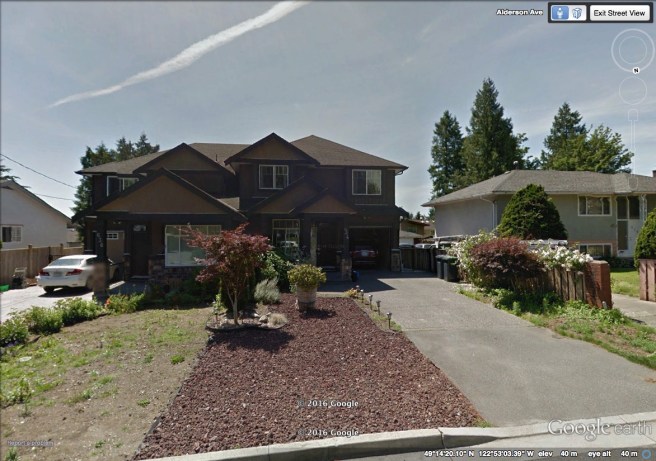
634now
Picture 1

The second is also of 634 Alderson Avenue in Coquitlam, British Columbia but this house no longer exists. It stood on exactly the piece of ground now occupied by the duplex in picture 1. It was my family home.
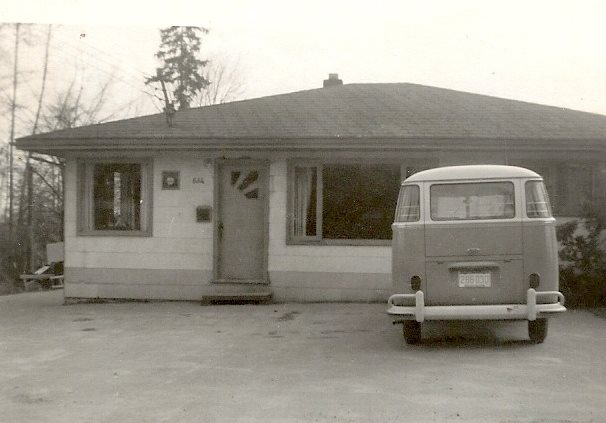
634then
Picture 2


Just so you know, the first image I downloaded from Google Earth street view. The second one I got from one of my sisters. I don’t want to relive my family’s life in the home depicted in the second photograph, the one I would call my family home but it would be an interesting journalistic exercise. After all, it was a very important place in my life for years. No, what I want to do is dwell upon another reality. But first a little background.


Look at photograph 1 and you see a relatively new duplex between a home on the right and a fourplex on the left. The fourplex has been there some time and existed when the house in photograph 2 was there. It was built after a very dilapidated home was torn down sometime in the sixties if memory serves me right. The house on the right stands on a lot my family sold after our property was subdivided into a number of parcels. It was built sometime in the sixties too. The photo is unexceptional in just about every way. The unit on the left of the duplex is 636 Alderson Avenue and the unit on the right is 634.


That (634) was the address of my family home for a long time. I’m not sure exactly for how long because I don’t really know when my father and his first wife moved into it. I think it was sometime in 1937. When my parents moved out of the house you see in picture 2 one of my sisters bought it from them, sometime in the 1980s, the house was still in the family for a period of time. Later, after my sister sold the house it was eventually demolished and the duplex in picture 1 was built to replace it. By the time it was demolished, the house in picture 2 had undergone extensive renovations. Although the house was ‘serviceable’ that mattered not, it was demolished. That’s just the way it is. I lived there for 12 years with my many siblings starting in 1947 before I went off to boarding school in Edmonton in 1959, then on and off for a few more years. Actually the details aren’t important except as background information.


What I want to focus on here is something that has been a preoccupation of mine throughout my academic career and even earlier, I’m thinking, and that’s the fleeting aspect of our lives, their finiteness within a field of infiniteness.  It’s a cliché to say that the generations come and go, that each of us is born and dies. That’s certainly true, but what interests me here is the substance underlying the cliché, how we think about these things, explain them to ourselves, reconcile them with the natural cycles of matter and energy and attempt to derive some kind of meaning for our existence.

The house I lived in, the house my family occupied for decades is gone. All the activity, all the sorrow, the happiness, the sadness, the love that permeated that place are gone. All gone. Yes, my sisters and brothers have many memories of life there. Stories abound. Yet the house is gone, forever. Poof! In a flash of time.

I’m thinking that the people who currently live at 634 Alderson Avenue in Coquitlam, BC, have no sense at all of what may have stood on the very spot they now occupy. To them, the property is what it is. Their lives are ongoing. They move easily from room to room. They have things to do, people to see, work to go to. They eat and sleep without ever thinking about the people who lived there previously. They may not even know that people lived there previously.

Yet, people did. I did. My brothers and sisters did. My parents did. There was life there, there was drama. There was tedium. The current residents don’t know that my father had the front yard paved over. I know that he did, but I’m not sure exactly why except to get rid of the patchy lawn that was there before and to increase parking spaces. They have no idea of the tons of laundry my  mother did every week, of the piles of soiled diapers that she cleaned, the Sunday pork and beef roasts my father used to put on the stove in the morning and the many loaves of bread my mother baked every three or four days. They don’t know about the laughter, the tears, the pain and the joy that characterized that home. They have no sense of anything that was there before them. Fair enough of course. I wouldn’t expect them to.

What is interesting, I think, is that the same kind of experience of things exists in cities, towns and villages everywhere. The current Rome is built on several past Romes that keep turning up in archeological digs. The same thing goes for Paris, Beirut and London and every other human occupied place on earth. I’m quite sure that the house I lived in at 634 Alderson Avenue was the first one built on that piece of property. I’m guessing trees, brambles and bushes stood on the homesite before the house was built. In Rome there are buildings raised on the debris and remains of several other generations of houses and homes previously erected there. Of course, at one time there were no man-made structures on the planet at all. Then, as a species, we moved like a fungus across the planet and occupied large tracts of land, building structures on them, some with a degree of longevity, some with none. It seems solid. It all seems so real, yet it’s all fleeting. Nothing is forever, not 634 Alderson Avenue, not Rome. We move silently through time glancing backward now and then but catching only glimpses of what went before.

We, as a species, will evolve right out of existence. No doubt at all about that. But that’s nothing to be sad about, nothing to fear. That’s just the way it is. Fighting it has gotten us nothing but pain and grief.

We try to hang on to the past in many ways. We write history.  We practice archaeology and anthropology. We study how biological forms change and evolve. We measure tectonic action and we track the movements of stars and the galaxies.

We try to hang on to some sense of what we were. We take photographs. We write diaries in the hope of remembering something from the past. I have some journal writing from the 80s and 90s and when I look at them and read about what I was doing on a specific day in February, 1989, I’m not actually remembering those experiences. I’m not reliving them. I have an idea of what I was doing, getting a coffee, for example, but I’m not reliving that moment.

We record action, events, scenes of all kinds. We record human conversations and whale vocalizations. We film political speeches and we have buildings full of archives, artifacts, petrified bones and old art works. We try to hang on to the past. But all of it is fleeting.


As I approach my 70th birthday in January, 2017, I guess my death is more of a reality to me than it’s ever been. I’m not sad about that. I’m not depressed about that. My death will happen momentarily because life passes by that quickly, but that’s fine. Some of you will mourn my passing but don’t spend too long grieving. As I watched my father-in-law dying in a hospital bed in Burnaby General Hospital in 1989, the traffic outside just passed on by. Not many people took notice of his death. We did, of course, and we were sad. Same for when my father died in 2007. He as 94 years old and ready to go. His body was determined to go back into the pot of organic matter that makes our world go around. One day he was there, kissing babies, working his ass off trying to feed his many children, and the next moment he was gone. That’s our truth.

That’s our lives. I often think about my father these days. He was a man of tradition but he was also an excellent craftsman and inventor. After I got to be 14 years old or so we often worked together. He was my boss on many occasions, and he was a good one too. I don’t know why this is still with me, but I vividly remember the first time I heard him say ‘fuck’. My, I was shocked but impressed. I was 9 years old and with him on a Saturday visit to the sawmill he worked at on Lulu Island. As we left the plant in late afternoon he talked briefly to the watchman and that’s when he uttered the infamous word. Shocking and revealing. My father was human! I remember when he and I flew to Winnipeg to pick up my Austin Healy Sprite, a car I left there after a youthful infatuation with a young woman in St-Norbert, who at that time I would say was way above my station in life. He was great. He put up with my whining and snivelling. He was so forgiving and caring. I must say that I could be a jerk as a kid. But I wasn’t a complete waste of skin. We had some wonderful times as kids building forts, digging tunnels and just farting around. I was mouthy and bratty and that got me into trouble on occasion. As a teen, I was often sullen, thoughtless and miserable. Par for the course.  I smashed up the Volkwagen van parked in front of the house in picture 2. Damn near killed myself along with a friend of mine. I was careless. I was irresponsible, and after that crash, I was brain-damaged for years, something that didn’t improve my outlook on life. Eventually, I grew out of it and up, went back to school and the rest is history. The people who now live at 634 Alderson Avenue know nothing of this and I’m sure they wouldn’t care if they did. That’s the way it is.

We look for continuity in our lives, we look for meaning. We even crave immortality and have created countless ways of convincing ourselves that our bodily deaths aren’t real and that our ‘souls’ will live on. I know people, irreligious people even, who at celebrations of life, still insist that the deceased loved one is somewhere up there, looking down and waiting for us to follow. It’s so hard to find any meaning in the minutia of life, in the fleeting memories and impressions we have of past events. So we look elsewhere and we create elaborate cultural schemes to convince ourselves that our lives have ultimate meaning and that there is life after death. It’s kind of a natural reaction, I’m thinking, that our big brains have devised to deal with death, the ultimate evil. Of course it depends on what we think life is and what death is.

Enough for now.


My personal statement from 1990 on the Knowledge Network.

Why not post a video I did in 1990. That’s only 26 years ago! Frankly, what I say in this 7 minute clip I still relevant to me today. I think it’s a good way to start off my new set of blog posts. Hope you enjoy it, although ‘enjoy’ may not be the best word to use here. The clip was filmed in Vancouver with a Knowledge Network crew over a 12 hour period in one day. It was part of my North Island College tele course on the Knowledge Network that ran from 1986 until 1992. Interesting times.

Roger

Now, back to writing. Do you have any themes you’d like me to address here?

Time to get back to writing. Several ideas have come to mind as themes for blog posts. One is mapping. In the 1980s and 90s I taught mind mapping, a note making method created by Tony Buzan, and that spurred me to research mapping in general as a means of understanding the world using line and metaphor. That, in turn, motivated me to look into language, semantics and semiotics. That led me to the work of Alfred Korzybski and especially his book, Science and Sanity (I have a copy). He coined the famous phrase: The Map is not the Territory. It is one of the most complex books I have ever read on mapping and metaphor and destroys the myths we have about sanity, insanity, science and reality. It also dissects the idea of science. I also discovered many books by the likes of Umberto Eco (The Theory of Semiotics), Mark Johnson and George Lakoff. Lakoff and Johnson wrote one of my favourite books. It’s called Metaphors We Live By. I used all of these books – and hundreds of others, of course – extensively in my lectures. Words are metaphorical by their very nature as are maps and all representations. Dictionaries are essentially closed systems of metaphors. There’s lots more to be said on this subject, making it a strong candidate for future blog posts.


Another theme, one that I’ve already addressed quite a lot, is the relationship of nationalism and capitalism, especially as they relate to the rise of global finance capital and what we call globalization. The rise of global finance capital was bound to produce the kinds of backlash among the working classes of the world as labour becomes an increasingly smaller component of capitalist production. The general public tends to cling to the notion that the nation-state is a means of controlling and promoting economic production and jobs in the face of growing finance capitalist expansion. People don’t think using highfalutin terms like I use here. They do, however, know that their world of work has become more and more precarious, tenuous and fragile. They know that little by little jobs ‘Canadian’ jobs are being eliminated by automation and exportation. They don’t know that there are no “Canadian’ jobs, just jobs in the capitalist world. They have also been convinced that having a job is the way to happiness. Anyone in their right mind knows that ‘work’ is not often a means of acquiring happiness, whatever that means.

Employment is alienating, no matter how we cut it. Work, however, is a different thing and humans by their very nature are producers of goods, makers of things (homo faber).

As we get squeezed between the need to pay our rents and mortgages and the increasingly insecure labour market, something has to give. The tension brought on by ‘austerity programs’ and ‘structural adjustment programs’ imposed on debtor countries by the World Bank and other transnational organizations in cahoots with national governments will be released somehow. Can you say ‘open rebellion’ and ‘violence in the streets’? Trump’s disaffected followers are just the spark that could ignite and then fan the flames of violence in America. People will find scapegoats upon which to heap their fears because they have no idea who their real enemy is.

Part of this theme revolves around the nature of capital and the evolution of social, economic and cultural systems. This form of evolution has been a major theme in my teaching practice.

I just might pick up this theme again in future blogs.

How could I leave out sex? Of course I will deal with sex and its role in our lives in future blog posts, but I want to also consider aspects of our language around sexuality and the pornography industry in particular. Why do we so often refer to sex as dirty? And what do we make of the fact that we are born between shit and piss? How do we  culturally and psychologically address the mess that happens in labour with the wonderfulness of babies and their eventual and necessary deaths?

Contradictions abound in our cultural creations around sex and sexuality. We love the act of sex and lovemaking, but we are supposed to do it in very prescribed ways between approved partners. Tell that to teenagers with sex pheromones bleeding out of every pore of their bodies and it becomes ludicrous. Bodies will trump social rules more often than we would like to consider. Of course, sexual mores have become increasingly lax over the last few decades, but that doesn’t mean that they’ve completely vanished.

St. John’s Homeless-Serving System Coordination Framework | The Homeless Hub

I think all communities can learn something from this framework. We don’t need to re-invent the wheel although we do have to deal with local conditions. Those local conditions include a lack of coordination of services, extensive privatization of services with a landscape of fragmented resources. We can do better.

Source: St. John’s Homeless-Serving System Coordination Framework | The Homeless Hub

The power of what we think we know or: Marx was a dumbass, we know that!

The power of what we think we know or: Marx was a dumbass, we know that!

by Roger JG Albert

[I published this post in November of last year on another one of my blogs now defunct. I thought I’d publish it again, because I think it is relevant now.]

I write. I used to teach. I suppose that in some individual cases I may have even convinced a few people to change their minds about the way they perceived the world. Mostly my efforts are and were in vain.

Our dominant ideologies around possessive individualism, the nature of countries and what we value in life are so powerful as to frustrate and flummox the efforts of the most competent of teachers to get people to change their minds about anything. 

I’ve changed my mind a number of times in my life but generally in line with added knowledge gained from reading and researching writers and authors who compelled me to see beyond what I had previously accepted as true. I came to understand fairly early in my career that there is no absolute truth, only tentative truth which must be abandoned when confronted with superior ways of explaining things. 

For the first few years of my career as a sociologist I was a Marxist through and through. That early dedication to Marx’s work was soon tempered in many ways by the works of Harold Innis, Thorstein Veblen, Emile Durkheim, Sigmund Freud, Thomas Szasz, R. D. Laing, Erving Goffman, Ernest Becker, Otto Rank and many others. It’s been a ride. Although I’ve gone beyond Marx in many ways, I still often come back to one of Marx’s aphorisms about history in which he said (and I paraphrase): Human history will begin when we stop being so barbaric towards one another. 

He was an optimist who actually believed that this would come to pass with the eventual eclipse of class society, a time in which there would no longer be any reason to kill and exploit because of the rise of technology and the elimination of labour exploitation. 


Faced with the litany of accounts of death and destruction perpetrated by groups of people over the face of the earth going back millenia and it becomes difficult to accept Marx’s promise. I also being an optimist agree for the most part with Marx on this especially given globalization, the concentration of capital, the erosion of national sovereignty and the degradation of the natural world. These aren’t particularly uplifting processes for me, but they all point to a time in the future where capital will do itself in by increasingly attenuating the profit margin. 

Strangely, I write this knowing full well that the vast majority of people who on the off chance might read this will not have read Marx and will have no idea of what I’m writing about here. People are generally quick to dismiss ideas that don’t agree with their preconceived notions about things. That’s certainly true when it comes to Marx’s work. People can easily dismiss Marx (and most other fine writers in history) by thinking they know what Marx (and most other fine writers in history) argued and can therefore cheerfully scrub him (and the others) from their minds. Or they think of themselves as anti this or that, in Marx’s case ‘anti communist’ so that anything that Marx argued just cannot be ok. Mind shut, let no light enter. 

One of Marx’s most important ideas was that the division of society into classes would inevitably be relegated to the dustbin of history and along with it barbarism of all kinds. I like that idea, but ‘inevitably’ in this context will probably still be some time in the future. There’s plenty of time left for ignorant, highly suggestible “cheerful robots” (a term from C. Wright Mills) to commit mass murder or other kinds of atrocities in the name of eliminating the evil that they feel is blocking their prosperity or their road to heaven. 

Probably the most influential writer for me over the last 40 years of my career has been Ernest Becker.  His little book Escape From Evil published in 1975 after his untimely death in 1974 of cancer at the age of 49, has most profoundly influenced my way of thinking and seeing the world. Escape from Evil, in my mind contains all the knowledge one would ever need to explain the bloody massacre in Paris on November 13th or all the other atrocities ever committed by us towards others and vice-versa over the last 10,000 years, or for the time of recorded history, and probably even further back. It’s all there for anyone to read. But people won’t read it and even if they do, they will read it with bias or prejudice and will be able to dismiss it like they dismiss everything else that doesn’t accord with their ideology or interests. And there’s the rub.

It’s people’s interests rather than their ideas that drive their capacity to change their minds. Change the way people live and you just may change the way they think. It doesn’t work very well the other way around. 

Given Marx’s long term view on barbarism and senseless violence we cannot hope for much in the short term. We just have to wait it out. Of course our actions speak louder than our words, so within the bounds of legality, it’s not a bad idea in my mind to oppose talk that can incite some unbalanced people among us to violent action. It’s also a good idea to support peaceful solutions to conflict rather than pull out the guns at the first sign of trouble. Violence can easily invite violence in retaliation. We can resist that. It’s tough when all we want to do is smack people for being so ignorant and senselessly violent, but we can forgive rather than fight, tough as that may be. Turn the other cheek as some historical figure may have said at one point a couple of millenia ago. 

We will be severely challenged in the years to come to keep our heads as globalization increasingly devalues our labour and the concentration of wealth makes for more and more poverty. Sometime, somewhere we will have to say enough is enough and mean it in spite of the forces trying to divide us. We can regain our humanity even though it’s tattered and in shreds at the moment. It’s either that or we won’t have much of a future on this planet.

What is the Significance of the UK leaving the EU?

What is the Significance of Britain leaving the EU?


Not much in the long term. In the short term, there will be some consequences, but probably not many for ordinary folks. Nobody’s going to war over this one although the political map may see some ‘adjustments’. One might argue that this is just a slight correction, a reminder to the 1% and to finance capital that globalization will not be an easy, carefree ride into a glorious future of one world for the benefit of capital accumulation. There will be push back by the people negatively affected by globalization, especially the poor and those workers who can easily be replaced by automated machines.


The European Union is just one of several political structures that, at least in political and financial terms, override countries and their sovereignty. But there is a whole new level of organizations like the World Bank and the World Trade Organization that has been messing with national sovereignty for decades in the name of securing the free flow of capital and labour in increasingly global markets. When the World Bank can impose austerity measures and structural adjustment programs on countries who have borrowed money from the WB and are having trouble paying it back, you know that national sovereignty is on borrowed time.


That said, countries come and go. Nothing is permanent in our world. There was no Canada before 1867 and Newfoundland was a British colony until 1948 when it voted by a squeaker of a margin to join Canada. The UK used to have a vast empire spanning the globe. Not so much anymore. Now it seems Brits want to pull back into insularity but they can’t hope to get their empire back. Get their country back? Hardly, because they never actually had control of it. Parliament, voting, elections, politicians are there to draw attention away from the real action and that happens behind closed doors in corporate boardrooms everywhere. There is no democracy in finance. Money knows no borders. Democracy is for us, and is meant to give us the impression that we have some control over our lives. Of course, sometimes people take that impression very seriously and Brexit is a consequence of that. In the long term, Brexit won’t change anything. In the short term, things can get ugly especially with people like Boris Johnson and Donald Trump fanning the flames of popular discontent.


Obviously, the ‘leave’ side tapped into a well of discontent among voters. Globalization is changing everything for everybody and the changes are not always comfortable or beneficial to a majority of the population. Employment insecurity tops the long list of grievances that many ‘ordinary’ people feel when their jobs disappear and seem to reappear in China or somewhere else, given to workers who make a fraction of what British, European or North American workers made in the presumed glory days of rapid industrial expansion after World War II erasing important gains in worker safety and security won by unions everywhere. Ronald Reagan and Margaret Thatcher rode out of the West to change all of that to launch decades of austerity for workers in ‘developed’ countries. Voters are looking for people to blame for their waning fortunes and are finding them in visible minorities, immigrants, especially from the Middle East and former British colonies and everybody else that isn’t what some consider ‘purely’ British and, of course, China, India and other countries which are presumably ‘stealing’ good British jobs. The ‘other’ is blamed for just about everything. Don’t be surprised by that. Outraged maybe, surprised, not.


Discontent due to disenfranchisement can often lead to conflict and violence given the ‘right’ leadership. Britain has had its share of violence and public insurrection over the centuries. We could end up with more of the same.


The EU is a highly visible and present symbol of globalization and consolidation of power in the hands of global finance capital. What better target for popular hatred? It stands for everything older Brits seem to be feeling pissed off about, but globalization is not going away any time soon, nor is the creation of larger and larger political units like the EU and organizations of global management organizations like the World Bank and the World Trade Organization. Work will continue to be moved around the globe as corporations look for cheaper and cheaper sources of labour and resources. No, leaving the EU will not mean an end to globalization for the UK.


That said, human beings live in communities, not in global organizations and labour for most people means employment in local enterprises or government (education, health care, etc.). As I noted above, a consequence of globalization is the disappearance of steady, predictable, good paying jobs, especially for people whose jobs can easily be automated. When we see our communities attacked by austerity measures and global ‘structural adjustment programs’ we get angry. The EU, as a political unit, represents distance and is seen as anti-democratic and it is. The EU is a mechanism for securing the ascendency of finance capital, but it had better be careful not to piss off people who live locally and don’t think globally. It’s hard to convince a bloke who just saw his factory job of 20 years disappear and re-appear in China two months later that globalization is a good thing. For him or her, it’s not. So there is push back.


Part of the push back will be in the form of popular unrest and violence. At the political level, there will be lots of re-negotiating to do as the UK leaves the EU, but at the local level, there may be random acts of violence, but there are some promising developments that should at least get the attention of global capital and that’s the movement to greater and greater local autonomy and control over food supplies, power generation, waste management and social services. People may not get their countries back, but they may, over the long term, get more local control as technologies present opportunities for greater local autonomy.


We are in a period of transition when global capital has proven itself capable of exploiting every part of the globe. I think we are getting close to the end times of the glory days of capitalist expansion when profit margins inexorably diminish because there are no longer cheaper workers to be found or resources become too expensive to exploit and when markets are flooded with consumer products that are increasingly at the margins of utility and no longer producing the satisfaction we all seek in our lives.


That means the opportunities will abound for us in our communities to get creative in finding local solutions to some of our most pressing problems while we connect to the rest of the world on the internet and create communities there as well, communities of ideas and mutual help that don’t imply direct political involvement or control.

I think Brexit is a wakeup call for capital. That is certainly true, but we must find in it a resolve not to descend into xenophobia, racism, brutish nationalism and violence while seeking solutions to problems in our lives for ourselves, by ourselves, ironically using the tools global capital has so generously provided us. We must resist the urge to blame and scapegoat and instead turn our attention to our communities creating in them the means of living meaningful lives.


Welcome to the Age of Petitions! Have a Nice Day!

We’ve had the Age of Aquarius, now we’re into the Age of Petitions.

Although I haven’t done a study of the history of petitions, I can say with some confidence that petitions have been around for some time. In pre-internet days, petitions had to be circulated by mail or by person to person. Now, it’s a cinch to circulate petitions.

There are quite a few petition organizations these days. LeadNow is one of those. It’s a ‘professional’ petition generator with, it claims, has 500,000 adherents. It runs petitions on a number of issues that come from people who have a problem with what governments, corporations, their neighbours, their dogs, and many other ‘targets’ are doing. They circulate petitions exclusively online via websites and email. Easy peasy.

Petitions seem to be democratic. They give people a say on an issue, an outlet for their outrage. They help people support other people, some they know, others they don’t. Petitions now span a huge spectrum of issues. My favourite ones have markers like this: Help Mr. Jones keep his cats! His landlord is a dick! Then, of course, there is the usual and ubiquitous request for a donation: Help us help people like Mr. Jones! Your small donation makes all the difference in the world. 

I’m sure it does.

It helps lots of people working for petition organizations to keep their jobs. I’m not saying that’s their main goal, but I get a little suspicious when I get an email asking me: Is there a petition you’d like to start? It’s like fishing for issues. Find something to protest, will you, we’re getting bored down here at ABC Petitions!  

So what can we make of this trend?

Well, it allows us to throw a bit of money at an issue and convince ourselves that we’ve actually done something for a cause we really believe in. But maybe I shouldn’t be so cynical. After all, I’ve signed a few petitions myself. It IS a way to do SOMETHING in a world where we seem to have so few ways that we can control our lives and make a difference in the world. Actually, I’m a sucker for petitions about animal abuse and animal rights. AND it seems that petitions make a difference. At least that what petition organizations often claim. It’s hard to know where the truth lies. I suspect that sometimes petition organizations take a little too much credit for political and social change. But it’s hard to say. It’s so difficult to measure these things.

I’m certain the petition ‘industry’ is here to stay. It’s become institutionalized. As long as people are being jerks somewhere, there’s always someone willing to call them on it, and maybe sign a petition. Canada is selling arms to Saudi Arabia. Enough of that! Sign our petition demanding the Canadian government immediately halt all sales of arms to the Saudis. Now who wouldn’t sign that petition? Well, I’m sure there’s a few of you out there.

Maybe I should start a petition against people who won’t sign a petition telling the Canada (arms manufacturers, actually) to stop selling arms to Saudi Arabia.

On second thought, maybe I’ll just eat my strawberries and ice cream.


What were you doing on February 29, 1988?

On Monday, February 29th, 1988, early in the morning I boarded CP flight number 502 in Comox bound for Vancouver. I flew to Vancouver like this many times in the late 1980s and early 1990s to make my way to the Knowledge Network studios at UBC, then on Mathissi Place, in Burnaby to get my make-up on and teach live interactive telecourses for North Island College. I taught introductory and advanced study skills and introductory sociology all live with a phone in segment during each show. I did 254 discreet hour long lectures in the studio to be broadcast all over Western Canada.

One year I accounted for 10% of college enrolments by teaching on the Knowledge Network, but I was also responsible for tutoring a schwack of courses at our learning centre in Courtenay. I learned later that some of my colleagues thought I was getting paid extra money for doing this. On the contrary, not only did I not get paid any more but in fact it cost me money personally to do this. And I got burned out…but I did receive and award from the Association of Canadian Community Colleges. It was an honorary mention in the technical category.

That is all in the distant past now.

That is all.

Private Forest Companies: The New Aristocracy

So, in this neck of the woods, criticizing logging and forestry companies is like badmouthing Jesus so I will refrain from doing that. What I will say, however, may seem like finding fault with the forestry based companies and their government supporters and ‘regulators’ but it isn’t. That doesn’t mean that I’m happy with what the likes of Hancock Forest Management, TimberWest, and Island Timberlands are doing. I think that most of their logging practices are unsustainable, damage the environment, compromise watersheds and unnecessarily restrict access to forested lands. But it’s all perfectly legal. They only do what the government allows them to do. It’s not their fault.

From their websites we learn that together they own in fee simple (the same way in which you own your house and the property it sits on) some 1,500,000 acres of forest lands on Vancouver Island, mostly in the lower half of the Island but with assets all over the place. TimberWest also has harvesting rights for 700,000 cubic metres of timber per year. The Private Forest Landowners Association says that private forest lands account for only 2 percent of BC’s land mass. That’s true, but I’d like to know what percentage of Vancouver Island is private forest land. That would be more relevant to me. Even more relevant would be an indication of what percentage of forest land, not bare mountain tops or urban areas, is held privatively and how that percentage has changed over the decades.

Also according to their websites these companies are fully in compliance with all the government regulations and comply with or exceed national and global harvesting standards, something I have no doubt is entirely true.  They claim that good relations with their neighbouring communities is also a high priority as is sustainability.

That’s all fine and dandy.

I have no doubt that there are many well-intentioned people who work for the companies I note above. I actually know some of them and they’re generally good people. And I don’t really have anything to say about the fact that these companies comply with government regulations and standards. I’m sure they do.

The problem is that government regulations are so lax as to be insignificant to these companies and violations of rules and regulations often go unpunished because the government has gutted enforcement staff and doesn’t really want to prosecute forestry companies anyhow. The company websites argue that they have over 30 Acts and regulations and rules to live by, but they are somehow making the best of it and at all times and in all places operate by commonly described ‘best practices’ to maintain sustainability, environmental, wildlife and community values. If a number of recent media reports have any credence, that’s hardly the case.

I just don’t see how the public good is served by having most of the southern half of Vancouver Island owned by private companies, why governments would allow this and how we are supposed to believe what the companies say about the wonderful and sustainable ways that they cut forests down.

Forest companies are really like a new aristocracy. During the Middle Ages and beyond, aristocrats and monarchs owned and controlled great swaths of land in Europe and elsewhere allowing only limited access to the peasantry and locals. That’s what is happening here with forest companies being the new aristocrats and us being the peasants. Of course, aristocrats and monarchs didn’t want to piss off the peasants too much or they could, and did, get rather revolting. There may be a lesson here for our new aristocratic forest companies and their government cheerleaders.

Governments have given land away to private companies for decades now starting with the big giveaway by the federal government to the CPR and on Vancouver Island to Dunsmuir in the late 19th century. Social Credit, Liberal and NDP governments have all participated in the giveaway over the decades and now we are in a situation where privatization of public lands seems to have gotten to the point where there is precious little Crown Land in the mountains and valleys of southern Vancouver Island.

Governments are increasingly committed to privatization.

They privatize as many services as they can by contracting out legal, technical, medical, health care and other services without drawing too much attention to it. They privatize land too. Most privatization now happens under the public radar, incrementally and often imperceptibly. It goes largely unnoticed. Privatization removes public assets from the public domain and places them in private hands. Even regulatory enforcement is sometimes privatized or put in the hands of the affected industries by making them self-regulating.

The reality is that the public sector is shrinking in BC as are public assets which are increasingly ending up in private hands. The common good is being sacrificed more and more to the gods of profitability. Less and less control stays in the hands of the public. With regards to forest lands, the result of this is watershed damage as recently reported on the Englishman River, environmental degradation and the alienation of wealth into the hands of the few, all sanctioned and abetted by government. The Private Forest Landowners Association supports the Trans-Pacific Partnership (TPP) and opposes any regulation on the exportation of raw logs. It claims that there is no money in domestic value-added production for the companies it represents and log exports are the only way they make money. The TPP is aimed at gutting national sovereignty and would serve to put corporations in greater and greater control over our lives. That’s the reality no matter how much they protest otherwise. I find it extremely difficult to accept the industry argument that they are acting in the public interest and for the common good.

It’s also clear that the provincial government does not govern in the public interest. In terms of forest lands it governs for the corporations and acts to protect and enhance their private interests at every turn.

The class system is alive and well and apparently hasn’t really changed much since the Middle Ages. Oh, the ruling class looks different, but it’s really the same. The only change is that we have been convinced that we live in a democracy and that together we make the rules. Such a sad delusion.


True Believers

The following I’ve already posted here but I’m posting it again because I have just completed a fictional account of a few days in the lives of oblate priests in what is now Manitoba and Saskatchewan in 1851. I wrote it in French for a couple of reasons. First, I wanted to re-acquaint myself intimately with my first language and second, I wanted to write in the language of the people who are the subject of my piece.  A few moments ago I submitted this fictional piece to the Cedric Literary Awards. We’ll see how I do. I have no illusions about this, but I will never get published unless I submit material and for some, probably masochistic reason, I want to get published. Oh, I have been published before, but research reports, essays, dissertations and the like don’t count in my present world.

If you read French, you may soon be able to read my story. If not, oh well.

Here is the blog post from some time ago now:

Deep down, are we all racist and xenophobic?

In my last two posts I wrote about a book by Dom Benoit published in 1904 about the Catholic missions in the mid 19th Century in the Canadian West.  The book is a biography of Msg. Taché, second archbishop of St. Boniface (1853-1894).

Was I unfair in singling them out for a special call-out for being racist?

It’s pretty obvious that the missionaries understood that the indigenous peoples of the area were human, but that they were significantly different from themselves, especially in the fact that they weren’t ‘children of God.’ The derogatory manner in which they describe indigenous peoples, especially plains peoples, would immediately label them racist in most people’s books.

Their mission’s objective was to make ‘savages’ into ‘children of God’. They may have thought they had accomplished that by baptizing as many as possible, but that apparently still didn’t make them equal to white folk in the eyes of Canadian governments, all of which had institutionally racist practices and values regarding indigenous people. There is no doubt that Sir John A. Macdonald’s government was racist to the core. It’s hard not to conclude that most Canadian governments over the decades, both federal and provincial have been racist. Their policies prove it, the Indian Act proves it, all their actions prove it.

So, along with the missionaries of the mid 19th Century, are they special in their racism? Are governments racist, along with a few bad individuals, or are we all racist, deep down? Some of us may deny it vehemently, but the impetus, the imperative, the drive to characterize ‘other’ groups of people and their institutions as inferior or undeserving because of some national or group trait is pervasive. Can we avoid being racist and xenophobic? Can we avoid labelling groups (gender, age, colour, etc.) and nations with sweeping generalizations that deny human individuality and capacity for free thought?

The short answer is that I think we can, but it takes a lot of effort and thought. It means letting go of a lot of ‘isms’ some of which we love dearly, like patriotism.

If we believe that our society, our way of life is the greatest thing on earth, it makes it difficult to just accept others as they are and not to try to convince them, by ideology or coercion, that they should change. The Catholic missionaries of the Canadian West obviously thought that their religious beliefs and practices were the only ones that could lead to salvation, that is to eternal life in the presence of God. It seems to me that they would feel a holy obligation to try to ‘convert’ as many ‘savages’ as possible to save them from being condemned to an eternity in pergatory or hell. One could argue that their drive to ‘save’ the indigenous people is no different from a compulsion we might have to pull someone out of the way of a speeding train in order to save their lives. It’s just something ya gotta do.

So, yes, if we feel we have the only road to heaven, or to salvation, the good life, prosperity or whatever you might want to call it, it’s hard not to want to share it or conversely, to prove to others that ours is a superior way by kicking their asses just to prove it. If, however, we can express some humility in the face of the diversity of human (and other) life on this planet, we can begin to overcome prejudice and ignorance. It’s not easy and it’s not even likely to happen on any scale until the structural and historical conditions in place currently on the planet that make prejudice and ignorance possible and even inevitable are still dominant.

If you ever get a chance, watch a 2003 documentary film called Flight From Death: The Quest for Immortality. It does a beautiful job in visually summarizing my argument above. You can do that, or you can rummage around the archives on my blog to find references to Ernest Becker’s work Escape From Evil. The film is based on his work.