Trials and Tribulations

[Feeling a little disjointed today…]

If you’ve been reading this blog for any length of time, you’ll know that it’s all about me and my trials and tribulations around my experience with myeloma, old age, medicine, chemotherapy, and its side effects. Of course, I’m not completely self-absorbed, just mostly so. To be honest, it’s been a bit difficult to focus on anything else. Myeloma and its effects have taken over my (and my family’s) life. The pandemic hasn’t helped either. Both myeloma and the pandemic have severely restricted any social activity in which I used to take great pleasure. Driving is a challenge but not impossible. My neck seems to be getting somewhat better after the dexamethasone injection in my neck about six weeks ago. Now I fear that my time with Daratumumab may be coming to an end. I don’t know that for sure, but the neuropathy in my left hand is getting quite bad. Increased peripheral neuropathy is a side effect of Daratumumab and may be a signal that my body is rejecting the Dara. I talk to an oncologist in Victoria next month and we’ll certainly talk about my chemo treatments. On top of that I have a tooth that is dying if not completely dead. The endodontist I saw about that says I need a root canal and I should be on antibiotics for a bacterial infection just below that tooth. To be on antibiotics I probably need to cease chemotherapy treatments for a time. That’s another thing I need to talk to the oncologist about. So it goes. 

By the way, I’ve just finished reading The Cancer Code (2020) by Dr. Jason Fung. Aside from being a practicing nephrologist in Toronto, Fung is a prolific writer. This book on cancer is fine although Fung focusses on tumor-based cancers and mentions myeloma only in passing. I quite like his analysis and where he ends up suggesting that cancer is subject to evolution and natural selection like any organism. He argues that in the past cancer was seen as a mistake, then as a somatic mutation, but he writes: 

“Cancer had always been considered a single genetic clone, so evolutionary processes were considered irrelevant. But the realization that cancers evolve was electrifying. For the first time in decades, we had a new understanding of how cancer develops. The entire field of science known as evolutionary biology could now be applied to understand and explain why cancer develops mutations.” (from “The Cancer Code: A Revolutionary New Understanding of a Medical Mystery (The Wellness Code Book 3)” by Dr. Jason Fung)

Daratumumab is a monoclonal antibody. It worked well for a time. I hope it works for a while longer, but it is destined to fail when it no longer responds to myeloma’s mutations. He notes that cancer cells act like prokaryotes or single-celled organisms and not like eukaryotes or multi-celled organisms. According to Fung, we are on the cusp of a major paradigm shift in cancer treatment, but it will be expensive. What do we do about that? 

______________________________________________________________________

Just to remind myself that I’m still a sociologist, I’ve spent quite a bit of time lately reading and watching MSNBC, CNN, The Guardian, NPR, BBC, Al Jazeera, Ring of Fire, Beau of the Fifth Column, and other newsy YouTube videos. I check out some Canadian content, but the elephant next door is far more compelling than Trudeau’s antics or O’Toole’s foibles. I’ll come back to the US below, but before I go there, I just want to say that I’m reading a book by David Graeber and David Wengren published just last year called The Dawn of Everything. The book challenges everything we know about the “Western” version of history and is a refreshing read. For one thing it sheds value on indigenous ideas and ways of seeing as providing the real challenges to the philosophers (Locke, Hume, Hobbes, etc.) of the Enlightenment, Rousseau, and other incipient lefties. The authors reject the idea that indigenous peoples were the child-like innocents they are often portrayed as by European travellers and colonizers. They also challenge the idea that things can’t change, that we’re stuck with large scale, ridiculous, bloated states. Unfortunately, Graeber died on September 2nd, 2020, three weeks after this book was released. He was fifty-nine years old. That hardly seems fair.

I don’t know how many of you are interested in American politics. It can be a nasty, grubby place at times and unless you are steeled against media biases and distortions of reality, you might be left with all kinds of strange ideas about what’s really going on to the south of us. One thing is for certain, I’m getting just a little perturbed at the ignorance and stupidity of some American politicians in Congress who shout “socialism” every time Biden and the Democrats dare spend a dime on regular, run-of-the-mill citizens or on infrastructure. They want all the cash to go to the 1%. I’m still not sure how that benefits them personally unless they believe Milton Friedman’s ridiculous trickle-down theory by which if regular people as taxpayers give billionaires all the money that some of it will trickle down to them. That is such a bullshit theory. The proof of that is that it’s never worked and the concentration of wealth in the über-wealthy is clear evidence of that. 

Ted Cruz, Rand Paul, Josh Hawley, Marjorie Taylor Greene, Lauren Boebert, Jim Jordan, and their ilk in the Republican Party and sitting members of Congress obviously haven’t a clue what socialism is, or, if they do, they are being disingenuous about it. The truth is that it may be some of both. For these clowns, any money spent on bridges, highways, city roads, the electrical grid, wastewater systems, potable water, etcetera, is evidence of socialism. So stupid. They take the notion of individual initiative and investment to the extreme. But, of course, they just want to get re-elected and making outrageously false statements is the name of the game. They can always be retracted later when nobody is paying attention.  

I’d say that I follow American Congressional politics as entertainment, but it’s not funny. There is a fairly serious challenge to the status quo there from a far-right racist Republican cabal and some people seem to want to continue the Civil War of the early 1860s. I do take some comfort in the fact that there are over 300,000,000 people in the United States and that would be a hard ship to turn around. I have a lot more to say about the US, supply chains, the wane of capitalism, the rise of oligarchy (which is already close to the surface), and history. Stay tuned. 

I strongly recommend reading Heather Cox Richardson on Facebook. You’ll get a well-researched commentary on American politics from a classy historian. Check her out.

Sleepless in Cumberland

Yesterday was my day at the hospital for my monthly infusion of Daratumumab, the monoclonal antibody. It along with other flavours of monoclonal antibodies have changed a lot about how medicine thinks about and treats cancer, arthritis, and other nasty ailments of us fragile mortals. Along with my Dara, I also take some dexamethasone, only 12 mgs for the month, and a few other meds designed to protect me from viral infection. It’s the dex that keeps me awake as I’ve noted many times on this blog. 

So, instead of lying awake, allowing whatever thoughts I had rattle around in my brain causing no end of silly talk, I decided to read instead. Reading is a good way of filling in the night hours in what some people would call a ‘progressive’ way. However, I may need to revise the material that I choose to read at night. I haven’t read a lot of fiction in my life, focussing my reading time on sociology, anthropology, philosophy, and other sundry disciplines. I have read most of Kurt Vonnegut’s work, all of Emily St. John Mandel’s books and I did recently read several books by Kim Stanley Robinson, fictional accounts of the human colonization of Mars, New York under flood, and other similar topics. In his Mars trilogy one interesting commentary was on longevity. If people accepted a certain treatment, they could live hundreds of years instead of the paltry number of years generally allotted to our species. That fact, however, did not seem to mitigate the angst they felt about death and dying. In a book called Aurora, Robinson is at his most pessimistic about human excursions to other planets and their satellites in our solar system. His conclusions about the time it takes to travel from Earth to other planets are telling. Travelling to and back from a satellite of Venus, for example may take a hundred and seventy years or more with the need for cryogenic sleep. So, if you were one of the ‘lucky’ ones who won the lottery for space travel you would return to Earth after several decades of travel at a time when no one would know you, you would have no recognizable family and you would be relegated to the margins of society. I read Robinson at night. It was a bit hard to get to sleep after reading some of his stuff, but not impossible. Reading Barbara Ehrenreich and other non-fiction writers of her ilk is an entirely different story (no pun intended). Last night I finished reading her book Natural Causes: Life, Death, and the Illusion of Control. This book is firmly planted in reality. Problem is reality sucks sometimes. Ehrenreich is especially blunt when she writes about aging. Getting old is no cake walk. It’s not for the faint of heart although in our culture it’s not cool to ‘give in’ to the infirmities of age. Ehrenreich writes:

“But as even the most ebullient of the elderly eventually comes to realize aging is above all an accumulation of disabilities, often beginning well before Medicare eligibility or the arrival of the first Social Security check. Vision loss typically begins in one’s forties, bringing the need for reading glasses. Menopause strikes in a woman’s early fifties, along with the hollowing out of bones. Knee and lower back pain arise in the forties and fifties, compromising the mobility required for “successful aging.”” (from “Natural Causes: Life, Death and the Illusion of Control” by Barbara Ehrenreich)

And:

“Not doing anything is the same as aging; health and longevity must be earned through constant activity. Even the tremors of Parkinson’s disease can be seen, optimistically, as a form of health-giving exercise, since they do, after all, burn calories. The one thing you should not be doing is sitting around and, say, reading a book about healthy aging. There are bright sides to aging, such as declines in ambition, competitiveness, and lust.”*

So, we must always put a happy face on adversity, be positive about everything, and keep moving. I don’t think my nine hours a day sitting with my computer on my lap would be morally acceptable. But you know what? I’m finding it a wee bit difficult to feel positive about dying. A Cumberland friend, Howard Jones, who died recently spent his last few days in the hospital. He couldn’t breathe on his own much anymore. Months ago, over coffee he confided that he didn’t know how long he could continue on oxygen with a life very much reduced to sitting or lying in bed. He could no longer walk in his beloved forest. I meant to visit him in the hospital when I was there for my usual chemo treatment, but I was cautioned not to because of my compromised situation. I should have gone anyways. Now it’s too late. We did text each other, but that’s not the same as a face-to-face visit. One day, the day he died as far as I know, he was the one to make the decision to go off oxygen, thus ensuring his death. I think that Howard died a good death. 

The especially difficult decisions I know I will face in the near(ish) future will be whether I continue with the chemotherapy that has so far kept me alive. I will be thinking of Howard when the time comes. I expect that my (and my family’s) decision will hinge on the quality of life my treatments are now offering me and the intensity of their side effects. There is a question of how much benefit a few months of life can give in the face of much reduced quality of life. It will not be an easy decision. I love life, I love my family, my community and where I live. I am loathe to give that up, to know that the world will carry on without me. But it’s not like I or any of us have a choice in the matter. We all die. Some of us, however, are given the privilege of deciding when and how we die. 

______________________________________________________________________________________________________________

*I’m reading Ehrenreich as an ebook on a Kindle. The problem with that is that when I select a quotation to use on my post, it doesn’t give me a page number. I find that unacceptable and will see if I can find a work around. 

Lassitude

Yes, lassitude, which the dictionary that Apple so kindly provides for us as part of the operating system on my computer defines as: “a state of physical or mental weariness; lack of energy.” That about sums it up. 

I know my expectations for myself are way out of whack. I keep forgetting the basic realities of my life: I’m almost seventy-five years old, I have a slow acting, but debilitating cancer and chemotherapy designed to fight said cancer that has side effects I’ve already discussed on this blog at nauseum. No need to flog a dead horse (as they say). I also have some neck issues that most people of my age get but that don’t afflict all of us in this demographic with pain. We won’t talk about arthritis now, shall we? 

So, I’m tired and generally not feeling that great. What should I expect? Duh! 

The past month has been especially unpleasant. My computer tells me that I’ve spent about nine hours a day of screen time. That seems about right. I’ve watched a lot of YouTube videos on everything from sailing to boat building, to prospecting, art, art history, lumber manufacturing, bushcraft, the La Palma volcano, people living alone in off-grid cabins, American Congressional politics, and more. Nine hours a day. It’s true that I also read quite a few articles from The Guardian, The Tyee, NPR, the CBC, and lots of internet-based news sources. And I’ve written a bit too. Still, I do a lot of sitting in my recliner, staring at my computer screen. I often think about things I could be doing like drawing, painting, woodwork, etcetera. Sometimes I do these things, generally followed by increased pain in my back and legs. That doesn’t encourage me to do more things. In fact, it actively discourages me from doing things. So, I go back to my recliner for another few hours. This pattern seems to be my fate now. I’m not sure I can do anything about it either.

Today is Sunday and this week is my chemo week. This is the fourth week in my monthly cycle and for the fourth week I don’t take lenalidomide, a drug I would normally take daily. On Thursday I take dexamethasone, valacyclovir, montelukast, and get one and a half hour of a Daratumumab infusion. That’s all no big deal. However, the effects of these meds will leave me feeling like I’ve got the flu for at least a week after. 

Tomorrow, I have to go to the lab for blood tests. So, VIHA has now closed all satellite labs in the Valley leaving only the lab at the hospital. There used to be three satellite labs, one in Cumberland, one in Courtenay, and one at St-Joseph’s hospital. All gone now. Apparently, VIHA can’t find enough staff. There are no appointments to be had either for tomorrow, and I need lab results tomorrow to be able to get my infusion on Thursday. I may spend the better part of the day tomorrow at the hospital waiting to get my blood tested. That will not put a smile on my face. But, we’ll see. I’ll report back on my next post.

Do I sound like I’m complaining and whining? Well, I am.

Dexamethasone for the Win!

Last post I more or less said that I would not write about pain anymore. Well, that’s not really practical if I want to write about my life so that idea is out the window. Lately pain has been my life. It’s dominated everything that I do and don’t do (because of it). So, away we go.

Along with the general pain in my legs and back from the chemo treatments I get, I have serious neck issues that are fairly common in older people, that is, vertebrae that collapse or the passages in the spine shrink (stenosis). For all of you young’uns out there, this is your future. However, most people don’t have pain to accompany these age-related changes. I just happen to be one of the lucky ones to get excruciating pain in my neck that includes cramps and a low-grade throbbing pain. Most of this I can handle. The cramps require immediate attention much like a charley-horse in the leg muscles. I often wear a neck brace to keep my neck from moving too much and inducing the cramps. In fact, I’ve just put one on because looking down on my keyboard is a sure way of bringing on a cramp.

I’ve been exasperated with my neck pain because it severely limits my mobility and I want to do some painting, drawing, and boat work. As soon as I look down for any length of time, I get a cramp and that really cramps my style, if you know what I mean. So, I called my GP. He, I’m sure being sick and tired of me complaining about pain referred me to the Pain Clinic at the hospital in Nanaimo. They called me from the clinic surprisingly quickly and we set up a telephone appointment with Dr. Pariser, one of the doctors who works at the clinic. We decided on a procedure. It would take place on October 6th, yesterday. All that was left was the waiting.

Carolyn drove me down to Nanaimo yesterday morning when I got to see Dr. Pariser. We decided on a treatment that’s been around for a long time and that works fifty percent of the time and only after a month following the procedure. It (the procedure) involves injecting a steroid in the spinal cord to deaden the pain. It’s clinically referred to as an epidural. Epidurals are sometimes given to women during labour but they are not uncommon for lower back pain.

In my case the steroid was dexamethasone. I’ve often mentioned dexamethasone (dex) in my previous posts because it’s a staple medication of my chemotherapy and it has interesting side effects. I was a bit surprised when Dr. Pariser told me that he would be injecting dex into my neck, but he assured me that there would be no adverse effects from adding this dosage of dex into my mix along with my monthly oral 12 milligrams taken in conjunction with my infusion of Daratumumab at the hospital. Frankly, I didn’t know what to expect in terms of side effects from the dex injection in my neck. It didn’t take long to find out.

Before I tell you about the effects of the dex injection in my neck I want to tell you about another source of pain I’ve had recently that prompted a visit to my dentist. It started innocently enough with a bit of sensitivity in an upper left molar. It has a large crown which has been there for some twenty-five years. X-rays showed a probable need for a root canal. Well, that was fine and dandy, but when could that be scheduled. I was in pain NOW. My dentist was very concerned and referred me to a group of dental specialists in the Valley that specializes in this kind of work. Great. Their office called me and cheerfully informed me that I was booked for an appointment on November 15th. Yahoo! That’s all I needed: a six week wait for a consultation, never mind the procedure. After whining for a bit I got the appointment moved up to October 15th. That was some improvement but still a long way off given the level of pain I was in. I mean, this pain trumped all other pain in my body. It was excruciating, it was relentless.

So, yesterday when we drove to Nanaimo I was still in a lot of pain, but it had attenuated some due to an onslaught of hydromorphone. I take hydromorphone daily in a small dose for pain associated with my multiple myeloma, its side effects and the side effects from the chemo. I take a slow-release dosage morning and night, but I also have a stock of what’s called breakthrough medication for times when the slow-release dosage just doesn’t cut it anymore. Over the last while I used a lot of breakthrough hydromorphone. It has a lot of side effects that I don’t particularly enjoy, like insomnia, but too bad about that. I needed pain relief and damn the torpedos! It’s a good thing I had my breakthrough hydromorphone.

This is where serendipity comes in. I love serendipity. Dex can relieve pain. I had pain in my mouth as well as my neck so what would dex do for my molar pain? Well, I’m pleased to report that the dex pretty much killed the pain in my mouth, at least for now. I don’t expect the pain relief to last a long time, but any relief is welcome. I have the hiccups, a common dex side effect so I know it’s working. Strangely enough, I slept very well last night. Insomnia is also a common side effect, but it’s also a side effect of other meds I’m taking so who knows what’s going on in my body.

As a bit of a side note, if there are scientists reading this, scientists interested in pain and its management, you might want to think about a way of letting others know how much pain we’re in. That wouldn’t have any pain relief effects, but it may increase positively the way most people react to people with chronic pain. I mean, it’s hard to know if someone is in pain or not. People can fake it. There are clues in bodily function and blood work, but not many that show physically. Arthritis can sometimes show clearly in the body. In the last decade of his life, my father’s hands became deformed with arthritis. He was unable to open them, and he kept them clutched against his chest. Maybe, if our pain wasn’t obvious, if our limbs glowed blue or green that would be a clear indication of pain. Whatever. Work on it.

So, in summary, dex was a clear winner for me yesterday and today. I still had a shake (liquid diet) for breakfast today like yesterday rather than my usual granola or toast, but I’ll carry on with that because I really like the shakes Carolyn makes! Besides, I expect my toothache to reappear as the dex wears off. So be it. Pain management is very complex because the pain never stays the same in terms of source or intensity. It’s like playing whack-a-mole, but with no fun involved.

Moments in my life #3: Dealing with Pain

If you read this blog regularly you will know that I am preoccupied with pain. There are at least ten posts wherein I address pain more or less directly. This one will make it eleven. What triggered my writing this post is a Zoom class I had yesterday on Somatics designed to help us deal with chronic pain. It comes from the Central Island Pain Program at the Nanaimo General Hospital, an organization I had something to do with several years ago after I experienced a lot of pain from kidney surgery. I’ll deal with Somatics at the end of this blog post.

Pain! There are a few people who do not experience pain at all (their condition is called congenital insensitivity to pain,(CIP) or also hereditary sensory and autonomic neuropathy type IV (HSAN IV). Those individuals who can’t feel pain wish they could because if they inadvertently put their hand on a hot stove element they don’t know about it until they smell burning flesh, that’s if their sense of smell is operative which it often isn’t. (There is some very interesting research reported on a Wikipedia site about the gene that is involved in congenital insensitivity to pain.)

So pain is not always a bad thing.

In fact pain is a signal that something is not quite right in our body. For instance, the sensation (pain) I feel in my left thoracic area is a result of surgery, as I noted earlier. I had my left kidney removed because of kidney cell cancer. That was in 2002 and the sensation has not gone away although it varies in severity. These days I don’t feel it that often but that’s because I don’t stress that area of my body by doing work or sitting inappropriately. A few years ago a doctor at the Pain Clinic at the Nanaimo General Hospital ultimately suggested that I have a tens machine implanted in that part of my thoracic area to relieve pain. I respectfully declined the invitation. In the Pain Clinic’s orientation session the staff told us that the pain we were experiencing in various parts of our bodies was really in our brains, not at the site of the trauma. Apparently it’s the brain that tells us that we have pain. If the brain doesn’t get a signal from the site of trauma, we don’t experience pain. I experience pain in various parts of my body these days and it seems that the pain receptors in my brain are quite active but the pain always seems to be located at the trauma site.

Pain is not just one type of bodily phenomenon or experience. If you go to the emergency department of the local hospital or to your family physician’s clinic you may very well be asked what kind of pain you are having. I always find that a difficult question to answer. Well, are you having stabbing pain? Or is it like electric shock? Or is it throbbing pain? My answer is often “yes” because I can experience several kinds of pain simultaneously. For example, my neck pain can be quite severe at times. I experience it as stabbing pain or what I call ‘charley-horse’ pain because of the cramping that accompanies it, but there’s always an underlying throbbing pain too that varies in severity. It’s caused by degenerative disc syndrome which is very common in older people and by arthritis. Simultaneously I’m having peripheral neuropathy and my legs hurt as well as my lower back. So I have lots of pain in various parts of my body. In fact, there are dozens of types of pain, some specific, some very general.

The Johns Hopkins Blaustein Pain Treatment Center website provides a list of pain types for our reading pleasure:

“At the Johns Hopkins Blaustein Pain Treatment Center, we provide treatment for the following types of pain:

  • Low back pain
  • Spinal stenosis
  • Vertebral Compression Fractures
  • Cervical and lumbar facet joint disease
  • Sciatica/Radiculopathy (“pinched nerve”)
  • Sacroiliac joint disease
  • Failed back surgery pain (FBSS) / Post-Laminectomy Neuropathic Pain
  • Neuropathic (Nerve) pain
  • Head pain / Occipital neuralgia (Scalp/head pain)
  • Hip pain
  • Intercostal neuralgia (Rib pain)
  • Peripheral neuropathy (Diabetic nerve pain)
  • Complex regional pain syndrome (Reflex Sympathetic Dystrophy –  RSD)
  • Herniated discs and degenerative disc disease (discogenic pain)
  • Neck pain
  • Shoulder and knee arthritic pain (osteoarthritis)
  • Myofascial (Muscular) pain
  • Post surgical pain
  • Cancer pain (pancreatic, colorectal, lung, breast, bone)
  • Pain from peripheral vascular disease
  • Anginal pain (chest pains)
  • Post-herpetic neuralgia (shingles pain)
  • Nerve entrapment syndromes
  • Spastisticy related syndromes/ pain
  • Spinal Cord Injury (central pain)
  • Pelvic pain
  • Thoracic outlet syndrome”

Well, shit, I can experience any ten of these types of pain at any one given time. So, if you ask me what kind of pain I’m having, take your pick. Don’t ask me to come up with just one, unless of course, at any specific moment a particular pain experience is taking centre stage as in my appendectomy.

Is it acute or chronic? Well, yes!

Acute pain is the result of injury. Chronic pain is the result of disease. That may be a classificatory simplification, but it’s basically accurate. To me, my neck pain seems to be both. There’s definitely disease going on in there, but if I move my neck suddenly or if I try to do something like draw, paint, or work on my canoes, the resultant pain feels like pain caused by an injury. If I (or you) have chronic pain from one or more sources, that doesn’t mean I can’t also experience acute pain, and vice versa.

And what about the intensity of the pain? Well, goddamn it, that’s another tough question to answer. Doctors and other sundry medical types generally trot out the ten point scale to measure pain intensity, but there is a list of ten scales here, so it’s not simple. Pain clinics are everywhere and are very busy these days. I’m currently attending the Pain Clinic at the Nanaimo Regional Hospital (again!). Well, I’m not really attending, yet. So far all interactions with the clinic have been by Zoom. But on October 6th I’m going to Nanaimo to have a steroid injected into my neck to see if we can attenuate the pain signals to the brain. That’s a good solution because surgery is not really an option and it’s so common among old folks like me that it’s hardly worth the bother to consider. Palliative care is the goal. It’s interesting, though, that the decision to inject the steroid is a tacit recognition that pain starts at the site of trauma. I have bone pain. It’s clear that that’s caused by multiple myeloma and its propensity to cause bone lesions. The bone lesions in my femurs result in pain signals to my brain where I’m told pain is experienced. So how can this kind of pain, or any of the pain I’m experiencing, be treated? Well, let me count the ways!

Just to be clear, I mentioned palliative care in the above paragraph. As this website notes, palliative care is all about pain management. It’s not the same as hospice care or what we sometimes refer to end-of-life care. So palliative doctors (there are some in the Comox Valley) focus on pain relief mostly for chronic severe pain. They offer a number of treatments for pain relief.

Overall, there are many treatment options for severe chronic pain. Medications are commonly used for pain relief. Opioids like hydromorphone are quite often used. I take hydromorphone orally every day. Gabapentin and nortriptyline are two I’m familiar with but there are hundreds or meds used for pain relief (Google it). Surgery is often used to relieve pain as are injections of various kinds like the one I’ll be getting next month where a steroid will be injected in my neck. There is a procedure where a cement is injected into vertebrae to relieve pain and there is a procedure where a balloon is used to open up the spaces in the vertebrae blocked by compression.

The Pain Clinic at the Nanaimo General Hospital offers many options for classes designed to help one address pain by conscious activation of the autonomic nervous system with gentle ‘exercise’. Somatics is a practice used to slowly and consciously re-program the nervous system to deal with pain. I’ll give it a try. Muscle tension is a major source of pain so anything that can relieve tension is worth a try. So far, for me, medications have been the major treatment I’ve received for pain relief. They haven’t always worked that well. Hydromorphone works but to relieve pain I need to take so much that it leaves me cognitively impaired and that’s not something I’m willing to entertain. So I put up with some pain so that I can retain some cognitive and psychic sharpness.

That’s enough for today, and maybe I’ve written enough about pain. Thanks for reading my posts.

________________________________________________________________________________

Up, up in the air.

What do I want to do with this blog? The thought crossed my mind that just giving up on it would not be the worst-case scenario. I’ve been at it for a few years now so it wouldn’t be outrageous for me to either quit entirely or maybe just take a break over the summer. Mygawd, I’m not making any money writing it. Lots of bloggers make money on YouTube with their blogs. I don’t, so what’s the point? Maybe I could monetize my blog, attach it to a video log and turn it loose on YouTube. After all, we DO live in a capitalist society. Might work. Probably not. 

The weather has been wonderful lately if you want to lay about on a deck. I sit on the deck close to the rock/fountain and watch the birds come down for a drink. The one in the video here is a female goldfinch we think. She flits around avoiding direct contact with the fountain. It would probably knock her over if she did. 

The wisteria gives them some shelter and protection before they come down to the fountain, but they’re still wary. Smart birds. There are cats prowlin’ around here. Our princess is one of them and she’s a hunter sometimes, mostly mice, but we don’t want to tempt her with birds. She’s being such a brat lately. She seems to have figured out exactly when I’m just about to fall asleep, then she pounces on the bed, meowling like crazy and poking my face with her paw. 

Tilly has been hanging around the pond a lot lately. She patrols the perimeter sniffing around trying to get frogs to abandon their rocks along the shore. I don’t like the way she’s been fixated on frogs lately. She come close but she hasn’t caught any yet. I’d be very pissed off if she did. She spends most of her time under the deck these days where it’s cool. She’s got such a thick black coat she must really suffer in this heat, but she never complains.

Got a call from my Oncology GP this morning. He noted that my bloodwork is coming back from the lab within reference ranges (normal). Tomorrow I go to the hospital for another infusion of Daratumumab. After that, I don’t get another one until the end of August. As of this month, I’m down to once a month for the Dara. I keep taking my regular chemo meds, lenalidomide and dexamethasone, three weeks on, one week off. So, I’m in a weird space where I have no myeloma detectable in my blood, but I’ll be on chemo for the foreseeable future, that is, until the drugs don’t work anymore. At that point they’ll put me on another regime. That means that I must be vigilant around the side-effects of the chemo. It’s not always easy to tell chemo med side-effects from pain med side-effects. 

For an old man, I’m feeling pretty good these days for about fifty percent of the time. I’m sleeping moderately well most of the time, but I have wakeful nights periodically. My neck is what’s tormenting me the most these days. According to my Oncology GP I have OAD (Old Age Disease). I can’t turn my neck more than 3% left or right. Maybe 4%. Makes it hard to do shoulder checks when I’m driving. Of course, I still drive. What are you thinking? I just have to turn my whole body when I do a shoulder check. That’s fine.

Technically, I have degenerative disc syndrome and it’s common among older people. I’m getting a CT scan early next month to confirm the diagnosis. Once I get the scan, I can ask my GP for a referral to someone who might be able to do something for me. That would be good. If I do get some relief, I’ll be able to do more writing, and maybe some sculpting. I’d love to do a bit of printmaking too. Or maybe I could just lie on the couch more comfortably. That would be good.

And the beat goes on…

Yes, it does. Sonny and Cher knew what they were singing about what seems like a lifetime ago now. I don’t know why, but the fact that Sonny died slammed up against a tree on a ski slope in Lake Tahoe the day after my birthday (January 5th) 1998 has my current attention. I guess it’s because his is a good example of a quick, unpredictable, death. Sonny had no time to sweat it. Death just happened to Sonny. No time to ruminate about it. Go Sonny go! I must confess that in some ways I envy Sonny his quick release.

Moving on, in my last post I told you that there was no longer any trace of multiple myeloma in my blood. I’m happy about that, but I must attach a disclaimer to that fact. The multiple myeloma will return. As I’ve repeated over and over, multiple myeloma is incurable although it is treatable. My oncologists have suggested to me that myeloma is a lot like type 2 diabetes in the way that it is treated by the medical profession. 

So, I can reasonably expect to make it to my eightieth birthday, although, frankly, longevity is not the holy grail here. And, of course, the six years from now until my eightieth year are not years owed to me. They are purely hypothetical time, years I might live, and years I might not. Moreover, as far as I know, after I’m dead, I won’t be able to regret anything about my life, how I lived it and for how long. “I” will not be so it’s ridiculous to speculate on what “I” might do after “I” am no longer. After I’m dead, “I” enter my immortality stage. 

I was not going to explore the whole business of mortality in this post, but I changed my mind. Bear with me. I just want to introduce here some ideas that I’ll come back to it in an upcoming post. These are not simple concepts to grasp, but, if you make the effort, it may help you understand life and death as I see them. So, here we go:

Humans are mortal, but only as long as we’re alive. To be blunt about it, it’s only when we are alive that we can die. Once we die, we are no longer mortal, we now become immortal, that is, we no longer change, and we consist only of what others remember of us. Our lives are complete. Simply put, immortal means not mortal. Well, once we’re dead, we are no longer mortal, by definition. We’ve arrived! We’ve become immortal! That doesn’t mean that we will live on forever in some form or other as defined by most of the religions that exist on this planet. No. “We” exist, after our deaths, only in the minds of others. 

My definition of immortality is clearly not the one espoused by most religions. The Abrahamic religions, for example, get around the problem of death by coming up with the idea of the soul. According to Christianity, the soul is the immortal aspect of human existence and is continuous before and after death. The body may return to the planetary store of compounds, atoms, and molecules, but the soul, well, the soul lives on in some kind of ill-defined relationship with a deity, “God” in the case of Christianity.  My definition of immortality does not acknowledge the bicameral nature of the person as consisting of body and soul. I see no evidence for the existence of a soul. Therefore, it does not ‘fit’ into any explanatory scheme I concoct. 

I could go on and on about death and dying as most of you well know, and as I promised I’ll get back to it in a subsequent post, but for now I’ll drop the philosophizing about immortality, death and dying and take up an issue that I’m currently faced with given the fact that we’ve tamed my myeloma. 

A few months ago, while I was still struggling with active myeloma, the pain in my bones was severe, and it was compounded by peripheral neuropathic pain. At that time a priority for me was pain relief. It still is to a large extent, but now, my priority is to see how far I can go in weaning myself off pain medications that were crucial for me for the time I was under the full effect of myeloma.  Now, I’m on two prescription pain medications and I take acetaminophen when I think of it. I was on three prescription pain meds until just recently, but I quit one of the medications cold turkey. Along with several annoying side effects, one of the more insidious side effects of that medication is dry mouth. My sense of taste was affected. I could barely taste some of my favourite foods and some I could not taste at all. I was anxious to try life without this med and as it turns out I’m quite confident that I’ll be fine without it. 

That leaves me with two pain meds. Gabapentin is a med I take for neuropathic pain. I’m currently cutting back on it to see how it goes. I’m not going cold turkey on Gabapentin, but I am determined to eliminate it from my pantheon of drugs. Hydromorphone is the drug that is the backbone of my pain treatment. I take it in slow-release form twice a day to deal with the daily predictable pain I get from myeloma’s excavations of my femurs as well as from sciatica and degenerative disk disease. I can also take hydromorphone in what’s called a pain breakthrough mode. That is, if the slow-release form of hydromorphone isn’t doing the job, I can take a more fast-acting form of the drug in any amount I feel is needed. I have taken breakthrough hydromorphone, but only sporadically, and as a last resort. I take as little of this drug that I feel will do the job. Taking more than a few milligrams of breakthrough hydromorphone leaves me hallucinating, not something I enjoy.  

The problem is that I’m seventy-four and at my age, the degenerative process is well under way. There’s no stopping it, and it’s not satisfied until it’s done. At my age, just about everybody has back pain and sciatica. These are conditions endemic to the species. It serves us right to have evolved from an arboreal species to one that is bipedal and an upright walker. Monkeys don’t have back problems. 

So, my challenge at the moment is to reduce my intake of pain meds to the point where I get pain relief without experiencing all the negative side effects of the various meds involved. So far so good. We’ll see how it goes.

__________________________________________________________________________

I’m writing this post on one of the hottest days of the year so far with tomorrow promising to be even hotter yet. Thankfully we have air conditioning, so the house is staying at a very acceptable 24.5˚C. Outside today, according to our weather station, the temperature has topped out at around 40˚C. Tomorrow, the prognosticators have promised us temperatures of 40˚C at mid-afternoon, so the beat goes on. 

I’m not complaining about the weather. The weather is what it is. It doesn’t respond to our needs, but instead requires that we respond to it if we’re not happy with it. Good luck with that. On to the next post now. Maybe I’ll take less time to get it out than it took me to get this one out. No promises. 

Check out this article Carolyn found for me. It’s a great discussion of chronic pain:

https://www.theguardian.com/australia-news/2021/jun/28/sufferers-of-chronic-pain-have-long-been-told-its-all-in-their-head-we-now-know-thats-wrong?CMP=Share_iOSApp_Other

#86. ???????

I woke up this morning at seven twenty three and got out of bed at seven twenty eight. In that five minutes between seven twenty three and seven twenty eight I had a couple of thinks1. These were little thinks, nothing momentous or earth-shattering. They were thinks about what I would do today. I decided on a couple of things to work on, writing a blog post is one and the other is going down to my studio to continue a clean up I started some time ago in preparation for some work I want to do.

Today is the day after my Daratumumab infusion at the hospital. That’s a bi-monthly event for me. We get to the hospital for a nine o’clock appointment. I grab a coffee after being logged in at the Wellness Centre then make my way to the Cancer Care Centre. After getting settled in they hook me up to an IV drip and then call the pharmacy to tell them I’ve arrived and that they can prep the Dara. Yesterday it took over an hour for the pharmacy to get the Dara to the Cancer Care Centre. I waited patiently but with a little frustration, I must admit. After about ten fifteen they released the Dara starting the infusion. I read my book for a bit but soon fell asleep. I woke up at eleven forty five. Cool. The infusion was almost done. It generally takes about one and a half hours. At about twelve twenty, Carolyn picked me up and we came home.

Along with the Dara, as you well know, I take dexamethasone and lenalidomide. These are the chemo drugs. Dara is not a chemo drug, but a monoclonal antibody. Click on the word Daratumumab in the paragraph above for some good information about Dara. Dex and Lena are very different drugs that do different things in the blood. Dexamethasone is a steroid and has some annoying side effects like interfering with sleep. That it did last night. I slept in fits and starts and got maybe four hours of sleep total. I won’t get much sleep until Monday.

My life these days is organized around my chemotherapy. Of course, my Dara infusions predominate, but the dex has the most immediate and dramatic effects aside from the hydromorphone. I most often go to bed before nine o’clock in the evening. I rarely go to sleep right away, however. Yesterday, I did fall asleep after going to bed at eight thirty. I woke up about forty-five minutes later with a start. I had gone to sleep with the cat laying between my legs. I dreamt that the cat had been joined by my brother. I woke up with nobody on the bed with me. I was startled when I woke up but relieved too because I find it uncomfortable to have the cat sleep with me. I mean, I could easily get her off the bed, but I’m a sucker for the cat. She rules.

A preoccupation I have these days relates to the purpose of life and how to determine what to do with the time I have left to live. I have all kinds of time every day to think about things so off I go. Obviously there will be some physical restrictions that hamper the kinds of activities I can do; after all, I am seventy-four years old. One serious big think I’m having these days is coming to grips with the kinds of activities I am still capable of doing amongst the many I did during my younger years. I don’t want to simply lay back and avoid any activities that would require of me exertion that might tire me or leave me incapable of doing anything for a couple of days afterwards. I’m still strong enough, but I’m not as well coordinated as I used to be. I’m learning that I have to strike a balance between what I want to do and what I’m really capable of doing. There is a slew of activities I did when I was younger that are beyond me now. I have to be realistic about these things. I cranked up the chainsaw the other day and chopped a bit of wood. That was fine. I could do that. But what I want to do in terms of sculpture would require that I use saws and chisels for a sustained period of time. I don’t know if I have the sustainability to sculpt, but I know I can paint and draw. Whether I have the desire to do these things is another question.

____________________________________________________________________________

1 This is a verb being used as a noun, but it’s probably not original.

#71 My Life With Multiple Myeloma

I just finished reading Deaf Sentence, a novel by David Lodge. Carolyn tells me it isn’t Lodge’s best work, but I quite enjoyed it. I really should review it sometime on Amazon. In any case, finishing a novel for me is quite something. I don’t usually read books until I go to bed, and that’s usually around 9 PM. At that point I may read a few pages, but usually I fall asleep after a few minutes with book still in hand or Kindle on but with light out. I was about half way through the book a couple of days ago after reading it for a couple of months. For some reason, I went to bed as usual but unlike most nights, there’s no way I could fall asleep. I had no hint of sleepiness. So, I started reading the book at around 9:15 and, except for pee breaks, I didn’t put the book down until 5 AM. Now that’s a marathon reading session for me. Completely unpredictable and not particularly welcome, but after I realized that there was no way I was going to sleep I relaxed and enjoyed the book. Finished it too!. Damn the clock!

In the book, when the main protagonist’s father dies at age 89, he takes it as an opportunity to muse about death in general. He quotes Wittgenstein, probably the most famous of all 20th Century philosophers who died in 1951, and who wrote: ” Death is not an event of life. You cannot experience it, you can only behold it happening to others with various degrees of pity and fear, knowing that one day it will happen to you.” Having myeloma I can assure you that death is never far from my mind.

Still, life goes on. I certainly don’t think about death all the time. Every once in a while I’ll remember that I have incurable cancer and I say to myself: “Yeah, I’m on my way out. But then I think I might not face death for another ten years. There have been many other myeloma patients who have lived over ten years. It’s not at all uncommon. I really don’t dwell on it. Dealing with pain on a daily basis takes up much more brain power than contemplating death. Thankfully, I have some dedicated palliative care docs who talk with me every week so as to constantly tweak my meds. It seems to be working better than it has been. I can usually sleep these days without taking ‘breakthrough’ hydromorphone. The gabapentin seems to be doing its job but I wouldn’t swear to that in court.

Most days I spend in my recliner although I do get up now and again for a bout of exercise. We have a semi-recumbent bike in my studio. I use that occasionally although it’s not my favourite way of getting exercise. I really enjoy walking on the River Walkway but I don’t get there that often. It may be that I’ll have to drive myself down there two or three times a week. Carolyn usually walks the dogs in the morning on the trails in Cumberland. I really can’t join her because of the distances she walks, the pain in my legs, and the uneven walking surfaces. I’m not complaining, just thinking out loud trying to figure out a way of getting a little more exercise without too much danger to myself or others. I drove the truck the other day without too much trouble so I think I can do it more regularly. Carolyn is doing an important job walking the mutts, so she needs to be free to do that. It’s true that I don’t need as much looking after than I did a few weeks ago. I still have moments of excruciating pain, but Carolyn can’t do anything about that. She is already very attentive and an excellent caregiver. I am so fortunate.

A few days ago, feeling chipper, I went out into the yard to do a few chores, like chop firewood. Yes, we still burn wood. In fact, we just got a new wood stove that is rated at 1.8 gr/hr. It’s a Pacific Energy wood stove made in Duncan, same brand as we had before, but with many upgrades from our old stove. You won’t see smoke coming out of our chimney 98% of the time, only for a few minutes when we first get it going in the morning. We burn only dry wood, down at least 14 months. We check the humidity of our firewood with a humidity gauge. I expect we’re among the most responsible wood stove users in the Valley. I’m sure people will still object to us burning firewood. So be it.

My recliner is close to the stove. I like it. Keeps me warm inside and out.

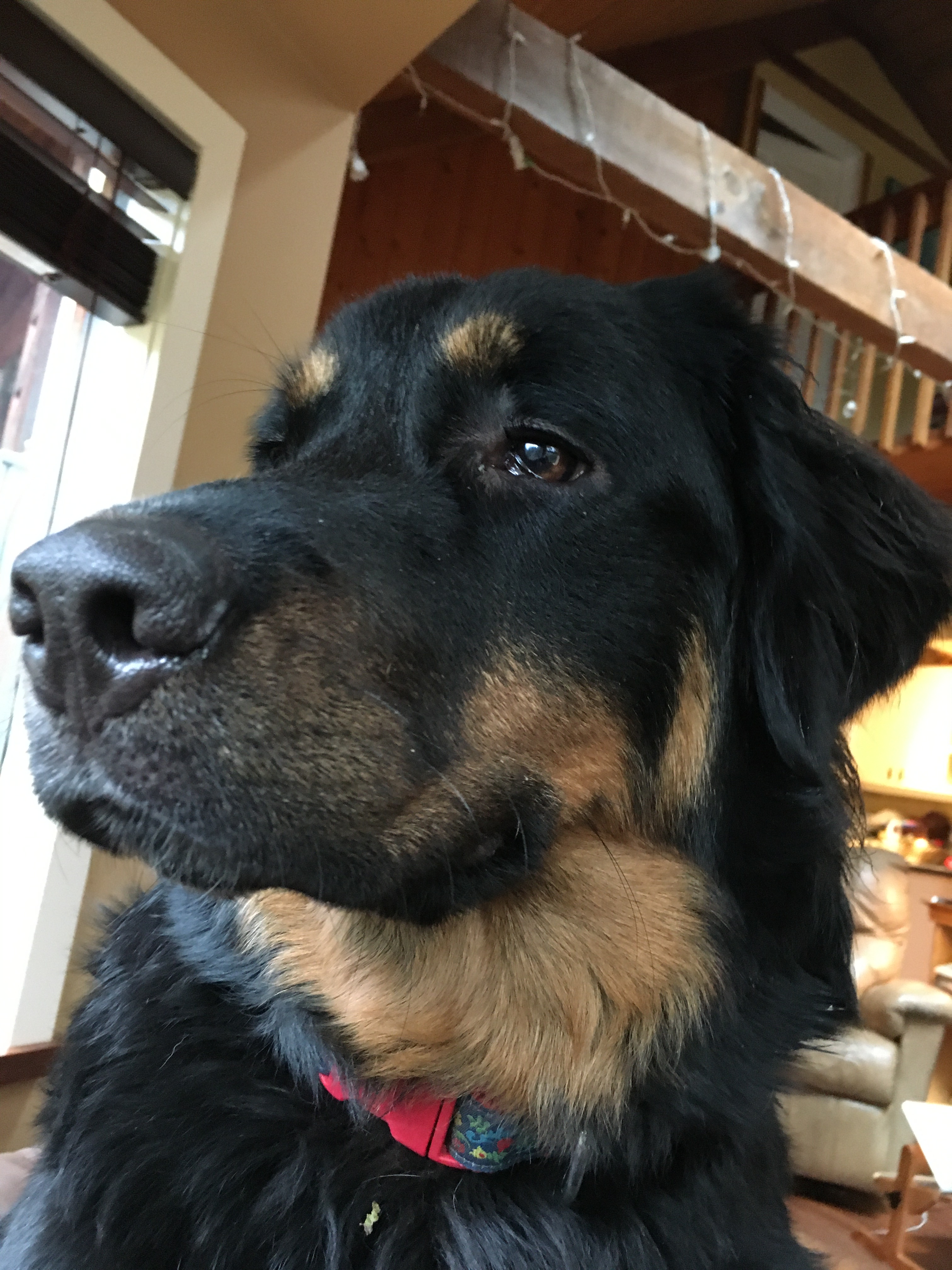
Tilly is getting so big. Seven months old, well over 70 pounds now. Not only that but she’s losing her puppy ways and is becoming a really sweet dog. Carolyn has posted recent pictures of her on Facebook. She’s big buddies with Cooper, the neighbour’s dog. He’s ‘intact’ and was getting very interested in Tilly’s butt so we thought it wise to have her spayed. She got through that very well. Now, she and Cooper fly around the yard wrestling and playing tug-o-war with a toy or a stick. They’ve destroyed so much of the garden with their antics but Carolyn just shrugs knowing that things will recover and will thrive come spring. We can only hope the dogs get more relaxed as time goes on and are less apt to run around the property like gilly-galoos. We expect they will get mellower and mellower as they age. That’s generally the way it works with dogs. Tilly always gets treats from me first thing in the morning. She might even get some later in the day if she’s a good dog, and she is most often a good dog. She gives us lots of kisses.

Tilly

#70 Fun With Meds.

I’m finally able to write a few paragraphs. My neck has been such a problem lately that I haven’t been able to write much or draw and paint much either. It’s because my neck gets spasms easily if I look down at the computer screen for too long. Ten minutes at a time is about all I can handle. However, I remembered that acetaminophen works quite well for neck pain. I took a couple last night for my arthritis and degenerative disks in my neck and that seemed to help. I took a couple at around 8 AM this morning and now, although I still have neck pain, it’s manageable. We’ll see how long it works. I want to go outside and play.

Funny how I used to take acetaminophen regularly for some kinds of pain and it worked marginally well. Then I forgot about it when I got into stronger meds after my cancer diagnosis. Hydromorphone is my go to pain reliever now, but I’m also taking a low dose of gabapentin on the advice of my palliative care docs.

Palliative care docs are specialists in pain management. They often get linked with end-of-life care, but their mandate is much broader than that and is tied to pain management generally. We talk every week, usually on Wednesdays always working to fine tune my meds to balance pain with my need to be able to do some activity. Of course, as my pain doc told me this week they could easily make me pain free. I’d be pretty much catatonic though so we’ll probably save that for when I’m closer to dying. No, the objective with my pain docs is to balance pain management with quality of life.

I must say that lately it’s been a bit of an odd dance. We tried nortriptyline but it made me excessively sleepy without doing much to lessen my pain levels. We tried a really low dose of gabapentin. That hasn’t seemed to have worked very well so we’re now increasing my dose of gabapentin to a bit of a higher dose to see if that makes a difference. That’s always on top of my basic hydromorphone slow release tablets that I take morning and evening.

I suggested to my pain doc yesterday that I should just go off of all pain meds to just see what happens. She said that I probably shouldn’t do that because the pain would be unbearable without some intervention. I have to agree, but it’s frustrating. It’s hard to know which med is doing what when I take a cocktail of meds. It would be simple to back off to just one med, but that wouldn’t work either because as I noted before, neurological pain is different from muscle pain with is different from bone pain, arthritis and disk disease. I need different meds for the various kinds of pain I have so a cocktail is required. Simple would be nice, but it’s not practical.

So, I sit here now banging away on my computer keyboard. My neck pain is manageable but really annoying. I’m hoping the increased dose of gabapentin will deal with the neurological pain I have in my legs, but we’ll see. It takes a while to kick in. I’ve had two MRIs this week. The first one was on Monday and imaged my lower back. The one yesterday was for my upper back and neck. I’m not sure how they may help with diagnosis or with determining what drugs will work for me, but at least they will give us a good baseline for subsequent tests.

I’ve been thinking a lot lately about the time I have left. I have incurable cancer so it’s like I’m on death row waiting to see if my next appeal (chemo course) works or not. I’m technically in remission right now. We’ll know in January how that’s going. I’m scheduled for blood tests on January 5th, the day after my 74th birthday. That will mark seven months that I’ve been off of chemotherapy. I hope those little bastard myeloma proteins take a long vacation and I can stay off of chemo for a while longer.

Inevitably though, chemo won’t work anymore and that will be that. Bring on the morphine and call in hospice and MAID people at that point. When I get to the point that I can’t DO anything anymore, I will probably welcome my exit from this mortal coil. The thing I regret is putting my family through a long, prolonged, slow exit. Maybe it would be better to pull the plug sooner than later. But I’m not ready to make that decision. So, we carry on, balancing meds, counting on chemo to beat back the myeloma proteins when they get out of hand, and hoping for the best.

I haven’t written at all about politics lately. I’m tempted to, but my neck pain may decide how much I can write, draw and paint. Politics is fun, but it’s not at the top of my list of priorities at the moment. Cancer has a way of focussing my attention narrowly on my life and possibility. I’m still interested in BC politics, Trump, etcetera, but they just aren’t centre of mind like they used to be for me when I was teaching. The pandemic is close to mind too, of course. I’d love to see my family as much as I can. Covid makes that impossible. Cancer and Covid are dominating my life right now. Not the best of scenarios, but I do have Carolyn to commiserate with and to share my Covid isolation.

I’m not sure how we can talk about happiness in the circumstances we are in. I’m not happy about any of this shit but that doesn’t help much either. It’s just that how in hell can anybody be happy right now?