Is Canada a Capitalist Country?

This is a script I presented on a Knowledge Network sociology telecourse in the early 90s.  Still relevant today, maybe even more so than then:

Is Canada a Capitalist Society?  Interesting question and not as simple to answer as it seems, I think.  Generally, when this question comes up, people immediately think about Capitalism and Socialism or Communism.  Canada isn’t communist, that’s clear…but is it socialist?  Well, what does socialism mean?  Many people think of socialism as government ownership and control.  For some, socialism means no more free enterprise, no more freedom of choice and no more good life!   For others it means Medicare, UIC,  Canada Pension and Social Services.  If socialism means government takeover of private business, then the W.A.C. Bennett Social Credit government of  B.C. was one of the first socialist governments in Canada.  It took over B.C. Electric and made it into B.C. Hydro, took over responsibility for ferries in the province and monopolized the sale of alcohol.  Well, most people would never think of the Socreds as socialists, but there you have it…  Just kidding of course…  But it still leaves us with the problem of coming up with a way of deciding whether or not Canada is a capitalist society.  Is it mostly capitalist with some socialist policies?  Can we talk of shades of pink, or is it one or the other?  Well, maybe there’s another way of approaching the whole question.


Let’s stand way back and check out the view from there.  We are very accustomed in this part of the world to seeing things from the perspective of our countries.  I’m not saying that we’re nationalists, necessarily, but that our frame of reference is our country.  We think of “Canadian” society, the Canadian educational system, the Canadian political system, the Canadian legal system, the Canadian transportation system, etc.  We view Canada as an entity, a thing in itself.  We use Canada as “containing” our society.


There is another way of thinking about these things.  It is very difficult, though, because we take our conventional view of things completely for granted.  We have difficulty even conceiving of another way of seeing things.   It requires a real perceptual shift.  But let’s try this on.  Think of the concept of Capitalism as a basic reference point rather than the idea of Canada. In this conceptual scheme capitalism has time and space dimensions but I want you to think about it more as a set of institutions or way of doing things, organizing ourselves and thinking.  The primary institutions of modern capitalism are private property, business enterprise, the machine-process, the class system, wages, the division of labor, the market and the price system.   Taken together, these institutions, along with others, make up what we might call the economic basis of capitalist society.  I’m not talking about people here, but about the ways that have evolved by which we relate to each other in society.  The primary institutions are those concerned with how we organize ourselves to make a living…that being the basis for the rest of social organization.  We have to make a living as societies before we can do anything else.   In order to survive…and this is an evolutionary perspective…capitalism generates a whole range of other institutions, or it appropriates them, borrows, begs or steals them historically from previous societies.  These institutions  we usually define as being political, social, legal, educational, etc… And they evolve  themselves and together…like all the organs of your body evolve together.


From this perspective, the way we organize official learning, in classrooms with the teacher as authority and children conceived of as empty vessels to be filled with standardized knowledge is a basic educational institution of modern capitalism.  Whole organizations, plants and facilities we call  schools, colleges and universities are created to service this institution which itself serves to ensure the survival of capitalism.  What kids learn in school is more important than just math and social studies.  In the way the school is organized, in the way they are regimented and disciplined, kids learn their eventual place as workers within a capitalist society. It could hardly be otherwise.  An educational institution that would contradict the basic way that we organize ourselves to make a living wouldn’t last long.


Countries as we know them are political institutions that arose in conjunction with the rise of capitalism in Europe.  They are the products of the growth of capitalism:  they exist to regulate the flow of capital and labour; to provide infrastructures such as roads for the movement of capital and labor (not always successfully); to defend capitalism, or sometimes the interests of a group of capitalists in competition with another group; to provide a context for law and order and the right “climate” for investment, etc… Once in existence along with the institution of citizenship, countries tend to legitimize the notion that citizenship is a status more important than that of worker.    Citizenship, with all of its caveats and rights,  is the political/legal expression of your right to sell your labour on a market.


Canada, then, is by definition a capitalist institution.  It “fits” into a now global system of political institutions that exist to perpetuate capitalism…and make no mistake about it, capitalism is the more fundamental institution here.  It makes little sense to speak of “Canadian” capitalism or even of “Canadian” society, for that matter.  Canada, the political institution, is part of a global capitalist society.  It makes much more sense to speak of the role of the Canadian state in the perpetuation and  survival of the growing capitalist global system.  If the government takes over the operations of a losing propositions such as B.C. Electric, then it does so to ensure that capitalism can still grow and prosper.  Capitalism needs cheap power.  There’s no money in it, but it is nonetheless necessary.  Why not get workers, as citizens and taxpayers, to subsidize it?    If the government sets up systems to train potential workers (i.e., the school system), to support unemployed workers, to nurse them back to health, to provide them with pensions upon retirement, it relieves the pressure from the capitalist to do so, a pressure that the slave master or the lord of the manor had in totality with regard to the well-being of his slaves or serfs.  So, in a big way, the governments in our country help to manage the working class.  And through the tax system arrange to have the working class cover the expenses for its own management and even cover the costs of capitalist risk-taking itself, again through the tax system.


This may sound cynical and negative, but I don’t think it is.  Nor do I think that the system stinks and that all capitalists and politicians are lying, good for nothing exploiters of the working class.  I’d rather be a worker with only half of my waking life in the service of someone else than a slave with my whole being and life in the service of someone else.  Besides, capitalists and politicians are harnessed to the needs of capitalism as we all are…much as all the cells in a human body are harnessed for the survival of the body as a whole…and the whole thing will live just as long as it has not exhausted all the resources it has to keep it alive.  Countries are one of those resources that serve the ends of capitalist survival.  Canada is one of those resources.
A Commie I’m not. A crusty old Marxist, maybe.

So, we had a big party at the homestead recently and I was lovingly described as a communist by my son-in-law. I appreciate the sentiment behind this remark.  For him, it’s a term of endearment.  There were many ‘left-leaners’ in the crowd who would have appreciated the comment because in some senses we share many moral precepts.  Oh, I’ve been described as a commie before.  It wasn’t the first time, nor will it be the last in all likelihood.  I really don’t mind all that much.  Whether or not people actually believe that I’m a communist is another matter and I hope to set the record straight here for anyone who cares.  If people read this blog posting,  and few will, they will know my position on the matter.  For my own sense of self, for myself, I want to set the record straight once and for all.

When I state that I’m not a commie, that doesn’t mean for one second that I’m a proponent of ‘capitalism.’  Many people see communism and ‘capitalism’ as opposites, as alternate ways of organizing ‘the economy’ and ‘society.’   I don’t, nor did Karl Marx when he got old enough to think straight.  As an aside, Harold Adams Innis, the brilliant Canadian political economist and historian said, in a moment of particular lucidity, that one cannot make a contribution to the social sciences before one reaches the age of 50 and he’s probably correct.  He was 58 when he died and his best work happened in the last 5 or 6 years of his life.  Marx was born in 1818 and died in 1883.  It wasn’t until the late 1860s that he really got his shit together, hunkered down in the British Museum and started writing Capital.  Yes, yes, he wrote the Economic and Philosophical Manuscripts earlier, but he really got serious later.

The reason I say I’m not a communist is that I’m not a proponent of communism.  For me, or anyone else, to be labeled a communist or anything else for that matter implies a certain level of advocacy, of ‘proponency.’  It’s not necessary to be proponent of something that will eventually happen no matter what we think or wish.  It’s like being described as an old-agist.  I know that old age will happen to all of us, but that doesn’t mean I’m a proponent of old age.  I’M getting old, but that doesn’t mean that I advocate old age. That would be ridiculous.  A communist mode of production will inevitably replace the capitalist one because the internal contradictions within the capitalist mode of production dictate it in the same way the feudal relations of production replaced slave based ones and the capitalist mode of production replaced feudal ones.  The change will happen gradually, just as old age creeps up on us.  Before it’s clear what’s happening, the old bones get brittle, the arteries plug up and the organs just can’t cut it anymore.  The resiliency of youth is past, old solutions no longer get the same results they used to.  Life inevitably brings on death, they are different sides of the same coin.  What that means for me as an individual is clear, what it means for ‘society’ or for the ‘capitalist mode of production’ is also clear.  Nothing is forever, nothing.  Not the capitalist mode of production, not our beloved countries, not our cities, not our towns, not our fabulous wealth.  The question is not whether or not the capitalist mode of production will live on forever, but when it will die.  It’s not even a question of how.  That’s also been clear for a long time.  Still, classical economics is still in classical denial over the whole thing, a fact which is made clear on virtually every page of The Economist which is a proponent of capitalism.

For what I’ve written above I could be branded with the sin of determinism, one of scholarship’s seven deadliest.   If saying that one day I will die makes me a determinist, well that’s ok by me.  Call me whatever name you want.  Furthermore,  what I write above does not mean that life is completely meaningless to me.  We live life on many levels, a day at a time.  My life is full of activity and that means that every day I make many moral decisions most having nothing or little to do with my eventual death.  I don’t  live life as though my life is about to end (I didn’t do that even when I had cancer and the possibility of my quick exit from this life was very real).  I DO things, there is nothing else to do.  I read the papers, listen to the radio and watch TV.  I play with my grandkids.  I can’t help but get outraged by the blatant bullshit and crap that comes out of the government in Ottawa on a daily basis.  Yet I understand  the role that national governments play in the capitalist mode of production and their essential collaboration in making it possible for capital to flow with greater and greater ease globally  and for controlling labour by keeping tight reins on migrations and regulation.  I haven’t lost my moral compass.  I even get angry on one level…say, at incivility, at stupid driving, at poor highway engineering…while understanding that at other levels, the picture is much different and anger makes no sense.  As I write above, we live life on many levels, many planes.  They are all connected although not always in obvious ways.  Even otherwise highly educated people don’t see the connections.  The connections, interconnections and interweavings become visible only after a sustained gaze upon them.  To see them requires special training.  Somewhere, Norbert Elias got that training, as did many other thinkers who have had a sustained influence on me over the decades.

Apparently, staring is rude, even for an 8 month old baby.

I’m reading Norbert Elias’ The Civilizing Process, the edition I have being published in 1994, but which is really a compilation of  two earlier separate works entitled the History of Manners and State Formation and Civilization both from 1939.  It’s a long, involved and complicated book, a detailed historical sociology rivalling Max Weber’s work.  At the moment I’m reading his fascinating account of the evolution of the use of table implements like the knife, spoon and fork and their moral implications.  He writes that it took centuries from the first appearance of the two pronged fork on the European scene in the early Middle Ages as an implement usually made of gold or silver and strictly used by the upper nobility to its more general use only three centuries later.

Normally I wouldn’t write about a book while still in the process of reading it, but in this case I’m not reviewing his book and it turns out Elias’ analysis provides a great backdrop for something that happened to me today in an elevator.  Carolyn and I were rushing around looking for a cash machine in a mall at 555 West 12th Street in Vancouver, BC., not that the location has any particular significance.  The same event probably could have happened in a number of similar locations.  So what happened was this: We chase around the mall for a bit looking for a cash machine and eventually find one, get some cash and head back to the elevator to get back to the parkade, one floor below.  A woman also waited at the elevator.  She pushed a stroller into the elevator as the door opened and we all got in, but just before she did that she turned to me and said: “He hasn’t learned yet that it’s impolite to stare at people.”  Well, alright.  So I asked her, “How old is he?”  She replied: “eight months.” At which point, the sociologist in me kicked in and I told her that it was a little too early in his life to be learning manners as complicated as not staring or averting the eyes.  She probably thought I was just a nutty old man and left it at that, but she definitely had the old moral wall on her mind.  No way was she going to let her son break an inviolable rule of etiquette such as not staring and she just wished she could enforce it on him even at his tender age.  At least she didn’t hit him for it.

Granted, the use of forks has very little in common with not staring at someone when it comes to etiquette.  Still, they are both things that ‘are not done.’  That is if you want to be accepted as part of a civilized society.  Savages and pagans stare and eat with their fingers, but not civilized people.  The study of manners is the study of morality, who is part of my world and who isn’t.  We struggle constantly with whether or not we ‘fit in.’  In saying that I’m not breaking any social scientific sound barriers.  Sociologists, psychologists and anthropologists have long been interested in manners.  They open an impressive window into what we will accept as ‘civilized’ behaviour.  Their evolution is key to understanding a multitude of other social relations.

That said, I’m a little concerned for the little tike I met in the stroller on the elevator in the mall at 555 West 12th Avenue in Vancouver.  His mother seems to be hyper sensitive to etiquette rule violations.  If it’s true that children hear ‘no’ or ‘don’t’ 40,000 times before they enter kindergarten, this little guy might be in for maybe 60 or 70 thousand ‘nos and ‘don’ts.’  By  the time he gets to kindergarten, he may be so hemmed in by his mother’s imaginary moral wall that he will have difficulty turning around without scraping an elbow.

SHOP.CA

SHOP.CA.

So begins the endgame for  the small retail commodity store.  Services will still be immune from this type of shopping, but not most commodity shopping.  Hard goods retailers will be especially hard hit.  WalMart is not immune although it will take some time to topple that giant.

What is more interesting is the way this website and organization is being promoted – using very nationalistic themes – and how it’s connected to banking.  The nationalistic appeal on the YouTube video advertizing this site, which only appeared a couple of days ago, is highly misleading of course.  We don’t buy products as citizens, but as consumers.  We buy tons of hard goods, services, and other commodities from all over the planet.  There is no ‘Canadian’ consumer.  There is only a consumer of capitalist commodities.  Don’t be fooled by the rhetoric.  But, it doesn’t matter much.  The end result of all of this is a more integrated global social system that is at the same time more local in its meaning for people.  We are more and more globalized as we become more and more insular, shopping from home on our computers, iPads and iPhones.  The world, she is a changin’.  We don’t understand the implications of such a centralized, overarching ‘Canadian shopping experience’ until the deal is done.  But there’s no turning back.  This is not a moral dilemma.  All I’m doing here is observing what’s fast becoming our new social order.

In 1976 Soviet Union Grows Children to Eat

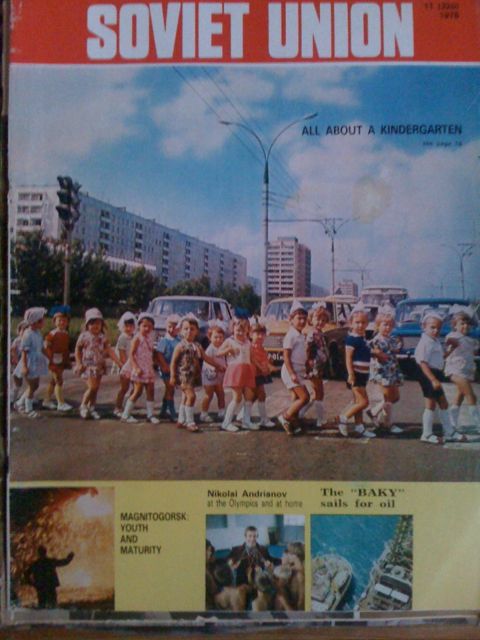
Well, not quite.  But that’s what a lot of North Americans would have believed about the ‘commies’ in the Soviet Union if they had been told by a reputable source like Rush Limbaugh (who was a DJ in the 70s, but you know what I mean) that this was God’s own truth.  I remember when I was in school I had the impression of the Soviet Union as a drab, grey place.  I mean, how could it be colourful…a bunch of communists lived there and communists abhor colour, we all know that.  The photograph below  is of the Soviet Union, a publication started by Maxim Gorky,  a Russian writer and journalist who wrote many novels, plays and poems.  He was jailed by the Tsars several times during the last days of the Empire.  He was always pro-Bolshevik except for some censorship issues during a short period of time  during his career.  He was born in 1868 and died in 1936.  He is a hero in Russia even today.  But this post is not about Gorky, it’s about the Soviet Union, the publication that attempted to dispel negative and distorted American views of life in the Soviet Union. This publication appeared in 19 languages and was distributed widely outside of the Soviet Union.

The children in the photograph, in their mid-thirties now, are colourfully dressed, probably off on some kind of field trip. I’m guessing they’re not destined for a meat processing plant either as many Americans would have half expected back then. Lots of colour in this photograph.  Kids seem to be having a good time.  They lived in a town called Togliotti on the Volga river where the Lada car was and is still built to some extent. The article about them is called: All About A Kindergarten.  The kindergarden in question sits among row after row of 5 or 6 storey massive apartment buildings designed to house the masses of workers while the ‘management’ of the Lada factory drove to work in his Mercedes and lived in his detached family home out in the suburbs.  No classes in the Soviet Union?  Not at all.  The Soviet Union was one big workers’ paradise where everyone was equal. One of the features of this edition of the magazine, which has no ads in it as one would expect, is about  the “Baky” oil rig which the magazine proudly holds up as an example of Soviet superiority in engineering and production.  Another feature is about Nikolai Andrianov, the Olympic gymnast who won 7 medals, 4 of them gold.  Adrianov is held up as a model for Soviet children much as Olympians are today.  He makes as good use of his leisure time as his training time the editors are proud to point out.   They never pass up a chance to hold up Soviet practices as superior to those in capitalist countries.  They write: “People in the socialist countries devote from two to six times as many hours to improving their general and specialized education as do people in the capitalist countries.”  Soviet Union is clearly a propaganda tool, but what should we expect?  Not all Soviet publications were so blatantly propagandistic, but this was this publication’s principle goal.  There is hardly any mention of politics in this issue except to report that there is some resistance in the West to more economic cooperation between European ‘capitalist’ and ‘socialist’ countries.  However, the reality was that there was a lot of cooperation during this ‘detente’ period between the Soviet state and ‘businesses’ and Western European countries.  It’s this ‘rapprochement’ that led a few years later to Peristroyka, the demise of the Berlin Wall and eventually, Valdimir Putin.  It wasn’t Ronald Reagan who engineered the end of the Berlin Wall, as many Americans believed at the time, it was the class system in the Soviet Union and the slow infiltration of ‘business’ in production and distribution (both domestic and foreign) that made a lie of the communist ideology.

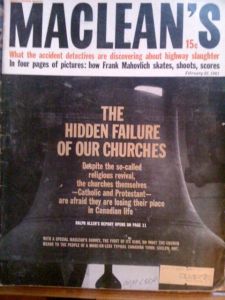
Frank Mahovlich and the Hidden Failure of Our Churches

I’ll get to the title of this post in the next paragraph but for now let me just say that in my library I have copies of a number of magazines from the 1960s and 1970s.  I have several copies of Maclean’s dating from the early 60s. I also have several copies of a magazine called Soviet Union and I have a copy of Fortune Magazine, a much more substantial publication than the first two I mention above.  Soviet Union  is a publication founded by Maxim Gorky in 1930 originally called USSR in Construction, it was renamed in 1950.  Maclean’s was, in the early 60s, a domestic weekly current affairs magazine with fairly innocuous content, much as today. All the publications I address here are large format, about 34 X 26 centimeters.  The current Maclean’s is 27 X 20 centimeters.

In this post I write about the Maclean’s of February 25th, 1961. In the next post I write about Soviet Union and I’ll follow that with a post on Fortune.  All of these publications are essentially propagandistic although there would be vehement denials of this on the part of the publishers although I doubt if they care an iota about what I have to say about them.  For a current affairs magazine, Maclean’s addresses a range of topics as can be noted from a photograph of the front page:

Sports, religion and police work dominate this edition of the magazine.  Peter Gzowski writes an article called Viva Mahovlich!  In it he waxes poetic about the “Maple Leafs’ young star.”  I was 14 years old at the time and Frank Mahovlich was a young star on the Maple Leafs. He played against the best, such as Henri Richard and Bobby Hull.  I played very poorly  at a boarding school in Edmonton, one of a number of boys from  the west coast of British Columbia with very little experience with ice.  I would never qualify for Junior ‘B’, never mind the NHL.  Frank Mahovlich was a star before he joined the Maple Leafs.  The names in the NHL have changed, but I still can’t play hockey worth a shit.  But I’m not dead yet, which is more than I can say for lots of hockey players who played with Frank Mahovlich.

The religion part of this edition features a report by Ralph Allen who writes this about Christianity: “Against such other gigantic forces as communism, materialism and a thinly sheathed militarism, the Christian church is widely held to be the most hopeful protector of the human race, physically as well as spiritually.”  How’s that for objective journalism.  Whatever, this is just a year after the heady days of the defeat in Quebec of the Duplessis government by the Lesage Liberals with René Lévesque in the Cabinet.  This year marks the beginning of a huge transformation in Quebec politics and religion.  Bring on secular religion and bring on a much expanded French speaking provincial government bureaucracy and the beginnings of the CEGEP movement in higher education.

So, 1961 was the year I was 14 years old, the year Diefenbaker would march side by side with John Kennedy and the year Quebec turned church buildings  into gift shops.  The ads in the 1961 Maclean’s include ones for booze, big American cars and insurance…and there’s a Pepsi ad appealing to the young.  Nothing’s changed except the youth of then are the old farts of now.

Human Behavioural Biology

In my opinion, Robert Sapolsky of Stanford University is one of the most compelling lecturers I’ve ever encountered.  His course on Human Behavioural Biology addresses the links between neural functioning and behaviour.  His work on stress and depression are critically important as a point of departure for anyone involved in clinical work on these issues or for anyone suffering from stress or depression.  For years I used his National Geographic video called Stress in my Sociology classes to show how class distinctions affect even biological functions and can cause poor health and early death.  In this film he compares Olive baboons in Kenya to people working in the British bureaucracy in Whitehall.  He notes that the higher one is in the social structure in terms of power and prestige, the less one is stressed out and the less one shows the characteristic signs of stress like the use of medications and the loss of work productivity, often involving long absences from work on sick leave.  It’s happened to me. I twice took long periods of leave due to stress at work.  I know of what he speaks.  The feelings of frustration and impotence are extreme when we are faced with lots of responsibility and no or little authority.

Sapolsky’s entire course on Human Behavioural Biology is made availably by Stanford University on YouTube.  There’s probably 20 hours of lecture material here, but worth every minute of it.  Your TV could not be put to better use.  Enjoy!

What Sociology is For Me (in 1990). Yes, you can chuckle…

Alright, you’re allowed to chuckle a bit as you watch this video.  It’s me in 1990.  Yes, I still have a full head of hair, and it’s still brown. The quality of the video is very poor.  It’s probably 4th generation.  I won’t win any Academy Award for this performance, either.  We filmed this (Dan Moscrip, the Knowledge Network director and his crew) starting early in the morning on Granville Island and finishing twelve hours later at the Bloedel Conservatory.  I memorized my script as we went from venue to venue.  Probably my favourite venue was in Chinatown, shooting over the crowd.  This was all great fun.

So, maybe I didn’t win an Academy Award, but I still go along with the message I was trying to get across 22 years ago…with some minor adjustments I might make.  Now…have a look:

The Christian Idiom

I was raised Catholic, but it didn’t take me too long into my late adolescence to realize it wasn’t for me.  There was so much belief, blind faith and not a lot of evidence.  Isn’t that the point of religion, really?  When I was 17 or so I was told by a priest that I shouldn’t be reading a book by Pierre Teilhard de Chardin.  I was still a practicing Catholic at the time, but I was stunned when this former physics teacher of mine at Collège St-Jean in Edmonton, told me that I wasn’t ‘intellectually prepared’ enough to read de Chardin. According to the Gaiamind website (gaiamind.com):

“Pierre Teilhard de Chardin was a visionary French Jesuit, paleontologist, biologist, and philosopher, who spent the bulk of his life trying to integrate religious experience with natural science, most specifically Christian theology with theories of evolution. In this endeavor he became absolutely enthralled with the possibilities for humankind, which he saw as heading for an exciting convergence of systems, an “Omega point” where the coalescence of consciousness will lead us to a new state of peace and planetary unity. Long before ecology was fashionable, he saw this unity he saw as being based intrinsically upon the spirit of the Earth: ‘The Age of Nations is past. The task before us now, if we would not perish, is to build the Earth.’ ”

Methinks my former physics professor was slightly disingenuous about his motives for telling me I wasn’t ‘intellectually prepared’ to read de Chardin.  Anyone still steeped in Catholic doctrine would have to reject de Chardin.  It’s easy to see that from the above quote.   de Chardin’s work contradicted the Catholic Magisterium and many of his books were censored by Rome. He basically rejected the whole Biblical account of creation in Genesis.   His Le Phénomène Humain published posthumously strayed far from the dogma of the Church.  So, fearing the loss of yet another young adherent to the Church, my Oblate physics teacher was really imploring me to avoid reading heresy.  But it was too late.  I was already on a road to greater intellectual curiosity.  I read works by ethologists such as Konrad Lorenz.  I read popularizations of anthropology such as Robert Ardrey’s The Territorial Imperative. I read The Origin of Species.  Later, at Simon Fraser University, I would quote Ardrey in an anthropology paper to be told that my professor that he was a charlatan. What can I say, I was a newbie.

In any case, my point here is that de Chardin opened my eyes to thinking about the world and the universe in very different ways from what is contained in Catholic doctrine.  Biblical accounts taken literally made no sense to me whatsoever.  I read the Bible over and over again and continued to be mystified by the language, the smiting of one’s enemies, and the gnashing of teeth.  It took me some time to realize that taken metaphorically, the Bible makes much more sense than it does literally.  de Chardin led the way in my awakening on this front.  I don’t subscribe to Biblical accounts of creation any more than de Chardin did and I can definitely relate to his view of the cosmos.

For de Chardin (and science, for that matter) there is ‘immortality’ in the universe in the sense that matter and energy are not lost, but are constantly ‘reconfiguring’ and ‘reconstituting’ themselves.  As the saying goes, we are the stuff of stars.  The matter that makes up my body has always existed and always will.  The particular configuration of matter that is me is transitory, but the matter that is me is eternal and immortal.  So, in a sense, I ‘believe’ in immortality.  Humans, however, aren’t generally satisfied with such an abstract idea of immortality.  No, we want something more tangible such as the soul upon which to hang our hopes of individual immortality.  We really want to be ‘ourselves’ eternally, as if our deaths never happened, cavorting and enjoying ourselves in heaven with our earthly companions and with God overseeing everything like a cosmic party host.  This is a picture of God as very human like and of humans as very god-like. For de Chardin, God has no specific connection with the human species.

For de Chardin, God is the universe, the Omega as he called it.  That is a far cry from the story of creation in the Bible, but if our denial of death is as profound a drive as Ernest Becker suggests, the fall from grace symbolized by the eating of the forbidden fruit and the subsequent split of humans into our symbolic and material selves whereby our symbolic selves are immortal and our material selves are mortal makes more sense.  Our bodies are our own worst enemies.  They die.  They betray us at every turn.  They are fundamentally evil.  It’s our symbolic side that is good, pure and immortal.  So the story of creation in the Bible is idiomatic.  It metaphorically concretizes the goodness of the power of the universe, the abstract power we cannot understand and from which all life emanates, and the badness of matter which at every turn bleeds and dies.  The interesting thing here is that people get caught up with the Bible’s literal explanations and don’t, as de Chardin did, see the story of the unfolding universe in the Genesis code.  How long we will need to bend to metaphor and idiom rather than face the reality of the universe full face is anyone’s guess.  More on this later.

Death is necessary for life…

Try eating live things.  They don’t like it and usually put up a fight.  The fact is that we normally like to eat our food dead.  There are situations where we like to get close to the line between life and death, say when we boil lobster or crab alive, or when we go to a restaurant featuring live fish in large tanks and pick out our dinner as it swims by.  But by and large we like to be assured that our food is nicely and fully dead.  Vegetables are no problem.  We hardly consider them alive in the first place although they are of course.  Not everyone likes their veggies, but their dislike is generally not based on whether or not they are dead.  With animals, it’s another matter.

We ‘relate’ to animals, animate things, especially if they’re young, cute and cuddly.  When we in the West find out that some people in China and Korea eat young dogs, preferably St-Bernards, we find it hard not to gag or throw up.  We know that ‘veal’ really means baby cow but we try not to think about it. Lamb is the same, baby sheep.  So are weaner pigs, that is, pigs that have just been weaned.  We know killing happens.  We wouldn’t be able to eat steak, bacon, roasts or ham without the killing. It’s just not right to think about it or bring it up in polite conversation.  The fact is that humans slaughter millions if not billions of animals every year (for food or as ‘pests’), sometimes by specialists like in the West, but by lots of non-specialists in Africa and other ‘poor’ parts of the world too.  People all over the world realize that they like to eat their food dead and somebody has to do the dirty deed.  Now, isn’t that an interesting way of putting it: do the dirty deed?  Of course you’ve heard that.  To do a dirty deed…ultimately means killing someone or something. The reference to dirt we’ll come back to.  But for now, let’s face it.  Although we don’t like to admit it, death is really important to us.  But of course death is important to us not just in terms of the food we eat.

If things didn’t die, things couldn’t live. If people didn’t die, there would be standing room only on the planet in very short order.  We think there’s a lot of people on the planet now!  If people didn’t die, I’m not sure how they would be born, but that’s an issue for another post.  So our underlying unquestioned assumption that life is good and death is bad is patently ridiculous.  Not that we’ve ever shied away from espousing ridiculous ideas.  No, people need to die so others may live.  The problem is all about the quality of death and dying.  We know that we are born at one point, grow up, mature and then die, at least on a ‘normal’ trajectory.  There’s lots of variation in the length of time we live.  For instance, in some parts of Africa an individual is lucky to live to be 37 years of age.  Here in Canada we’re looking at a normal life span getting into the eighties.  In the ‘poor’ countries, many children die very young.  We think that’s a shame, really. But we don’t like to think about it too much.  We see the starving children in the OxFam or whatever commercials and cringe a little, but it’s not really our problem.  Distant death is barely death at all whether we are talking about time (as in death centuries ago) or space, (as in death in Somalia or Mali, far away in Africa).  We have some vague sense that many people die in Canada every year, but we don’t really know how many, nor are we particularly interested.  But death gets more interesting the closer it gets to us, especially so close that we just can’t deny it.

When my cousin’s daughter was murdered on Halloween night last year, I was shocked and angry.  She was just at high school graduation age.  Some very disturbed young man -who’s since been caught and faces first degree murder charges – killed her that night and she’ll never be coming home. Many other thousands of people died that same day all over the world, but that doesn’t matter.  What matters is that someone in the family met a very tragic, unnecessary death.  I didn’t know Taylor Van Diest personally.  She lived a long distance from where I live on Vancouver Island.  My uncle Denis (my father’s brother) moved his family (including Taylor’s mom) to the Okanagan Valley decades ago.  He’s since passed away.  That broke the tie that kept our families in close contact.  Since then we’ve had large family reunions, but I haven’t attended many of them.  Too busy working most of the time.  Families drift apart.  There’s nothing wrong with that.  It’s just the way it is in a world that encourages radical insularity and downplays family except for ideological purposes.  Still, when a family member meets such an untimely death, it hurts.  For the immediate family the pain must be almost unbearable and it doesn’t wane.  The passage of time does little to heal the still gaping wound that is the absence of Taylor.  But, like I said, death is only meaningful to us when it’s close and it’s importance to us is inversely proportional to it’s distance to us in time and space.  What I’ve found in my career is that there isn’t just one kind of death.  There are many kinds of death just as there are many kinds of life.  Taylor’s death is not the same kind of death as the death of the pig that made it possible for me to eat bacon this morning.  One seems senseless, the other necessary.  We are horrified by Taylor’s death, rightly so.  When my father-in-law lay dying at Burnaby General Hospital twenty-three years ago, I was struck by the traffic noise, the talk in the hallway, the realization that death matters little to most of us most of the time.  The world doesn’t stop every time a person dies even though we think it should when that person is close to us.  No, we are really little affected by death.  Our systems of death denial are very  strong indeed making it all the more horribly distressing when the experience of death is so personal that our usual systems of death denial no longer work and we have to face it unmediated by ideology.  The experience is soul destroying and extremely isolating.  The visceral reaction of most people in this situation is to reach for meaning anywhere it can be found.  No search for meaning is entirely satisfactory.  There is always a residual emptiness.

To finish this up, I want to just say that death is not the opposite of life.  Living and dying are one in the same thing.  Distinguishing between the two is the result of a feeble attempt on humanity’s part to deny death.  To be blunt about it, the moment we are conceived we are on a death trajectory. How can we live with that realization without effective ideologies of death denial?  More on that in the next post.